© 2019, IRJET | Impact Factor value: 7.34 | ISO 9001:2008 Certified Journal
| Page 1335
“
EXPERIMENTAL STUDY ON PARTIAL REPLACEMENT OF CEMENT BY
HYPO SLUDGE IN CONCRETE
”
Ashutosh Kote
1, G.C. Jawalkar
21
Student M.E. (Civil-STRUCTURES), Department of Civil Engineering, N.B.N.Sinhgad College of Engineering,
Solapur, Maharashtra, India.
2
Assistant Professor, Department of Civil Engineering, N.B.N.Sinhgad College of Engineering, Solapur,
Maharashtra, India.
---***---
Abstract: Energy plays a crucial role in growth of developing countries like India. To save energy and to earn carbon credit is very much essential for the betterment of mankind. Now a day there is low availability of non-renewable energy resources, and also large requirements of Building Construction Materials like cement, etc.. The global cement industries contributes about large amount of greenhouse gases emission to earth’s atmosphere and industrial waste are being produced Largely by chemical process in the India. In order to reduce cement manufacturing and disposal problem of paper waste, there is need to develop alternative binding material in construction field. Utilization of paper industry waste product as supplementary cementitious material in concrete is very important aspect in view of economical, environmental and technical reasons. This paper summarizes that the research work on the behavior of concrete while adding of hypo sludge with different proportion as part replacement of cement in concrete by using test like Compression strength test, Split Tensile Strength test and Flexural Strength Test. The experimental investigation gives results that the test results are increasing their strength values up to some initial Percentage replacement of cement by Hypo sludge and further replacement are carried out then strength results are falling down.Key words: Cement, Hypo Sludge, Workability, Compression strength test, Split Tensile Strength test and Flexural Strength Test.
1. INTRODUCTION:-
Over 300 million tonnes of industrial wastes are being produced per annum by chemical and agricultural process in India. These materials pose problems of disposal and health hazards. Out of several wastes being produced at present, the use of phosphogypsum, fluorogypsum, lime sludge, hypo sludge, red mud, and mine tailing is of paramount significance to protect the environment. Paper making generally produces a large amount of solid waste. Paper fibers can be recycled only a limited number of times before they become too short or weak to make high quality paper. It means that the broken, low-quality paper fibers are separated out to become waste sludge. This paper mill sludge consumes a large percentage of local landfill space for each and every year. Worse yet, some of the wastes are land spread on cropland as a disposal technique, raising concerns about trace contaminants building up in soil or running off into area lakes and streams. Some companies burn their sludge in incinerators, contributing to our serious air pollution problems. To reduce disposal and pollution problems from these industrial wastes, it is most essential to develop profitable building materials from them. Keeping this in view, investigations were undertaken to produce low cost concrete by blending various ratios of cement with hypo sludge. The most basic building material for construction is concrete. A significant quantity of cement is utilized in making concrete. The most basic building material for construction is concrete. A significant quantity of cement
is utilized in making concrete. Use of cement, in producing Conventional concrete creates environmental problems. During manufacturing of 1 tones of Ordinary Portland Cement we need about 1…1⅓ tones of earth resources like limestone, etc. Further during manufacturing of 1 tones of Ordinary Portland Cement an equal amount of carbon-dioxide is released into the atmosphere. The carbon-dioxide emissions act as a silent Killer in the environment as various forms. So in this way the industrial waste used as eco-friendly and minimizes the maximum degradation in environment due to cement. From this backdrop, the search for cheaper substitute to OPC is a needful one.
1.2. Necessity of project-
Utilization of the widely spread industrial wastes in the civil construction practice may lead to a real possibility of significant decrease in the environment pollution by paper production wastes and perceptibly economize the price of civil construction. By utilizing this waste the strength will be increased and also cost reduction in the concrete is achieved.
2. LITERATURE REVIEW:-
There are various investigation are carried on concrete for a partial percentage replacement of cement by Hypo sludge for various grades of concrete and also taking the Workability test, concrete strength test like compression strength test ,split tensile strength test and flexural strength. Due to percent Replacement there is an increase in the strength of concrete up to certain %replacement level. Also there is certain variation in the various test result due to Material properties and mixing techniques and other parameters. The following literature has been reviewed:
1. Ms.T.Karthika, Ms.S.Shanthi (June 2017) “An experimental investigation on concrete with partial replacement of cement by paper industry waste”.-This project presents result of an experimental investigation carried out to evaluate effects of replacing cement by hypo sludge which is an industrial waste by-product on concrete strength. The primary aim of this research was to evaluate the durability of concrete made with hypo sludge. The partial replacement by replacing cement via 10%, 20%, 30%, and 40%, of Hypo Sludge for mix design of M20 , M25, M30.The Investigation was carried out for the following test like compressive strength and split tensile strength , Flexural strength. Paper making generally produces a large amount of solid waste. Keeping this in view, investigations were undertaken to produce low cost concrete by blending various ratios of cement with hypo sludge.
2. Ankur Jain, Manish Dubey (Oct-2016) “Utilization of Hypo Sludge as a Cement Replacement in Concrete “This research study is touched with the experimental investigation on strength of concrete and optimum percentage of the partial replacement by replacing cement via 5%, 10%, 15%, and 20% of Hypo Sludge. Holding all this view, the purpose of the investigation is the behavior of concrete. While adding of waste with different proportions of Hypo sludge in concrete by using tests like compression strength flexural strength and workability. The mix design was carried out for M30 and M40 grade concrete as per IS: 10262-2009. A particle of hypo sludge which passes from 90 micron IS sieve will replace cement in concrete.
3. VVS.Sarma, P.V.Rambabu and Dr.N.C.Anil (May-2016) “Durability Studies on Concrete with Hypo Sludge as Partial Replacement of Cement”
This paper summarizes the research work on the properties of hypo sludge when used as partial replacement for Ordinary Portland Cement (OPC) in concrete. OPC was replaced with hypo sludge by weight at 0%, 5%, 10%, 15%, 20% and 25%. 0% replacement served as the control. Compacting factor test was carried out on fresh concrete while Compressive Strength test was carried out on hardened 150mm concrete cubes after 7, 14 and 28 days curing in water. The results revealed that the Compacting factor decreased as the percentage replacement of OPC with hypo sludge increased. The compressive strength of the hardened concrete also decreased with increasing OPC replacement with hypo sludge. It is recommended that further studies be carried out to gather more facts about the suitability of partial replacement of OPC with hypo sludge in concrete.
4.Mrs.S.Selvarani (March2016) “Structural
performance of concrete by partial Replacement of
cement with hypo sludge “This project is concerned
with experimental investigation on strength of concrete and optimum percentage of partial replacement by replacing cement 5%, 10%, 15%, and 20% of Hypo Sludge. In this project view, the aim of investigation is the behavior of concrete while adding of waste with different proportions of Hypo sludge in concrete by using tests like compressive strength and split strength. The mix design was carried out for M25 grade concrete as per IS: 10262-2009.
5. Mr.R.Balamurugan, Mr.R.Karthickraja (April-2014) “An Experimental Investigation of Partial Replacement of Cement by Industrial Waste (Hypo Sludge)”In this Paper, research work is concerned with experimental investigation on strength of concrete and optimum percentage of the partial replacement by replacing cement via 5%, 10%, 15%, and 20% of Hypo Sludge. Keeping all this view, the aim of investigation is the behavior of concrete while adding of waste with different proportions of Hypo sludge in concrete by using tests like compression strength and split strength. The mix design carried out for M25 grade concrete as per IS-10262-2009
2.2. SUMMARY OF LITERATURE-
© 2019, IRJET | Impact Factor value: 7.34 | ISO 9001:2008 Certified Journal
| Page 1337
compressive strength with an increase in replacement%of Hypo sludge is due to presence of low silica content in composition. 5. The final setting time is also increased if the % replacement of Hypo sludge exceeds above 15-20%.
2.3. Objectives:
The main objective of this investigate is to utilize the Hypo Sludge as Supplementary Cementitious Materials (SCM) and influence of this hypo sludge on the Strength on concrete made with different Cement replacement levels. Also to make economical concrete and reduce utilization of cement. In this Backdrop, the search for cheaper substitute to OPC is a needful one.
2.4 Methodology:
The hypo sludge was collected from. Plant located at ‘PUDUMJEE PULP AND PAPER PRODUCTS’ Thergaon, Pune-411033. The representative samples of hypo sludge were tested in ‘ANALAB’, 26, Siddheshwar Shopping center Panch Katta, Solapur for the chemical properties. After testing we have got results which were matching with the chemical properties of cement. Then,
mix design was prepared for M20, M30 M35concrete
according to IS 10262-2009. Test samples were prepared containing different proportions of hypo sludge and tested to get optimum strength by partial replacement of cement by hypo sludge. The following methodology will be adopted for project work,1) Collection and review of literature.2) Study for need of project.3) Study for objectives and scope of project.4) Material properties testing as per Indian standards code (IS 383–1996) procedures.5) Mix designing for concrete proportion as per IS 10262 Casting and curing the
concrete specimens as per Indian
standardsprocedure.7)Testing of characteristic strength of hardened concrete specimen as per IS 456 – 2000.8) Finding the optimum strength of optimum replacement of hypo sludge as cement.9) Comparative study of conventional concrete with Hypo Sludge concrete.10) Comparative Cost Analysis.
3.1THEORETICAL
FORMULATION-The materials used for preparation of hypo sludge concrete were
1. Cement 2.Fine aggregates 3.Coarse aggregates 4.Water 5. Hypo sludge
All the materials are taken as per standard to meet the requirements to make test samples and mixed according to the mix design. The materials are described as following.
1. Cement: The cement used is an Ordinary Portland Cement (OPC). The Ordinary Portland Cement of 53 grade (OPC) conforming to IS: 12269-2013 is used.
2. Fine Aggregates (Sand): The sand used for the experimental work was locally procured and conformed to grading zone III. Sieve analysis of the fine aggregate was carried out in the laboratory as per IS 383:1970
3. Coarse Aggregate: Locally available coarse aggregate having maximum size of 20 mm was used in the present work confirming to IS-383-1970.
4. Water- Water is an important ingredient of concrete as it actually participates in the chemical reaction with cement. In present work tap water is used for both mixing and curing and also P.H. 6.9
5. Hypo Sludge: Hypo Sludge used in this study was collected from ‘PUDUMJEE PULP AND PAPER PRODUCTS’ Thergaon, Pune-411033, and Maharashtra. The company produces superior varieties of paper and paperboard mainly coated papers. The main raw material for the paper manufacturing is bleached pulp imported from Indonesia, Canada and other pulp surplus countries. Hypo sludge is the paper waste produce by paper mill .
4. PARAMETRIC INVESTIGATION
4.1-: Experimental Procedure:-
To investigate the effect of replacement of cement by hypo sludge in concrete on strength of concrete a mix of various grades M20, M30 M35 was designed as per According to IS 10262:2009 and IS 456:2000 the design of concrete mix is done and the same was used to prepare the test samples. To reduce the quantity of cement, partial replacement of cement is done with hypo sludge in 5%, 10%, 15%, 20%, 25%, and the samples were prepared. For Compressive strength test there are total 162 no. of Cubes for all grades are casted and testing is carried on 3, 7, and 28 days, for Split tensile strength test &Flexural strength test 108 no of samples are casted for all grades and testing is done on 7days and 28 days.
Design mix proportions-
Table 4.1-Mix Proportions of M20
Grade M20
Proportion 1:2.06:3.160
W/c Ratio 0.50
Cement 372
Fine Aggregate 768.834
Coarse aggregate 1177.63
Water 186
Table 4.2-Mix Proportions of M30
Grade M30
W/c Ratio 0.48
Cement 398.95
Fine Aggregate 730.340
Coarse aggregate 1177.02
Water 191.5
Table 4.3-Mix Proportions of M35
Grade M35
Proportion 1:1.77:2.84
W/c Ratio 0.45
Cement 413.33
Fine Aggregate 735.181
Coarse aggregate 1174.896
Water 186
4.2-Result and Discussion
4.2.1-Workability:-
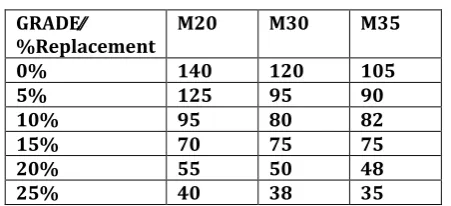
Workability of Normal concrete and Concrete Mixed with Hypo Sludge for various Percentages are measured before casting of samples. The Workability of concrete goes on decreasing as % increase of hypo sludge in concrete.
a) Slump cone Test-
[image:4.595.46.272.484.587.2]Following are the test result obtained from slump cone test for various grade and % replacement of Hypo sludge
Table-4.4 Result of Workability Test (slump Cone Test)
GRADE⁄⁄
%Replacement M20 M30 M35
0% 140 120 105
5% 125 95 90
10% 95 80 82
15% 70 75 75
20% 55 50 48
25% 40 38 35
b) Compacting Factor test- Following are the test result obtained from compacting factor test for various grade and % replacement of cement by hypo sludge.
Table 4.5 Test result of workability (Compacting Factor Test)
GRADE⁄⁄
%Replacement M20 M30 M35
0% 0.92 0.88 0.85
5% 0.88 0.84 0.82
10% 0.82 0.80 0.78
15% 0.78 0.77 0.75
20% 0.75 0.74 0.72
25% 0.74 0.72 0.70
The Above test result shows the Workability of concrete by two methods mainly slump cone Test and compacting Factor Test. The following observations are to be concluded from above table 4.4 and 4.5
a) from table as increase in hypo sludge %( 5 to25) in concrete the values of slump cone test and compacting factor test are to be goes on reducing.
b) As compare to the grade the values of slump cone test and compacting factor test are also reducing as grade increases.
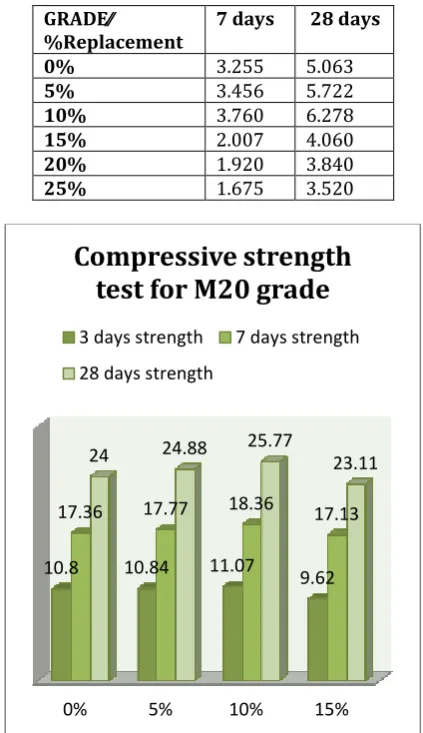
4.2.2. Compressive Strength Test-
The below test result shows the compressive strength Test for grade M20, M30, and M35 for 3,7and 28 days. The following observations are to be concluded from above table 4.6 and graph 4.7 to 4.8
a. For normal plain concrete, the compressive
strength at 28 days is to be come as per acceptance criteria clause no.16.1 & table no 11 of IS 456-2000,
b. As the % of Hypo sludge increases from 5% to 10% the value of compressive strength are increases than the normal concrete strength for every grade of concrete.
c. When the Hypo sludge % increases 15% &
above 15% the values of compressive strength are goes on reducing, but for 15% replacement of hypo sludge the values of compressive strength are more than the required grade.
Table 4.6 Test Result of Compressive Strength test for M20 Grade
GRADE⁄⁄
%Replacement 3 days 7 days 28 days
0% 10.84 17.36 24.00
5% 10.80 17.77 24.88
10% 11.07 18.36 25.77
15% 9.62 17.13 23.11
20% 8.14 14.21 18.66
25% 6.071 13.24 17.77
Table 4.7 Test Result of Compressive Strength test for M30 Grade
GRADE⁄⁄
%Replacement 3 days 7 days 28 days
0% 15.550 25.030 34.220
5% 15.400 25.200 34.888
10% 16.193 25.620 36.00
15% 13.090 22.800 32.888
20% 11.690 21.670 29.330
© 2019, IRJET | Impact Factor value: 7.34 | ISO 9001:2008 Certified Journal
| Page 1339
Table 4.8 Test Result of Compressive Strength testfor M35Grade
GRADE⁄⁄
%Replacement 3 days 7 days 28 days
0% 17.500 28.317 39.550
5% 17.730 28.505 40.880
10% 18.150 28.930 41.770
15% 15.140 25.600 37.777
20% 13.530 23.690 36.440
25% 13.320 21.428 33.770
4.2.3 Split Tensile Strength Test-
The Above test result shows the Split Tensile Strength Test for grade M20, M30, and M35 for 7and 28 days. The following observations are to be concluded from above table 4.9 to4.11
a. For normal plain concrete, the Split tensile
strength test on 28 days is to be come as per acceptance criteria of IS 456-2000.
Table 4.9 Test Result of Split tensile Strength test for M20Grade
GRADE⁄⁄
%Replacement 7 days 28 days
0% 1.637 2.456
5% 1973 2.960
10% 2.314 3.470
15% 1.226 1.840
20% 1.100 1.650
25% 0.740 1.110
b. As the % replacement of cement by hypo sludge
increases from 5% to 15% the value of Split Tensile strength test are increases than the
normal concrete strength for M20 grade of
concrete.
c. As the % replacement of cement by Hypo sludge
increases from 5% to 10% the value of Split Tensile Strength test are to be increases than the
normal concrete strength for M30, M35 grade
of concrete.
d. When the Hypo sludge % is increases up to 15%
& above 15% the values of Split Tensile strength Test is to be goes on reducing.
Table 4.10 Test Result of Split tensile Strength test for M30Grade
GRADE⁄⁄
%Replacement 7 days 28 days
0% 1.900 2.850
5% 2.312 3.468
10% 2.546 3.820
15% 1.726 2.590
20% 1.480 2.220
25% 1.260 1.890
Table 4.11 Test Result of Split tensile Strength test for M35Grade
GRADE⁄⁄
%Replacement 7 days 28 days
0% 2.110 3.120
5% 2.340 3.680
10% 2.620 3.965
15% 1.650 2.780
20% 1.640 2.450
25% 1.320 1.985
4.2.4 Flexural Strength Test
The Below test result shows the Flexural Strength Test for grade M20, M30, and M35 for 7and 28 days. The following observations are to be concluded from above table 4.6
a. For normal plain concrete, the Flexural strength
test on 28 days is to be come as per acceptance criteria of IS 456-2000.
b. As the % replacement of cement by Hypo sludge
increases from 5% to 15% the value of Flexural strength values are to be increases than the
normal concrete strength for M20 grade of
concrete.
c. As the % replacement of cement by Hypo sludge
increases from 5% to 10% the value of Flexural Strength test are to be increases than the normal
concrete strength for M30, M35 grade of
concrete.
d. And When the Hypo sludge % is increases 15%
& above 15% the values of Flexural strength Test is to be goes on reducing.
Table 4.12 Test Result of Flexural Strength test for M20Grade
GRADE⁄⁄
%Replacement 7 days 28 days
0% 1.803 3.160
5% 2.129 3.304
10% 2.665 3.835
15% 2.094 3.156
20% 1.829 2.950
Table 4.13 Test Result of Flexural Strength test for M30Grade
GRADE⁄⁄
%Replacement 7 days 28 days
0% 2.760 3.950
5% 2.778 4.412
10% 3.479 4.739
15% 2.452 3.810
20% 1.654 3.382
[image:6.595.325.550.407.694.2]25% 1.256 3.210
Table 4.14 Test Result of Flexural Strength test for M35Grade
GRADE⁄⁄
%Replacement 7 days 28 days
0% 3.255 5.063
5% 3.456 5.722
10% 3.760 6.278
15% 2.007 4.060
20% 1.920 3.840
25% 1.675 3.520
Chart no 1-Chart for Compressive strength test on concrete cubes for M20 Grade
Chart no 2-Chart for Compressive strength test on concrete cubes For M30 Grade
Chart no 3-Chart for Compressive strength test on concrete cubes for M35 Grade
0% 5% 10% 15%
10.8 10.84 11.07
9.62
17.36 17.77 18.36 17.13
24 24.88 25.77 23.11
Compressive strength
test for M20 grade
3 days strength 7 days strength
28 days strength
0% 5% 10% 15%
15.55 15.4 16.193
13.09
25.03 25.2 25.62
22.8
34.22 34.88 36 32.888
Compressive strength test
For M30 Grade
3 days strength 7 days strength
28 days strength
0% 5% 10% 15%
17.5 17.73 18.15
15.41
28.317 28.505 28.93
25.6
39.55 40.88 41.77 37.78
Compressive strength test
For M35Grade
3 days strength 7 days strength
© 2019, IRJET | Impact Factor value: 7.34 | ISO 9001:2008 Certified Journal
| Page 1341
Chart no 4-Chart for Split Tensile strength test onconcrete cubes For M20 Grade
Chart no 5-Chart for Split Tensile strength test on concrete cubes For M30 Grade
Chart no 6-Chart for Split Tensile strength test on concrete cubes For M35 Grade
Chart no 7-Chart for Flexural strength test on concrete cubes For M20 Grade
0% 5% 10% 15%
1.673
1.973
2.314
1.226 2.456
2.96
3.47
1.84
Split Tensile Strength
test For M20 Grade
7 days strength 28 days strength
0% 5% 10% 15%
1.9
2.312 2.546
1.726 2.85
3.468
3.82
2.59
Split Tensile Strength
test For M30 Grade
7 days strength 28 days strength
0% 5% 10% 15%
2.11 2.34
2.62
1.65 3.12
3.68
3.965
2.78
Split Tensile Strength
test For M35 Grade
7 days strength 28 days strength
0% 5% 10% 15%
1.803
2.129
2.665
2.094
3.16 3.304
3.835
3.156
Flexural Strength test
For M20 Grade
Chart no 8-Chart for Flexural strength test on concrete cubes For M30 Grade
Chart no 9-Chart for Flexural strength test on concrete cubes for M35 Grade
4.3 Cost Analysis-
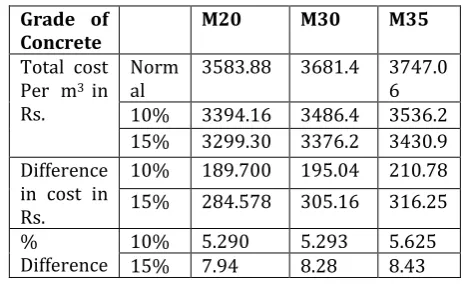
[image:8.595.320.552.181.323.2]The following Table shows the cost variation for various Percentage replacement of cement by Hypo sludge in 1M3 Concrete Mix.
Table 4.15 Cost Analyses & % Difference
Grade of
Concrete M20 M30 M35
Total cost Per m3 in
Rs.
Norm
al 3583.88 3681.4 3747.06
10% 3394.16 3486.4 3536.2
15% 3299.30 3376.2 3430.9
Difference in cost in Rs.
10% 189.700 195.04 210.78
15% 284.578 305.16 316.25
%
Difference 10% 15% 5.290 7.94 5.293 8.28 5.625 8.43
5. CONCLUSIONS &FUTURE SCOPE FOR STUDY-
A) CONCLUSION:-
1. The slump decreased when a higher amount of hypo-sludge content was included. The hypo-sludge exhibited a high water-absorption capability. Consequently, when a higher amount of hypo-sludge was included in the mixture, it required more water to achieve a given Target slump.
2. Several factors could lead to adverse effects on the workability of paper pulp concrete. The amount of hypo-sludge replacement, hypo-hypo-sludge physical properties, and the carbon content of the hypo-sludge would be the main reasons for the reduction of concrete workability.
3. Effects of hypo sludge on hardened concrete.
I. The compressive strength value increases up to
10% replacement and above 10% replacement of cement by hypo sludge the values of compressive strength test values are decreasing. But at 15% replacement the result for all grades are more than required grade.
II. The split tensile and flexural strength test was carried out for 7 and 28 days, respectively. The values of test result are increase up to 10% replacement and above 10% replacement of cement by hypo sludge the values of split tensile strength and Flexural strength values are goes on reducing for both strength tests.
III. The decrease in compressive strength spilt
tensile test &flexural strength values with increase in hypo sludge content is due to lack of Silica &Magnesia content in the hypo sludge.
0% 5% 10% 15%
2.76 2.778
3.479
2.743 3.95
4.412
4.739
3.81
Flexural Strength test
For M30 Grade
7 days strength 28 days strength
0% 5% 10% 15%
3.255 3.456
3.76
2.007 5.063
5.722
6.278
3.99
Flexural Strength test For
M35 Grade
© 2019, IRJET | Impact Factor value: 7.34 | ISO 9001:2008 Certified Journal
| Page 1343
IV. Use of hypo sludge in concrete can save the
paper industry disposal costs and produces a greener’ concrete for construction. And also make the Structure light in weight.
V. The setting time of concrete will be increased
above 15% replacement of cement by hypo sludge due to lack of alumina content
VI. Considerably this type of concrete will be used for road works effectively with less consumption of cement, also it is used for PCC work, Making of paver blocks etc.
4. The concrete using hypo sludge up to 10% reduces the cost up to Rs. 189.72 for M20 Grade concrete, Rs195.04. for M30 Grade concrete & Rs. 210.78 for M35 Grade concrete.
5. And for 15% replacement reduce cost up to Rs. 284.578 for M20 grade, Rs. 305.16 for M30 grade, Rs. 316.15 for M35grade.
6. Percentage reduction in cost per m3 for 10% and
15%for various grades as follows. For M20 Grade 5.290% and7.293% For M30 Grade 5.293% and 8.28% for M35 Grade 5.625% and 8.43 % respectively.
B) FUTURE SCOPE FOR STUDY
Through this study we have already come to the conclusion that Hypo sludge would be the best cementitious product to replace the cement in concrete mix. . Hypo sludge in near future is the best solution to produce the concrete. As the concrete forms the major component of any structure without which the structure could not be finished and also it has big financial value too. Developers now a day’s looking to save the money by producing the concrete with replacement of some of its ingredient and without affecting its quality. Apart from this we should also look seriously towards the effect of fire and temperature on Hypo Sludge concrete. Hypo sludge is the waste produced by paper industry so some research is required to be carried out in above area. Already we have come across these products like fly ash which is used widely in construction industry. So we shall be rest assure that our research subject possess high significance and future of concrete belongs to the Hypo sludge.
Hence, Following Point should be considered for better performance of Hypo sludge in concrete.
1. From above conclusion for better workability
test result of concrete mixed with hypo sludge we can add the admixture like Plasticizer and super plasticizer in proper amount in concrete.
2. It has been noted that at15% and above 15% the
test results are likely to fall due to lack of silica
content and magnesia content, hence one should add the proper amount of siliceous material like reactive powder (silica fume, quartz powder).
3. The setting time can be optimized by adding
alumina content.
4. This Project work has been carried out for PCC
work, therefore for R.C.C work Hypo sludge can be utilized.
5. Replacement of Natural sand with different
proportion of M-sand With Hypo sludge can be carried out.
6. Improvement in the strength can be observed
beyond 15%replacement with good quality of hypo sludge.
7. Replacement of fresh coarse aggregate with
different proportion of recycled coarse aggregate with hypo sludge can be carried out.
8. Combination of fly ash and hypo sludge with
different proportion can be utilized for plain concrete or reinforced cement concrete.
6. REFERENCES
1. Ms.T.Karthika, Ms.S.Shanthi “An experimental
investigation on concrete with of partial
replacement of cement by paper industry waste. IJASER volume-2, Issue: 2, June-2017
2. Ankur Jain, Manish Dubey “Utilization of Hypo Sludge as a Cement Replacement in Concrete” IJSRD|Volume.4, Issue 10, 2016
3. VVS.Sarma, P.V.Rambabu and Dr.N.C.Anil “Durability Studies on Concrete with Hypo Sludge as Partial Replacement of Cement” IJERA ISSN: 2248-9622, Vol-6 Issue-5, (Part-7), May-2016.
4. Mrs.S.selvarani “Structural performance of concrete by partial Replacement of cement with hypo sludge” IJARTET Vol.3, Special Issue-2, March-2016
5. Mr.R.Balamurugan, Mr.R.Karthickraja (April-2014)
“An Experimental Investigation of Partial
Replacement of Cement by Industrial Waste (Hypo Sludge)” IJERA ISSN; 2248-9622, Vol. 4 Issue 4 April-2014
I.S.CODES-
IS-10262-2009, “Concrete mix
IS 456 - 2000, “Plain and reinforced concrete - code of practice”, 4th Revision, 2000, Bureau of Indian Standards, New Delhi, India
IS 383–2016; Specification for Coarse aggregate and fine aggregate from natural sources for concrete
IS 12269-2013 Ordinary Portland cement 53 Grade Specification.
IS 4031- Method of Physical Testing on Cement
IS 2386-1963-“Method of Test for Coarse aggregate for Concrete
IS 5816-1970 Method of test for split tensile strength of concrete.
IS: 516 – 1959; Method of test for strength of concrete.
IS: 9399 – 1979; Specification for apparatus for flexure testing of concrete.
BOOKS- 1.Concrete Technology-M.S.Shetty.