© 2019, IRJET | Impact Factor value: 7.34 | ISO 9001:2008 Certified Journal | Page 153
Design of Spoon Mold using Flow Analysis and Higher End Design
Software
Bhushan Manikrao Gadhe
1, Dr. A. Yadao
21PG Student
,
Department of Mechanical Engineering, GHRCEM, Pune, India-412207
2Professor, Department of Mechanical Engineering, GHRCEM, Pune, India-412207
---***---
Abstract: This paper presents the design and flowanalysis of mould for producing a plastic spoon. Multi-cavity molds can help to produce the components in mass quantities in a short duration. Mold Design forms the basis of the development work required for producing the desired number of units in a given time frame. The objective of this study is to ensure that the mould flow analysis is done with flow analysis software therefore defects are reduce and mould can be manufactured with ease to obtain an optimized result. Thus our project aims at the awareness of developments of the new age technology of 3D CAD/Mold Wizard for Mold Design.
Keywords: Mold Design & Optimization, flow analysis, Multi cavity.etc
1. INTRODUCTION
Generally, plastic injection molding design contains a plastic part design, a mold design, and a design of injection molding process, all of which subsidize to the quality of the molded product and the production efficiency. The developed program system makes possible to perform: 3D modeling of the parts, numerical simulation of injection molding, analysis of part designs, and mold design with calculation. By the realization of the projected integrated system, this problem could be solved. The main part of the system consists of a knowledge based. The molding may cause defects and its processing offers a challenge during its development phase. The cost of the mold is high and any process that is not optimized renders heavy overheads during its development cycle and production. So designing the mold which ensures best suitability for the features on the component with smooth flow of molten plastic is very important part of development process. The successful launch of any plastic product depends on knowing the true costs and profitability before the job is started. Injection molding typically involves large volumes of parts. Small cost overheads per part can be compounded to large cost differences over the life span of the part. Major cost components considered here are material, re-grind and machine costs. Scrap, rejections and regrind costs are also accounted in the cost.
Fig.1: Injection Moulding 2. LITERATURE REVIEW
Mahale and Patil [1] have design the basis of the development work required for producing the desired number of units in a given timeframe. Multi-cavity molds can help produce the components in mass quantities in a short duration. The simplicity of the mold is the key to ensure the quality of the component produced and the associated costs of development. A review of the same with ingenious inputs in the design phase would help the Company to achieve its overall objectives. As such, the objective of this dissertation work is to Design a Plastic Injection Molded Component for the Automotive Industry that would ensure a minimal time for development of the mold as well as deliver a good quality product during trial and testing. This would in turn help the overall product development process at the subassembly and the final assembly level of the Product development.
mould design, the product was designed into two changeable inserts to produce two different types of plastic product in one mould base. Before proceeding to injection machine and mould design, this part was analyzed and simulated by using ANSYS 15.0. From the analysis and simulation we can define the most suitable injection location, material temperature and pressure for injection. Ajaykumar and Abhishek [3] have explain the factors that affect the quality of a molded part can be classified into four categories: part design, mold design, machine performance and processing conditions. This dissertation work covers the Design of multi cavity Injection Molding Tool for the Production of torch body using hydraulic side core. The design of injection molding systems for plastic parts relies heavily on experience andintuition. The main important thing in mold design is the location of gate (Optimum gate location). So it is necessary to go for a design optimization methodology. Design Optimization methodology, which tackles the design of an injection mold by integrating the structural, feeding, ejection and heat-exchange sub-systems to achieve significant improvements. The objective of this work is to provide statistical evidence for optimizing parameters of an injection molding machine. The machine parameters to be investigated include cooling time, back pressure, and plasticizing limit. These parameters are evaluated against the problem of decreasing the cycle time for each part.
Pathan et al. [4] have concluded the past mold design process was time taking as well as hectic. At first Drawing board, then 2D software’s were used after which patterns were made. But in this case the results were not considerable most of the times. Thus the design to market time increased immensely and also project cost required was on a higher side. Due to the technological advancement the process of Mold Design has fastened and also the results are considerable. With the help of 3D software we can create Parametric Design, Which are editable. Also we can look at number of possibilities for designing a mold. Most importantly the process of Drawing Creation for Mold Design becomes very easy. In a 3D software Visualization of our design is easy possible. Thus our project aims at the awareness of developments of the new age technology of 3D CAD/Mold Wizard for Mold Design.
Mate and Kadlag [5] have studied and gives the significance of injection molding. Due to heavy demand in plastic products, plastic industries are growing in a faster rate. Plastic injection moulding begins with mould making and manufacturing of intricate shape with good dimensional accuracy. To meet such requirements it is very important to adopt various advance technologies for the development of injection moulded components. This study deals with Design and Mould Flow Analysis of an automatic plastic injection mould for production of Luggage Bag Wheel. Plastic wheels, commonly used in
standard bags, suitcases and are manufactured exclusively by the injection moulding process all around the world. Modelling in done by using Unigraphics (NX 6.0). The material used is Polypropylene (PP) for the outer part and Thermoplastic Elastomer for the Outer cover. Guide bush is used which acts as a sleeve is made by material Derlyin. The elements of injection moulding tool has designed and analyzed. A Design of Experiments (DOE) of the moulding process parameters is used to identify key moulding parameters by analyzing a multi cavity injection system.
Vishwanath and Ramegowda [6] have studied injection moulding is one of the techniques used to produce plastic products by forcing the molten plastic material under pressure into a mould, where it is solidified and subsequently released by opening the two halves of the mould. The tool design and development is a specialized and critical area. This paper presents the conceptual design of plastic injection mould. The method represented here is for the design of a two-plate and split-cavity injection mould. The material used for the production of the component is Nylon 66 GF30. The technique is incorporated to produce a good quality component considering the ease of manufacturability and positive ejection of the component within the minimum possible time and cost. Desired product to be manufactured requires mold and tool. So, the tool design should be such that so as to match the machine specifications and should be accurate and economical for successful life of the component or product.
3. PROBLEM DEFINATION
[image:2.595.326.549.605.756.2]To increase the productivity, there are several factors like best method of doing job, time taken to do it, labour efforts, eliminating all unnecessary movements, improvements in design, product development, etc. Many companies produce ice-cream In old design of spoon manufacturing die, as shown in Figure productivity was less as only 4no. Of spoons were manufactured in 1 cycle. Thus labour time was wasted in pouring and ejection again and again
© 2019, IRJET | Impact Factor value: 7.34 | ISO 9001:2008 Certified Journal | Page 155
4. METHODOLOGYA) 3D Modelling & Drafting of the Plastic Product: In 3D CAD i.e. Unigraphics NX (Siemens product) software we can design the product concept, we can create drawing and drafting views automatically then easy apply a dimensions using the 3D model, can create assembly and can check for interferences and also can check motion simulation
B) Mold Design using Mould Wizard for Optimum Solution: Using Mold Wizard module of Unigraphics NX (Siemens product) the process of Mold Design can be done with ease as well as in least time. This wizard helps us in creating Core & Cavity. Standard library helps us in selecting Mold Base, Ejector pins, Sprue Bush, Locating Ring, Sliders, Runner gating, Cooling Lines etc. Also the Drawing Views of all the parts are created automatically which we can draft as per our requirement.
C) CAE for Regulating the Material Flow in Mold: Computer-aided engineering (CAE) simulation programs for plastics molding processes. It is used widely by the plastics injection molding industry. The MOLDFLOW injection molding Simulation of polymers can provide information on the thermo-mechanical properties and residual stresses of the Part resulting from the manufacturing process. MOLDFLOW writes this information to an interface file for subsequent finite element stress analysis.
D) Mold Drawing: In Mold Wizard, there are options by selecting which we can create standard drawing views, Hole Table (Ordinate Dimensions) as well as part list as per one’s requirement can be created. Also dimensioning the parts is easy. Section views as per requirement can be obtained.
[image:3.595.313.555.73.773.2]E) Manufacturing (CAM): In CAM we can generate the CNC Codes, specify the tool path, and specify tools, check for collision, and check simulation on the part which has been designed using CAD. We can avoid the accidents that may be caused while manual programming on CNC or VMC Machines. The methodology used is illustrated in figure
5. DRAFTING
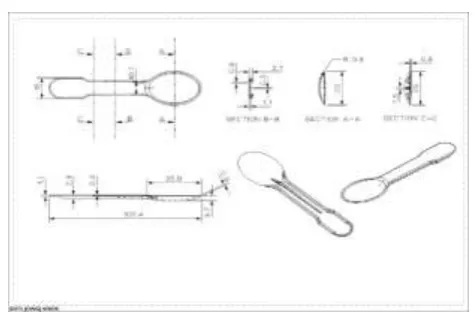
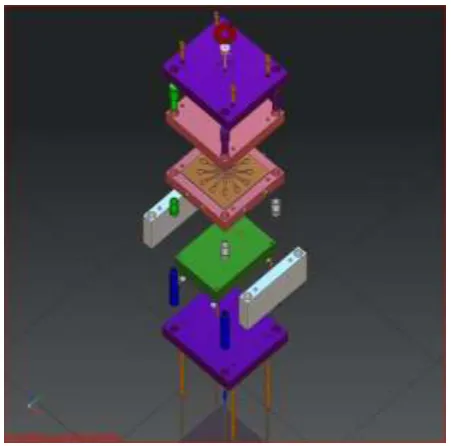
To initiate for designing, study of all the components is necessary. Principal components should chiefly design to get Noticeable improvement. Rest of parts may get designed depending on it. At first, the 3D model is created in Unigraphics Nx. It takes around 5 to 6 hours. After this the drawing of the model is created for cross checking purpose. Then by using Mold Wizard of Unigraphics Nx 4, the mold of spoon is created. At first, the company was having a 4 cavity mold for the component. Thus for increasing productivity design of a 12 cavity mold is done.
A] Spoon
Fig.3 Cad Drafting Model Of Spoon B] Cavity
Fig.4 Cad Model Of Cavity
C] Core
[image:3.595.318.556.107.268.2]D] BOM
[image:4.595.281.560.63.716.2]Fig 6 CAD Model of BOM E] Exploded View Of BOM
Fig.7 Exploded View Of BOM 6. FLOW ANALYSIS
The analysis results herein are believed to be reliable but users should undertake sufficient verification and testing to determine the suitability for their own particular purpose of Solid Model any information presented herein. The “flow analysis” of the component would provide useful inputs for expecting the performance of component during itsprocessing phase. It is generally not achievable to generate a soft mold for testing because of high cost involved.
Fig. 8. Sold Model
Fig. 9. [0.54 Sec Fill Time]
[image:4.595.40.266.337.560.2]© 2019, IRJET | Impact Factor value: 7.34 | ISO 9001:2008 Certified Journal | Page 157
FLOW ANALYSIS REPORTPart Name: SPOON
Material Supplier Reliance Industries Limited Material Grade: Repol R120MK
Max Injection
Pressure: 140.00 MPa
Mold
Temperature: 50.00 deg.C Melt
Temperature: 225.00 deg.C
Model Suitability: Part model was highly suitable for analysis.
Moldability:
Your part can be easily filled but part quality may be unacceptable. View the Quality plot and use the Dynamic Adviser to get help on how to improve the quality of the part.
Confidence: High
Injection Time: 0.54 sec Injection
Pressure: 33.69 MPa
Weld Lines: Yes
Air Traps: Yes
Shot Volume
(cavity, runner): 27.33 cu.cm ( 19.61, 7.72 ) Filling Clamp
Force: 31.33 tonne
Packing Clamp Force Estimate
@20%: ( 6.74 )MPa 12.17 tonne Packing Clamp
Force Estimate
@80%: ( 26.95 )MPa 48.67 tonne Packing Clamp
Force Estimate
@120%: ( 40.43 )MPa 73.01 tonne Clamp Force Area: 177.08 sq.cm
7. RESULT A] COMPARISION
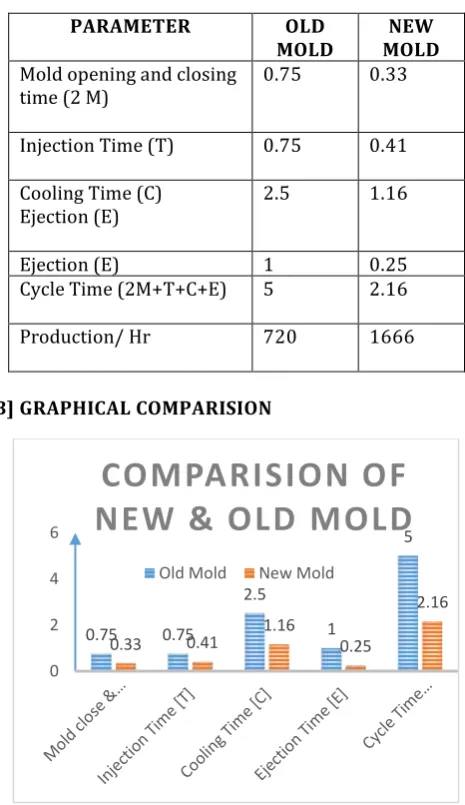
Time Required For One Spoon ( In Sec)
PARAMETER OLD
MOLD MOLD NEW Mold opening and closing
time (2 M) 0.75 0.33
Injection Time (T) 0.75 0.41 Cooling Time (C)
Ejection (E) 2.5 1.16
Ejection (E) 1 0.25
Cycle Time (2M+T+C+E) 5 2.16
Production/ Hr 720 1666
[image:5.595.319.552.150.553.2]B] GRAPHICAL COMPARISION
Fig. 11. Graphical Representation Of Result (Time In Second)
C] ACHIEVED RESULT:
Increase In Production Per Hr = 1666-720 = 946 Nos. Reduction In Time Required For 1 Product = (5-2.16) Sec = 2.84sec.
Increase In Productivity = (946 X 100) / 1666 = 56.78%.
Decrease In Production Time = (2.84 X 100) / 5 = 56.80%.
0.75 0.75
2.5
1
5
0.33 0.41 1.16 0.25
2.16
0 2 4 6
COMPARISION OF
NEW & OLD MOLD
8. CONCLUSIONS:
Mold flow provides acceptable information results such as fill time, injection pressure and pressure drop. With this result, users can avoid the imperfection of the plastic in actual injection such as sink mark, indecision, over packing, air traps. Mold with minimum modifications and it will also reduce the mold setup time. With this analysis and simulation it will help to lessen time and cost. The productivity is increased up to 56.62% and production time is decreased up to 56.8%.The Mold can be filled completely and gives reliable results. Users should undertake sufficient verification and testing to determine the suitability for their own particular purpose. The Design of the Mold and the processing factors has an effect over the quality of the part produced. Defects can bereduced through improved design of the mold with the study of simulation of flow through the mold. The material, size, obscurity (complexity) and the rate of production required should be considered for evolving the right Mold design for the given component. From the analysis simulation, Mold flow provides acceptable information results such as fill time, injection pressure and pressure drop. With this result, users can avoid the imperfection of the plastic in actual injection such as sink mark, indecision, over packing, air traps. The analysis will also help the mold designer to design a perfectmold with minimum modifications and it will also reduce the mold setup time. With this analysis and simulation it will help to lessen time and cost.
REFERENCES:
[1] Kiran C. Mahale Prof. Avinash. V. Patil “Design Enhancement For A Plastic Injection Mold For An Automotive Component Using Results Of Simulation For Input”, 2013, Volume : 3(4).
[2] Korrapati Surendra Babu, Sk. Muneer Basha And Dr. Sreedhar “Design And Simulation Of Plastic Injection Molding Process By Using Ansys”, 2016, Volume 1(11). [3] Ajaykumar K And Abhishek Basappa “Design Of Multi Cavity Injection Molding Tool For The Component Torch Body By Using Hydraulic Sidecore”, 2017, Volume 04(11).
[4] Mohammad Safi A. Pathan ,Kulkarni Pooja, Jadhav Ramdas And Lalit N. Patil, “Design & Development Of Injection Mold Using Flow Analysis And Higher End Design Software” , 2016, Vol. 3(3), PP: (17-23).
[5] Sonali Dinkar Mate and Prof. V. L. Kadlag “Design and Mould Flow Analysis of Injection Mould for Luggage Bag Wheel - A Review”, 2016, Volume-3(1).
[6] Vishwanath Dc and Dr. D Ramegowda “Design Of Singe Impression Injection Mould for Lower Bearing Cover”, 2015, Vol. 4 (5).
[7] Gurjeet Singh and Ajay Verma “A Brief Review on Injection Moulding Manufacturing Process”, 2016, Vol 2214-7853.
[8] Arun R Nair and Mr. Sandip B Patil “Design Optimization for A Plastic Injection Mould through Moldex 3d Analysis (CAE)”, July 2017, Vol. 3, Issue.2, PP (20-28).