© 2019, IRJET | Impact Factor value: 7.211 | ISO 9001:2008 Certified Journal
| Page 107
Acid Fracturing
Mohd Emad
1, Vaibhav Kumar
2, Mazhar Abbas
31,2,3
Department of Petroleum Engineering, Uttaranchal Institute of Technology, Uttaranchal University,
Dehradun – 248 007, Uttarakhand, India
.
---***---Abstract - Acid fracturing is one of the favored techniques to invigorate wells in carbonate supplies. It comprises of infusing an acid arrangement at sufficiently high strain to separate the development and to spread a two-wing break far from the wellbore. The acid responds with the carbonate arrangement and this causes the carving of the crack surfaces. After the treatment, the made scratched surfaces don't close superbly and that abandons a very conductive way for the hydrocarbons to be delivered. We recognize the issue of treatment measuring (that is the assurance of the volume of acid to be infused) and the issue of making ideal crack measurements given the extent of the treatment. This is sensible in light of the fact that the last expense of a treatment is resolved for the most part by the volume of acid infused and our objective ought to be to accomplish the best execution of the treated well. The well execution relies upon the made crack measurements and break conductivity and might change with time because of different reasons.
Key words: acid fracturing, formation damage, migration, wettability, clay swelling
1. INTRODUCTION
Matrix stimulation might be a system amid in which a dissolvable is infused into the arrangement to break down some of the materials present and subsequently recoup or increment the penetrability in the close wellbore district. Such medications are called ―matrix‖ medicines in light of the fact that the dissolvable is infused at weights underneath the separating weight of the arrangement all together that cracks aren't made. The goal is to significantly upgrade or recoup the permeability close to the wellbore, instead of effect a vast bit of the supply. The most usually utilized matrix stimulation treatment is acidizing, in which an acidic arrangement is infused to break down minerals in the development. In any case, different solvents are additionally utilized. The following most basic liquids are natural solvents gone for dissolving waxes, paraffins, asphaltenes or other natural harming materials.
The most widely recognized acids are acid (HCl), utilized fundamentally to break down carbonate minerals, and blends of HCl and acid (HF), used to assault salt minerals like mud and feldspars. Different acids, quite some feeble natural acids, are used in uncommon applications, similar to high-temperature wells. Matrix acidizing could be a close wellbore treatment, with all the acid responding at
interims concerning one straight unit of the wellbore in arenaceous shake arrangements and at interims a couple of crawls to perhaps the most extreme sum as ten direct unit from the wellbore in carbonates. Matrix acidizing will extensively upgrade the efficiency of a well once close wellbore arrangement harm is blessing and, on the other hand, is of confined benefit in a perfect well.
2. Formation Damage Description
Formation damage is commonly arranged by the instrument of its creation as either natural or actuated. Natural damages are those that happen principally as a consequence of assembling the repository liquid. Instigated damages are the consequence of an outside activity that was performed on the well, for example, a boring, admirably consummation, fix, incitement treatment or infusion task. What's more, some fulfillment tasks, incited damages or structure issues may trigger natural damage components.
3. Fines Migration
Formation mischief will happen as an after effect of molecule movement inside the made liquid. The particles will connect over the pore throats inside the close wellbore locale and cut back the well efficiency. At the point when the harming particles come back from the supply shake, they are commonly referred to as fines. Relocating fines can be a scope of different materials, including muds (phyllosilicates with an ordinary size yet 4 μm) and residues (silicates or aluminosilicates with sizes beginning from four to sixty four μm). The basic muds that represent the greater part of the genuine and saw dirt issues are kaolinite, smectite (montmorillonite), illite and chlorite.
4. Swelling Clays
© 2019, IRJET | Impact Factor value: 7.211 | ISO 9001:2008 Certified Journal
| Page 108
recognized swelling clays territory unit is smectite and smectite blends. Smectite swells by bringing water into its structure. It will expand its volume up to 600%, extensively decreasing permeability. On the off chance that smectite clay involves just the littler pore throats and entries, it won't be a difficult issue; nonetheless, in the event that it possesses the bigger pores and especially the pore throats, at that point it's fit for making partner degree essentially impermeable hindrance to stream in the event that it swells. Clays or diverse solids from boring, fruition or work over liquids will attack the formation once these particles zone unit littler than the pore throat openings. Any subsequent increment in rate of course through the attacked zone can constrain a high grouping of particles into the rock matrix.
5. Scales
The accompanying scales are among the first troublesome:
Carbonate or spar (CaCO3)
CaCO3 is commonly formed once the weight is decreased
on waters that are well off in metal and hydrogen carbonate particles. The statement might be tormented via carbon dioxide out gassing, that raises the hydrogen particle focus cost and makes the high groupings of metal shaky.
Mineral (“gyp”)
Gypsum could likewise be the chief regular sulphate scale inside the refining industry (Cowen and Weintritt, 1976). With a substance structure of CaSO4⋅ 2H2O, it shares an
indistinguishable structure to the hemihydrates CaSO4 ⋅1⁄2H2O, unremarkably alluded to as mortar of Paris or by
its mineral name, bassonite. It’s moreover predictably practically like the store mineral anhydrite (CaSO4).
Barium sulphate (BaSO4)
BaSO4 might be a less basic sort of sulphate store, anyway
it causes top to bottom issues. For all intents and purposes any mix of metal and sulphate particles causes precipitation. It is hard to dispose of, in light of the fact that it isn't impressively dissolvable in acids and solvents except if it's finely ground or the structure is hindered with pollutions like carbonate scale. Like calcium sulphate, blanc fixe is ordinarily thought to be a result of mixing non compatible waters, with precipitation quickened by weight drop, out gassing or disturbance. Some blanc fixe is radioactive; this is regularly a piece of present radioactive
Chloride scales
Chloride scales, similar to parallel compound precipitation from water brought about by temperature reduction or dissipation of the water, are normal. There’s no viable gratitude to prevent salt precipitation, and cleanup has been practiced exploitation water exclusively. Salt fuses a confined solvency in corrosive (1⁄4 lbm/gal in twenty
eighth HCl), along these lines exploitation corrosive isn't regularly thought of. Updating the framework to dodge temperature misfortune and water dissipation is furthermore a chance.
Oxide scales
Silica scales commonly happen as finely solidified stores of quartz or as indistinct mineral. they're identified with alkalic or steamflood comes and originate from the disintegration of silicious arrangement minerals by high-pH liquids.
6. Emulsions
Emulsions zone unit combos of 2 or a ton of contrary liquids (counting gas) which won't scatter molecularly into each other (Hoover, 1970; Sherman, 1968; Lissant, 1974; Lissant and Mayhan, 1973; Bandbach, 1970; Hausler, 1978; Bikerman, 1964; Ogino and Onishi, 1981; Gidley and Hanson, 1973; Coppel, 1975). The breaking instrument of these flimsy emulsions is by bead contact and development and after that by liquid thickness partition. As the beads move close and contact, the surface film around the drop may thin and burst, shaping vast drops in a procedure called blend. The bigger beads settle quickly inferable from thickness contrasts between the fluids framing separate layers. Just a segment of the drops that touch will combine. At the point when least combination happens, the emulsion is steady.
7. Water Blocks
Water can cause obstructing in low-penetrability rocks (Keelan and Koepf, 1977). Water squares are an exceptional instance of relative penetrability issues. In water square, water generally consumes the streaming spaces (either pores or regular breaks) that are normally utilized by hydrocarbons to stream to the wellbore. In view of the quality and consistency varieties, the hydrocarbon liquid may not be fit for uprooting the water. The most serious instances of water squares territory unit commonly found in unaggressive, low-penetrability, gas-creating developments when treatment with water that fuses a high physical wonder.
8. Wettability Alteration
© 2019, IRJET | Impact Factor value: 7.211 | ISO 9001:2008 Certified Journal
| Page 109
9. Acid Mineral Reaction
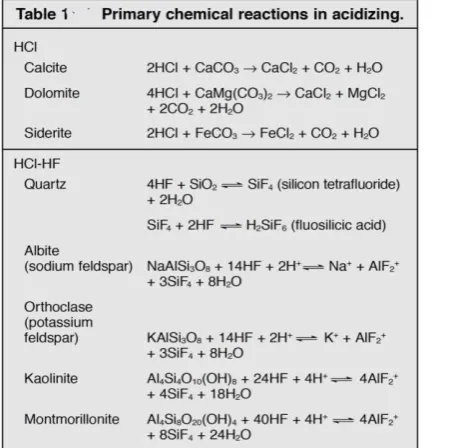
The measure of acid expected to break down a given measure of mineral is chosen by the proportion of the compound procedure that depicts the amount of moles of each species worried inside the response known as stoichiometry.
For example, the fundamental reaction among HCl and calcite (CaCO3) can be created as
2HCl + CaCO3 → CaCl2 + CO2 + H2O
This exhibits that 2 moles of HCl are required to separate 1 mole of CaCO3. The numerals 2 and 1 expanding the
species HCl and CaCO3 are the stoichiometric coefficients
VHCl and VCaCO3 for HCl and CaCO3, exclusively.
At the point when HF responds with salt minerals, various auxiliary responses may happen that impact the general stoichiometry of the response. For example, when HF responds with quartz (SiO2), the main response is
4HF + SiO2 → SiF4 + 2H2O
Delivering semiconducting material tetrafluoride (SiF4)
and water. The stoichiometry of this response demonstrates that four moles of HF region unit expected to expend one mole of SiO2. In any case, the SiF4 made may
respond with HF to make fluosilicic acid (H2SiF6)
predictable with
SiF4 + 2HF → H2SiF6
6 moles of HF, rather than 4 moles, will be exhausted to separate 1 mole of quartz. A perplexity is that the
fluosilicates may exist in various structures, with the objective that the total proportion of HF required to
separate a given proportion of quartz depends upon the game plan center.
10. Methodology
[image:3.595.55.280.515.739.2]Natural fractures are sporadically appropriated in a carbonate store and are assembled into sets with favored crack introduction. To improve the issue, a model was developed where a using pressurized water incited break was met by symmetric transverse natural fractures. The crack geometry was approximated as a channel between two parallel plates. The model area (Fig. 1) is a parallelepiped of length, l, tallness, h, and width, w. The facilitate framework is characterized to such an extent that the x pivot is parallel to the length, the y hub is parallel to the tallness, and the z hub is lined up with the width of the parallelepiped. The x-y plane speaks to the break divider plane, and the separation between the planes, w, speaks to the crack width. Corrosive is infused from one side of the crack (through the y-z plane) and exits from the contrary side. Natural fractures converge water powered break opposite to the x-y plane, and the territory of convergence has measurements of h • wnf, where h is the stature of the natural crack, which is equivalent to the pressure driven break tallness, and wnf is the width of the natural break. The control volume is a parallelepiped with measurements of x, y, and w, where w is the crack width at the point (x, y).
Figure 1 - Hydraulic fracture model schematic
For acid fracturing in a naturally fractured limestone reservoir, we can assume the following:
1. Steady state.
2. Laminar flow of incompressible Newtonian fluid. This assumption holds for injection of straight acid into a fracture at injection rates typical for an acid fracturing treatment rates.
3. Gravity effects are neglected.
4. Infinite acid/rock reaction rate. This assumption is valid for the fast reaction between concentrated hydrochloric acid with calcite.
© 2019, IRJET | Impact Factor value: 7.211 | ISO 9001:2008 Certified Journal
| Page 110
11. Calculation Method
The technique for deciding the fracture conductivity is as per the following. In the first place, the information parameters, for example, water powered and regular fracture geometry, treatment conditions, repository properties, and corrosive properties are characterized. The number and area of regular fractures are assumed. At that point, the gridding of the pressure driven fracture space is executed. A non-uniform gridding is connected along the fracture length, with refined matrix measure in the x heading close to the convergence of the pressure driven fracture with the regular fracture.
From that point forward, the leak off in the regular fractures is evaluated expecting an estimation of the weight differential between the fracture and the repository. In view of the acquired leak off speed, the speed of the stream from the pressure driven fracture into the characteristic fracture is assessed. The mass parity condition is then unraveled to acquire the weight appropriation along the water driven fracture.
The common fracture leak off is then re-determined utilizing the refreshed estimation of the
weight distinction, and the outcome is contrasted and the accepted esteem. The emphasis procedure is rehashed until intermingling is gotten inside the characterized resilience. At that point, the corrosive equalization condition is explained to acquire the corrosive focus conveyance along the water powered fracture. From that point onward, the fracture width carving is assessed and the fracture width is refreshed. The PDE's are fathomed numerically utilizing the limited contrast strategy. In light of the determined characteristic fracture leak off speed, the leak off Reynolds and Peclet numbers are ascertain. The difference in the regular fracture width is evaluated systematically utilizing the corrosive focus dissemination along the water powered fracture length as a contribution for the bay corrosive fixation into the characteristic fractures. Toward the finish of the treatment, the last fracture conductivities of the pressure driven fracture and the normal fractures are acquired dependent on the last fracture width that was accomplished amid the infusion.
12. Natural Fracture Width
As the initial dynamic width of the natural fractures increases, the leak off Peclet number increases, which creates more etching of the natural fractures. The Peclet number is a function of the leak off velocity inside the natural fracture and the average width of the natural fracture. The leak off velocity decreases with time and does not depend on the natural fracture width. Therefore, the leak off Peclet number only depends on the fracture width. The natural fracture width etching is greater for the
first natural fracture than for the second natural fracture due to the acid penetration inside the hydraulic fracture. The concentration of the acid entering the natural fracture, which is located closer to the hydraulic fracture inlet, is higher than the concentration of the acid flowing into the natural fracture located further down the hydraulic fracture. The greater width change of the natural fracture causes the higher values of the leak off Peclet number for that fracture. The created natural fractures conductivity is presented in Fig. 6, where the dimensionless length is defined as the distance from the fracture inlet normalized by the fracture half- length. The same definition of the dimensionless length is used in all the following figures. It was found that the natural fracture width has a negligible effect on the hydraulic fracture etched width and fracture conductivity. It was found that the natural fracture width has a negligible effect on the hydraulic fracture etched width and fracture conductivity.
13. Conclusions
Natural fractures can have both either positive or negative impact on the made corrosive crack conductivity of water driven break and its relying upon the geometry and thickness of natural crack.
•Those natural fractures which have higher starting width will have higher break conductivity and more noteworthy powerful length. The underlying width of natural break has no base impact which is unimportant on pressure driven crack conductivity.
•If the length of natural crack expands, the conductivity of natural break just as water driven break diminishes due to the expanded of corrosive leak off in to natural break.
•As the quantity of natural break crossing the water powered crack builds, the made crack conductivity of pressure driven break and the conductivity of natural crack declines and its aftereffect sufficiently long natural break.
•Hydraulic crack and natural break conductivities increment when we expand corrosive infusion since it expanded corrosive infiltration inside the water driven break.
14. References
© 2019, IRJET | Impact Factor value: 7.211 | ISO 9001:2008 Certified Journal
| Page 111
Carbonates Pay Zones in Kazakhstan. Presented at the SPE International Symposium and Exhibition on Formation Damage Control. Lafayette, Louisiana, 13-15 February. SPE-112419-MS.
http://dx.doi.org/10.2118/112419-MS.
Leal Jauregui, J. A., Malik, A. R., Nunez Garcia et al. 2011. Successful Application of Novel Fiber Laden Self- Diverting Acid System during Fracturing Operations of Naturally Fractured Carbonates in Saudi Arabia. Presented at SPE Middle East Oil and Gas Shoe and Conference, Mahama, Bahrain, 25-28 September. SPE-142512-MS.
http://dx.doi.org/10.2118/142512-MS.
McCartney, E., Al-Othman, M., Alam, A., and et al. 2017. Enhanced Acid Fracturing with Improved Fluid Loss Control and Near Wellbore Diversion Increases Production in Kuwait. Presented at the SPE Annual Technical Conference and Exhibition, San Antonio, Texas, 9-11 October. SPE-187444-MS.
http://dx.doi.org/10.2118/187444-MS.
Hongjie, X. 1994. Prediction of Effective Acid Penetration and Acid Volume for Matrix Acidizing Treatments in Naturally Fractured Carbonates.
http://dx.doi.org/10.2118/25410-PA.
Salimi, S., Ghalambor, A., and Hayer, H. 2014. Insights Into the Process of Effectively Acidizing Naturally Fractured Reservoirs. Presented at the SPE International Symposium and Exhibition on Formation Damage Control. Lafayette, Louisiana, 13-15 February. SPE-168126-MS
http://dx.doi.org/168126-MS.
Dong, C., Zhu, D., & Hill, A. D. 2002. Acid Penetration in Natural Fracture Networks. SPE Prod & Fac 17 (3): 160-170. SPE-78791-PA.
http://dx.doi.org/10.2118/78791-PA.
Dong, C., Zhu, D., and Hill, A. D. 2002. Modelling of the Acidizing Process in Naturally Fractured Carbonates. SPE J. 7(4): 400-408. SPE-81816-PA.
http://dx.doi.org/10.2118/81816-PA.
Mou J., Zhang S., and Shang, Y. 2012. Transp Porous Med (2012) 91: 573–584. Acid Leakoff Mechanism in Acid Fracturing of Naturally Fractured Carbonate Oil Reservoirs.
http://dx.doi.org/10.1007/s11242-011-9860-4.
Economides, M.J., Hill, A. D., Ehlig-Economides, C. and Zhu D. 2013. Petroleum Production Systems, second edition.
Prentice Hall. Berman, A.S. 1953. Laminar Flow in Channels between Porous Walls. J. Appl. Phys. 24 (1953): 1232.
http://dx.doi.org/10.1063/1.1721476.
Terrill, R.M. 1965. Heat Transfer in Laminar Flow between Parallel Porous Plates. Internat. J. Heat and Mass Transfer (1965): 1491-1497.
Schechter R.S. 1992. Oil Well Stimulation. New Jersey: Prentice Hall.
Mou J., Zhu, D., and Hill, A.D. 2011. New Correlations of Acid-Fracture Conductivity at Low Closure Stress Based on Spatial Distributions of Formation Properties. SPE Prod & Oper 26 (2): 195–202. SPE-131591-PA.
http://dx.doi.org/10.2118/131591-PA.
Deng, J., Mou, J., Hill, A.D., and Zhu D. 2012. A New Correlation of Acid–Fracture Conductivity Subject to Closure Stress. SPE Prod & Oper 27 (2): 158– 169. SPE-140402-PA.
http://dx.doi.org/10.2118/140402-PA.
Nierode, D.E. and Kruk, K.F. 1973. An Evaluation of Acid Fluid Loss Additives, Retarded Acids, and Acidized Fracture Conductivity. Presented at the Fall Meeting of the Society of Petroleum Engineers of AIME, Las Vegas, Nevada, 30 September–3 October. SPE-4549-MS.