© 2019, IRJET | Impact Factor value: 7.34 | ISO 9001:2008 Certified Journal
| Page 779
Analysis of Hard Chrome Plating Process to Reduce Rejections using
PDCA Cycle
Mr. Saurabh Tatyaso Nikam
11
Department of Mechanical Engineering, Dr D. Y. Patil Institue of Engineering, Management & Research,
Akurdi, Pune, Maharashtra, India
---***---Abstract -
This paper concentrates on Hard Chrome Plating process of piston rod and the defects arising. This defects lead
to rejections of piston rods. Being an expensive process, rejections up to 11% are unacceptable. This leads to rise in production time and reduction in overall equipment effectiveness which leads to delay in achieving target. This leads to bigger consequences like gap between customer supplier bonds. We used proper systematic approach namely PDCA cycle to analyze the process and find the gaps in process. We used certain quality control tools and six sigma tools to analyze these flaws. After implementation of results obtained from analysis, we got reduction in rejection quantity by 50%. This resulted in increase in production, cost saving and most importantly increase in product quality.Key Words: Quality control tools, CT matrix, Pareto Chart, XY Matrix, Hard Chrome Plating
1.
INTRODUCTION
In today’s world everyone wants product with high quality. But when production is considered, there are always some flaws and gaps which lead to decrease in quality of product and efficiency of process. These flaws can be tackled by use of proper and systematic approach. In this paper we are going to use PDCA cycle to analyze and reduce the process related problems.
In a piston rod manufacturing industry, hard chrome plating is carried out on piston rods to increase their corrosive resistance property and increase their life. But due to some unknown flaws and problems in process, approximately 10 to 11% rods are facing rejections. To analyze and find the root cause of the problem we have to take help of some quality control tools and six sigma tools.
2.
THEORY
Chrome plating is also known as chrome. It is a process of electroplating a thin layer of chromium on a metal body. The chrome plating is carried out for decorative purpose for example car fronts. It also acts as corrosion resistance, ease cleaning procedures. Sometime it is also used to increase surface hardness.
There are mainly two types of chrome plating, decorative and hard. In this paper we will be focusing on hard chrome plating (also known as industrial plating) on piston rods of dampers and the defects arising on rods during process.
2.1 Types:
(i) Decorative:
Decorative chrome is used for aesthetical purpose. The chrome layer thickness varies from 0.05 to 0.5 μm, however to be more precise they are generally between 0.13 and 0.25 μm. Typically base materials used includes steel, copper alloys, aluminium, plastic and zinc alloys. Decorative chrome plating is also corrosion resistant and is generally applied on kitchen utensils car parts, and tools.
(ii) Hard:
© 2019, IRJET | Impact Factor value: 7.34 | ISO 9001:2008 Certified Journal
| Page 780
3.
GENERAL PROCEDURE OF HARD CHROME PLATING:
(i) Loading Station:
Generally jigs with slots are provided to carry piston rods. These piston rods are threaded at one side and jig has slots with internal threading. Hence the rods have threaded joint with jig.
Fig-1: General process of Hard Chrome Plating
(ii) Hot Soak Tank:
Jigs are dipped in hot soak tank in order to remove rust and oil from surface. Generally temperature maintained is 65-80 degree Celsius. Dipping time varies from 4-6 minutes.
(iii) Hot Electric Soak Tank:
Purpose and characteristics of this tank is same as above tank. Just current of 30-40 Ampere is supplied to tank.
(iv) Water Rinse Tanks:
These tanks contain RO water. Purpose of this tank is to remove alkali from surface due to dipping of rods in previous tank. There are three water rinse tanks having pH from 7-12.
(v) Etching Tanks:
This tank has chrome salt with concentration of 130-175 gm/lit. Rods are dipped for generally 1-1.5 minutes. Current varies from 1-1.2 Ampere.
(vi) Hard Chrome Plating Tanks:
Main plating operation is done in this tank. Temperature is generally between 50-61 degree Celsius. Chromic acid concentration varies from 225-275 gm/lit and sulphate content from 2.25-2.75 gm/lit. Time and current varies according to size of piston rod.
(vii) Drag out 1 & 2:
Purpose of this tank is to remove excess chemical from the component.
(viii) Chrome Water Rinse 4 & 5:
These tanks consist of RO water. It is used to remove final traces of chemical from the rod.
(ix) Unloading:
Unload the rods and inspect the rods visually. Inspect for defects like scratches, dents etc.
(x) Super finishing:
© 2019, IRJET | Impact Factor value: 7.34 | ISO 9001:2008 Certified Journal
| Page 781
(xi) Final inspection:Final inspection is done by passing the rods through air gauge and visual inspection. Also plating thickness is checked by Dry Film Thickness (DFT) meter.
4.
METHEDOLOGY:
We will be following Plan-Do-Check-Act Cycle (PDCA) which is a model used for continuous improvement. Demings cycle is also used to increase effectiveness and efficiency of processes. In this paper we will be using PDCA model to improve efficiency of Hard Chrome Plating Process by analyzing the defects or reasons for reworks and eliminating this defects.
(i) PLAN: Define problem and find root cause
(ii) DO: Do analysis on defect and find remedies
(iii) CHECK: Implement the remedies & compare results.
(iv) ACT: Standardize the process.
5.
PLAN PHASE:
This phase is initial phase of Plan-Do-Check-Act. In this we will define our problem and identify the root causes and plan for improvements in process. In this phase we have to analyze the current situation. To analyze the process certain sample length was decided i.e. 100000 piston rods for July month. Following data shows rejection data for given month. As we can see about 10.79% rods were rejected due to certain defects.
Table 1: Details of rejection of rods in July 2019
Details July 2019
Rods Produced 100000
Line Rejection 10796
Rejection % 10.79%
Rejection PPM 107960
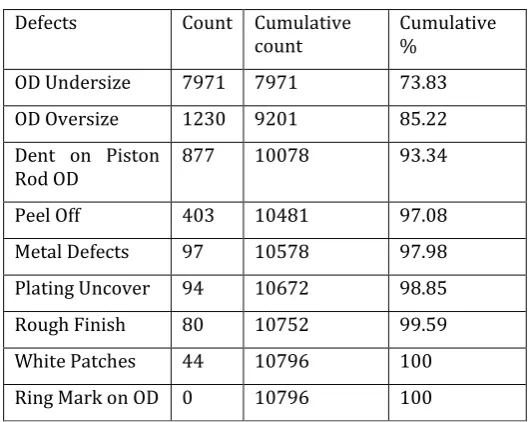
[image:3.595.165.430.539.750.2]These rejections are due to some of the defects in rods. Following data shows types of defects and their respective counts:
Table 2: Defects with occurrence count
Defects Count Cumulative
count Cumulative %
OD Undersize 7971 7971 73.83
OD Oversize 1230 9201 85.22
Dent on Piston
Rod OD 877 10078 93.34
Peel Off 403 10481 97.08
Metal Defects 97 10578 97.98
Plating Uncover 94 10672 98.85
Rough Finish 80 10752 99.59
White Patches 44 10796 100
© 2019, IRJET | Impact Factor value: 7.34 | ISO 9001:2008 Certified Journal
| Page 782
As you can see in above table we have listed out all defects and their occurrence. To know on which defect we have to focus, we have to plot Pareto chart. A Pareto chart is used to break down each of the parameters. Pareto chart has many benefits. It tells us which parameter is most important and which has to be looked on.A Pareto chart gives emphasis on problems so that the major problems can be found out. Pareto chart is one of the seven quality control tools. It helps us to narrow our focus on a major parameter or topic. It is also known as 20-80% chart. It means if we work on 20% defect we will get our problems reduced to certain extent. According to Pareto chart, we have to work on defect OD undersize. Reducing occurrence of this defect will result in significant decrease in rejection quantity.
Chart-1: Pareto Chart for defects
6.
DO PHASE:
© 2019, IRJET | Impact Factor value: 7.34 | ISO 9001:2008 Certified Journal
| Page 783
Chart-2: CT MatrixChart-3: XY Matrix
Action taken or Remedies:
© 2019, IRJET | Impact Factor value: 7.34 | ISO 9001:2008 Certified Journal
| Page 784
Table-3: Critical to process parameters and remedies7.
CHECK PHASE:
After applying all above remedies, we analyzed the process on another 100000 piston rods. We got following results after applying the remedies in month of August:
Table-4: Details of rejection data in August
Details August 2019
Rods Produced 100000
Line Rejection 5568
Rejection % 5.57%
Rejection PPM 55680
Table-5: Details of defects and their counts
Defects Count Cumulative
count Cumulative % OD Undersize 3423 3423 61.47
OD Oversize 852 4275 76.77
Dent on
Piston Rod OD 745 5020 90.15 Peel Off 425 5445 97.79
Metal Defects 45 5490 98.59
Plating
Uncover 30 5520 99.13 Rough Finish 27 5547 99.59
White Patches 21 5568 100
Ring Mark on
© 2019, IRJET | Impact Factor value: 7.34 | ISO 9001:2008 Certified Journal
| Page 785
After the trial, we observed significant drop in rejection quantity. The line rework quantity fell from 10796 to 5568. This resulted in drop in rework ppm from 107960 to 55680 ppm. So we can see that approximately 50% reduction in rejection quantity was absorbed. In all the defects, OD undersize defect was reduced by more than 50 %. Following Pareto chart shows the defect quantities for month of august.Chart-4: Pareto Chart for defects after implementing remedies
8.
ACT PHASE:
Final and last phase of PDCA cycle is act phase. As we have seen significant decrease in rejection quantity, we should implement these changes. In addition to this sustaining this new process is important to achieve higher outputs .This process and method should be standardized. On Regular basis on job trainings should be given to operator about method. This will increase the productivity of company and hence increase the profit with high quality products. In return customer supplier bond also gets stronger.
9.
RESULTS:
Piston rods after undergoing process change results in lesser rejections. Before this the rework was 10.47% which was too large. After analysis and implementation of remedies we got significant decrease in rejection quantity. In addition to this significant reduction were observed in all the defects. Following table shows the rejection data comparison of July and August.
Table-6: Comparison of Rejection Data
Details July 2019 August 2019
Rods Produced 100000 100000
Line Rework 10796 5568
Rework % 10.79% 5.57%
Rework PPM 107960 55680
3423
852
745
425
45 30 27 21 0
61.47
76.77
90.15
97.79 98.59 99.13 99.59 100 100
0 20 40 60 80 100 120 0 500 1000 1500 2000 2500 3000 3500 4000 OD Undersize OD Oversize Dent on Piston Rod OD
© 2019, IRJET | Impact Factor value: 7.34 | ISO 9001:2008 Certified Journal
| Page 786
Chart-4: Comparison of defects count in July versus August10.
CONCLUSION:
This study was carried out to improve the production by reducing defects. To do this we required proper systematic approach, hence use of PDCA cycle, quality control and six sigma tools was beneficiary. The process of hard chrome plating is critical and important for piston rod and also expensive. So decreasing the rejection quantity also eliminated the rework cost to certain extent. This can only be implemented by adopting the process as a culture of company. In future doing further in depth analysis can further improve the process and production.
11.
REFERENCES:
[1] Maraya Irudaya Raj, Analysis of Hard Chromium Coating Defects and its Prevention Methods, International Journal of Engineering and Advanced Technology, ISSN: 2249-8958, Volume-2, Issue-5, June 2013
[2] Manoj Kumar, Optimization and Improvement of Plastic Decoration using Chrome Plating Process,International Journal of Advance Research And Development, Volume-3 , Issue-2,2018
[3] Vasile Bratu, Research on Chrome Plating of Steel Bars, the Scientific Bulletin of VALAHIA University- Materials & Mechanics- Nr-10, 2015
[4] M.S Milton, Improvement in the Production of Powder Coating Process of Fan Blades through PDCA, International Journal for Research in Applied Science & Engineering Technology, Volume-5, Issue- 4, April 2017
[5] www.dearsystem.com/Lean-six-sigm
0 1000 2000 3000 4000 5000 6000 7000 8000 9000
July