Top Lang Disorders Vol. 00, No. 00, pp. 1–12
Copyrightc 2018 Wolters Kluwer Health, Inc. All rights reserved.
Constructing and Navigating
Cultural Borderlands Using
Augmentative and Alternative
Communication
Martine M.
Smith
[AQ]
Individuals who use augmentative and alternative communication (AAC) occupy complex socio-cultural and sociolinguistic territories. They are immersed in spoken language communities but to participate as speakers in conversational interactions, they may rely on atypical communication modes, including systems for generating speech that set them apart as what C. Mattingly (2006) termed “Other.” This article explores the challenges and tensions implicit in shifting between cultural roles ofNatural SpeakerandAided Communicatorusing the construct of cultural bor-derlands. Borderlands are first explored in terms of social participation, focusing on questions such as whether aided communication offers a bridge across borderlands or constitutes a marker of cultural difference and on the question of ownership of aided communication. The borderlands of speaker–listener roles that are negotiated within interactions involving aided communication are then considered. Possible implications of how the construct of cultural borderlands supports understanding of interactions involving aided communication are suggested.Key words: aided
[AQ1]
communication,borderland,communication device,speaker–listener roles,voice
O
VER the past several decades, the field of augmentative and alternative communi-cation (AAC) has expanded and evolved (e.g., Hourcade, Pilotte, West, & Parette, 2004). Technological developments have opened up exciting possibilities to enhance communica-tion access for individuals with severe com-munication impairments related to a broad range of disabilities. Augmentative and alter-native communication solutions may serve many different purposes—to augment or re-place speech for expressive communication, to support both comprehension andexpres-Author Affiliation:Department of Clinical Speech &
[AQ2]
Language Studies, Trinity College Dublin, Dublin, Ireland.
The author declares no financial disclosure.
Corresponding Author:Martine M. Smith, PhD, De-partment of Clinical Speech & Language Studies, Trinity College Dublin, 7-9 South Leinster St, Dublin 2, Ireland ([email protected]).
[AQ3]
DOI: 10.1097/TLD.0000000000000148
sion, and as a temporary or permanent set of resources and strategies.
The focus in this article is on people whom von Tetzchner and Martinsen (2000) characterize as using AAC forexpressive pur-poses. Individuals in this group are presumed to be able to hear and understand spoken language but cannot produce expressive output that is sufficiently intelligible to meet their functional communication needs. Typically, individuals in this group require AAC over an extended period of time, if not permanently. Specifically, the focus here is on individuals who use aided communication, in other words communication that draws on resources external to the communicator. Such aided options can range from low-tech
paper-based communication books and
boards to high-tech speech-generating de-vices and computer-based systems. Although many in this group may experience some receptive language difficulties, their access to comprehension is primarily through spoken language. Their expressive communication
is multimodal (as it is for most people), but uniquely, their multimodality incorporates use of aided communication.
Individuals who use aided communica-tion for expressive purposes occupy com-plex sociocultural and sociolinguistic territo-ries. They usually live their lives immersed in spoken language environments, in homes, families, and social networks, where their membership of cultural communities of “nat-ural speakers” is unchallenged. However, for effective expressive communication, aided communication modalities may be required. The motor, cognitive, linguistic, and sensory demands of using aided communication cre-ate new interaction demands (e.g., Clarke & Kirton, 2003; Light & McNaughton, 2014; Murray & Goldbart, 2009). The implicit rules of engagement that underpin successful spo-ken interactions (e.g., in terms of timing, lin-guistic specificity, or turn-taking) may be frac-tured, creating a new cultural territory that ranges from “not quite natural speaker” to “aided communicator.”
Indeed, the complexity of the situation is partially reflected in the constant termi-nological debates and controversies about acceptable terms, labels, and descriptions (e.g., von Tetzchner & Basil, 2011). Even the value of the term aided communicator is open to question, if the evidence is that for most individuals to whom this label is ap-plied, communication relies more heavily on unaided than aided modalities (e.g., Andzik, Chung, & Kranak, 2016). Such considerations have prompted questions about the appropri-ateness of talking about a sociolinguistic or sociocultural group defined by use of aided communication (e.g., Woll & Barnett 1998). As noted by von Tetzchner (2016), “the pres-ence of a communication aid may facilitate an attribution of identity as belonging to a category of aid users, but there may be a weak uniting force” (p. xi). However, if culture is defined as a form of encounter, rather than a form of life (Mattingly, 2008, p. 139), then the encounters of individuals who use aided communication with communication part-ners who use natural speech share sufficient overlap to suggest that culture may indeed
of-fer a useful lens through which to view these experiences.
In Mattingly’s terms, the practice of culture is [in part] “the practice of Othering, of identi-fying cultural (and racial) difference in a thou-sand subtle and unconscious ways” (2006, p. 495). Othering implies a focus on differ-ence. In this respect, it is egocentric: The interpretation of “Other” is referenced back to the individual making a judgment, explor-ing “how is this person (the Other) different tome?” Individuals who use aided communi-cation may experience Othering in multiple ways across their days. This article will focus on practices of Othering at two levels: (a) the broader social context of everyday life and (b) the level of the individual, in the moment-by-moment context of interpersonal communi-cation interactions. The construct of clinical– cultural borderlands is used to explore how in-dividuals who use aided communication nav-igate their membership of cultural groupings, using as a starting point Mattingly’s statement that “culture is not to be found in a group’s shared set of beliefs and values so much as in its practices of drawing contrasts and bound-aries with other groups” (Mattingly, 2006, p. 495). Cultural borderlands offer a uniquely rich context for considering culture, “in a bor-derland, culture emerges more vividly as a space of encounter than of enclosure” (Mat-tingly, p. 495). The metaphor of cultural bor-derlands offers a way of considering the inter-action experiences of individuals who hear and understand spoken language but whose access to natural speech is severely restricted and who therefore find themselves between the worlds of natural speakers and aided communicators.
Cultural Borderlands in AAC 3
also places in which actors sometimes find common ground” (Mattingly, 2008, p. 139). They are spaces of encounter where people attempt to make themselves interpretable and to interpret the behaviors of others. For individuals who use aided communication, the struggle to be interpretable can play out overtly and covertly across the day, as they attempt to bridge the cultural divide between natural speaker and aided communicator and to make themselves readable in a way that is acceptable not only to their interaction partners but also to themselves.
CULTURAL BORDERLANDS AND AIDED COMMUNICATION
[AQ4]
Communication is one of the key means by which social groups connect, cultures co-alesce, and shared understandings are nego-tiated. People with very limited expressive communication face significant barriers in as-serting their membership of the spoken lan-guage cultural communities in which they are based. Because features of speech produc-tion are such salient markers of membership of a specific cultural group, failure to pro-duce speech that marks that membership can have far-reaching consequences. Such Oth-ering may be particularly salient for people whose understanding of the spoken language of their community is unimpaired, as well as people who areinthe community physically, cognitively, and linguistically but marked out by their lack of speech as notofthe commu-nity. One extreme example can be found in the autobiography of Martin Pistorius, who at the age of 12 developed locked-in syndrome due to an unexplained illness. Over the sub-sequent 5 years, he gradually regained cogni-tive awareness and recepcogni-tive language skills. With no way of expressing himself that was interpretable to those he encountered, Pisto-rius struggled to bridge the cultural divide be-tween the speaking communities in which he spent his days and the role assigned to him by virtue of his lack of speech. He described this role as a “box” marked in his words as “imbecile,” a potted plant, “something to be
given water and left in the corner” (Pistorius & Davies, 2011, p. 16).
[AQ5]
Aided communication offers a pathway into communication interactions. Such inter-actions serve as a foundation for social con-nections and belonging, for defining one’s role within a community within a social net-work and ultimately, within a culture. How-ever, this pathway may be fraught with chal-lenges. Three such challenges are considered here. One challenge reflects the potential of aided communication to act as a barrier as well as a bridge to membership of the culture of natural speakers. The second challenge fo-cuses on the importance of physical features of aided communication devices and the im-pact these may have on how easily someone may blend into a community of communi-cation partners. The third challenge relates to fuzzy boundaries surrounding the role of aided communicator, the extent to which use of aided communication is required or ex-pected, and the role of individuals in defining such boundaries.
Communication aids: Markers of or bridges across cultural borders?
In the writings of individuals who use aided communication, there are many pow-erful descriptions of the impact of having ac-cess to speech output in asserting identity and cultural membership. For example, Jan-ice Staehely (2000) described an experience in a summer camp when she was 13 years of age. On her second day, a new counselor be-came frustrated after multiple efforts to put shoes on Janice’s feet. Janice recalled:
[she] must have been thinking that I was a big, spoiled brat! I, on the other hand believed that the counselor was hopeless if she couldn’t tell that the sneakers couldn’t possibly be mine! . . . . Fi-nally I pointed to my [SGD] . . . .“Those are not my shoes” came out in a DEEP electronic male voice. There was a moment of silence and then laughter broke loose. Laughter was the music that started our friendship (Staehely, 2000, p. 8).
provided a bridge across the cultural bound-ary between Natural Speaker and Other and made it possible to negotiate common ground. This incident highlights the power that access to aided communication po-tentially offers in bridging cultural border-lands and finding ways to be interpretable. However, such success is not always easily achieved. The operational demands associ-ated with aided communication can consti-tute significant barriers to successful and sat-isfying interactions.
Many individuals who use aided communi-cation require additional support with many activities of daily living. As a group, they may experience more interactions with peo-ple paid to be in their presence (e.g., ther-apists, teachers, personal assistants) than with other kinds of communication part-ners (Thirumanickam, Raghavendra, & Ols-son, 2011). In their encounters with these partners, they may find themselves in a bor-derland between alternate identities as “Re-ceiver of Help” and full conversational part-ner. In the study by Smith and Connolly (2008), many adults who used aided commu-nication reflected on the time pressures they faced, including the difficulty of persuading care staff to pause long enough to allow gen-uine communication to take place. Being re-liant on paid staff for activities such as wash-ing, dresswash-ing, eatwash-ing, and moving into the community, places individuals who use aided communication in a vulnerable power rela-tionship within these encounters. They may juggle concerns about being perceived as a burden with a desire to establish a working relationship based on mutual understanding, an understanding that is normally negotiated through conversational interactions. Marion [pseudonym], who lives independently with the support of a number of personal assis-tants reflected in a personal communication (included here, with permission, in her own words, as typed by her):
talking is not comfortably if people only have time caring only for your physically needs. people might be in a hurry in doing other tasks in their job that
they get too frustrated having a friendly conversa-tion with you. . . . You might be thinking of trying to make life easier for people assisting you as well as you. You dont mean to be a barrier to them. You fully understand there are many more more people to care about in their working environment.
For personal care assistants with busy schedules, the primary purpose of an en-counter with an individual who uses aided communication may be the provision of care. Encounters that under other circum-stances might offer a natural context for a conversation are transformed into new borderlands, where the pace and effort of interactions involving aided communication may be difficult to accommodate. Staff may compensate for these time pressures by avoiding conversations, occupying the con-versational floor by maintaining monologues, or closing off the conversational space by maintaining silence (e.g., Smith, Murray, von Tetzchner, & Langan, 2010). Individuals who persist in seeking interactions that are more satisfying are at risk of finding themselves labeled “difficult” or “demanding.” The dilemma described by Marion was that she was aware of these pressures, but she also knew that a genuine conversation might lead to solutions that make life easier for everyone. That is, she knew that she could help her helper, rather than embodying the role of “barrier.”
Cultural Borderlands in AAC 5
Aesthetics, appearances, and fitting in
Many stakeholders may be involved in the process of selecting and designing an aided system for a specific individual. Often within those stakeholder groups, there are compet-ing agendas, considerations, and pressures. These tensions can emerge in encounters that span multiple borderlands, between parents, education systems, clinical services, peer net-works, parent–child interactions, and social community networks. Although all stakehold-ers may share common ground in viewing aided communication as a way of supporting effective participation for a child, adolescent, or adult, they may differ greatly in the values they place on features of an aided communica-tion device, what a device should represent, or the purposes and roles they attribute to use of aided communication.
Stakeholders also may diverge in their ex-pectations about whose voice carries most weight in decisions about device selection. Traditionally, recommendations about spe-cific aided communication devices were often driven largely by the expertise of specialist speech–language pathologists, AAC special-ists, or manufacturers, but the emergence of tablet technologies has revolutionized access to high-tech aided communication options (Fager, Bardach, Russell, & Higginbotham, 2012; McNaughton & Light, 2013). Not only are these options significantly more afford-able, they also are more socially desirable. Augmentative and alternative communication specialists now find themselves in a new consumer-driven model of AAC technology provision (Hershberger, 2011), where fami-lies or individuals may arrive at an initial meet-ing with a preferred technological solution already in hand. Such encounters represent borderlands in which previously defined cul-tural roles such as Expert and Recipient/Pupil are fractured and new cultural roles must be negotiated.
In such interactions, the priorities of a speech–language pathologist may be focused not only on current needs but also on long-term goals related to attainment of commu-nicative competence. From that perspective,
key considerations may include how well a particular device or software application is likely to support language development or de-vice longevity and availability of ongoing sup-port. By contrast, parental concerns in select-ing technology may be driven by priorities re-lated to more immediate pressures of demon-strating competence, fitting in, and/or finding a niche. Whereas using a speech-generating device may mark a child as Other, using an iPad may allow for a different status of Other, even a desirable Other. In her book,Giving
Voice,Alper (2017) tracked the experiences
of 20 families parenting young people who used iPads to support their communication. Many of the parents mentioned that while their children were socially ostracized in mul-tiple ways, they were more easily accepted among peers because of the appeal of their iPad. Danny’s mother Alice observed “A per-son sees someone like Danny with an iPad and it’s not weird” (Alper, 2017, p. 73).
iPad sabotaged its potential to reduce barriers and reinforced a narrative that depicted per-sonal incompetence, flying in the face of the stated purpose of the iPad to enhance com-municative competence.
Some of these tensions may be understood in terms of the financial implications related to aided communication. Provision of a “voice” for individuals who use aided communication costs money. These costs can amount to sev-eral thousands of dollars, putting individuals who use aided communication in a uniquely vulnerable situation as they try to navigate a path to participation. They and their families may find themselves cast in the role of “Bene-ficiary,” disempowered and reluctant to chal-lenge decisions or recommendations for fear of losing what may be a long-awaited opportu-nity. For example, Daisy, a mother in Alper’s (2017) study, was unhappy with some of the decisions made by her son’s school about the purpose of the iPad but recognized the imbal-ance in power in their relationship. She rea-soned, “I shouldn’t complain too much. Just the fact that they gave me an iPad, and the fact that I’m able to put stuff for home and that it’s just his and that we get to take it home” (2017, p. 99). The cost implications raise com-plex questions about ownership of communi-cation devices and obligations related to the role of being a Beneficiary.
Obligations, ownership, and autonomy: Whose voice is it anyway?
Not all costs associated with aided commu-nication are clearly visible. The apparent low costs of communication boards mask the time costs involved in determining the appropriate symbolic representational system, the target vocabulary, and the optimal display organiza-tion. Indeed, these costs (both the upfront purchase cost of a high-tech device and hid-den costs of low-tech options) are simply the first installment in an investment process that may extend over many months or years in attempts to optimize a system for a specific individual.
Aided communication may assume a status and importance as a key mode of
communi-cation, despite the evidence that (a) effec-tive communication is multimodal (Light & McNaughton, 2014), (b) unaided modes such as facial expression, eye gaze, gesture, and vo-calization are frequently more efficient, more accessible, and more transparent than aided communication (Loncke, 2014), and (c) un-aided modes are frequently relied on even by individuals who are considered expert aided communicators (e.g., Joyce, 2000; Williams, 2000). As a Beneficiary of a high-cost device that has taken time, effort, and money to pro-cure, an individual may either assume or be assigned a range of obligations, including an obligation to use what has been provided as effectively as possible, as much as possible, for as many purposes as possible, in order to provide evidence that the investment was worthwhile.
Cultural Borderlands in AAC 7
and interpretable. Unaided modes also may al-low individuals to assert alignment with oth-ers, to identify themselves as members of the interaction community, and to belong to the cultural group of natural speakers.
It is difficult to imagine a situation in which individuals who use natural speech could be required to justify the extent to which they use gesture, facial expression, or intonation. A tension in relation to aided communication is that it takes time and practice to master the operational demands of a communication aid. Individuals need access to aided communica-tion systems that are relevant to their needs and abilities, as well as multiple opportuni-ties to use aided communication in order to achieve the level of competence that allows them to make informed choices about their preferred modes of communication. Negoti-ating that process requires crossing a border-land where boundaries around ownership of communication modes and autonomy in com-munication preferences may easily be blurred. There may be sound reasons why an individ-ual is explicitly requested to use aided com-munication, even if a message has already been interpreted and understood (e.g., Smith, 2003).
[AQ6] However, if aided communication
ulti-mately is to enhance personal autonomy and choice, then ownership of modes of com-munication also implies choices about when not to use a communication device. Staehely (2000, p. 5) recalled
despite all the hard work at practicing to use my language board, I think I always left it at home. In my opinion, it was much easier to use my own voice or to rely on my mom, sisters, or close friends to say my words for me.
Similarly, Estrella (2000) challenged the per-ceived obligation to use his device in a pre-specified way. Messages can be stored in a device as single words or, alternatively, as longer stretches of speech such as phrases, sentences, or extended paragraphs of output. Prestored utterances can be generated with a single-cell selection and thereby increase rate of communication and potentially enhance
overall communicative efficiency. However, as Estrella pointed out, prestored utterances are often a poor fit with immediate communi-cation demands:
I was also given piles of sentences and criticized for not using them. I don’t know about you, but I don’t think in terms of pre-formed sentences. Sometimes I even change my thought halfway through the sentence and I have also been known to throw in a very descriptive word when the mood strikes me. I can think of few things more dehumanizing and even demeaning than selecting canned sentences from a list and seeing the subject matter that you want to talk about is nowhere to be found (p. 38).
Ownership can be further blurred by com-plications about the funding source. On the one hand, individuals may be directed to “Use your device,” but on the other hand, decisions about access to the device may ultimately be held by others. If a device is purchased by a school district for a specific student, then the district may control not only the case or other ancillary products provided but also ac-cess to the device as in the case of Daisy’s son described earlier. In contexts of low in-come, devices may be shared across multiple students and their use limited to the school context (T¨onsing & Dada, 2016). In other con-texts, the demarcations may be less extreme but no less present because of their subtlety. For example, in some instances, damage to a device may be covered only by insurance if the damage is incurred on school property, implying that the rightful place for a device is geographically defined rather than linked to an individual (Alper, 2017). Some of the par-ents in Alper’s (2017) study objected to the decision of school districts to lock an iPad into a communication application without consul-tation with family members or students. In the case of one student, Beatriz, a new passcode on the iPad effectively locked her out of what was on the one hand her communication de-vice, with all its associated obligations, but simultaneously the property of the school. As her father commented:
the device and her communicative agency were immobilized by the school’s device settings and technology management infrastructure once she walked through the doors of her home. Along the way, both humans and machines made decisions that rendered Beatriz’s iPad simultaneously, and ir-reconcilably, mobile and immobile (Alper, 2017, p. 101).
The complications related to ownership and obligation, outlined previously, speak to the fluid and blurred boundaries between nat-ural speaker and aided communicator and the complicated territory between aided commu-nicator and Not-Quite Natural Speaker roles. These tensions also play out at the level of individual, interpersonal conversational interactions.
CULTURAL BORDERLANDS WITHIN MULTIMODAL INTERACTIONS
Interactions that involve use of aided com-munication are often described as differing structurally and temporally from other inter-actions (e.g., Clarke & Kirton, 2003; Light, 1988; von Tetzchner & Stadskleiv, 2016). The pace and rhythm of interactions are in-fluenced by the demands of accessing and selecting messages within an aided commu-nication system (Clarke & Wilkinson, 2008; Higginbotham, Fulcher, & Seale, 2016). Com-munication partner roles may be extended to disambiguate contributions communicated using aided communication (e.g., Bloch & Clarke, 2013). Within these conversations, in-dividuals who use aided communication oc-cupy roles as both speaker and listener. In their roles as listener, their membership of the natural speaker community is unchallenged. However, in their role as speaker, they are vul-nerable to Othering. This vulnerability may be increased by the pace and dynamics of inter-actions where aided contributions must first be individually selected and sequenced. Indi-viduals then often need to explicitly negoti-ate shared interpretations of aided output so that the conversational task of “narrative mind reading” (Mattingly, 2008, p. 136) may be par-ticularly complicated for all involved.
Conversation pacing and structure
Within these conversational encounters, the complexity of multimodal communica-tion plays out in real time, influencing the role of aided communicator as speaker but also challenging the traditional role of listener for the person’s communication partner. If in cross-cultural encounters, “individuals are continually engaged in creating plausible nar-ratives to make sense of the exotic actions of others” (Mattingly, 2008, p. 139), then from the point of view of the listener, the exotic action of a speaker who makes no appar-ent response is plausibly interpreted within a narrative of rudeness, of incompetence, of disengagement, or of boredom. Such misun-derstandings can easily occur while someone attempts to use a scan-dependent, speech-generating device or pauses to consider how to communicate something when the neces-sary vocabulary is not available. Pistorius and Davies (2011) reflected eloquently on the im-pact of aided communication on the structure of his conversations and, by implication, his role as a speaker:
A conversation with me is slow and takes time and a patience that many people don’t have . . . people’s voices move in a seamless cycle, sentences running one into another while they talk. But I interrupt the rhythm and make it messy. People must make a conscious effort to look at me and listen to what I have to say. They must allow me the space to speak because I can’t butt in and many don’t want to listen to the silence I create as they wait for me to input words into a computer . . . a conversation with me is as much about the silences as it is about the words, and I notice if my words are listened to or not because I choose each one so carefully. (p. 139)
Cultural Borderlands in AAC 9
reflected on the responsibilities they felt as natural-speaking partners for managing the overall flow and success of the interactions. Comments included “I talked more to keep the conversation going and to make it easier for the person (P1); I felt like I should fill in the blanks for my partner when they couldn’t find the word (P2)” (p. 273). When they switched roles to use aided communication, they re-ported a sense of pressure, of making each symbol selection count to minimize the bur-den on their naturally speaking partner (e.g., “I was able to convey most factual informa-tion but I felt like I couldn’t tell a story or write long sentences” (P1); “I started limiting myself to bare essentials of answering ques-tions without expanding” (P4); “I felt I had to stick to topics I could see on the board” (P4); p. 280).
Added to these challenges are the cognitive and physical efforts often involved in both generating and interpreting aided communi-cation, where misunderstandings are com-mon, and fatigue and frustration can quickly transform a conversation into a chore. One stark example is described by Higginbotham et al. (2016), where Rita, a 49-year-old woman, who used a speech-generating device using a head mouse and knee switch, was interact-ing with her husband, Max, to complete a way-finding task. Over the course of the task, Rita experienced several technical problems while composing her utterances, resulting in long delays in generating a response. Max, apparently unaware of these issues and un-able to interpret the apparently “exotic ac-tion” of no response, expressed his frustra-tion by directing her to not “ . . . spell out the whole thing, just one WORD in there. One letter man” (p. 215). As pointed out by the authors, Max’s words imply that Rita, rather than the device, was responsible for the communication delays. In this interac-tion, Rita was “Othered,” in the sense that Max seemed to judge her either as not aware of the temporal demands of effective con-versations or unwilling to comply. Citing the work of Robillard (1994), Higginbotham et al. (2016) reflected that “finding fault with
the augmented speaker in not adhering to the temporal order of conversation is common practice, and, unfortunately, one which fre-quently brings with it notions of incompe-tence and reluctance to maintain long-term relationships” (p. 215).
The question of voice in voice output
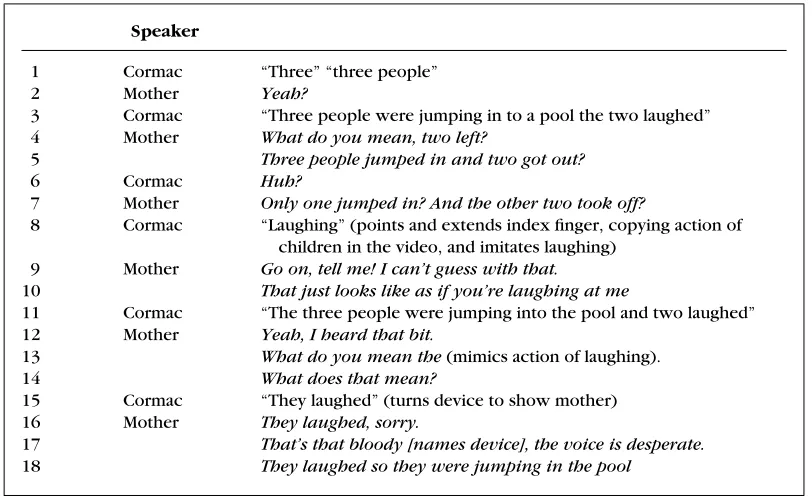
Although speech-generating devices may be promoted as the “voice” of individuals with severe speech impairments, the status of voice output within interactions may be somewhat uncertain. An important question is whether such output should be literally in-terpreted as the “voice” of someone who uses aided communication, or as a representation of voice more generically. For example, Cor-mac, aged 8 years, used a speech-generating device to describe to his mother what had happened in a video he had viewed (see
Table 1). [T1]
Cormac’s mother could not see the visual display of his communication device and at Line 4 misinterpreted “laughed” as “left.” At Line 8, Cormac attempted to repair this break-down, using gesture. His gestures were inter-preted as ambiguous, potentially mocking his mother, and she directed him to “tell me,” an explicit direction to use speech. He com-plies, but when he makes the device visible to his mother, she referred to “the voice” (Line 17) rather than Cormac’s voice, imply-ing that it belongs to a third party—in her words “that bloody [device].” This designa-tion granted permission to overtly evaluate the voice negatively in a way that would be unacceptable if it were conceived as that of a natural speaker. This interaction illustrates the potential paradox of being in the role of a speaker, generating a voice that is somehow not quite the voice of the speaker.
Table 1. Extract of conversation describing contents of silent video event
Speaker
1 Cormac “Three” “three people”
2 Mother Yeah?
3 Cormac “Three people were jumping in to a pool the two laughed”
4 Mother What do you mean, two left?
5 Three people jumped in and two got out?
6 Cormac Huh?
7 Mother Only one jumped in? And the other two took off?
8 Cormac “Laughing” (points and extends index finger, copying action of
children in the video, and imitates laughing)
9 Mother Go on, tell me! I can’t guess with that.
10 That just looks like as if you’re laughing at me
11 Cormac “The three people were jumping into the pool and two laughed”
12 Mother Yeah, I heard that bit.
13 What do you mean the(mimics action of laughing).
14 What does that mean?
15 Cormac “They laughed” (turns device to show mother)
16 Mother They laughed, sorry.
17 That’s that bloody [names device], the voice is desperate.
18 They laughed so they were jumping in the pool
responsibility for aided communication, dis-cussions should center on interactions that
involve aided communication. This would
shift the emphasis to all participants in negoti-ating meaning as part of a common endeavor. Through this lens, interpretation of aided communication becomes a shared space for participants. Despite the new understandings this perspective offers, questions of voice, ownership, and authorship resonate particu-larly in the field of aided communication, in light of controversies such as Facilitated Com-munication or the Rapid Prompting Method (see Schlosser et al., 2014; Tostanoski, Lang, Raulston, Carnett, & Davis, 2014; Travers, Tincani, & Lang, 2014). At the core of these controversies are questions related to autonomy in communication and blurring of boundaries between speakers’ and listeners’ roles and responsibilities. It seems likely, therefore, that voice output will continue to occupy a curious disembodiment within interactions, belonging to—but not quite owned by—one of the participants within the interaction.
According to Mattingly (2008), “culture has come to be the name of a land one travels through as much as lives in, a land charac-terized by hybridity” (p. 139). In the many and varied contexts in which people who use aided communication navigate their daily lives and conversations, they encounter strangers and familiars. In the complex cultural border-lands between “natural speaker,” “not quite natural speaker,” and “aided communicator,” both their achievements and their challenges can be exposed. The decisions of other play-ers in these cultural borderlands can ex-ert a powerful influence on their conversa-tional experiences and on their success in bridging the apparent divides between these multiple identities. The construct of cultural borderland offers a valuable prism through which to understand some of the challenges they encounter in constructing identities as communicators.
Cultural Borderlands in AAC 11
vulnerability and risk of social exclusion of individuals with significant communication challenges highlights the importance and potential power of aided communication in asserting competence and membership of an interaction community. Explicit discussion of the ways in which aided communication may not only support membership of that community but also create barriers offers a mechanism to increase awareness, tolerance, and openness to communication diversity that can support richer communication inter-actions for all concerned. Following Clarke and Wilkinson’s (2008) suggestion that the focus should shift away from individuals who use aided communication to interactions that involve aided communication creates a new way of considering what interventions might target. Specifically, interventions
may target development of an individual’s skills and competencies or extending ca-pacities within dyads to engage in effective “narrative mind reading” (Mattingly, 2008, p. 136).
Cultural borderlands are relatively unchar-tered and constantly changing. They evolve and emerge in cultural practices. As such, they offer opportunities for new understandings across a range of domains. Aided communi-cation is a relatively recent phenomenon and its reach is broad and diverse. Communica-tion aids can be regarded as cultural artifacts, whose value is defined through use within a cultural context. In this sense, the construct of cultural borderlands offers a potentially valuable framework for exploring both the cultural practices and values associated with aided communication.
REFERENCES
Alper, M. (2017).Giving voice: Mobile communication, disability and inequality. Cambridge, MA: The MIT Press.
Andzik, N., Chung, Y., & Kranak, M. (2016). Com-munication opportunities for elementary school students who use augmentative and alternative com-munication.Augmentative and Alternative Commu-nication,32, 272–281. doi:10.1080/07434618.2016. 1241299
Bloch, S., & Clarke, M. (2013). Handwriting-in-interaction between people with ALS/MND and their con-versation partners. Augmentative and Alternative Communication,29, 54–67. doi:10.3109/07434618. 2013.767497
Clarke, M., & Kirton, A. (2003). Patterns of interaction between children with physical disabilities using aug-mentative and alternative communication and their peers.Child Language Teaching and Therapy,19, 135–151.
Clarke, M., & Wilkinson, R. (2008). Interaction between children with cerebral palsy and their peers 2: Under-standing initiated VOCA-mediated turns. Augmenta-tive and AlternaAugmenta-tive Communication,24, 3–15. Estrella, G. (2000) Confessions of a blabber finger. In
M. Fried-Oken & H. Bersani (Eds.),Speaking up and spelling it out(pp. 31–46). Baltimore, MD: Paul H. Brookes.
Fager, S., Bardach, L., Russell, S., & Higginbotham, D. J. (2012). Access to augmentative and alterna-tive communication: New technologies and clini-cal decision-making.Journal of Paediatric
Rehabil-itation Medicine, 5, 53–61. doi:10.3233/PRM-2012 -0196
Farrier, L., Yorkston, K. M., Marriner, N., & Beukelman, D. (1985). Conversational control in nonimpaired speak-ers using an augmentative communication system.
Augmentative and Alternative Communication,1, 65–73.
Hershberger, D. (2011). Mobile technology and AAC apps from an AAC developer’s perspective.Perspectives on Augmentative and Alternative Communication,20, 28–33. doi:10.1044/aac20.1.28
Higginbotham, D. J., Fulcher, K., & Seale, J. (2016). Time and timing in interactions involving individu-als with ALS, their unimpaired partners and their speech generating devices. In M. Smith & J. Murray (Eds.),The silent partner? Language, interaction and aided communication(pp. 199–229). London: J&R Press.
Hourcade, J., Pilotte, T., West, E., & Parette, P. (2004). A history of augmentative and alternative communi-cation for individuals with severe and profound dis-abilities.Focus on Autism and Other Developmen-tal Disabilities,19, 235–244. doi:10.1177/10883576 040190040501
Johnson, J. M., Inglebret, E., Jones, C., & Ray, J. (2006). Perspectives of speech language pathologists regard-ing success versus abandonment of AAC. Augmenta-tive and AlternaAugmenta-tive Communication,22, 85–99. Joyce, M. (2000). A fish story. In M. Fried-Oken & H.
Light, J. (1988). Interaction involving individuals using augmentative and alternative communication: State of the art and future directions.Augmentative and Al-ternative Communication,4, 66–82.
Light, J., & McNaughton, D. (2014). Communicative com-petence for individuals who require augmentative and alternative communication: A new definition for a new era of communication?Augmentative and Al-ternative Communication,30, 1–18.
Loncke, F. (2014).Augmentative and alternative com-munication: Models and applications for educators, speech-language pathologists, psychologists, care-givers and users. San Diego, CA: Plural Publishers. Mattingly, C. (2006). Pocahontas goes to the clinic:
Pop-ular culture as lingua franca in a cultural borderland.
American Anthropologist,108, 494–501.
Mattingly, C. (2008). Reading minds and telling tales in a cultural borderland. Ethos, 36, 136–154. doi:10.1111/j.1548-1352.2008.00008.x
McNaughton, D., & Light, J. (2013). The iPad and mo-bile technology revolution: Benefits and challenges for individuals who require augmentative and alter-native communication.Augmentative and Alterna-tive Communication,29, 107–116. doi:10.3109/074 34618.2013.784930
Murray, J., & Goldbart, J. (2009). Cognitive and language acquisition in typical and aided language learning: A review of recent evidence from an aided com-munication perspective. Child language Teaching and Therapy,25, 31–58. doi:10.1177/02656590080 98660
Pistorius, M., & Davies, M. L. (2011).Ghost boy. London: Simon & Schuster.
Robillard, A. (1994). Communication problems in the intensive care unit.Qualitative Sociology,3, 1197– 1121.
Scherer, M. (2005).Living in the state of stuck: How assistive technology impacts the lives of people with disabilities(4th ed.). Cambridge, MA: Brookline Books.
Schlosser, R., Balandin, S., Hemsley, B., Iacono, T., Probst, P., & von Tetzchner, S. (2014). Facilitated communica-tion and authorship: A systematic review. Augmenta-tive and AlternaAugmenta-tive Communication,30, 359–368. doi:10.3109/07434618.2014.971490
Smith, M., & Connolly, I. (2008). Roles of aided com-munication: Perspectives of adults who use AAC.
Disability and Rehabilitation: Assistive Technol-ogy,3, 260–273. doi:905849173 [pii]10.1080/174831 00802338499
Smith, M., McCague, E., O’Gara, J., & Sammon, S. (2016). “ . . . this is not going to be like, you know, stan-dard communication?”: Naturally speaking adults us-ing aided communication. In M. Smith & J. Murray (Eds.), The silent partner: Language and interac-tion in aided communicainterac-tion(pp. 269–288). Lon-don: J&R Press.
Smith, M., Murray, J., von Tetzchner, S., & Langan, P. (2010). A tale of transitions: The challenges of inte-grating speech synthesis in aided communication. In J. Mullenix & S. Stern (Eds.),Computer synthesized speech technologies: Tools for aided impairment(pp. 234–256). New York, NY: IGI Global.
Staehely, J. (2000). The communication dance. In M. Fried-Oken & H. Bersani (Eds.), Speaking up and spelling it out(pp. 1–12). Baltimore, MD: Paul H. Brookes.
Thirumanickam, A., Raghavendra, P., & Olsson, C. (2011). Participation and social networks of school-age children with complex communication needs: A descriptive study. Augmentative and Alterna-tive Communication, 27, 195–204. doi:10.3109/ 07434618.2011.610818
T¨onsing, K., & Dada, S. (2016). Teachers’ percep-tions of implementation of aided AAC to sup-port expressive communication in South African special schools: A pilot investigation. Augmenta-tive and AlternaAugmenta-tive Communication,32, 282–394. doi:10.1080/07434618.2016.1246609
Tostanoski, A., Lang, R., Raulston, T., Carnett, A., & Davis, T. (2014). Voices from the past: Comparing the rapid prompting method and facilitated communication.
Developmental Neurorehabilitation,17, 219–223. Travers, J., Tincani, M., & Lang, R. (2014).
Facili-tated communication denies people with disabili-ties their voice.Research and practice for persons with severe disabilities,39, 195–202. doi:10.1177/ 1540796914556778
von Tetzchner, S. (2016). Foreword. In M. Smith & J. Mur-ray (Eds.),The silent partner? Language, interaction and aided communication(pp. ix–xii). London: J&R Press.
Von Tetzchner, S., & Basil, C. (2011). Terminology and notation in written representations of conversations with augmentative and alternative communication.
Augmentative and Alternative Communication,27, 141–149. doi:10.3109/07434618.2011.610356 von Tetzchner, S., & Martinsen, H. (2000).Introduction
to augmentative and alternative communication
(2nd ed.). London: Whurr.
von Tetzchner, S., & Stadskleiv, K. (2016). Constructing a language in alternative forms. In M. Smith & J. Mur-ray (Eds.),The silent partner? Language, interaction and aided communication(pp. 17–34). London: J&R Press Ltd.
Williams, M. B. (2000). Just an independent guy who leads a busy life. In M. Fried-Oken & H. Bersani (Eds.),
Speaking up and spelling it out(pp. 221–230). Balti-more, MD: Paul H. Brookes.
Queries to Author
Title: Constructing and Navigating Cultural Borderlands Using Augmentative and Alternative Communication
Author: Martine M. Smith
[AQ]: Please check if authors name are correctly captured for given names (in red) and surnames (in blue) for indexing after publication.
[AQ1]: Please check whether the key words are OK as typeset. [AQ2]: Please check whether the author affiliation is OK as typeset. [AQ3]: Please check whether the corresponding address is OK as typeset. [AQ4]: Please check whether the levels of headings are OK.
[AQ5]: Please check whether the right running head is OK as typeset.