Architecture Support for Defending Against Buffer Overflow Attacks
Jun Xu, Zbigniew Kalbarczyk, Sanjay Patel and Ravishankar K. Iyer
Center for Reliable and High-Performance Computing
Coordinated Science Laboratory
University of Illinois at Urbana-Champaign
junxu,kalbar,sjp,iyer
@crhc.uiuc.edu
Abstract
Buffer overflow attacks are the predominant threat to the secure operation of network and in particular, Internet-based applications. Stack smashing is a common mode of buffer overflow attack for hijacking system control. This paper evaluates two architecture-based techniques to de-fend systems against such attacks: (1) the split control and data stack, and (2) secure return address stack (SRAS). The split stack approach separates control and data stack to prevent the function return address from being overwritten. This approach can be implemented with compiler support or with architectural support by modifying the semantics of call and return instructions. The compiler implementation shows slight performance overhead (e.g., 2% for ftp server), and the architectural support eliminates the overhead of the software solution. The SRAS is a hardware-based solution for detecting attacks. It uses the redundant copy of the re-turn address maintained by the processor to validate rere-turn addresses and thereby detect malicious attacks. SRAS has been implemented in the SimpleScalar processor simula-tor. Simulation results show that the maximum overhead is 0.02% with a SRAS size of 64 entries for SPECINT 2000 benchmarks.
1. Introduction
The explosive growth of the Internet has brought an in-crease in Internet systems being compromised by malicious attacks. The extent of attacks ranges from exhaustion of system resources to seizing of root privileges and ultimately unrecoverable damage. Among all attacks, a substantial and growing portion of attacks exploit buffer overflow vulnera-bilities. In 1988, the Morris Internet worm [10] exploited
a buffer overflow vulnerability in fingerdon Unix
sys-tems. In recent years, buffer overflow exploitation are be-coming increasingly popular among attackers. In the Sum-mer of 2001, Code Red Worm [7] spread over the Internet
exploited a buffer overflow vulnerability in the Microsoft IIS (Internet Information Server) indexing service DLL. It allowed arbitrary code to be executed on the compromised host. More recently, in December of 2001, several security related bugs were discovered in Microsoft Windows XP’s UPnP (Universal Plug and Play) service [9], one of which is a stack buffer overflow vulnerability that allowed an at-tacker to gain remote administrator access to any default installation of Windows XP.
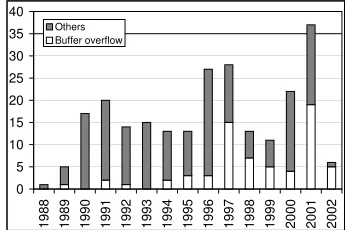
Figure 1 shows the number of security alerts reported by
CERT/CC [6]1 between 1988 and March, 2002 (statistics
[image:1.612.339.513.432.547.2]prior to 1999 from [18]). Attacks that exploit buffer over-flow vulnerabilities have accounted for approximately half of all the alerts after 1997. Among the six alerts during the first two months of 2002, five of them exploit buffer over-flows.
Figure 1. CERT Security Alerts by Years
Buffer overflow attack exploits vulnerabilities in pro-grams (most often unchecked buffer on the process run-time stack) to overwrite control information (i.e., function return address). By overflowing a stack-allocated buffer, the at-tacker can seize the control of the process and force it to execute arbitrary, malicious code. Although, various
soft-1The CERT Coordination Center was established after the Morris
ware solutions have been proposed to tackle the problem, buffer overflow attacks still dominate. This is mainly due to the following reasons: (1) thousands of legacy applica-tions are still being used and many of them are vulnerable to buffer overflow attacks; (2) many proposed software so-lution incur undesirable performance overheads and/or can-not protect from all attacks. As a result, users are reluctant to patch their software; (3) new software products, due to their inherent complexity and lack of thorough testing due to time-to-market pressure, can leave serious vulnerabilities concealed. This paper proposes two architectural solutions for run-time protection against buffer overflow attacks: (1) split control and data stack and (2) secure return address stack (SRAS).
Split Control and Data Stack: An important reason that
an overrun buffer can result in control being seized is that current systems use a unified stack for both control infor-mation (i.e., function return addresses) and data storage (buffers). We propose to split the unified stack into a con-trol stack for return addresses and data stack for locally-allocated data items such as temporary buffers. This scheme can be implemented either in software or in hardware. We implemented the software approach by modifying the GNU
C Compiler, gcc [12]. Results show that the proposed
approach is effective in protecting real applications with slight performance overhead (e.g., 2% for ftp server). By changing the semantics of function call/return instructions, hardware-based split stack implementation eliminates the overhead of the software-based implementation.
Secure Return Address Stack (SRAS) is hardware-based
solution for detecting buffer overflow attacks. It uses the redundant copy of the return address maintained by the pro-cessor’s fetch mechanism to validate return addresses and thereby detect malicious tampering. The operation of SRAS is similar to the Return Address Stack (RAS) implemented in most modern processors (e.g., Pentium and SPARC). Three different variants of SRAS, speculative SRAS, non-speculative SRAS, and non-non-speculative SRAS with over-flow handling are evaluated using SimpleScalar simulator [5]. Performance evaluation shows that with SRAS of 64 entries, the performance degradation of the non-speculative SRAS with overflow handling is between 0% and 0.02%.
2. Buffer Overflow Exploit
Buffer overflow is the result of writing more data into a buffer than the buffer can hold. This happens when a vul-nerable program receives external input, and stores the input to a buffer without checking the buffer’s boundary. In order for a buffer overflow attack to succeed, it needs to achieve the following two goals (1) Inject the attack code and (2) force the process to execute the injected code. If either goal fails, the attack fails. The most dominant form of buffer
overflow exploitation is stack smashing attack. We explain how this kind of attack works using a synthetic example adapted from [1].
Figure 2 shows the C source code of the simple syn-thetic example. The attack program first prepares the
in-put in large string, and then copies the content of
it to the buffer on the stack. Note that buffer has
only 96 bytes of space while large string has 128
bytes. Functionstrcpy()blindly copies everything from
large string to buffer without boundary check-ing, hence an overflow situation occurs. The content of
large stringhas been carefully crafted to both inject the malicious code and change the return address on the stack to the start of the malicious code. The stack layout
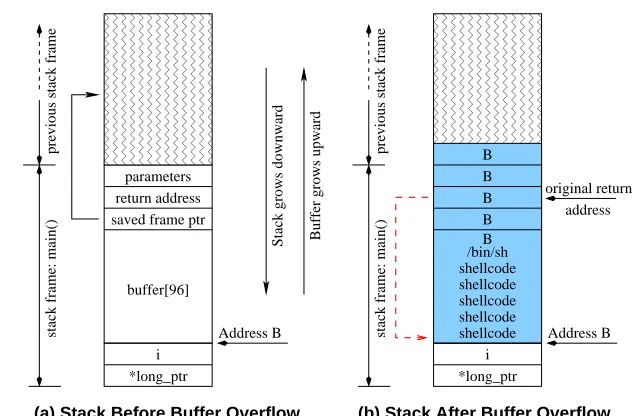
before and after strcpy() is shown in Figure 3. The
shaded area in Figure3(b) shows the content of the
over-run buffer after strcpy()which includesbufferand
the location of original return address. The first part of the
overrun buffer is filled using the code inshellcodeand
the second part is filled using the address ofbuffer, i.e., the starting address of the malicious shellcode on the stack. The function return address on the stack is overwritten by
the address ofbuffer(B in Figure 3). Whenmain()
re-turns, it actually transfers control to address B and begins to execute the malicious code. The malicious code executes theexecvsystem call to start a shell/bin/sh.
In a real security attack, the malicious code normally comes from an environment variable, user input, or from a network connection. A successful attack on a privileged process such as a set uid program or a daemon process run-ning as root would give the attacker an interactive root shell. Such an attack is often based on reverse-engineering the tar-get program. Using techniques from [1], an attack method can be relatively easily engineered.
3. The Split Control and Data Stack Approach
A fundamental reason that the stack buffer overflow is possible is that current systems use a unified stack for both control flow (function return addresses) and local data (tem-porary buffers, variables and function arguments) as shown Figure 4(a). When a function receives external data, and transfers that data to a stack-allocated buffer without check-ing the buffer’s boundary, both the buffer and the return ad-dress (adjacent to it on the stack) can be overwritten. We propose to split the unified stack into: (1) a control stack used to store function return addresses only, and (2) a data
stack to store temporary data and function arguments
char shellcode [ ] =
”xebx1fx5ex89x76x08x31xc0”
”x88x46x07x89x46x0cxb0x0b”
”x89xf3x8dx4ex08x8dx56x0c”
”xcdx80x31xdbx89xd8x40xcd”
”x80xe8xdcxffxffxff / bin / sh” ; char l a r g e s t r i n g [128];
void main ( ) char buffer [ 9 6 ] ; int i ;
long long ptr ;
long ptr =(long ) l a r g e s t r i n g ; for ( i = 0 ; i 32; i ++)
( long ptr + i ) = ( int ) buffer ; for ( i =0; is t r l e n ( shellcode ) ; i ++)
l a r g e s t r i n g [ i ] = shellcode [ i ] ; strcpy ( buffer , l a r g e s t r i n g ) ;
[image:3.612.237.555.74.282.2]
Figure 2. Example Source Code
0000000000000 0000000000000 0000000000000 0000000000000 0000000000000 0000000000000 0000000000000 0000000000000 0000000000000
1111111111111 1111111111111 1111111111111 1111111111111 1111111111111 1111111111111 1111111111111 1111111111111 1111111111111
000000000 111111111 parameters
return address
saved frame ptr
*long_ptr i buffer[96]
Address B
Stack grows downward Buffer grows upward
original return address
0000000000000 0000000000000 0000000000000 0000000000000 0000000000000 0000000000000 0000000000000 0000000000000 0000000000000
1111111111111 1111111111111 1111111111111 1111111111111 1111111111111 1111111111111 1111111111111 1111111111111 1111111111111
000000000 111111111 B
B
*long_ptr i
Address B shellcode
shellcode shellcode shellcode shellcode /bin/sh
B B B
previous stack frame
stack frame: main()
previous stack frame
stack frame: main()
(a) Stack Before Buffer Overflow (b) Stack After Buffer Overflow
Figure 3. Stack Layout for the Example
Linux on Intel IA-32 architecture, we first briefly describe the function calling convention on IA-32.
In the Intel IA-32 architecture [13], function call and
return are implemented using two instructions,calland
ret, respectively. When executing acallinstruction, the
processor pushes the function return address (the address of the instruction that immediately follows) onto the stack
location pointed to by the stack pointer register esp and
transfers control to the target function. When a ret
in-struction is executed, the processor pops off the current top
of the stack pointed to byespto the program counter and
transfers control to that address. When executingret, the processor assumes that the top of the stack holds the correct return address. The compiler uses the same stack pointer register to grow and shrink the stack space allocated for buffers, variables, and function arguments storage.
3.1
Compiler-based Split Stack Approach
The compiler-based split stack approach is illustrated in Figure 4(b). At the entry to each function, the return address saved on top of the data stack is also saved to on the top of the control stack. Before the function returns, the top of the control stack is restored to the top of the data stack. As a result, the return instruction that immediately follows uses the saved return address from the control stack instead of the one that has been on the data stack through the lifetime of the function invocation. As Figure 4(b) shows, there are two copies of the return address, one on the data stack that can be tampered by buffer overflow, and another on the control stack that is immune against such tampering. Since a return
instruction always uses the safe copy of the return address on the control stack, an overflow attack cannot seize the execution control of a process.
Our implementation of the compiler-based split stack re-quires modifying the GNU C Compiler, gcc [12], on Linux platform. The compiler allocates space for the control stack and manages the control stack pointer variablecsp. Saving the return address on the control stack is implemented in the prologue for each function. Function prologue is respon-sible for setting up the stack frame, initializing the frame pointer register (if used), saving registers, and allocating additional temporary storage. It is generated at the very beginning of each function. An added instruction copies the function return address from the top of the data stack
pointed to by stack pointer registerespto the top of the
control stack pointed to by the variablecspand increments
cspby one word. Restoration of the return address from
the control stack to the data stack is done in the epilogue of each function. Function epilogue code is responsible for restoring the saved registers and stack pointer to their orig-inal values and returning control to the caller. The extra instructions restore the function return address at the top of the control stack (pointed to bycsp) to current top of data stack (pointed to by stack pointeresp). The control stack
pointer is then decremented by one word. When theret
instruction is executed, it uses the return address saved on the control stack.
Effectiveness of the compiler-based split stack approach.
parameters
saved frame ptr return address B
parameters
saved frame ptr return address C
local variables 0000000000000 0000000000000 0000000000000 0000000000000 0000000000000 0000000000000 1111111111111 1111111111111 1111111111111 1111111111111 1111111111111 1111111111111 parameters
saved frame ptr return address A
local variables
local variables
parameters
saved frame ptr return address B
parameters
saved frame ptr return address C
local variables 0000000000000 0000000000000 0000000000000 1111111111111 1111111111111 1111111111111
return address B return address A
return address C
esp esp
local variables saved frame ptr
parameters saved frame ptr
local variables parameters 0000000000000 0000000000000 0000000000000 0000000000000 0000000000000 0000000000000 1111111111111 1111111111111 1111111111111 1111111111111 1111111111111 1111111111111 parameters esp saved frame ptr
local variables 00000000000000 00000000000000 00000000000000 11111111111111 11111111111111 11111111111111
return address B return address A
return address C csp 00000000000000 00000000000000 00000000000000 00000000000000 00000000000000 00000000000000 11111111111111 11111111111111 11111111111111 11111111111111 11111111111111 11111111111111
Stack grows downward
parameters
saved frame ptr return address A
local variables local variables csp Control Stack Data Stack Control Stack Data Stack prev. frames func_A() func_B() func_C()
(a) Unified Stack
func_C()
func_B()
func_A()
prev. frames
(c) Architecture Supported Split Stack
prev. frames
func_A()
func_B()
func_C()
[image:4.612.105.481.57.252.2](b) Compiler-based Split Stack
Figure 4. The Split Stack Scheme
in their distribution package [2]. The distribution includes 5 synthetic exploits, which construct different malicious in-put, and one real attack, the xlockmore attack, which locks an X Window display. The xlockmore exploits a bug in the X window display lock program that usually runs setuid as
root. Without any protection, these exploits result in a
inter-active shell being forked due to the malicious code. After compiled using the modified version of the compiler, exe-cution of these exploits resulted in the program terminating abnormally, preventing the intruder from compromising the system.
Benchmark Base Time Split Stack Overhead(%)
164.gzip 355.7 384.6 8.14%
175.vpr 594.1 615.5 3.61%
176.gcc 335.9 347.8 3.52%
181.mcf 708.2 708.3 0.01%
186.crafty 407.6 466.2 14.38%
197.parser 487.8 515.6 5.69%
254.gap 241.9 278.7 15.20%
255.vortex 505.4 625.5 23.77%
256.bzip2 496.3 532.6 7.32%
300.twolf 1125.6 1154.8 2.59%
ftpd (1KB) 0.117 0.123 5.43%
ftpd (1MB) 0.127 0.130 2.38%
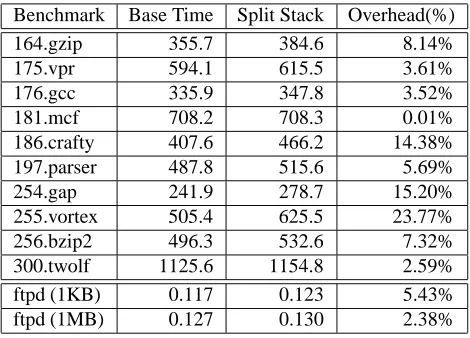
Table 1. Runtime Overhead for Compiler-based Split Control and Data Stack (All time in seconds)
Performance of the compiler-based split stack approach.
The performance overhead of the compiler-based split stack approach is evaluated by running the SPECINT 2000
benchmark programs 2with the reference input set and the
FTP server, wu-ftp-2.6.0 [20]. The results are shown in Ta-ble 1. The Base Time column provides execution time for the applications compiled using the original gcc. The fig-ures in the Split Stack column are obtained while running the benchmark programs compiled using the modified com-piler. The overhead of the integer benchmarks ranges be-tween 0.01% and 23%. Performance of the FTP serever is obtained by measuring the end to end delay as seen by a FTP client. The client logs onto the server and transfers 1KB or 1MB file. The overhead for the FTP server with 1KB file transfer is about 5% and for 1MB file transfer is 2%. In the case of larger file transfer, more time is spent on I/O which hides the overhead due to the split stack imple-mentation.
The measured overhead is due to the extra memory ac-cesses for saving and restoring of return addresses. Saving of an address includes two memory reads and two memory writes, i.e., read the address from data stack, write it to the control stack, read and write of control stack pointercsp. Similarly, restoring an address also requires four memory accesses. For each function invocation, eight extra memory accesses are required which might cause observable over-head. For server applications that are the primary targets for most attacks, the overhead shall be insignificant as in the case of FTP server.
In the next section, we show that with appropriate sup-port from the processor, the overhead introduced by the compiler-based approach can be eliminated.
2The SPECINT 2000 benchmarks are a suite of integer applications
[image:4.612.51.286.433.602.2]3.2
Split stack with architectural support
The extra overhead introduced by the compiler-based ap-proach can be eliminated by modifying the semantics of the function call and return instructions on IA-32. We explore
changing the semantics of thecallandretinstructions
to eliminate the extra memory accesses due to saving and restoring of the return addresses. The new semantics of
the two instructions are as follows: (1) for the call
in-struction, the processor pushes the function return address onto the control stack pointed to by the newly added control
stack pointer register csp (instead ofesp) and transfers
control to the target function, and (2)for theret instruc-tion, the processor pops off the current top of the control stack (pointed to by the control stack pointercsp) to the program counter and tranfers control to that address. The
extra register,cspis needed to manage the control stack
and to eliminate extra memory accesses due to the read and
write operations for adjusting the memory variable csp.
The semantics of instructions that manipulate the stack such
aspushandpopremain unchanged. In this new scheme,
the function call and return instruction only manipulate the control stack and do not interfere with the operation of the normal data stack. In case of buffer overflow, the attacker can potentially overwrite the data stack, while return ad-dresses stored in the control stack are protected from being maliciously changed. The scheme is illustrated in Figure 4(c). The difference between the compiler-based approach shown in Figure 4(b) and the architecture-based approach is that the latter preserves only a single copy of the return address stored on the control stack and hence is more space efficient.
Employing the proposed calling semantics, the run-time system (in particular, the program loader) needs to allocate control stack space for a process. The location of the control stack shall be far away from the data stack. Since buffers grow to higher address, the optimal control stack location is below the area for the data stack, so a buffer overflow can never reach the control stack.
3.3. Discussion
The advantage of the compiler-based approach is that it does not require changes in the processor, the disadvantage is the introduced runtime overhead. The architectural ap-proach does not incur performance overhead and is trans-parent to application programs, however, it requires chang-ing the instruction set semantic and addchang-ing a new register into the processor. Next, we discuss several system imple-mentation issues that are not addressed in our current solu-tion.
Control Stack Size. The amount of space required by
the control stack depends on the number of nested function
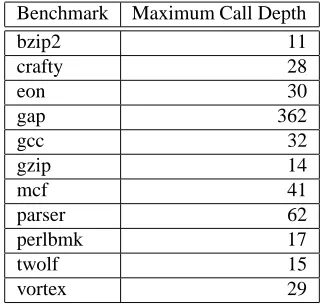
calls in an application. Table 2 shows the maximum func-tion call depth for SPECINT 2000. Most applicafunc-tions have very limited call depth (less than 32). A control stack with one memory page (the granularity of kernel page allocation) shall suffice for almost all practical applications.
Benchmark Maximum Call Depth
bzip2 11
crafty 28
eon 30
gap 362
gcc 32
gzip 14
mcf 41
parser 62
perlbmk 17
twolf 15
[image:5.612.346.507.129.282.2]vortex 29
Table 2. Maximum Function Call Depth
Handling Multi-threading and Longjmp. For multi-threaded applications, each thread needs to have its
own control stack. Thread creation APIs such as
pthread create() can be changed to automatically and
trans-parently allocate the required space for the application pro-grams. Setjmp and longjmp are used in some applications for returning directly from multiple levels of nested func-tions calls. Adding an extra field in the jmp buf structure 3 to save and later restore the control stack pointer solves the problem.
It should be noted that StackShield [4] implements the similar idea as our split stack approach. By changing the assembler, StackShield provides similar support for stack buffer protection. We distinguish our work with Stack-Shield in the following respects: (1) our implementation changes the compiler while StackShield changes the assem-bler; directly modifying the compiler, the optimizer can more efficiently optimize the application code (including the code for the split stack operation); (2) the proposed ar-chitectural support for implementing the split stack elimi-nates the overhead of software solution overhead and does not require access to the source code.
4. Secure Return Address Stack (SRAS)
In this section, we propose the Secure Return Address Stack (SRAS). In the split stack approach discussed in the previous section, return addresses are stored in the control stack in memory to prevent them from being changed. In contrast to the split stack approach, SRAS does not try to
3The C structure jmp buf is used by setjmp and longjmp to record and
prevent overwriting a return address stored on the stack, it instead detects an attack after the return address is mali-ciously changed but before the attack can have any negative impact.
The operation of the SRAS approach is similar to Return Address Stack (RAS) [17] implemented in modern proces-sors. RAS is usually implemented at the instruction fetch stage of processor pipeline to maximize effective instruc-tion fetch bandwidth. RAS can accurately predict the target address for a return instructions. When a function call in-struction is fetched, the return address is pushed onto the RAS. When the return instruction is fetched, the top of the RAS is popped off and is used as the fetch address for the next instruction fetch cycle. RAS can usually achieve very high prediction accuracy (greater than 99%) [17]. Observe that the RAS contains a redundant hardware copy of the return address on the process’s stack in memory and is im-mune from stack overflow. This redundant copy of the re-turn address can be used to detect situations when the rere-turn address has been tampered with. In normal operations, RAS mis-predictions are due to speculative update of the stack and overflows due to limited RAS size. A buffer overflow attack can also contribute to a RAS mis-prediction because it changes the correct return address on the stack.
Three alternative RAS extensions are proposed and eval-uated for detecting buffer overflow attacks: (1)
Specula-tive SRAS that extends the existing RAS and raises
ex-ceptions whenever mismatch/mis-prediction occurs; (2)
Non-speculative SRAS that operates as new RAS at the
commit stage of processor pipeline and eliminates RAS mis-prediction due to speculative RAS update; (3)
Non-speculative SRAS with overflow handling that handles
over-flow in the Non-speculative SRAS. While hardware com-plexity and cost increase, the performance overhead is re-duced going from alternative one to three. This section presents the three approaches and provides evaluation re-sults from implementation in the SimpleScalar [5] proces-sor simulator.
4.1
Speculative and Non-speculative SRAS
The mis-prediction handling mechanism of the existing Return Address Stack (RAS) can be extended for buffer
overflow attack detection. In the proposed speculative
SRAS approach, any time a RAS mis-prediction occurs, an exception is raised so that the operating system can han-dle such a mismatch and determine whether the exception is due to mis-prediction or buffer overflow. The excep-tion handler can use a table of all valid return points or the stack trace of the current process to make this decision. If a buffer overflow has occurred, the handler will not be able to trace back to previous stack frame. Such a handler will incur large overhead since it needs to go through a
se-ries indirect memory references to trace the process stack. Currently, a penalty of 500 cycles4is associated with each mis-prediction exception. The performance overhead of this scheme is evaluated in the simulator. For RAS size of 64, except for bzip2 and gzip, most of the applications ex-perienced significant performance degradation, exceeding 100% for some applications. The main reason for the high overhead is the speculative update of the RAS at the fetch stage. The higher the RAS prediction rate, the lower the overhead.
To improve the performance of RAS-based detection, the speculative nature of the RAS at the fetch stage needs to be changed. A non-speculative SRAS is implemented in our simulator at the instruction commit stage, where we can more accurately establish the function call/return se-quence without concern about the effect of speculatively ex-ecuted instruction. Incorrect mismatches (mismatches that are not due to an attack) in this scheme can occur due to RAS overflow—such mismatches unnecessarily trigger the exception code. Simulation results with a SRAS size of 64 entries show that all but gap have no or less than 0.001% overhead. Benchmark gap still has around 4% overhead be-cause its maximum call depth is larger than 64.
4.2
Non-speculative SRAS with Overflow
Han-dling
We further improve the SRAS performance based on the
Non-speculative SRAS from the previous subsection.
Mis-matches in the previous schemes are due to SRAS overflow. A perfect SRAS can be achieved by handling the overflow situation. Any mismatch with a perfect SRAS is a definitive signal of a buffer overflow attack.
A perfect SRAS is achieved by eliminating the two sources of false positives: (1) speculative update due to branch mis-prediction and (2) overflow due to too many lev-els of nested function calls. To eliminate pollution of the SRAS due to speculative update, the SRAS is implemented in the commit stage of the processor pipeline instead of the fetch/decode stage — this is our non-speculative version of the SRAS. To eliminate SRAS overflows, we save part of its content to an corresponding data structure in memory al-located for each process. The freed space in SRAS can be used for deeper levels of nested calls. Subsequently, when these nested function call return, SRAS might underflow. At that time, the content from the memory data structure are reloaded into the SRAS. Saving and reloading of the SRAS can be implemented either as an operating system excep-tion handler or as an processor special unit much like the
4Let’s assume the average call depth of a process is 25 levels, which is
TLB (Translate Look-aside Buffer) miss handling by MMU (memory management unit). Finally, to preserve the content of SRAS across process context switch, its contents needs to be saved/restored at context switch time.
Performance overhead of SRAS is mainly due to over-flow and underover-flow handling. In the current simulation, any time SRAS overflows, half of its content is transferred to the
in-memory data structure. A fixed number, of penalty
cy-cles is associated with each return address transfer. Letbe
the size of SRAS, andbe the penalty associated with each
SRAS overflow/underflow. then. In the
simula-tion conducted, the fixed numberis set to be the memory
access latency (the default value in the SimpleScalar sim-ulator is 18 cycles). This formula of penalty calculation is pessimistic in associatingcycles of with every transfer of
thereturn addresses from/to the SRAS. In practice, only
part of them experience thecycles of latency while the
[image:7.612.74.264.355.485.2]others can be transferred in the bulk mode. The formula is optimistic on the other hand in that the overflow/underflow handling requires some additional processing to locate the in-memory data structure and to adjust pointers. Taking these two factors, we believe that the formula above shall be a reasonable estimate of the overall penalty for an excep-tion.
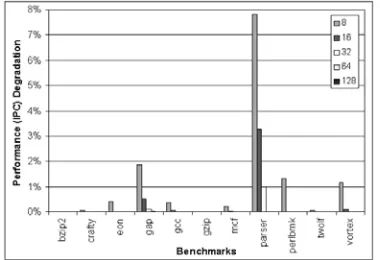
Figure 5. Performance Degradation of Non-speculative SRAS with Overflow Handling
Performance degradation of the SRAS is evaluated for SPECINT 2000 benchmarks. Figure 5 shows the perfor-mance (IPC, instructions per cycle) degradation due to the operation of the SRAS for various SRAS sizes. Most bench-mark programs exhibit a small amount of runtime overhead when SRAS size is much smaller than their maximum call depth. Only gap and parser exhibit overhead when SRAS is 32 since their maximum call depth is 362 and 62. After SRAS reaches 64, only gap shows slight overhead (0.02%, 0.005% and 0.0006% for SRAS size of 64, 128 and 256 respectively). Its overhead disappears when SRAS has 512 entries. We believe that a SRAS size of 32 or 64 entries shall
incur minimal performance overhead for most applications.
4.3
Discussion
As with the split stack approach, there are certain system implementation issues that affect the SRAS. Most notice-ably, for each context switch, the operating system kernel needs to save the content of the SRAS to the thread/process control block and to restore its content when execution is re-sumed. The overhead due to context switch is not measured in our current implementation. With some clever tricks, it is possible not to save or restore the entire stack. For ex-ample, with a SRAS size of 32, an application might only use 10 of the entries. It is clear that only the first 10 entries needs to be save and restored. We can keep improving this because the application might stays at the depth between 7 and 10 most of the time, in this case, only these four entries needs to be restored when resuming execution. A second issue is also with setjmp and longjmp. This can be solved by a special instruction to rewind the SRAS to an specified level.
5. Related Work
Since the Morris Internet Worm of 1988 [10], a signif-icant amount of research effort has been dedicated to pre-venting and detecting buffer overflow attacks. Proposed so-lutions can be divided into two broad categories: (1) static program analysis for buffer overflow avoidance and (2) time buffer overflow detection. Our work falls into the run-time detection category. It is different from previous solu-tions in that it is based on architectural support for detection instead of pure software techniques. We discuss the related research in this section and compare our work when appro-priate.
Static Analysis Several commonly used tools, such as
Lint [14], and those proposed in [11] use compile-time anal-ysis to detect common programming errors. Existing com-pilers such as gcc have also been augmented to perform bounds-checking. Wagner et al. [18] used compile-time range analysis that formulate buffers as a pair of integer, the allocated size and number of bytes currently in use. The project specifically focuses on the set of unsafe library func-tions and checks for each string buffer whether its inferred allocated size is at least as large as its inferred number of bytes currently in use. Larochelle et al. [15] proposed to use special comments (annotations) in program source code as a heuristic to infer and detect vulnerabilities in C programs. All these methods produce undesirable false positives and false negatives and require access to source code.
compilers. StackGuard [8] place a canary (a random num-ber) on the stack at function entry and check it when func-tion returns to detect overflow. It bases on the assumpfunc-tion that tampering of the canary implies tampering of return ad-dress. StackShield [4] modifies the assembler to implement the similar idea as our split stack approach. We have dis-cussed the difference between our work and StackShield in Section 3.3.
Operating System Kernel Patches. By changing part
of the operating system kernel, it is possible to prevent
or detect certain types of buffer overflow attacks. The
Non-executable Stack Linux Patch [16] prevents execution of malicious code on the stack by making the stack non-executable. This approach is transparent to application pro-grams and offers zero performance overhead. However, the
return-into-libc [19] attack completely defeats this scheme
by overwriting the return address and transfers execution control to the heap or shared libraries.
C Library Patches. Since many buffer overflow
vul-nerabilities are caused by unsafe C library functions such as gets and strcpy, this class of solutions patch the stan-dard C library for detections. Libsafe [3] intercepts function calls to shared C Library and conducts frame-pointer based boundary checking. These approaches can fail in two cases: (1) if a program chooses not to enable frame pointer at com-pile time (many programs do so for performance optimiza-tion) and (2) if the buffer overflow vulnerability is caused by application internal function calls.
6
Conclusion
This paper proposes and evaluates two approaches (the split stack and SRAS) for detecting stack buffer overflow
attacks. The split stack approach separates control and
data stack to prevent the function return address from be-ing overwritten. It is implemented and evaluated by chang-ing the GNU C compiler gcc. The compiler implementa-tion showed slight performance overhead (e.g., 2% for ftp server). We also showed that the technique can be imple-mented with architectural supported that incurs no overhead and does not require source code access. The SRAS ap-proach uses a redundant copy of return addresses inside the processor and detects an attack when a return instruction is being retired. Simulation results show that a maximum overhead of 0.02% with a SRAS size of 64 entries. Fu-ture work will address design implications of integrating the proposed solutions with actual processors. We also plan to further enhance the proposed techniques to handle a larger class of attacks, such as heap buffer overflow.
References
[1] Aleph One. Smashing The Stack For Fun And Profit. Phrack
Magazine, 49(7), Nov. 1996.
[2] Avaya Labs Research. Libsafe: Pro-tecting Critical Elements of Stacks.
http://www.research.avayalabs.com/project/libsafe/,
Feb. 2002.
[3] A. Baratloo, T. Tsai, and N. Singh. Transparent Run-Time Defense Against Stack Smashing Attacks. In Proceedings.
of the USENIX Annual Technical Conference, June 2000.
[4] Bulba and Kil3r. Bypassing StackGuard and StackShield.
Phrack Magazine, 56(5), May 2000.
[5] D. Burger, T. M. Austin, and S. Bennett. Evaluating Fu-ture Microprocessor: the SimpleScalar Tool Set. Technical Report TR-1308, Dept. of Computer Science, University of Wisconsin-Madison, July 1996.
[6] CERT/CC. CERT Advisories.
http://www.cert.org/advisories/.
[7] CERT/CC. CERT Advisory CA-2001-19 Code Red Worm Exploiting Buffer Overflow In IIS Indexing Service DLL. http://www.cert.org/advisories/CA-2001-19.html,
July 2001.
[8] C. Cowan, C. Pu, D. Maier, H. Hinton, P. Bakke, S. Beattie, A. Grier, P. Wagle, and Q. Zhang. StackGuard: Automatic Adaptive Detection and Prevention of Buffer-Overflow At-tacks. In Proceedings of the 7th USENIX Security
Confer-ence, 1998.
[9] eEye Digital Security. UPNP - Multiple Re-mote Windows XP/ME/98 Vulnerabilities.
http://www.eeye.com/html/Research/Advisories/AD20011220.html,
Dec. 2001.
[10] M. W. Eichin and J. A. Rochlis. With Microscope and Tweezers: An Analysis of the Internet Virus of November 1988. In Proceedings. of IEEE Computer Society
Sympo-sium on Security and Privacy (SSP ’89), pages 326–343,
1989.
[11] D. Evans. Static Detection of Dynamic Memory Errors. In Proc. ACM SIGPLAN Conference on Programming
Lan-guage Design and Implementation, 1996.
[12] Free Software Foundation. The GNU C Compiler.
http://gcc.gnu.org/.
[13] Intel Corporation. Intel Architecture Software Developer’s
Manual, volume 2, Instruction Set Reference, 1999.
[14] S. C. Johnson. Lint, a C Program Checker. Bell Laboratories
Computer Science Technical Report 65, Dec. 1977.
[15] D. Larochelle and D. Evans. Statically detecting likely buffer overflow vulnerabilities. In Proc. 10th USENIX
Se-curity Symposium, Aug. 2001.
[16] OpenWall Project. Linux Kernel Patch from the Openwall Project. http://www.openwall.com/linux/.
[17] K. Skadron, P. S. Ahuja, M. Martonosi, and D. W. Clark. Improving prediction for procedure returns with return-address-stack repair mechanisms. In International
Sympo-sium on Microarchitecture, pages 259–271, 1998.
[18] D. Wagner, J. S. Foster, E. A. Brewer, and A. Aiken. A First Step Towards Automated Detection of Buffer Overrun Vul-nerabilities. In Proceedings of 7th Network and Distributed
System Security Symposium, Feb. 2000.
[19] R. Wojtczuk. Defeating Solar Designer Non-executable Stack Patch. http://www.insecure.org/sploits/non-executable.stack.problems.html, Jan. 1998.
[20] WU-FTPD Development Group. WU-FTPD.