S E C O N D E D I T I O N
S E C O N D E D I T I O N
Advances
in
Fingerprint
Technology
Advances
in
CRC SERIES IN FORENSIC AND POLICE SCIENCE
BARRY A. J. FISHER,
Series Editor
L.A. County Sheriff’s Department
TECHNIQUES OF CRIME SCENE INVESTIGATION Sixth Edition
Barry A. J. Fisher
SCIENTIFIC EXAMINATION OF QUESTIONED DOCUMENTS Revised Edition
Ordway Hilton
ADVANCES IN FINGERPRINT TECHNOLOGY Second Edition
Henry C. Lee R. E. Gaensslen
INSTRUMENTAL DATA FOR DRUG ANALYSIS Second Edition, Volumes 1–4
Terry Mills, III J. Conrad Roberson
INSTRUMENTAL DATA FOR DRUG ANALYSIS Second Edition, Volume 5
Terry Mills, III J. Conrad Roberson H. Horton McCurdy
William H. Wall
INSTRUMENTAL DATA FOR DRUG ANALYSIS Second Edition, Volumes 6-7
Terry Mills, III J. Conrad Roberson
William H. Wall Kevin L. Lothridge William D. McDougall
Boca Raton London New York Washington, D.C. CRC Press
E D I T E D B Y
S E C O N D E D I T I O N
S E C O N D E D I T I O N
Henry C. Lee and R. E. Gaensslen
Advances
in
Fingerprint
Technology
Advances
in
Fingerprint
This book contains information obtained from authentic and highly regarded sources. Reprinted material is quoted with permission, and sources are indicated. A wide variety of references are listed. Reasonable efforts have been made to publish reliable data and information, but the author and the publisher cannot assume responsibility for the validity of all materials or for the consequences of their use.
Neither this book nor any part may be reproduced or transmitted in any form or by any means, electronic or mechanical, including photocopying, microfilming, and recording, or by any information storage or retrieval system, without prior permission in writing from the publisher.
All rights reserved. Authorization to photocopy items for internal or personal use, or the personal or internal use of specific clients, may be granted by CRC Press LLC, provided that $1.50 per page photocopied is paid directly to Copyright Clearance Center, 222 Rosewood Drive, Danvers, MA 01923 USA. The fee code for users of the Transactional Reporting Service is ISBN 0-8493-0923-9/01/$0.00+$1.50. The fee is subject to change without notice. For organizations that have been granted a photocopy license by the CCC, a separate system of payment has been arranged.
The consent of CRC Press LLC does not extend to copying for general distribution, for promotion, for creating new works, or for resale. Specific permission must be obtained in writing from CRC Press LLC for such copying.
Direct all inquiries to CRC Press LLC, 2000 N.W. Corporate Blvd., Boca Raton, Florida 33431.
Trademark Notice: Product or corporate names may be trademarks or registered trademarks, and are used only for identification and explanation, without intent to infringe.
Visit the CRC Press Web site at www.crcpress.com
© 2001 by CRC Press LLC No claim to original U.S. Government works International Standard Book Number 0-8493-0923-9
Library of Congress Card Number 2001025816 Printed in the United States of America 1 2 3 4 5 6 7 8 9 0
Printed on acid-free paper
Library of Congress Cataloging-in-Publication Data
Advances in fingerprint technology / edited by Henry C. Lee, R.E. Gaensslen.--2nd ed. p. cm -- (CRC series in forensic and police science)
Includes bibliographical references and index. ISBN 0-8493-0923-9 (alk. paper)
1. Fingerprints. 2. Fingerprints--Data processing. I. Lee, Henry C. II. Gaensslen, R. E. (Robert E.) III. Series.
HV6074 .A43 2001 363.25'8--dc21
2001025816
Preface
The first edition of this book was published as a volume in the Elsevier Series in Forensic and Police Science. Elsevier’s book business has since been acquired by CRC Press LLC and CRC has supported and extended their forensic science program. We thank CRC for the opportunity to revise
Advances in Fingerprint Technology to this second edition.
Fingerprints is an area in which there have been many new and exciting developments in the past two decades or so, although advances in DNA typing have tended to dominate both the forensic science literature and popular information about advances in forensic sciences. Particularly in the realm of methods for developing latent prints, but also in the growth of imaging and AFIS technologies, fingerprint science has seen extraordinary breakthroughs because creative applications of principles derived from phys-ics and organic chemistry have been applied to it.
Fingerprints constitute one of the most important categories of physical evidence. They are among the few that can be truly individualized. Fingerprint individuality is widely accepted by scientists and the courts alike. Lately there have been some modest challenges to whether a firm scientific basis exists for fingerprint individuality, based on the U.S. Supreme Court’s 1993 Daubert v. Merrell Dow Pharmaceuticals, Inc. decision [113 S.Ct. 2786 (1993)] in which new standards for the admissibility of scientific evidence were articulated for the first time. The issues underlying these challenges are treated in Chapters 9 and 10. A perspective on the history and development of fingerprinting and the fundamentals of latent print identification are treated in Chapters 1 and 2, revised from the first edition. Latent fingerprint residue chemistry, on which every latent print detection technique is ultimately based, is covered in detail in a new Chapter 3. Chapter 4, the survey of latent print develop-ment methods and techniques, has been revised and updated. Chapter 5 on ninydrin analogues has been revised and updated. New chapters on physical developers (Chapter 7) and photoluminescent nanoparticles (Chapter 6) are added. AFIS system technology and fingerprint imaging are now widespread and may be considered mature. They are covered in a new Chapter 8.
The first edition of this volume was dedicated to the memory and lifetime work of Robert D. Olsen, Sr., who wrote the original Chapter 2, but passed away unexpectedly before the book could be published. That chapter has been revised and retained in this edition.
We want to thank all the contributors to this revised edition for their outstanding work and cooperation in bringing this work to completion. We also thank the staff at CRC, especially our acquisitions editor, Becky Mc Eldowney, for making the task comparatively painless. Again we thank our wives, Margaret and Jacqueline, for their continued love and patience with us and our work habits.
Acknowledgments
We gratefully acknowledge the assistance of Ms. Nancy Folk, Ms. Cheng Sheaw-Guey, Mr. Hsieh Sung-shan, and Mr. Kenneth Zercie in the prepara-tion of the original Chapter 3 of the first ediprepara-tion. We particularly thank Ms. Erin Gould, a M.S. graduate of the University of Illinois at Chicago forensic science program, for her significant help with revised Chapter 4 for this present edition. We also thank Robert Ramotowski of the U.S. Secret Service Forensic Services Division for helpful commentary on and additional infor-mation for the revised Chapter 4.
Contributors
Joseph Almog, Ph.D.
Casali Institute of Applied Chemistry Hebrew University of Jerusalem Jerusalem, Israel
John Berry, FFS, BEM
Fingerprint Examiner and Historian (Retired)
South Hatfield, Hertfordshire, England
Antonio Cantu, Ph.D.
Forensic Services Division U.S. Secret Service Washington, D.C. [email protected]
R. E. Gaensslen, Ph.D.
Forensic Science, College of Pharmacy University of Illinois at Chicago Chicago, Illinois
Robert J. Hazen
Spotsylvania, Virginia
Anil K. Jain, Ph.D.
Department of Computer Science and Engineering
Michigan State University East Lansing, Michigan [email protected]
James L. Johnson
Forensic Services Division U.S. Secret Service Washington, D.C.
Henry C. Lee, Ph.D.
Connecticut State Police Forensic Science Laboratory
Meriden, Connecticut
E. Roland Menzel, Ph.D.
Center for Forensic Studies Texas Tech University Lubbock, Texas
Sharath Pankanti
IBM T. J. Watson Research Center Hawthorne, New York
Clarence E. Phillips
Robert Ramotowski
Forensic Services Division U.S. Secret Service Washington, D.C.
David A. Stoney, Ph.D.
McCrone Research Institute Chicago, Illinois
and Clinical Professor Forensic Science University of Illinois at Chicago Chicago, Illinois
Table of Contents
Preface
Acknowledgments
The Editors
Contributors
1
History and Development
of Fingerprinting
John Berry and David A. Stoney
2
Identification of Latent Prints
Robert D. Olsen, Sr. and Henry C. Lee
3
Composition of Latent Print Residue
Robert S. Ramotowski
4
Methods of Latent Fingerprint Development
Henry C. Lee and R. E. Gaensslen
5
Fingerprint Development by Ninhydrin
and Its Analogues
Joseph Almog
6
Fingerprint Detection with
Photoluminescent Nanoparticles
E. Roland Menzel
7
Silver Physical Development
of Latent Prints
Antonio Cantu and James L. Johnson
8
Automated Fingerprint Identification
and Imaging Systems
Anil Jain and Sharath Pankanti
9
Measurement of Fingerprint Individuality
David A. Stoney
10
The Expert Fingerprint Witness
Robert J. Hazen and Clarence E. Phillips
History and Development
of Fingerprinting
JOHN BERRY
DAVID A. STONEY*
Contents
Introduction
Evolution and the Elliptical Whorl (1976) Neolithic Bricks (7000 B.C.)
Prehistoric Carvings (3000 B.C.) Mummies
Finger Imprints on Artifacts in Antiquity (circa 3000 B.C.) Grauballe Man (A.D. 400)
Philosophical Transactions (1684) De Externo Tactus Organo (1686) William of Orange (1690)
Thomas Bewick (1753–1828)
Concerning the External Physiological Examination of the Integumentary System (1823)
Fingerprint Classification
Dr. Ivan Vucetich (1858–1925) The Henry System
Sir Edward Henry and Sir William Herschel Dr. Henry Faulds (1843–1930)
Sir Francis Galton (1822–1911)
Early Fingerprint Usage in Other Countries Germany
Cuba Canada
Australia and New Zealand United States of America Developments to Date Reference
Addendum to the First Edition Update
Introduction
The fascinating story of the development and use of fingerprints in the last hundred years will only be properly appreciated if the reader is acquainted with some knowledge of dactyloscopy; therefore I will briefly outline the basic details of this science. The inside surfaces of the hands from fingertips to wrist and the bottom surfaces of the feet from the tip of the big toe to the rear of the heel contain minute ridges of skin, with furrows between each ridge. A cross section of a finger would look exactly like the cross section of a plowed field. Whereas on a plowed field the ridges and furrows run in straight parallel lines, on the hands and feet the ridges and furrows frequently curve and, especially on the fingertips and toe ends, the ridges and furrows form complicated patterns. The ridges have pores along their entire length that exude perspiration; hence, when an article is picked up, the perspiration runs along the ridges and leaves an exact impression of the ridges, just as an inked rubber stamp leaves its impression on a blank sheet of paper.
Ridges and furrows have evolved on the hands and feet to fulfill three specific functions:
1. Exudation of perspiration 2. Tactile facility
3. Provision of a gripping surface
[image:15.612.127.311.46.224.2]The ridges and furrows form seven basic characteristics, as shown in
Figure 1.1. Some authorities consider that only two types of characteristics
Figure 1.1 Ridge characteristics. (Drawn by John Berry.)
are present, a ridge ending and a bifurcation, all other characteristics being variations of the two basic forms. I consider that my illustration defines the most important varieties of ridge detail, also known as ridge characteristics. The ridges and furrows form patterns on the last joint of the fingers and toes, forming four basic types, as shown in Figure 1.2. There are variations of these patterns, especially with whorls, but these are the province of the fingerprint expert. Every person in the world shares these patterns — a person can have all of one type or even a mixture of all of them. The everyday use of fingers as an identification method and the production of finger and palm evidence in courts of law are based on one magnificent premise: no one has ever been found who has a sequence of ridge detail on the hands and feet that is identical to the ridge detail of any other person.
Evolution and the Elliptical Whorl (1976)
Before I researched the history of fingerprints in 1975, the earliest evidence of ridge detail on the hands and feet of humans was seen in the 4000-year-old mummies of ancient Egypt. The hands and feet of mummies have been examined on numerous occasions, and I can confirm the presence of ridge detail on the mummies’ digits. Before 1975, the only other evidence reported was the presence of a small portion of palm imprint on hardened mud found in Egypt on a paleolithic site at the Sebekian deposit, Kom Ombo plain, on the east bank of the river Nile, dated around 10,000 years ago. The fact that primates have ridge detail was announced for the first time, as far as I can discover, by Joannes Evangelista Purkinje in his thesis (discussed later) pub-lished on December 22, 1823. He wrote:
In the hands of the monkeys, as well as in their prehensile tails, similar lines occur, the distinction of which adds to the knowledge of the characteristics Figure 1.2 Basic fingerprint patterns.
of all species. Zoologists, unless they consider them unimportant, will add further details.
Purkinje illustrated a palm impression and a small portion of the prehensile tail of a spider monkey.
In 1975–1976, I and my colleagues in the Fingerprint Office in Hertford-shire, U.K. — Roger Ball, David Brooker, Nicholas Hall, Stephen Haylock, and Martin Leadbetter — commenced protracted research to confirm that all species of primates have ridge detail on their hands and feet in patterns
and toe ends that conform to human patterns (see Figure 1.2). We prepared
a list of over 180 species of primates from the tree shrews (family Tupaiidae) to the gorilla (family Pongidae) and prepared a roster whereby, in small groups, we visited zoos and private collections, examining and in many cases taking impressions of the hands and feet of primates. This research engen-dered publicity in the press and television; one sarcastic writer commented in a national newspaper that Stephen Haylock was fingerprinting monks.
Eventually, Leadbetter and I contacted Professor and Mrs. Napier, who have now retired to a Scottish island. Professor Napier was a professional writer and a world-renowned expert on the hand; his wife Prue was also a writer and worked in the British Natural History Museum on Cromwell Road, London. We discovered that her terms of reference covered a section of the museum denied to ordinary visitors where thousands of deceased primates, many of them stuffed with straw, were placed in wide receptacles in an air-conditioned hall. Mrs. Napier explained that a “rule” existed whereby when a primate died in England, the skin was sent to the museum. This “rule” has been in existence for many years. For example, Roger Ball and I used a fingerprint-lifting technique to obtain the entire length of ridge detail from the prehensile tail of a red howler monkey that had died in 1829. Figure 1.3
shows an enlarged section of the lift.
The museum authorities gave permission for Roger Ball, Stephen Hay-lock, Martin Leadbetter, and me to examine all the stuffed primates in the huge collection. Working in pairs and using our vacation days, we eventually examined the hand and foot surfaces of all the primates. In a few instances we lifted ridge details from the hands and feet of selected specimens. This was done by carefully smoothing several layers of acrylic paint over the surfaces and waiting for each layer to dry before peeling it off. When we returned to the Fingerprint Office in Hertfordshire, the acrylic lifts were dusted with aluminum powder and then lifted with transparent tape and placed on transparent Cobex, forming a negative duly processed in the Camtac machine, producing a positive impression, i.e., ridges were black and furrows and pores were white. After 18 months of research, we had become
the first researchers, as far as I can ascertain, to examine and record the hands, feet, and prehensile tails of every species of primate.
In a later section, I shall discuss the fingerprint pioneer Dr. Henry Faulds (pronounced “folds”) in some detail; but in the present context I believe it is enormously interesting to report that on February 15, 1880, Faulds wrote to evolutionist Charles Darwin requesting his aid in obtaining the finger impressions of lemurs, anthropoids, etc. “with a view to throw light on human ancestry.” On April 7, 1880, Darwin replied to Faulds:
Dear Sir,
The subject to which you refer in your letter of February 15th seems to me a curious one, which may turn out interesting, but I am sorry to say that I am most unfortunately situated for offering you any assistance. I live in the country, and from weak health seldom see anyone. I will, however, forward your letter to Mr. F. Galton, who is the man most likely that I can think of to take up the subject and make further enquiries.
[image:18.612.124.317.37.293.2]Wishing you success, I remain, dear Sir, Yours faithfully, Charles Darwin Figure 1.3 Portion of the prehensile tail of a red howler monkey (1829).
The “Mr. F. Galton” referred to in the letter from Darwin in due course became an authority on fingerprint matters in England and was part of an establishment clique that sought to revile Faulds (to be described later). However, note the amazing chain of events: … fingerprint pioneer Faulds … primates’ fingerprints … Charles Darwin … Mr. F. Galton (later Sir Francis Galton) … fingerprint pioneer!
During the summer of 1976, I was, as always, fully occupied in my work as a fingerprint expert in Hertfordshire, specializing in searching for the ownership of finger imprints found at crime scenes, known in the U.S. by the particularly apt expression “cold searching.” Many identifications are made as the direct result of suspects being named by investigating police officers, but it is thrilling for a fingerprint expert, even a grizzled veteran like myself working with fingerprints for 37 years, to delve into the unknown and give the police a named person for the crime they are investigating, a name completely fresh and unknown to them, which we refer to as being “out of the blue.” Some astute detectives, when given the name as the result of a successful search, attempt to give the impression that somehow “they had an idea” that the name supplied to them was at that time under serious review. Fingerprint experts do not like this because the identification might have been made after laboriously searching perhaps thousands of fingerprint forms.
So in 1976 my position was that I had been scanning hundreds, possibly thousands, of fingerprints every working day for almost 22 years and at the back of my mind was the ever-present thought that all primates have “human type” finger impressions — after all, we are all primates — and, prompted by the letter from Faulds to Darwin, some original thoughts occurred to me.
I had recently read Prue Napier’s book Monkeys and Apes, wherein she
illustrated every primate, describing the physical similarities and differences that occur in geographically separate areas, such as South America (only South American primates have ridge detail on their prehensile tail strip), Japan, Africa, Sumatra, Gibraltar, India, and Madagascar. I perused books on plate tectonics, averaging the estimated dates of the separation of Mada-gascar from the East African coast, and calculated that this occurred 50,000,000 years ago. Madagascan primates, I mused, differ physically from African primates, but they also bore ridge detail on their hands and feet. One fingerprint pattern that frequently occurs on primates in all geographical areas is the elliptical whorl (Figure 1.4), which is also found on human finger impressions. I must stress that arches, tents, loops, and whorls (see Figure 1.2) are also found on primates, but I “latched onto” the elliptical whorl as the basis for my sudden inspiration. Surely, if East African and Madagascan primates have elliptical whorls (among other patterns), only two theories could account for this phenomenon:
Theory 1: Before the distribution of certain land masses between 50,000,000 and 100,000,000 years ago, ridge detail was present on the hands and feet of our subprimate ancestors.
Theory 2:At some undetermined moment in time, perhaps allied with
the emergence of Homo sapiens, primates all over the world suddenly developed ridge detail on their hand and foot surfaces, all species having associated patterns.
I submit that Theory 2 does not even require the remotest consideration, unless one is prepared to put forward a subtheory of Divine Intervention; but even then, cynically, why would God suddenly decide to gratuitously hand out ridge detail? I forwarded details of Theory 1 to Professor Napier and to Professor Beigert, Zurich, Switzerland, for their consideration. I met with Professor Napier, who kindly presented copies of his relevant publications. In Monkeys Without Tails, Professor Napier considers that the develop-ment of tree climbers like Smilodectes required, among other physical devel-opments, “replacement of sharp claws by flattened nails associated with the development of sensitive pads on the tips of the digits.” He wrote to me:
[image:20.612.142.301.34.265.2]I am quite sure that fingerprints are as old as you suggest, particularly if the evolution of the monkeys is put back to the Eocene. The chances of evolving the “human” primate pattern are very high by means of the simple process of evolutionary convergence which your thesis strongly suggests … it is obviously a basic pattern of Nature.
Figure 1.4 Elliptical whorl.
For many years Professor Beigert has published numerous books con-cerning ridge detail on the hand and foot surfaces of selected primates. He also forwarded to me copies of his literature and wrote, making the following observations:
I agree with you that dermatoglyphics on palma and planta of primates have to be dated very early. In my opinion in the Paleocene, 50,000,000– 60,000,000 years ago.
In his book The Evaluation of the Skull, Hands and Feet for Primate
Taxonomy (1963), Professor Beigert writes:
Much less attention has been given to the fact that among the other sense organs, the touch receptors underwent a significantly higher development.
My thesis was published in Fingerprint Whorld (July 1976) and in my
esoteric annual publication Ridge Detail in Nature (1979); both publications were circulated to fingerprint bureaus, universities, and museums all over the world. No one has claimed prior publication of my theory regarding the fact that subprimates bore ridge detail before the separation of land masses. I therefore submit that ridge detail appeared on the hands and feet of our subprimate ancestors over 100,000,000 years ago (a new 1987 estimate for the separation of Madagascar from Africa is closer to 200,000,000 years) and that our subprimate ancestors developed ridge detail on their hands and feet to facilitate the evolutionary requirement for grip, tactile facility, and the exudation of perspiration.
Neolithic Bricks (7000 B.C.)
Dame Kathleen Kenyon carried out excavations in the ancient city of Jericho,
and in her book Archaeology of the Holy Land, referring to houses dated
between 7000 B.C. and 6000 B.C., she reported
The bricks of which the walls were constructed were made by hand (not in moulds, as is usual later), in shape rather like a flattened cigar, with the surface impressed with a herringbone pattern by pairs of prints of the brick-layer’s thumbs, thus giving a keying such as is provided by the hollow in modern bricks.
In Paphos — History and Archaeology by F. G. Maier and V. Karageorghis, dealing with excavations in Paphos, birthplace of Aphrodite, reference is made to the walls of the ancient city, eighth century B.C.
The bricks, carefully laid and accurately jointed, are of near uniform size and of dark brown clay. A distinctive bright red-clay mortar was used. Many bricks have impressed fingerprints on their lower side.
Prehistoric Carvings (3000 B.C.)
Recently I discovered details on two archaeological items that proved to my entire satisfaction that early humans were cognizant of patterns on their fingertips. However, before discussing them, I wish to report on the work of “a distinguished fingerprint authority,” a certain Mr. Stockis, who published a treatise in the early 1920s in which he attempted to justify his claims that persons who carved patterns on standing stones in dolmen on Goat Island, Brittany, France, were aware of ridge detail on their digits. The carvings he illustrated depicted symbolic arches, tents, loops, and whorls.
The so-called Stockis theory was investigated by the eminent fingerprint expert Professor Harold Cummins, from the U.S., who reported
If it be true that Neolithic men really noted fingerprint patterns, and with the attention to minute detail which is claimed, credit is due to them for a spontaneous interest and keenness in such observation hardly matched by the average man of the present day.
In his critique of the Stockis theory, Professor Cummins acknowledges that pottery making could have revealed ridge detail to Neolithic humans and accepts that the carvings are “highly suggestive” of fingerprints; he even concedes that this could have been associated with hand worship. However, he concludes that although ridge detail can be noted in the carvings, there are other features included that definitely do not refer to dermatoglyphics. He concluded that “sound evidence that the carved designs had their origin in fingerprints appears to be wanting.”
The first of my discoveries concerns a national monument at New Grange, Republic of Ireland (Eire), that I wrote about in the 1984 edition of
Ridge Detail in Nature:
The national monument at New Grange dates from around 3,000 B.C. and features a huge man-made mound with a narrow passage leading to an inner burial chamber. An opening is located above the entrance so that for just a few moments at dawn on 21st December each year the rays of the rising sun penetrate along the passage to illuminate the burial chamber. A postage stamp issued on 4th May 1983 depicts patterns at the monument incised in stone. I note that the four basic fingerprint patterns are shown, together with numerous deltas. Is it mere coincidence that these patterns
are found on the design, or was the interest of a pre-Celtic artist kindled by a perusal of his fingerprint patterns?
In Ridge Detail in Nature (1986) I illustrated and described for the first time in a ridge detail context a carving on a standing stone on Goat Island (Figure 1.5). I wrote:
[image:23.612.113.326.43.401.2]Megalithic tombs and architectural monuments were built in Western Europe around 4,000 years ago, and the richest carvings are found in Brit-tany, north western France. It is thought that inspiration for the remarkably decorated tombs came from Spain and Southern France. A dozen charac-teristic symbols on the tombs represented important items in the lives of Figure 1.5 Standing stone, Goat Island. (Redrawn by John Berry, from The Mega-lithic Builders of Western Europe, Glyn Daniel, 1963.)
the megalithic builders, including axeheads, horns, yokes, the sun, etc. This photograph of carvings from Gavrinnis is covered with symbolic represen-tations, and the seemingly superimposed shape at the bottom of the carving shows a tent pattern. Ridge detail is scarce, but pores are quite clear on the ridges, being especially noticeable on the ridges draped over the central spine. I have no doubt that this particular carver was aware of patterns on finger tips, possibly superimposing one of his own patterns, as clear and precise as any of English wood-carver Thomas Bewick’s fingerprint repre-sentations. (Bewick is discussed later.)
I do accept there is the slight possibility that the New Grange designs could be coincidental, although I do believe that the artist was conversant with patterns plainly visible on the ends of his fingers or the fingers of his associates; but I certainly do not have any doubts whatsoever that the person who carved the tent pattern (see Figure 1.5) was aware of fingerprint patterns. This megalithic monument, carved in France at about the same time as the pyramids were being built, convinces me that the artisan knew of this pattern, and possibly, to accord individuality to one of his designs, he incorporated one of his digit patterns, perhaps carved from a mud impression purposely made. The tent pattern is “squared-off ” at the base. The sweat pores are pronounced, equally spaced on the ridges; I regard this as being a most significant pointer. This carving of a tent pattern was not a coincidence: it was carved from direct observation. I unhesitatingly align myself with, and fully support, the Stockis theory.
Mummies
As I have stated, the examination and recording of ridge detail on the hands and feet of mummies has been reported. I have visited museums in several countries, always specifically seeking out the Egyptian sections, and although many of the mummies were wrapped, I have been able to scrutinize ridge detail on the hands and feet of embalmed bodies on display and confirm the presence of fingerprint patterns similar to those shown in Figure 1.2.
In 1977, the mummy Asru, from the Temple of Karnak, was fingerprinted by experts in Manchester under the direction of Detective Chief Inspector Thomas Fletcher, head of the Fingerprint Bureau of the Greater Manchester Police. He kindly sent me a report and illustrations that were subsequently
published in Fingerprint Whorld. Mr. Fletcher utilized the technique I have
already described when the Hertfordshire personnel fingerprinted primates: the application of layers of acrylic paint on the digits. (This technique was
invented by Roger Ball and was revealed for the first time in Fingerprint
Whorld, January 1976.) Mr. Fletcher used his experience as a detective to
discover the occupation of Asru in the Temple of Karnak; she was either a dancer or a chantress:
Three thousand years ago Egyptian temple dancers performed their ritual dances barefoot, the foot being used as part of the body’s expression. The sole was in constant contact with the ground and even on the smoothest of flooring there would be friction and consequent wearing of the ridges on the underside of the toes and balls of the feet. Asru’s feet did not show any traces of this constant contact with the floor, the depth of the furrows and the clarity of the characteristics were not consistent with her having been a dancer, and the alternative of her being a chantress was much more acceptable.
Finger Imprints on Artifacts in Antiquity (circa 3000 B.C.)
In Fingerprint Whorld, October 1976, I published my research on this subject under the rather facetious title “Potter Throws Light on Prints.” I consider that I covered the subject quite fully and wrote:
Research into finger imprints in antiquity is a fascinating subject, because references occur of fingerprints on pottery and figurines in many parts of the world, even in pre-history. The scope for detailed research by the fin-gerprint expert is considerable, because my initial source material (quoted later) reveals authorities finding fingerprints on Neolithic vases, Bronze Age cooking pots, Assyrian clay tablets, ancient Mexican pottery and Aztec clay figures. Obviously, many of these instances occurred in the manufacture of articles where the manipulation of the basic clay into utensils indirectly left fingerprints. I write here detailing examples which suggest that the finger-prints were purposely indented into the clay. The earliest trace of finger imprints being purposely impressed occurred in Mesopotamia and dates from circa 3,000 B.C. where an authority asserts that a “digital impression” was placed on each brick used in the construction of the king’s storehouse. This method of making identifying marks is also found on bricks used in the construction of the “royal buildings” in Ancient Egypt. It is pertinent to note that in these two examples the buildings were for kings or pharaohs, suggesting the importance placed in the craftsmanship which was confirmed by the finger impressions of the masons.
William Frederick Bade, once director of the Palestine Institute of Archaeology, conducted excavations at various sites in Palestine and at one place found finger imprints on many pieces of broken pottery. The chaotic state of this scene caused initial difficulty in dating artifacts, but it transpired that a study of the imprints on the numerous shards indicated that one potter
made most of them. These “identifications” permitted the confused debris to be dated accurately; in fact, this particular excavation was dated to the
fourth century A.D.Commenting on this case, Fingerprint Magazine (1937)
stated that “these impressions were obviously intentional, and, no doubt, represented the workman’s individual trade mark.”
A Chinese clay seal, dated before the third century B.C., has been the focus of considerable research and speculation for many years. A left thumb imprint is deeply embedded in the seal, and on the reverse side is ancient Chinese script representing the name of the person who made the thumb imprint. The mark is so specific in pressure and placing that there can be no doubt that it was meant as an identifying mark. If this is so, there is the strong inference that the Chinese were aware of the individuality of fingerprints well over 5000 years ago.
According to Mr. Laufer, a famous researcher who worked at the Field Museum of Natural History in the U.S., before the first century B.C., clay seals were used extensively in sealing documents such as official letters and packages. Of the superb left thumb imprint mentioned above, he stated:
It is out of the question that this imprint is due to a mere accident caused by the handling of the clay piece. This impression is deep and sunk into the surface of the clay seal and beyond any doubt was effected with intentional energy and determination. In reasoning the case out logically, there is no other significance possible than that the thumb print belongs to the owner of the seal who has made his name on the reverse side. This case is therefore somewhat analogous to the modern practice of affixing on title deeds the thumb print to the signature, the one being verified by the other. This unique specimen is the oldest document so far on record relating to the history of the fingerprint system.
There is no evidence to conclude that the ancient Chinese were aware of the individuality of fingerprints on a universal basis. However, the care taken to impress the clay seals suggests that the persons utilizing this form of signature (even should they only be symbolic tokens, as suggested) were aware that the design on their fingers or thumbs so applied constituted individuality. This must represent, even at its crudest level, the local recog-nition that the person who impressed a digit on a seal was permanently bound to the contents of the documents so certified.
A researcher who dedicated many years of work in this direction, although he was not a fingerprint expert, stated:
Fingerprint identification in our usage of the term appears to have been practiced in a simple form in times long past … but the history of fingerprint identification becomes shadowy as it is traced backwards.
I have examined Roman pottery and noted that finger imprints are sometimes present; one example in my possession shows three whorl types (twin loops) on the semismoothed underside. Yet when I was in Romania in 1985, I visited the ruins of a Greek settlement at Hystria, on the western coast of the Black Sea, and found shards of pottery completely devoid of finger imprints. I was extremely pleased to find the handle and part of the side of a Getic earthenware vessel among the rubble on the site. It was made during the first century B.C., and under examination with my fingerprint magnifying glass, I could see that the handle and side had been smoothed with fingers so finely that I believe every endeavor had been made to avoid leaving finger imprints on the finished product. I visited museums in Hystria, Constantsa, and Bucharest, especially looking for finger imprints on pottery, and did not even find a lone example. Ergo, it is reasonable to assume that the potters in this area at least decided it was worthwhile removing offending imprints,
which they had noted, in order to obtain an unsullied surface, a rather civilized artistic appreciation of subtlety of form.
Grauballe Man (A.D. 400)
On Saturday, April 26, 1952, a body was discovered in the Nebelgard Fen
near Grauballe, in Jutland, and 14C dating revealed that the body had been
in the bog between A.D. 1 and A.D. 400. The skin had been tanned like leather owing to the preservative qualities of the bog water. The cause of death was a deep incision across the throat, and it was presumed that the man had been ritually sacrificed to a fertility god to ensure the survival of his fellows. Two members of the staff of the police laboratory at Aarhus were entrusted with the examination of the Grauballe man’s hands and feet. They found the ridge detail was excellent and were able to take impressions from the body. The right thumb was “a double curve whorl,” a twin loop, and the right forefinger was an ulnar loop.
Philosophical Transactions (1684)
The first person to study and describe ridges, furrows, and pores on the hand and foot surfaces was English plant morphologist Nehemiah Grew (Figure 1.6), born in Warwickshire in 1641. He was the first fingerprint pioneer; besides writing on the subject, he also published extremely accurate drawings of finger patterns and areas of the palm. In the 1684 publication he described, in the most beautiful phraseology, descriptions and functions of ridge detail:
For if any one will but take the pains, with an indifferent Glass, to survey the Palm of his Hand very well washed with a Ball; he may perceive (besides those great Lines to which some men have given Names, and those of middle size call’d the Grain of the skin) innumerable little Ridges, of equal bigness and distance, and everywhere running parallel with one another. And espe-cially, upon the ends and first Joynts of the Fingers and Thumb, upon the top of the Ball, and near the root of the Thumb a little above the Wrist. In all which places they are regularly disposed into Spherical Triangles, and Ellipticks. Upon these Ridges and Pores, all in Even Rows, and of that magnitude, as to be visible to a very good Eye without a Glass. But being viewed with one, every pore looks like a little Fountain, and the sweat may be seen to stand therein, as clear as rock water, and as often as it is wiped off, to spring up within them again. That which Nature intends in the position of these Ridges is, That they may the better suit with the use and motion of the Hand: those of the lower side of every Triangle, to the bending in or clutching of the Fingers: and those of the other two sides, and one of the Ellipticks to the pressure of the Hand or Fingers ends against any body, requiring them to yield to the right and left. Upon these Ridges, the Pores are very providently placed, and not in the furrows which lie between them; that so their structure might be more sturdy, and less liable to be depraved by compression; whereby only the Furrows are dilated or contracted, the Ridges constantly maintaining themselves and so the Pores unaltered. And for the same reason, the Pores are also very large, that they may be still Figure 1.6 Nehemiah Grew. (Drawn by John Berry.)
better preserved, tho the skin be never so much compressed and condens’d by the constant use and labour of the Hand. And so those of the Feet, notwith-standing the compression of the skin by the weight of the whole body.
Grew died suddenly on March 25, 1712. He is buried atCheshunt Parish
Church, Hertfordshire.
De Externo Tactus Organo (1686)
Grew’s contemporary, Marcello Malpighi (1628–1694), also a plant morphol-ogist, researched the functions of the human skin, and the “Malpighian layers” were named for him. He worked at the University of Bologna, Italy, and in his publication he mainly dealt with the skin, although he did briefly mention ridge detail. It is believed that Grew and Malpighi corresponded to a degree, but the differences in language were a frustration, strangely because Grew was more adept at Latin usage than the Italian.
William of Orange (1690)
I am sure that the reader will think this section is a hoax, but I report herewith one well-known historical fingerprint landmark, and the latest tremendous 1987 discovery, both having a direct connection with the expatriate Dutch monarch William of Orange. The city of Londonderry (now in Northern Ireland) was under siege until relieved by forces under the command of William of Orange, and in 1691, 225 citizens of Londonderry, who had suffered damage and loss during the siege, made a representation to London for compensation. The claimants appended digit impressions on the docu-ment, adjacent to their signatures, obviously considering the individuality of their fingers as being inviolable. I have examined a photograph of the doc-ument (and have tried really hard but unsuccessfully to trace the original) and report that the imprints are unfortunately of poor quality, but it must be remembered that they were made 300 years ago.
An accidental fire occurred at the historic building Hampton Court, west of London, causing considerable damage; early in 1987, workmen removed some warped wooden panels in The Little Oak Room, Fountain Court, and found that the plaster underneath bore 17 complete handprints. I immedi-ately visited the site with Martin Leadbetter and Nicholas Hall, a Hertford-shire Constabulary photographer, and we made a detailed examination, including measurements, photography, and an abortive attempt at lifting.
Most of the handprints were excellent, revealing clear ridge detail; photograph A2 (Figure 1.7) shows the finest example. The plaster was made of lime, sand, and animal hairs. Archaeologists told us that The Little Oak Room had been redecorated in 1689–1690 for King William III and his queen. The hands had been impressed in the plaster before it had hardened. We found that three different people had made the imprints. I do not believe that the plasterers
Figure 1.7 Right palm imprint in plaster, Hampton Court, London, 1689–1690. (Figure supplied by Nicholas John Hall, M.F.S., Hertfordshire.)
would desecrate their handiwork; perchance the vagrant handprints were made by carpenters, soldiers, or servants who would be aware that large wooden panels of oak would speedily be placed atop the plaster. It was a fascinating experience to have the opportunity to examine the handprints on the wall, albeit the results of our examination were officially handed to the Hampton Court authorities as part of the records of the archaeological and other finds before refurbishment; also, our work was featured in an official Home Office film that is scheduled for television broadcast and publication in book form.
Thomas Bewick (1753–1828)
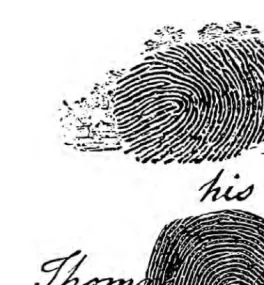
Thomas Bewick (Figure 1.8) is mentioned quite frequently in fingerprint
publications simply because in a few books he used an engraving of his fingerprints as a signature. The importance of this fact is that he did this almost 200 years ago, and authorities such as Sir William Herschel have credited Bewick with stimulating their initial interest in the study of fingerprints.
[image:31.612.141.299.40.259.2]He was born in Ovingham, Northumberland, England, on August 12, 1753, the son of a farmer. His early school career was marred by his absence from classes and disinterest in Latin, English grammar, and arithmetic, although he was eventually constrained to study them to a reasonable stan-dard, as one contemporary writer put it:
Figure 1.8 Thomas Bewick. (Drawn by John Berry.)
By kindly words of persuasion a reformation was at length affected that severe discipline and punishment had failed to accomplish.
He used all the spaces in his school papers to draw murals, and when he used these up he continued his artistic progress by chalking designs on gravestones and the church porch. He became famous in the rural community as an artist, and he decorated the walls of their cottages “with an abundance of my rude productions at a very cheap rate.”
While still a child, his head was scalded and thereafter his crown had no hair, necessitating, when he grew older, the application of a brown silk cap. When he was 14 years old, he became an apprentice to an engraver in Newcastle, and after 5 years he completed his apprenticeship; the first book with a Bewick woodcut was published in 1774.
As the years progressed, Bewick became famous throughout England, and ultimately his fame became worldwide. Without doubt he was England’s finest engraver. He invented the “white line” wood-engraving technique, “thus paying attention, not to what he left, but what he cut away from the block.” Most of his famous wood engravings featured animals and birds. His
AGeneral History of the Quadrupeds ran to eight editions, as did his monu-mental History of British Birds. The finger imprint in Figure 1.9, showing the cottage and trees etched faintly in the background, is from History of British Birds 1797–1804. His love of the countryside and nature must have caused him to note ridge detail on his hands. It has not been possible to find out how he concluded that ridge detail was unique, but it is obvious from his
carved imprint superimposed with Thomas Bewick his Mark that he was
utterly satisfied that his imprint denoted individuality. One of his contem-poraries observed that “Bewick’s signature is sometimes written, a genuine autograph, but generally printed; the quaint conceit of his thumb print is amusing.” Bewick died on November 8, 1828, at Gateshead, and he was buried in Ovingham churchyard, in the parish where he was born.
Concerning the External Physiological Examination of the
Integumentary System (1823)
Joannes Evanelista Purkinje was a Bohemian, and part of his thesis published on December 22, 1823, dealt in considerable detail with the functions of ridges, furrows, and pores; additionally, he illustrated and described nine fingerprint patterns: one arch, one tent, two loops, and five types of whorl. In 1985 my Hertfordshire colleague Martin Leadbetter optimistically wrote to the Burser of Wroclaw University, Poland, asking for photographs and part of the original thesis dealing with fingerprints. In 2 months, to our considerable
surprise, a 35-mm film arrived with negatives of all the pertinent pages in Latin (Martin has entrusted the film to me to retain in my capacity as Historian of The Fingerprint Society). Professor Harold Cummins and Rebecca Wright Kennedy, of the U.S., translated the thesis in 1940, and The Royal Society of London obtained the translation and duly gave permission for it to be published in Fingerprint Whorld, April 1987.
These are some of the interesting observations Purkinje made regarding the four basic patterns (Figure 1.2) and also a most detailed description of a palm impression:
Arch: From the articular fold, rugae and sulci first course in almost straight
lines transversely from one side of the phalanx to the other; then little by little they become more curved in the middle, until they are bent in arches which are nearly parallel with the periphery of the phalanx.
Tent: This is almost the same conformation as the above, the only
[image:33.612.90.354.41.326.2]dif-ference being that the transversely coursing ridges are wrapped over a little perpendicular stria, as if it were a nucleus.
Figure 1.9 Trademarks of Thomas Bewick. (From the publications of Thomas Bewick. With permission.)
Loop: Now if this oblique stripe by a simple curve returns to the side from which it came and follows many others in a similar curve, an oblique loop is formed which may be more or less erect or may bend forwards. Near its base, on one side or the other, a triangle is formed from the different directions of the rugae and sulci. Their configura-tion in the form of the oblique loop is the commonest, and I may almost say, typical of man.
Whorl: The circle, where in the ellipse a simple line occupies the center,
there is a small tubercle (island); it is surrounded with concentric circles which reach the rugae of the semicircular space.
Palm: From the space between the index finger and the thumb, great
numbers of parallel lines run which pass in diverging directions across the palm, next to the linea palmiformis, into the margins of the meta-carpals of the thumb and little finger. Thus triangles are formed with the vertices at the wrist. This is their most common conformation. Other parallel lines from the roots of the fingers meet and accompany the lines running across from the interval of the thumb and the index finger toward the external margin of the fifth metacarpal. Running out from these intervals, loops and whorls are interposed; but it would take too long to explain in this chapter the many varieties of these. On the thenar eminence, a trapezoidal region occurs where the rugae and sulci are set transversely to the circles. On the hypothenar emi-nence, toward the radial margin of the metacarpal, a larger loop is often observed where the rugae and sulci going out from the margin are again reflected onto it. Sometimes an elliptical whorl is seen on this eminence.
Fingerprint Classification
A major step forward in the use of fingerprints was a method of classification that enabled fingerprint forms bearing differing patterns to be placed in a certain order, thus enabling the search area to be minimized. If a classification system did not exist, and a person gave a wrong name, each set of fingerprint forms would have to be examined to discover the correct identity of the offender; the person would obviously not be traced by doing an alphabetical check. Many countries in the world now use the “Henry System,” the
brain-child of Sir Edward Henry (Figure 1.10), an Englishman who served in India
toward the end of the nineteenth century. His system became operational at Scotland Yard in 1901, but I must point out that a European who emigrated to Argentina in 1884 caused the world’s first fingerprint bureau to be insti-tuted in 1896.
Dr. Ivan Vucetich (1858–1925)
Dr. Ivan Vucetich (Figure 1.11) was employed in the Central Police Depart-ment, La Plata, Argentina, and was ordered to install the French Bertillon Anthropometric Identification System, which used a number of body mea-surements and was in extensive use in European countries. Vucetich obtained a copy of the journal Revue Scientific which contained an article on English fingerprint pioneer Francis Galton, who had formulated his own classifica-tion system. Dr. Vucetich became extremely interested in fingerprints and within a year had worked out his own unique system for classifying them. This became known as “vucetichissimo,” and it utilized four fingerprint
pat-terns as described in his book Dactilospia Comparada. In 1893, the Rojas
[image:35.612.137.304.41.318.2]murder was solved by fingerprints, proving their effectiveness, and Vucetich was enthusiastically operating a fingerprint office built at his own expense. In 1893, he was suddenly ordered to abandon his fingerprint system and revert to bertillonage. Of course, he realized that this was a retrograde action,
Figure 1.10 Sir Edward Henry. (Drawn by John Berry.)
and he tried unsuccessfully to explain to the police authorities how superior fingerprint usage was to the measurement system. Fortunately in 1896, Argentina abandoned bertillonage and began to use vucetichissimo. (I possess a U.S. FBI “flyer” for someone who absconded from a state camp at Daven-port, Iowa, in 1929, and although the card shows his photograph and rolled finger impressions, it also gives numerous Bertillon measurements.) The Vucetich system is not in use outside South America.
The Henry System
The FBI, with its huge collection of fingerprint forms, uses the basic Henry system, amended to the FBI’s requirements. I have visited fingerprint bureaus in Australia, South Africa, Greece, Canada, and the U.S., and they all use the Henry system, which is extremely ingenious.
On British fingerprint forms, the fingers are numbered from 1 to 5 on the right hand and from 6 to 10 on the left hand (see below).
Figure 1.11 Dr. Ivan Vucetich. (Drawn by John Berry.)
Whorl patterns only have values, as shown below. Even numbers on the form constitute the numerator, odd numbers provide the denominator.
The finger numbers are not used in the system; totaled whorl patterns only apply. Therefore, if a person does not have any whorl patterns on the fingers, the classification would be
This is a negative symbol, and therefore Sir Edward decided to always add
“1” to both the numerator and denominator. Hence, a fingerprint classifica-tion without whorls would be
This section has the largest number of fingerprint forms, as loops constitute 63% of all fingerprint patterns.
If all fingerprint patterns were whorls, the classification would be
The Henry system therefore divided all fingerprint forms into 1024 bundles. It is quite obvious that if fingerprint forms are filed according to this system, the searcher chooses the bundle bearing the appropriate Henry fraction and merely searches this one bundle.
There are further subclassifications, which mean that every bundle can be further divided for searching. Unfortunately, some fingerprint patterns merge their characteristics and have to be searched as alternatives, meaning that additional bundles have to be examined in order to positively conclude a search. It must also be remembered that missing or bandaged digits have to be further searched to cover all possibilities. Some examples of the Henry system classification are shown in the following table.
0 0
1 1
32 32
Sir Edward Henry and Sir William Herschel
In England, an “Establishment” controversy has existed since the end of the nineteenth century concerning the merits of British fingerprint pioneers. Although the Henry system is a superb achievement, Sir Francis Galton and Sir William Herschel (Figure 1.12) also worked out classification systems, and these knights, with Sir Edward predominating, were considered to be very nice chaps. Herschel was an important figure in fingerprint pioneering because he was the first person to confirm ridge persistency, which states that the formation of ridge detail that develops on the hands and feet in the womb does not change, except as a result of serious injury to the digits or decom-position after death. This is the major requirement for a fingerprint system. I have seen the originals of Herschel’s experiments, during which he took his own palm impressions in 1860 and again in 1890. The ravages of time had caused creases to flourish across his fingers and palms, and the ridges were somewhat coarser, but the sequences of ridge detail remained exactly the same. The German anthropologist Welker also took his own palm impres-sions in 1856 and again in 1897, just before he died. He did not envisage any criminal application to his recognition that the ridge detail present on his fingers and palms did not change with time.
Herschel wrote the famous “Hooghly letter” on August 15, 1877, to the Inspector of Jails in Bengal, India, in which he propounded the idea that persons committed to prison should be fingerprinted to confirm their iden-tities. Herschel had been experimenting with fingerprints for 20 years before 1877 and during this time had taken thousands of fingerprints. Like Welker, he had never associated fingerprints with the identification of finger imprints found at crime scenes.
Edward Henry must receive due credit for his practical interest in fin-gerprints in the latter part of the nineteenth century in India as a means of identifying workers to ensure that the payment of wages was not duplicated. However, legend and myth have arisen around Sir Edward Henry, perpetu-ated by writers who have produced this giant among fingerprint pioneers;
his name even now is mentioned many times daily in most fingerprint bureaus in the world. After all, didn’t Henry, while traveling in a train in India, suddenly have a flash of inspired genius whereby he quickly worked out the system of 1024 groups utilizing whorl patterns, as I have already described? In order to record this magnificent mental feat, I have read, Henry hastily scribbled the essential equations on his stiff and clean white shirt cuff. I embellish the legend every day: “I’m going to search in the ‘A’ Division Henry collection,” I announce. If I manage a successful “cold search” from finger imprints found at a crime scene, I complete a register in the office and under the heading Method of Identification, I write “A” Henry. I should know better, but habit makes a slave of thoughtlessness. It just is not true: Sir Edward Henry shrewdly gave his name to the classification system worked out by his Indian employees Khan Bahadur Azizul Haque and Rai Bahadur Hem Chandra Bose. Haque is alleged to have muttered to confidants that Henry could not even understand the system when it was patiently explained to him.
There are always two versions to a controversy. Henry appeared before the Belper Commission in 1900. Lord Belper had been asked to chair a committee to decide what identification system should be used in Great Britain. Henry was asked point blank if the 1024 bundle system was his own invention, and he firmly announced that it was; in the past, writers have tended to support Henry’s claim. They point out that as the English official
Figure 1.12 Sir William Herschel. (Drawn by John Berry.)
in charge he undoubtedly supported and encouraged his staff and should therefore be responsible for the innovation they suggested. In a letter dated May 10, 1926, Henry wrote to a correspondent concerning Haque:
I wish to make it clear that, in my opinion, he contributed more than any other member of my staff and contributed in a conspicuous degree to bringing about the perfecting of a system of classification that has stood the test of time and has been accepted in most countries.
The Belper Commission, aware that Henry’s book was due to be pub-lished, recommended the use of the Henry Classification System, which was introduced at Scotland Yard in 1901. Police forces from all over the world duly sent their officers to learn this new fingerprint system.
The maintenance of a fingerprint collection serves the primary function of causing a file to be associated with each person whose finger impressions appear in the collection. When fingerprint sets are received at police head-quarters, the person is allocated a number; in Great Britain this is known as the Criminal Record Office Number (CRO No.). This number always remains the same for the individual, and as the individual ages and collects convic-tions, the file accordingly gets thicker, all convictions in the file being con-firmed by fingerprints taken at the time of arrest. It does happen that a person gives a fictitious name when fingerprinted, and if dealt with expeditiously at court, previous convictions will not be cited and punishment will be dealt out as if for a first-time offender. In the meantime, the routine is inexorably taking place: the fictitious name with the associated fingerprint classification is not found after a name search, and so the fingerprint form is then searched through the fingerprint collection. The true name will certainly be discov-ered, the alias and conviction will be added to the file, and the next time that person appears in court on another charge, they will discover, to their cha-grin, that they did not beat the system.
The secondary use of a fingerprint collection is to provide a catchment area for identifying offenders who leave their fingerprints at crime scenes, and this has been my special province for the last 37 years. For the initial suggestion associating the identification of finger imprints found at crime scenes with finger impressions in the collections, we owe a quite considerable debt of gratitude to Dr. Henry Faulds.
Dr. Henry Faulds (1843–1930)
Henry Faulds (Figure 1.13), the son of Scottish parents, was born in Beith, Ayrshire, Scotland, on June 1, 1843. He became a medical missionary for the Church of Scotland and spent a year in India; however, because of a clash of personalities with the clergy in charge, he returned to Scotland the following
year. He joined the United Presbyterian Church of Scotland and married Isabella Wilson before sailing to Japan as a medical missionary. He arrived on March 5, 1874, and set up a hospital at Tsuki, in Tokyo, that was the first of its kind in Japan. While walking along the beach of the Bay of Yedo, he found ancient shards of pottery bearing the finger imprints of the potters (obviously not using the Getic technique of smoothness of surface). He became extremely interested in fingerprints. In one classical experiment, he removed the skin from the fingers of his patients after fingerprinting them; when the skin regrew on the fingertips he fingerprinted them once more, noting that the ridge detail was exactly the same as it was before the skin was removed. He recognized that fingerprint patterns were variable, but con-cluded that ridge detail was immutable. I believe Faulds was the person to identify finger imprints at crime scenes; the Japanese sought his assistance twice to compare scene imprints with suspects; the people he identified subsequently admitted to the crimes.
I have already mentioned the amazing letter Faulds sent to Charles Dar-win in 1880 and DarDar-win’s reply mentioning Mr. F. Galton, later Sir Francis
Galton. However, Faulds’ letter to Nature on October 28, 1880, was a most
staggering document, and I dearly wish there was sufficient space to reprint the letter in full. It covered the following points:
Figure 1.13 Dr. Henry Faulds. (Drawn by John Berry.)
1. Finding finger imprints on prehistoric Japanese pottery 2. Comparing skin furrows on humans
3. Studying fingertips of monkeys
4. Collecting the finger impressions of persons of various nationalities “which I hope may aid students of ethnology in classification” 5. Using “an ordinary botanical lens” to examine fingerprints 6. Describing ridge characteristics
7. Taking finger impressions with printer’s ink, with hints on removing the ink afterward
8. Discussing fingerprints of mummies
9. Describing ancient Chinese fingerprint usage
10. Describing the Egyptian method of thumbnail printing of criminals
The article contained the first and most important sentence ever written regarding crime investigation from a fingerprint standpoint:
When bloody finger marks or impressions on clay, glass, etc., exist, they may lead to the scientific identification of criminals.
Sir William Herschel responded to Faulds’ letter by writing to Nature;
his letter was published on November 25, 1880, and the controversy in British fingerprint circles dates from this time. Faulds could not possibly be privy to Herschel’s fingerprint experiments since he was in Japan for some of the time. In Fingerprint Whorld, in conjunction with Martin Leadbetter, I pub-lished eight chapters of The Faulds Legacy, and regarding Herschel’s letter in
Nature, I commented that
… in Herschel’s own words he was working with fingerprints for twenty-three years prior to Faulds’ Nature letter, consequently it was surely his responsibility to publicly announce his researches at a time convenient to himself.
Very belatedly, in Nature January 18, 1917, Herschel wrote:
His [Faulds’l letter of 1880 announced … that he had come to the conclu-sion, by original and patient experiment, that fingerprints were sufficiently personal in pattern to supply a long-wanted method of scientific identifi-cation, which would enable us to fix his crime upon any offender who left finger marks behind him, and equally well to disprove the suspected identity of an innocent person. (For which I gave him, and I still do so, the credit due for a conception so different from mine.)
However, the battle lines had been drawn 30 years before this: the Establish-ment view in Scotland Yard circles was that Faulds had preempted Herschel’s
decades of research. As recently as 1977, a senior police officer at New Scot-land Yard told me firmly that Faulds was a charlatan.
Frederick Cherrill was the senior officer in charge of the New Scotland Yard Fingerprint Bureau for many years and was a hard-working and skilled fingerprint expert, visiting scenes and making identifications in major crimes even when of senior rank. However, in his Cherrill of the Yard (1955), he does not even mention Faulds in his chapter on the history of fingerprints. How-ever, a year previously in The Fingerprint System at New Scotland Yard (1954), he wrote the following on page 6:
The value of Henry Faulds’ (1843–1930) contribution to fingerprint science has been much discussed, but it is beyond question that Herschel was in the field many years before Faulds; in fact there is incontrovertible proof that Herschel was experimenting with finger, palm and sole prints when Faulds was but 16 years old. Faulds, in his letter to Nature 28th October 1880, entitled On the Skin Furrows of the Hand, did, however, anticipate any public declaration on the part of Herschel. Faulds made reference in his letter to the use of “nature prints” for the purpose of tracing criminals, but such prints were confined to visible marks made in blood, etc., and he did not suggest the development of latent sweat deposits from the fingers which now plays such an important part in modern criminal investigation.
Faulds was annoyed when knighthoods were granted to Galton, Herschel, and Henry because he believed that he was the originator of the scenes-of-crime aspect of fingerprint identification. Indeed, Faulds was even more piqued when the fingerprint bureau was formed at the Yard in 1901, because between 1886 and 1888 he had called at the Yard and offered to organize a fingerprint bureau at his own expense, a suggestion which allegedly caused a police officer to rebuke him and make insinuations regarding his sanity.
Faulds’ obsession, even hatred, of the Yard was revealed in 1905 when he allied himself with the defense at the trial of the Stratton brothers, charged with a double murder at Deptford, London. A thumb imprint on a cash box found opened at the crime scene was identified as having been made by Alfred Stratton. It was a good clear imprint with ample ridge detail to afford a positive identification, but Faulds considered it to be a “smudge” and cast doubts on its status. The Strattons were convicted of the murder and duly hanged. There was a great deal of circumstantial evidence in the case, perhaps strong enough to have gained a conviction without the fingerprint evidence, but this was the first time fingerprints had been used in a murder trial in England, and experts at the Yard were extremely delighted: the marvelous system initiated in 1901 was vindicated in this glorious triumph. Faulds was not amused.
Faulds edited seven issues of a fingerprint journal Dactylography in the early 1920s that contained much original thought but in which he continually carped about “the worthy baronets”; he suffered from ill health and died in Wolstanton, Staffordshire, on March 19, 1930.
The Japanese regarded Faulds with great reverence and placed a com-memorative stone on a tree-lined pavement in Tokyo with Japanese and English inscriptions. It reads:
DR. HENRY FAULDS
PIONEER IN FINGERPRINT IDENTIFICATION LIVED HERE
FROM 1874 TO 1886.
The Faulds family gravestone in Wolstanton was in a sorry state early in 1987, with a dirty chipped headstone with weeds and grass covering it. Two American fingerprint men, James Mock, F.F.S., California, and Michael Car-rick, Hon. M.F.S., Salem, Oregon, paid for it to be refurbished. This was done and completed in April 1987. A plaque states:
IN MEMORY OF DR. HENRY FAULDS MEDICAL MISSIONARY IN RECOGNITION OF HIS WORK
AS A PIONEER IN THE SCIENCE OF FINGERPRINT IDENTIFICATION
1843–1930
THE FINGERPRINT SOCIETY QUAERITE ET INVENIETIS.
This was a wonderful gesture, belatedly bequeathing to Faulds the accolade he deserved throughout his life but which was denied him.
His two daughters died without having their lifelong ambition fulfilled — to have a bronze bust of their father placed inside Reception at New Scotland Yard. Strangely enough, in the corridors of the sixth floor at the Yard are a number of large framed aspects of fingerprints, and on one of them Faulds is credited with being a “Sir” — Sir Henry Faulds! Obviously, the researcher was confused with Sir Edward Henry. Fate indeed moves in a mysterious way.
Sir Francis Galton (1822–1911)
Sir Francis Galton’s (Figure 1.14) interest in fingerprints should have been alerted by Dr. Henry Faulds’ letter to Charles Darwin in 1880; the letter was passed to Galton as promised, but he reposited it in the Anthropological
Institute where it stayed until 1894. Galton was an authority on bertillonage, but it was in 1888 that he commenced his enthusiastic foray into dactylos-copy. Initially, he collected only thumb impressions, but in 1890 he com-menced to collect full sets of finger impressions. He worked out a fingerprint classification system and was duly called before the Asquith Committee on December 18, 1893; the committee was considering the Bertillon measuring system and pondering over a replacement. It was considered that the scope of Galton’s classification system was limited when a large collection was envisaged, but the committee ordered that Galton’s primary classification should be added to Bertillon cards. It is noteworthy that when Galton gave evidence before the Asquith Committee, he had 5 years of experience in the study of fingerprints, which accords with the present minimum standard requirement in order to give evidence of identity before courts of law in Great Britain.
I have twice visited the Galton Laboratory in London and have had the extreme good fortune to examine one of the world’s most precious early
fingerprint documents, Galton’s Photography III, a large album containing
Figure 1.14 Sir Francis Galton. (Drawn by John Berry.)