LAND FORCE
INTELLIGENCE, SURVEILLANCE,
TARGET ACQUISITION AND
RECONNAISSANCE (ISTAR)
(ENGLISH)
(Supercedes B-GL-352-001/FP-001 dated 2001-08-01)
Issued on the Authority of the Chief of Land Staff
B-GL-352-001/FP-001
WARNING
LAND FORCE
INTELLIGENCE, SURVEILLANCE,
TARGET ACQUISITION AND
RECONNAISSANCE (ISTAR)
(ENGLISH)
( Supercedes B-GL-352-001/FP-001 dated 2001-08-01)
Issued on the Authority of the Chief of Land Staff
OPI: DAD 5-4 2004-01-07
B-GL-352-001/FP-001
WARNING
FOREWORD
GENERAL
1. B-GL-352-001/FP-001 Intelligence, Surveillance, Target Acquisition and Reconnaissance (ISTAR) is issued on the authority of the Chief of the Land Staff.
2. This publication is effective upon receipt and supercedes B-GL-352-001/FP-001 dated 2001-08-01.
3. The French version of this publication is B-GL-352-001/FP-002 Renseignement, surveillance, acquisition d'objectifs et reconnaissance (ISTAR).
4. Suggestions for amendments should be forwarded through normal command channels to the Directorate of Army Doctrine (DAD), Attention DAD 5-4.
5. Unless otherwise noted, masculine pronouns contained herein apply equally to men and women.
6. This publication is available electronically on both the Defence Information Network (DIN) and the World Wide Web in the Army Electronic Library (AEL). Keyword—Army Electronic Library
PREFACE
AIM
1. The aim of this manual is to provide guidance for the employment of the Intelligence, Surveillance, Target Acquisition and Reconnaissance (ISTAR) capability in Canadian Forces land operations.
SCOPE
2. This publication contains ISTAR tactics, techniques and procedures (TTP) appropriate to brigade group and battle group level operations.
3. These TTPs apply to all levels of intensity. However, it must be understood that in domestic operations, legal requirements will vary from situation to situation and will need to be addressed and resolved prior to implementation of the ISTAR plan. It is recognized that the particular legal and other restraints and constraints involved in domestic operations will affect these TTP and are considered to be outside of the scope of this manual.
REFERENCES
4. The following references form the foundation of, and should be read in conjunction with, this manual:
a. B-GL-300-005/FP-001 Land Force Information Operations;
b. B-GL-357-001/FP-001 Land Force Information Operations—Intelligence Field Manual; and c. B-GL-333-001/FP-001 Formation Standing
TABLE OF CONTENTS FOREWORD
General... i
PREFACE Aim ... iii
Scope... iii
References... iii
CHAPTER 1 INTRODUCTION SECTION 1 GENERAL...1
Definition ...1
Role ...1
Principles of Deployment...1
Characteristics...2
SECTION 2 OPERATIONAL CONCEPT OF DEPLOYMENT...3
ISTAR at Brigade HQ...3
ISTAR at Battle Group Level...3
Independent Battle Group Ops...4
SECTION 3 ISTAR IN RELATION TO OTHER PROCESSES ...4
ISTAR in Relation to the Intelligence Cycle...4
ISTAR in Relation to Intelligence Preparation of the Battlefield (IPB)...5
ISTAR in Relation to the Operational Planning Process (OPP)...5
ISTAR in Relation to the Targeting Cycle...5
Counter-ISTAR...6
CHAPTER 2 THE ALL-SOURCE CELL (ASC) SECTION 1 INTRODUCTION ...9
Definition ...9
SECTION 2 ORGANIZATION ...9
SECTION 3 FUNCTION ...10
SECTION 4 POSSIBLE ASC FIELD / OPERATIONAL LAYOUT...13
SECTION 5 ASC BATTLE PROCEDURE...15
SECTION 6 PROCESSES ...17
ANNEX A ...25
CHAPTER 3 ISTAR ORGANIZATIONS AND THEIR RELATIONSHIPS SECTION 1 GENERAL...27
SECTION 2 THE ISTAR COORDINATION CENTRE ...27
SECTION 3 THE ALL-SOURCE CELL...31
SECTION 4 SENSOR MANAGEMENT ...32
SECTION 5 ISTAR COORDINATION CENTRE LAYOUT IN A BRIGADE HEADQUARTERS...33
SECTION 6 ALL-SOURCE CELL REPORTING ...34
SECTION 7 BYPASSING OF NORMAL PROCESSING...35
SECTION 8 TARGETING...36
CHAPTER 4 CHARACTERISTICS AND EMPLOYMENT OF ISTAR COLLECTION ASSETS SECTION 1 INTRODUCTION ...39
SECTION 2 ARTILLERY ASSETS...40
SECTION 3 RECONNAISSANCE SQUADRON ...42
SECTION 4 ARMOURED REGIMENT ...45
SECTION 5 INFANTRY ...46
SECTION 6 ENGINEER ASSETS ...48
SECTION 7 COMBAT SERVICE SUPPORT ...50
SECTION 8 ELECTRONIC WARFARE ...51
SECTION 11 HUMAN INTELLIGENCE...58
SECTION 12 IMAGERY INTELLIGENCE ...59
Special Remarks...61
SECTION 13 TECHNICAL INTELLIGENCE ...61
SECTION 14 MEDICAL INTELLIGENCE...64
CHAPTER 5 ISTAR SENSOR INTEGRATION SECTION 1 GENERAL...67
Ground Surveillance Radar ...68
Sound Ranging Equipment...68
Airborne Surveillance Platforms ...68
Terrain Management WRT ISTAR System Requirements ....68
SECTION 2 AIR SPACE MANAGEMENT (TBC) ...69
Deconfliction of ISTAR Assets...69
CHAPTER 6 THE ISTAR PROCESS The ISTAR Process...71
Steps of the ISTAR Process ...71
CHAPTER 7 CONDUCT OF THE ISTAR BATTLE General...75
Planning the ISTAR Battle...75
Coordinating with Higher, Lower, and Flanking Units...75
Advising on Sensor Integration, Including Dual Source Targeting ...76
Advising the Commander on ISTAR Related Issues ...76
ISTAR Overlay Tips ...76
Executing the ISTAR battle ...76
CHAPTER 8 ISTAR IN RELATION TO INFORMATION OPERATIONS General...79
ANNEX B ISTAR OVERLAY...85
ANNEX C ASC DEPLOYMENT SECURITY
GUIDANCE
Security Checklist ...88
ANNEX D ISTAR TERMINOLOGY
Sense ...96
LIST OF FIGURES
Figure 2-1: Organization of the All-Source Cell ...10
Figure 2-2: All-Source Cell Interactions ...14
Figure 3-1: ISTAR Org in BDE HQ...28
Table 3-1: Typical Source Representation...29
Table 3-2: Suggested ISTAR CC/ASC Org...32
Table 3-3: Sample ASC Retasking Situations ...33
Figure 3-2: 1 ISTAR CC Tasking Chain ...34
Figure 3-3: ISTAR Data Flow ...37
Figure 8A-1: Combined ICP/OPP Process ...81
Figure 8A-2: Sample of Spreadsheet Intelligence Collection Plan...83
Figure 8A-3: ISTAR Task Matrix, as Issued with Op O ...84
Figure 8D-1: Battlefield Framework ...93
Figure 8D-2: Area NAI...96
Figure 8D-3: Point NAI...96
CHAPTER 1 INTRODUCTION
SECTION 1 GENERAL
1. This document describes the tactics, techniques and procedures (TTP) for employment of the Land Force (LF) intelligence, surveillance, target acquisition and reconnaissance (ISTAR) capability during operations. For the remainder of this publication, the use of the term ISTAR will mean LF ISTAR capability.
DEFINITION
2. ISTAR is a grouping of information collection, processing, dissemination and communication assets designed, structured, linked and disciplined to provide situational awareness (SA), support to targeting and support to commanders in decision making.1 ROLE
3. The role of ISTAR is to integrate the intelligence function with surveillance, target acquisition (TA), reconnaissance and other information-generating assets in order to improve a commander’s SA, streamline decision-making processes and cue manoeuvre, strike and/or other ISTAR assets.
PRINCIPLES OF DEPLOYMENT
4. It must be stressed that ISTAR must not replace the asset owner’s tactical role in commanding assets but rather ISTAR integrates these assets as part of a seamless web to support decision-making. The principles of ISTAR deployment can be described as follows:
a. Centralized Coordination. ISTAR must be coordinated centrally at each level of command
1 The term ISTAR is used to refer both to the operational process and to the
without sacrificing the principle of mission command. This ensures the most effective and efficient use of resources.
b. Timeliness. Information and intelligence must be provided to the commander in a timely fashion to allow him to work within the enemy’s decision-action cycle.
c. Accuracy. The ISTAR product must be accurate and relevant to the operation it is supporting. d. Passage of Information. Within an ISTAR system, it must be possible to pass information between ISTAR assets and appropriate
commanders and staffs without overloading them with irrelevant data.
e. Economy of Effort. The ISTAR plan must use all sensors to their maximum ability while retaining enough redundancy for contingency operations.
CHARACTERISTICS
5. The following are the characteristics of the ISTAR system: a. Responsiveness. The system must be able to react
quickly to the commander’s information and intelligence requirements and to rapidly exploit targeting information.
b. Continuous Coverage. Surveillance, target acquisition and reconnaissance must be able to provide coverage 24/7 in all weather.
c. Robustness. ISTAR assets must provide a robust mix of overlapping systems in terms of
technology, range and performance in order to cope with enemy action as well as changing meteorological and light conditions and to defeat adversary deception plans.
SECTION 2
OPERATIONAL CONCEPT OF DEPLOYMENT
6. By its very nature ISTAR must cover the deep, close and rear battle as well as future and current ops. This translates into the need for flexibility within the ISTAR system and from those assets directly effected by the ISTAR process. The overall benefit gained from ISTAR is that it is a process that enhances both the speed with which targets are engaged and the assessment of engagement results (BDA). This will lead to a clear assessment of the enemy
disposition, which will in turn help the commander in formulating and executing his plan.
ISTAR AT BRIGADE HQ
7. The Intelligence, Surveillance, Target Acquisition and Reconnaissance Coordination Centre (ISTAR CC) and the All-Source Cell (ASC) form the nucleus of ISTAR operations within a brigade headquarters (bde HQ), with the ASC providing
coordination and analysis under the direction of the ISTAR CC. They must work closely with other elements of the HQ to ensure a coordinated and seamless ISTAR effort throughout the area of operations. Within the bde HQ there are three other coordination centres that are closely linked to the operation of the ISTAR CC and the ASC, respectively. The Fire Support Coordination Centre (FSCC) is the bde HQ link to the fire support system and gives the ASC access to artillery intelligence. The Engineer Support Coordination Centre (ESCC) is the bde HQ link to the engineer net and the ASC relies on it for specialist engineer intelligence. The Air Support Coordination Centre (ASCC) is the bde HQ link to both the air support and air defence (AD) nets. The ASCC provides air attack warning and access to the common air picture. It is also responsible for the airspace coordination necessary for unmanned aerial vehicle (UAV) planning. The remainder of the bde units provide the ASC with combat information that contributes to the common operating picture (COP). In particular, combat information adds necessary detail that may not be provided by dedicated ISTAR assets for close and rear operations.
ISTAR AT BATTLE GROUP LEVEL
higher levels. They are primarily concerned with the
minute-to-minute management and control of units within their area of command. Compared to bde, tasks at the BG level and below are more immediate and time expiring. Levels of command at BG and below need to receive, process and disseminate information provided by combat teams, observation posts (OPs), reconnaissance parties and weapon platforms and ensure its timely distribution to those who need it, be that higher command, adjacent units or logistic resources. They must respond rapidly and effectively to changes in the tactical situation imposed both from above and below.
INDEPENDENT BATTLE GROUP OPS
9. Battle groups can be called upon to operate independently of a bde HQ, such as in coalition operations. In the absence of a bde HQ, many of the ISTAR activities normally carried out at bde level will have to take place at the BG HQ. Operational experience has shown that a BG Int section augmented from higher HQ can carry out ISTAR tasks effectively. When planning, care must be taken to ensure that sufficient personnel and connectivity are provided to manage the available sensors effectively as it is not sufficient to “pro-rate” the size of the BG ISTAR CC against that of a bde ISTAR CC.
SECTION 3
ISTAR IN RELATION TO OTHER PROCESSES
10. Nothing within the ISTAR concept eliminates the requirement for other processes to take place. Intelligence
preparation of the battlefield (IPB), the operational planning process (OPP), the intelligence cycle, and the targeting cycle all remain. The only significant change is to their integration into a process of processes.
ISTAR IN RELATION TO THE INTELLIGENCE CYCLE
intelligence requirements on behalf of all staff branches and analyze how to obtain it. The management of these overarching intelligence and information requirements is conducted by means of a collection plan, which is supervised by the intelligence staff on behalf of the commander. Accordingly, ISTAR is a subset of the overarching collection plan. On the occasions intelligence staffs do not have executive control over assigned collection assets, they typically recommend to the operations staff how the intelligence/information is to be obtained. Operations staff usually leads the detailed coordination and approval of ISTAR operations. The information derived from ISTAR operations is provided concurrently to the intelligence cycle, the targeting process and other appropriate staff.
ISTAR IN RELATION TO INTELLIGENCE PREPARATION OF THE BATTLEFIELD (IPB)
12. ISTAR begins during step 2 of IPB. That is, initial NAI can be identified based on restrictive terrain and its effect on movement as well as key terrain and vital ground. During step 3 and the creation of an event template, further NAI are identified. And during step 4, courses of action, more NAI are added and TAI are plotted.
ISTAR IN RELATION TO THE OPERATIONAL PLANNING PROCESS (OPP)
13. During the war game, the ISTAR plan will be finalized and additional NAI and TAI will be added as required. The G3 Staff must endeavour to mesh the synchronization matrix and the decision support template with the ISTAR plan in order to maintain
coordination of sensors and to streamline the targeting process.
ISTAR IN RELATION TO THE TARGETING CYCLE
14. Coordination of the Targeting Process. Targeting is defined as “the process of selecting targets and matching the appropriate response to them, taking account of operational requirements and capabilities.”2 It is the mechanism for
coordinating ISTAR and attack resources such as aviation, indirect
fire and offensive information operations (IO) to ensure that they are properly integrated and that the most appropriate weapon system attacks each target. It is, therefore, a tool for the efficient and effective management of resources and its successful
implementation is fundamental in our speed of reaction to the enemy.
15. The decide function is the cornerstone of the targeting process and requires close coordination between the commander and the intelligence, plans, operations and targeting team elements. The process begins with receipt of a mission, whether assigned by higher headquarters or deduced by the commander. The commander, with input from his staff, analyzes the mission and considers the tasks that must be performed. Targeting priorities must be addressed for each phase or critical event of an operation. The decisions made are reflected in visual products and clearly convey the commander’s intent with respect to the following priorities:
a. the tasking of ISTAR assets; b. information processing; c. target selection;
d. selection of the engagement means; and e. the requirement for BDA.
COUNTER-ISTAR
16. Counter-ISTAR is concerned with preventing an adversary collecting information on our forces and intentions. Counter-ISTAR actions will be directed by the counterintelligence (CI) plan and will employ a range of effects from across the Combat Functions. Generally, the counter-ISTAR plan will coordinate existing response assets rather than requiring niche capabilities. The destruction, degradation, suppression or manipulation of adversary ISTAR should, however, be considered as a potential task when developing response capabilities within eachcombat function.
17. Response capabilities targeting adversary ISTAR will require own force ISTAR support to locate and identify targets. Targets will include passive and active sensors on a range of
CHAPTER 2
THE ALL-SOURCE CELL (ASC)
SECTION 1 INTRODUCTION
DEFINITION
1. The All-Source Cell (ASC) is an element of the Intelligence Surveillance and Target Acquisition (ISTAR) Coordination Centre (CC) responsible to support brigade and unit level operations through the provision of timely, accurate, and relevant intelligence derived from a broad spectrum of sources fused to positively influence decision-making cycles.
ROLE
2. The role of the ASC is to provide analysis and collection coordination within the ISTAR system resulting in the provision of Red and Brown Situational Awareness (SA) to the ISTAR CC and the Commander. Furthermore, the ASC will assist in the
coordination of targeting and development of the Common Operating Picture (COP) for commanders and act as a central hub for sensor, source, and agencies links into the Brigade Headquarters (Bde HQ).
SECTION 2 ORGANIZATION
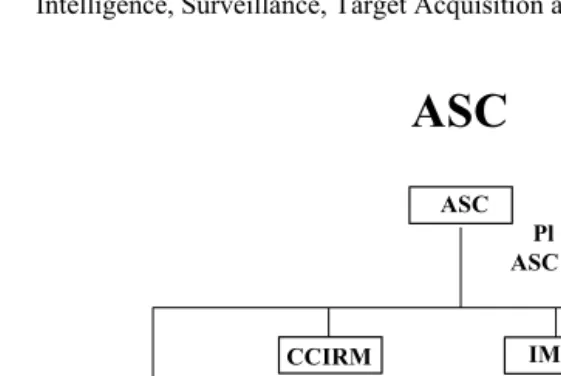
3. The organization of the ASC (Figure 1) is separated into five cells: Command, Analysis, Collection Coordination Information Requirements Management (CCIRM), Information Management Support (IM Sp), and the Secure Compartmented Information Facility (SCIF).
Figure 2-1: Oranization of the All-Source Cell
SECTION 3 FUNCTION
5. The functions integral to the ASC are: Command and Liaison, Analysis, CCIRM, Red and Brown Information
Management (including dissemination), and Management of TS/SA material.
6. The basic ASC functions can be extracted from the All-Source Cell Terms of References and as such define:
a. Command. The ASC Pl Comd will command the ASC, hold the position of G2 Ops, liaise with operations staff and Sensor, Source, and Agency Liaison Officers (LO) regarding all current operational issues, and provide Red and Brown SA to the COP (Red Track Manager IAW FSOP 109). The ASC Pl Comd is directly responsible to the G2 and shall assume the role of acting G2 as required. The ASC Coordinator is to ensure that ASC processes and requirements are completed in an accurate and timely manner. The ASC Coord assumes the duties of the ASC Pl Comd, when
Duty Offr – Capt/Lt Analyst Cell 2IC - WO Senior Analysts - 2x Sgt
Collator - Cpl Plotter - Cpl
IM Coord - WO IM Asst Coord - Sgt Prod & Dissem - MCpl Col Mgr - WO
IR Mgr - Sgt
Pl Comd - Capt ASC Coord - MWO
SCIF Det Comd - MCpl SCIF Asst - 2x Cpl
ASC
Analysis
CCIRM IM Sp SCIF
absent or as required, and is responsible for the ASC night shift.
b. Analysis. The Analysis Cell staff is responsible for producing the following:
(1) General. The Analysis Cell staff becomes responsible for the evaluation of Sensor, Source, and Agency data in the absence of pre-processing. In order to process this data, the Analysis Cell personnel requires, at a minimum, rudimentary knowledge of Sensor, Source, and Agency data processing skill sets.
(2) Duty Officer. The Duty Officer (DO) is responsible for the timely production of Intelligence Summaries (INTSUMS), Intelligence Reports (INTREPS), certifying Red and Brown current SA for publishing to the COP, and shall focus on the elimination of intelligence gaps. The DO provides all source finished (fused) intelligence to enhance the Commander’s situational awareness of the Red and Brown current situation. The focus of the ASC DO will be on the provision of predictive and “value added” intelligence information for the commander. (3) Analysis 2IC. The Analysis Cell 2IC is
to ensure that all incoming Analysis Cell information is reviewed and processed according to importance and provides timely Indication and Warning (I&W). The 2IC is also responsible for the regular production of INTSUMS, INTREPS, and the development of Requests for
Information (RFIs) to be staffed through CCIRM. The 2IC must be able to produce an all source finished (fused) intelligence product.
reviewed and shall provide timely I&W. The analysts are also responsible for the regular production of INTSUMS, INTREPS, and the development of RFIs within their areas of responsibility. (5) Collator. The Collator is responsible for
the effective management of the digital collation system. The collator is to be prepared to assume the duties of the Plotter or Senior Analyst, as required. (6) Plotter. The Plotter is responsible to
ensure that all Red and Brown information displayed on the digital overlay is current and accurately plotted. The Plotter is to be prepared to assume the duties of the Collator or Senior Analyst, as required.
c. CCIRM. The CCIRM Cell will take the G2 Plan Cell developed PIRs and IRs and pass them to the Analyst Cell for processing. The ASC CCIRM Collection Manager will coordinate with the G2 Plans Cell the development Commander’s Critical Intelligence Requirements (CCIR). RFIs are logged and passed to analysis shifts for exploitation. Information gaps are identified through the ISTAR matrix, and passed to the ISTAR CC with recommended sensor tasking. Close coordination with the ISTAR CC as well as G3/G2 Plans is required to recommend the best use of collection assets to eliminate gaps in the Red and Brown digital templates. The ASC CCIRM Collection Manager ensures that PIR/IR answers are provided to the IM Sp Cell for dissemination.
SA and ASC products by the required means and IAW FSOP 109. The IM Sp Coord will act as the intelligence database custodian on behalf of the ASC, G2, and ISTAR CC. The IM Sp Coord will assist the Analysis Cell, CCIRM, and SCIF (sanitized product only) to publish respective product to the COP.
e. SCIF. The SCIF Supervisor is responsible for the collection of information and dissemination of (sanitized) intelligence products to the Analysis, CCIRM and IM Support Cell staff. The SCIF Supervisor ensures that ASC PIRs and IRs are input into National, Allied, and Strategic RFI systems and monitors the RFI status. The SCIF Supervisor is responsible for effective
management and safeguarding of sensitive documents and will comply with Information System Security Officer (ISSO) policies and direction. Lastly, the SCIF is responsible for the immediate dissemination of critical corroborated intelligence.
SECTION 4
POSSIBLE ASC FIELD/OPERATIONAL LAYOUT
7. General. The options and variants of a layout are dependent on the type of HQ shelter the Commander wishes used, the IT hardware and requirements, Coordination Cell’s location (EWCC/UAV/ERSTA), and the type of ASC vehicles.
8. Setup. Although currently undecided, some basic premises for an ASC layout should hold true:
a. the ASC should be set-up as one cohesive, interconnected sub unit;
b. the Analysis Cell, IM Sp, CCIRM, Coordination Cells (Sensor, source, and agency) and the ASC HQ should all be collocated and share a SECRET and below network with sufficient built in redundancy; c. the ASC needs to be connected to the Current
d. although the ASC will operate in a digitized environment, an area for reversion to a manual system should be available;
e. the SCIF location, whether collocated or physically separated, from the ASC requires further examination during FTX’s;
f. the SCIF should have hard wired (land line) connectivity to the ASC; and
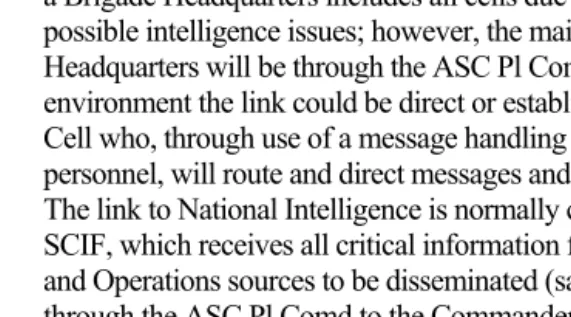
[image:28.612.40.326.342.500.2]g. the ASC layout and especially the SCIF must have controlled access and blackout protected entry points. 9. ASC Interactions (Figure 2-2). The ASC interactions are complete and continuous within all ASC cells. The ASC interaction with a Brigade Headquarters includes all cells due to the broad spectrum of possible intelligence issues; however, the main personal link to a Brigade Headquarters will be through the ASC Pl Comd as G2 Ops. In a digital environment the link could be direct or established through the IM Sp Cell who, through use of a message handling system or intelligence personnel, will route and direct messages and information as required. The link to National Intelligence is normally coordinated through the SCIF, which receives all critical information from Higher Intelligence and Operations sources to be disseminated (sanitized) to the ASC, or through the ASC Pl Comd to the Commander.
Figure 2-2: All-Source Cell Interactions
Flanks/Other
CMBG HQ
Nat’l/
Nat’l/
Nat’l
Nat’l IntInt
G2 Plans Staff
G3 Staff
Bde Units and Attachments
Higher
Higher
Fmn
Fmn//IntInt
ASC Interactions
Coord Centres & LOs
Analysis Sections CCIRM ASC Comd SCIF IM Sp
SECTION 5
ASC BATTLE PROCEDURE
10. Receipts of Tasks (Higher Order Received). As step one of OPP, this task is straightforward; an internal warning order to the staff in the headquarters should be issued, which will lead into mission analysis.
11. G2 Staff Guidance. The G2 guidance provides essential direction to the ASC staff to begin preliminary preparations such as updating available background information and refining basic intelligence. The G2 assigns IPB tasks.
12. Battlespace Environment Defined. The ASC Analysis Cell, when directed, will help identify the geographical limits of the unit's Area of Operation (AO), battle space and area of intelligence interest, area of intelligence responsibility and general physical characteristics of the battlefield. The next IPB step, Battlespace Effects Described, normally does not involve ASC staff but instead focuses on the G2 Plan Staff, G2 Geo, G2 Met, CIMIC, and Engineers Staff as principal players.
13. Threat Evaluated. The ASC Analysis Cell will help the G2 Plans staff using basic intelligence, doctrinal templates, and open source intelligence to refine basic intelligence and doctrinal
templates, develop situational templates and the initial HVTL, identify intelligence gaps and threat capabilities and weaknesses. 14. Develop Threat COAs. The ASC Analysis Cell will aid the G2 Plans staff in combining the products of the previous IPB steps in order to assess potential adversary courses of action and to develop situational templates, event templates, draft the information collection plan, and update the HVTL. Once the most likely, next likely, and most dangerous courses of action have been developed the G2 and G2 Plans will participate in COA Wargaming. The resulting products from the COA wargame will be a draft AGM, updated collection plan, draft decision support template and draft synchronization matrix.
16. ISTAR Matrix Developed. The ASC CCIRM, ASC Pl Comd in conjunction with the G2 Plan Staff, and Sensor Liaison Officers, will draft the ISTAR matrix in conjunction with the G3 ISTAR staff. Once approved and sensor, source, and agency tasks have been coordinated, the ISTAR Matrix will be published. 17. Intelligence Gaps Identified. The ASC Analysis Cell, ASC CCIRM, and G2 Plan Staff will use the updated Collection Plan and updated Current Intelligence, and refined and published ISTAR Matrix to identify the Intelligence Gaps.
18. New PIR/IR Identified/Developed. The ASC CCIRM and ASC Pl Comd can identify PIRs and IRs to augment/refine those that the commander has already identified and stated as being critical for operations and planning (approval is required by the G2 and or G3 ISTAR (possibly titled Chief of Staff or CO ISTAR).
19. Sensor, Source, and Agency Tasking Recommended. The ASC CCIRM and ASC Pl Comd, in liaison with G3 ISTAR and Sensor, Source, and Agency LOs, will evaluate the products listed under input requirements and the current situation to recommend taskings. The ASC Analysis Cell and ASC CCIRM will ensure currency regarding status for possible utilization of sensor, sources, and agencies for tasking.
20. Intelligence Collection Plan Refined. The ASC Analysis Cell, ASC CCIRM, ASC Pl Comd, G3 ISTAR, and Sensor, Source, and Agency LOs are responsible for identifying Intelligence Collection Gaps and refining the Intelligence Collection Plan (ICP) and ultimately refine and publish the ISTAR Matrix.
21. Sensor Report Handling. The Collator as well as CCIRM will log the incoming report. The Analysis Cell Collator and 2IC will screen the report for urgency and relevance, thereafter,
22. RFI Management. ASC CCIRM receives the RFI, records it, and reviews it with respect to work in progress. To ensure that RFIs are staffed efficiently by grouping similar tasks and exploiting existing current intelligence. ASC CCIRM will group similar RFI to turn them into one task, will consolidate duplicate RFI into a single task, and check the existing current intelligence to determine if there is existing intelligence to respond to the RFI without any further analysis. The ASC CCIRM will update the RFI Status Information. 23. Intelligence Gap Identified. When current intelligence is inadequate, this step will initiate activities within the collection plan execution process. As a result of the previous check of the current intelligence database, the ASC CCIRM determines that the intelligence is inadequate to answer the RFI thereby identifying an intelligence gap. This gap will then be used to initiate new collection within the collection plan execution process. The ASC CCIRM, ASC Pl Comd, and ASC Analysis Cell will use updated RFI Status Information to identify Intelligence Gaps.
24. Suggest Tasking for Collection (answer RFI). CCIRM will suggest the best method to obtain an RFI answer and through liaison between the ASC Pl Comd and the G3 ISTAR create a tasking entering the collection management cycle. Based on current intelligence or collected information, ASC CCIRM will draft a response to the RFI. The response will be verified by the ASC Pl Comd, and verified and signed by the G2. The outgoing RFI will be managed in accordance with outlined RFI management procedures.
SECTION 6 PROCESSES
25. ASC COMD. The ASC Comd Cell answers directly to the G2 and has the following responsibilities:
a. Analyzing single source information and
processing data into accurate, relevant, and timely all source intelligence products.
b. Continuous updating of Red and Brown SA at the ISTAR CC and COP.
c. Warning Intelligence.
e. Conducting CCIRM for the current battle, including:
(1) management (awareness); (2) identification of intelligence gaps; (3) obtaining means to fill identified
intelligence gaps; and
(4) matching received information to stated information requirements.
f. Welfare, discipline, morale and training of ASC/G2 NCMs in coordination with the G2. g. Supervision and coordination of all ASC
administration.
h. Supervise and assist in information collection activities.
i. Assist G2 in the identification of PIRs, Combat Indicators, and NAIs as required.
j. Accountable for all official ASC correspondence. k. Operational readiness of the ASC.
l. Coordination and assign intelligence shifts for the ASC.
m. Control and account for passwords, nicknames and code-words.
n. Review Counter Intelligence plan and coordinate IAW orders.
o. Coordinate Special Access Intelligence.
26. ASC Analysis Cell. The Analysis Cell answers directly to the ASC Pl Comd and has the following responsibilities:
G2 Geomatics will be utilized to improve and develop Brown situational awareness.
b. On some occasions, information will be single source, unevaluated and therefore, could be inaccurate. However, information deemed critical needs to be disseminated at the same time the Analysis Cell is conducting a detailed analysis in an attempt to corroborate the accuracy and relevance of this information.
c. Collation is the core function of the IM cycle. The principle task of the collator is to separate
pertinent information and/or intelligence that is received from incoming data and transform it into a useable form for processing by the Analyst. The collator, as part of the Analysis Cell, is responsible for development and continuous improvement of the database.
d. The Analysis Cell will attempt to exploit any sensor, source, and agency data and information that has not been pre-processed. If required, items deemed “interesting” will be forwarded to the appropriate authorities for further evaluation. 27. ASC IM. The ASC IM Section answers directly to the ASC Pl Comd and has the following responsibilities:
a. The ASC IM Section is to ensure all data sources are exploited, managed, produced, and
disseminated with minimal delay.
b. There are a variety of functions that are the responsibility of the IM section:
(1) collation of incoming/outgoing traffic and data pertinent to the ASC;
(2) database management;
(3) administering intelligence based and red and brown situational awareness web pages; and
c. The IM Sp Cell will ensure an adequate
redundancy of data exists in order to prevent data loss or data accessibility problems. Also, in case a system fails, the IM Sp Cell will make available backup copies of key designated material such as the COP with accompanying overlays. Digital data exchange shall be done in accordance with FSOP 109.
28. ASC CCIRM. The ASC CCIRM Section answers directly to the ASC Pl Comd and has the following responsibilities:
a. The CCIRM Cell will be the central point of contact within the ASC (Brigade Headquarters) for coordinating, answering, replying to and
forwarding RFIs relating to Red and Brown SA. An RFI should be generated to answer CCIRs, PIRs, IRs, and to fill Intelligence gaps. The CCIRM Cell will review each request; to eliminate duplication, establish production priorities, and maintain balanced support to the intelligence community, so no one source is over tasked. RFIs are to be submitted utilizing the format provided in Appendix 1.
b. The Commander’s PIRs are Priority Intelligence Requirements associated with a decision that will affect the overall success of the commander’s mission. The Commander may change the PIRs depending on the evolving situation and mission. IR's are Intelligence Requirements (a subset of PIRs) to fill knowledge gaps. With advice from the Brigade Intelligence Staff, the Commander alone can determine what the PIRs are, and their priority in order to focus intelligence resources on critical information gaps which may affect the overall mission. PIRs generally are very focused and share some common characteristics:
(1) they ask only one question;
(2) they focus on a specific fact; event, or activity;
(4) they are tied to key decisions that the commander has to make.
c. The CCIRM Cell simplifies the collection effort by merging similar requirements. The CCIRM Cell must exercise caution to ensure that in merging requirements it does not lose the intent of either of the original requests. The CCIRM Cell must also ensure that when merging requests it does not lose accountability of the replaced RFI. d. Prior to consolidation the CCIRM Cell searches
established databases for available answers before prioritizing any new RFI.
e. After consolidation, the CCIRM Cell will have a composite list of IRs. Some of these RFIs are more important to mission success then others: therefore, the RFI Mgr must prioritize the list. This prioritizing enables the focus of assets on the most important requests, while economizing assets for less significant areas.
f. The CCIRM Cell must consider the following when prioritizing requests:
(1) Justification. Rationalization and determine the importance of the RFI to the current battle and CCIRs.
(2) Specificity. Scrutinize the request for detail and if possible refine to the most specific what, when and where questions. (3) Timeliness. Determine the RFI
precedence from when the latest time information is of value, and note the time when a reply will no longer be valid or pertinent.
h. RFI Management includes dissemination of reporting and related information to the original requestor and other users as required. All of these functions require a recording system that allows the CCIRM Cell to track the progress of each requirement and cross-reference incoming reports to outstanding requirements.
i. The CCIRM Cell must exercise caution regarding the release and dissemination of material in accordance with SOPs for appropriately classified material.
j. The CCIRM Cell must record who has received what information. It is not uncommon for a concerned user not to receive information, even though the information was marked for
dissemination. Audit trails further optimize dissemination by ensuring that concerned users receive each report only once.
k. As planning or execution of a course of action evolves and as the threat situation develops, Commanders will generate new RFIs. The CCIRM Cell should ensure careful prioritization against the older RFIs rather then simply add them to the existing list. Similarly, the Cell must not simply discount the previous requirements; some may still be valid.
l. Collection Management is the methodology by which an organization or individual focuses the intelligence effort in support of the Commander's PIRs. The collection manager acquires the information that satisfies the Commander’s IRs within specified timelines that support decisions. There are in essence six steps to the collection management process. They are as follows: (1) Develop Requirements. Determine
Commander's PIRs & IRs.
(3) Request Collection. Suggested taskings coordinated through ISTAR CC RFI Managers.
(4) Disseminate. Answers received and analyzed, then disseminated. (5) Evaluate Reporting. Evaluation of
information received against PIRs. (6) Update Collection Planning. PIR
answered/not answered. Suggest
retasking, change PIRs, change collection taskings.
m. All PIR/RFI taskings from the ASC to National and Higher sources will be processed through CCIRM since they are responsible for coordinating and tracking requests and requirements.
n. The ASC must maintain and post a watch list, itemizing those issues for which immediate warning is required. I&W indicators should be integrated into the Intelligence Collection Plan. The watch list must be passed to and coordinated with equivalent organizations of higher and flanking formations. As one of the tenets of Warning is that it is most important when warning of previously unexpected actions, this list must never be considered to be all-inclusive.
ANNEX A
Ref: FSOP 109.13.2 REQUESTS FOR INFORMATION FORMAT
Field Example
A A1 A2 A3
Originator Identification RFI Identification Number (Assigned by RFI Manager) Originating HQ or Cell DTG of submission
A1. (INT 001) A2. 3 PPCLI BG A3. 121300Z Mar 02 B Latest Time Information of
Value (LTIOV) (DTG)
B. 121800Z Mar 02
C Information Required C. What is current radiological hazard along ROUTE SEAGULL between GR 123456 and GR 234567?
D Response Format
(Text, Graphic, Imagery, Video, Any)
CHAPTER 3
ISTAR ORGANIZATIONS AND THEIR RELATIONSHIPS
SECTION 1 GENERAL
1. There are two components to ISTAR: the ANALYSIS component and the ACTIONcomponent. The ANALYSIS component is the ASC while the ACTION component is the ISTAR CC. Everything entering the analyst table in the ASC should already have a first level analysis conducted by the sensor rep attached to the ASC, either physically or virtually. Second level analysis is conducted at the analyst table, where it is fused with other
intelligence and then passed to the ISTAR CC. Targeting data has the highest priority for passage from the ASC to the ISTAR Coridination Centre (CC). Although Geo and Met are resident in the Plans section, they must support both Plans and Current Ops.
SECTION 2
THE ISTAR COORDINATION CENTRE
2. The ISTAR CC is responsible for managing the collection efforts of the formation through the synchronous tasking and active retasking of collectors in support of the collection effort. These efforts include all collectors integral to the formation and those placed under its control.
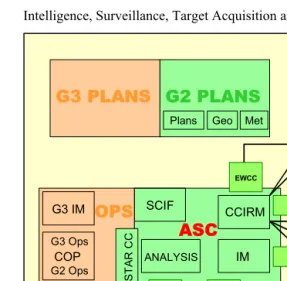
Figure 3-1: ISTAR Org in BDE HQ
4. All ISTAR information is fed directly into the ASC, however, time sensitive information must also be sent to the ISTAR CC with minimal delay for strike and/or sensor retasking. From the ASC, Red and Brown situational awareness (SA) is fed directly into the ISTAR CC. Due to its proximity to the ops station, the G2 has up-to-the-minute ops SITREPs, which allow the flexibility of ISTAR to be used to maximum effectiveness. Within the ISTAR function itself, there are a number of key players who perform a vital role in ISTAR operations. These personnel include:
a. ISTAR Coord. This is the officer in the ISTAR CC who acts as central authority for tasking or retasking decisions. The ISTAR Coord must have complete SA and be intimately familiar with the friendly CONOP. Normally, he is a member of the operations staff.
b. G2. The G2 is is the intelligence advisor to the commander, and he can act as ISTAR Coord. c. G2 Ops is responsible for the overall functioning
of the ASC, including ISTAR planning and execution. CCIRM IM ANALYSIS SCIF IS T A R C C G3 IM COP G3 Ops G2 Ops OPS ASC
G3 PLANS G2 PLANS
Plans Geo Met
d. Plans Cell. The bde Plans team consists of the G3 Plans, the G2 Plans, G4 Plans and all other coordination cell representatives. Assisting the G2 Plans are the Geomatics cell and the Meteorology cell in the execution of Intelligence Preparation of the Battlefield (IPB) and the input of weather and terrain to the enemy course of action assessments. This G2 Plans team coordinates its efforts with those of the ASC. This coordination consists of providing terrain analysis products and meteorological forecasts to the ASC so that the ASC can complete the picture of Brown SA. The Plans team also depends upon the intelligence produced by the ASC as the basis for the intelligence estimate.
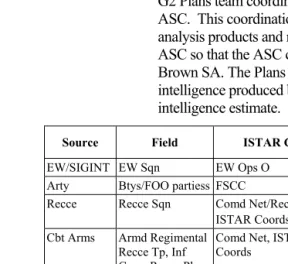
Source Field ISTAR CC ASC Higher/Lateral
EW/SIGINT EW Sqn EW Ops O EWCC SIGINT Arty Btys/FOO partiess FSCC BAIO
Recce Recce Sqn Comd Net/Recce Net ISTAR Coords
Comd Net/Recce Net
Cbt Arms Armd Regimental Recce Tp, Inf Coys, Recce Pl, Unit STANO
Comd Net,ISTAR
Coords Comd Net
Engr Fd Eng Sqns ESCC Engr IO CSS S&T, Maint Admin Net Admin Net
UAV ASCC CGS
ERSTA Tac Hel Sqn ASCC CGS HUMINT HUMINT Pl HUMINT LO
IMINT DIST CFJIC
TECHINT Virtual3
MEDINT Fd Amb Virtual4
MET MET (G2 Plans
cell)
GEO GEO (G2 Plans
[image:43.612.76.364.222.486.2]cell)
Table 3-1: Typical Source Representation
3 Secondary duty for Int pers. Direct Support Battlefield TECHINT Teams
may be deployed as required.
4 Secondary duty for Int pers. MEDINT Specialists may be deployed as
e. Brigade Artillery Intelligence Officer (BAIO). The BAIO is responsible for coordinating higher surveillance (UAV, counter mortar, counter battery) and is resident in the ASC.
f. G3 Aviation/G3 Air. At the ISTAR CC, these pers provide the advice and coordination for attack helicopter (AH), close air support (CAS) and joint air attack teams (JAATs). It is critical that these missions be coordinated with the FSCC and ASCC to avoid duplication of effort, prevent scattering of targets and reduce the risk of fratricide.
g. Engineer Int. Engineer Int is a very specialized task. The engineers must identify information requirements to the HQ staff for inclusion in the collection plan. Engineers provide the assets that conduct reconnaissance as well as the specialized skills to process and analyze engineer related information collected and report by various all arms sources.. However, general engineer information can be collected and reported by all arms. The products of engineer reconnaissance, which result in information related to both the enemy and the terrain, are essential to the COP. Copies of all engineer reconnaissance reports must be submitted to the ASC for inclusion in the COP. Since the ASC is responsible for Red and Brown SA, the ASC must coordinate closely with the ESCC to ensure that the results of engineer analysis are accurately incorporated into the COP and are accurately disseminated through the intelligence system.
h. Attached Assets. The multifaceted characteristic of the ISTAR CC allows any other asset
(CEE) and captured enemy documents (CED), is a direct product of the execution of their own missions. Information is also collected as a result of an information collection task issued as part of the formation operations order. Additionally, information can be collected incidental to their operations, such as information on routes or civilian population movements, which can be gained during sustainment operations.
SECTION 3
THE ALL-SOURCE CELL
5. As already described, the role of the ASC is to provide analysis and collection coordination within the ISTAR system. It provides Red and Brown SA to the ISTAR CC to assist in coord of targeting and answers directly to the G2 in the ISTAR CC. The ASC does not have authority to physically move sensors since only the ISTAR CC, based on G2/G3 coordination, has the authority to move or retask sensors.
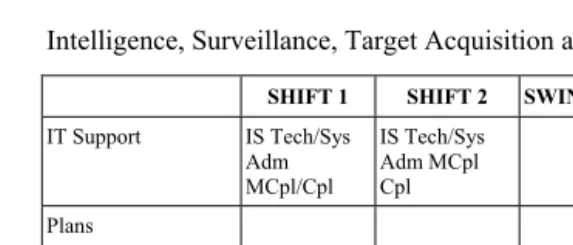
SHIFT 1 SHIFT 2 SWING REMARKS
ISTAR CC Manning: 2-1-2
G2
G2 Ops G2 Ops WO Plotter/ Track
Manager Plotter/dvr Cpl Plotter/dvr Cpl
ASC Manning: 2-3-8
ASC Duty Offr Capt 82A Lt 111 Fusion Analyst Sgt 111 MWO 111 Fusion Collator/ Data
Coord Cpl/MCpl 111 Cpl/MCpl 111 Plotter/ Track
Manager Cpl/Pte 111 Cpl/Pte 111 CCIRM5
Collection
Manager MCpl/Sgt 111 or 291 w/ Cbt Int trg
Cpl/MCpl 111 or 291 w/ Cbt Int trg
Data mining, ICP management, RFI manager for RFIs to higher (works PSSS/SPARTAN (STONEGHOST for Coalition ops) Collection
Coordinator WO 111
SHIFT 1 SHIFT 2 SWING REMARKS
IT Support IS Tech/Sys Adm MCpl/Cpl IS Tech/Sys Adm MCpl Cpl Plans
G2 Plans Plans WO Manning: 1-1-2 CCIRM Collection
Manager Cpl/MCpl 111 or 291 w/ Cbt Int trg
MCpl/Sgt 111 or 291 w/ Cbt Int trg
[image:46.612.38.325.52.174.2]Manning: 5-5-12
Table 3-2: Suggested ISTAR CC/ASC Org
6. The ASC coordinates the continuous collection effort throughout the formation on behalf of the G2. This coordination function is executed by consolidating respective unit ISTAR plans and incorporating them into the formation plan. The ASC also requests information from national, higher and flanking sources and processes the information received from those sources. The ASC is responsible to the G2 for:
a. fusion of sensor data into a timely all-source product;
b. continuous updating of Red and Brown SA at the ISTAR CC and COP;
c. warning intelligence—constant vigilance is required for problems which were not originally included in the comd’s PIRs;
d. collection, coordination, and intelligence requirements management (CCIRM) for the current battle;
e. minute-by-minute sensor management on behalf of the ISTAR CC;
f. continuous liaison with all sources to maximize synergy and overlapping coverage; and
g. constant update of sensor status and availability.
SECTION 4 SENSOR MANAGEMENT
amendments/retaskings as they happen and shall retain authority to override or cancel.
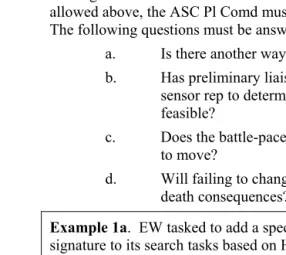
8. Sensor Tasking Changes. Should the ASC determine that a change must be made to a sensor tasking, which is beyond that allowed above, the ASC Pl Comd must liaise with the ISTAR CC. The following questions must be answered before this is done:
a. Is there another way to get the data required? b. Has preliminary liaison been effected with the
sensor rep to determine if the change is even feasible?
c. Does the battle-pace allow for the retasked sensor to move?
d. Will failing to change the tasking have life and death consequences?
Example 1a. EW tasked to add a specific radar signature to its search tasks based on HUMINT reporting of SAM assets or to confirm a spurious imagery sighting of AD kit
OK
Example 1b. Recce ptl tasked to deviate from its
patrol route in order to investigate same sighting NOT OK
Example 2a. UAV flight path changed to assess
precise origin of radar emission detected by ELINT NOT OK
Example 2b. UAV GCS operator asked to adjust look angle of camera without altering UAV flight path in order to assess precise origin of radar emission detected by ELINT
[image:47.612.73.360.164.419.2]OK
Table 3-3: Sample ASC Retasking Situations
9. Requirements for changes should be assessed to determine scope for improvements in future planning and assessment.
SECTION 5
ISTAR COORDINATION CENTRE LAYOUT IN A BRIGADE HEADQUARTERS
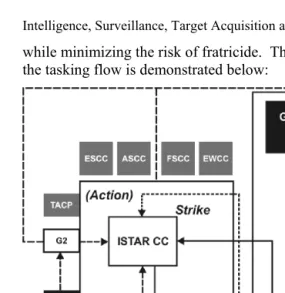
while minimizing the risk of fratricide. The set-up of the bde CP and the tasking flow is demonstrated below:
Figure 3-2: 1 ISTAR CC Tasking Chain
SECTION 6
ALL-SOURCE CELL REPORTING
11. Sensor reporting will normally be direct through the sensor’s chain of command to the ASC fusion table. The ASC has two important duties which must be balanced against each other continuously:
a. ensure timely flow of significant amounts of accurate information and intelligence; and
NOTE
While the ASC can be physically separate from the ISTAR CC (a requirement imposed by footprint required for the ASC as well as security levels of material
b. prevent information overload at the ISTAR CC and COP.
12. The ASC fusion table will provide a continuous update of SA data and intelligence to the ISTAR CC and COP. This data will primarily be in the form of graphical map updates, which are refined as information is focussed or additional intelligence is derived. Prior to reporting being passed to the ISTAR CC and the COP, the fol questions should be satisfactorily answered:
a. Is the information relevant?
b. Is the information of an acceptable reliability? c. Is the information of sufficient granularity to add
knowledge to the COP? d. Is the information timely?
13. Data that does not meet the above criteria should be held for further amplification, explanation or confirmation.
SECTION 7
BYPASSING OF NORMAL PROCESSING
14. Information which may have an immediate effect on the tactical situation, or which may require the commander to make immediate decisions, must be transmitted in a more immediate way. Information which meets any of the following criteria must be considered for immediate passage:
a. positive reporting regarding weapons of mass destruction (WMD);
b. data which is of direct benefit to the targeting process;
c. reporting which indicates an immediate threat increase to deployed troops, likely to result in casualties if action is not taken;
d. reporting which significantly changes collateral damage risks to active targets (e.g., report of children in buildings previously assessed as unoccupied); and,
e. reporting which significantly changes previously assessed enemy capability, intent, or coarse of action (COA).
immediate warning is required. Indications and warning (I&W) should be integrated into the intelligence collection plan (ICP). The watch list must be passed to and coordinated with equivalent organizations of higher and flanking formations. As one of the tenets of warning is that it is most important when warning of previously unexpected actions, this list must never be considered to be all-inclusive.
16. When either the ASC and/or a sensor obtains information or derives intelligence that warrants immediate passage, it shall be passed immediately to the ISTAR CC. This does not relieve the ASC and individual sources from the requirement to continue further developing this data into a normal update and fully analyzed end product.
SECTION 8 TARGETING
17. The targeting cycle (decide, detect, deliver, assess) must be closely integrated with the ISTAR information flow in order to ensure effective and timely exploitation of information. The
targeting cycle is a continuous process, which requires flexibility and timely response to be effective. The following staff have a direct involvement in the targeting cycle:
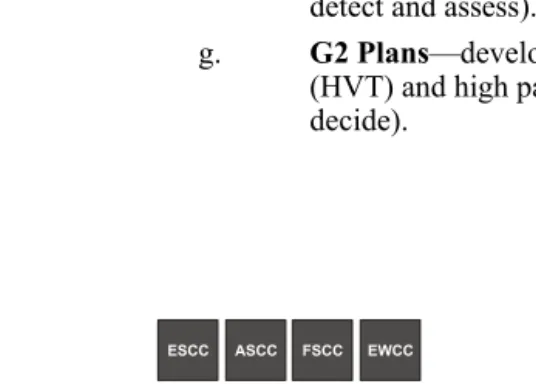
a. FSCC—normally coordinates targeting activity (i.e., deliver).
b. ESCC—assist in coordinating targeting and BDA activity. Destroying infrastructure targets may limit the military options for an enemy in the short term but may create significant limitations on own forces in the long term. Engineer input may assist in effects based targeting by denying rather than destroying targets. Engineers can identify alternative targets that create similar effects without consequent limitations and cost. Emplacement of scatterable mines or a reserve bridge demolition, to hinder enemy mobility, are examples of targeting advice.
c. ASCC—coordination of air assets, provision of battle damage assessment (BDA) from air assets (i.e., deliver and assess).
perspective must also be passed into targeting cycle (i.e., detect and assess).
e. G3—coordinates overall application of force (i.e., decide and deliver).
f. G2—ensures target locational data is passed to appropriate authorities. Assists G3 in determining target values and vulnerabilities (i.e., decide, detect and assess).
[image:51.612.79.347.225.417.2]g. G2 Plans—development of high value target (HVT) and high payoff target (HPT) lists (i.e., decide).
CHAPTER 4
CHARACTERISTICS AND EMPLOYMENT OF ISTAR COLLECTION ASSETS
SECTION 1 INTRODUCTION
1. The term ISTAR is used to refer both to the operational process and to the personnel, assets and architecture involved in the process. The entire range of assets should be considered during the operational planning process (OPP) for any deployment. On most operations, though various issues may prevent the commander from employing all possible assets, an effort must be made to fully exploit the range of capabilities to ensure that a synergistic “mix” is
deployed. Attention must also be given to non-specialist assets organic to the deployed organization. Again it is stressed that ISTAR does not replace the asset owner’s tactical control. Assets which must be considered and which will be discussed below include:
a. artillery (arty) assets; b. reconnaissance squadron; c. armoured regiment; d. infantry, to include: e. sniper detachments, f. recce platoon, and, g. rifle companies; h. engineer assets;
i. combat service support (CSS); j. electronic warfare (EW); k. unmanned aerial vehicle (UAV);
l. electro-optical reconnaissance, surveillance and target acquisition (ERSTA);
m. air;
n. air defence (AD);
p. imagery intelligence (IMINT) or defence imagery support team (DIST);
q. technical intelligence (TECHINT); and, r. medical intelligence (MEDINT).
SECTION 2 ARTILLERY ASSETS
2. General. The role of artillery is to assist in the defeat of the enemy with indirect fire as part of the all-arms battle. With its intrinsic flexibility, field artillery can be brought to bear on deep, close and rear operations simultaneously if necessary. It must be synchronized with other battlefield activities in terms of time, space and purpose to achieve the optimum concentration of force. Target priorities must be established, and artillery must be used
aggressively in concert with other firepower assets and intelligence, surveillance, target acquisition and reconnaissance (ISTAR) resources.
3. Two aspects of artillery ISTAR capability are implicated directly in the operation of the All-Source Cell (ASC) and the ISTAR Coordination Centre (ISTAR CC):
a. locating artillery; and
b. the Fire Support Coordination Centre (FSCC). 4. Locating artillery is responsible for:
a. target acquisition; b. direction of fire;
c. combat surveillance; d. artillery intelligence;
e. survey; and
f. meteorological data.6
5. The FSCC is employed so that each indirect fire asset is used to the best advantage, in the most effective and efficient manner and such that all conflicting demands are resolved. Careful
coordination of all fire support resources must be carried out in accordance with the following guidelines:
a. Requests for fire support must be assigned to the agency that can deliver the most effective fire in time.
b. Fire support requests and calls for fire must be submitted directly to the agency that will deliver the fire.
c. The effects of fire support furnished must meet the wishes of the supported arms commander. If the commander’s request cannot be met, viable alternatives must be suggested and provided. d. Care must be taken to prevent fratricide.7
6. Advantages of Artillery:
a. Artillery personnel are likely able to provide excellent advice when dealing with intelligence problems relating to enemy indirect fire systems. b. Forward observation officer (FOO) parties, trained
observers located well forward with good observation equipment and good comms, are ideally placed to report on enemy artillery near the forward edge of the battle area (FEBA).
c. FOO parties can often provide battle damage assessment (BDA) data immediately after indirect fire and CAS missions.
7. Artillery roles in the ASC. The BAIO is located in the ASC with one additional officer to act as a duty officer, plus technicians and communicators.8 There will be one officer, one senior
technician and a junior technician/communicator on duty at all times. This cell is provided from the locating troop of the field regiment. The BAIO, located in the ASC, provides:
a. hostile battery (HB) lists;
7 B-GL-371-003/FP-001 Field Artillery Operational Procedures, Chapter 4.
8 B-GL-371-003/FP-001 Field Artillery Operational Procedures,
b. weapon density overlays;
c. artillery intelligence summaries (arty INTSUMs); d. artillery supplementary intelligence reports (arty
SUPINTREPs);
e. SITREPs and INTREPs, as required; f. advice and liaison to the collection planning
process; and,
g. BDA data, by liaising with FOO parties.
8. Artillery Assets at the ISTAR CC. The FSCC is located at the brigade (bde) HQ as a part of the ISTAR CC.
9. ASC Responsibilities to the BAIO. The ASC shall ensure that the BAIO is provided and continually updated with:
a. working space;
b. locations, capabilities and ORBAT of all known enemy arty assets;
c. the commander’s priority intelligence requirements (PIRs);
d. the information operations (IO) plan; and e. the ISTAR plan.
SECTION 3
RECONNAISSANCE SQUADRON
surveillance. Without important augmentation in firepower, the recce sqn has almost no capability to impose delay on a determined enemy. It can observe, report, maintain contact and provide warning but little more.
11. Categories of Reconnaissance. Land force reconnaissance is categorized as follows:
a. Combat Reconnaissance is the collection of information by combat arms elements within battle groups in the course of close combat with the enemy.
b. Close Reconnaissance is conducted by a battle group or brigade group headquarters on specific tasks within their areas of influence. This is the domain of the brigade reconnaissance squadron and of infantry reconnaissance platoons. c. Medium Reconnaissance is conducted by
reconnaissance units under the direct control of a higher formation headquarters. The range of operations could extend to the limits of the formation's area of interest with the purpose of determining the location, composition and disposition of enemy reserves, nuclear delivery means and supporting troops that can influence the immediate battle.
d. Long Range Reconnaissance involves the collection of information beyond the limits of medium range reconnaissance. Special units will normally conduct long range reconnaissance. 12. Advantages of the recce sqn include the following:
a. Mobility. The recce sqn can move by roads or cross-country in any terrain that is passable by the brigade. Unit personnel are capable of foot patrolling; however, such operations separate the crews from their vehicles and hinder subsequent mobility.
of tasks, quick deployments and the rapid execution of diverse taskings.
c. Logistic Economy. With its inherent administrative echelon and the range of its vehicles, the recce sqn is capable of extended operations with a minimum of logistic support. 13. Disadvantages of the recce sqn include the following:
a. Lack of Firepower. This precludes fighting for information or the execution of guard or delay missions without augmentation in firepower. b. Vulnerability in Close Quarter
Fighting. Because of the noise of the vehicles and the limited manpower available for dismounted patrolling, the recce sqn is extremely vulnerable in, or on the periphery of, built-up areas or woods. Supporting infantry is required to provide protection.
c. Endurance. The recce sqn has no spare crews. Prolonged operations, situations of continued stress and casualties will rapidly become limiting factors. d. Reserve. It will seldom be possible for
the recce sqn to retain a strong reserve.9
e. Deployment Time. Coming into and out of action requires 20 to 40 minutes for either operation when deploying the Coyote sensors. These timings must be taken into account when executing the ISTAR plan.
14. The recce sqn provides reporting through established comms nets, which are monitored by the ASC.
15. Recce Sqn in the ISTAR CC. In a brigade deployment, the recce sqn will not normally have a permanent physical presence in the ISTAR CC or at the ASC. The recce sqn laison officer (LO), representing officer commanding (OC) recce sqn, is the brigade comd’s recce advisor. The recce sqn LO, or the OC recce sqn will attend the ISTAR coord meetings. The recce sqn’s presence in the ASC is virtual: ASC staff will be required to monitor the recce net. 16. ASC Responsibilities to the Recce Sqn. It is vital that close liaison be maintained with the recce sqn HQ. The following must be available to the recce sqn at all times:
a. the commander’s PIRs; b. the ISTAR plan;
c. Red SA;
d. Brown SA;
e. Blue SA, with due consideration given to operational security (OPSEC); and f. debriefing assistance when required.
SECTION 4
ARMOURED REGIMENT
17. The Reconnaissance Troop is the only dedicated
reconnaissance element in the regiment. The troop may be employed on reconnaissance, surveillance, security or other tasks, reporting directly back to RHQ, or it may be placed under command or in support of one of the squadrons, either in total or by patrols. 18. Typical tasks for the troop include:
a. reconnaissance of counter-attack and blocking routes;
b. advance, flank or rear area surveillance;
c. acquiring terrain (going) information for the tanks; d. maintaining contact with the enemy;
e. surveying chemical or radiological contamination; f. traffic control;
h. liaison duties; and
i. communications tasks.
19. The troop shares the advantages of all armour assets, firepower, protection, mobility, flexibility and ability to hold ground. In ISTAR terms, this asset can move, fight and report making it a durable and flexible reconnaissance platform.
SECTION 5 INFANTRY
20. General. The function of Infantry is to close with and destroy the enemy. For the purposes of ISTAR, experience has demonstrated that infantry assets, due to their widespread position on the battlefield, are ideal sources of information
21. Infantry Assets. Whether a battle group or brigade sized operation, the following assets will likely be available:
a. Capable of limited independent action, infantry companies can conduct various types of patrol activity, from company to detachment size. b. Reconnaissance platoon (recce pl), consisting of
patrol and sniper detachments, equipped with higher fidelity observation equipment and specialist training, which permits recce pl
detachments to carry out long-range patrol activity similar to that carried out by allied nations SOF. 22. Infantry Employment. Infantry elements can provide valuable information through:
a. ops; b. patrols;
c. contact reports; and d. SITREPS.
24. Infantry Roles in the ASC. Infantry presence in the ASC is virtual. The ASC staff will be required to monitor the comd net. Contact reports and SITREPS form a critical part of Red SA. 25. Liaison with infantry units and assets will occur through the G3 Ops.
26. Patrol (ptl) debriefings will normally be conducted by the Battle Group Intelligence Officer (BG IO) except as noted below. a. Where a ptl is tasked at the ISTAR CC level, it
may be required to provide briefing and debriefing at the ASC. Specific questions that the ptl is to answer must be coordinated with ops staff and be passed to them as soon as practicable. To be effective, this must be scheduled early during the planning stages. Soldiers must know ahead of time that their observations will have value and that they will be required to report them. Failing to plan ahead for patrol debriefs leads to missed opportunities, missed details and disgruntled soldiers.
b. Patrol debriefings must be ready for the ptl on its return. They will normally be conducted by the ASC duty offr/WO. It is critical that the fol be kept in mind:
(1) Relevant specialists (Engr Rep, BAIO, etc.) must be aval and awaiting the ptl on its return.
(2) Questions must be prepared in writing ahead of time.
(3) Operational security (OPSEC) must be kept in mind. Most patrol members will NOT be cleared.