rr" ' _ _ - - - - "
:';",
P
H I LC 0
EL E CT RO N I C DATA PRO CESS I N G SYST EMS
.
-
.
catalog
of
•
•
•
•
•
•
•
•
•
•
•
•
•
PRINTED
MATERIAL
preface
PHILeo
A 5uSSIDIARY Of ,5i;;V/(oIor't5V?n/lany,
catalog of
COMPUTER DIVISION
This catalog replaces the Catalog of Printed
Material dated May 1962. All publications
issued after that edition are indicated by an
asterisk following the catalog number.
Addi-tions to this catalog are announced
period-ically in NEW LITERATURE
ANNOUNCE-MENTS which are numbered serially with
reference to this edition of the catalog. The
NEW LITERATURE ANNOUNCEMENTS may
be inserted on the inside back cover of this
catalog.
The program and subroutine descriptions
listed in this catalog are for those programs
and subroutines distributed and maintained
by the Philco Computer Division
Program-ming Department. TUG, the Philco 2000
Users' Group, distributes descriptions and
programs contributed by the TUG
member-ship.
The TUG Program Abstract Listing
contains all programs in the TUG Library.
Copies of the TUG Abstract Listing and
addi-tional copies of this catalog are available on
request.
contents
PHILeo
catalog of
COMPUTER DIVISION
Page
TECHNICAL MANUALS (TM). . . .
1
PROGRAM DESCRIPTIONS (PD). . . .
5
PROGRAM REPORTS (PR). . . .
7
PROGRAMMING R AND D NOTES (RD) . . . .
9
BROCHURES AND FACT SHEETS. . . ..
11
TAC SUBROUTINES - MATHEMATICAL (8M)..
13
Trigonometric (SMA) . . . ..
13
Logarithm and Exponential (SMB) . . . ..
14
Powers (SMC) . . . ..
14
Integration (SMD). . . ..
14
Solution of Differential Equations (SME). ..
15
Special-Purpose Arithmetic (SMF) . . . . ..
15
Statistics (SMG). . . ..
16
Management Sciences (SMH). . . ..
1 7
Matrix Operations (SMI) . . . ..
18
Interpolation (SMJ). . . ..
19
Random Numbers (SMK) . . . ..
19
Solution of Equations (SML) . . . ..
19
Special Functions (SMM) . . . ..
19
TAC SUBROUTINES - DATA
CONVERSION (SDC) . . . ..
21
TAC SUBROUTINES - DATA
PROCESSING (SDP) · · . · . · · · . · · · . .
23
TA.C SUBROUTINES - INPUT-OUT"PUT (SIO).
25
SYS SUBROUTINES (SSYS). · · · .. · · . . . . · ..
27
TAC MACRO-INSTRUCTIONS (M) · · . · · · . · ..
29
CAT. NO. TM-6A*
TM-7 A*
TM-8
TM-9
TM-10
TECHNICAL MANUALS
TECHNICAL MANUALS
Technical manuals provide full documentation on the specifications and use of Philco electronic data processing system components and programming systems.
DATE
July 1962
July 1962
Nov. 1960
Dec. 1961
Jan. 1963
TITLE AND DESCRIPTION
OPERATING CONTROLS MANUAL. Describes the functions and features of controls and indi-cators of units of Philco 2000 Computer Systems listed below:
Central Computer (Philco 210, Philco 211) Console Typewriter
Input-Output Processor Magnetic Tape
Punched-Card System Paper Tape System Magnetic Drum System Universal Buffer-Controller
Each of these sections is available separately.
LINEAR PROGRAMMING SYSTEM - LP-2000. Describes a comprehensive system for the solution of linear programming problems. Dis-cusses the options available, the input formats required, and the outputs produced.
PHILCO 2000 SYSTEMS DESCRIPTION.
De-scribes the features of the Philco 2000 system, the Central Computer, input-output equipment, performance speCifications, programming in-formation, installation data, and an equipment list.
PHILCO 2000 INSTALLATION GUIDE. A guide to the planning and preparation required for a Philco 2000 computer installation. Describes requirements for power and air conditioning, maintenance and service, installation time-table; illustrates typical layouts and provides an equipment specification table.
TECHNICAL MANUALS
CAT. NO.
TMS-10*
TM-ll
TM-12C*
TM-16S*
TM-17
TM-1SA*
2
DATE July 1962
Aug. 1962
Jan. 1963
Nov. 1962
Nov. 1961
July 1962
TITLE AND DESCRIPTION
PHILCO 212 COMPUTER SYSTEM. A supple-ment to the Programming Manual TM-10, de-scribing those aspects of the Philco 212 which are in addition to or different from those de-scribed for the Philco 210 or Philco 211.
TAC MANUAL - TRANSLATOR-ASSEMBLER-COMPILER. Describes the Philco 2000 Trans-lator-Assembler-Compiler system. Contains specifications and descriptions of instruction formats, control instructions, constants, and library routines.
PHILCO 2000 TOTAL OPERATING AND
PRO-GRAMMING SYSTEM - TOPS. Describes an
automatic programming and integrated operating system which permits simplified programming of business applications.
PHILCO 2000 INPUT-OUTPUT SYSTEMS. Pro-vides detailed descriptions of the below listed Philco 2000 input-output devices, their functions and input output orders.
Magnetic Tape (90KC) Input-Output Processor
High-Performance Magnetic Tape (240KC) Universal Buffer-Controller
Punched-Card System Paper Tape Systems
Accounting Clock Printing Systems X-Y Plotter
Magnetic Drum System Real-Time System Console Typewriter
Each of these sections is available separately.
PHILCO 2000 SORT GENERATOR MANUAL. Presents a detailed description of the Sort Program released November 1961 and its opera-tion and use.
INPUT-OUTPUT PROGRAMMING SYSTEM lOPS. Describes the use of lOPS, a series of TAC library generators which automatically generate all the coding necessary to perform
CAT. NO. TM-19A TM-20* TM-21* TM-22* TM-23* TM-24* DATE
Feb. 1963
July 1962·
Feb. 1963
Od. 1962
Jan. 1963
Jan. 1963
TITLE AND DESCRIPTION
TECHNICAL MANUALS
PHILCO 2000 PERT SYSTEM. Describes the
preparation of PERT programs using the Philco
2000 PERT System. It includes an introduction
to PERT, input and output formats, initial and successive PERT runs, and associated diag-nostic, service and error correcting routines. STATISTICAL SYSTEM - STAT. Describes an automatic programming system designed to perform statistical functions. The functions include: Mean, Variance, Standard Deviation, Median, Simple Regression, Multiple Regres-sion, Polynomial Approximation, Exponential Approximation, Minimum Number, Maximum Number, and Range of Numbers.
PHILCO 2000 SORT SYSTEM. Contains a com-prehensive description for the user of the Sort System released February 1963. Includes tape formats, parameter examples, and error recovery procedures.
PHILCO 1000 COMPUTER SERIES. Describes the Philco 1000 computer series, its instruc-tions and input-output operainstruc-tions.
PHILCO 2000 OPERATING SYSTEM - SYS.
Describes Version E of the Philco 2000
Operating System. Service routines and TAC Library routines included are listed below:
Service Routines AIDE (SYSAIDE) ANALYZEB BINDEL DATA
RPLC (SYSRPLC) SYSTRACE
TACLTC
T ACSERV (T ACSERVS) SYSFLID
TAC Library Routines LOADGEN
SNAPGEN
PHILCO 2000 COBOL - This manual describes the Philco COBOL Programming System for use with any computer in the Philco 2000 Com-puter Series. Included are all elements of re-quired COBOL-61. Philco COBOL electives are
TECHNICAL MANUALS
CAT. NO.
TM-26*
TM-27*
4
DATE
Nov. 1962
Jan. 1963
TITLE AND DESCRIPTION
PHILCO 2000 CRITICAL PATH SCHEDULING
SYSTEM - CPS. Describes a programming
system designed to aid management in planning and evaluating project schedules.
ALTAC III. Describes ALTAC, a Philco 2000
CAT. NO. SR-l SR-2 SR-3 PD-2 PD-3 PD-l0 PD-llA* PROGRAM DESCRIPTIONS
PROGRAM DESCRIPTIONS
Program descriptions present final specifications of programs available to the general programmer, describing the features and use of the program. Service routines listed are designed primarily for those installations which do not use the Philco 2000 Operating System (SYS).
DATE
10/26/60
12/15/60
2/1/61
Nov. 1961
Apr. 1961
May 1962
Oct. 1962
TITLE AND DESCRIPTION
RPL LOCATOR. Service routine, provides a means of searching a machine language tape for a given program, and of reading that program into memory.
RPL CORRECTOR. Service routine, provides a means for revising a machine language pro-gram tape by copying, deleting, adding, or cor-recting specified programs in running program language.
AIDE. Service routine, provides a means of
reading, writing, spacing, comparing, copying, and correcting magnetic tapes.
DUMPCON. Edits dump data supplied by SYS
on logical Magnetic Tape Unit 2 into off-line printer format.
TAC II. Contains preliminary information on
the TAC II compiler, the changes from TAC I, pseudo-operations, machine language outputs, error indications, operating instructions and other information.
In addition, it includes information on the following:
TAC II Loader lOPS II
PROC Changes for T AC II ALTAC Changes for TAC II Bibliography
FLID - A PROGRAM TO FIND OR LIST ID'S. Finds or lists the identities of RPL, ABS, REL, and TACL programs in Code or Image Mode. FLID can also be used to position any tape following a specified sentinel block.
PROGRAM DESCRIPTIONS
CAT. NO.
PD-12*
PD-13*
6
DATE
Oct. 1962
Jan. 1963
Feb. 1963
TITLE AND DESCRIPTION
THE FILE MACRO INSTRUCTIONS. Describes the macro-instructions, WRF, RDFF, and RDFB, used for writing, forward reading, and backward reading a file of information on magnetic tape.
ANALYZER. Describes a service routine which locates, analyzes, and lists all references made by a program, or a portion of the program to a specified area in memory.
TACSERV. TAC service routine, provides a
PROGRAM REPORTS
-" .
-CAT. NO.
PR-3a PR-4 PR-5 PR-6 PR-7 PR-8 PR-9 PR-10
PROGRAM REPORTS
Program reports describe details of Philco programs for the systems programmers, as well as specialized mathematical programs. DATE 2/5/62 6/24/59 8/1/59 2/8/60
7/1/60 .
4/13/60
10/12/60
10/1/61
TITLE AND DESCRIPTION
MATRIX INVERSION. Describes a program for the inversion of matrices by the Gauss Elimi-nation Method and the T AC Subroutine, FMAIN, which performs the inversion.
EIGENVALUE COMPUTATION. Describes a program for the computation of the Eigenvalues and Eigenvectors of a real, symmetric matrix by the Jacobi Diagonalization Process. This report includes a standard description of TAC Subroutine FEIGT J.
LINEAR PROGRAMMING. Describes a
pro-gram for the solution of linear propro-gramming problems by a composite simplex algorithm. This report includes a standard description of TAC Subroutine FLP.
DIFFERENTIAL EQUATIONS. Describes a
program for the solution of a system of N first order differential equations with error control using the Modified Euler Integration Technique. This report includes a standard description of TAC Subroutine FICE.
ROOTS OF A POLYNOMIAL. Describes a program for the evaluation of the roots of a polynomial with real coefficients. This report includes a standard description of TAC Sub-routine FPORC.
L.P. EDIT ROUTINES. Describes an input edit, FLPI, and an output edit, FLPO, which are associated with linear programming routine, FLP. The FLP Routine is described in Pro-gram Report No.5.
RUNGE-KUTTA INTEGRATION. Describes a program for a solution of a system of N first order differential equations with error control using the Runge-Kutta Integration Technique.
PROGRAM REPORTS
CAT. NO. PR-ll
PR-12
PR-13
PR-14
PR-16
8
DATE
10/1/61
1/2/62
May 1962
3/27/62
12/1/62
TITLE AND DESCRIPTION
TRANSPORTATION PROBLEM. Presents two programs, a transportation problem routine (TRAN), and an associated input-output edit routine (TRANED). TRANED accepts data in units of one block, converts the data to a form required by TRAN, and leaves various tables stored in memory.
TAPE TRANSLATOR EDIT ROUTINE.
De-scribes TAC Subroutine, TUIGNR, which can be used to interpret a Philco tape produced from an IBM tape via the Philco Tape Translator,
Model 231. Since IBM tape is composed of
variable length records, and Philcotape contains fixed length blocks, the translator inserts control field information on the Philco tape.
PROGRAM FOR LIBRARY UPDATING AND
MAINTENANCE (PLUM). Used to update
li-brary tapes, create a new lili-brary tape, or
up-date an old tape. It enables the librarian to
replace, delete, or add macros, generators, TAC L subroutines or binary relocatable sub-routines and produce an edited listing.
TAPE ERROR ROUTINE. Describes TAPER, a subroutine designed to be used with PROC or
lOPS. It analyzes tape errors and provides for
possible recovery.
PIOS. Describes a collection of input/output
CAT. NO. RD- 25
RD-34
RD-37*
RD-40*
RAND D NOTES
PROGRAMMING RAND D NOTES
Rand D Notes are the initial documentation of the most recent programming developments. They are prepared for immediate distribution to all interested parties.
DATE 5/15/60
3/2/62
5/25/62
10/15/62
TITLE AND DESCRIPTION
MAGNETIC TAPE MACRO-INSTRUCTIONS.
Describes specifications for magnetic tape ma-cro-instructions and their functions. Describes the Subroutine PROC and its method of storing and executing input-output orders. Appendix I contains a description of macro-instruction ERRORS, and error correcting routine for use with magnetic tape macro-instructions.
CHECK8. Describes a new version of the SYS program which checks to see that card-to-tape transfer of data does not result in faulty tran-scription.
ADVANCE ITEM MACROS - Describes the macro-instructions, as listed below, which pro-vide for writing, forward reading, and backward
reading on magnetic tape.
RFFILE RFITEM RFRUNOUT RBFILE RBITEM RBRUNOUT WRFILE WRITEM WRRUNOUT SENTFILE
CAT. NO. AB-3 AB-12A *
1A* 2* 30*
4*
9A*
10*
11*
12* 13A*
14A* 16*
17 A*
18*
BROCHURES AND FACT SHEETS
BROCHURES AND FACT SHEETS
Brochures and Fact Sheets provide summarized information on Philco computer systems, programming systems, and services to customers.
DATE
Feb 1963
Aug. 1962
May 1962
Jan. 1963
May 1962
Jan. 1963 Dec. 1962 Dec. 1962 Dec. 1962
Jan. 1963
Jan. 1963 Dec. 1962
Jan. 1963 Dec. 1962
TITLE AND DESCRIPTION
CUSTOMER TRAINING. Describes the various customer training programs, courses, and man-agement seminars offered by Philco Computer Division.
CATALOG OF PRINTED MATERIAL. A com-plete listing and index of currently available Philco Computer publications.
Disc File System for the Philco 212
Philco High-Performance Magnetic Tape System
Philco 1000 Computer Series
New Philco 2000 Software
Philco 4000 Computer Series
Philco 4000 Series Magnetic Tape Unit
Philco 4000 Series Card Reader
Philco 4000 Series Card Punch
Philco 4000 Series Printer
DMNI/DMNO - Device for Multiplexing
Non-Synchronous Input/Output
United Aircraft DIG II and DIG III
SPADATS CAD, Computer Access Device
TAC SUBROUTINES
MATHEMATICAL SUBROUTINES
Subroutine descriptions describe the subroutines available on the Philco library tape.
MATHEMATICAL (SM)
TRIGONOMETRIC (SMA)
CAT, NO.
SMA-la SMA-2a
SMA-3
SMA-4
SMA-5
SMA-6
SMA-7 SMA-8
SMA-9CJ SMA-lOa
SMA-ll
DATE
7/9/59
6/1/61
2/1/60
4/20/59
3/4/59
11/9/59
3/2/62
10/1/61
TITLE AND DESCRIPTION
FSC - Computes the sine or cosine of an angle x in radians, in floating-point, single-precision arithmetic.
FT ANX - Compute s the tangent of an angle x in radians in floating-point, single-precision arithmetic.
FASIN - Computes y = arc sin x in
floating-point, single-precision arithmetic.
FACOS - Computes y = arc cos x in
floating-point, single-precision arithmetic.
FATAN - Computes y = arc tan x in
floating-point, single-precision arithmetic.
FHSC - Computes the hyperbolic sine or hy-perbolic cosine of an argument x in floating-point, single-precision arithmetic.
XSC - Computes the sine or cosine of a scaled angle x (in radians) in fixed-point, single-precision arithmetic.
MATHEMATICAL SUBROUTINES
LOGARITHM AND
CAT. NO.
5MB-1 5MB-2 5MB-3a 5MB-4a 5MB-5 5MB-6 5MB-7 5MB-7.l 5MB-7.2 5MB-8
POWERS (SMC)
SMC-1b
SMC-4
INTEGRATION
SMD-2
14
EXPONENTIAL (SMB)
DATE 2/1/60 2/1/60 1/1/59 11/4/59 2/1/59 6/16/59 6/7/61 10/1/61 10/1/61 6/13/61 3/28/60 2/3/59 (SMDl 8/15/61
TITLE AND DESCRIPTION
FLOGEX - Computes y = logex in
floating-point, single-precision arithmetic.
FLOG lOX - Computes y = loglOx in
floating-point, single-precision arithmetic.
FLOG2X - Computes y = log2x in
floating-point, single-precision arithmetic.
FEX - Computes y = eX in floating-point,
single-precision arithmetic.
F2X - Computes y = 2x in floating-point,
single-precision arithmetic.
FTENX - Computes y = lOx in floating-point,
single-precision arithmetic.
FA2X - Computes y = aX in floating-point,
single-precision arithmetic.
AEXPQ - Computes aX for floating-point num-bers a and x.
XAEXPQ - Computes mn for fixed-point in-tegers m and n, all inin-tegers at Bl5.
FLOGAX - Computes y = logax in
floating-point, single-precision arithmetic.
FSQRT - Computes y =
rx
in floating-point,single-precision arithmetic.
SQRT - Computes y = {X in fixed-point,
slngle-precision arithmetic.
SOLUTION OF
DIFFERENTIAL EQUATIONS (SME) CAT. NO.
SME-l SME-2
DATE 2/8/60 10/12/60 SPECIAL-PURPOSE
ARITHMETIC (SMF) SMF-l 7/3/61 SMF-2 7/5/61
SMF-3 2/15/61 SMF-4 10/1/61 SMF-4.1 10/1/61 SMF-4.2 10/1/61 SMF-4.3 10/1/61 SMF-4.4 10/1/61 SMF-4.5 10/1/61 SMF-4.6 10/1/61 SMF-4.7 10/1/61
TITLE AND DESCRIPTION
MATHEMA TICAL SUBROUTINES
FICE - Solves a system of N first order dif-ferential equations using the Modified Euler Integration Method in floating-point, single-precision arithmetic. (See PR-6.)
FRKG - Solves a system of N first order dif-ferential equation using the Runge-Kutta-Gill method of integration in floating-point,
single-precision arithmetic. (See PR-9.)
FCR - Performs complex arithmetic upon
floating-point, single-precision numbers (A,B) and (C,D).
FCO - FCABS - Computes the absolute value
and square root of a complex number, x = a
+ bi.
FCSQRT - Computes square root of a complex
number, x + yi = a + bi, in floating-point,
single-precision arithmetic.
FDP - Performs double-precision, floating-point arithmetic operations.
ABS - Computes the absolute value of a float-ing-point number.
DIM - Computes x-min for two normalized floating-point numbers x and y.
INT - Computes an integral part of x, given a floating-point number x.
MOD - Computes x (mod r) for floating-point numbers x and r.
SIGN - Transfers the sign of y to x, without changing x, given two floating-point numbers x and y.
XABS - Computes the absolute value of a fixed-point number.
XDIM - Computes m-min, (m,n), for two fixed-point numbers m and n.
MATHEMATICAL
SUBROUTINES
CAT. NO.
SMF-4.8
SMF-5
SMF-5.l
SMF-5.2
STATISTICS (SMG)
SMG-l SMG-l.1 SMG-2 SMG-3 SMG-4 SMG-4.1 SMG-4.2
16
DATE 10/1/61 10/1/61 10/1/61 10/1/61 2/16/60 8/25/61 2/15/61 10/1/61 7/25/61 7/20/61 11/20/61TITLE AND DESCRIPTION
XSIGN - Given two fixed-point numbers m and n, transfer the sign of n to m.
DECADD - Edits the result of an addition of eight or fewer BCD digits.
DECADD2 - Edits the result of an addition of 16 or fewer BCD digits.
DECSUB - Edits the result of a subtraction of eight or fewer BCD digits.
FMEV A - Computes the mean and variance of a set of numbers up to 4095 in floating-point, single-precision arithmetic.
FMNVR - Computes the mean and variance of a set of numbers limited only by the size of
memory in floating-point, single-precision
arithmetic.
FLSM - Computes the least squares polynomial approximation or an exponential approximation for a given set of co-ordinates.
FMLREG - Computes the nth dimensional re-gression hyper plane on n variables using the least squares criterion in floating-point, single-precision arithmetic.
FCOR - Computes the correlation coefficient (r) of two variables given their respective means and variances in floating-point, single-precision arithmetic.
FCORMV - Computes the correlation coeffi-cient and the respective means and variances of two variables in floating-point, single-pre-cision arithmetic.
CAT. NO. DATE SMG-5 7/20/61 SMG-6 7/20/61 SMG-7 8/25/61 SMG-9 2/9/62
MANAGEMENT SCIENCES (SMH) SMH-1 8/1/59 SMH-l.1 4/13/60 SMH-1.2 4/13/60 SMH-2 10/1/61 SMH-2.1 10/1/61
TITLE AND DESCRIPTION
MA THE MATI CAL SUBROUTINES
FCORM - Computes the correlation matrix of n variables, where there are m observations per variable, in floating-point, single-precision arithmetic.
FNORM - Performs the statistical normal-ization of a given number of observations of a
variable in floating-point, single-precision
arithmetic.
FREG - Computes the regression line, the cor-relation coefficient (r), and the respective means and variances of two variables in floating-point, single-precision arithmetic.
FMDN - Determines the median of a set of N floating-point values.
FLP - Solves a linear programming problem by a composite Simplex Algorithm in floating-point, single-precision arithmetic. (See PR-5.)
FLPI - Performs an input edit preparatory to using routine FLP for solving a linear
pro-gramming problem. (See PR-B.)
FLPO - Performs an output edit on the solu-tion produced by the Linear Programming rou-tine FLP. (See PH-B.)
TRAN - Solves a transportation problem by the "stepping stone" method. (See PR-11.)
MATHEMA TICAL SUBROUTINES
MATRIX OPERATIONS (SMI)
CAT. NO. DATE
SMI-la 2/2/62
SMI-2a 6/16/59
SMI-3.1 3/23/60
SMI-3.2 4/11/60
SMI-4 7/28/61
SMI-4.1 12/29/61
SMI-5 6/24/59
SMI-6 4/11/60
SMI-7 4/11/60
SMI-8 1/15/62
SMI-9 1/22/62
SMI-10 1/22/62
18
TITLE AND DESCRIPTION
FMAIN - Computes the inverse and determinant of a matrix in floating-point, single-precision arithmetic.
FMAMU - Forms the matrix product C=AB in single-precision, floating-point arithmetic.
GTRP - Replaces a matrix in memory by its transpose.
TRP - Transposes a matrix A and stores the transpose in a separate area, B.
FLEJ - Solves a system of n linear equations in n variables in floating-point, single-precision arithmetic.
FLEC - Solves a system of n linear equations in n variables by Crout's Method in floating-point, single-precision arithmetic.
FEIGT J - Computes the eigenvalues and eigen-vectors of a real, symmetric matrix A by the threshold Jacobi Diagonalization Process. (See PR-4.)
FMAAD - Computes the sum of matrices A and B in floating-point, single-precision arith-metic. (See PR-4.)
FMASUB - Computes the difference of two matrices A and B in floating-point, single-precision arithmetic.
FDIAG - Forms the matrix product C = AB,
where A, B, and C are diagonal matrices, in single-precision, floating-point arithmetic.
FDIMA - Forms the matrix product C
=
AB,where A is a diagonal matrix and B is any other
matrix, in single-precision, floating-point
arithmetic.
FMADI - Forms the matrix product C = AB, where A is any matrix and B is a diagonal
matrix, in single-precision, floating-point
CAT. NO. SMI-l1 SMI-12
INTERPOLATION (SMJ) SMJ-l
DATE 2/5/62 2/5/62
9/8/61 RANDOM NUMBERS (SMK) SMK-l 5/8/59 SMK-2 4/19/60
SOLUTION OF EQUATIONS (SML) SML-l 1/5/60 SML-2 2/15/60 SML-3 4/7/60 SML-4 7/1/60
SPECIAL FUNCTIONS (SMM) SMM-l 12/4/61
TITLE AND DESCRIPTION
MATHEMATICAL SUBROUTINES
FTRMA - Forms the matrix product C
=
A TB,where A and B are any two matrices with an equal number of rows, in single-precision, floating-point arithmetic.
FMATR - Forms the matrix product C
=
ABT,where A and B are any two matrices with an equal number of columns, in single-precision, floating-point arithmetic.
FINTL - Interpolates by Lagrange's formula within a table of n points in floating-point, single-precision arithmetic.
RANDI - Generates sequences of
pseudo-random numbers xi in fixed-point, single-precision arithmetic.
FNRAND - Generates a normally distributed pseudo-random number y of a set of numbers with given means and standard deviation in floating-point, single-precision arithmetic.
FBISCT - Computes a real root of a real-valued function of x in the interval (A,B) by the method of bisection in floating-point, single-precision arithmetic.
FRE FAL - Computes a real root of a real-valued function of x by the method of regula falsi in floating-point, single-precision arithmetic.
FRTISO - Isolates the real roots of a function of x which occur in an interval (A,B) in floating-point, single-precision arithmetic.
FPORC - Determines all roots (both real and
complex) of the
W
h degree polynominal. (SeePR-7.)
FGAMMA - Computes
r
(x) for an argumentDATA CONVERSION (SOC)
CAT. NO. DATE
SDC-3a 7/1/61
SOC-4 1/12/60
SOC-5 3/18/60
SOC-6a 2/9/62
SOC-7 6/14/61
SOC-8 6/14/61
SOC-9 6/30/61
SOC-10 7/3/61
SOC-ll 10/1/61
SOC-12 10/1/61
SDC-13 10/1/61
SDC-14 10/1/61
SOC-15 10/1/61
TITLE AND DESCRIPTION
DATA CONVERSION SUBROUTINES
DEC2FLO - Converts a decimal quantity to its floating-point binary equivalent.
FBTD - Converts a floating-point binary num-ber to its decimal equivalent.
BIDEC - Converts a fixed-point binary number x with a given scale factor b to its binary-coded decimal equivalent.
BCD2BIN - Converts a binary-coded decimal integer to its binary equivalent.
OCT2BIN - Converts two binary-coded decimal words regarded as 16 BCD characters to their binary equivalent.
BIN20CT - Converts a binary word regarded as 16 octal characters to its binary-coded representation.
BIN2HX - Converts a binary word considered as 12 hexadecimal characters to its binary-coded decimal equivalent.
HX2BIN - Converts a binary coded hexadecimal word composed of 12 BCD characters to its binary equivalent.
ENCODE - Converts an image mode card of 2n consecutive core memory locations into the corresponding code mode card of n consecutive core memory locations.
FENCODE - Same as ENCODE, except that FENCODE assumes floating-point hardware. (See SDC-11.)
XFIX - Converts a floating-p-oint number x to a fixed-point integer, (mod 215) at B15.
FLOAT - Converts a fixed-point integer n at B15 to normalized floating-point.
DATA
CONVERSION SUBROUTINES
CAT. NO.
SDC-16 SDC-17 5DC-18 SDC-19
50C-20·
22
DATE
10/1/61
12/15/61
4/6/62
4/6/62
5/15/62
TITLE AND DESCRIPTION
FL02FIX - Converts floating-point binary
number to its fixed-point binary equivalent.
FIX2FLO - Converts a 48 bit, two's complement fixed-point number x at binary point n into a normalized floating-point value.
IMADDI - Adds 1 to a four-digit image mode
number n (modulo 10000).
DECODE - Internal code to image conversion. Converts a code mode card of n consecutive core memory locations into the corresponding image mode card of 2n consecutive core mem-ory locations.
DATA PROCESSING (SOP)
CAT. NO. DATE
SDP-1 7/9/59
SDP-2 1/2/62
SDP-3 10/1/61
SDP-4 10/1/61
SDP-5 3/27/62
SDP-6 12/4/61
TITLE AND DESCRIPTION
DATA PROCESSING SUBROUTINES
BLKCK - Combines checksum from previous data with data in new block to form new checksum.
TUIGNR - A post conversion edit routine which functions only in conjunction with the output of the Tape Translator -- TUI. TUIGNR processes one full IBM record from the TUI output tape and leaves the record in memory. (See PR-l2.)
PLOT - Given certain information about the coordinate system and the points to be plotted, PLOT produces a graphical representation in printer format. (See PR-lO.)
ZSUPP - Suppresses leading zeros with spaces for a word of BCD characters.
TAPER - Provides a standard tape error re-sponse for PROC, lOPS and the SORT Genera-tor. (See PR-l4.)
INPUT-OUTPUT (510)
CAT. NO. DATE
SIO-lA* 10/15/62
510-2· 11/21/62
TITLE AND DESCRIPTION
INPUT -OUTPUT SUBROUTINES
XORD - Executes and checks single and multi-block read, write, space and rewind orders.
SYS (SSYS)
CAT. NO. DATE SSYS-1 8/24/61 SSYS-2 8/24/61 SSYS-3 8/24/61 SSYS-4 2/28/62 SSYS-5* 11/21/62
TITLE AND DESCRIPTION
OPERATING SYSTEM SUBROUTINES
ERRDM1> - Provides a convenient way of ini-tiating error dumping by SYS within an ALTAC program. Applies only within programs run under SYS control.
NXTCON - Provides a convenient means of returning to the lNXTCON function of SYS from an ALT AC program. Applies only within pro-grams run under SYS control.
ENDJOB - Provides a convenient means of returning to the end of job function of SYS from an ALTAC program. Applies only within pro-grams run under SYS control.
SYSDE F - Provides a convenient way to assign the specific values to the more commonly used SYS symbols.
TAC MACRO-INSTRUCTIONS (M)
CAT. NO. DATE
M-l 2/1/59
M-2 2/1/59
M-3 6/24/60
TITLE AND DESCRIPTION
MACRO-INSTRUCTIONS
TLUEQ - Table look-up for equality. Searches a list of n consecutive locations extracted ac-cording to a mask.
POLYVAL - Polynominal evaluation. Evaluates
the polynomial aoxn + alxn - 1 + a2Xn-2 + .. .
+ an-l x + an where the coefficients a o' al' .. .
an appear in consecutive words.
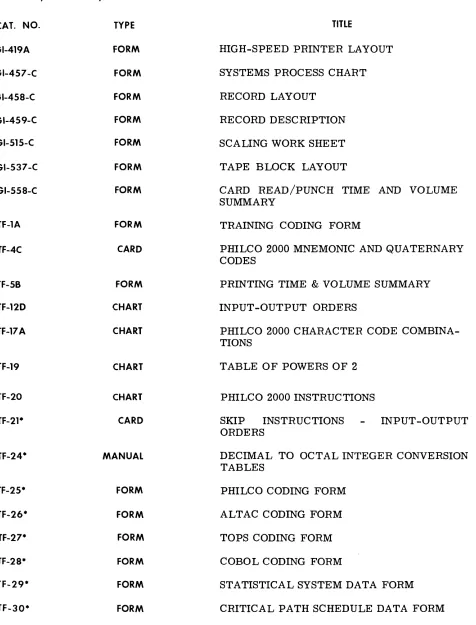
FORMS, CHARTS, AND CARDS
CAT. NO. TYPE GI-419A FORM GI-457-C FORM GI-45S-C FORM GI-459-C FORM GI-515-C FORM GI-537-C FORM GI-55S-C FORM TF-1A FORM TF-4C CARD TF-58 FORM TF-12D CHART TF-17 A CHART TF-19 CHART TF-20 CHART TF-21* CARD TF-24* MANUAL TF-25* FORM TF-26* FORM TF-27* FORM TF-2S* FORM TF-29* FORM TF-30* FORM
TITLE
HIGH-SPEED PRINTER LAYOUT SYSTEMS PROCESS CHART RECORD LAYOUT
RECORD DESCRIPTION SCALING WORK SHEET TAPE BLOCK LAYOUT
FORMS, CHARTS, AND CARDS
CARD READ/PUNCH TIME AND VOLUME SUMMARY
TRAINING CODING FORM
PHILCO 2000 MNEMONIC AND QUATERNARY CODES
PRINTING TIME & VOLUME SUMMARY INPUT-OUTPUT ORDERS
PHILCO 2000 CHARACTER CODE COMBINA-TIONS
TABLE OF POWERS OF 2 PHILCO 2000 INSTRUCTIONS
SKIP INSTRUCTIONS INPUT-OUTPUT
ORDERS
DECIMAL TO OCTAL INTEGER CONVERSION TABLES
PHILCO CODING FORM ALTAC CODING FORM TOPS CODING FORM COBOL CODING FORM
[image:34.612.70.546.112.737.2]index
A
ABS (see SMF-4), 15 AB3 - Customer Training, 11 Advance Item Macros (see RD-37), 9 AEXPQ (see 5MB-7.1), 14
AIDE (SYSAIDE) (se,e TM-23; SR-3), 3,5 ALTAC
-Changes for TAC II (see PD-3), 5 Coding Form (see TF-26), 31 III Manual (see TM-27), 4 III (see RD-40), 9
ANALYZER (see TM-23; PD-13), 3,6 Auto-Control Unit (see TM-16), 2
B
BCD2BIN (see SDC-6a), 21 BIDEC (see SDC-5), 21 BINCON (see SDC-15), 21 BINDEL (see TM-23), 3 BIN2HX (see SDC-9), 21 BIN20CT (see SDC-8), 21 BLKCK (see SDP-l). 23
c
PHILeo
COMPUTER DIVISION
D@®~
F
F ACOS (see SMA-5), 13 F ASIN (see SMA-4), 13 FATAN (see SMA-6), 13 F A2X (see 5MB-7), 14 FBISCT (see SML-l), 19 FBID (see SDC-4), 21 FCO (see SMF-2), 15 FCOR (see SMG-4), 16 FCORM (see SMG-5), 17 FCORMMV (see SMG-4.2), 16 FCORMV (see SMG-4.1). 16 FCR (see SMF-l), 15 FDIAG "(see SMI-S). IS FDIMA (see SMI-9). 18 FDP (see SMF-3), 15
catalog of
FEIGTJ (see PR-4; SMI-5), 7,18 FENCODE (see SDC-12), 21 F EX (see 5MB-4a), 14 FGAMMA (see SMM-l), 19 FHSC (see SMA-7; SMA-8), 13 FIC E (see PR-6; SM E-l), 7,15 File Macro-Instructions (see PD-12), 6 Find or List ID's (see PD-I0), 5 FINTL (see SMJ-l), 19 FIX2FLO (see SDC-17). 22 FLEC (see SMI-4.1). 18 FLEJ (see SMI-4), 18 Card Read/Punch Time andVolume Summary Form (see GI-558-C). 31
Character Code Combinations (see TF-17), 31
FLID (see PD-I0), 5 FLOAT (see SDC-14), 21 FLOGAX (see 5MB-8). 14 CHECKS (see RD-34). 9
COBOL - 3
Coding Form (see TF-28), 31 Manual (see TM-24), 3 Coding Forms
-ALTAC (see TF-26). 31 COBOL (see TF-28), 31 CPS (see TF-30), 31 Philco (see TF-25). 31 STAT (see TF-29), 31 TOPS (see TF-27), 31 Training (see TF-IA), 31
Console Typewriter (see TM-6; TM-16); 1,2 CPS (see TM-26), 4
Critical Path Scheduling System -Coding Form (see TF-30), 31 Data Form (see TF-30), 31 Manual (see TM-26), 4
Customer Training (see AB-3). 11
o
DATA (see TM-23), 3
Data Conversion Subroutines (see SDC), 21 Data Processing Subroutines (see SDP), 23 DECADD (see SMF-5), 16
DECADD2 (see SMF-5.1), 16 DECODE (see SDC-19), 22 DECSUB (see SMF-5.2), 16 DEC2FLO (see SDC-3a), 21
Differential Equations (see PR-6; SME-l; SME-2), 7,15,15 DIM (see SMF-4.1)'. 15
DUMPCON (see PD-2), 5
E
Eigenvalue Computation (see PR-4; SMI-5), 7,18 ENCODE (see SDC-11). 21
ENDJOB (see SSYS-3), 27 ERRDMP (see SSYS-l). 27
FLOGEX (see 5MB-l), 14 FLOG2X (see 5MB-3a), 14 FLOGI0X (see 5MB-2), 14 F L02FIX (see SDC-16), 22 FLP (see PR-5; SMH-l), 7 FLPI (see PR-8; SMH-1.1), 7,17 FLPO (see PR-8; SMH-1.2), 7,17 FLSM (see SMG-2), 16
FMAAD (see SMI-6), 18 FMADI (see SMI-I0), 18 FMAIN (see PR-3; SMI-la), 7,18 FMAMU (see SMI-2a), 18 FMASUB (see SMI-7), 18 FMATR (see SMI-12), 19 FMDN (see SMG-9), 17 FM EV A (see SMG-l), 16 FMLREG (see SMG-3), 16 FMNVR (see SMG-l.l), 16 FNORM (see SMG-6), 17 FNRAND (see SMK-2). 19 FPORC (see PR-7; SML-4), 7,19 FREFAL (see SML-2), 19 FREG (see SMG-7). 17 FRKG (see PR-9; SME-2). 7,15 FRTISO (see SML-3), 19
FSC (see SMA-la; SMA-2a), 13,13 FSIMP (see SMD-2), 14
FSQRT (see SMC-lb), 14 FTANX (see SMA-3), 13 FTENX (see 5MB-6), 14 FTRMA (see SMI-ll), 19 F2X (see 5MB-5), 14
G
GI-419-High-Speed Printer Layout Form, 31 GI-457-Systems Process Chart. 31
INDEX
H
High Speed Printer (see Printing Systems), 1,2,3 High Speed Printer Layout Form (see GI-419), 31 HX2BIN (see SDC-10), 21
IlVIADDI (see SDC-1S), 22
Input-Output Orders (see TM-1S; TF-12D), 2,31 Input-Output Processor (see TM-1S; TM-S), 2,1 Input-Output Subroutines (see SIO), 25
Input-Output Systems Manual (TM-1S), 2 Installation Guide (TM-9), 1
Instructions, Philco 2000 (see TF-20), 31 INT (see SMF-4.2), 15
Interpolation (see SMJ -1), 19 Interval Timer (see TM-1S), 2 lOPS (see TM-1S), 2
lOPS II (see PD-3), 5
L
Lagrange Interpolation (see SMJ-1), 19 Linear Programming
-Manual (TM-7), 1
Subroutines (SMH-1; SMH-1.1; SMH-1.2), 17,17,17 (see also PR-5; PR-S), 7,7
LOADGEN (see TM-23), 3
L.P. Edit Routine (see PR-5; PR-S; SMH-1.1; SMH-1.2), 7,7,17,17
M
Macro-Instructions (see M), 29
Magnetic Drum System (see TM-16; TM-6), 2.1 Magnetic Tape Macro-Instruction (see RD-25), 9 Magnetic Tape Systems
-Philco 1000 (see TM-22), 3 Philco 2000 (see TM-16; TM-6). 2,1
Mathematical Subroutines (see SMA thru SMM), 13 thru 19 Matrix Inversion (see PR-3a; SMI-1a), 7.18
Matrix Operations (see PR-3a; SMI; PR-4). 7,18.7 MOD (see SMF-4.3), 15
Mnemonic and Quaternary Codes, Philco 2000 (see TF-4C), 31 M-l, TLUEQ, 29
M-2,POLYVAL.29 M-3, RDFF, 29
N
NXTCON (see SSYS-2). 27
o
OCT2BIN (see SDC-7), 21 Operating System Subroutines, 27
p
Paper Tape Systems (see TM-16; TM-6), 2,1 PD-2, DUMPCON. 5
PD-3. TACII. 5 PD-10, FLlD, 5 PD-ll, XORD. 5
PD-12, File Macro Instructions, 6 PD-13, ANALYZER, 6
PD-14, TACSERV, 6 PERT (see TM-19), 3
Philco Coding Forms (see TF-25), 31 Philco 212 Computer System (see TMS-10). 2 Philco 1000 Computer Series (see TM-22), 3 Philco 2000 Operating System (see TM-23), 3 PLOT (see PR-10; SDP-3). 7,23
Plotting on the Printer (see PR-10), 7 PLUM (see PR-13), S
POLYVAL (see M-2), 29 PREP (see SDC-20), 22
Printing Systems (see TM-6; TM-16; TM-22), 1,2,3 Printing Time and Volume Summary Form (see TF-5B), 31 PROC (see RD-25). 9
Changes for T ACII (see PD-3), 5
Program for Library Updating and Maintenance (see PR-13). S Programming Manual (TM-10), 1
Program Reports (PR). 7 and S
PR-3a, Matrix Inversion, 7 (see also SM-1a), 13
PR-4;...Eigenvalue Computation, 7 (see also SMI-5; SMI-6), lS,18 PR-5-Linear Programming, 7 (see also SMH-1). 17
PR-S-Differential Equations, 7 (see also SME-1; SME-2), 15,15 PR-7-Roots of a Polynomial, 7 (see also SML-4), 19
PR-8-L.P.Edit Routine, 7 (see also SMH-1.1; SMH-1.2). 17,17 PR-9-Runge-Kutta-Gill Integration, 7 (see also SME-2). 15 PR-10-Plotting on the Printer, 7 (see also SDP-3), 23
PR-ll-Transportation Problem, 8 (see also SMH-2; SMH-2.1), 17.17 PR-12-Tape Translator Edit Routine, 8 (see also SDP-2). 23 PR-13-Program for Library Updating and Maintenance, 8 PR-14-Tape Error Routine, 8 (see also SDP-5), 23 PR-1S-PIOS, 8
Punched-Card System (see TM-16; TM-S; TM-22), 2.1,3
Q
Quaternary Codes (see TF-4c), 31
R
Rand D Notes, 9
Random Numbers (see SMK-l; SMK-2), 19,19 RAND1 (see SMK-1), 19
RDFF (see PD-12; M-3), S,29
RD;-25-Magnetic Tape Macro-Instructions, 9 RD-34-CHECKS, 9
RD-37-Advance Item Macros, 9 RD-40-ALTAC III, 9 (see also TM-27), 4 Real-Time System (see TM-16), 2
Record Description Form (see GI-459-C), 31 Record Layout Form (see GI-45S-C). 31 Roots of a Polynomial (see PR-7; SML-4), 7.19 RPLC (SYSRPLC) (see TM-23). 3
RPL Corrector (see SR-2), 5 RPL Locator (see SR-1), 5
Runge-Kutta-Gill Integration (see PR-9; SME-2). 7.15
5
Scaling Work Sheet (see GI-515-C), 31 SDC-3a-DEC2FLO. 21
SDC-4-FBTD, 21 SDC-5-BIDEC. 21 SDC-6a-BCD2BIN, 21 SDC-7-0CT2BIN. 21 SDC-8-BIN20CT, 21 SDC-9-BIN2HX. 21 SDC-10-HX2BIN. 21 SDC-ll-ENCODE, 21 SDC-12-FENCODE. 21 SDC-13-XFIX. 21 SDC-14-FLOAT.21 SDC-15-BINCON. 21 SDC-16-FL02FIX. 21 SDC-17-FIX2FLO,21 SDC-18-IMADDI, 21 SDC-19-DECODE, 21 SDC-20-PREP, 21 SDP-1-BLKCK. 23 SDP-2-TUIGNR, 23 SDP-3-PLOT, 23 SDP-4-ZSUPP. 24 SDP-5-TAPER,23 SDP-6-TYPESUB,20 Service Routines (see SR), 5 SETAPES (see SI0-2). 25 SIGN (see SMF-4.4), 15 SIO-1A-XORD, 25 SI0-2-SETAPES.25
Skip Instructions. Input-Output Orders (see TF-21), 31 SMA-1a-FSC.13
SMF-4.8-XSIGN. 16 SMF-5-DECADD. 16 SMF-5.1-DECADD2. 16 SMF-5.2-DECSUB. 16 SMG-I-FMEVA. 16 SMG-1.1-FMNVR. 16 SMG-2-FLSM. 16 SMG-3-FMLREG. 16 SMG-4-FCOR. 16 SMG-4.1-FCORMV. 16 SMG-4.2-FCORMMV. 16 SMG-5-FCORM.17 SMG-6-FNORM, 17 SMG-7-FREG. 10 SMG-9-FMDN, 17 SMH-I-FLP.17 SMH-1.1-FLPl, 17 SMH-1.2-FLPO. 17 SMH-2-TRAN.17 SMH-2.1-TRANED.17 SMI-la-FMAIN. 18 SMI-2a-FMAMU. 18 SMI-:l.1-GTRP. 18 SMI-a.2-TRP, 18 SMI-4-FLEJ. 18 SMI-4.1-FLEC. 18 SMI-fi-FEIGTJ.18 SMI-6-FMAAD. 18 SMI-7-FMASUB. 18 SMI-8-FDIAG, 18 SMI-!}-FDIMA, 18 SMI-I0-FMADI, 18 SMI-ll-FTRMA. 19 SMI-12-FMATR, 19 SMJ-1-FINTL. 19 SMK-I-HANDl, 19 SMK-2-FNRAND, 19 SML-1-FBlSCT, 19 SML-2-FREFAL,19 SML-:l-FRTISO, 19 SML-4-FPORC, 19 SMM-I-FGAMMA, 19 SNAPGEN (see TM-23), 3 Sort Generator (see TM-17), 2 Sort SYHtem (see TM-21), 3 SQRT (Hee SMC-4), 4 SR-I-RPL Locator. 5 SR-2-RPL Corrector. 5 SR-3-AIDE, 5
SSYS-1-ERRDMP. 27 SSYS-2-NXTCON, 27 SSYS-3- ENDJOB. 27 SSYS-4-SYSD EF. 27 SSYS-5- EXIT. 27
StatiHtical System (see TM-20), 3 Subroutines
-Data Conversion (see SDC), 21 Data Processing (see SDP). 23 Differential Equations (see SM E). 15 Input-Output (see SIO). 25
Integration (see SMD), 14 Interpolation (see SMJ). 19
Logarithm and Exponential (see 5MB). 14 Management Sciences (see SMH), 17 Matrix Operations (see SMI), 18 Powers (see SMC). 14
Random Number (see SMK), 19 Special Functions (see SMM). 19 Special Purpose Arithmetic (see SMF). 15 Solutions of Equations (see SML). 19 Statistics (see SMG). 16
SYS (see SSYS). 27
Trigonometric (see SMA), 13 SYS (see TM-23). 3
SYSDEf (see SSYS-4). 27 SYS Subroutines (see SSYS). 27 Systems Description (TM-8). 1 Systems Process Chjlrt (see GI-457), 31 SYSTRACE (see TM-23). 3
INDEX
T
Table of Powers of 2 (see TF-19). 31
TAC Language Tape.Comparison (TACLTC) (see TM-23), 3 TACLTC (see TM-23). 3
TAC (see TM-ll). 2
TACSERV (TACSERVS) (see PD-14; TM-23), 6,3 T AC II (see PD-3). 5
T AC Subroutines (see Subroutines), 13 TAC II Loader (see PD-3), 5
TANH (see SMA-ll). 13
Tape Block Layout Form (see GI-537-C), 31 Tape Error Routine (see PR-14), 8 TAPER (see PR-14. SDP-5). 8.23
Tape Translator Edit Routine (see PR-12), 8 Technical Manuals (see TM). 1
TF~la-Training Coding Form, 31
TF-4C-Philco 2000 Mnemonic and Quaternary Codes. 31 TF-5B-Printing Time and Volume Summary Form, 31 TF-12D-Philco 2000 Input-Output Orders, 31
TF-17 -Philco 2000 Character Code Combinations. 31 TF-19-Table of Powers of 2. 31
TF-20-Philco 2000 Instructions. 31
TF-21-Skip Instructions - Input-Output Orders. 31 TLUEQ (see M-1), 29
TMS-10-Philco 212 Computer System, 2 TM-6A-Operating Controls Manual, 1 TM-7 A-Linear Programming System. 1 TM-8-System Description, 1
TM-9-Installation Guide TM-10-Programming Manual, 1 TM-ll-TAC Manual, 2 TM-12C-TOPS Manual, 2 TM-16B-Input-Output Manual, 2 TM-17-Sort Gnerator Manual, 2 TM-18A-IOPS Manual. 2 TM-19-PERT Manual, 3
TM-20-Statistical System Manual, 3 TM-21-Sort System, 3
TM-22-Philco 1000 Computer Series, 3 TM-23-Philco 2000 Operating System, 3 TM-24-COBOL Manual, 3
TM-26-Critical Path Scheduling System, 4 TM-27-ALTAC III Manual, 4
TOPS Coding Form (see TF-27), 31 Training Coding Form (see TF-IA). 31 TRAN (see PR-ll; SMH-2), 8 .. 17 TRANED (see PR-ll; SMH-2.1), 8,17
Transportation Problem (see PR-ll; SMH-2; SMH-2.1), 8,17,17 TRP (see SMI-3.2), 18
TUIGNR (see PROI2; SDP-2), 8,23 TYPESUB (see SDP-6). 23
u
UBC (see Universal Buffer-Controller)
Universal Buffer-Controller (see TM-16; TM-6), 2,1
w
WRF (see PD-12), 6
x
XABS (see SMF-4.5), 15 XAEXPQ (sec 5MB-7.2). 14 XDIM (see SMF-4.6), 15 XFIX (see SDC-13), 21 XMOD (see SMF-4.7), 15 XORD (see PD-ll; SIO-IA), 5,25 XSC (see SMA-9a; SMA-lOa), 13,13 XSIGN (see SMF-4.8), 16
X-Y Plotter (see TM-16), 2
z
NAME
COMPANY
ADDRESS
CITY ZONE
Date
STATE
PUBLICATIONS REQUEST