Table 6 List of solvents for separation of morphine
Solvent CAS-NO Predicted Experimental Compound
class (RTECS) Tb(K) Tm(K) (MPa1/2) Tb(K) Tm(K) (MPa1/2)
Benzene 71-43-2 353.24 278.68 18.73 C,D,M,T,S
Toluene 108-88-3 383.78 178.18 18.32 C,M,T,S
CCl4 56-23-5 349.79 250.33 17.55 C,D,M,T,S
Cyclohexane 110-82-7 353.87 279.69 16.76 M,S
1,5-Pentanediol 111-29-5 491 253 27.0 512.15 257.15 26.45 S
Acetol 116-09-6 418 226 27.2 418.65 256.15 25.75 M
D, drug; S, primary irritant; T, reproductive-effector; M, mutagen; C, tumorigen.
however, need to integrate aspects of molecular mod-elling and computational chemistry before acceptable solutions to problems involving complex solutes and tight environmental regulations can be obtained. Finally, it should be noted that having a good
so-lvent means easier design/operation of the
solvent-based separation technique. Therefore, it is important to formulate correctly the solvent selection problem
and to Rnd reliable results in the form of optimal
solvents.
Further Reading
Barton AFM (1985) CRC Handbook of Solubility
Para-meters and Other Cohesion ParaPara-meters. Boca Raton,
FL: CRC Press.
Fredenslund AA, Gmehling J and Rasmussen P (1972)
Vapour}Liquid Equilibrium Using UNIFAC.
Amster-dam: Elsevier.
Harper P, Gani R, Kolar P and Ishikawa T (1999) Com-puter aided molecular design with combined molecular modelling and group contribution.Fluid Phase Equilib-ria337: 158}160.
Horvath AL (1992) Molecular Design. Amsterdam: Elsevier
Lo TC, Baird MHI and Hancon C (1987)Handbook of
Solvent Extraction. New York: John Wiley.
Marcus Y (1998)The Properties of Solvents. New York: John Wiley.
Mavriounioutis M (ed.) (1998) Special issue on design of chemical compounds.Computers and Chemical
Engin-eering Journal22: 713.
Seader JD and Henley E (1998)Separation Process
Prin-ciples. New York: John Wiley.
Steam Distillation
L.Ramos, Free University, Amsterdam,
The Netherlands
Copyright^ 2000 Academic Press
Sample preparation is nowadays the limiting step in the trace analysis of organic pollutants in environ-mental and biological samples. Looking forward to the laboratory of the future, versatile and universal sample enrichment techniques are required, which can produce fast and valid data, with low costs in terms of solvent consumption and operator involve-ment. A selectivity higher than that of the classical exhaustive extraction methods or the simultaneous elimination of the interference material could be an additional requirement, as it would reduce the amount of solvents and adsorbents used by reducing or eliminating the subsequent clean-up step. Possible
additional beneRts deriving from a low manual
ma-nipulation of the samples would be a reduction in the
risk of contamination and loss of the analytes, as well as an easier automation of the process.
Steam distillation extraction}solvent extraction
(SDE) has been presented as such a universal sample enrichment technique. SDE allows the simultaneous extraction, clean-up and concentration of the target compounds in a closed system, with short analysis times
(1}8 h) and by using small amounts of organic solvents
(a few mL). This paper reviews this assumption for the case of the analysis of less volatile organic pollutants in environmental samples. The SDE advantages and short-comings for such an analysis have been discussed.
Introduction
The monitoring of toxic organic chemicals in envir-onmental and biological samples is a major concern
in many differentRelds. However, the large variety of
their environmental levels and physico-chemical properties, and the complexity of the matrices typi-cally investigated make the development of universal
analytical methods for such an analysis a very difR
-cult goal. This is especially true for the most toxic organic pollutants as their high toxicity makes their
reliable detection and accurate quantiRcation at the
trace level more relevant.
Most of the procedures described in the literature for the analysis of less volatile organic pollutants are
time-consuming, laborious and speciRc for the
deter-mination of an analyte (or family of compounds) in a selected matrix. Examples of selective extraction of the target compounds, allowing their determination without any additional clean-up, can be found in the literature. However, most of these procedures involve sophisticated and expensive analytical techniques,
such as supercritical Suid extraction or gel
per-meation chromatography. On the other hand, the
efRciency of these methods have been recognized to
be highly matrix-dependent. Because of these unresol-ved shortcomings, classical exhaustive extraction
techniques, i.e. liquid}liquid extraction, LLE,
solid}liquid extraction or Soxhlet extraction, are still
widely used in ofRcial methods and routine
applica-tions. Due to the low selectivity of these methods, subsequent elimination of the co-extracted material is recommended. Such a clean-up step is mandatory for reliable trace level determination of lipophilic and bio-accumulative pollutants in biological and com-plex environmental samples.
Steam distillation-solvent extraction (SDE) has been used mainly for the extraction and
concentra-tion of fragrance and Savour compounds. However,
a variety of SDE methods reporting sample prepara-tion for the analysis of pollutants in environmental samples can be found in the literature. Most of these methods allow the simultaneous extraction, clean up and concentration of the target compounds. The in-vestigated compounds range from volatile polar and non-polar pollutants to non-ionic surfactants. This article reviews the suitability and the limitations of SDE for the determination of less volatile trace or-ganic pollutants, such as pesticides, polychlori-nated biphenyls (PCBs), polychloripolychlori-nated
dibenzo-p-dioxins and furans (PCDD/Fs), or surfactants, in
en-vironmental and biological matrices. The most
rel-evant variables affecting the efRciency of the SDE of
these compounds are discussed and the results of some selected applications reviewed.
General Considerations
According to the theoretical model developed by
Rijkset al., in 1983, the efRciency of the SDE process
increased with the extraction time and with the liquid
and vapour Sows. The process also depends on
analyte-speciRc parameters related to the activity
co-efRcient (calculated from the water solubility of the
analyte at 1003C) and the gas-liquid distribution
co-efRcient of the compound in water at the process
temperature (i.e., 1003C for water steam). Not
unex-pectedly, the recoveries increased with the afRnity of
the target compounds for the extracting solvent. This theoretical model is applicable only under ideal con-ditions, which are achieved when all volumes and
Sow rates remain constant and there is ideal mixing
and equilibrium at every stage. In spite of these
lim-itations, the model reSects the effect of several
experi-mental factors on the SDE process. In fact, the
differ-ent modiRcations carried out on the SDE devices
originally described by Likens and Nickerson in 1964
and by Flath and Forrey in 1977 reveal the inSuence
of several parameters on the recoveries of the target
compounds. The modiRcations were mainly focused
on increasing the size of the vapour chamber and/or
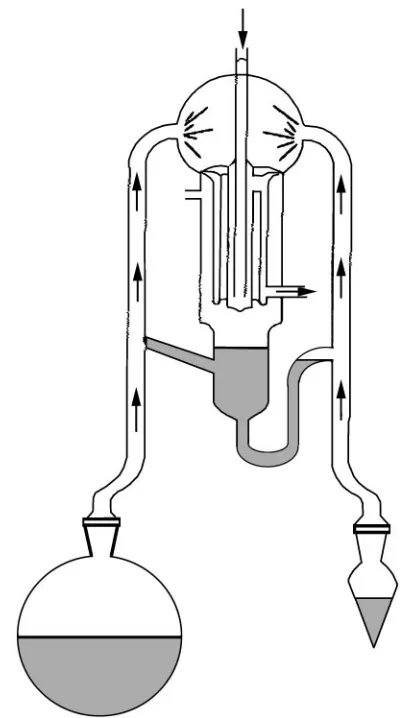
the condensing surface to allow a more complete mixing of the solvent and steam vapours, as well as on the miniaturization of the system. As a
conse-quence of the changes in design (Figure 1), the efR
-ciency of the extraction was increased, the analysis
time reduced and theReld of SDE expanded through
the analysis of residue levels of less volatile pollutants in environmental samples.
Due to the characteristics of the technique, the feasi-bility of SDE for the analysis of less volatile com-pounds depends on their (i) potential for forming azeo-tropes with water and (ii) relative solubility in water and in the extraction solvent. However, the SDE of the target compounds from complex samples can be ex-pected to occur only after destruction or degradation of the main matrix components, which usually entrap the analytes (see below). Therefore, as stated by Nash in 1984, the applicability of the SDE technique to the analysis of this kind of environmental matrices would be limited by the resistance of the investigated com-pounds to the selected degradation procedure. Alterna-tively, in some cases, co-distillation solvents have been
used to improve the SDE efRciency by reducing the
surface tension of the water and by increasing the extraction power (polarity) of the organic solvent. Finally, rather different results have been published about the suitability of adding anti-foam agents in
applications involving fatty samples (seeTable 3).
Application of SDE to the Analysis
of Aqueous Samples
Water was one of the Rrst environmental samples
Figure 1 A typical SDE modern design.
technique for the determination of less volatile
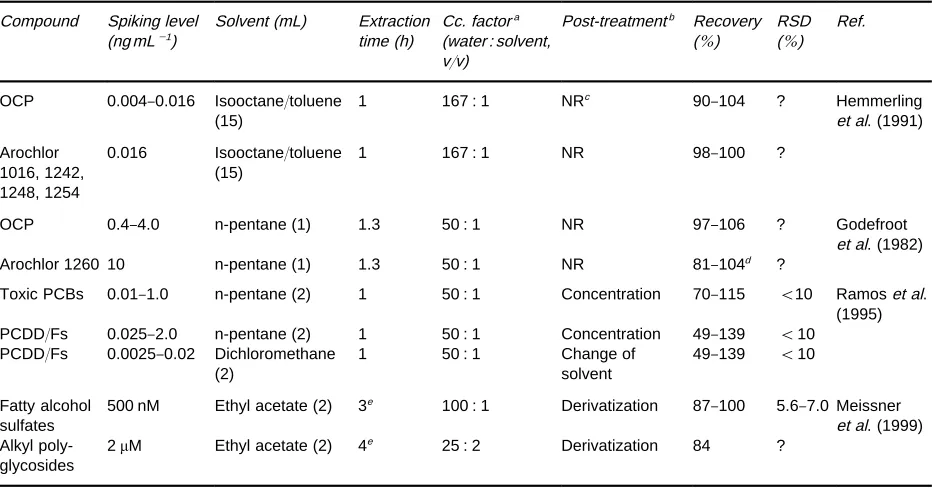
or-ganic contaminants levels. Table 1 summarizes
rel-evant data concerning some reported methods for the analysis of this matrix.
Quantitative recoveries of spiked
organoch-lorinated pesticides, OCPs (globally, in the range
90}106 ppb), and PCBs (globally, in the range
70}104 ppb) in aqueous samples have been reported
using the SDE technique. The reported methods al-lowed the simultaneous extraction and concentration
of the analytes in 1}1.3 h in a relatively small amount
of a non-polar solvent (1}15 mL). Usually, no
addi-tional treatment of the sample or the organic extract was required. The SDE technique was favourably compared with other widely used extraction proced-ures, such as LLE or solid-phase extraction (SPE) by
Ramoset al. in 1995, e.g. similar recoveries have been
published for the analysis of PCBs in water at the ppb
(ng mL\1) level by using SDE, LLE or SPE. However,
the higher repeatability of the SDE procedure (rela-tive standard deviations, RSD, lower than 10%) and
the small amount of organic solvent involved, as well as the short sample preparation times, makes SDE a valuable alternative technique for such an extrac-tion, especially when a large number of analyses have to be carried out.
Nevertheless, some limitations of SDE have also been reported for less volatile pollutants in water
samples. Nashet al. in 1984 studied different
para-meters affecting the efRciency of the steam distillation
process. They concluded that this technique is prob-ably limited to compounds with a vapour pressure of
about 1 kPa at 1003C. Their results also showed that
the performance of SDE depends on the concentra-tion investigated and that recoveries tend to increase with the spiking level.
Similar tendencies have been observed by Ramos
et al. in 1995 when using the SDE technique for the
extraction of water spiked with the
2,3,7,8-sub-stituted-CDD/Fs at different levels of concentration
(0.25}2 ng mL\, 0.025}0.2 ng mL\ and 0.0025}
0.02 ng mL\). The recoveries obtained for the lower
and higher boiling point congeners (tetra- and
octa-CDD/Fs, respectively) are consistently lower than
those found for the rest of the investigated congeners:
respectively 40}76% and 73}137% at the highest
level of concentration investigated, 39}60% and
62}92% at the intermediate, and 37}55% and
25}72% at the lowest spiking level. These results also
show that the SDE recoveries for a given compound decrease with the concentration level when using n-pentane as the extraction solvent. The simple substi-tution of n-pentane for a solvent more selective for
the PCDD/Fs (dichloromethane) increases recoveries
from 25}73% to 71}139% for tetra- to
hepta-CDD/Fs at the 0.0025}0.02 ng mL\level. However,
no additional improvement is obtained for the
octa-CDD/F recoveries (38}56%). In spite of the
low recoveries obtained for OCDD/F, the
pro-posed SDE procedure compares favourably with re-sults previously published by using LLE or SPE in terms of repeatability, analysis time and solvent con-sumption.
Good recoveries (in the range 84}100%) have
been reported by Meissneret al. for the analysis of
Table 1 SDE methods for the analysis of less volatile organic pollutants in aqueous samples
Compound Spiking level (ng mL\1)
Solvent (mL) Extraction time (h)
Cc. factora (water : solvent, v/v)
Post-treatmentb Recovery (%)
RSD (%)
Ref.
OCP 0.004}0.016 Isooctane/toluene (15)
1 167 : 1 NRc 90}104 ? Hemmerling
et al. (1991)
Arochlor 1016, 1242, 1248, 1254
0.016 Isooctane/toluene (15)
1 167 : 1 NR 98}100 ?
OCP 0.4}4.0 n-pentane (1) 1.3 50 : 1 NR 97}106 ? Godefroot
et al. (1982)
Arochlor 1260 10 n-pentane (1) 1.3 50 : 1 NR 81}104d ?
Toxic PCBs 0.01}1.0 n-pentane (2) 1 50 : 1 Concentration 70}115 (10 Ramoset al. (1995) PCDD/Fs 0.025}2.0 n-pentane (2) 1 50 : 1 Concentration 49}139 (10
PCDD/Fs 0.0025}0.02 Dichloromethane (2)
1 50 : 1 Change of
solvent
49}139 (10
Fatty alcohol sulfates
500 nM Ethyl acetate (2) 3e 100 : 1 Derivatization 87}100 5.6}7.0 Meissner et al. (1999) Alkyl
poly-glycosides
2M Ethyl acetate (2) 4e 25 : 2 Derivatization 84 ?
aConcentration factor. bPost-SDE treatment required. cNR, not required.
dRecoveries for some selected peaks.
eThe SDE was conducted after hydrolysis with 4 M H
2SO4 plus liquid}liquid extraction with diethyl ether of the hydrolysate and concentration.
Application of SDE to the Analysis of
Non-Fatty Environmental Samples
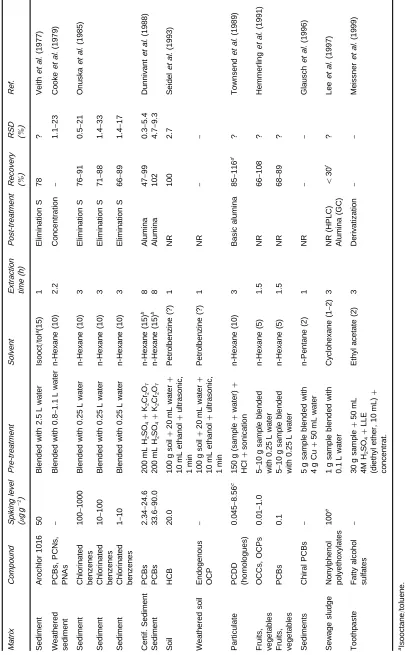
Table 2 summarizes relevant data related to some reported SDE methods for the analysis of less volatile organic pollutants in non-fatty environmental sam-ples. Most of the reported SDE applications referred to the analysis of OCPs and toxic aromatic com-pounds, e.g. PCBs, polychlorinated naphthalenes (PCNs), or polynuclear aromatic hydrocarbons (PNAs), in soils and sediments. Contrary to what might be expected from the high complexity of these samples, most of the methods did not include any further pre-treatment of the matrix but blending with the selected volume of water. Only a few procedures involving drastic treatments (e.g. blending of the
sample with H2SO4and K2Cr2O7) during the SDE to
guarantee the destruction of the soil or sediment components in which the target compounds could be entrapped, can be found in the literature.
The efRciency (or need) of such a drastic treatment
is difRcult to evaluate from the data published. In
general, high (quantitative) recoveries have been re-ported for freshly spiked analytes (globally in the
range 78}102% for PCBs and OCPs at the
20}90g g\level) with all the procedures (Table 2).
However, the efRciency of the proposed SDE methods
for the extraction of endogenous pollutants from weathered samples has been scarcely evaluated. In
these studies, Seidel et al. (1993) and Cooke et al.
(1980) found concentrations very close or below the limit of detection have usually been reported for the endogenous contaminants, but the lack of comparison of the SDE results with those obtained by standard or more exhaustive methods, i.e. Soxhlet extraction, do not allow any discussion about the methods used.
Dunnivant et al. in 1988 reported recoveries
ranging from 47 to 99% for SDE of certiRed
sedi-ments with PCBs at the 2.34}24.6g g\. However,
as quoted above, this SDE method involved a diges-tion of the sample under drastic condidiges-tions.
In a closely related study, Nashet al.compared the
efRciency of steam distillation with subsequent
or-ganic solvent extraction to that of Soxhlet extraction for the analysis of pesticides in soil, plant tissues and
air (polyurethane foamRlters). Both procedures
pro-vided similar recoveries for the spiked samples (in the
ranges 80}90%, 80}90% and 90}100%,
respective-ly). However, the SDE levels determined for
weathered soils blended with water were 40}50%
lower than the concentrations found by the Soxhlet
of the SDE depends on the soil type and, in agreement with that mentioned for aqueous samples, on the volatility of the selected compounds. The less volatile the compound, the lower the recovery: SDE
recove-ries for DDT were only 21}60% of those found by
Soxhlet extraction.
Onuska and Terry observed a similar trend when
comparing the SDE and the Soxhlet efRciencies for
the extraction of spiked chlorinated benzenes from a sediment. The concentrations found using SDE
were 14}36% lower than those using the Soxhlet
method, except for pentachlorobenzene and 1,3-dich-lorobenzene, which were not determined by the latter procedure. The authors also reported a decrease in the SDE recoveries of the target compounds as the investigated concentration level decreased (Table 2). The recoveries of the studied chlorinated benzenes
decreased from 76}91% to 66}89% as the spiking
level decreases from 100}1000g g\to 1}10g g\.
In a recent study, Meissneret al.used SDE for the
determination of fatty alcohol sulfates in cosmetics (toothpaste) by combining this technique with a hy-drolysis treatment. However, the application of SDE to the analysis of nonylphenol polyethoxylates in
sew-age sludge by Leeet al.failed when compared with the
more efRcient supercriticalSuid extraction technique.
In general, the published SDE methods for the analysis of non-fatty environmental samples involve
longer extraction times (1}8 h) than those reported
for aqueous samples (1}1.3 h). In addition, and
con-trary to that proposed by the theoretical model of
Rijkset al., the recoveries of less volatile compounds
from non-fatty complex samples have been found to
be independent of the vapourSow rates. However, it
is important to note that in this study by Seidel
ethanol was added to the waterSask to improve the
OCP recoveries, and that the possible effect of a co-distillation solvent was not included in the theoretical model.
Application of the SDE to the Analysis
of Fatty Biological Samples and Food
Due to the high lipophility of some of the most toxic
pollutants, such as OCPs, PCBs and PCDD/Fs, the
classical procedures for the analysis of these pollu-tants in fatty samples were based on an exhaustive extraction of the lipids from the matrix. Subsequent removal of the co-extracted lipids has been widely recognized as the main problem with these kinds of methods, especially when analysing samples with high fat contents such as dairy products. Because of the characteristics of the SDE technique, the disrup-tion of the strongly bound pollutant-matrix in these
samples can be accomplished before SDE by degrada-tion of the matrix components entrapping the target
compounds. Treatment with 1}2 M sulfuric acid
fol-lowed by ultrasonication in a bath and heating of the sample during the SDE process has been found to be
one of the most efRcient procedures for breaking
down the matrix structure allowing steam distillation of the analytes. Furthermore, this acid treatment
al-lowed a simultaneous clean up of theRnal extract as
the matrix components form more polar products, which can then be easily separated from the non-polar analytes. According to the published results, most samples submitted to this kind of treatment did
not require any additional clean up. Fileket al. report
good recoveries for the SDE of OCPs from dairy products when using this type of acid pre-treatment:
in the range 83}126% for powdered milk and human
milk spiked at the 20.0}51.3 ng g\level, and in the
range of 73}111% for a certiRed dairy product (OCP
levels ranging from 1.5 to 6.6 ng g\). However, the
SDE method failed when it was used for the extrac-tion of the endogenous PCBs from dairy products with different fat contents. According to the reference
method, the PCBs detected by Ramoset al.,in 1998
ranged from 2 to 0.01 ng g\in the investigated
ma-trices. Nevertheless, most of the PCB congeners were found to be non-detectable with the SDE procedure
and, when found at quantiRable levels, the reported
concentrations were less than 26% of those deter-mined by the reference method.
Rather similar results were reported by Seidel and Lindner in 1993 for the analysis of the OCPs in dairy products and human milk as none of the investigated
compounds were found to be at a quantiRable level.
However, no additional comparison with a reference method was included in this study, in which 10 g of sample was blended with water and ethanol. In this case, the alcohol, added as a co-distillation solvent, would also be able to disrupt the fat globule thereby allowing the SDE of the analytes. An important short-coming of this kind of approach is the formation of large oil drops during the extraction, which increase the diffusion layer and hinder the SDE process. Filek
et al. proposed blending of the sample with
surfac-tants has been proposed as a possible solution for the
case of fatty matrices without natural emulsiRers.
When no pre-treatment of the fatty sample was carried out, a co-distillation (total, according to Yoon
Tabl e 3 SDE me th o d s fo r th e a n alys is o f le ss vola ti le or ga n ic p o llut a n ts in fa tt y e n viro n m e n ta l s a m p les (symbo ls a s in T a ble 1 ) M a tr ix Com p o un d S p iking le vel (n g g \ 1) P re -tr e a tm e n t S o lv e n t E x tr a c ti o n time (h ) P o st -t re at m e n t R e cove ry ( % )
RSD (%
[image:7.568.111.464.54.723.2]in some of theRrst reported applications of SDE for the analysis of toxic aromatic compounds in
biolo-gical matrices. The investigated samples includedRsh
tissues, muscle, liver and kidney and, although
satis-factory recoveries (67}100%) were reported for the
spiked PCBs, PCNs and DDT (i.e. DDT#
DDE#TDE), it is important to note that the spiking
level in these experiments ranged from 1000}
5000 ng g\(Table 3). Even at such a high level of
concentration, the authors reported an evident de-pendence of SDE recoveries on the analyte
concentra-tion. In fact, Cookeet al. found that the PCB, PCN
andDDT recoveries from animal tissues decreased
from 67}100% to 65}85% when the spiking level
decreased from 5000 to 1000 ng g\. According to
this trend, it can be concluded that the very low levels of the endogenous pollutants in environmental sam-ples together with the typical complexity of the matrix would be the main reasons for the disappoint-ing results reported for some SDE applications in-volving non-spiked fatty samples.
See also: II/Extraction: Analytical Extractions; Solid-Phase Extraction; Solid-Solid-Phase Microextractions; Supercriti-cal Fluid Extraction. Distillation: Extractive Distillation.
Further Reading
Cooke M, Nickless G, Povey A and Roberts DJ (1979) Polychlorinated biphenyls, polychlorinated naphtha-lenes and polynuclear aromatic hydrocarbons in Severn estuary (UK) sediments.Science of Total Environment
13: 17}20.
Cooke M, Roberts DJ and Tillett ME (1980) Poly-chlorinated naphthalenes, polyPoly-chlorinated biphenyls and DDT residues in British birds of Prey. Science of
Total Environment15: 237}246.
Dunnivant FM and Elzerman AW (1988) Determination of polychlorinated biphenyls in sediments, using sonication extraction and capillary column gas chromatography-electron capture detection with internal standard calib-ration.Journal of the Association of the OfTcial
Analyti-cal Chemistry71: 551}556.
Filek G, Bergamini M and Lindner W (1995) Steam distilla-tion-solvent extraction, a selective sample enrichment technique for the gas chromatographic-electron capture detection of organochlorine compounds in milk powder and other milk products.Journal of Chromatography A712: 355}364.
Glausch A, Blanch GP and Schurig V (1996) Enantioselec-tive analysis of chiral polychlorinated biphenyls in sedi-ments samples by multidimensional gas chromatogra-phy-electron capture detection after steam distillation-solvent extraction and sulfur removal. Journal of
Chromatography723: 399}404.
Godefroot M, Stechele M, Sandra P and Verzele M (1982) A new method for the quantitative analysis of
organo-chlorine pesticides and polychlorinated biphenyls.
Journal of High Resolution Chromatography
Commun-ications5: 75}79.
Hemmerling C, Risto C, Augustyniak B and Jenner K (1991) Untersuchungen zur aufbereitung von Lebensmittel- und Umwelproben fur die ruckstandsbes-timmung von pestiziden und PCB mittels kontinuier-licher wasserdampfdestillation. Die Nahrung 35: 711}719.
Lee HB, Peart TE, Bennie DT and Maguire RJ (1997) Determination of nonylphenol polyethoxylates and their carboxylic acid metabolites in sewage treatment plant sludge by supercritical carbon dioxide extraction.
Jour-nal of Chromatography A785: 385}394.
Meissner C and Engelhardt H (1999) Trace analysis of surfactants derived from fatty alcohols. II. Hydrolysis and enrichment techniques. Chromatographia 49: 12}16.
Nash RG (1984) Extraction of pesticides from environ-mental samples by steam distillation. Journal of the
Association of the OfTcial Analytical Chemistry 67:
199}203.
Onuska FI and Terry KA (1985) Determination of chlorin-ated benzenes in bottom sediments samples by WCOT column gas chromatography.Analytical Chemistry57: 801}805.
Rajendran N and Venugopalan VK (1991) Bioconcen-tration of endosulfan in different body tissues of estuar-ine organisms under sublethal exposure. Bulletin of
Environmental Contamination and Toxicology 46:
151}158.
Ramos L, Blanch GP, HernaHndez L and GonzaHlez MJ (1995) Recoveries of organochlorine compounds (PCBs, PCDDs and PCDFs) in water using steam distillation-solvent extraction at normal pressure. Journal of
Chromatography A690: 243}249.
Ramos L, Tabera J, HernaHndez L and GonzaHlez MJ (1998) Selective extraction of polychlorinated biphenyls from dairy products using steam distillation solvent extrac-tion at normal pressure.Analytica Chimica Acta376: 313}323.
Rijks J, Curvers J, Noy T and Cramers C (1983) Possibili-ties and limitations of steam distillation-extraction as a preconcentration technique for trace analysis of or-ganics by capillary gas chromatography. Journal of
Chromatography279: 395}397.
Seidel V and Lindner W (1993) Universal sample enrich-ment technique for organochlorine pesticides in environ-mental and biological samples using a redesigned simul-taneous steam distillation-solvent extraction apparatus.
Analytical Chemistry65: 3677}3683.
Townsend DI, Lamparski LL and Nestrick TJ (1989) La-boratory simulation and potential mechanisms explain-ing PCDD congener group ratio behaviour on partic-ulates from combustion sources. Chemosphere 16: 1753}1757.
Veith GD and Kiwus LH (1997) An exhaustive steam-distillation and solvent-extraction unit for pesticides and industrial chemicals. Bulletin of Environmental