Abstract— Wildfire detection is an active and challenging re-search topic in computer vision. Wildfires can cause damage to valuable natural resources and can harm people and their com-munities. In this paper, we present CICLOPE, a tele-surveillance system that can perform remote monitoring and au-tomatic fire and smoke detection. The CICLOPE system cur-rently covers about 1.300,000 hectares of mainland Portugal en-abling the monitoring of large areas at a very low cost per hec-tare. The goal of this paper is to present an assessment and eval-uation of three of CICLOPE’s eleven automatic fire and smoke detection algorithms. Concretely, we aim to determine the po-tential benefits of three CICLOPE’s legacy algorithms: ADBACK, BEFORT, and BESTEST. ADBACK uses back-ground subtraction techniques and a quasi-connected compo-nents method to detect smoke and fire while BEFORT and BESTEST use active learning techniques to update an auxiliary database of non-fire occurrences. We compare these three algo-rithms against one approach from the literature as a means to draw comparisons between the existing techniques. We also pro-pose a number of performance metrics important to measure in a system of this kind, focusing on the consistent detection of smoke plumes and fire incidents over time, while achieving a low false positive rate. Using these evaluation measures, we show that our proprietary algorithms can attain the best performance on a dataset of 75 real wildfires over 3 months of surveillance.
Index Terms—Computer Vision, Smoke, and Fire detection, Surveillance Systems
I. INTRODUCTION
recently there has been increasing interest in developing real-time algorithms to automatically detect wildfire us-ing surveillance systems [1]-[14]. Wildfire represents one of the most relevant problems nowadays both from a social and environmental standpoint; particularly, in Portugal where ar-son fires are the main cause of forest destruction [15]. The development of efficient and robust fire detection systems is an active research area. Here, video-based detection can be adopted as a viable alternative to traditional smoke sensor de-tectors [16], as a single camera can surveil a large area from a distance, being able to detect smoke much earlier than a tra-ditional sensor if a robust computer vision algorithm is used.
Even though video-based detection is a promising alterna-tive to traditional smoke sensor detectors, there are a number
Manuscript received March 06, 2019; revised March 26, 2019. This work has been partially supported by Portuguese National funds through FITEC - Programa Interface, with reference CIT "INOV - INESC Inovação - Finan-ciamento Base".
Marcia Baptista is with the INOV INESC Inovação – Instituto de Novas Tecnologias, Lisbon Portugal (corresponding author e-mail: [email protected]).
Bruno Oliveira is with INOV INESC Inovação – Instituto de Novas Tecnologias ([email protected]) and ISCTE-IUL, Lisbon, Portugal (e-mail: [email protected]).
of challenges in the field [17]. Smoke plumes and flames are difficult to model due to its dynamic shape and texture fea-tures. Unstable cameras, obstacles and shadows, dynamic backgrounds and meteorological conditions also pose major obstacles to efficient smoke detection.
To address the previous challenges, we present CICLOPE, a system which allows for (1) implementation of state-of-the-art fire and smoke detection algorithms, (2) numerical perfor-mance evaluation and (3) result visualization to understand the detection outcome. More specifically, CICLOPE is a tele-surveillance system developed by a team of INOV research-ers, with a background in the design of remote monitoring and control systems. INOV is a private nonprofit institution with a clear commitment in the area of video surveillance such as automatic fire detection, intrusion detection, traffic control, and suspicious behavior. Concretely, CICLOPE is an effort in the field of automatic fire detection.
Due to the characteristics of the equipment used, CICLOPE enables remote monitoring of large areas from a distance at a very low cost per hectare. The system currently covers about 1.300,000 hectares of mainland Portugal. Sim-ultaneous or individual use of video cameras in the visible and infra-red range, as well as LIDAR, allows for daytime and nighttime observations in almost all weather conditions. The CICLOPE system is designed to be able to operate in any location, with completely autonomous power supply and communications systems.
The CICLOPE system currently includes eleven distinct algorithms, of which the following three legacy algorithms are considered in this paper: ADBACK, BEFORT, and BESTEST. The first algorithm is inspired by [1]. ADBACK uses adaptive backgrounds and a quasi-connected compo-nents scheme to detect potential targets. BEFORT uses a sim-ilar scheme to ADBACK to decide on a fire incident but trains their adaptive backgrounds using a database of past images. BESTEST uses another approach by performing a statistical analysis of the RGB channels of the image over time.
Even though the topic of automatic fire and smoke detec-tion is a fairly mature field of research, there is some lack of agreement in the community on how to present and compare results. For instance, the fact that authors tend to use different
Paulo Chaves is with INOV INESC Inovação – Instituto de Novas Tecnologias, Lisbon, Portugal (e-mail: [email protected]).
Joao C. Ferreira is with INOV INESC Inovação – Instituto de Novas Tecnologias, Lisbon, Portugal (e-mail: [email protected]), Instituto Universitário de Lisboa (ISCTE-IUL) and Information Sciences, Technologies and Architecture Research Center (ISTAR-IUL), Lisbon, Portugal (e-mail: [email protected]).
Tomás Brandão. is with ISCTE-IUL, Lisbon, Portugal (e-mail: [email protected]).
Improved Real-time Wildfire Detection using a
Surveillance System
Marcia Batista, Bruno Oliveira, Paulo Chaves, Joao C Ferreira and Tomas Brandao
performance metrics leads to a lack of uniformity and stand-ards that ultimately delay progress in the field and has an overall negative impact. Accordingly, and as a secondary contribution of this paper, we describe a set of performance measures used to evaluate this kind of systems.
The contribution of this work is therefore twofold. First, we propose a wildfire smoke detection method based on im-age processing techniques that are specifically designed to be applied in a great variety of environments and weather con-ditions. Secondly, we describe relevant performance metrics.
The remainder of this paper is organized as follows. In Sec-tion 2 we describe related work. In SecSec-tion 3 the CICLOPE system is described in detail. In Section 4, we describe the algorithms that are considered in this paper evaluation. In Section 5 we introduce the used performance measures. In Section 6 results are presented. Section 7 contains some final remarks.
II. RELATEDWORK
There are roughly two kinds of smoke detection systems: (i) systems based only on classical machine vision techniques and (ii) systems based on deep learning techniques. It is still not clear if deep learning can outperform the first class of al-gorithms and therefore research is still ongoing in both areas. We start by reviewing the most relevant contributions to the field in (i) and then in (ii). We also review what has been done in the field of benchmark systems and evaluation measures for fire and smoke detection systems.
One of the first methods proposed in the field is the Lehigh Omnidirectional Tracking System (LOTS) by Boult et. al. [1]. The system aims to detect small moving targets by the use of two adaptive models that capture slow background changes using two distinct thresholds. A quasi-connected components (QCC) analysis is used as a final processing detection step.
Jerome and Philippe [2, 3] propose a real-time fire detec-tion system for video-based surveillance stadetec-tions. The main idea of their approach is to capture the energy of the velocity distribution of smoke and contrast it with another natural phenomenon such as clouds or shadows. They use fractal em-bedding and linked list chaining to segment the image into potential smoke regions. The method is used in the commer-cial system “ARTIS FIRE” from the company “T2M Auto-mation”.
Another approach to wildfire detection is by Gomez-Ro-driguez et. al. in [4]. The authors use the optical flow algo-rithm for motion detection and Wavelet decomposition to solve the aperture problem in the optical flow. After a poten-tial smoke target is detected with optical flow and segmented, different characteristics, such as speed, height, gray level, and inclination angle are extracted using sequential video frames to make the final decision.
In their approach, Damir et. al. [5] investigate several color space transformations and feature classifiers to perform a his-togram-based segmentation of potential fire region. They evaluate histograms in YCrCb, CIELab, HSI, and HSI color spaces. They use two different naive Bayes classifiers to clas-sify the histograms. The best performances are achieved with HSI and RGB color spaces. The method described is used in
the commercial system iForestFire
(https://www.lama.hr/en/solutions/integral-solutions/iforest-fire/) to monitor the coastline of Republic of Croatia.
A method for smoke detection at long ranges is proposed in [6] by Qinjuan and Ning. The method uses multi-frame temporal difference and OTSU thresholding to find the mov-ing areas. Observmov-ing the color and area growth clues the sys-tem verifies the existence of smoke.
In [7,8], Töreyin et. al. also relies on background subtrac-tion to perform detecsubtrac-tion but use wavelet analysis. In [9] the same authors propose a long-range smoke detection based on a real-time learning method that updates its decision based on human supervision (security guard at the watchtower). The approach uses four sub-algorithms for detecting (i) moving objects using background subtraction, (ii) gray regions using YUV color space, (iii) rising regions using hidden Markov models (HMM), and (iv) shadows using RGB angle between image and the background. The Least Mean Square (LMS) fuses the results of these methods.
A video-based wildfire detection system based on spatio-temporal correlation descriptors is presented in [10]. The pro-posed method uses background subtraction and color thresh-olds to find the moving regions. These regions are then di-vided into spatiotemporal blocks and correlation features are extracted from these blocks. A support vector machine (SVM) classifier is trained and tested with these descriptors obtained both from image data containing smoke and non-smoke objects.
A similar work to [10] is in [11]. In this work, a spatiotem-poral bag-of-features (BoF) and a random forest classifier are used to detect smoke. First, candidate regions are detected us-ing frame differences and non-parametric color models. Then, spatiotemporal regions are built by combining the can-didate regions in the current frame and the corresponding re-gions in previous frames. A histogram of the gradient (HOG) is extracted as a spatial feature, and a histogram of optical flow (HOF) is extracted as a temporal feature. Here the au-thors assume that the diffusion direction of smoke is generally upward. Using these spatiotemporal features, a codebook and a BoF histogram are created. A random forest classifier is then built using the BoF histogram.
A number of works have been using deep learning tech-niques to address the problem of smoke and fire detection [12]-[14]. For instance, in [12] the authors propose the use of convolutional neural networks (CNNs) for CCTV surveil-lance cameras, which can detect fire in varying indoor and outdoor environments.
In [13] a CNN is proposed for smoke detection. The au-thors use a potential target area extraction before deep learn-ing. Then, the extracted feature maps of candidate areas are classified by the designed deep neural network model based on CNN.
In [14] a smoke detection algorithm is proposed based on the motion characteristics of smoke and a CNN architecture. The authors use an object detection algorithm based on back-ground dynamic update and dark channel prior. Then, the fea-tures of suspected regions are extracted automatically by a CNN and detection is performed.
Despite the promising results of deep learning approaches, the training of CNNs relies on large datasets containing nu-merous images where the fire must be present (which are dif-ficult to acquire) and it is still not clear how they behave in extreme conditions such as long-range detection.
smoke and Some efforts have been made to measure the ex-isting smoke and fire detection algorithms across some of the previous perspectives. For instance, the detection perfor-mance of the system proposed in [18] was compared against that of the state-of-the-art Töreyin algorithm [7] using 9 online video sequences downloaded from http://sig-nal.ee.bilkent.edu.tr/VisiFire. Despite using a standard test data set, only three metrics were evaluated, namely false pos-itives, true positives and detection rate (true positive rate over false positive rate). A comparison of selected algorithms for fire monitoring was proposed in [19], using data from the NOAA Advanced Very High-Resolution Radiometer
(AVHRR). The performance of the methods was character-ized according to true and false positive rates as a function of fire temperature and area, solar and viewing geometry, visi-bility, season and biome. A project of note in the field is the Fire Modelling Standards/Benchmark (FMSB) [20]. The FMSB aimed to demonstrate the major principles behind benchmarking systems of fire detection models. Another im-portant work of note is that of [21] which reviews evaluation measures for this kind of systems. The proposed framework ignores however important metrics such as recall or precision.
III. CICLOPEPROJECT
CICLOPE is a distributed monitoring and control system that operates on around 60 surveillance towers in Portugal. These surveillance or “watch” towers are placed at different locations all over Portugal near risk areas. Surveillance cam-eras are placed in these watch towers to monitor the surround-ing areas for possible wildfires. Cameras, once installed at
watch towers, operate all year long.
The CICLOPE system is designed to be able to operate in any location, with completely autonomous power supply and communications systems. The cameras and all associated equipment, namely the positioning and control systems, are maintained by a team of specialized technicians and engi-neers. A CICLOPE installation consists of several watch tow-ers (WT) and a Management and Control Center (MCC). It is from the MCC that all towers are controlled and to which all the images captured by the cameras arrive. The MCC has a powerful control application, with some innovative features, patented by INOV.
The entire CICLOPE system works over IP, from image acquisition to visualization and processing, which guarantees high performance, unlimited scalability and the use of any digital communication medium (Microwave, GPRS / UMTS, fiber optics, etc.).
CICLOPE is based on the client/server concept, allowing the towers to be controlled from different locations, for ex-ample from a Fire Station, Civil Protection, Police Point and so on. For instance, Fig.1 shows an image of a Civil
Protec-tion center in Santarém, Portugal.
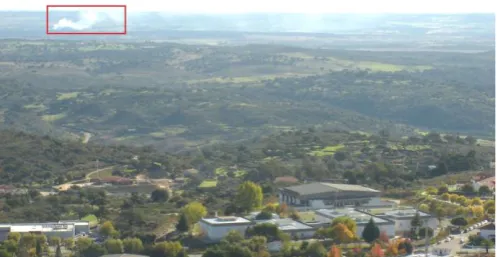
It is usually difficult to view fire flames from a camera mounted on a watch tower. However, smoke is visible at long distances. A snapshot of a typical wildfire smoke captured by a watch tower camera from a far distance is shown in Fig.2. Since smoke can be spotted before the flames themselves, smoke detection is usually the primary aim of the system.
The diagram of Fig. 3 shows the execution of a standard detection flow in the system. There is a first module sible for acquiring video frames. The next module is respon-sible for detecting changes between frames. While not all changes between consecutive frames are necessarily fires, it is likely that a fire incident results from a change between two consecutive frames especially when the frame rate is low (as in the case of CICLOPE). The detection module is the core of the platform and implements the algorithms.
The evaluator is also an important building block of the system. The goal of this model is to evaluate and measure the performance of each of the algorithms. Here, it is important to evaluate not only if true hits occur but also if smoke plumes/fires in consecutive frames are being correctly tracked. A set of measures are related to this module: how long did it take to detect a fire, for how long was the fire de-tected, the number of missed hits for the same fire and others. We describe, in detail, how to evaluate image alignment and smoke/fire detection in the results section.
IV. ALGORITHMS
[image:3.595.49.293.196.346.2]In the following, we describe three algorithms of CICLOPE for fire and smoke detection.
[image:3.595.302.552.309.405.2]Fig. 2. Image captured by CICLOPE showing a fire detection at long-range.
[image:3.595.42.291.616.744.2]Fig. 3. Smoke/fire detection process implemented.
A.
ADBACK
The first algorithm is based on ADaptive BACKground subtraction (ADBACK) and is inspired by the LOTS algo-rithm [1]. ADBACK uses two gray level background images (𝐵𝑙𝑖𝑔ℎ𝑡 and 𝐵𝑑𝑎𝑟𝑘), that are initialized during an initial
train-ing process ustrain-ing a set of consecutive 𝑁 frames, without tar-get objects:
𝐵𝑙𝑖𝑔ℎ𝑡(𝑥, 𝑦) = 𝑚𝑎𝑥(𝐼𝑡(𝑥, 𝑦), 𝑡 = 1, … , 𝑁) (1)
𝐵𝑑𝑎𝑟𝑘(𝑥, 𝑦) = min(𝐼𝑡(𝑥, 𝑦), 𝑡 = 1, … , 𝑁) (2)
where 𝐼𝑡(𝑥, 𝑦)denotes a frame at the time instant 𝑡.
Target objects are detected with two thresholds (𝑇𝐿, 𝑇𝐻).
The difference between each pixel and the closest back-ground image is calculated and, if it exceeds a low threshold
𝑇𝐿, the pixel is considered active. A target is detected if a set
of connected active pixels such that a subset of them verifies
mini|It(x, y) − Bit(x, y)| > TH (3)
where 𝑇𝐻 is the high threshold. The low and high thresholds
as well as the background images are updated dynamically as new frames come in.
B.
BEFORT
BEFORT, the second algorithm is based on the same rea-soning of ADBACK but uses a database of past images to construct the background light and dark. Concretely, for each new image, the algorithm analyses 𝑁 previous images. For each pair of these images 𝐼1 and 𝐼2 creates the two gray level
backgrounds
𝐵𝑙𝑖𝑔ℎ𝑡(𝑥, 𝑦) = max(𝐼1(𝑥, 𝑦), 𝐼2(𝑥, 𝑦)) (4)
𝐵𝑑𝑎𝑟𝑘(𝑥, 𝑦) = min(𝐼1(𝑥, 𝑦), 𝐼2(𝑥, 𝑦)) (5)
Target objects are detected with two thresholds (𝑇𝐿, 𝑇𝐻).
The difference between each pixel and the closest back-ground image is calculated and if it exceeds a low threshold
𝑇𝐿, the pixel is considered active. If a pixel is active for at
least one pair of past images, then it is considered a target.
C.
BESTEST
The BESTEST algorithm uses 𝑁 previous images to create a statistical background model per pixel. For each new image
𝐼𝑡
it calculates the average and standard deviation value of the component Red, Green and Blue. If a pixel is within a certain distance of the background it is considered active. This dis-tance is computed using the standard deviation of the pixel for each color component:
|𝐼𝑅𝑡(𝑥, 𝑦) − 𝐵𝑅𝑡(𝑥, 𝑦)| > 𝜎𝑅(𝑥, 𝑦) ⋁
|𝐼𝐺𝑡(𝑥, 𝑦) − 𝐵
𝐺𝑡(𝑥, 𝑦)| > 𝜎𝐺(𝑥, 𝑦) ⋁
|𝐼𝐵𝑡(𝑥, 𝑦) − 𝐵𝐵𝑡(𝑥, 𝑦)| > 𝜎𝐵(𝑥, 𝑦) (6)
When the red, green or blue distance is superior to the re-spective standard deviation of the pixel then the pixel is con-sidered an active pixel. Quasi-connected components are used to determine the final targets.
V. PERFORMANCEMEASURES
In this section, we describe a set of general performance measures applicable to any smoke and fire detection method that can be of use both from an academic as well as a real-life standpoint.
A.
Alignment Performance Measures
One of the most important steps of our algorithms is change detection. For successful change detection, it is im-portant to have correct frame alignment. Alignment here re-fers to the ability to align two successive frames from the same scene. Concretely, alignment consists of moving, and potentially deforming, a template image to minimize the dif-ference between the template and an input image [22]. In or-der to evaluate alignment, it is important to first determine what a correct alignment is: Suppose we are trying to align a template image T(x) to an input image I(x), where 𝑥 = (𝑥, 𝑦)T is a vector containing the image coordinates. If the
warp is denoted by W(x, p), where p =(𝑝1, … 𝑝𝑛)𝑇 is a vector
of parameters, we assume that the goal of image alignment is to minimize:
∑ [I(W(x; p)) − T(x)]x 2 (7)
with respect to p, whereby the sum is performed over the range of pixels x in the template image T(x).
There is a vast range of alignment evaluation measures. In this section, we present one of the most popular measures: Pearson’s correlation coefficient (PCC).
Pearson Correlation Coefficient
Pearson’s Correlation Coefficient (PCC) is a widely used statistical measure used in pattern recognition and image pro-cessing. The PCC has the ability to output a single scalar from the comparison of two images. The coefficient takes value 1 if the two images are identical, 0 if they are completely un-correlated, and -1 if they are anti-un-correlated, for example, if one image is the negative of the other.
A major advantage of PCC is that it is invariant to linear transformations of x and y. Accordingly, the method is mostly indifferent to uniform variations in brightness and contrast. The correlation coefficient between sequences 𝑋 = {𝑥𝑖 | 𝑖 =
1 … , 𝑛} and 𝑌 = {𝑦𝑖 | 𝑖 = 1 … , 𝑛} is given by:
r = 1
n∑ (xi−x̅)(yi−y̅) n
i=1
√√1n∑ni=1(xi−x̅)2 √ 1
n∑ (yi−y̅)2 n i=1
(8)
where
𝑥̅ = 1
𝑛∑ 𝑥𝑖 𝑛
𝑖=1 and 𝑦̅ = 1 𝑛∑ 𝑦𝑖
𝑛 𝑖=1
which can also be written as:
𝑟 = 1
𝑛∑ (
(𝑥𝑖−𝑥̅)
𝜎𝑥 ) (
(𝑦𝑖−𝑦̅)
𝜎𝑦 )
𝑛
𝑖=1
(9) or
r = 1
𝑛𝑋̅
𝑡 𝑌̅ (10)
This measure is compared against a threshold to determine if the alignment was a good or bad alignment. Over time, the system keeps track of the overall number of processed images and computes the percentage of aligned images. An aligned image is an image whose PCC is above a given threshold of alignment (PCC > 𝑇𝐴= 0.65)These figures are presented as
B.
Detection Performance Measures
There are four types of errors that can be made in detection. First, the system may indicate the presence of a smoke plume/fire in a place where the fire does not exist. The second type of error may occur when a fire or smoke plume exists somewhere in an image, but the system does not recognize it or indicates the presence of fire in the wrong location. Each of these errors can be referred to as respectively:
Measure D-1: (FP) – False Positive in the frame. An estimate exists that is not associated with a ground truth object.
Measure D-2: (FN) – False Negative in the frame. A ground truth object exists that is not associated with an estimate.
Two other fundamental measures which are often ignored in this field are precision and recall. They are often used in information retrieval but are rarely used to determine if and how well fire and smoke are being detected.
Recall. Given a collection of true positive samples (TP) and false negatives (FN)
𝑅𝑒𝑐𝑎𝑙𝑙 = TP
TP+FN. (11)
Recall assesses how much of the ground truth (fire data set) is covered by estimation (detection data set). It varies be-tween 0 (no overlap) and 1 (full overlap). The recall is neces-sary for good detection quality as it measures how well a model detects all the relevant fires.
Precision, Given a collection of true positive samples (TP) and false negatives (FN)
𝑃𝑟𝑒𝑐𝑖𝑠𝑖𝑜𝑛 = TP
TP+FP (12)
Precision assesses how much of the estimation covers the ground truth and can take values between 0 (no overlap) and 1 (full overlap). As a recall, precision alone is an important property but cannot guarantee a high-quality detection.
F-measure.To address the limitations of precision and recall it is possible to use the F-measure. The F-measure is ex-pressed as
𝐹𝑚𝑒𝑎𝑠𝑢𝑟𝑒 = ( 𝑃𝑟𝑒𝑐𝑖𝑠𝑖𝑜𝑛∗𝑅𝑒𝑐𝑎𝑙𝑙
𝑃𝑟𝑒𝑐𝑖𝑠𝑖𝑜𝑛+𝑅𝑒𝑐𝑎𝑙𝑙). (13)
This measure is a better indicator of good detection as it re-quires both high precision and recall values. We also use the standard measure of accuracy:
𝐴𝑐𝑐𝑢𝑟𝑎𝑐𝑦 = ( 𝑇𝑃+𝑇𝑁
𝑇𝑃+𝑇𝑁+𝐹𝑃+𝐹𝑁). (14)
VI. RESULTS
In this section, we present the results of comparing CICLOPE’s three algorithms against LOTS [1]. We divide this section into three subsections: (i) dataset description, (ii) alignment results and (iii) detection results.
A.
Dataset
The smoke and fire detection algorithms are applied to a set of 68951920 × 1080 real-world images collected between October and December 2018 from a viewpoint of a watchtower in Castelo Branco, Portugal. The images were
sampled every 5 minutes during daylight period from 7 A.M to 19 P.M. Overall, the dataset encompasses 50 critical days with at least one fire. Concretely, the set includes 438 images samples with smoke or fire representing 75 real fire incidents. Fires can be at a close, mid and long range.
B.
Alignment Results
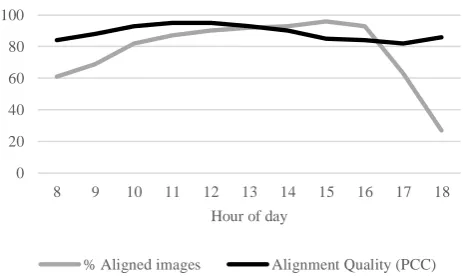
The results of applying the CICLOPE aligner to the 7000 images are summarized in Fig. 4. The chart of Fig. 4 shows the efficiency of the aligner measured in two perspectives: (i) % of aligned images and (ii) average correlation coefficient over time. As shown, the aligner works best under optimal lighting conditions i.e. between 12 and 16H. Here, the per-centage of aligned images is always above 90% and the aver-age correlation coefficient is consistently high (> 0.80).
These results suggest that CICLOPE’s aligner could be im-proved during these hours.
C.
Numerical Results
We ran our tests in a PC with Intel (R) Core (TM) i5-8400 CPU 2.80 GHz, 8.0 GB memory, 64 bits OS. The results of our experiments are shown in Table I. Here, a true positive (TP) or “fire observation” is defined as an image (video frame) that has at least one smoke/fire. We also show in col-umn 2 (in parentheses) the number of fire incidents detected out of the 75.
In regard to the TP measure the best model was ADBACK with a total of 388TP in 438 fire samples (representing 69 detected fires in 75). Predictably, this model is also the one with the highest recall (88.58%) as it is the algorithm with by far the highest number of successful detections.
There may be situations where a high recall rate may be necessary, namely during fire danger season dates where the risk of fire is more likely and the potential for destruction is larger. In such cases having a more sensitive algorithm, such as ADBACK, eventually aided by human supervision, can be more of use than resorting to a more conservative method.
[image:5.595.311.543.65.203.2]We consider a false positive as any image (video frame) where there are one or more false alarms. According to this metric, BEFORT excels the other algorithms with only 609 false alarms in the 6895images. Please note that given the images’ sample rate of 5 minutes, this figure means that every hour there will only be around 1.8 false alarms (on average), a very acceptable rate. The drawback of this algorithm is its conservativeness as it has a considerably low recall (5.71%) Fig. 4. Efficiency of the image aligner module measured per hour of day.
0 20 40 60 80 100
8 9 10 11 12 13 14 15 16 17 18
Hour of day
compared to ADBACK’s recall (88.58%).
Another balanced algorithm is BESTEST. It shows an ac-ceptable recall (16.67%), a not so low precision (6.75%) (close to the one of ADBACK), the highest accuracy (80.07%) and the second highest F-measure (9.60%). The ADBACK is, however, the best in recall (88.58%), precision (12.32%) and F-measure (21.63%).
It is important to discuss the relevance of F-measure to pro-vide an overall view of the performance of models. It is clear from our example that the F-measure is better than the tradi-tional metric of accuracy. For instance, consider the accuracy of LOTS, 84.12%, which is the second highest accuracy of the set. This metric does not translate the low recall attained by this method (2.51%) resulting from LOTS only detecting
7 fires out of the 75. In contrast, the F-measure gives the best scores to BESTEST, BEFORT, and ADBACK which makes sense as these methods show more balanced results.
As a final note please consider that the F-measure results were not remarkable (21.63% for the best case of ADBACK). This follows again from the fact that it is difficult to remove false alarms, especially given the low fps under which the system operates, resulting in a low precision rate. Environ-mental conditions, sudden light changes, fog, camera shifts, rain, and other factors contribute to a high number of frames with alarms. This, however, and as explained before, does not mean that a model with low precision and consequently low F-measure is necessarily a bad model in this context.
TABLEI
PERFORMANCEOFTESTEDALGORITHMS
Measure LOTS [1] ADBACK BEFORT BESTEST
True Positives (TP) (Detected fires) 11 (7 fires) 388 (69 fires) 25 (16 fires) 73 (31 fires)
False Positives (FP) 668 2762 609 1009
Precision (%) 1.62 12.32 3.94 6.75
Recall (%) 2.51 88.58 5.71 16.67
Accuracy (%) 84.12 59.22 85.17 80.07
F-measure (%) 1.96 21.63 4.66 9.60
I. CONCLUSION
In this paper, we present CICLOPE, a surveillance system that is able to perform remote detection of smoke and fire in real-time. We describe three of its legacy algorithms and compare them against LOTS [1], a similar model from the literature.
Our main contribution is showing how this kind of algo-rithms performs in challenging real-world datasets. Our da-taset is challenging for several reasons. First, it comprises both close, mid and long-range fires. It is easier to detect fire and smoke at close or mid-range than at far-range especially when we consider tenths of kilometers away. It is problematic to define thresholds that can be applied both to detect close and long-range fires. In the future, a solution may be devel-oped to take into consideration a depth map of the scene when defining the thresholds.
Second, the camera can shift considerably. For the purpose of background subtraction, it is important to have aligned im-ages. Misaligned images can result in non-moving objects such as trees and houses being detected as moving objects and eventually generate false alarms. As future work, the CICLOPE aligner may be improved for its problematic hours.
Third, sudden light changes, fog, and rain as well as other environmental conditions can also lead to false detections. Note that we aim to detect smoke plumes/fires that can have very small dimensions (such as a minimal area of 10 pixels in a 1920 × 1080 image. Developing algorithms that can deal with these complex scenes is a non-trivial task. To this aim, it may be necessary to develop tailored algorithms/heuristics to solve each of these problems.
We also aimed to show how evaluation measures such as recall, precision, and F-measure can be of use to compare smoke and fire detection algorithms. We stress that it is im-portant to analyze these measures as well as standard false positive and true positive rates and accuracy.
R
EFERENCES[1] Boult, Terrance E., Ross J. Micheals, Xiang Gao, and Michael Eck-mann. "Into the woods: Visual surveillance of noncooperative and cam-ouflaged targets in complex outdoor settings." Proceedings of the IEEE 89, no. 10 (2001): 1382-1402.
[2] Philippe Guillemant and Jerome Vicente, “Real-time identification of smoke images by clustering motions on a fractal curve with a temporal embedding method,” Optical Engineering, vol. 40, no. 4, pp. 554–563, 2001.
[3] Jerome Vicente and Philippe Guillemant, “An image processing tech-nique for automatically detecting forest fire,” International Journal of Thermal Sciences, vol. 41, no. 12, pp. 1113 – 1120, 2002.
[4] F. Gomez-Rodriguez, B. C. Arrue, and A. Ollero, “Smoke monitoring and measurement using image processing: application to forest fires,” in Society of PhotoOptical Instrumentation Engineers (SPIE) Confer-ence Series, F. A. Sadjadi, Ed., Sept. 2003, vol. 5094, pp. 404–411. [5] Damir K., Darko S., and Toni J, “Histogram based smoke segmentation
in forest fire detection system,” Information technology and control, 2009.
[6] Qinjuan L. and Ning H., “Effective dynamic object detecting for video-based forest fire smog recognition,” in 2nd International Congress on IImage and Signal Processing CISP, 2009, pp. 1–5.
[7] B.U. Toreyin, Y. Dedeoglu, and A.E. Cetin, “Computer Vision Based Method for Real-Time Fire and Flame Detection,” Pattern Recognition Lett., vol. 27, no. 1, 2006, pp. 49-58.
[8] B. U. Toreyin and A. E. C¸ Etin, “Computer vision-based forest fire detection,” in IEEE 16. Sinyal Isleme ve Iletisim Uygulamalari Ku-rultayi, SIU-2008, 2008.
[9] B. U. Toreyin and A. E. C¸ Etin, “Wildfire detection using LMS based active learning,” in in Proceedings of the IEEE International Confer-ence on Acoustics, Speech and Signal Processing (ICASSP, 2009). [10] Habiboglu, Y. Hakan, Osman Gunay, and A. Enis Cetin. "Real-time
wildfire detection using correlation descriptors." In 2011 19th Euro-pean Signal Processing Conference, pp. 894-898. IEEE, 2011. [11] Park, JunOh, ByoungChul Ko, Jae-Yeal Nam, and SooYeong Kwak.
"Wildfire smoke detection using spatiotemporal bag-of-features of smoke." In 2013 IEEE Workshop on Applications of Computer Vision (WACV), pp. 200-205. IEEE, 2013.
[13] Zhong, Zhen, Minjuan Wang, Yukun Shi, and Wanlin Gao. "A convo-lutional neural network-based flame detection method in video se-quence." Signal, Image and Video Processing 12, no. 8 (2018): 1619-1627.
[14] Luo, Yanmin, Liang Zhao, Peizhong Liu, and Detian Huang. "Fire smoke detection algorithm based on motion characteristic and convo-lutional neural networks." Multimedia Tools and Applications (2018): 1-18.
[15] Tedim, Fantina, Ruben Remelgado, Célia Borges, Salete Carvalho, and João Martins. "Exploring the occurrence of mega-fires in Portu-gal." Forest Ecology and Management 294 (2013): 86-96..
[16] Xiong, Ziyou, Rodrigo Caballero, Hongcheng Wang, Alan M. Finn, Muhidin A. Lelic, and Pei-Yuan Peng. "Video-based smoke detection: possibilities, techniques, and challenges." In IFPA, fire suppression and detection research and applications—a technical working confer-ence (SUPDET), Orlando, FL. 2007.
[17] Çetin, A. Enis, Kosmas Dimitropoulos, Benedict Gouverneur, Nikos Grammalidis, Osman Günay, Y. Hakan Habiboǧlu, B. Uǧur Töreyin, and Steven Verstockt. "Video fire detection – Review." Digital Signal Processing 23, no. 6 (2013): 1827-1843.
[18] Celik, Turgay. "Fast and efficient method for fire detection using image processing." ETRI journal 32, no. 6 (2010): 881-890.
[19] Giglio, L., J. D. Kendall, and C. O. Justice. "Evaluation of global fire detection algorithms using simulated AVHRR infrared data." Interna-tional Journal of Remote Sensing 20, no. 10 (1999): 1947-1985. [20] Grandison, A. J., E. R. Galea, M. K. Patel, and David Peace. Fire
Mod-elling Standards/benchmark: Report on SMARTFIRE Phase 2 Simula-tions. University of Greenwich, Centre for Numerical Modelling and Process Analysis, 2001.
[21] Jakovčević, Toni, Ljiljana Šerić, Darko Stipaničev, and Damir Krstinić. "Wildfire smoke-detection algorithms evaluation." In VI Int. Conf. Forest Fire Res, pp. 1-12. 2010.