Effects of the molecule-electrode interface on the low-bias conductance of Cu–H2–
Cu single-molecule junctions
Zhuoling Jiang, Hao Wang, Ziyong Shen, Stefano Sanvito, and Shimin Hou,
Citation: J. Chem. Phys. 145, 044701 (2016); doi: 10.1063/1.4959287
View online: http://dx.doi.org/10.1063/1.4959287
View Table of Contents: http://aip.scitation.org/toc/jcp/145/4
Effects of the molecule-electrode interface on the low-bias conductance
of Cu–H
2–Cu single-molecule junctions
Zhuoling Jiang,1,2Hao Wang,1Ziyong Shen,1Stefano Sanvito,3and Shimin Hou1,4,a)
1Key Laboratory for the Physics and Chemistry of Nanodevices, Department of Electronics, Peking University, Beijing 100871, China
2Centre for Nanoscale Science and Technology, Academy for Advanced Interdisciplinary Studies, Peking University, Beijing 100871, China
3School of Physics, AMBER and CRANN Institute, Trinity College, Dublin 2, Ireland 4Beida Information Research (BIR), Tianjin 300457, China
(Received 30 April 2016; accepted 11 July 2016; published online 22 July 2016)
The atomic structure and electronic transport properties of a single hydrogen molecule connected to both symmetric and asymmetric Cu electrodes are investigated by using the non-equilibrium Green’s function formalism combined with the density functional theory. Our calculations show that in symmetric Cu–H2–Cu junctions, the low-bias conductance drops rapidly upon stretching, while asymmetric ones present a low-bias conductance spanning the 0.2–0.3 G0interval for a wide range of electrode separations. This is in good agreement with experiments on Cu atomic contacts in a hydrogen environment. Furthermore, the distribution of the calculated vibrational energies of the two hydrogen atoms in the asymmetric Cu–H2–Cu junction is also consistent with experiments. These findings provide clear evidence for the formation of asymmetric Cu–H2–Cu molecular junctions in breaking Cu atomic contacts in the presence of hydrogen and are also helpful for the design of molec-ular devices with Cu electrodes.Published by AIP Publishing.[http://dx.doi.org/10.1063/1.4959287]
I. INTRODUCTION
Molecular electronic devices, with the potential to be the solution for electronics “beyond silicon,” have aroused widespread attention during the past two decades.1
The development of experimental techniques, such as mechanically controllable break junctions and scanning probe microscopy methods,2,3has made molecular electronics
evolving from a theoretical hypothesis into an experimental reality. Thus great opportunities have opened up with the exciting possibility of manipulating quantum states, which are impossible to capture in conventional solid-state electronic devices. Among all the possible molecular junctions, a single hydrogen molecule bridging two metal electrodes is their prototype. The first of such junctions was reported by Smit et al.4In their experiment, a conductance plateau near 1 G0 (G0=2e2/h is the conductance quantum) was observed when platinum quantum point contacts were broken in a hydrogen atmosphere and the corresponding conductance histogram exhibited a sharp peak at 1 G0 with a low conductance tail. Further theoretical investigations revealed that the 1 G0 conductance is the result of the strong hybridization between the antibonding state of the H2 molecule and the apex Pt atoms.5 Afterward, considerable efforts have been devoted
to the study of single hydrogen molecular junctions with coinage metal electrodes due to their much easier applications in molecular electronics.6–15 However, most of these studies focused on Au/H2 junctions, while only a few works have been reported for Ag and Cu atomic contacts, because
a)Author to whom correspondence should be addressed. Electronic mail:
no stable monatomic chains can be formed in the latter two cases. Recently, Kiguchi and co-workers investigated the electronic transport properties of Cu–H2–Cu molecular junctions fabricated by breaking Cu atomic contacts in a hydrogen environment, and the conductance histogram showed a sharp 0.2–0.3 G0 peak together with a clear 1 G0 peak corresponding to the Cu atomic contacts.11,12 To account for this observation, Mottaet al.tentatively attributed the low-conductance state to a specific junction configuration in which one H2 molecule sits laterally on the side of the Cu atomic contact.13 The calculated conductance for such geometry is ∼0.6 G0, which is about twice as large as the experimental value.
The second important information for determining the geometry of the junction was also provided by Kiguchi and co-workers, who determined the vibrational energies of the Cu–H2–Cu molecular junctions from the peaks of the differential conductance spectra.11They found that these
vibrational energies are distributed in the 10-80 meV range with peaks at 20, 40, and 60 meV. They also suggested that the Cu–H2–Cu molecular junctions should actually present asymmetric molecule-electrode interfaces, since the shape of the current-voltage (I-V) characteristics is itself rather asymmetric.14 Although these experimental studies confirm
the formation of Cu–H2–Cu single-molecule junctions, the details of the atomic configuration and the conducting mechanism of Cu–H2–Cu molecular junctions still remain elusive.
In order to address these important issues, we investigate the structural and electronic transport properties of a hydrogen molecule connecting to two Cu electrodes with different binding configurations by employing the non-equilibrium
044701-2 Jianget al. J. Chem. Phys.145, 044701 (2016)
Green’s function formalism combined with the density func-tional theory (that is the so-called NEGF+DFT approach).16–25 Our calculations show that, as the electrode separation is increased, the low-bias conductance of the symmetric Cu–H2–Cu junction with one H2 molecule sandwiched between two identical pyramidal Cu tips drops rapidly. In contrast, the asymmetric Cu–H2–Cu junction, in which the H2 molecule is wired to one Cu electrode through a pyramidal Cu tip but binds at the hollow site of a pyramidal base on the surface of the other Cu electrode, can successfully reproduce the observed 0.2–0.3 G0conductance plateau. Moreover, the calculated vibrational energies of the asymmetric Cu–H2–Cu junction are also distributed in the 20-80 meV range. Thus, the asymmetric Cu–H2–Cu single-molecule junction is an appropriate junction model to explain both the low conductance plateau in the conductance curve and the distribution of vibrational energies observed for Cu atomic contacts broken in a hydrogen environment.
II. CALCULATION METHOD
In this work we use the SIESTA code to calculate the atomic structure of the Cu–H2–Cu junctions and the quantum transport code SMEAGOL to study their electronic transport properties.23–26SIESTA is an efficient DFT package, in which the improved Troullier-Martins pseudopotentials are used to describe the atomic cores, while the wave functions of the valence electrons are expanded over a finite-range numerical orbital basis.26,27 We adopt a double-zeta plus polarization basis set for all atoms, and the Perdew-Burke-Ernzerhof generalized gradient approximation for the exchange-correlation functional.28 With our choice
of pseudopotentials and basis functions, a lattice constant of 3.68 Å is obtained for bulk copper, in good agreement with the experimental value of 3.61 Å,29 while the H–H
bond length and the stretching frequency of the H2molecule in the gas phase are, respectively, calculated to be 0.75 Å and 4411 cm−1 consistent with the experimental values of 0.74 Å and 4401 cm−1.30,31In the calculations, the Cu–H
2–Cu junctions are geometrically optimized until the atomic forces are smaller than 0.02 eV Å−1. The Brillouin zone was sampled with a 4×4×1 k-points mesh, and an energy cutoffof 250 Ry is used for the real-space integration mesh.
SMEAGOL is a practical implementation of the NEGF+DFT approach, which employs SIESTA as the DFT platform.23–25 The unit cell of the extended molecule,
where the scattering potential is computed self-consistently, comprises the hydrogen molecule, some Cu atoms with low coordination and ten Cu(111) atomic layers with a 3×3 in plane supercell. We always consider periodic boundary conditions in the plane transverse to the transport. The I-V characteristics of the Cu–H2–Cu junction is calculated as
I= 2e h
+∞
−∞
T(V,E)[f(E−µL)−f(E−µR)]dE, (1)
where T(V,E) is the bias-dependent transmission function of the junction, f(E) is the Fermi-Dirac distribution, and
µL/R=EF±eV/2 is the local Fermi level of the left/right copper electrode with EF being the Fermi energy. Then,
the total transmission coefficient T(V,E) of the junction is evaluated as
T(V,E)= 1
Ω2DBZ
2DBZ
T(⃗k;V,E)d⃗k, (2)
where Ω2DBZ is the area of the two-dimensional Brillouin zone (2DBZ) in the transverse directions. The k-dependent transmission coefficientT(⃗k;E)is obtained as
T(⃗k;E)=Tr[ΓLGRMΓRGRM+], (3)
where GRM is the retarded Green’s function matrix of the extended molecule and ΓL(R) is the broadening function
matrix describing the interaction of the extended molecule with the left-hand (right-hand) side copper electrode. Here, we calculate the transmission coefficient by sampling 6×6 k-points in the transverse 2DBZ.
III. RESULTS AND DISCUSSION
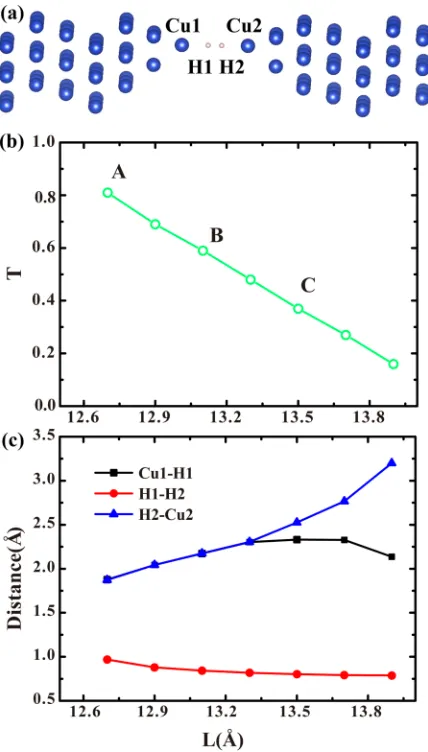
FIG. 1. (a) The optimized atomic structure of the symmetric Cu–H2–Cu junction at the electrode distance L=12.70 Å. The transmission coefficient at the Fermi level (b) and some typical bond distances (c) as a function of the electrode separation.
The equilibrium transmission spectrum of the symmetric Cu–H2–Cu junction at the electrode separation of 12.70 Å, together with the local density of states (LDOS) projected onto the atomic orbitals of the hydrogen and apical copper atoms, is shown in Fig.2. A noticeable transmission plateau appears around EF. When comparing with the LDOS of the H and the apical Cu atoms in the junction, we find that the transmission plateau around EF is dominated by the Cu 4s and H 1s atomic orbitals. This is also corroborated by the eigenchannel analysis,33,34which reveals that aroundE
Fthere is only one nearly full open conducting channel consisting of the Cu 4s and H 1s atomic orbitals (see Fig. S1 in the supplementary material).35 In Fig. 2(d), we present the
[image:4.594.58.272.47.423.2]transmission spectrum projected onto the frontier molecular orbitals of the hydrogen molecule by using our previously developed scattering states projection method.33Similarly to the case of Pt–H2–Pt molecular junctions,5 the antibonding state of the hydrogen molecule hybridizes strongly with the adjacent Cu atoms and thus dominates the transmission around EF. In contrast, the bonding state of the H2molecule yields a sharp transmission peak at −7.25 eV and makes a minor contribution to the transmission aroundEF.
FIG. 2. The equilibrium transmission spectrum (a), the LDOS projected onto the 4s, 4p, and 3d atomic orbitals of the Cu2 atom (b), 1s and 2p atomic orbitals of the H2 atom (c), and the transmission projected onto the frontier molecular orbitals of H2(d) for the symmetric Cu–H2–Cu junction at the electrode separation L=12.70 Å.
The low-bias conductance of the symmetric Cu–H2–Cu molecular junction drops rapidly following the increase of the electrode separation. When the junction conductance takes the value of 0.2–0.3 G0, the symmetric Cu–H2–Cu junction has broken at one of the two molecule-electrode interfaces (Fig.1(c)). Therefore, the symmetric junction configuration cannot be responsible for the experimental observation of the 0.2–0.3 G0 conductance plateau.11,12 Since the I-V characteristics measured for the Cu–H2–Cu junctions exhibits a prominently asymmetric shape, Kiguchi and co-workers claimed that the hydrogen molecule is asymmetrically bonded to the two copper electrodes.14 Usually monatomic chains
cannot be formed in Cu atomic contacts. Thus, when one Cu atomic contact breaks, the central single copper atom may remain on the surface of one Cu electrode forming a protruding single Cu atom whereas the other electrode ends with a smooth copper cluster on its surface. If a hydrogen molecule is trapped between these two electrodes thereafter, an asymmetric Cu–H2–Cu molecular junction will be formed. We believe that this is the most likely geometry in breaking junction experiments.
[image:4.594.318.539.48.199.2]044701-4 Jianget al. J. Chem. Phys.145, 044701 (2016)
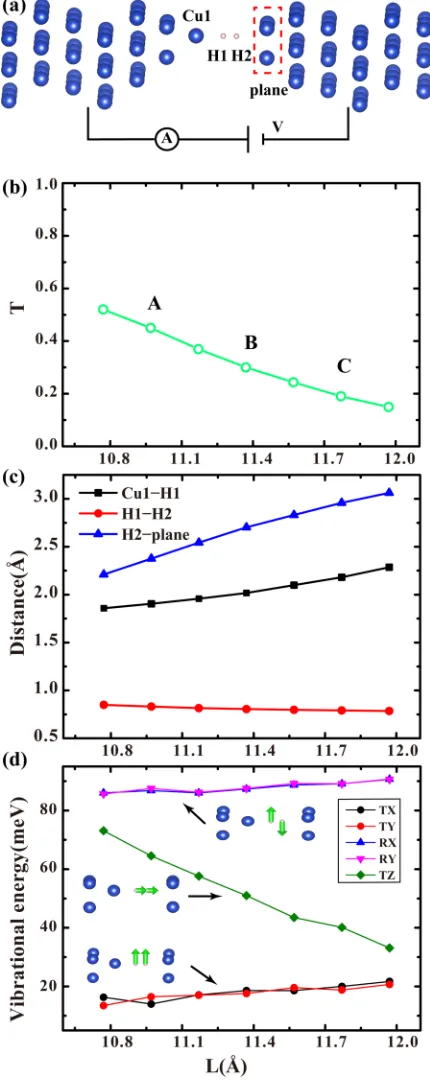
FIG. 3. (a) The optimized atomic structure of the asymmetric Cu–H2–Cu junction at the electrode separation L=11.37 Å. The transmission coefficient at the Fermi level (b), some typical bond distances (c) and the vibrational energies of the transverse vibration modes and the longitudinal translation mode of the two H atoms (d) as a function of the electrode separation.
in the 0.2–0.3 G0 interval within a rather long range of electrode separations, in good agreement with the experiment results.11,12,14This marked difference between the asymmetric and symmetric junctions can be traced back to their different behaviors upon stretching. At variance with the symmetric Cu–H2–Cu junction, where one Cu–H bond becomes longer but the other one becomes shorter as the electrode separation
becomes larger than a certain value (Fig. 1(c)), in the asymmetric case the bond length dCu1−H1 and the distance
dH2−planebetween the H2 atom and the plane constituted by the three Cu adatoms always get longer as the electrode separation is increased (Fig.3(c)). Certainly, the major displacement of the two Cu electrodes occurs between the H2 molecule and the three Cu adatoms. In detail, when the electrode separation is increased from 10.77 Å to 11.97 Å, the distancedH2−plane increases from 2.21 Å to 3.06 Å, while the bond lengthdCu1−H1 is elongated by only 0.43 Å.
Because of the inelastic electron tunneling caused by electron-vibration interaction, experimental techniques such as action spectroscopy can measure the vibrational energies of a single-molecule junction and help us in characterizing the atomic configuration of the junction.36In order to further
ascertain the suitability of the asymmetric Cu–H2–Cu junction model, we have studied its dynamical properties. At variance with the gas phase in which only a stretching mode exists, the H2molecule in the asymmetric Cu–H2–Cu junction has four types of vibration modes: the longitudinal stretching mode (ST), the longitudinal translation mode (TZ) with the center of mass of the H2molecule vibrating along the transport direction, the two transverse rotation modes (RX, RY) in which the angle between the H–H bond and the transport direction vibrates, and the two transverse translation modes (TX, TY) in which the center of mass of the H2molecule vibrates along the transverse directions. We calculate these vibration modes by using the frozen phonon method at each stretching step. Since the vibrational energy of the ST mode is around several hundreds meV, the observed vibration modes of Cu-H2–Cu junctions can only be attributed to the other three types of molecular vibrations. As shown in Fig.3(d), the calculated vibrational energies of the transverse translation modes are concentrated around 20 meV, while the vibrational energies of the transverse rotation modes are at about 85 meV, and all of these transverse vibration modes depend weakly on the electrode separation. In contrast, the vibrational energy of the longitudinal translation mode monotonically decreases from
∼70 meV to∼30 meV as the electrode separation is increased from 10.77 Å to 11.97 Å, showing a strong dependence on the electrode separation. This is not a surprising result, considering that the longitudinal translation mode of the H2 molecule in the asymmetric Cu–H2–Cu junction depends sensitively on the molecule-electrode interaction. As the junction is elongated the binding energy between the H2 molecule and the two Cu electrodes is weakened and thus the vibrational energy of the longitudinal translation mode becomes smaller. Thus, the vibration modes observed around 20 meV and 80 meV can be respectively assigned to the transverse translation and rotation modes, and the vibration modes observed between 30 meV and 70 meV can be assigned to the longitudinal translation mode. This good agreement between the calculated and experimental results provides a further support for the appropriateness of the asymmetric Cu–H2–Cu junction model.12
[image:5.594.57.272.51.592.2]FIG. 4. The equilibrium transmission spectrum (a), the LDOS projected onto the 4s, 4p, and 3d atomic orbitals of the Cu1 atom (b), 1s and 2p atomic orbital of the H2 atom (c) of the asymmetric Cu–H2–Cu junction at the electrode separation L=11.37 Å. (d) The LDOS projected onto the 1s atomic orbital of the H2 atom at different electrode separations which are labeled in Fig.3(b).
and the LDOS of the H and Cu atoms in the constriction. As shown in Fig. 4(a), a small transmission peak appears at −0.39 eV and extends above the Fermi level, resulting in a transmission coefficient of 0.30 at EF. An analysis of the LDOS of the Cu1, H1, H2, and the three Cu adatoms, together with the calculation of the eigenchannels (see Fig. S2 in the supplementary material),35reveals that the transmission around EFis dominated by the 4s orbital of Cu and the 1s of H. The dependence of the LDOS of the H2 1s atomic orbital on the electrode separation shows that, as the asymmetric Cu–H2–Cu junction is stretched, the sharp peak centered at
−0.39 eV and the LDOS around EFhave a small reduction, indicating that the coupling of the hydrogen molecule to the Cu electrodes is slightly weakened (Fig.4(d)). As a result, the low-bias conductance of the asymmetric Cu–H2–Cu junction shows a relatively weak decrease following the increase of the electrode separation. In contrast, in the symmetric Cu–H2–Cu junction, the LDOS of the H2 1s atomic orbital presents a distinct decrease around EF during the junction elongation (Fig. S3 in the supplementary material),35 resulting in a dramatic drop of the zero-bias transmission.
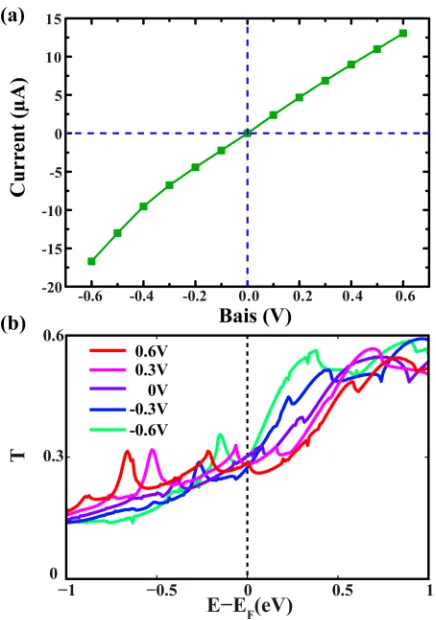
[image:6.594.56.277.49.199.2]Finally, we calculate the I-V curve of the asymmetric Cu–H2–Cu molecular junction at the electrode separation L=11.37 Å (Fig.5(a)). As we can see, the electric current through the junction shows a clear dependence on the applied bias polarity and increases more rapidly at negative bias voltages. The asymmetry of the calculatedI-V characteristics is rooted in the different coupling strengths at the two molecule-electrode interfaces, which can be appreciated from the bias-dependent transmission spectra (Fig. 5(b)). When a negative bias is applied to the left-hand side Cu electrode, which is decorated with a pyramidal Cu tip on its surface, the local Fermi level of that electrode shifts upwards, the transmission peak centered at−0.39 eV at zero bias is shifted to higher energies and the transmission aroundEFis enhanced, resulting in a higher current. In contrast, when the bias polarity is reversed, the local Fermi level of the left-hand side Cu electrode shifts downwards, the same transmission peak is shifted to lower energies, and the transmission around EF is on average diminished, resulting in smaller
FIG. 5. The calculatedI-V curve (a) and the bias-dependent transmission spectra (b) of the asymmetric Cu–H2–Cu junction at the electrode separation L=11.37 Å.
conductance. Therefore, the electronic coupling at the left-hand side molecule-electrode interface is stronger than that at the right-hand side one. Although the asymmetric shape of the I-V curve is successfully reproduced, the ratio between the calculated currents at the two bias polarities is less than that observed in experiments. In detail, the ratio between the currents calculated at±0.6 V is only 1.3 whereas the measured value is 4.0 when the bias voltages are±0.3 V.14This may be
due to the too simplistic models of the Cu electrodes in our calculations and more complex asymmetric Cu electrodes are formed in real experiments.14
IV. CONCLUSION
In this study we have investigated the atomic structures and electronic transport properties of both the symmet-ric and asymmetsymmet-ric Cu–H2–Cu junctions employing the NEGF+DFT approach. Our calculations show that the symmetric Cu–H2–Cu junction presents a dramatic drop in conductance upon elongation and thus fails in reproducing the 0.2–0.3 G0conductance plateau measured in experiments. In contrast, an asymmetric junction shows a slowly descending conductance curve spanning the 0.2–0.3 G0 range for long electrode separations. Vibrational analysis of the asymmetric Cu–H2–Cu junction reveals that the vibrational energies of the transverse translation and rotation modes of the H2 molecule, respectively, keep the nearly constant values of
044701-6 Jianget al. J. Chem. Phys.145, 044701 (2016)
the longitudinal translation mode has vibrational energies around 30–70 meV, which are in good agreement with the experimental values. Therefore, the asymmetric Cu–H2–Cu junction is the more preferred atomic configuration for single hydrogen molecules bonded to Cu electrodes. These findings not only provide an explanation to the observed vibrational and electronic transport properties of copper atomic contacts in a hydrogen environment but are also helpful in facilitating the design and fabrication of molecular electronic devices made with Cu electrodes.
ACKNOWLEDGMENTS
This project was supported by the National Natural Science Foundation of China (Grant Nos. 61321001 and 61271050) and the MOST of China (Grant No. 2013CB933404). S.S. thanks additional funding support from the European Research Council (QUEST project) and by AMBER (Grant No. 12/RC/2278).
1D. Xiang, X. Wang, C. Jia, T. Lee, and X. Guo,Chem. Rev.116, 4318 (2016).
2J. M. Krans, J. M. van Ruitenbeek, V. V. Fisun, I. K. Yanson, and L. J. De Jongh,Nature375, 767 (1995).
3B. Xu and N. Tao,Science301, 1221 (2003).
4R. H. M. Smit, Y. Noat, C. Untiedt, N. D. Lang, M. C. van Hemert, and J. M. van Ruitenbeek,Nature419, 906 (2002).
5K. S. Thygesen and K. W. Jacobsen,Phys. Rev. Lett.94, 036807 (2005). 6S. Csonka, A. Halbritter, G. Mihály, E. Jurdik, O. I. Shklyarevskii, S. Speller,
and H. van Kempen,Phys. Rev. Lett.90, 116803 (2003).
7R. N. Barnett, H. Häkkinen, A. G. Scherbakov, and U. Landman,Nano Lett.
4, 1845 (2004).
8S. Csonka, A. Halbritter, and G. Mihály,Phys. Rev. B73, 075405 (2006). 9T. Frederiksen, M. Paulsson, and M. Brandbyge,J. Phys.: Conf. Ser.61, 312
(2007).
10M. Kiguchi, T. Nakazumi, K. Hashimoto, and K. Murakoshi,Phys. Rev. B
81, 045420 (2010).
11R. Matsushita, S. Kaneko, T. Nakazumi, and M. Kiguchi,Phys. Rev. B84, 245412 (2011).
12T. Nakazumi, S. Kaneko, and M. Kiguchi,J. Phys. Chem. C118, 7489 (2014).
13C. Motta, G. Fratesi, and M. I. Trioni,Phys. Rev. B87, 075415 (2013). 14Y. Li, S. Kaneko, S. Fujii, and M. Kiguchi,J. Phys. Chem. C119, 19143
(2015).
15Z. Jiang, H. Wang, S. Sanvito, and S. Hou,Phys. Rev. B93, 125438 (2016). 16Y. Meir and N. S. Wingreen,Phys. Rev. Lett.68, 2512 (1992).
17P. Hohenberg and W. Kohn,Phys. Rev.136, B864 (1964). 18W. Kohn and L. J. Sham,Phys. Rev.140, A1133 (1965). 19Y. Xue, S. Datta, and M. A. Ratner,Chem. Phys.281, 151 (2002). 20M. Brandbyge, J.-L. Mozos, P. Ordejón, J. Taylor, and K. Stokbro,
Phys. Rev. B65, 165401 (2002).
21J. Zhang, S. Hou, R. Li, Z. Qian, R. Han, Z. Shen, X. Zhao, and Z. Xue,
Nanotechnology16, 3057 (2005).
22R. Li, J. Zhang, S. Hou, Z. Qian, Z. Shen, X. Zhao, and Z. Xue,Chem. Phys.
336, 127 (2007).
23A. R. Rocha, V. M. García-Suárez, S. W. Bailey, C. J. Lambert, J. Ferrer, and S. Sanvito,Nat. Mater.4, 335 (2005).
24A. R. Rocha, V. M. García-Suárez, S. Bailey, C. Lambert, J. Ferrer, and S. Sanvito,Phys. Rev. B73, 085414 (2006).
25I. Rungger and S. Sanvito,Phys. Rev. B78, 035407 (2008).
26J. M. Soler, E. Artacho, J. D. Gale, A. García, J. Junquera, P. Ordejón, and D. Sánchez-Portal,J. Phys.: Condens. Matter14, 2745 (2002).
27N. Troullier and J. L. Martins,Phys. Rev. B43, 1993 (1991).
28J. P. Perdew, K. Burke, and M. Ernzerhof,Phys. Rev. Lett.77, 3865 (1996). 29C. Kittel,Introduction to Solid State Physics, 8th ed. (Wiley, Hoboken, NJ,
2004).
30P. C. H. Mitchell, P. Wolohan, D. Thompsett, and S. J. Cooper,J. Mol. Catal.
A: Chem.119, 223 (1997).
31D. A. Mcquarrie and J. D. Simon, Physical Chemistry: A Molecular
Approach(University Science Books, Sausalito CA, 1997). 32D. Cakir and O. Gulseren,Phys. Rev. B84, 085450 (2011).
33R. Li, S. Hou, J. Zhang, Z. Qian, Z. Shen, and X. Zhao,J. Chem. Phys.125, 194113 (2006).
34M. Paulsson and M. Brandbyge,Phys. Rev. B76, 115117 (2007). 35See supplementary material athttp://dx.doi.org/10.1063/1.4959287for the
eigenchannel analysis of symmetric and asymmetric Cu–H2–Cu molecular junctions around the Fermi level, the LDOS projected onto the 1s atomic orbital of the H2 atom in the symmetric Cu–H2–Cu junction at different electrode separations, and the dependence of the PDOS and transmission spectrum of the asymmetric Cu–H2–Cu molecular junction as a function of the k-point integration mesh.
36Y. Kim, K. Motobayashi, T. Frederiksen, H. Ueba, and M. Kawai,Prog. Surf.