Computer-assisted Structuring of
Emergency Management Information: A Project Note
Yotaro Watanabe Kentaro Inui Shingo Suzuki Hiroko Koumoto
Tohoku University Kyoto University Fuji Tokoha University
{yotaro-w,inui}@ecei.tohoku.ac.jp [email protected] [email protected]
Mitsuhiro Higashida Yuji Maeda Katsumi Iwatsuki
ESIP NTT Secure Platform Laboratories Tohoku University
[email protected] [email protected] [email protected]
Abstract
In order to achieve high-level resilience against disasters, effective utilization of previous emergency management infor-mation is necessary. The goal of this project is to establish effective utiliza-tion of emergency management informa-tion and emergency response logs that are accumulated as a fundamental dataset to learn lessons for emergencies in the fu-ture. More precisely, we develop a frame-work that simplifies structuring emer-gency management information and cre-ating databases through various media or formats by exploiting technologies such as natural language processing to fix the bottlenecks for inputting information in emergency response sites, to share disas-ter state, and to contribute towards achiev-ing more effective use of human resources. The academic aim of this project is to establish the task of creating a database of emergency management information as a subfield of natural language processing applications.
1 Introduction
In order to confront natural disasters which could become a national crisis, high-level resilience against disasters is required. To achieve this, it is necessary to assume emergency situations, prompt actions for emergencies, and conduct quick and correct restorations and recoveries. This requires effective use of emergency management informa-tion.
In response to the 2011 Tohoku earth-quake/tsunami in Japan, a strong desire for the de-velopment of new methods to improve emergency response came about. The basic framework for emergency management by local governments is
the following: (i) As soon as a disaster takes place, the local government organizes a headquarter for disaster control, which consists of the mayor (as the director-general) and directors from executive branches (Water and Sewer Division, Civil En-gineering Division, etc.) as well as representa-tives from the police, the fire station, etc. (ii) Each executive branch collects disaster informa-tion from a large variety of sources and responds to requests from disaster sites. (iii) The collected in-formation is conveyed to the headquarter and also shared with other branches so that the headquarter and branches can effectively cooperate with each other. (iv) The headquarter keeps the situation in perspective and makes local government-wide de-cisions. (v) A summary of the accumulated dis-aster information and responses is communicated to neighboring local governments and the higher administrative division (i.e. prefecture or state).
As the reader may imagine from the above, the most important key for this whole system to work effectively is communication; i.e. the key issue is how efficiently and precisely information about the progress situation and the responses against it can be shared among the executive branches and the headquarter together with the outside of the disaster site. Unfortunately, however, the 3.11 earthquake revealed that in most local govern-ments in the disaster-hit areas, the current means for emergency management communication was crucially inefficient, which sometimes caused mis-communications and prohibited the disaster con-trol headquarters from making optimal or appro-priate decisions. While the inefficiency of com-munication was partly due to severe damages of communication networks, critical problems arose even under the situation where communication networks were available. In most of the local governments in the disaster-hit areas, each piece of information from outside (through phone calls, radio communications, etc.) was recorded only
emergency management information system
manually input
by experts
collection and communication
by papers and sounds
white boards
local government
Japan
U.S.
Emergency management
information database
SNS
phone
!"#$%#&'() "*&*%#"#&+)) ,&-.$"*/.&)
Figure 1: Emergency management systems in Japan and United States.
by hand writing and thus distributed to divisions in charge only by oral communication or through white boards as shown in Figure 1. This makes it difficult to efficiently share emergency manage-ment information among divisions and local gov-ernments, also hinders promptly update status of disaster response.
In contrast, in the United States, WebEOC (EOC: Emergency Operation Center), a web browser-based information system conformable to a standardization of incident management by NIMS (National Incident Management System), has been introduced to more than 80% of the state governments, and has achieved effective emer-gency responses. To operate the systems, pro-fessional employees are hired at each crisis agement office to manually input emergency man-agement information as structured information us-ing a computer. Standardization of information management in crisis situations has internationally progressed and has been recommended for ISO 22320. On the other hand, such emergency man-agement information systems have not been intro-duced to actual situations in Japan.
It is not enough that simply converting emer-gency management information from a large va-riety of sources to unstructured texts. Realizing quick and correct restoration and utilization of them for the future disasters needs making them as structured information to be searchable by storing, classifying and organizing them. The structuriza-tion consists of selecting one of database schemas and search its items from texts, and prohibitively
high cost will be required if the operation is per-formed by human. In order to operate such system with limited resources, reducing the cost of struc-turization is essential.
Given this background, we have launched a government-founded three-year project to develop a system that assists with creating databases of emergency management information to digitize, accumulate and utilize them. We address the fol-lowing three issues in this project.
Designing standard DB schemas for emergency management information By analyzing actual emergency response operations, we design stan-dard DB schemas for emergency management in-formation that can be commonly applied for di-verse local governments.
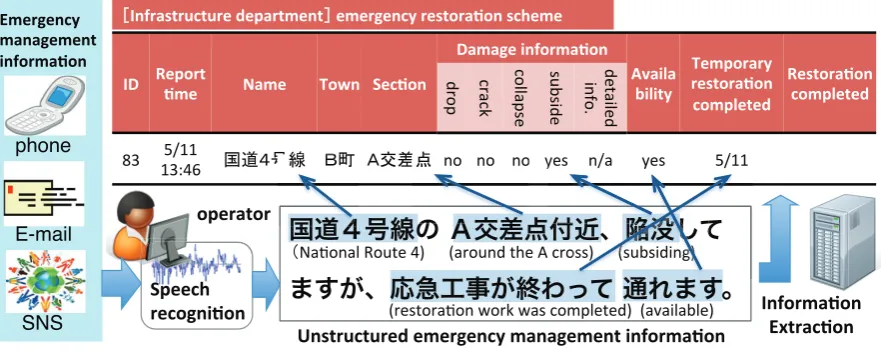
Developing a system that assist with creating emergency management information databases By further advancement of natural language pro-cessing technologies, we develop a system that ef-ficiently stores unstructured emergency manage-ment information to databases. This system at first extracts important information from unstructured texts, selects one of database schemas, and finally fills each of the elements with a corresponding ex-pression in a text, as shown in Figure 2.
experi-!" #$%&'()
*+$ ,-+$ .&/0 1$2*&0
"-+-3$)405&'+-*&0) 67-48-9484(: .$+%&'-':) '$;(&'-*&0) 2&+%8$($< #$;(&'-*&0) 2&+%8$($<) !" # $ %"&% ' %#
((&$)* )+,
)-! * !* .&-(* !/ -0 1# 2 34 5677/
7489: !"#$% &' ()*+/ 0# 0# 0# ;*) 06& ;*) 5677
,!05'-;('=2(='$)<$%-'(+$0(-)$+$'3$02:)'$;(&'-*&0);2>$+$
!05&'+-*&0) ?@('-2*&0 A0;('=2(='$<)$+$'3$02:)+-0-3$+$0()405&'+-*&0
国道4号線の A交差点付近、陥没して
ますが、応急工事が終わって 通れます。
.<&=#0&(/>#+.*/9?//////@&"#+0!/.A*/B/%"#))?//////@)+,)-!-0C?/
/////////////////////////@"*).#"&=#0/D#"'/D&)/%#E$(*.*!?//@&F&-(&,(*?
% &'
国道4
4
4
4
+ 0# 0# 0#
の
線の A
A交差
差
差
差
差
差
点
点
;*)
点付
5677
付近、
、
陥
陥
陥
陥
陥
陥
陥
陥
陥
陥
て
て 通れます
#))???//////@@@@@@@@@))
付近 陥
06& *)
し
し
し
し
し
し
し
し
し
し
し
て
陥
陥
陥
陥
陥
陥
陥
陥
陥
陥
陥
没
没
没
没
没
没
没
没
没
没
没
没
没
し
し
し
し
し
し
し
し
し
し
し
通れます
)+,)-!-0CCCCCCCCCC???????????
;*)
陥
陥
陥
陥没
没
没
没
没
没
没
没
没
没
没
[image:3.595.77.518.67.243.2]1%$$2>)) '$2&304*&0 SNS phone E-mail ?+$'3$02:) +-0-3$+$0()) 405&'+-*&0) &%$'-(&'
Figure 2: Creation of emergency management information databases.
ments of technologies of adding emergency man-agement information to databases.
In addition, we develop a system that uni-fies these research outcomes and evaluates per-formance of the developed system by conducting experiments cooperated with the emergency man-agement information system. Through discussions of technical and systematic issues we will have, we find knowledge for deploying the system into the field.
2 Research Issues and Plans in Our Project
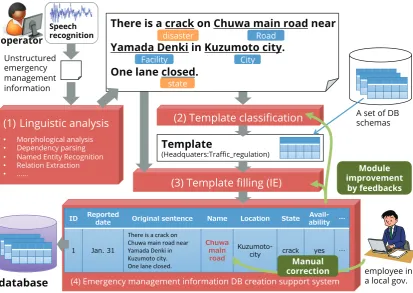
In this project, we develop an emergency manage-ment information database creation support sys-tem using speech recognition and natural language processing technologies as shown in Figure 3. To do this, we (1) design emergency management information schemas, (2) develop an emergency management information database creation sup-port system whose inputs consist of various forms of information such as speeches, faxes with hand-written characters, and so on, and (3) improve the environment for the usage of the emergency man-agement information system. In addition, we in-corporate the developed system into WebEOC, a standard emergency management information sys-tem, and then conduct demonstration experiments with the developed system by cooperating with lo-cal governments to analyze technilo-cal and system-atic issues in deploying the system into the field. The detailed explanations of the tasks we address are explained as follows.
2.1 Task 1: Designing Emergency Management Information Schemas
In this task, we at first analyze emergency re-sponse operations thus far in local governments cooperating in this project. We then design and standardize emergency management informa-tion schemas and develop a system that assists with creating emergency management information databases. In addition, we develop a framework that automatically creates emergency management information in conjunction with WebEOC.
man-(4) !"#DB$%&'()*(+, Template
(Headquaters:Traffic_regulation) (2) Template classification,
(3) Template filling (IE), (1) Linguistic analysis
• Morphological analysis • Dependency parsing • Named Entity Recognition • Relation Extraction • ……,
employee in a local gov. Module improvement
by feedbacks
database
There is a crack on Chuwa main road near
Yamada Denki in Kuzumoto city.
One lane closed.
Road
City Facility
disaster
state
(4) Emergency management information DB creation support system, Speech
recognition operator
operattttttttttttttttttttttttttttttttottttttttttttttttttttttttttttttttttoooooooooooooooooooor
Unstructured emergency management information,
!" #$%&'($) )*($ +',-,.*/01$.($.2$ 3*4$ 5&2*(,&. 6(*($ *:,/,(; 78*,/9 <
-, ./0123-,
!"#$#%&'%(%)$()*%+,% -"./(%0(&,%$+(1%,#($% 2(0(1(%3#,*&%&,% 4.5.0+6+%)&678% 9,#%:(,#%):+'#18%
=>?@* 4*,.
'&*)
45657898:,
;<9=, ;>/;?, =@A, B, Manual correction
[image:4.595.92.506.66.359.2]A set of DB schemas,
Figure 3: An emergency management information database creation support system.
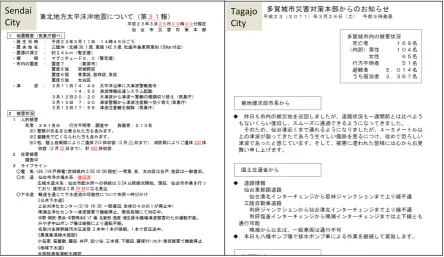
age pieces of emergency information using paper-based media such as FAX and share them in their own formats as shown in Figure 4, we consider the needs for these local governments by establish-ing sharable and flexible emergency management information schemas customizable for each local government.
Then, we standardize emergency management information schemas through comparison to out-comes of previous work. Standardization of emer-gency management information schemas is con-ducted through several opportunities such as do-mestic or international conferences, and developed on a cloud-based system. For this, we develop a guideline of the cloud-based system as a emer-gency management cloud through ASPIC (ASP-SaaS-Cloud Consortium) 1 and encourage broad use of the system.
2.1.1 Research Issues and Plan
Toward efficient sharing of emergency responses, United States defined Incident Command System (ICS) Forms, a standard of federal emergency management, in which items required for ICS are defined. The templates of them were provided to
1
http://www.aspicjapan.org/
WebEOC. However, it is unclear whether those forms are both necessary and sufficient for operat-ing response activities. Additionally, they may not be applicable to response in Japan. In a Kashihara city case study, Higashida et al. (2012) created operational templates to deal with necessary data. Schemas of the templates indicate necessary data items for operations. They are, however, not based on information in actual response. In or-der to establish standard emergency management schemas which are applicable for various types of emergency situations and usable in ordinance-designated cities, the administrative divisions of Japan and central governments, we interview lo-cal governments to draw out information of past emergencies and analyze them to address the is-sue.
2.2 Task 2: Development of an Emergency Management Information Database Creation Support System
!"#$%&' (&)*
+%,%-.'' (&)*
Figure 4: Different forms of damage reports.
emergency management information databases.
2.2.1 Developing Emergency Management Information Structurization
Technology
We assume that inputs in the system are dig-itized unstructured texts transformed from pri-mary emergency management information such as sounds and papers, e-mails, and social networks. We develop a structurization technology that auto-matically extracts information which corresponds to items in schemas from unstructured texts.
Considering actual use of this technology, we have to handle not only text data but also speeches and images. However, considering the fact that this research has a limited time frame of only three years, we decided to concentrate on creat-ing databases from digitized, unstructured texts. Since speech recognition performance depends on speech environment, acoustic model, etc., it is necessary to consider such factors into improve the accuracy of speech recognition which digi-tize emergency management information. In this project, we assume that speech input is performed by some particular operators. This enables us to provide invariable environment for speech recog-nition. Also we consider using a fixed form for reading out emergency management information. On the other hand, existing hand-written character
recognition technologies are currently not reliable for use, so it would be necessary to read hand-written texts out loud and digitize the speech via speech recognition.
technolo-gies of large-scale linguistic and domain knowl-edge acquisition from web pages.
2.2.2 Development of a User Interface of the Emergency Management Information Database Creation Support System
For the emergency management information databases we design in this project, we prepare schemas for more than ten divisions of local gov-ernments and define dozens of items for each of the schemas. The structurization we described in Section 2.2.1 requires extraction of extremely fine-grained database items from natural language text, and this kind of difficult task setting has not yet been explored in previous work. Thus, instead of using system outputs without change, we need a system which can easily display choices presented by the system for operators to select. To address this, we develop a high-quality framework that ef-ficiently create databases from unstructured emer-gency management information by effectively us-ing emergency management information structur-ization technologies. These technologies are im-proved through interactions with users and ma-chine learning approaches which enable us to dy-namically improve the performance of the system by user feedback.
2.2.3 Research Issues and Plan
The structurization includes diverse information extraction subtasks including named entity recog-nition (NER) such as location names (city, road, etc.), facility names (shelter, shop, school, etc.), numerical expression identification and normaliz-ing, relation extraction (RE), location name dis-ambiguation and slot filling.
In Message Understanding Conference (MUC) (Grishman and Sundheim, 1996) and Automatic Content Extraction (ACE) (Doddington et al., 2004) communities, various information extrac-tion tasks including named entity recogniextrac-tion, re-lation extraction and slot filling have been plored. The task of disambiguation location ex-pressions is called toponymy disambiguation, and has been explored by (Buscaldi and Rosso, 2008b; Buscaldi, 2010; Buscaldi, 2011; Habib and van Keulen, 2013; Bo et al., 2012; Lee et al., 2013) and GeoNLP Project2. For the task of disam-biguation location names, Buscaldi and Rosso de-veloped Geo-WordNet (2008a) in which entries
2
http://agora.ex.nii.ac.jp/GeoNLP/
of location names are coupled with their coordi-nates. TAC Knowledge Base Population (KBP) (McNamee and Dang, 2009; Ji et al., 2010a; Ji et al., 2010b) also has dealt with the task of entity disambiguation task as an entity linking problem where systems are required to link entity mentions to corresponding database entries. The difficulty of our task is that we have to detect fine-grained actual locations of location expressions which can include not only named entities but also expres-sions with general nouns (e.g. the convenience store in front of the station). Such disambigua-tion of general locadisambigua-tion expressions is a major is-sue since systems are required to predict actual en-tities from contextual information, etc. There is no previous work that addresses this kind of difficult task setting.
Also, how to collaborate with speech recog-nition systems is an important issue. Since the performance of the state-of-the-art speech recog-nition system is not perfect, we explore how to input emergency management information effec-tively and accurately from speeches.
Customizability is also an important require-ment to make the system applicable for various lo-cal governments because processes of emergency management information can be different for each local government. We establish effective cus-tomizing methods through cooperating with local government employees.
2.3 Task 3: Environment Improvement for the Usage of Emergency Management Information Systems
improve such skills. It is important to best utilize practical response data of the Earthquake to cre-ate such scenarios and implement drills to provide them.
For improvement of the environment for the us-age of emergency manus-agement information sys-tems, we prepare manuals that describe usage of the emergency management information systems and the database schemas used in the system. Also, we develop a scenario dataset for emergency drills. More precisely, we generate (a) hazard and damage maps for the purpose of training in emer-gency situations using a Web service we have de-veloped. In addition, we create (b) a progress sce-nario of issues to be addressed based on the emer-gency management manuals, responses for flood damages, research results regarding cause-effect structures and the interview for employees in dis-aster affected local governments. Based on (a) and (b), we create a drill scenario dataset while appro-priately including emergency responses for sev-eral emergency situations. Since we use the emer-gency management information database creation support system in training, we conduct situation annotation by using appropriate media consistent with the input interface of the system. Also, the drill scenario dataset will be used as a data for developing several structurization technologies in Task 2. To exploit the drill scenario data, we make the dataset capable, especially in size, for training machine learning models. This scenario dataset will also be used as an evaluation scenario for con-ducting demonstration experiments. In addition, we prepare a useful manual that describes the us-age of the scenario dataset by clarifying required contents of the manual in the demonstration exper-iments.
2.3.1 Research Issues and Plan
In the improvement of the environment for the us-age of emergency manus-agement information sys-tems, we need emergency response data to de-velop drill scenarios. However, so far, digitized emergency responses have not been accumulated as archives. The records of emergency responses in Tohoku earthquake/tsunami have especially not been digitized, which can be effectively utilized to conduct emergency response training for poten-tial Nankai Trough off the coast of western Japan. Developing training datasets and designing gency management systems require actual emer-gency management records that are digitized and
recorded in a unified way. However, there are several local governments which cannot provide such records. In order to address this issue, we develop a drill scenario data by enhancing lim-ited emergency response data obtained from inter-views for emergency responders by complement-ing them with damage information and status in-formation. In addition, we take every possible means to develop drill scenario data by examining media used for situation annotation and consider-ing status change due to emergency responses. Af-ter the development, we improve the data by ask-ing employees in charge of disasters in local gov-ernments to check the data. By developing a mul-tiple drill scenarios, we make the data applicable for various local governments.
To encourage broad use of the system, we demonstrate the system and conduct emergency response training in the local governments that co-operated with us. In the encouragement, we make the system cloud-based and construct a system which makes it easily available to conduct training in local governments through networks. In making the system cloud-based, we follow ISO22320, the standard of emergency management.
3 Current Status
We have already developed cooperative relations with some disaster affected local governments and have analyzed emergency response records pro-vided by them in regards to how many contacts were received for each division, etc. From the analysis, we obtained fundamental information which should be considered in the development of database schemas. By analyzing the documents of the emergency management headquarter, we found that (i) updates of emergency information are mainly focused on 3 days after the disaster and (ii) understanding an overview of the disas-ter is easily accomplished by organizing and fix-ing items of emergency management information beforehand, etc.
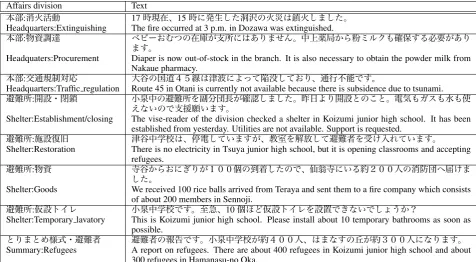
Based on the data and the analysis, we devel-oped a sample scenario data consisting of 100 en-tries and used it as reference data for designing the system. Table 1 shows some entries extracted from the developed scenario data.
structur-Affairs division Text
本部:消火活動 17時現在、15時に発生した洞沢の火災は鎮火しました。
Headquarters:Extinguishing The fire occurred at 3 p.m. in Dozawa was extinguished.
本部:物資調達 ベビーおむつの在庫が支所にはありません。中上薬局から粉ミルクも確保する必要があり
ます。
Headquaters:Procurement Diaper is now out-of-stock in the branch. It is also necessary to obtain the powder milk from Nakaue pharmacy.
本部:交通規制対応 大谷の国道45線は津波によって陥没しており、通行不能です。
Headquarters:Traffic regulation Route 45 in Otani is currently not available because there is subsidence due to tsunami.
避難所:開設・閉鎖 小泉中の避難所を副分団長が確認しました。昨日より開設とのこと。電気もガスも水も使
えないので支援願います。
Shelter:Establishment/closing The vise-reader of the division checked a shelter in Koizumi junior high school. It has been established from yesterday. Utilities are not available. Support is requested.
避難所:施設復旧 津谷中学校は、停電していますが、教室を解放して避難者を受け入れています。
Shelter:Restoration There is no electricity in Tsuya junior high school, but it is opening classrooms and accepting refugees.
避難所:物資 寺谷からおにぎりが100個の到着したので、仙翁寺にいる約200人の消防団へ届けま
した。
Shelter:Goods We received 100 rice balls arrived from Teraya and sent them to a fire company which consists of about 200 members in Sennoji.
避難所:仮設トイレ 小泉中学校です。至急、10個ほど仮設トイレを設置できないでしょうか?
Shelter:Temporary lavatory This is Koizumi junior high school. Please install about 10 temporary bathrooms as soon as possible.
とりまとめ様式・避難者 避難者の報告です。小泉中学校が約400人、はまなすの丘が約300人になります。
[image:8.595.72.549.65.327.2]Summary:Refugees A report on refugees. There are about 400 refugees in Koizumi junior high school and about 300 refugees in Hamanasu-no Oka.
Table 1: Samples of the developed entries of emergency management information.
ization of natural language texts, template selec-tion, information extracselec-tion, and error correction by humans. In the structurization of natural lan-guage texts, we found that we need morphologi-cal analysis, chunking, dependency parsing, coor-dination analysis, entity extraction, event extrac-tion, numerical expression recogniextrac-tion, location expression recognition, relation extraction, modal-ity analysis, voice analysis, aspect analysis, exis-tence analysis, clause relation analysis, discourse relation analysis and anaphora resolution.
We have started to develop linguistic analyzers required for the development of the proposed sys-tem, including a numerical expression recognizer, location expression recognizer, relation extractor, etc. As of now, the developed system is still in infant stage.
4 Conclusion
In this paper, we described an overview of our project, developing a system that assists structur-ing of emergency management information, and its current status. To utilize emergency manage-ment information in order to improve resilience against emergencies, we develop a framework that simplifies structuring emergency management in-formation through various media or formats by exploiting natural language processing
technolo-gies. The tasks we address in this project are: (1) Designing standard DB schemas for emergency management information, (2) Developing a sys-tem that assists with creating emergency manage-ment information databases, and (3) Environmen-tal improvement for the usage of emergency man-agement.
In the future, we plan on establishing the database schemas commonly applicable for vari-ous local governments, and we progress with the development of the system that assists with cre-ating databases with emergency management in-formation using natural language processing tech-nologies. After the development, we include the developed system into WebEOC, a standard emer-gency management information system, and con-duct demonstration experiments with local gov-ernments to analyze technical and systematic is-sues for deploying the system into the field.
References
Han Bo, Paul Cook, and Timothy Baldwin. 2012. Ge-olocation prediction in social media data by finding location indicative words. InProceedings of COL-ING 2012: Technical Papers, pages 1045–1062.
Davide Buscaldi and Paolo Rosso. 2008b. Map-based vs. knowledge-based toponym disambiguation. In Proceedings of the 5th ACM Workshop On Geo-graphic Information Retrieval (GIR 2008), pages 19–22.
Davide Buscaldi. 2010. Toponym disambiguation in information retrieval. Ph.D. thesis, .
Davide Buscaldi. 2011. Approaches to disambiguating toponyms.SIGSPATIAL Special, 3(2):16–19, July.
George R. Doddington, Alexis Mitchell, Mark A. Przy-bocki, Lance A. Ramshaw, Stephanie Strassel, and Ralph M. Weischedel. 2004. The Automatic Con-tent Extraction (ACE) Program - Tasks, Data, and Evaluation. InProceedings of LREC 2004.
Ralph Grishman and Beth Sundheim. 1996. Message understanding conference-6: A brief history. In Pro-ceedings of the 16th conference on Computational linguistics - Volume 1, COLING ’96, pages 466– 471.
Mena B Habib and Maurice van Keulen. 2013. A Hybrid Approach for Robust Multilingual Toponym Extraction and Disambiguation. In International Conference on Language Processing and Intelligent Information Systems, LP & IIS 2013.
Mitsuhiro Higashida, Masahiro Sugiyama, Hideki Takeda, Tomomi Yamamoto, Yuji Maeda, and Haruo Hayashi. 2012. Analysis of information pro-cessing patterns appeared at emergency operation center training. Outline of Social Safety and Sci-ence, 30:93–96.
Zhexin Hu, Yasunori Hada, Toyoharu Itou, and Yashushi Saitou. 2007. A study on scenario mak-ing methods for disaster response exercised by local government personnel.Journal of Social Safety and Science, 9:271–278.
Heng Ji, Ralph Grishman, Hoa Trang Dang, Kira Grif-fitt, and Joe Ellis. 2010a. Overview of the TAC 2010 knowledge base population track.
Heng Ji, Ralph Grishman, Hoa Trang Dang, Kira Grif-fitt, and Joe Ellis. 2010b. Overview of the TAC 2011 knowledge base population track.
Kisung Lee, Raghu Ganti, Mudhakar Srivatsa, and Prasant Mohapatra. 2013. Spatio-Temporal Prove-nance: Identifying Location Information from Un-structured Text. InIEEE Information Quality and Quality of. Service for Pervasive Computing (IQ2S).
Paul McNamee and Hoa Trang Dang. 2009. Overview of the TAC 2009 knowledge base population track.
Yutaka Motoya, Haruo Hayashi, Norio Maki, Keiko Tamura, Reo Kimura, and Kayoko Takemoto. 2009. Suggestions on how to design efficient training and management systems for personnel in charge of emergency responses, placing an emphasis on the process of developing human resources: A study