Determining Compositionality of Word Expressions Using
Various Word Space Models and Measures
Lubom´ır Krˇcm´aˇr1,2 1University of West Bohemia,
Faculty of Applied Sciences, NTIS – New Technologies for the Information Society,
Pilsen, Czech Republic
Karel Jeˇzek2
2University of West Bohemia,
Faculty of Applied Sciences, Department of Computer Science and Engineering, Pilsen, Czech Republic
jezek [email protected]
Pavel Pecina3
3Charles University in Prague,
Faculty of Mathematics and Physics, Institute of Formal and Applied Linguistics,
Prague, Czech Republic
Abstract
This paper presents a comparative study of 5 different types of Word Space Mod-els (WSMs) combined with 4 different compositionality measures applied to the task of automatically determining seman-tic compositionality of word expressions. Many combinations of WSMs and mea-sures have never been applied to the task before.
The study follows Biemann and Gies-brecht (2011) who attempted to find a list of expressions for which the composition-ality assumption – the meaning of an ex-pression is determined by the meaning of its constituents and their combination – does not hold. Our results are very promis-ing and can be appreciated by those inter-ested in WSMs, compositionality, and/or relevant evaluation methods.
1 Introduction
Our understanding of WSM is in agreement with Sahlgren (2006): “The word space model is a computational model of word meaning that uti-lizes the distributional patterns of words collected over large text data to represent semantic similar-ity between words in terms of spatial proximsimilar-ity”. There are many types of WSMs built by different algorithms. WSMs are based on the Harris distri-butional hypothesis (Harris, 1954), which assumes that words are similar to the extent to which they share similar linguistic contexts. WSM can be viewed as a set of words associated with vectors representing contexts in which the words occur. Then, similar vectors imply (semantic) similarity of the words and vice versa. Consequently, WSMs
provide a means to find words semantically simi-lar to a given word. This capability of WSMs is exploited by many Natural Language Processing (NLP) applications as listed e.g. by Turney and Pantel (2010).
This study follows Biemann and Giesbrecht (2011), who attempted to find a list of non-compositional expressions whose meaning is not fully determined by the meaning of its con-stituents and their combination. The task turned out to be frustratingly hard (Johannsen et al., 2011). Biemann’s idea and motivation is that non-compositional expressions could be treated as sin-gle units in many NLP applications such as In-formation Retrieval (Acosta et al., 2011) or Ma-chine Translation (Carpuat and Diab, 2010). We extend this motivation by stating that WSMs could also benefit from a set of non-compositional ex-pressions. Specifically, WSMs could treat se-mantically non-compositional expressions as sin-gle units. As an example, consider “kick the bucket”, “hot dog”, or “zebra crossing”. Treat-ing such expressions as sTreat-ingle units might improve the quality of WSMs since the neighboring words of these expressions should not be related to their constituents (“kick”, “bucket”, “dog” or “zebra”), but instead to the whole expressions.
Recent works, including that of Lin (1999), Baldwin et al. (2003), Biemann and Giesbrecht (2011), Johannsen et al. (2011), Reddy et al. (2011a), Krˇcm´aˇr et al. (2012), and Krˇcm´aˇr et al. (2013), show the applicability of WSMs in deter-mining the compositionality of word expressions. The proposed methods exploit various types of WSMs combined with various measures for de-termining the compositionality applied to various datasets. First, this leads to non-directly compa-rable results and second, many combinations of
WSMs and measures have never before been ap-plied to the task. The main contribution and nov-elty of our study lies in systematic research of several basic and also advanced WSMs combined with all the so far, to the best of our knowledge, proposed WSM-based measures for determining the semantic compositionality.
The explored WSMs, described in more detail in Section 2, include the Vector Space Model, Latent Semantic Analysis, Hyperspace Analogue to Language, Correlated Occurrence Analogue to Lexical Semantics, and Random Indexing. The measures, including substitutability, endocentric-ity, compositionalendocentric-ity, and neighbors-in-common-based, are described in detail in Section 3. Sec-tion 4 describes our experiments performed on the manually annotated datasets – Distributional Semantics and Compositionality dataset (DISCO) and the dataset built by Reddy et al. (2011a). Sec-tion 5 summarizes the results and SecSec-tion 6 con-cludes the paper.
2 Word Space Models
The simplest and oldest types of WSMs1 are the Vector Space Model (VSM) and Hyperspace Ana-logue to Language (HAL). More recent and ad-vanced models include Latent Semantic Analy-sis (LSA), which is based on VSM, and Corre-lated Occurrence Analogue to Lexical Semantics (COALS), which originates from HAL. Random Indexing (RI) is WSM joining the principles of LSA and HAL. Many other WSMs have been pro-posed too. Their description is outside the scope of this paper and can be found e.g. in Turney and Pantel (2010) or Jurgens and Stevens (2010).
VSM is based on the assumption that similar (re-lated) words tend to occur in the same documents.2 VSM stores occurrence counts of all word types in documents a given corpus in a co-occurrence matrix C. The row vectors of the matrix corre-spond to the word types and the columns to the documents in the corpus. The numbers of occur-rencescij inCare usually weighted by the prod-uct of the local and global weighting functions (Nakov et al., 2001). The local function weights
cij by the same mathematical function; typically none (further denoted as no), log(cij + 1)
(de-1
WSMs are also referred to as distributional models of semantics, vector space models, or semantic spaces.
2VSM was originally developed for the SMART informa-tion retrieval system (Salton, 1971).
noted as log) or √cij (denoted as sqrt). The purpose of local weighting is to lower the im-portance of highly occurring words in the docu-ment. The global function weights every value in row i of C by the same value calculated for row i. Typically: none (denoted as N o), In-verse Document Frequency (denoted as Idf) or a function referred to as Entropy (Ent). Idf
is calculated as 1 + log(ndocs/df(i)) and Ent
as1 +{P
jp(i, j) logp(i, j)}/logndocs, where
ndocsis the number of documents in the corpora,
df(i)is the number of documents containing word typei, andp(i, j)is the probability of occurrence of word typeiin documentj.
LSA builds on VSM and was introduced by Landauer and Dumais (1997). The LSA algo-rithm works with the same co-occurrence matrix
Cwhich can be weighted in the same manner as in VSM. The matrix is than transformed by Sin-gular Value Decomposition (SVD) (Deerwester et al., 1990) into C. The purpose of SVD is to project the row vectors and column vectors of C
into a lower-dimensional space and thus bring the vectors of word types and vectors of documents, respectively, with similar meanings near to each other.3 The output number of dimensions is a pa-rameter of SVD and typically ranges from 200 to 1000 (Landauer and Dumais, 1997; Rohde et al., 2005).
HAL was first explored by Lund and Burgess (1996). It differs from VSM and LSA in that it only exploits neighboring words as contexts for word types. HAL processes the corpus by moving a sliding double-sided window with a size rang-ing from 1 to 5 around the word type in focus and accumulating the weighted co-occurrences of the preceding and following words into a matrix. Typically, the linear weighting function is used to ensure that the occurrences of words which are closer to the word type in focus are more significant. The dimensions of the resulting co-occurrence matrix are of size|V|and2|V|, where
V denotes the vocabulary consisting of all the word types occurring in the processed corpora. Fi-nally, the HAL co-occurrence matrix can be re-duced by retaining the most informative columns only. The columns with the highest values of en-tropy (−P
jpjlogpj, wherepj denotes the
ability of a word in the investigated columnj) can be considered as the most informative. The alter-natives and their description can be found e.g. in Song et al. (2004).
COALS was introduced by Rohde et al. (2005). Compared to HAL, COALS also processes a cor-pus by using a sliding window and linear weight-ing, but differs in several aspects: the window size of COALS is 4 and this value is fixed; COALS does not distinguish between the preceding and following words and treats them equally; applying COALS supposes that all but the most frequentm
columns reflecting the most common open-class words are discarded; COALS transforms weighted counts in the co-occurrence matrix in a special way (all the word pair correlations are calculated, negative values are set to 0, and non-negative ones are square rooted – corr); and optionally, Singu-lar Value Decomposition (Deerwester et al., 1990) can be applied to the COALS co-occurrence ma-trix.
RI is described in Sahlgren (2005) and can be viewed as a mixture of HAL and LSA. First, RI assigns random vectors to each word type in the corpus. The random vectors, referred to as index vectors, are very sparse, typically with a length of thousands, and contain only several (e.g. 7) non-zero values from the{-1,1}set. Second, RI processes the corpus by exploiting a sliding win-dow like HAL and COALS. However, RI does not accumulate the weighted co-occurrence counts of neighboring words to the vector of the word type in focus. Instead, RI accumulates the index vec-tors of the co-occurring words. For accounting the word order, the permutation variant of RI was also developed (Sahlgren et al., 2008). This variant permutes the index vectors of neighboring words of the word type in focus according to the word order.
3 Compositionality Measures
We experimented with four basically different compositionality measures (further referred to as Measures) (Krˇcm´aˇr et al., 2013). Each Measure employs a function to measure similarity of WSM vectors. We experimented with the following ones: cosine (cos), Euclidian (inverse to Euclid-ian distance) (euc), and Pearson correlation (cor).
The mathematical formulas are presented below.
cos(a,b) =
Pn
i=1aibi
pPn
i=1(ai)2Pni=1(bi)2
euc(a,b) = 1
1 +pPni=1(ai−bi)2
cor(a,b) =
Pn
i=1(ai−¯a)(bi−¯b)
q Pn
i=1(ai−¯a)2
Pn
i=1(bi−¯b)2
where ¯a= Pn
i=1ai
n ,
¯b= Pn
i=1bi
n
SU The substitutability-based Measure is based on the fact that the replacement of non-compositional expressions’ constituents by the words similar to them leads to anti-collocations (Pearce, 2002). The compositionality of expres-sions is calculated as the ratio between the num-ber of occurrences of the expression in a corpora and the sum of occurrences of its alternatives – possibly anti-collocations. In a similar way, we can compare pointwise mutual information scores (Lin, 1999). As an example, consider the possible occurrences of “hot dog” and “warm dog” in the corpora.
Formally, adopted from Krˇcm´aˇr et al. (2012), we calculate the compositionality scorecsufor an examined expression as follows:
csu =
PH
i=1Whahi, mi ∗
PM
j=1Whh, amj i
Whh, mi ,
wherehh, mi denotes the number of corpora oc-currences of the examined expression consisting of a head and a modifying word,ah
i andamj denote
i-th andj-th most similar word4in a certain WSM to the head and modifying word of the expression, respectively. W stands for a weighting function; following Krˇcm´aˇr et al. (2012), we experimented with no (no) and logarithm (log) weighting. The
∗symbol stands for one of the two operators: ad-dition (plus) and multiplication (mult).
EN The endocentricity-based Measure, also re-ferred to as component or constituent-based, com-pares the WSM vectors of the examined expres-sions and their constituents. The vectors expected to be different from each other are e.g. the vector representing the expression “hot dog” and the vec-tor representing the word “dog”. Formally, the
compositionality score cen can be calculated as follows:
cen=f(xh, xm) ,
where xh and xm denote the similarity (sim) or inverse rank distance (–dist) between the exam-ined expression and its head and modifying con-stituent, respectively, with regards to a certain WSM. Functionf stands for a combination of its parameters: 0.5xh + 0.5xm (avg), 0xh + 1xm (mOnly),1xh+ 0xm(hOnly),min(xh, xm)(min), andmax(xh, xm)(max).
CO The compositionality-based Measure com-pares the true co-occurrence vector of the exam-ined expression and the vector obtaexam-ined from the vectors corresponding to the constituents of the expression using some compositionality function (Reddy et al., 2011a). Commonly used compo-sitionality functions are vector addition (⊕) and pointwise vector multiplication (⊗) (Mitchell and Lapata, 2008). The vectors expected to be dif-ferent from each other are e.g. “hot dog” and “hot”⊕“dog”. Formally,
cco=s(ve, vh∗vm) ,
whereve, vh, and vm stand for vectors of an ex-amined expression, its head and modifying con-stituents, respectively.∗stands for a vector opera-tion.
NE The neighbors-in-common-based Measure is based on overlap of the most similar words to the examined expression and to its constituents (McCarthy et al., 2003). As an example, consider that “hot dog” is similar to “food” or “chips” and “dog” is similar to “cat” or “bark”. On the other hand, the list of neighbors of a semantically com-positional expression such as “black dog” is sup-posed to overlap with at least one of the lists of neighbors of both the expression constituents. For-mally,
cne=ohN +omN ,
where ohN andomN stand for the number of same words occurring in the list of the most similar words to the examined expression and to its head and modifying constituent, respectively.
4 Experiments
We evaluated the ability of various combinations of WSMs and Measures to rank expressions as the human annotators had done ahead of time.
Datasets We experimented with the DISCO (Biemann and Giesbrecht, 2011) and Reddy (Reddy et al., 2011a) human annotated datasets, built for the task of automatic determining of se-mantic compositionality. The DISCO and Reddy datasets consist of manually scored expressions of adjective-noun (AN), verb-object (VO), and subject-verb (SV) types and the noun-noun (NN) type, respectively. The DISCO dataset consists of 349 expressions divided into training, valida-tion, and test data (TestD); the Reddy dataset con-sists of one set containing 90 expressions. Since the DISCO validation data are of low size (35), we concatenated them with the training data (Tr-ValD). To TrValD and TestD we added the Reddy dataset, which we had divided stratifically ahead of time. Numbers of expressions of all the differ-ent types are summarized in Table 1.
dataset AN-VO-SV AN VO SV NN
TrValD 175 68 68 39 45
TestD 174 77 62 35 45
Table 1: Numbers of expressions of all the differ-ent types from the DISCO and Reddy datasets.
WSM construction Since the DISCO and Reddy data were extracted from the ukWaC cor-pus (Baroni et al., 2009), we also build our WSMs from the same corpus. We use our own modifica-tion of the S-Space package (Jurgens and Stevens, 2010). The modification lies in treating multiword expressions and handling stopwords. Specifically, we extended the package with the capability of building WSM vectors for the examined expres-sions in such a way that the WSM vectors previ-ously built for words are preserved. This differen-tiates our approach e.g. from Baldwin et al. (2003), who label the expressions in the corpus ahead of time and treat them as single words.5As for treat-ing stopwords, we map trigrams containtreat-ing deter-miners as the middle word into bigrams without the determiners. The intuition is to extract better co-occurrence statistics for VO expressions often containing an intervening determiner. As an ex-ample, compare the occurrences of “reinvent
(de-5
terminer) wheel” and “reinvent wheel” in ukWaC being 623 and 27, respectively.
We experimented with lemmas (noT) or with lemmas concatenated with their part of speech (POS) tags (yesT). We labeled the following strings in ukWaC as stopwords: low-frequency words (lemmas with frequency<50), strings con-taining two adjacent non-letter characters (thus omitting sequences of various symbols), and closed-class words.
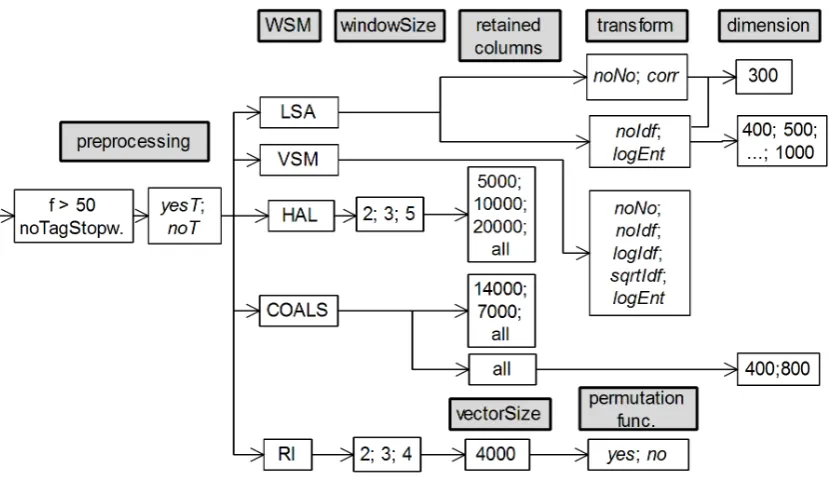
For our experiments, we built WSMs using var-ious parameters examined in prevvar-ious works (see Section 2) and parameters which are implied from our own experience with WSMs. Figure 1 sum-marizes all the parameters we used for building WSMs.
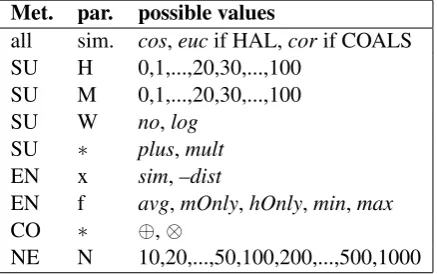
Measure settings We examined various Mea-sure settings (see Section 3), summarized in Ta-ble 2. For all the vector comparisons, we used the cos similarity. Only for HAL we also examined eucand for COALS cor, since these are the rec-ommended similarity functions for these particu-lar WSMs (Lund and Burgess, 1996; Rohde et al., 2005).
Met. par. possible values
all sim. cos,eucif HAL,corif COALS SU H 0,1,...,20,30,...,100
SU M 0,1,...,20,30,...,100 SU W no,log
SU ∗ plus,mult EN x sim,–dist
EN f avg,mOnly,hOnly,min,max
CO ∗ ⊕,⊗
[image:5.595.73.292.407.544.2]NE N 10,20,...,50,100,200,...,500,1000
Table 2: All the parameters of Measures for de-termining semantic compositionality described in Section 3 used in our experiments.
Experimental setup Following Biemann and Giesbrecht (2011), Reddy et al. (2011a), Krˇcm´aˇr et al. (2012), and Krˇcm´aˇr et al. (2013), we use the Spearman correlation (ρ) for the evaluation of all the combinations of WSMs and Measures (Se-tups). Since the distribution of scores assigned to Reddy’s NN dataset might not have corresponded to the distribution of DISCO scores, we decided not to map them to the same scale. Thus, we do not create a single list consisting of all the examined expressions. Instead, we order our Setups
accord-ing to the weighted average of Spearman corre-lations calculated across all the expression types. The weights are directly proportional to the fre-quencies of the particular expression types. Thus, the Setup score (wAvg) is calculated as follows:
wAvg=|AN|ρAN+|V O|ρV O+|SV|ρSV +|N N|ρN N
|AN|+|V O|+|SV|+|N N| .
Having the evaluation testbed, we tried to find the optimal parameter settings for all WSMs com-bined with all Measures with the help of TrValD. Then, we applied the found Setups to TestD.
Notes Because several expressions or their con-stituents concatenated with their POS tags did not occur sufficiently often (for expressions: ≥ 0, for constituents: ≥ 50) in ukWaC, we removed them from the experiments; we removed “number crunching”, “pecking order”, and “sacred cow” from TrValD and “leading edge”, “broken link”, “spinning jenny”, and “sitting duck” from TestD.
5 Results
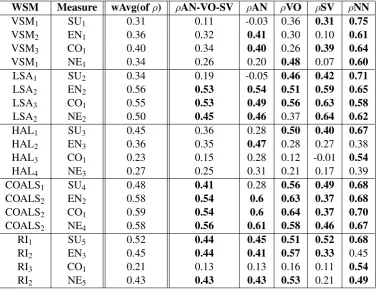
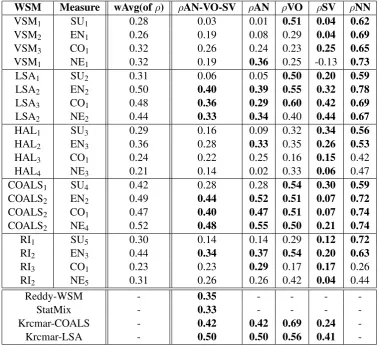
The Setups achieving the highestwAvg when ap-plied to TrValD are depicted in Table 3. The same Setups and their results when applied to TestD are depicted in Table 4. The values of Spearman cor-relations in TestD confirm many of the observa-tions from TrValD6:
Almost all the combinations of WSMs and Measures achieve correlation values which are sta-tistically significant. This is best illustrated by the
ρ(AN−V O−SV) column in Table 4, where a lot of correlation values are statistically (p <0.05) or highly statistically (p <0.001) significant, with regards to the number of expressions (172).
The results suggest that for every expression type, the task of determining compositionality is of varying difficulty. While determining the com-positionality of the NN expression type seems to be the simplest (the highest correlations observed), determining the compositionality of the SV ex-pression type seems to be hard since the majority of values in theρSV column are not statistically significant; taking into account the number of SV expressions in TestD – 35, the statistically signifi-cant value ofρat thep <0.05level is 0.34.
The correlation values differ with regards to the expression type. Certain WSMs combined with
Figure 1: All the parameters of WSMs described in Section 2 used in all our experiments. Semicolon denotes OR. All the examined combinations of parameters are implied from reading the diagram from left to right.
certain Measures, although achieving high corre-lations upon certain expression types, fail to cor-relate with the rest of the expression types. Com-pare e.g. the correlation values of VSM and LSA combined with the SU Measure upon the AN and SV types with the correlation values upon the VO and NN types.
The results, as expected, illustrate that employ-ing more advanced alternatives of basic WSMs is more appropriate. Specifically, LSA outperforms VSM and COALS outperforms HAL in 21 and 23 correlation values out of 24, respectively. Con-cerning RI, the values of correlations seem to be close to the values of VSM and HAL.
An interesting observation showing the appro-priateness of usingwAvg(of ρ) as a good evalu-ation score is supported by a comparison of the
wAvg(of ρ)andρ(AN−V O−SV)columns. The columns suggest that some Setups might only be able to order the expressions of the same type and might not be able to order the expressions of dif-ferent types among each other. As an example, compare the value of ρ = 0.42 in wAvg(of ρ)
withρ= 0.28inρ(AN−V O−SV)in the row cor-responding to COALS combined with SU. Con-sider also that all the values of correlations are higher or equal to the value inρ(AN−V O−SV).
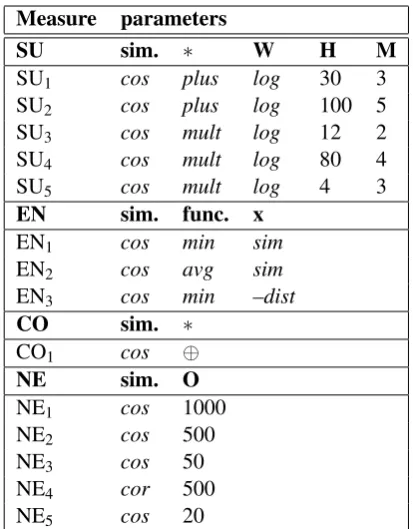
As for the parameters learned from applying all the combinations of differently set WSM algo-rithms and Measures to TrValD, their diversity is well illustrated in Tables 5 and 6. Due to this diver-sity, we cannot recommend any particular settings except for one. All our SU Measures benefit from weighting numbers of expression occurrences by logarithm.
The correlation values in TestD are slightly lower – probably due to overfitting – than the ones observed in TrValD. HAL combined with the Measures usingeucsimilarity was not as success-ful as when combined withcos.7
For comparison, the results of Reddy et al. (2011b) and Chakraborty et al. (2011) as the results of the best performing Setups based on WSMs and association measures, respectively, ap-plied to the DISCO data, are presented (Biemann and Giesbrecht, 2011). The correlation values of our Setups based on LSA and COALS, respec-tively, are mostly higher. However, the improve-ments are not statistically significant. Also, the re-cent results achieved by Krˇcm´aˇr et al. (2012) em-ploying COALS and Krˇcm´aˇr et al. (2013)
ing LSA are depicted.
Discussion As described above, we observed different values of correlations for different ex-pression types. This motivates us to think about other classes of expressions different from types; Measures could be e.g. varyingly successful with regards to different occurrence frequency classes of expressions (Evert, 2005). However, with such small datasets, as shown e.g. by the fact that the majority of our results are statistically indistguishable, we cannot carry out any deeper in-vestigations. A large dataset would provide a more reliable comparison. Ideally, this would consist of all the candidate expressions occurring in some smaller corpus. Also, we would pre-fer the annotated dataset not to be biased towards non-compositional expressions and to be provided with an inner-annotator agreement (Pecina, 2008); which is unfortunately not the case of the DISCO dataset.
6 Conclusion
Our study suggests that different WSMs combined with different Measures perform reasonably well in the task of determining the semantic composi-tionality of word expressions of different types. Especially, LSA and COALS perform well in our experiments since their results are better than those of their basic variants (VSM and HAL, re-spectively) and, although not statistically signifi-cantly, they outperform the best results of the pre-viously proposed approaches (Table 4).
Importantly, our results demonstrate (Section 5) that the datasets used for the experiments are small for: first, a statistical learning of optimal parame-ters of both WSM algorithms and Measures; sec-ond, a thorough (different types) and reliable (sta-tistically significant) comparison of our and the previously proposed approaches.
Therefore, we plan to build a larger manually-annotated dataset. Finally, we plan to extract a list of semantically non-compositional expres-sions from a given corpus and experiment with us-ing it in NLP applications.
Acknowledgments
We thank to V´ıt Suchomel for providing the ukWaC corpus and the anonymous reviewers for their helpful comments and suggestions. This work was supported by the European
Regional Development Fund (ERDF), project NTIS – New Technologies for the Informa-tion Society, European Centre of Excellence, CZ.1.05/1.1.00/02.0090; by Advanced Comput-ing and Information Systems (grant no. SGS-2013-029); and by the Czech Science Foun-dation (grant no. P103/12/G084). Also, the access to the CERIT-SC computing facilities provided under the programme Center CERIT Scientific Cloud, part of the Operational Pro-gram Research and Development for Innovations, reg. no. CZ.1.05/3.2.00/08.0144 is highly appreci-ated.
References
Otavio Costa Acosta, Aline Villavicencio, and Vi-viane P. Moreira. 2011. Identification and treatment of multiword expressions applied to information re-trieval. InProceedings of the Workshop on Multi-word Expressions: from Parsing and Generation to the Real World, MWE ’11, pages 101–109, Strouds-burg, PA, USA.
Timothy Baldwin, Colin Bannard, Takaaki Tanaka, and Dominic Widdows. 2003. An empirical model of multiword expression decomposability. Proceed-ings of the ACL 2003 workshop on Multiword ex-pressions analysis acquisition and treatment, pages 89–96.
Marco Baroni, Silvia Bernardini, Adriano Ferraresi, and Eros Zanchetta. 2009. The WaCky wide web: a collection of very large linguistically processed web-crawled corpora. Journal of Language Re-sources And Evaluation, 43(3):209–226.
Chris Biemann and Eugenie Giesbrecht. 2011. Dis-tributional semantics and compositionality 2011: shared task description and results. InProceedings of the Workshop on Distributional Semantics and Compositionality, DiSCo ’11, pages 21–28.
Marine Carpuat and Mona Diab. 2010. Task-based evaluation of multiword expressions: a pilot study in statistical machine translation. In Human Lan-guage Technologies: The 2010 Annual Conference of the North American Chapter of the Association for Computational Linguistics, HLT ’10, pages 242– 245, Stroudsburg, PA, USA.
Tanmoy Chakraborty, Santanu Pal, Tapabrata Mondal, Tanik Saikh, and Sivaju Bandyopadhyay. 2011. Shared task system description: Measuring the com-positionality of bigrams using statistical methodolo-gies. InProceedings of the Workshop on Distribu-tional Semantics and ComposiDistribu-tionality, pages 38– 42, Portland, Oregon, USA.
WSM Measure wAvg(ofρ) ρAN-VO-SV ρAN ρVO ρSV ρNN
VSM1 SU1 0.31 0.11 -0.03 0.36 0.31 0.75
VSM2 EN1 0.36 0.32 0.41 0.30 0.10 0.61
VSM3 CO1 0.40 0.34 0.40 0.26 0.39 0.64
VSM1 NE1 0.34 0.26 0.20 0.48 0.07 0.60
LSA1 SU2 0.34 0.19 -0.05 0.46 0.42 0.71
LSA2 EN2 0.56 0.53 0.54 0.51 0.59 0.65
LSA3 CO1 0.55 0.53 0.49 0.56 0.63 0.58
LSA2 NE2 0.50 0.45 0.46 0.37 0.64 0.62
HAL1 SU3 0.45 0.36 0.28 0.50 0.40 0.67
HAL2 EN3 0.36 0.35 0.47 0.28 0.27 0.38
HAL3 CO1 0.23 0.15 0.28 0.12 -0.01 0.54
HAL4 NE3 0.27 0.25 0.31 0.21 0.17 0.39
COALS1 SU4 0.48 0.41 0.28 0.56 0.49 0.68
COALS2 EN2 0.58 0.54 0.6 0.63 0.37 0.68
COALS2 CO1 0.59 0.54 0.6 0.64 0.37 0.70
COALS2 NE4 0.58 0.56 0.61 0.58 0.46 0.67
RI1 SU5 0.52 0.44 0.45 0.51 0.52 0.68
RI2 EN3 0.45 0.44 0.41 0.57 0.33 0.45
RI3 CO1 0.21 0.13 0.13 0.16 0.11 0.54
[image:8.595.111.490.62.352.2]RI2 NE5 0.43 0.43 0.43 0.53 0.21 0.49
Table 3: The Spearman correlationsρof the best performing (wAvg) combinations of particular WSMs and Measures from all the tested Setups applied to TrValD. The highest correlation values in the particular columns and the correlation values which are not statistically different from them (p <0.05) are in bold (yet we do not know how to calculate the stat. significance for the wAvg(ofρ) column). The parameters of WSMs and Measures corresponding to the indexes are depicted in Tables 5 and 6, respectively.
1990. Indexing by latent semantic analysis. Jour-nal of the American Society of Information Science, 41(6):391–407.
Stefan Evert. 2005. The statistics of word cooccur-rences : word pairs and collocations. Ph.D. the-sis, Universit¨at Stuttgart, Holzgartenstr. 16, 70174 Stuttgart.
Zellig Harris. 1954. Distributional structure. Word, 10(23):146–162.
Anders Johannsen, Hector Martinez Alonso, Christian Rishøj, and Anders Søgaard. 2011. Shared task sys-tem description: frustratingly hard compositionality prediction. InProceedings of the Workshop on Dis-tributional Semantics and Compositionality, DiSCo ’11, pages 29–32, Stroudsburg, PA, USA.
David Jurgens and Keith Stevens. 2010. The s-space package: an open source package for word space models. InProceedings of the ACL 2010 Sys-tem Demonstrations, ACLDemos ’10, pages 30–35, Stroudsburg, PA, USA.
Lubom´ır Krˇcm´aˇr, Karel Jeˇzek, and Massimo Poesio. 2012. Detection of semantic compositionality using semantic spaces. Lecture Notes in Computer Sci-ence, 7499 LNAI:353–361.
Lubom´ır Krˇcm´aˇr, Karel Jeˇzek, and Pavel Pecina. 2013. Determining compositionality of word expressions using word space models. InProceedings of the 9th Workshop on Multiword Expressions, pages 42–50, Atlanta, Georgia, USA.
Thomas K. Landauer and Susan T. Dumais. 1997. A solution to Plato’s problem: The latent semantic analysis theory of acquisition, induction, and rep-resentation of knowledge. Psychological Review, 104(2):211–240.
Dekang Lin. 1999. Automatic identification of non-compositional phrases. In Proceedings of the 37th annual meeting of the Association for Compu-tational Linguistics on CompuCompu-tational Linguistics, ACL ’99, pages 317–324, Stroudsburg, PA, USA.
Kevin Lund and Curt Burgess. 1996. Produc-ing high-dimensional semantic spaces from lexi-cal co-occurrence. Behavior Research Methods, 28(2):203–208.
WSM Measure wAvg(ofρ) ρAN-VO-SV ρAN ρVO ρSV ρNN
VSM1 SU1 0.28 0.03 0.01 0.51 0.04 0.62
VSM2 EN1 0.26 0.19 0.08 0.29 0.04 0.69
VSM3 CO1 0.32 0.26 0.24 0.23 0.25 0.65
VSM1 NE1 0.32 0.19 0.36 0.25 -0.13 0.73
LSA1 SU2 0.31 0.06 0.05 0.50 0.20 0.59
LSA2 EN2 0.50 0.40 0.39 0.55 0.32 0.78
LSA3 CO1 0.48 0.36 0.29 0.60 0.42 0.69
LSA2 NE2 0.44 0.33 0.34 0.40 0.44 0.67
HAL1 SU3 0.29 0.16 0.09 0.32 0.34 0.56
HAL2 EN3 0.36 0.28 0.33 0.35 0.26 0.53
HAL3 CO1 0.24 0.22 0.25 0.16 0.15 0.42
HAL4 NE3 0.21 0.14 0.02 0.33 0.06 0.47
COALS1 SU4 0.42 0.28 0.28 0.54 0.30 0.59
COALS2 EN2 0.49 0.44 0.52 0.51 0.07 0.72
COALS2 CO1 0.47 0.40 0.47 0.51 0.07 0.74
COALS2 NE4 0.52 0.48 0.55 0.50 0.21 0.74
RI1 SU5 0.30 0.14 0.14 0.29 0.12 0.72
RI2 EN3 0.44 0.34 0.37 0.54 0.20 0.63
RI3 CO1 0.23 0.23 0.29 0.17 0.17 0.26
RI2 NE5 0.31 0.26 0.26 0.42 0.04 0.44
Reddy-WSM - 0.35 - - -
-StatMix - 0.33 - - -
-Krcmar-COALS - 0.42 0.42 0.69 0.24
-Krcmar-LSA - 0.50 0.50 0.56 0.41
-Table 4: The Spearman correlationsρof the best performing (wAvg) combinations of particular WSMs and Measures trained in TranValD applied to TestD. The highest correlation values in the particular columns and the correlation values which are not statistically different from them (p <0.05) are in bold (yet we do not know how to calculate the stat. significance for the wAvg(ofρ) column). Reddy-WSM and StatMix stand for the best performing system based on WSMs and association measures, respectively, applied to the DISCO task (Biemann and Giesbrecht, 2011). Krcmar-COALS and Krcmar-LSA stand for the best published results achieved upon the dataset presented in Krˇcm´aˇr et al. (2012) and Krˇcm´aˇr et al. (2013), respectively. The parameters of WSMs and Measures corresponding to the indexes are depicted in Tables 5 and 6, respectively.
Jeff Mitchell and Mirella Lapata. 2008. Vector-based models of semantic composition. InProceedings of ACL-08: HLT, pages 236–244, Columbus, Ohio.
Preslav Nakov, Antonia Popova, and Plamen Ma-teev. 2001. Weight functions impact on lsa per-formance. In Proceedings of the EuroConference Recent Advances in Natural Language Processing (RANLP’01), pages 187–193.
Athanasios Papoulis. 1990. Probability & statistics. Prentice Hall.
Darren Pearce. 2002. A Comparative Evaluation of Collocation Extraction Techniques. InProceedings of the Third International Conference on Language Resources and Evaluation, LREC.
Pavel Pecina. 2008. Reference data for Czech
collo-cation extraction. InProceedings of the LREC 2008 Workshop Towards a Shared Task for Multiword Ex-pressions, pages 11–14, Marrakech, Morocco. Euro-pean Language Resources Association.
Siva Reddy, Diana McCarthy, and Suresh Manand-har. 2011a. An empirical study on composition-ality in compound nouns. InProceedings of 5th In-ternational Joint Conference on Natural Language Processing, pages 210–218, Chiang Mai, Thailand, November. Asian Federation of Natural Language Processing.
[image:9.595.109.489.62.408.2]WSM parameters
VSM tags trans.
VSM1 noT noNo
VSM2 yesT noNo
VSM3 yesT noIdf
LSA tags trans. dim.
LSA1 noT logEnt 900
LSA2 yesT noNo 300
LSA3 noT noIdf 300 HAL tags win s. ret. c.
HAL1 noT 5 20000
HAL2 yesT 5 20000
HAL3 noT 2 10000
HAL4 yesT 5 all
COALS tags ret. c.
COALS1 noT 7000
COALS2 yesT 7000
RI tags win. s. vec. s. perm.
RI1 noT 2 4000 no
RI2 noT 4 4000 no
[image:10.595.313.520.60.325.2]RI3 noT 2 4000 yes
Table 5: Parameters of WSMs (Section 2) which, combined with particular Measures, achieved the highest average correlation in TrValD.
Douglas L. Rohde, Laura M. Gonnerman, and David C. Plaut. 2005. An improved model of semantic sim-ilarity based on lexical co-occurrence. Unpublished manuscript.
Magnus Sahlgren, Anders Holst, and Pentti Kanerva. 2008. Permutations as a means to encode order in word space. In V. Sloutsky, B. Love, and K. Mcrae, editors,Proceedings of the 30th Annual Conference of the Cognitive Science Society, pages 1300–1305. Cognitive Science Society, Austin, TX.
Magnus Sahlgren. 2005. An introduction to random indexing. InMethods and Applications of Semantic Indexing Workshop at the 7th International Confer-ence on Terminology and Knowledge Engineering, Leipzig, Germany.
Magnus Sahlgren. 2006. The Word-Space Model: Us-ing distributional analysis to represent syntagmatic and paradigmatic relations between words in high-dimensional vector spaces. Ph.D. thesis, Stockholm University.
Gerard Salton. 1971. The SMART Retrieval Sys-tem; Experiments in Automatic Document Process-ing. Prentice-Hall, Inc., Upper Saddle River, NJ, USA.
Dawei Song, Peter Bruza, and Richard Cole. 2004. Concept learning and information inferencing on a
Measure parameters
SU sim. ∗ W H M
SU1 cos plus log 30 3
SU2 cos plus log 100 5
SU3 cos mult log 12 2
SU4 cos mult log 80 4
SU5 cos mult log 4 3
EN sim. func. x
EN1 cos min sim
EN2 cos avg sim
EN3 cos min –dist
CO sim. ∗
CO1 cos ⊕
NE sim. O
NE1 cos 1000
NE2 cos 500
NE3 cos 50
NE4 cor 500
NE5 cos 20
Table 6: Parameters of Measures (Section 3) which, combined with particular WSMs, achieved the highest average correlation in TrValD.
highdimensional semantic space. In ACM SIGIR 2004 Workshop on Mathematical/Formal Methods in Information Retrieval.
[image:10.595.78.288.61.355.2]