Reliability Updating in Linear
Opinion Pooling for Multiple
Decision Makers.
A thesis submitted to the University of Dublin, Trinity College
in partial fulfillment of the requirements for the degree of
Doctor of Philosophy
Department of Statistics, Trinity College Dublin
March 2016
I dedicate this thesis to the memory of my friend Faith Wilder,
5th of September 1985 - 21st of February 2015,
Declaration
I declare that this thesis has not been submitted as an exercise for a degree at this
or any other university and it is entirely my own work.
I agree to deposit this thesis in the University’s open access institutional repository
or allow the Library to do so on my behalf, subject to Irish Copyright Legislation and
Trinity College Library conditions of use and acknowledgement.
The copyright belongs jointly to the University of Dublin and Donnacha Bolger.
Donnacha Bolger
Abstract
Accurate information sources are vital prerequisites for good decision making. In this
thesis we consider a multiple participant setting, where all decision makers (DMs) have
a collection of neighbours with whom they share their beliefs about some common
relevant uncertain quantity. When determining which course of action to follow a DM
takes into account all the information received from her neighbours. Over time, in
light of the returns observed from choices made, DMs update their own beliefs over
the uncertain event, and also adjust the degree of consideration that they afford to
the opinions of each neighbour based on the level of reliability that the information
they provide is ascertained to have. Much of this thesis is concerned with constructing
a method that incorporates both of these learning facets in a dynamic fashion. This
technique, termed the Plug-in approach, is motivated and derived, and attempts are
made to justify its use by consideration of some attractive properties it obeys, in
addition to studies conducted using both simulated and real data which compared its
performance to some rational alternatives. Generalisations of this method are also
provided to a setting where DMs specify their opinions nonparametrically rather than
using probability distributions, as well as in a group setting where utilities as well as
opinions must be amalgamated. Two subjective approaches are also briefly discussed,
Acknowledgements
First and foremost I wish to extend my heartfelt thanks to my supervisor, Dr. Brett
Houlding. Throughout my Ph.D. tenure he has been constantly encouraging, and
extremely helpful at indicating which ideas deserved further consideration and which
should be forgotten about. Brett guided me through my first foray into research, always
quick to offer an insightful remark and never too busy for one of my frequent trips across
the corridor to his office. He generously funded me to travel to conferences, allowing me
to learn, to meet other statisticians, and visit exciting locations (and Kildare). Brett
demonstrated that “a Liverpool fan whose company I actually enjoy” is not necessarily
a guaranteed oxymoron. I could not have asked for a better supervisor than him.
I next wish to thank the staff of the Statistics Department, who have constantly
offered advice when I sought it and been incredibly supportive of my research over
the last three years. I’ve greatly enjoyed having a cup of tea with them every day.
Special gratitude goes to Simon Wilson, who both supervised my undergraduate final
year project (and hence kindled my passion for statistical research) and pointed me
towards Brett when I mentioned my contemplation of postgraduate study. Without
his encouragement it is doubtful if I would have embarked down the Ph.D. road.
I feel tremendously fortunate regarding the company I have been able to keep
during my time in Trinity, in terms of the postdocs and fellow Ph.D. students I’ve
worked alongside. I consider Angela, Gernot, Cristina, Joy, Sean, Arthur and Arnab
all to be great friends. It was a great pleasure to share an office with Shane O’Meachair,
Shuaiwei Zhou and Thinh Doan - all of whom are true Dubliners in different ways, and
who make for great company and constant fun. Finally Louis Aslett and Jason Wyse
were two wonderful mentor figures, doling out insights and counsel about the world of
research and academia both inside and outside of the Lincoln Inn on Friday evenings.
-they’re my homeboys at home, who have supported me constantly over the last three
years. After a tough day at work it was always nice to have an evening of hanging
out with them to look forward to. I am not a superstitious person, but a lot of stars
aligned extremely conveniently for me both in the lead-up to and during my time as a
Ph.D. student, and the unscientific part of me would like to think that my late mother,
Bernie, had a non-negligible impact upon this. A lot of the effort that I put into my
work was in the hope of doing her memory proud, and I’d like to think that in some
small way I achieved that.
Finally, it is utterly inconceivable that this thesis would have come into being
without the ever-present love and encouragement of Livi Flynn. Several times over
the past few years I felt that the Ph.D. challenge was too great for me to handle - a
bottle of Brooklyn Lager and slice of pepperoni pizza with her invariably righted my
wrongs. She has more goodness and patience than anyone I have ever met, and is
unquestionably my (statistically significantly) better half.
Contents
Abstract v
Acknowledgements vii
List of Tables xiii
List of Figures xvii
Chapter 1 Introduction 1
1.1 Contextual Setting . . . 2
1.2 Research Aims . . . 4
1.3 Research Methodology . . . 6
1.4 Outline of Thesis Chapters . . . 8
Chapter 2 Literature Review 13 2.1 Precise Probabilities . . . 13
2.2 Utility . . . 14
2.2.1 Expected Value Theory . . . 14
2.2.2 Utility Hypothesis . . . 15
2.2.3 Measures of Risk-Aversion . . . 15
2.2.4 Relationship between Utility and Probability . . . 17
2.3 Expected Utility . . . 17
2.3.1 Decisions . . . 17
2.3.2 Example using Precise Probabilities . . . 19
2.3.3 The axiomatisation of von Neumann and Morgenstern . . . 19
2.3.4 Objections and Alternatives . . . 20
2.4.1 Decision Making using Imprecise Probabilities . . . 22
2.4.2 Choosing a Primitive Quantity . . . 23
2.5 Sequential Problems . . . 24
2.6 Group Decision Making . . . 24
2.6.1 Arrow’s Impossibility Theorem . . . 24
2.6.2 Utilitarianism and the SWF . . . 25
2.6.3 Fully Probabilistic Design . . . 26
2.6.4 Other Alternatives . . . 27
2.7 Combining Expert Judgments . . . 27
Chapter 3 The Plug-in Approach 41 3.1 The Plug-in Approach . . . 41
3.1.1 Notation and Basics . . . 41
3.1.2 Updating Beliefs . . . 43
3.1.3 Updating Weights . . . 45
3.2 Bayesian Relationship . . . 49
3.3 Moments of PI Distribution . . . 53
3.4 Asymptotic Behaviour . . . 54
3.5 Properties and Initial Justifications . . . 56
3.6 Example . . . 58
3.7 Distributions of PI Weights . . . 63
3.8 Multiple Differing Simultaneous Returns . . . 66
3.9 Bayesian Model Averaging . . . 71
3.10 Limitations . . . 72
Chapter 4 Data-based Justifications 75 4.1 Alternatives Methods and Metric Choice . . . 75
4.2 Simulation Study . . . 78
4.3 Theoretical Calculations . . . 85
4.3.1 True Success Probabilities . . . 85
4.3.2 Unconditional Probabilities . . . 90
4.4 TU Delft Expert Judgment Data Base . . . 94
4.4.2 Problem Type and Metric Choice . . . 99
4.4.3 Results . . . 102
4.4.4 Conclusions . . . 107
Chapter 5 Group Decision Making 109 5.1 Group Expected Utility . . . 109
5.1.1 Combining Probabilities . . . 110
5.1.2 Combining Utilities . . . 111
5.1.3 Example . . . 113
5.1.4 Linear Identity . . . 113
5.2 Arrow’s Impossibility Theorem . . . 114
5.3 Comparison and Consideration of Axioms . . . 116
5.3.1 Universality . . . 117
5.3.2 Monotonicity . . . 117
5.3.3 Independence of Irrelevant Alternatives . . . 117
5.3.4 Non-imposition . . . 118
5.3.5 Non-dictatorship . . . 119
5.4 Discussion . . . 121
Chapter 6 Nonparametric Extension 125 6.1 Belief Specification . . . 125
6.2 Nonparametric Utility Inference . . . 126
6.3 Adapting NPUI to Prevision Bounds . . . 127
6.3.1 Single DM . . . 128
6.3.2 Multiple DMs . . . 132
6.4 Calculating Weights . . . 133
6.5 Extension to the Real Line . . . 136
6.6 Example . . . 137
6.7 Performance Measure . . . 141
6.8 Links between Individual and Combined NPPIs . . . 143
6.9 Small Simulation Study . . . 144
7.1.1 Differing Viewpoints and ARA . . . 156
7.1.2 Different Weights from Different Methods . . . 157
7.1.3 Differing Viewpoints Metric . . . 160
7.1.4 Contrasting the DV and PI approaches . . . 162
7.2 Kullback-Leibler Approach . . . 164
7.3 Comparing PI, DV and KL approaches . . . 165
7.4 Conclusions . . . 166
Chapter 8 Summary and Further Research 169 8.1 Social Networks . . . 170
8.2 Sequential Problems . . . 170
8.3 Imprecision of Probabilities and Utilities . . . 172
8.4 R Package . . . 172
8.5 Miscellaneous . . . 173
Appendix A Notation 183
Appendix B Proofs 185
Appendix C Simulation Study Results 191
Appendix D Sample Code 201
Appendix E Theoretical Calculations 213
List of Tables
2.1 Cross-tabulation of utilities for D and Θ. . . 18
2.2 Cross-tabulation of utilities for D={d1, d2, d3} and Θ ={θ1, θ2}. . . . 19
2.3 Cross-tabulation of utilities for D={d1, d2}and Θ = {θ1, θ2}. . . 22
3.1 Prior Information and DM Weights . . . 47
3.2 DM information for our financial example. . . 59
3.3 Optimal decisions for DMs at the first and second epoch . . . 59
3.4 Updated opinions, and weights, of DMs and Pooling Methods. . . 61
3.5 Success Proportions for Linear Pooling Methods . . . 62
4.1 Simulation Study Initialisation Information . . . 79
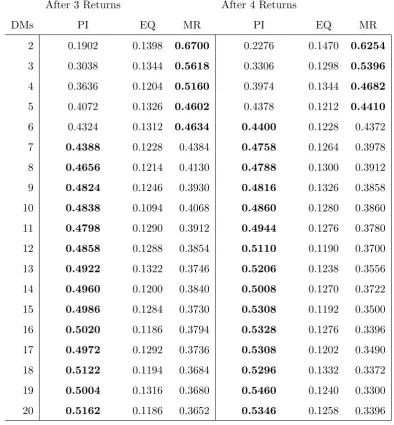
4.2 Group Success Proportions after three and four returns . . . 83
4.3 Individual Success Proportions after three and four returns . . . 84
4.4 Cross-tabulation of DMs and return streams . . . 87
4.5 TU Delft Expert Judgment Data Base details. . . 95
4.6 Differences between the Plug-in and classical methods. . . 96
4.7 Sample expert opinions . . . 96
4.8 Sample DM weights over time . . . 102
4.9 Individual problem success proportion. Optimal methods are in bold. . 104
4.10 Success proportions for the group problem. Optimal methods are in bold.105 4.11 Aggregated Individual Results . . . 106
4.12 Aggregated Group Results . . . 106
5.1 Sample DM utility information . . . 113
5.2 Original expected utilities of the DMs and the group. . . 119
5.4 Augmented Expected Utilities of P2 . . . 120
5.5 Original expected utilities of the DMs and the group. . . 121
5.6 The expected utilities of the DMs and the group. . . 123
6.1 Corresponding Values of ∆0 and ν . . . 131
6.2 Width vs. Accuracy merits . . . 135
6.3 Information at the first epoch . . . 138
6.4 First Weight Update . . . 139
6.5 First Opinion Update . . . 140
6.6 Information at the second epoch . . . 140
6.7 Second Weight/Opinion Update . . . 141
6.8 Success Proportions in Cases 1a-4a . . . 146
6.9 Success Proportions in Cases 1b-4b . . . 148
7.1 DM Information . . . 158
7.2 Weights from PI/DV methods . . . 158
7.3 Weights from PI/DV methods with fortunes doubled . . . 159
7.4 Change of Weights with ARA . . . 159
7.5 DM information for example. . . 160
7.6 Util Difference Between Predictions and Reality . . . 161
7.7 DM information for DV/PI comparison. . . 162
7.8 Weights from PI/DV methods . . . 163
7.9 Util Difference between PI/DV predictions . . . 164
7.10 DM information for DV/PI/KL comparison. . . 166
B.1 Original Expected Utilities of P1,P2 and the Group (P∗). . . 188
C.1 Success proportions: Normal overestimation in the group problem. . . . 191
C.2 Success proportions: Normal understimation in the group problem. . . 192
C.3 Success proportions: Normal mean-centred in the group problem. . . . 192
C.4 Success proportions: Poisson overestimation in the group problem. . . . 193
C.5 Success proportions: Poisson underestimation in the group problem. . . 193
C.6 Success proportions: Poisson mean-centred in the group problem. . . . 194
C.8 Success proportions: Binomial underestimation in the group problem. . 195
C.9 Success proportions: Binomial mean-centred in the group problem. . . 195
C.10 Success proportions: Normal overestimation in the individual problem. 196
C.11 Success proportions: Normal underestimation in the individual problem. 196
C.12 Success proportions: Normal mean-centred in the individual problem. . 197
C.13 Success proportions: Poisson overestimation in the individual problem. 197
C.14 Success proportions: Poisson underestimation in the individual problem. 198
C.15 Success proportions: Poisson mean-centred in the individual problem. . 198
C.16 Success proportions: Binomial overestimation in the individual problem. 199
C.17 Success proportions: Binomial undestimation in the individual problem. 199
List of Figures
2.1 Contrasting Utility Functions . . . 16
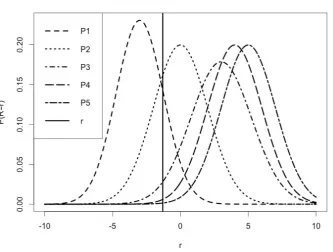
3.1 Prior Predictive Distributions/Plug-in Weights . . . 47
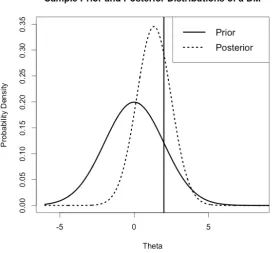
3.2 Normal Prior and Posterior Distributions . . . 50
3.3 Individual and combined distributions . . . 55
3.4 Illustration of Weights Convergence . . . 56
3.5 Prior Predictive Distributions . . . 60
3.6 Posterior Distributions . . . 61
3.7 Individual/PI Posteriors . . . 62
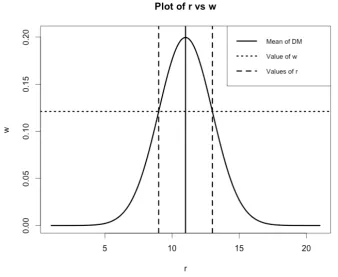
3.8 Plot of r vs. w . . . 64
3.9 Unnormalised plot of P(Wi =wi|θ) . . . 65
3.10 Normalised plot of P(Wi =wi|θ) . . . 66
4.1 The distributionsf1(θ)∼N(3,0.2) andf2(θ)∼N(−0.5,2), and θ = 1.8. 76 4.2 Optimal Methods in Normal overestimation . . . 80
4.3 Optimal methods for Binomial and Poisson overestimation. . . 80
4.4 Optimal methods for Binomial, Normal and Poisson underestimation. . 81
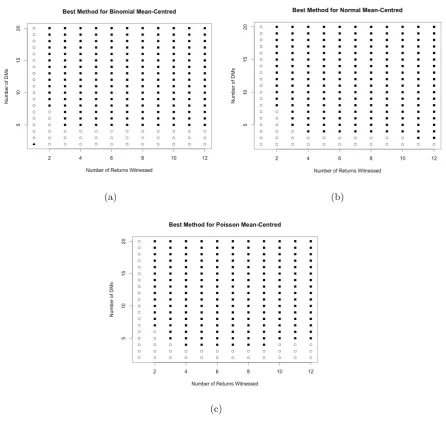
4.5 Optimal methods for Binomial, Normal and Poisson mean-centred beliefs. 82 4.6 Simulated Proportions . . . 88
4.7 Simulation Proportions . . . 89
4.8 Prior Probabilities of PI Superiority . . . 91
4.9 Success probabilities for the PI, EQ and MR approaches for P2. . . 92
4.10 Fitted Cumulative Distribution Functions . . . 98
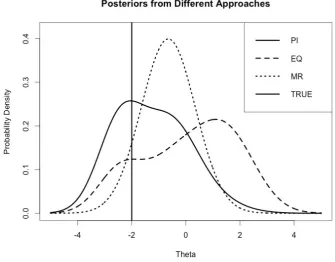
4.11 Posterior Distributions in Group Problem . . . 101
6.1 Prior and Posterior NPPIs . . . 131
6.2 Real line/Unit interval Prior and Posterior NPPIs . . . 138
6.3 Weights over time . . . 141
6.4 NPPIs over time . . . 142
7.1 PI/DV Posteriors . . . 163
7.2 Various Posteriors for DMs . . . 167
7.3 Weights allocated by DMs . . . 168
8.1 Social Network Illustration . . . 171
8.2 Two-period decision tree . . . 171
E.1 Poisson-Gamma Individual Convergence . . . 215
E.2 Poisson-Gamma Group Convergence . . . 216
E.3 Normal-Normal Individual Convergence . . . 218
Chapter 1
Introduction
When individuals make decisions they generally do so in the face of uncertainty.
Deci-sion makers (DMs, who are assumed feminine throughout this thesis) invariably have
some unsureness about the underlying process governing their decision environment,
e.g., they may not know the probability of a medical operation being successful, or
the number of cars that will pass along a motorway during rush hour. Generally the
language of probability is that used to express this uncertainty. It seems intuitive that
there is a connection between the accuracy of the relevant information that a DM
pos-sesses and the satisfaction that she will derive from the outcome resulting from the
decision that she makes. In this thesis we conjecture that it is beneficial for a DM to
absorb information from as many distinct sources as possible, and to assimilate these
into her decision process, incorporating additional knowledge into her task. Having
made a decision, a return is witnessed. We are concerned with two types of learning
that can subsequently occur. Firstly, a DM can update her own opinion about the
inherent decision uncertainty in light of this new evidence that has become available
to her. Secondly, she can reassess the respective perceived reliability of her various
information sources, who (in the context that we are concerned with) are a collection
of fellow non-competing DMs. Much of the work which follows aims at developing a
rational methodology that facilitates these two forms of learning and supplies a DM
with as accurate an opinion as possible to use in her decision task, as well as providing
justifications for the use of this approach in practice. We primarily assume individuals
specify their uncertainty via probability distributions, but we also provide an analogous
Above we have provided a broad outline of the original research that is contained
within this thesis. Below we supply detailed comments on the contextual setting that
this work is placed within, clearly outline the primary aims of the study conducted,
and highlight the research methodology that was adhered to throughout.
1.1
Contextual Setting
Every day important decisions with long-term repercussions are made. The United
Nations must reach resolutions on what actions to take concerning global conflicts,
governments of countries must determine how capital should be budgeted across their
departments, medical organisations must choose which drug trials should be funded
and which should not. In scenarios such as those illustrated above it seems unwise for
this decision to be made by a single individual, or at least to be made based solely
on the judgment held by one. A collection of people will generally possess a broader
knowledge span that a single person, and hence more pertinent information can be
incorporated into a decision making task by considering the opinions of a multiple
individuals. Additionally, on a practical basis, a crucial decision being made by one
person alone would lead to a great deal of accountability being placed on the shoulders
of that individual, something that can be lessened by a more collective process. Once
we concur that decision making via the amalgamation of several points of view holds
certain advantages over the alternative, the obvious question concerns the manner in
which such a decision should be made. In practical application there are numerous
methodologies that are likely to be employed.
Majority rule is an extremely straightforward approach, in which individuals vote
for their most favoured choice from a set of possible actions, with the action receiving
the greatest number of votes deemed to be best (in some sense) by the collective. This
is termed an ordinal decision scheme, with all emphasis explicitly placed on the
rank-ing order of decisions, rather than the degrees of preference inherent within individual
rankings and the ranking of the group as a whole. We shall return later in thesis
(no-tably in Section 5.4) to discuss the issues and potential pitfalls entailed within schemes
of this nature, but only comment now that they may not provide a complete picture
considered.
Different individuals will commonly hold diverse opinions based upon their
con-trasting degrees of knowledge over the uncertainty inherent within the forthcoming
decision to be made. Such contrasts may arise due to their potentially disparate
back-grounds; for instance their educational or socio-economic circumstances, how long they
have been involved with a particular organisation, if they have participated in a process
of this nature before, or if they have a vested interest in seeing a particular decision
chosen. Methods exist in which the individuals comprising a group will attempt to
bridge their intrinsic knowledge gaps by sharing their respective opinions and their
personal underlying rationales that led to their formations. Once they have listened
to the thoughts of those around them, individuals may potentially alter their own
opinions, perhaps conceding that they previously were ill informed about the topic at
hand and deferring to the wisdom of colleagues perceived to be wiser. Having done
this, the optimal decision is chosen by the group via discussion, which continues until
a collective consensus is happened upon. We shall further discuss methodologies of
this nature (known as behavioural methods) in more depth in our literature review of
Section 2, but for now only note that they too have complications ingrained within
them, perhaps most significantly being their susceptibility to biases and their potential
lack of rigour.
An obvious technique to be implemented is arguably the most democratic appearing
methodology, in which the opinions of all individuals are given an equal consideration.
On the surface there are certainly advantages apparent in approaches of this nature.
All participants are being treated equally, with no favouritism evident. The concept of
the wisdom of crowds is well known, with an averaging of opinions over an uncertain
quantity commonly leading to a more accurate estimate than if this was provided by
a single individual. Yet, as we shall discuss in our literature review of Section 2, and
numerous times in our findings of Section 4, there are clear foibles entailed in this
approach. If some individuals possess beliefs that are extremely inaccurate then these
have the potential to outweigh the beliefs of their more accurate peers, hence skewing
the collective opinion away from the truth. The greatest strength of this approach is
its simplicity of implementation, yet there are downsides that may occur as a result of
The clearest shortcoming of this equal weighting scheme is that the knowledge of
inaccurate individuals are given as much consideration as that of accurate individuals.
The easiest way to circumnavigate this would be to listen solely to the individual who
is deemed to possess the most reliable point of view, hence ensuring that unsound
opinions are discarded. Yet, even discounting our cautioning above about making
decisions based on a sole opinion, this leads to another major complication: how can it
be assessed who the most accurate individual is? All members of the collective believe
the opinion that they hold is accurate; if not they would not hold it, or would change
it to one that they felt was a more accurate reflection of the true state of nature.
It is extremely unlikely that any individual will willingly have their opinion discarded
entirely from the decision making task, especially considering that they may personally
believe it to be the most accurate of those proffered.
1.2
Research Aims
Given the above discussion concerning the contextual setting for our research, this
thesis can be seen as having three primary aims. First and foremost we aspire to
create an original decision making methodology, which takes steps towards solving the
complications that are inherent in the schemes discussed above. We mentioned the
shortcomings of decisions being made by a single individual, and hence our approach
shall be based upon the composition of a collection of (potentially diverse) opinions and
judgments from various sources. We commented on the issues inherent with behavioural
techniques, and therefore the scheme that we develop shall be strictly mathematical in
its formulation. An equal weighting scheme seems intuitive, but suffers from the fact
that accurate opinions may be outweighed by inaccurate opinions. However, at the
other end of the spectrum, it seems unwise to listen to a single individual deemed to
be most accurate, due to the complications in choosing such an individual, as well as
the aforementioned problem of basing a decision on a sole opinion. Hence our objective
is to create a method that accounts for the opinions of all individuals in an unequal
fashion. We aim to weight the opinions of individuals, and to set these weights as
proportional to the perceived level of knowledge of participants. Of course, as we shall
expand over the course of this thesis on reasons why our developed technique is indeed
truly original, and the advantages it can be seen to hold over existing alternatives.
Once we have developed a methodology of the nature discussed above our second
aim is to provide justification for its use in practical contexts. We want to be able to
pragmatically advocate for its application in realistic decision scenarios. It is our desire
for our approach to be mathematically logical, in the sense that it obeys properties
that a rational decision maker would deem important for an internally coherent decision
process to adhere to. Hence we intend to investigate the relationship between some
at-tractive statistical and mathematical attributes (for instance the Bayesian paradigm)
and our proposed methodology, and to confirm that this methodology does indeed
meet these criteria. In addition to justification by mathematical argument we also
want to provide data-driven validation, in order to highlight the practical merits of
our approach. We mentioned above that equal weighting, listening solely to the
indi-vidual deemed to be most reliable in a collective, and not taking any other opinions
into account at all are three frequently applied practices. We plan to compare the
performance of our methodology to each of these alternatives (using a suitably derived
comparative metric) to demonstrate the superiority of our technique. In Chapter 4
we see how this is achieved using a mix of simulated data and real world data. By
illustrating the merits of our approach against commonly used alternatives we hope to
underline the benefit of applying it in practical applications in order to increase the
quality of the decision process.
Our final primary aim is to provide some generalisations to our method, in order
to increase its flexibility and consequentially broaden the range of scenarios that it is
appropriate for usage in. Individuals may express their uncertainty concerned some
unknown commodity of interest in a variety of formulations, from a simple point
esti-mate to a fully parameterised probability distribution. Much of the work in this thesis
pertains to this latter case (with justification for this choice contained therein) but we
investigate in Chapter 6 if the general outline of our principal methodology can be
ex-tended to a significantly simplified setting, potentially increasing applicability (albeit
at the potential determent of the resulting decision quality). Arguably a strength of
the method that we derive is its rigid objectivity. However in Chapter 7 we develop
technique but that allow for different degrees of subjectivity to be entailed in their
mechanisms. These modifications, different flavours of our central methodology, allow
for our decision making scheme to be applied in a variety of contrasting settings rather
than a single specific one.
1.3
Research Methodology
We now progress to detail the research methodology that was followed during the
course of our research. Statistical decision theory has a rich history, formally dating
back at least as far as the 1730s. In order to be able to write knowledgably about
this topic, and the various nuanced subsets thereof, a reading of the seminal texts
was required. These are discussed in detail in the literature review of Section 2. We
began by consideration of the most basic decision making fundamentals (for instance
the notions of probability and utility), before expanding upon these in an incremental
fashion to explore increasingly deeper matters (such as decision making under imprecise
probabilities and the complications inherent within any group decision making scheme).
As indicated above, our foremost aim was in the development of a scheme suitable for
use in a decision context consisting of multiple individuals with differing degrees of
information about the uncertainty at hand. This concept of combining opinions or
judgments itself has an abundant amount of publications attributed to it. In Section
2.7 we thoroughly examine the most notable of these, highlighting ways in which they
contrast in their execution from what we desire, as well as detailing the contrasts
between them, and the various perceived advantages and disadvantages that they can
be said to hold over each other. The comprehensive literature review of Section 2 can
thus be seen as having a dual function: it provides the interested reader with enough
technical details and knowledge that they should be able to comfortably follow the
original research which it precedes, as well as providing adequate motivation for the
development of our novel decision making methodology.
It is in Section 3 that we derive this decision making methodology, explaining
comprehensively how weights (which represent the perceived accuracy of the decision
makers they are attached to) are calculated and updated over time, as well as how users
coher-ent fashion. Having produced our approach our desire was then to provide some formal
justification for it. We mentioned above that our approach is strictly mathematical,
rather than behavioural, and hence an obvious action was to assess its performance in
relation to some mathematical principles, and to see if it adhered to these. Crucially,
Section 2.6 contains discussion on how it is formally impossible to create a scheme that
can adhere to the entirety of a set of attractive criteria. Therefore we simply try to offer
a selection of desirable properties that our technique follows, without every making any
claims that these are indeed truly exhaustive. Section 3.2 delves into how our approach
fits into the Bayesian perspective, an important coherency property for those who wish
to adhere to this paradigm while updating weights/opinions over time. Section 3.5
presents four simple and attractive attributes that our method obeys. These pleasing
mathematical characteristics provide some initial basic justification for our technique.
As discussed in our aims earlier in this chapter it was our goal to provide a strong
justification for the method that we derive. The attractive coherency properties
cer-tainly are a step in this direction, but arguably not a full enough one. In order to
increase the rigorousness of our validation we strove to use data, and to compare our
technique to the aforementioned alternative approaches. An initial question concerned
the metric of comparison to be used. We consulted the seminal paper by Gneiting and
Raftery (2007) in order to be aware of the broad spectrum of possible metrics that could
be considered, eventually choosing one that we felt most appropriate for our setting.
Due to the novelty of our approach there were no pre-existing data sets constructed
in the commensurable fashion desired. Hence we simulated data to examine a broad
range of cases, varying the number of decision makers, the number of decision returns,
the confidence and accuracy of predictions, and the statistical distributions used to
represent these opinions. We compared our approach to the considered alternatives
under the chosen metric. The TU Delft Expert Judgment Data Base is a collection of
data sets that have arisen in realistic contexts, and have been used to provide
justifica-tion for one of the most commonly applied opinion pooling methodologies, the classical
method of Cooke (1991). Although the manner in which this data was collected does
not fully align with the required specifications of our context of interest we attempted
to suitably modify it in order to make it applicable for our approach. Having done this
data rather than simulated data, in order to strengthen the merits of our technique.
We briefly comment that methods of justification of the ilk discussed here are
repeated later in the thesis to deal with the various generalisations of our approach
that we develop: we consider a set of attractive properties that our group extension
obeys in Chapter 5, look at some axioms that our nonparametric approach in Chapter 6
adheres too in addition to consideration of a brief simulation study, before considering
some attractive coherency properties that our primary alternative subjective approach
in Chapter 7 obeys.
1.4
Outline of Thesis Chapters
We conclude our introduction with a brief summary of the the material contained in
the chapters of this thesis. In addition to this content there are several appendices,
highlighted in the main body of writing, that provide samples of code used, calculations
omitted, results summarised in the text, and tangential discussion points.
• Chapter 2 - Literature Review: The fundamental aspects of statistical decision
theory that will be used throughout this thesis are formally introduced. The
concept of precise probability is discussed, before the subtler notion of utility
theory is treated, as well as the relationship that exists between these two ideas,
and some additional comments on risk aversion. Maximisation of expected
util-ity is reviewed, with reference to its axiomisation and a brief numerical example.
Imprecise probability is then explored and a short numerical example given, as
well as discussion on how decisions can be made in the face of this additional
uncertainty, and a brief note on how expectation can be considered as a
primi-tive construct in lieu of probability. Group decision theory is then considered, as
well as the issues from Arrow’s Impossibility Theorem (Arrow, 1950) and notable
attempts to circumnavigate these. Finally, a detailed discussion takes place on
how a collection of opinions can be combined into a single opinion. The different
philosophies underlying methods of doing this are introduced, and the strengths
and weaknesses of various potential approaches supplied. Considerable attention
is paid to the classical method of Cooke (1991), and the TU Delft Expert
which we attempt to generalise in the following chapters.
• Chapter 3 - The Plug-in Approach: This chapter denotes the commencement
of the original research contained within this thesis. The notation used in the
remainder of the chapters is formally defined, and some further heuristic
justifi-cation provided for the concept of linear opinion pooling. The idea of Bayesian
updating is introduced, and discussion takes place in relation to three commonly
implemented conjugate cases which are used for illustration throughout. A
frame-work is supplied for decision making in the environment of interest, termed the
Plug-in (PI) approach. Details are provided regarding how individuals are
ini-tially given equal weights, before these are updated in light of their perceived
accuracy after returns are witnessed. A short numerical example demonstrates
PI weights in a Beta-Binomial conjugate setting. A discussion then takes places
relating to the Markovian elements of the PI process and two attractive Bayesian
properties it adheres to, as well as its relation to scoring rules. Some coherency
properties that the method obeys are examined, a detailed numerical example is
provided, and some asymptotic properties of weights and distributions are
men-tioned. Sample calculations are included regarding the distribution that weights
follow in the Normal-Normal conjugate case. The chapter also contains some
comments pertaining to the relatively straightforward extension of this approach
to a more generalised setting. We briefly compare our method with Bayesian
Model Averaging (Hoeting et al., 1999) and discuss some limitations on the
ap-plication of the PI approach.
• Chapter 4 - Data-based Justifications: Leading on from the somewhat informal
justifications of the PI approach in the previous chapter, we aim to provide
a more rigorous basis for its use. This is attempted using two types of data,
simulated and real. Data is simulated for the three distributional cases
previ-ously introduced, and the PI approach is compared to a collection of rational
alternatives under a particular probability density metric. We also provide the
theoretical calculations underlying these simulations, and demonstrate how our
simulated proportions asymptotically approximate the true probabilities of the PI
assessed using the previously introduced TU Delft Expert Judgment Data Base.
Discussion is provided on the contrast between the nature of this data and that
naturally arising within the PI approach, before rationalisation is provided for
the methods used to bridge these contrasts. The performance of the PI approach
is compared for each data set in turn to the performance of alternatives, with the
meaning of these results interpreted.
• Chapter 5 - Group Decision Making: This short chapter discusses how the PI
ap-proach can be applied in a group decision making context. This entails combining
utility functions as well as probability distributions, with commentary provided
on how this may be done in a manner ensuring commensurability (Boutilier,
2003). The proposed group decision making process is considered in relation to
each of the five axioms of Arrow (1950). The chapter concludes with comments
on the links between our method and Utilitarianism (Harsanyi, 1955), and the
merits of cardinal, rather than ordinal, decision ranking schemes.
• Chapter 6 - Nonparametric Extension: Up to this point it has been explicitly
assumed that DMs can supply fully parameterised probability distributions to
quantify their uncertainty, with the PI approach being reliant upon this premise.
Here we discuss how this assumption may be weakened, and consider a far more
simplistic method of nonparametric belief specification. The concept of
Nonpara-metric Utility Inference (Houlding & Coolen, 2012) is introduced. Arguments are
provided regarding how the rules of this method may be augmented for an opinion
updating scenario, where the opinions of a DM over the expectation of the
uncer-tain quantity are represented simply by intervals, referred to as Nonparametric
Prevision Intervals (NPPI). In the context that we consider here, expectation
(i.e., prevision) naturally arises as the obvious choice of primitive construct. A
weighting methodology that explicitly learns over time in multiple ways is
sug-gested, and a detailed heuristic justification is given for its use, invoking the
scoring rule discussed in Gneiting & Raftery (2007). A numerical example
illus-trates how this method may be used in practice. A suitable metric is proposed,
before a brief simulation study demonstrates the potential merit of our approach.
fully objective, in the sense that the weights it produces are based solely on
the data that is witnessed. In this short chapter two alternative methods that
incorporate considerable subjectivity are motivated and derived. The Differing
Viewpoints approach explicitly models the utility function of the individual
as-signing weights, with, for instance, a highly risk prone DM asas-signing a particular
prediction a substantially different weight than the weight assigned by deeply risk
averse DM. Some formal statements are provided in relation to the risk aversion
metric introduced in Chapter 2, and an appropriate performance metric is
de-tailed. The Kullback-Leibler approach, in which a DM assigns higher weights to
those individuals whose beliefs closely mirror her own, is briefly discussed and its
strengths and weaknesses examined. The chapter concludes with a short example
comparing the performance of the three original methodologies provided in this
thesis.
• Chapter 8 - Summary and Further Research: This final chapter of this thesis gives
a brief summary of the research conducted and the conclusions reached therein.
Various potential extensions for further work are offered. An application to a
social network setting is suggested, with a notation and linear opinion pooling
form provided. A discussion takes place about sequential decision problems,
most notably concerning the relation to the polynomial utility class (Houlding
et al., 2015), and its possible implementation in the setting from this thesis. A
method of decision making with constant learning is suggested using not only
imprecise probabilities (as in Chapter 6) but also imprecise utilities (for instance
over novel returns), allowing for additional uncertainty for users regarding the
specification of relevant quantities. Another idea for complementary research is
the introduction of a non-flat hierarchy inherent within a group (e.g., a
govern-ment), where the weight assigned to individuals incorporates their rank. We also
mention learning over time in relation to a series of correlated random quantities,
that are either realisations of distinct random variables (withθ potentially being
multivariate) or realisations of a single dynamic variable, rather than the static
quantity considered in this thesis. Links with the concept of value of information
Chapter 2
Literature Review
The two pillars upon which statistical decision making is built are probability and
utility, both of which shall be given substantial treatment in what follows. Initially we
focus on precise probabilities, but we will later turn our attention to imprecise
prob-abilities which shall become relevant in Chapter 6. We discuss maximising expected
utility as a decision making criteria, as well as the objections raised, and alternatives
proposed, to this approach. Comments are made regarding decision making
methodolo-gies in an imprecise setting. We analyse group decision making, issues associated with
implementing this fairly (in terms of Arrow, 1950), and some alternative approaches
put forward, which will be discussed again in Chapter 5. Lastly we review methods of
opinion pooling, referencing the various schools of thought on manners by which this
can be done, as well as advantages, disadvantages and justifications for these.
2.1
Precise Probabilities
Probability is a method of quantifying uncertainty. In a non-trivial decision making
framework uncertainty will be faced by a DM, who is unsure of the exact consequences
that will result from her decisions. Probability describes the unsureness of a DM
about the environment she inhabits. In this thesis we consider only DMs with
imper-fect knowledge, i.e., those who are unsure about some aspect of the true mechanisms
controlling their areas of interest,e.g., how a stock price fluctuates, or how many
pas-sengers will book a particular flight. Kolmogorov (1950) provides a strict axiomatic
provide these, where Θ is the space of all possible events, θ is a particular event, and
P(θ) is the probability of θ occurring.
• Axiom A1: Ifθ ∈Θ thenP(θ)∈Rand P(θ)≥0.
• Axiom A2: There is a universal event Θ∗ ⊆Θ such that P(Θ∗) = 1.
• Axiom A3: For a set of countable mutually exclusive events θ1, θ2, . . . ∈Θ
P(θ1 ∪θ2∪. . .) =
∞
X
i=1
P(θi)
Further rudimentary properties can be derived from these, e.g., monotonicity and
bounds of probability. A set of probabilities failing to meet A1-A3 risks falling prey to
a “Dutch book” (e.g., Maher, 1993), which occurs when a DM enters a wager she is
doomed to lose irrespective of what outcome occurs. The probability associated with
the occurrence of an eventθcan be considered the price at which a rational DM would
be willing to buy (or equivalently sell) a bet that pays one util (shortly to be defined)
if θ occurs, and zero utils if not. When we discuss imprecise probabilities we shall see
an intuitive extension of this betting analogy.
2.2
Utility
2.2.1
Expected Value Theory
Early probability studies were centred on gambling, i.e., in determining how likely a
player was to win a game and what was a fair stake for them to pay to play. Arguably
the foundations of probability theory arise from a series of letters between Blaise Pascal
and Pierre de Fermat concerning a question posed to them by Chevalier de Mere
regarding a particular game of chance. A fair stake was often considered the expected
value of the outcome of playing the game. This method had shortcomings, highlighted
by Bernoulli (1738) in the St. Petersburg Paradox. This describes a game in which
a player tosses a fair two-sided coin, and wins a pot (doubling with each success) for
every consecutive toss resulting in heads. She receives the pot the first time she tosses
E, we find
E = 1 2×2 +
1
2
2
×22+
1
2
3
×23+
1
2
4
×24+. . .= ∞
X
k=1
1 = ∞
This is clearly a ridiculous choice of fair price, indicating that the expected prize from
playing is an infinite sum. Hence we see that expected value theory is not always
a logical decision making criteria, as here a player will give any finite sum to play.
Bernoulli used this argument to motivate a new decision making criteria.
2.2.2
Utility Hypothesis
Bernoulli (1738) wrote that “. . . the determination of the value of an item must not be
based on the price, but rather on the utility it yields. There is no doubt that a gain of
one thousand ducats is more significant to the pauper than to a rich man, though both
gain the same amount”. He said that DMs should specify their own utility functions,u,
that describe their personal attitudes over outcomes, risks and gambles. Formally u is
a function, u:R→R, from the set of possible decision returns R, to the real numbers
R. For every possible decision a numerical value (measured in units called utils) can be
calculated, with the optimal decision returning the highest value, in a process formally
defined in Section 2.3.1. There are many advantages to this method in comparison
with expected value theory, e.g., it allows for personalistic interpretation of the merits
of outcomes. It will generally yield different numerical values (and hence decisions) for
different DMs depending on their utility functions, opinions and (in financial settings)
monetary situations. It can be argued as a more useful criteria than expected value
theory as it incorporates much more information into the decision making process.
2.2.3
Measures of Risk-Aversion
A DM’s utility function,u(r), measures the satisfaction she derives from returnsr∈R,
and reflects her attitude over gambles, i.e., if she is averse, neutral or
risk-prone, and to what degree. Suppose a DM has a fortune off units, and must determine
whether to play a game, raising her fortune tof +m units, or decreasing it to f −m
units, with probabilities of 0.5 respectively. Not playing the game has expected utility
• risk averse ifu(f)>0.5u(f+m) + 0.5u(f−m),i.e., she opts not to gamble, and
indeed would be prepared to pay to avoid taking the gamble.
• risk prone if u(f) < 0.5u(f +m) + 0.5u(f −m), i.e., she opts to gamble, and
indeed would be prepared to pay to take this gamble.
• risk neutral ifu(f) = 0.5u(f+m) + 0.5u(f−m), i.e., both decisions are equally
favourable, and she would neither pay to take or avoid taking the gamble.
A utility function that is risk-averse over a range is concave over this. Convexity
im-plies risk-proneness and a straight line imim-plies risk-neutrality, e.g., Fig. 2.1. Formal
measures exist to determine which classification a function falls under (and to what
degree), perhaps most commonly the Arrow-Pratt absolute risk-aversion (ARA)
coef-ficient, from Arrow (1965) and Pratt (1964), given by
A(r) =−u
00(r)
u0(r) (2.1)
Fig. 2.1: Contrasting utility functions over the range [1,10]. From left to right we have (a) the risk-averse (concave) function u(r) = ln(r), (b) the risk-neutral (straight)
function u(r) = 2r+ 1 and (c) the risk-prone (convex) function u(r) =r3.
As two examples, u(r) = log(r) leads to A(r) = 1r, positive for all possible values
of r (as logarithms take only positive input), implying risk aversion. By contrast,
u(r) = r3 yields A(r) = −2
r, indicating risk proneness/aversion for positive/negative
values of r respectively. Functions of the form u(r) = 1−exp(−αr) give A(r) = α,
A(r) = ar1+b (for a, b ∈ R) exhibiting Hyperbolic Absolute Risk Aversion (Merton, 1971). Higher order generalisations of ARA such as absolute prudence and absolute
temperance are discussed in Kimball (1990).
2.2.4
Relationship between Utility and Probability
We briefly mention the relationship that exists between utility and probability. Each
DM has a subjective utility function u(r). While in practice elicitation of this is
difficult, theoretically it is doable due to the “twinned” relationship of (subjective)
probability and utility, discussed in French (1994), whereby it is impossible to define
one without the other. The following two formal definitions illustrate this.
• Definition: A DM’s subjective probability for the occurrence of an event is the amountpshe is willing to gamble such that she receives 1 util if the event occurs,
and 0 utils if not.
• Definition: The utility a DM assigns to an outcomer is the value pmaking her indifferent between
(a) r for certain and
(b) a gamble between the best possible outcomer∗, withu(r∗)=1, with probability
p, and the worst possible outcomer∗, with u(r∗)=0, with probability 1−p.
In this utility definition the values are rescaled to the unit interval. We discuss why
this is possible in Section 2.3.3. Circularity can be noted between the two definitions.
It seems justifiable for French (1994) to refer to utility as “probability’s younger twin”.
Note both concepts are derived from the preference relation ordering,, that we shall
shortly define.
2.3
Expected Utility
2.3.1
Decisions
We denote a set of potential decisions by d1, d2, . . . , dn ∈ D, where D is the set of
admissible decisions, and each di is a distinct action. The satisfaction derived from a
uncertain over which state will obtain. For example, the merits of a trip to a restaurant
are dependent upon whether the chef is a good cook or not. One of these states is true,
but a DM is uncertain which one it is prior to choosing to eat there. Suppose there are
m potential mutually exclusive and exhaustive states of nature, θ1, θ2, . . . , θm ∈Θ. A
DM states her utilities over all possible outcomes (Table 2.1), where u(di, θj) denotes
the utility resulting from making decision di and the occurrence of θj.
Table 2.1: Cross-tabulation of utilities for D and Θ.
θ1 θ2 . . . θm
d1 u(d1, θ1) u(d1, θ2) . . . u(d1, θm)
d2 u(d2, θ1) u(d2, θ2) . . . u(d2, θm)
..
. ... ... ... ...
dn u(dn, θ1) u(dn, θ2) . . . u(dn, θm)
The expected utility of a decisiondi is the sum over the products of the probability
of each possible return occurring and the utility value associated with this, i.e.,
E[u(di)] = m
X
j=1
u(di, θj)P(θj) (2.2)
This sum is replaced by an integral if returns and/or probability distributions over
returns are continuous. The optimal decision,d∗, maximises Equation (2.2), i.e.,
d∗ = arg max
i E[u(di)] (2.3)
Lindley (1991) comprehensively treats this approach. In the framework discussed
here, it is assumed that DMs can both probabilistically quantify uncertainty over
po-tential returns and specify exact utility values corresponding to these. Realistically
this may often not be the case. In the absence of these abilities elicitation methods
exist to help discover these unknowns,e.g., the techniques of O’Hagan (1998) are often
used for belief elicitation. Regarding utility, a method by which preferences can be
ascertained over time is adaptive utility, discussed in,e.g., Cyert and DeGroot (1975),
and Houlding & Coolen (2011), and modified to incorporate extreme vagueness in the
priors over parameters in Houlding & Coolen (2012). Chajewska et al. (2000) also
2.3.2
Example using Precise Probabilities
A DM must choose whether to play football (d1), rugby (d2) or snooker (d3). There are
two possible mutually exclusive states of nature: the weather will be sunny (θ1) or rainy
(θ2), with Table 2.2 containing her utilities. Suppose she assessesP(θ1) = 0.7 implying
P(θ2) = 0.3. Using Equation (2.2) she finds that E[u(d1)] = 0.73, E[u(d2)] = 0.48 and
E[u(d3)] = 0.7,i.e., her optimal decision isd1, to play football.
Table 2.2: Cross-tabulation of utilities for D={d1, d2, d3} and Θ ={θ1, θ2}.
θ1 θ2
d1 1 0.1
d2 0.6 0.2
d3 0.7 0.7
2.3.3
The axiomatisation of von Neumann and Morgenstern
The work of von Neumann & Morgenstern (1944) axiomatically justified utility theory.
They created four rational axioms. If a DM agreed with these, and was herself rational,
then she would make decisions by maximising expected utility. These axioms are:
• Completeness: For any d1, d2 ∈ D, a DM can always determine which, if either,
she prefers, i.e. either d1 d2, or d2 d1. The relation implies weak
pref-erence, with d1 d2 stating d1 is at least as preferable as d2. Indifference is
indicated byd1 ∼d2, with denoting strict preference.
• Transitivity: If d1 d2 and d2 d3 then d1 d3, for all d1, d2, d3 ∈ D. This
ensures “money-pump” situations cannot arise.
• Continuity: Ifd1 d2 d3then there isp∈[0,1] withd2 ∼pd1+g(1−p)d3for all
d1, d2, d3 ∈D, i.e., there exists a probabilityp making a DM indifferent between
a gamble between the best and worst outcome (with probabilities p and 1−p
respectively) and a guaranteed intermediate outcome. Note that the operator +g
• Independence: If d1 d2 and p ∈ [0,1] then, for any alternative d3, we must
have pd1+g (1−p)d3 pd2 +g (1−p)d3 for all d1, d2, d3 ∈D, i.e., preference is
invariant to the introduction of independent alternatives.
Von Neumann and Morgenstern showed for a DM agreeing with these that there is a
unique (up to positive linear transformation) utility function such that:
• u(d1)≥u(d2) if and only ifd1 d2 for all d1, d2 ∈D.
• For all d1, d2 ∈D, and anyp∈[0,1],u(pd1+g(1−p)d2) =pu(d1) + (1−p)u(d2).
Hence a formal justification was given for maximising expected utility, advocating it
as a method for DMs deemed rational in some sense. Expanding on the invariance of
utility functions to positive linear transformations, a DM need not be concerned if she
specifies her utility function as u1(d) or u2(d) = au1(d) +b for a, b ∈ R and a > 0,
i.e., the decision deemed optimal under u1 is optimal underu2, and the converse. This
property arises due to the linearity of the expectation operator over its arguments.
2.3.4
Objections and Alternatives
The above method is normative,i.e., providing a formal method by which rational DMs
should make decisions. Yet human beings are prone to irrationality and not always
behaving in a manner consistent with this. The Allais paradox illustrates the decision
making irregularity often exhibited by DMs (Allais, 1953). DMs were questioned on
what decisions they would make in two separate hypothetical situations. The first
question asked if DMs would rather have $1,000,000 with certainty (A1), or $1,000,000
with probability 89%, $5,000,000 with probability 10% and $0 with probability 1%
(A2). The second question asked if DMs would rather have $1,000,000 with
probabil-ity 11% and $0 with probabilprobabil-ity 89% (B1) or $5,000,000 with probabilprobabil-ity 10% and $0
with probability 90% (B2). The most common pair of decisions to choose was A1 and
B2. This is inconsistent with utility theory, under which choosing A1 implies
automat-ically choosing B1, and choosing A2 implies automatautomat-ically choosing B2. Irrespective
of the utility function given by a DM it is impossible, under the framework of von
Neumann and Morgenstern, to choose both A1 and B2. This is presented by Allais as
A2, and B1 and B2, is a common increase in the probability of receiving $0, violating
this axiom.
An attempt to resolve this problem was the development of descriptive decision
making methods, describing how DMs actually make choices and incorporating human
characteristics, perhaps most notably Prospect Theory (Kahneman & Tversky, 1979).
This attempted to mirror behaviour exhibited by DMs in realistic scenarios, such as
how they feel the pain of a loss more severely than the joy of an equivalent gain,
and how they underweight outcomes that are probable compared to those that are
guaranteed. Fuzzy logic (Zadeh, 1965) modifies classical set theory, allowing items to
belong to several distinct sets at once with varying degrees of membership. Statements
need not be strictly true or false, but may have truth values in the [0,1] interval. There
are advantages to this approach but, as we shall shortly see in decision making under
imprecise probability, computationally it has significant disadvantages.
2.4
Imprecise Probabilities
Supplying a precise probability is a strong statement, implying that a DM knows
enough about the unknown quantity to exactly quantify her uncertainty over it. DMs
may have relevant prior experience, or expert advice, to help them do this. What
should a DM do if shea priori has little relevant information about the topic at hand?
Precise probability statements play a vital part in determining optimal decisions,e.g.,
in Section 2.3.2 using P(θ1) = 0.7 led to d1 being chosen, yet slight augmentation to
P(θ1) = 0.65 makesd3 optimal. DMs must be careful in supplying precise probabilities
as, if inaccurate, they may lead to negative (low utility) consequences. An alternative
is the concept of imprecise probabilities. Rather than a single probability value P(θ), a DM gives a lower bound P(θ), and upper bound ¯P(θ), that she maintains P(θ) lies within. Probability measures uncertainty, with imprecise probability allowing
addi-tional vagueness. Analogous to Kolmogorov (1950), there are imprecise probability
axioms (Weichselberger, 2000, 2001), B1-B3. It is assumedP(θ) obeys A1-A3.
• Axiom B1: 0≤P(θ)≤P¯(θ)≤1 for all θ∈Θ.
• Axiom B3: infP{P(θ)}=P(θ) and supP{P(θ)}= ¯P(θ).
From these further properties can be garnered. Denoting by θc the complementary
event of θ we have ¯P(θc) = 1−
P(θ) and P(θc) = 1 −P¯(θ). Previously we gave a
betting price interpretation to precise probabilities. There is an attractive analogy for
imprecise probabilities, with the lower bound probability being the smallest price for
which a DM is willing to sell a bet (in which she must pay one util if θ occurs and zero
utils if not) and the upper bound probability being the largest price for which she is
willing to buy a bet (in which she receives one util if θ occurs and zero utils if not).
Imprecise probability theory is an expanding topic, with many techniques constructed
for tasks that formerly required precise probabilities, e.g., Walley (1991) and Coolen
et al. (2010).
2.4.1
Decision Making using Imprecise Probabilities
How can DMs determine optimal decisions when opinions about θ are given by
im-precise probabilities? Consider Table 2.3, with a DM assessing P(θ1) = 0.4 and
¯
P(θ1) = 0.6. For P(θ1) = 0.55 she deems d1 optimal, P(θ1) = 0.45 means d2 is optimal
and P(θ1) = 0.5 gives a tie. Her optimal decision depends upon which probability (in
her range) is considered when calculating expected utilities. Often a single decision
cannot be declared unanimously optimal under all imprecise configurations.
Table 2.3: Cross-tabulation of utilities for D={d1, d2} and Θ ={θ1, θ2}.
θ1 θ2
d1 1 0
d2 0 1
If a single decision cannot be declared optimal it is important to eliminate decisions
that are unequivocally not optimal, i.e., inadmissible (e.g., Coolen, 2006). If a DM
cannot pick one alternative as maximal then she may choose a decision by a chance
mechanism, akin to uniform preference over decisions. It is desirable to omit as many
inadmissible decisions as possible before making this choice. We discuss four common
decision making methods for imprecise probabilities, two which choose an optimal
in Schervish et al. (2003), these methods can be seen as coherent, i.e., avoiding Dutch
books. If a decision has maximal expected utility under all belief configurations it is
optimal. This will frequently not be the case, but if it is then this decision choice is
robust. In a precise setting, Maximin (Wald, 1950) chooses the decision returning the
largest minimum expected utility value, i.e., a pessimistic approach. Γ−Maximin is
an imprecise probability extension of this. Maximality (Condorcet, 1785) eliminates
inadmissible decisions, i.e., those giving lower values than an alternative for all
con-figurations. E-Admissibility (Levi, 1974) removes all decisions from D except those
which are optimal under at least one belief specification. The set of decisions left after
applying E-Admissibility is a subset of that remaining after Maximality.
For the problem in Section 2.3.2, suppose P(θ1) = 0.3 and ¯P(θ1) = 0.7,
imply-ing P(θ2) = 0.3 and ¯P(θ2) = 0.7. Maximising expected utility is inconclusive. The
Γ−Maximum values ofd1,d2 and d3 are 0.37, 0.32 and 0.7 respectively,i.e., under this
criteria d3 is optimal. Maximality shows both d1 and d3 dominate d2, so it is
elimi-nated, while under E-Admissibility d1 is optimal for 23 <P(θ1)≤0.7 andd3 is optimal
for 0.3≤P(θ1)< 23. There is no configuration makingd2 optimal, so it is eliminated.
2.4.2
Choosing a Primitive Quantity
Probability is often used in statements of uncertainty. In deriving axioms and theorems
the concept of a probability is usually considered “the primitive”,i.e., the fundamental
quantity upon which all further statements are built. If we are interested in the
ex-pectation of a random variable X, and have probabilities for its potential realisations
x1, . . . , xn then we define this expectation as
E(X) =
n
X
i=1
xiP(X =xi) (2.4)
This is not the only possible route. As in de Finetti (1974) and Whittle (1992) we can
take expectation as the primitive and define other concepts in terms of this. Consider
an indicator variableIX(xi), taking a value of 1 ifX =xi, and 0 if not. The probability
of xi occurring is then the expectation of this indicator variable, i.e.,
P(X =xi) = E[IX(xi)] (2.5)
Equation (2.4) defines expectation in terms of probability while Equation (2.5) did the
(e.g., Walley, 1991). In Chapter 6 this is the framework we adhere to.
2.5
Sequential Problems
The methods above considered a DM making a single decision, yet DMs often need to
make decisions for several future epochs simultaneously,i.e., non-myopically. In a
my-opic setting DMs consider one step into the future, at which time they observe a result,
and consider one step into the future again. A non-myopic setting is one in which a DM
must decide in May how much money she will need in June, July and August. These
problems are solvable using decision trees and the “roll-back” technique (Alghalith,
2012, proposes a “roll-forward” method), discussed via maximising expected utility by
Lindley (1991). An issue with this approach is the “curse of dimensionality”,i.e., when
a large amount of epochs and/or potential decisions are involved trees rapidly become
very complicated and computation is slow. Intractability may occur depending on the
form of probability distributions and utility functions. A method easing these issues
is the polynomial utility class (Houlding et al., 2015), reliant upon the assumptions of
polynomial utility functions and Normal probability distributions, creating conjugacy
for utility functions analogous to that existing for probability distributions. We return
to sequential problems in Chapter 8.
2.6
Group Decision Making
The approaches above dealt with a single DM making a decision, yet group decision
making is an important task too. While there is motivation for a normative method to
assist groups in making rational choices we shall see, for a certain set of axioms, that
this is an unobtainable goal due to the Impossibility Theorem of Arrow (1950). Efforts
have been made to circumnavigate this and find an acceptable group decision making
method, with strengths and weaknesses of some such approaches discussed below.
2.6.1
Arrow’s Impossibility Theorem
Arrow (1950) considered preference ranking among a body of individuals, and if there
ranking (). He contemplated a Social Welfare Function (SWF) operating on a set
of individual rankings, which would obey certain basic properties (completeness and
transitivity) and lead to a group ranking obeying the same. He put forward five
desirable axioms for this SWF to obey. Universality stated that the SWF be defined
for every admissible set of individual orderings. Monotonicity declared that if a decision
d1 rose, or did not fall, in the ordering of each DM without any other change in those
orderings, and ifd1 was preferred tod2 before the change to individual orderings, then
d1 is still preferred to d2. Non-imposition and non-dictatorship respectively ruled that
the SWF be neither imposed nor dictatorial. Independence is the most controversial
axiom. In a two DM setting, let1,2 and01,
0
2 be two sets of individual orderings.
If for both individuals i, and for all d1, d2 ∈ D, d1 i d2 if and only if d1 0i d2,
then the choice made is the same whether the individual orderings are 1 and 2, or
0
1 and 02. Monotonicity and non-imposition can be combined to form the Pareto
principle axiom (Arrow, 1963). Arrow (1950) showed that for at least two DMs and
three distinct decisions, no SWF satisfying the five conditions can be created,i.e., any
SWF is irrational in some sense. Independence is the axiom researchers most commonly
try to sidestep, as it assumes no preference between any two outcomes is stronger than
that between any other two outcomes, i.e., it is ordinal rather than cardinal. Several
other interesting impossibility results exist, e.g., May’s Theorem (May, 1952), the
Liberal Paradox (Sen, 1970), the Gibbard-Satterthwaite Theorem (Gibbard, 1973 or
Satterthwaite, 1975), and the Duggan-Schwartz Theorem (Duggan & Schwartz, 1992).
2.6.2
Utilitarianism and the SWF
Utilitarianism is a normative theory, broadly stating that well-being should be
max-imised and suffering minmax-imised. A leader, P∗, must translate the rankings of n
in-dividuals to one collective ranking. From two axioms a cohesive group ranking may
be achieved, as in Harsanyi (1955). All DMs assign utilities to each potential option,
scaled to [0,1], giving utility functions u1, . . . , un that must be translated to a single
function, u∗. The axiom of anonymity states thatP∗ does not know who put forward
which ranking, i.e., no bias. The second axiom is the strong Pareto principle,
declar-ing that if each individual is indifferent between two outcomes then so is P∗, i.e., if