High Density HTPE Propellants T. F. Comfort and K. O. Hartman
Alliant Techsystems Allegany Ballistics Laboratory
Rocket Center, WV 26726 ABSTRACT
Alliant Techsystems, Inc.-ABL has continued the development of propellants based on a hydroxyl-terminated polyether (HTPE) polymer binder. In general, the performance of HTPE propellants is equal to that of most HTPB propellants. The addition of the high-density oxidizer bismuth oxide to the HTPE propellant formulations has been shown to increase both theoretical and delivered performance by about 10%. The bismuth oxide-containing HTPE propellants also retain the improved insensitive munition response characteristics and the long service life of the baseline HTPE propellants.
INTRODUCTION
HTPE propellants were originally developed under Hercules and Alliant Techsystems IRAD funding and have been further developed on several Navy-sponsored contracts dealing with motors such as Evolved Sea Sparrow 1-4. This family of propellant is of interest mainly because of their insensitivity. Both 5-inch and 10-inch diameter motors have passed the standard IM tests described in MIL-STD-2105B. HTPE propellant also passed the standard and six-inch diameter zero card gap tests demonstrating that it is a non-detonable propellant for motors with webs up through six inches. In addition, the risk of electrostatic initiation is much less than for HTPB propellants because the conductivity of HTPE propellant is several orders of magnitude higher.
As Table 1 shows HTPE propellant properties match or exceed those of HTPB propellants in several critical areas. The energy density of the two propellant families is the same within ~1% for both reduced smoke and aluminized formulations. The moderate viscosity and long pot life of HTPE slurries provide for facile processing. Burning rate, pressure exponent, and temperature sensitivity are all satisfactory for most tactical motor applications.
Table 1.HTPE PROPELLANTS HAVE THE PROPERTIES REQUIRED FOR TACTICAL ROCKET MOTORS
CHARACTERISTIC HTPB HTPE
Iosp••••ρρρρ (lbf••••s/in3) reduced smoke ≥ 15 ≥ 15
Iosp••••ρρρρ (lbf••••s/in3) metallized ≥17 ≥17
Rate1000psi (in/s) 0.3-1.5 0.3-1.2
Pressure Exponent ~0.5 ~0.5
ππππk (%/ o
F) 0.1 0.1
Failure Stress @ 77oF (psi) 120 170
Failure Strain @ 77oF (%) 40 50
Modulus @ 77 F (psi) 600 500
Pot Life (hours) 10 20
Shock Sensitivity ( NOL Card gap) Zero Card Zero card
DISCUSSION OF RESULTS
1. Increased Performance HTPE Propellant
a. Theoretical Considerations
Recently, Alliant Techsystems placed emphasis for IRAD-sponsored effort on increasing HTPE propellant performance and burning rate so that these propellants will have a wider application for future IM motors. For increased performance, increases in both specific impulse and density are important. The HTPE propellants have a higher energy binder than HTPB propellants and therefore do provide higher theoretical specific impulse than HTPB propellants as is illustrated in Figure 1. In Figure 1 both propellant types contain 22% aluminum and 14% HMX as does a high performance, 91% solids HTPB propellant currently in production. The HTPE propellants also contain 10% ammonium nitrate, which contributes significantly to their improved IM test responses although it does lower specific impulse.
Figure 1
Tests were performed early in this project to determine if 14% fine particle size (<3.0 ) HMX or RDX could be added to HTPE propellant without losing the zero card gap character of the baseline HTPE propellants. It was found that both HMX and RDX caused the card gap sensitivity to go above zero when added to the baseline aluminized HTPE propellant. Therefore, use of the nitramines was abandoned as an approach to increase performance for HTPE propellant since it would make them detonable at motor webs on the order of 1.5 inches or greater. The same is true of HTPB propellants.
specific impulse, as shown in Figure 2. The HTPE propellants without HMX still have higher impulse than the HTPB propellants and maximize impulse at lower solids loading. The lower solids loading permits the HTPE propellant to have superior mechanical properties compared to HTPB propellants, and this allows use of a higher propellant web fraction in motors.
Figure 2
Figure 3
3
Bismuth oxide has a much higher density (8.9 g/cc) than the more common oxidizers (AP = 1.95 g/cc and AN = 1.725 g/cc) used in solid propellants. Therefore, replacement of 21% AP and AN in the baseline HTPE propellant raises the density by about 23%. Bismuth and bismuth oxide also have the benefit that they are low toxicity. Some examination of bismuth oxide as an additive in HTPB and polyether propellants has been reported previously 5-7. Bismuth oxide powder, in high purity (99.5% minimum), ground to about 50-100 particle size is readily available from ASARCO Inc. for about $6/lb.
b. Performance in Volume Limited Motors
As the above discussion indicates, neither specific impulse nor volumetric impulse is an adequate measure of performance for propellants with different densities in a volume-limited motor. To compare propellants in which the density varies significantly and, in particular, where density is increased at the expense of Isp, the velocity at burnout (Vb) is a more useful figure of merit. Range and time to target are usually of primary concern in meeting mission goals and maximizing Vb generally will result in optimizing these parameters. Velocity at burnout depends on specific impulse and mass fraction as the well-known equation shows:
V
b= Isp
•
g
cln (1+m
p/m
I) = Isp
•g
cln (1+ V
p(
ρ
)/m
I)
Where Vb is the theoretical velocity at burnout (ft/s), Isp is the specific Impulse (lbf/lbm•s), gc is the gravitational constant (32.17[lbm/lbf]ft/s2) mp is the mass of the propellant and mI is the inert mass, Vp is the propellant volume and ρ is the propellant density. The inert mass includes the payload as well as the inert components of the motor itself.
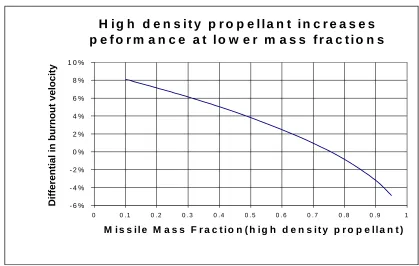
independent of the propellant, is not considered. Likewise, combustion and nozzle efficiency is assumed to be the same for the two propellants). The two propellants specifically compared in Figure 4 are the high density HTPE propellant (ρ = 0.079 lb/in3 and Isp = 235 lbf/lbm•sec) and a typical aluminized HTPE (ρ = 0.064 lb/in3and Isp = 264 lbf/lbm•sec). As the figure shows the high-density propellant gives a higher velocity at mass fractions less than 0.75. Essentially, the same differential is obtained for a comparison of the high density HTPE with an aluminized HTPB. At mass fractions below 0.5 the gain in performance is ≥ 4% which is significant for many applications. Hence, for many first stage motors and tactical missions the high-density formulation offers an advantage is system performance.
Some typical missile mass fractions are: Sidewinder 0.32
Hellfire 0.19
TOW 0.15
Figure 4
b. Measured Performance
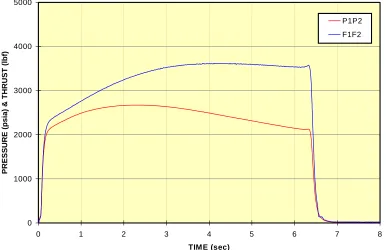
[image:7.612.98.517.110.376.2]It was demonstrated in a 93-lb motor firing that the partial replacement of AP and AN with 21% of the high-density oxidizer bismuth oxide in a baseline HTPE propellant with 20% aluminum increased delivered performance by about 10 percent. This was equal to the theoretical gain in performance. This propellant exceeded the performance for 91% solids HTPB propellant. Two motors of identical dimensions were fired one cast with the baseline propellant and one with the bismuth oxide propellant. Table 2 shows the weights, pressures and total thrust for both motors. Total thrust for the bismuth oxide containing motor was 10% higher than for the baseline. Figure 5 shows the measured pressure and thrust for the motor containing 21% bismuth oxide.
Table 2 - Propellant Formulated to Have 10% Higher Performance Than Baseline Aluminized HTPE Propellant
Motor Baseline HTPE Bi2O3 HTPE
Grain Length, inch 23 23
Grain OD, inch 8.385 8.385
Grain ID, inch 2.25 2.25
Weight, lbs 76.3 93.4
Average Pressure, psi 2128 2427
Total Thrust, lbf-sec 19,041 20,998
H i g h d e n s i t y p r o p e l l a n t i n c r e a s e s
p e f o r m a n c e a t l o w e r m a s s f r a c t i o n s
- 6 % - 4 % - 2 % 0 % 2 % 4 % 6 % 8 % 1 0 %
0 0 . 1 0 . 2 0 . 3 0 . 4 0 . 5 0 . 6 0 . 7 0 . 8 0 . 9 1
M i s s i l e M a s s F r a c t i o n ( h i g h d e n s i t y p r o p e l l a n t )
Initiation sensitivity for uncured propellant containing 21% Bi2O3 was the same as that for the baseline propellant. The HTPE propellant with 21% Bi2O3 was zero card in the standard NOL card gap test. Previously reported potlife6 problems with Bi2O3 were not experienced in these propellants.
Figure 5
Pressure and Thrust vs Time for Bi2O3-Containing Motor
2. Burning Rate Tailoring
The near-term potential applications for these high performance propellants require burning rates in the 0.7 to 1.1 in/sec range at 1000 psi, which is significantly higher than the 0.36 in/sec measured for the demonstration motor.
A series of propellant mixes was made to tailor higher burning rates for the Bi2O3-containing HTPE propellant. Various ballistic modifiers and AP particle size distributions were examined. After preliminary screening studies were conducted emphasis was concentrated on two burning rate modifiers designated BR1 and BR2. Figure 6 shows that burning rates up to 1.15 in/sec were obtained at 1000 psi by using up to 1.0% of BR1 and fine AP. Processing and castability of these formulations were completely satisfactory. It was observed that the pressure exponent often decreased as the burning rate and pressure increased. Use of burning rate modifier BR2 (see Figure 7) was found to be effective in increasing pressure exponent. Combinations of BR1 and BR2 are being examined for further ballistic property tailoring.
0 1000 2000 3000 4000 5000
0 1 2 3 4 5 6 7 8
TIME (sec)
PRESSURE (psia) & THRUST (lbf)
Figure 6
Burning Rates up to 1.15 in/sec Obtained at 1000 psi
BURNING RATE, IN/SEC
Figure 7
BURNING RATE, IN/SEC
3. Insensitive Munitions Testing
Figures 8 and 9
Passing Response Obtained for Bullet Impact Test
A second motor was subjected to the fragment impact test. The motor case and propellant were fragmented in this high-energy impact test as shown in Figures 10 and 11. Over 80% of both the case and propellant were recovered in the test area. The test was judged to be a passing response.
A third motor containing the bismuth oxide HTPE propellant failed the slow cookoff test with an explosive response. In a subsequent test when 2% ammonium nitrate was added to the bismuth oxide-HTPE formulation, slow cookoff resulted in a mild burning response just like the response for the baseline HTPE propellant. The addition of 2% ammonium nitrate to the formulation is very practical since it only results in a 0.3% decrease in impulse-density product. Additional formulation tailoring and IM testing is planned.
Passing Response to Fragment Impact Test
4. HTPE Propellant Aging
Previously five-year ambient and accelerated aging data was presented which showed that HTPE propellants will meet tactical motor service life requirements. Seven-year ambient aging data is now available which further confirms the excellent service life. Three plots of aging data are
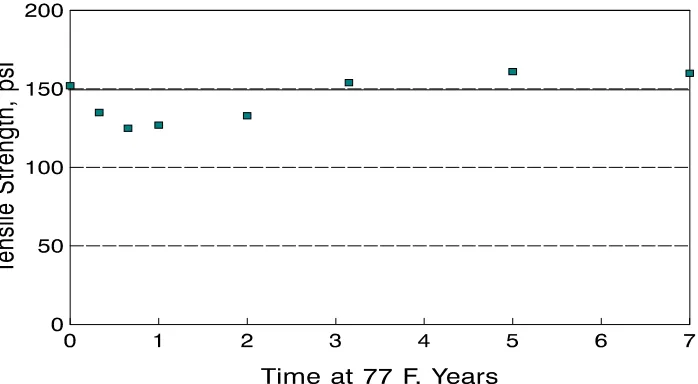
presented here. Figure 12 shows that the MNA stabilizer content is nearly unchanged during the seven-year aging period. The measured loss of 0.01% stabilizer in seven years is the quantity calculated from the depletion rates at higher temperatures and the 28 kcal/mole activation energy for the stabilization process. Figure 13 shows that the tensile strength of HTPE propellant remains unchanged at about 150 psi during seven years of aging. Figure 14 shows that there is a gradual increase in strain capability during the seven-year aging period. Burning rate was also unchanged during the seven-year aging period.
Initial aging data indicates that Bi2O3 does not have a negative effect on propellant service life in terms of mechanical property degradation or stabilizer depletion. Propellant from the 93-lb motor mix, containing 21% Bi2O3 was aged at ambient temperature for two years without any significant change in mechanical properties or stabilizer content as shown in the table below. There may have been a small increase in strain capability due to the two-year storage.
Property Initial Value Value After Two Year
Stress, psi 124 125
Strain, % 29 34
Modulus, psi 649 601
Figure 12
Figure 14
SUMMARY
The addition of the high-density oxidizer bismuth oxide to the HTPE propellant formulations has been shown to increase both theoretical and delivered impulse by about 10%. The bismuth oxide-containing HTPE propellants also retain the improved insensitive munitions response characteristics and long service life of the baseline HTPE propellants.
References
1. T. F. Comfort, R. M. Steckman and K. O. Hartman, “Insensitive HTPE Propellants,” CPIA Publication 630, p 87, Volume III, 1995.
2. T. F. Comfort, “HTPE Propellant Aging,” CPIA Publication 675, p 95, Volume II, 1998.
3. T. F. Comfort, “Characterization of HTPE Propellants.” CPIA Publication 687, p 87, Volume II, 1999.
4. K. O. Hartman and T. F. Comfort papers presented on Insensitive HTPE propellants at the NDIA IM Symposiums in 1994 and 1996.
5. J. P. Coughlin and J. T. Sellas, “High Density-Impulse Propellants,” CPIA Publication 457, Volume II, 1986
6. J. D. Braun and T. J. Jacks, “Increasing Density-Impulse Through Use of Bismuth Trioxide,” CPIA Publication 515, p 101, Volume V, 1989.