Adverse drug event classification of health records using dictionary-based
pre-processing and machine learning
Stefanie Friedrich and Hercules Dalianis
Department of Computer and Systems Sciences (DSV) Stockholm University
P.O. Box 7003 164 07 Kista
Sweden
[email protected], [email protected] Abstract
A method to find adverse drug reactions in electronic health records written in Swedish is presented. A total of 14,751 health records were manually classified into four groups. The records are nor-malised by pre-processing using both dic-tionaries and manually created word lists. Three different supervised machine learn-ing algorithm were used to find the best results; decision tree, random forest and LibSVM. The best performance on a test dataset was with LibSVM obtaining a pre-cision of 0.69 and a recall of 0.66, and a F-score of 0.67. Our method found 865 of 981 true positives (88.2%) in a 3-class dataset which is an improvement of 49.5% over previous approaches.
1 Introduction
Adverse drug events (ADEs) are the seventh largest cause of death in Sweden (Wester et al., 2008). ADEs also cause 3.7% of hospital admis-sions worldwide (Howard et al., 2007). Drugs have been developed by pharmaceutical compa-nies and tested on a small group of healthy young men (~3,000) (FDA, 2014); however, patients tak-ing the drugs are mostly elderly and multiple sick people, therefore, one needs to perform post-marketing drug safety surveillance in order to de-tect the ADEs’ effect on real patients.
The care of the patient is continuously docu-mented by the physician in health records also called electronic patient records. The health records contain both structured and unstructured information. The structured information is for ex-ample the age of the patient, time stamps, drugs, ICD-10 diagnosis code, and microbiological and blood values. Unstructured information is mainly
free text. Health records are usually long and written by different authors with different writ-ing styles (Allvin et al., 2011; Wijesekera, 2013). To identify entities in a text, to extract mean-ing and terms, and to consider their context, ad-vanced methods must carried out. Several strate-gies and methods have been developed, and some approaches are described in the next section.
2 Related research
There are several studies on automatically iden-tifying ADEs from the text of electronic health records using either rule-based or machine learning-based methods. In this section different approaches and their results are summarised.
2.1 Rule based methods
Several rule-based studies to detect ADEs have been carried out. Eriksson et al. (2013), car-ried out a rule and dictionary approach to detect ADEs in 6,011 Danish psychiatric patients’ hospi-tal records. The system identified 35,477 unique ADEs. They obtained a precision of 0.89 and a recall of 0.75.
Wang et al. (2009) developed a rule-based sys-tem to detect the drug - ADEs relationship for seven specific drugs. They used 25,074 discharge summaries in English to evaluate the system. The authors obtained a recall and precision of 0.75 and 0.31, respectively, for known ADEs.
Hazlehurst et al. (2009) detected vaccine ADEs among Kaiser Permanente Northwest (KPNW), which encompasses more than 450,000 persons. They compared automated methods MediClass with code-based detection methods; the Medi-Class method obtained better results than the code-based method - 0.74 versus 0.31 PPV (positive predictive value, which is the same as precision).
2.2 Machine learning based methods
There are several studies on automatically identi-fying ADEs from text of electronic patient records. One Spanish study by Santiso et al. (2014) used 6,100 concepts and 4,700 adverse drug reactions (ADRs) relations for training, and evaluated on 2,100 concepts and 1,600 ADR relations, and ob-tained 0.93 precision and 0.85 recall using the Random Forest algorithm.
In a Japanese study by Aramaki et al. (2010), using 3,012 Japanese discharge summaries, the authors annotated 1,045 drugs and 3,601 possi-ble adverse drug effects. They found that around 7.7% of the discharge summaries contained ADE. Of these, 59% could be extracted automatically. They used both support vector machine (SVM) and pattern matching methods(PTM) and obtained slightly better results using PTM; precision was 0.41 and recall 0.92 when using PTM, and SVM gave precision of 0.58 and recall of 0.62.
In a study by Roller and Stevenson (2014), UMLS was used to identify concepts and relations in millions of biomedical articles (for instance, drug contraindications, ADE drug relations), and used them to train a Naïve Bayes classifier obtain-ing 0.25 precision and 1.00 recall.
Gurulingappa et al. (2012) developed a man-ually annotated corpora in English consisting of 3,000 medical case reports (i.e. published scien-tific reports of specific patients, their drugs and their side effects). Three annotators annotated the corpora using the concepts drugs, drug dosage, adverse effect and relationship among the con-cepts. The three annotators have an M.Sc. degree in biomedicine, where two of them were experi-enced and one novice. One annotator was used as standard and the other as reference. Each anno-tator annotated 2,000 documents, and 1,000 docu-ments were annotated by all three annotators. The F-score was measured.Drugsobtained an F-score for partial match from 0.90 down to 0.38.Adverse effect-Drugsobtained an F-score of 0.79 down to 0.37. The ADE-corpus is publicly available1. The
authors performed machine learning experiments both with Naïve-Bayes and Maximum Entropy (MaxEnt) classifiers from the MALLET toolkit, and obtained, as best for MaxEnt, 0.75 precision and 0.64 recall.
1https://sites.google.com/site/adecorpus/
2.3 Aim and purpose
Previous approaches to detect adverse events have used either rule-based approaches or machine learning approaches, but none have applied a mixed method.
We aimed to design a method that identifies ADRs in health records. The identification of ADRs is realised with a mixture of keyword and phrase filtering and supervised machine learning algorithms that classify health records. By fil-tering of ADR related phrases, we achieved less computational effort to obtain the prediction and higher prediction performance. We also aspired to design a flexible method that is able to distinguish between different kinds of ADRs - for example, possible ADRs and ADRs related to a certain drug. Finally, we strived for both classification of med-ical records concerning ADRs and revealing the drug-symptom relations that are decisive for this classification.
3 Materials and methods
3.1 SEPR Corpus and SEPR Drug Cor-pus
Stockholm Electronic Patient Record (SEPR) Cor-pus is a patient record collection encompassing over one million patient records from the years 2006-2014 from Karolinska University Hospital in Stockholm, (Dalianis et al., 2012). Of this SEPR Corpus2, records were sampled to be used for the
machine learning experiment.
The SEPR Corpus is stored in a relational database. The unique serial number of each patient was extracted to identify the corresponding health record written by the physicians. Each entry of the record was ordered in temporal order including the drugs taken by each patient. Although, there are no personal names in the data base there can be personal names mentioned in the free text and therefore the data still may contain confidential in-formation. Thus, the data cannot be made publicly available. The problem is known and there are ini-tiatives to establish an infrastructure of publicly available medical records for research (Dalianis et al., 2015).
2This research has been approved by the Regional
The SEPR Drug Corpus is the sampled part of the SEPR Corpus. The sampling was performed in two steps. First, five drugs were selected for the focus, and second, four groups were defined to classify the records.
3.2 Methods
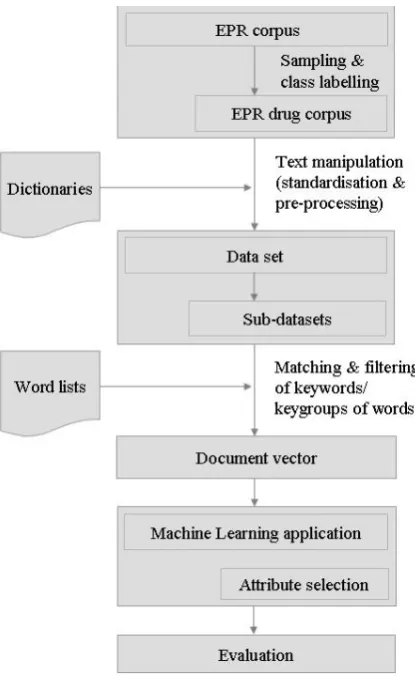
When developing our method as presented in Fig-ure 1, we faced two problems, that called for solu-tions. Firstly, health records are unstructured, not standardised texts, written by many authors with different writing styles. Secondly, health records tend to be long. The average number of words in a health record in the SEPR Drug Corpus is 11,228 words (133 words is the minimum and 74,457 words is the maximum). This volume of data can-not be handled by a Machine Learning applica-tion installed on a regular computer since machine learning applications in general need high primary memory capacity. For example, without any text manipulation and filtering, a document vector gen-erated from a sub-dataset with Cefuroxim patients (see SEPR Drug Corpus) would contain 391,761 features.
The first mentioned problem is solved by nor-malisation of writing format and words. The latter problem is solved by several pre-processing steps, focusing on five drugs and their known ADRs, di-viding the dataset into sub-datasets, and keywords and phrase filtering. The designed method is eval-uated with the known performance measurements precision (P), recall (R), (Rijsbergen, 1979) and F-score (Powers, 2015).
3.2.1 Sampling
[image:3.595.311.519.60.399.2]A sample should be composed in such a way that a machine learning algorithm can work effec-tively and efficiently. Moreover, a sample should mirror the whole corpus, so that the gained in-sights can be applied to the whole corpus, and even more importantly, can be generalised. With these defined requirements, a sampling of medi-cal records from the SEPR Corpus was performed in a multi-stage sampling approach. First, five drugs were selected. The choice was assigned and confirmed by our research physician. With this selection, the number of ADRs was nar-rowed down; however, the method has to work on any drug. Furthermore, independent sub-datasets can be formed to ensure that the results can be
Figure 1: Method process steps
generalised. The selected drugs belong to dif-ferent pharmacological/therapeutically subgroups according to the Anatomical Therapeutic Chemi-cal (ATC) classification system (WHO, 2015) to guarantee that the designed method is applicable to different drugs. Furthermore, each of them is given to at least 1,000 patients to guarantee that the designed method is valid; and two of the drugs are given to a larger number of patients (more than 1,000 patients) to guarantee that the designed method can distinguish between different class la-bels. To read more details about the requirements and the sampling please see (Friedrich, 2015).
The following drugs fulfil the above require-ments (FASS, 2014a), the ATC codes can be found here3:
1. Cefuroxim(ATC code J01DC02), antibiotic (Swedish: antibiotika); drug agent Cefuroxime
2. Imovane (ATC code N05CF01), psycholeptic (Swedish: neuroleptika, lugnade medel och sömn-medel), also called a tranquilliser or sleeping aid; drug agent Zopiclonum INN
3. Oxynorm (ATC code N02AA05), analgetica (Swedish: smärtstillande medel), also called a pain killer; drug agent Oxycodone
4. Prednisolon (ATC code H02AB06), corticosteroids (Swedish: Kortikosteroider för systemiskt bruk), also called cortisone; drug agent Prednisolon
5. Primperan (ATC code A03FA01), functional gas-trointestinal disorders (Swedish: funktionella mag-tarmsymptom); to treat nausea and vomiting, drug agent: Metoclopramide
Dosage and dosage form were not considered, nor the companies producing or dealing with any of the above mentioned drugs.
As a second sampling step, four classes were defined, and assigned to health records. Health records that could not be assigned to one of the four classes were excluded; these were mainly health records with contradicting notes about ADRs. The four classes are:
1. definitely ADRs and related to the chosen drugs: known and drug-related ADRs according to FASS (2014b)
2. definitely ADRs but not related to the chosen drug: ADR because an ADR term (in Swedish e.g. biverkn-ing, läkemedelutlöst) is mentioned in the health record, or diagnosis related to ADR (e.g. IDC G44.4 Drug-induced headache, not elsewhere classified); category A1 according to Stausberg and Hasford (2011) 3. possible ADRs: suspicious reaction or suspected
ad-verse drug event, however, neither diagnosis is related to ADR or symptoms are linked to ADR
4. no ADR: ‘clean’ patients with no ADR mentioned, no ADR related diagnosis, or ADR related symptom
3.2.2 Manual class labelling
The 14,751 health records from the SEPR Drug Corpus were manually classified by one annotator who also is a computer scientist. Large parts of the records do not contain any note about ADRs. To aid the annotator the records were pre-annotated; with pre-annotation, only ADR-related passages have to be read. Designed word lists were used, which supported the pre-annotation and the manu-ally performed class labelling. The manual anno-tation took around seven weeks to perform.
With the performed two sampling steps (five drugs, four classes) the SEPR Drug Corpus was constructed containing 14,751 health records as-signed to four class labels, presented in Table 1.
Stausberg and Hasford (2011) categorised 505 ICD-10 codes in seven groups “with respect to its validity as an indicator for an ADE and its defi-nition in the ICD-10”. To avoid biased class la-belling, patients with a diagnosis related to Staus-berg’s category A.1 (drug-related causation was
noted in the ICD-10) were assigned to class 2 re-gardless of whether ADRs were mentioned in the health record.
3.3 Text manipulation
To improve both prediction performance and computational speed, normalisation and pre-processing of the unstructured texts were carried out. The number of synonyms, abbreviations, and misspellings that exist for terms decrease the per-formance of a classifier, thus, normalisation was performed. Pprocessing was carried out to re-duce the document vector space. More precisely, the following measurements concerning text ma-nipulation were carried out:
1. Normalisation of text and letter format - Case converter, to change capital letters into small letters; that improves keyword search since capital letters do not have to be consid-ered anymore
- Punctuation marks (e.g. , ; / </n> ) are mostly erased or replaced with dots, so that the sentence structure is not ruined. Punctu-ation marks are not part of a text analysis, but it can be a hint for an unknown ADR or for class label 3. Therefore, the question mark (“?”) is changed into the word maybe
(Swedish:kanske) 2. Normalisation of words
- Expansion to change abbreviations and acronyms to their full word (e.g.patinto pa-tient)
- Misspellings and synonyms
For example, the following abbreviations and variations are found for the term biverkn-ing (English: side effect): biv, biverkn, biverkningarna. For the termbiverkning44 misspellings were recognised.
3. Pre-processing
- Number filter to reduce the vector space and increase computational speed
- N-Char filter [N=2] to remove words that contain less than N letters
- Stop Word Filter to filter out stop words (Leskovec et al., 2014)
3.4 Dictionaries and word lists
Total drug related ADR general ADR possible ADR no ADR class 1 class 2 class 3 class 4
Cefuroxim 1,243 11 840 134 258
Imovane 2,329 4 1,790 124 411
Oxynorm 2,886 16 2,120 143 607
Prednisolon 3,411 42 2,134 312 923
Primperan 4,882 34 3,237 296 1,315
Total 14,751 107 10,121 1,009 3,514
[image:5.595.131.468.60.157.2]Share 0.7% 68.6% 6.8% 23.8%
Table 1: SEPR Drug Corpus with health records per class and drug
• misspellings (contains 460 words) • abbreviations (contains 217 words) • synonyms (contains 19 words)
These dictionaries were created by applying a Swedish grammar checker (Semushin, 2015) to a Bag of Word list. Marked words were either ab-breviations or misspelling. The list was completed with corrected or expanded words. However, the dictionary for misspellings is not complete; the detection of misspellings was finalised after 460 words since the process was too time consuming.
To support the process of matching and filtering words or phrases, different word lists were created and can be found here4:
• ADR terms(12 words): they are found with an online thesaurus (SinovumMedia, 2015), online translator (bab.la, 2015), and lexica (Wikipedia, 2015; FASS, 2014b; Healthcare, 2015; Elsevier, 2015).
• ADR phrases (195 phrases): for this case a new iterative technique was developed: a term frequency counter for ADR terms (12 words) is applied. Words that co-occur with ADR terms are filtered and combined into one phrase. These three steps (applying a fre-quency counter, filter terms, and combining them) is executed three times in total. The re-sults are in a list of ADR phrases, which is checked manually.
• drugs(5 words): the five chosen drugs • drug-related ADR symptoms: ADR that
are known, related to one of the five chosen drugs, and listed in FASS (2014b)
• general ADR symptoms(93 words): the list is generated with terms retrieved with the web-content-mining technique from FASS (2014b). The retrieval and extraction process was not part of this research study.
4http://dsv.su.se/health/dictionaries
The word list ’ADR terms’ contains, for exam-ple:reaktion, bieffekt, biverkning, iatrogen(in En-glish: reaction, side effects, adverse events, ia-trogenic). The word list ’ADR phrases’ contains, for example: mycket vanlig biverkning, förmod-ligen biverkning, känd biverkning, misstanke om biverkning(in English: very common side effect, possible side effect, known side effect, suspected adverse reaction)
Both dictionaries and word lists were reduced to their stem with the Swedish version of Snow-ball stemmer (Porter, 2001) to improve hit accu-racy and to bypass spelling errors.
3.5 Matching and filtering
To reduce the word vector space even more, words and phrases were matched according to the cre-ated word lists and filtered from the health records. This match and filter process involves two dimen-sions: matching words that belong to three differ-ent intensities, and filtering the matched terms into three different levels.
perfor-mance. The matching intensities (dimension) are: 1. Intensity 1 -ADR terms: terms that indicate an ADR
(e.g. biverkning, bieffekt, biverkan, läkemedelsutlöst) were tagged as [Reaction]; additionally the names of the five chosen drugs were tagged as [Drug]. The tagged terms are mostly nouns.
2. Intensity 2 -ADR terms plus help words: helping words and terms that may indicate an ADR (e.g. för-modligen, misstänkt) or no-ADR (e.g.ingen, utan) are tagged as [HelpWord] additionally to intensity level 1. The additionally tagged terms are adjectives, adverbs, and verbs.
3. Intensity 3 -ADR terms, help words, plus symptoms: in addition to the two levels above, two types of symp-toms were tagged: general sympsymp-toms that often are ADRs as [Symptoms], and additionally, symptoms that are ADR related to the drug as [Symptoms]. The addi-tionally tagged terms are mostly nouns.
With matching and tagging a text is modified to: "Patient har inga[HelpWord] biverkningar [Reaction] av strålbehandlingen ännu, mår inte [HelpWord] illa [Symptom] och har inga [HelpWord] huvudvärk [Symptom]. Tar Ce-furoxim [Drug].” (English: "The patient has no [HelpWord] adverse drug reactions [Reaction] of radiotherapy yet, do not [HelpWord] feel bad [Symptoms] and have no [HelpWord] headaches [Symptoms]. Taking Cefuroxime [Drug].")
Since words create their meaning in a context, a second dimension was chosen to filter the matched words in three different levels of filtering. For ex-ample, a term such asadverse reactioninfluences the class label depending on whether the term is part ofpatient has no adverse reactionsor of pa-tient has an adverse reaction to Cefuroxim. That is why the context of the matched term is consid-ered with the filter level. Eriksson et al. (2013) ap-plied designed dictionaries to filter ADR relevant compounds in clinical texts. However, the number of features should also be reduced without losing important information so that a machine learning algorithm runs in an appropriate time. Therefore, the following filter levels are defined:
1. Filter level A -only matched words: only the tagged words are filtered. This means that if the term biverkn-ing(English: ADR) is tagged, it is filtered, no mat-ter if the mat-term is part of the sentenceingen biverkning (English: no ADR) orpratar om biverkning(English: talking about ADR); however, helping words like in-gen(English:no) are also filtered. The disadvantage of only matching and filtering keywords is that the order of words is not considered nor are negations.
2. Filter level B -matched words and their neighbours: tagged words and their word neighbours in the sentence are filtered (N-grams on word level). The idea behind this is to find and include words in the classification model that are close by the keywords and may influence their meaning, but were not tagged on purpose. Still, neither the order of words nor negations are considered. 3. Filter level C -phrases and tag as one attribute: ADR phrases are filtered, in addition to tagged words de-pending on the intensity level. The document vector
contains of both words and word groups, where a word represents one feature and an ADR phrase represents one feature. Here, negations and word order concern-ing ADR phrases are considered.
The reasons for this choice are, firstly, the at-tributes in a document vector usually consist of one word (as in level 1); however, the filtering should not be biased (therefore, level 2 was cre-ated). Secondly, a solution for considering nega-tions and word order was needed (therefore, level 3 was defined). With the filtered words and phrases, a document vector is formed, and ma-chine learning algorithms are applied.
3.6 Machine Learning
As mentioned in the Methods section, the dataset containing of five drugs and four classes (14,751 records) must be reduced to run a Machine Learn-ing tool in an appropriate amount of time. More-over, dividing the dataset into sub-datasets helps to distinguish different combinations of classes, and thus, a comparison for determining which com-bination yields higher prediction results. It also meets the aim of designing a flexible method that is able to distinguish between different kinds of ADRs. Therefore, three sub-datasets were created that contain:
1. Health records of patients that take either Imovane or Oxynorm and are class-labelled with 2 (general ADRs), 3 (maybe ADRs), or 4 (no ADRs) to distinguish pa-tients that may have ADRs from papa-tients that definitely have ADRs or no ADRs at all.
2. Health records of patients that take Prednisolon and are class-labelled as 1 (ADR related to Prednisolon) or 2 (general ADRs) to distinguish patients with Pred-nisolon related ADR from patients with ADRs related to other drugs.
3. Health records of patients that take Cefuroxim and are class-labelled with 1 (Cefuroxim related ADRs), 2 (general ADRs), 3 (maybe ADR), or 4 (no ADR). Other combinations are conceivable and are planned for the future.
Decision tree (DT) (Quinlan, 1993), Random Forest (RF) (Breiman, 2001) and Library Support Vector Machine (LibSVM) (Chih-Chang and Lin, 2001) were chosen as supervised machine learning algorithms. The produced model is applied on a test dataset containing 30% of the instances gained with stratified sampling. The predicted classes of the test data instances are evaluated with precision
Furthermore, as the machine learning tool KN-IME (Berthold et al., 2007) was chosen with WEKA add-ons for decision tree, random forest and libSVM (KNIME, 2015).
4 Results
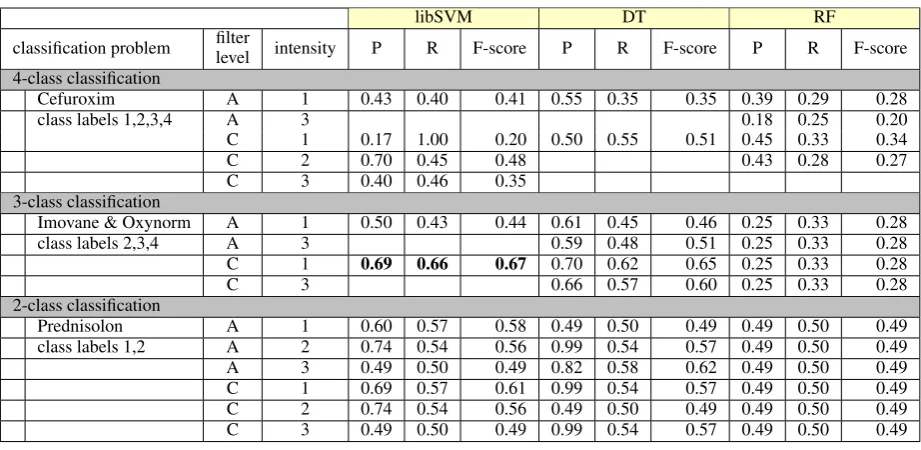
With this research project a method has been de-veloped that is able to do both predict, if an ADR/possible ADR in a health record occur, and identify an ADR as a drug-symptom relation. The latter was realised with attribute selection. With the presented method there were two results: firstly, prediction performance measurements as presented in Table 2, and secondly, attributes that are selected and may reveal drug-symptom rela-tionships.
4.1 Best results for classification
The best results for a classification on a test dataset that contains of 30% of the health records chosen with stratified sampling were achieved with lib-SVM (default parameters): precision of 0.69, re-call of 0.66 and F-score of 0.67. The prediction was performed on a 3-class sub-dataset contain-ing patients that take Imovane or Oxynorm, and health records that were class-labelled with ‘gen-eral ADR’ (class 2), ‘possible ADR’ (class 3), or ‘no ADR’ (class 4). 10-cross-fold validation was also carried but led to lower prediction per-formance.
4.2 Iterative filter and tag technique A new iterative technique was introduced to fil-ter ADR phrases, to combine them into one fea-ture, and to build a document vector. This tech-nique improves prediction performance for the best achieved result (3-class problem, intensity 1) from an F-score of 0.46 to an F-score of 0.65 (both with DT) and from an score = 0.44 to an F-score of 0.67 (with libSVM). This is an F-F-score improvement of 41% and 52%, respectively, for the 3-class problem, intensity 1.
4.3 Results for drug-symptom relation extraction/feature selection
With feature selection, the most important features concerning the class labels are selected. A selected attribute is important if it supports distinguishing
one class from the other. Here, it means an at-tribute helps to distinguish patients that, for exam-ple, have an ADR from patients that have none. However, a selected term does not mean that it is an ADR.
For the sub-dataset that is reduced to patients taking the drug Prednisolon (2-class problem, in-tensity level 3, filter level C, F-score of 0.62), a classifier must distinguish patients that show Prednisolon-related ADR from patients with gen-eral ADR. With attribute selection, 36 attributes were considered important. Four of them were categorised as ADR phrases, three can be related to Prednisolon, five terms are mentioned in FASS (FASS, 2014b) as either known ADR of nisolon or symptoms that are treated with Pred-nisolon. Eight of the 37 selected attributes are tagged as symptoms, but they are not mentioned as ADRs of Prednisolon nor as a symptom treated with Prednisolon (FASS, 2014b). One of these symptoms isbody weight, which is a known side effect of cortisone, however, it is not mentioned as side effect of Prednisolon. Sixteen attributes can-not be evaluated clearly.
For the sub-dataset that contains patients tak-ing the drug Cefuroxim (4-class problem, intensity level 1, filter level C, F-score of 0.48), 13 attributes are considered important with attribute selection, and all belong to ADR phrases.
4.4 Term frequencies
The term frequencies of tagged ADR terms were compared in the health records. Synonyms for an ADR are not equally distributed across the classes. For example, in class 2 the wordbiverkning (En-glish: adverse reaction ) occurs 320 times per 100 health records, whereas in class 3, it occurs only 165 times per 100 health records. In class 3 the ADR termbiverkan (English: adverse effect) is preferred with 139 occurrences compared to class 2 with 66 occurrences. For all three classes, the termsbiverkning(English: adverse reaction),
reaktion (English: reaction), biverkan (English:
libSVM DT RF
classification problem filterlevel intensity P R F-score P R F-score P R F-score 4-class classification
Cefuroxim A 1 0.43 0.40 0.41 0.55 0.35 0.35 0.39 0.29 0.28
class labels 1,2,3,4 A 3 0.18 0.25 0.20
C 1 0.17 1.00 0.20 0.50 0.55 0.51 0.45 0.33 0.34
C 2 0.70 0.45 0.48 0.43 0.28 0.27
C 3 0.40 0.46 0.35
3-class classification
Imovane & Oxynorm A 1 0.50 0.43 0.44 0.61 0.45 0.46 0.25 0.33 0.28
class labels 2,3,4 A 3 0.59 0.48 0.51 0.25 0.33 0.28
C 1 0.69 0.66 0.67 0.70 0.62 0.65 0.25 0.33 0.28
C 3 0.66 0.57 0.60 0.25 0.33 0.28
2-class classification
Prednisolon A 1 0.60 0.57 0.58 0.49 0.50 0.49 0.49 0.50 0.49
class labels 1,2 A 2 0.74 0.54 0.56 0.99 0.54 0.57 0.49 0.50 0.49
A 3 0.49 0.50 0.49 0.82 0.58 0.62 0.49 0.50 0.49
C 1 0.69 0.57 0.61 0.99 0.54 0.57 0.49 0.50 0.49
C 2 0.74 0.54 0.56 0.49 0.50 0.49 0.49 0.50 0.49
[image:8.595.72.533.60.285.2]C 3 0.49 0.50 0.49 0.99 0.54 0.57 0.49 0.50 0.49
Table 2: Performance measurer for a 30% test dataset
Figure 2: Distribution of record length per class.
4.5 Text length of health records
The length of a health record differs over the classes, as presented in Figure 2. The proportion of short texts shifts if patients are classified as 4 (no ADR), whereas health records classified as 1 or 2 (ADR occurred) tend to be longer.
5 Conclusions
Human beings are complex systems, so there can be great diversity in their reaction to a medical treatment. Clinical tests cannot carry out on all variants, even if all variants are known. Therefore, we have presented a method to perform ADR de-tection as post-marketing drug safety surveillance. Supervised machine learning algorithms were applied on the SEPR Drug Corpus with 14,751 class labelled health records. A good prediction
performance was yielded (F-score of 0.67, preci-sion of 0.69 and a recall of 0.66). Hazlehurst et al. (2009) identified vaccine adverse effects with a supervised machine learning approach and found 181 of 319 true positives (57%). Aramaki et al. (2010) conducted machine learning and predicted 59% of the adverse drug events correctly. The present method finds 865 of 981 true positives (88.2%) in a 3-class dataset, which is an improve-ment of 49.5%.
The high ratio of misspelled terms for selected attributes calls for smart spell checks specialised for medical texts. The supervised machine learn-ing algorithms prefer rare terms to distlearn-inguish classes. Misspellings disturb and mislead this pro-cess immensely.
The reason behind the different text length over the class labels (see figure 2) 1 to 4 may be that getting ADRs is just a question of time. Also, it may be that weakened, more sensitive, or ailing patients are prone to getting sick more often, and thus getting more medical treatment. Cascading effects arise, and therefore, it is more likely that an ADR occurs.
[image:8.595.73.295.324.466.2]rea-son to invest in post-marketing drug safety surveil-lance, since sensitive persons are limited in their participatiion in medical tests. The fact that the number of people that develop allergic reactions and other hypersensitivities has increased in recent years, highlights the urgency of post-marketing drug safety surveillance to better understand drug-symptom relations under special circumstances.
In the future, we plan to apply a spell check for Swedish, NER and parser techniques, to make the pre-processing faster and the prediction per-formance more accurate. Unfortunately, we used only one annotator; in the future, we will use at least two annotators to calculate the inter-annotation agreement (IAA). We also plan to test different methods of ADR expression extraction to perform machine learning and to obtain improved results.
Acknowledgements
The authors would like to thank Dr. Maria Kvist for her contributions as medical expert.
This work was partly supported by the project, High-Performance Data Mining for Drug Effect Detection, at Stockholm University, funded by Swedish Foundation for Strategic Research under grant IIS11-0053.
References
Helen Allvin, Elin Carlsson, Hercules Dalianis, Ri-itta Danielsson-Ojala, Vidas Daudaravicius, Mar-tin Hassel, Dimitrios Kokkinakis, Heljä Lundgrén-Laine, Gunnar H Nilsson, Øystein Nytrø, Salanterä Sanna, Suominen Hanna, and Velupillai Sumithra. 2011. Characteristics of Finnish and Swedish inten-sive care nursing narratives: a comparative analy-sis to support the development of clinical language
technologies. Journal of Biomedical Semantics, 2
Suppl 3:1–11.
Eiji Aramaki, Yasuhide Miura, Masatsugu Tonoike, Tomoko Ohkuma, Hiroshi Masuichi, Kayo Waki, and Kazuhiko Ohe. 2010. Extraction of adverse drug effects from clinical records. Stud Health Tech-nol Inform, 160(Pt 1):739–743.
bab.la. 2015. Online dictionary for 27 languages. http://bab.la/. accessed 31/5/2015.
Michael R. Berthold, Nicolas Cebron, Fabian Dill, Thomas R. Gabriel, Tobias Kötter, Thorsten Meinl, Peter Ohl, Christoph Sieb, Kilian Thiel, and Bernd Wiswedel. 2007. KNIME: The konstanz informa-tion miner. In Christine Preisach, Hans Burkhardt,
Lars Schmidt-Thieme, and Reinhold Decker, edi-tors, GfKl, Studies in Classification, Data Analy-sis, and Knowledge Organization, pages 319–326. Springer.
Leo Breiman. 2001. Random forests. Machine
learn-ing, 45(1):5–32.
Chih-Chang and Chih-Jen Lin. 2001.
LIB-SVM: a library for support vector machines. http://www.csie.ntu.edu.tw/˜cjlin/libsvm.
Hercules Dalianis, Martin Hassel, Aron Henriksson, and Maria Skeppstedt. 2012. Stockholm EPR Cor-pus: A Clinical Database Used to Improve Health
Care. InSwedish Language Technology Conference,
SLTC-2012, pages 17–18.
Hercules Dalianis, Aron Henriksson, Maria Kvist, Sumithra Velupillai, and Rebecka Weegar. 2015. HEALTH BANK - A workbench for data science applications in healthcare. In John Krogstie, Gustaf
Juel-Skielse, and Vandana Kabilan, editors,CAiSE
Industry Track, volume 1381 of CEUR Workshop Proceedings, pages 1–18. CEUR-WS.org.
Elsevier. 2015. Das Roche Lexikon
Medi-zin. https://www.tk.de/rochelexikon/. accessed
31/5/2015.
Robert Eriksson, Peter Bjødstrup Jensen, Sune Frankild, Lars Juhl Jensen, and Søren Brunak. 2013. Dictionary construction and identification of possi-ble adverse drug events in Danish clinical narrative
text. Journal of the American Medical Informatics
Association, 20(5):947–953.
FASS. 2014a. Fass atc register,
http://www.fass.se/lif/atcregister?usertype=0. http://www.fass.se/LIF/atcregister?userType=0. accessed 31/5/2015.
FASS. 2014b.
Läkemedelsindustriförenin-gens Service AB (LIF). Retrieved from
31/5/2015http://www.fass.se. accessed 31/5/2015.
U.S. Food Drug Administration FDA. 2014. Inside
Clinical Trials: Testing Medical Products in
Peo-ple. http://www.fda.gov/Drugs/ResourcesForYou/
Consumers/ucm143531.htm, accessed 31/5/2015.
Stefanie Friedrich. 2015. Detecting clinical entities using machine learning - How to find and predict (patients with) adverse drug reactions in medical records. Master thesis, Stockholm University.
Harsha Gurulingappa, Abdul Mateen Rajput, Angus Roberts, Juliane Fluck, Martin Hofmann-Apitius,
and Luca Toldo. 2012. Development of a
benchmark corpus to support the automatic extrac-tion of drug-related adverse effects from medical
case reports. Journal of biomedical informatics,
Brian Hazlehurst, Allison Naleway, and John Mullooly. 2009. Detecting possible vaccine adverse events in clinical notes of the electronic medical record. Vac-cine, 27(14):2077–2083.
Alliance Healthcare. 2015. Gesundheit.de.
http://www.gesundheit.de/. accessed 31/5/2015. Rachel L Howard, Anthony J Avery, Serena
Slaven-burg, Simon Royal, G Pipe, Peter Lucassen, and Munir Pirmohamed. 2007. Which drugs cause preventable admissions to hospital? a systematic
review. British journal of clinical pharmacology,
63(2):136–147.
KNIME. 2015. Knime weka data mining
inte-gration. https://www.knime.org/update/. accessed 31/5/2015.
Jurij Leskovec, Anand Rajaraman, and Jeffrey D.
Ull-man. 2014.Mining of massive datasets. Cambridge
University Press, pub-CAMBRIDGE:adr, second edition.
Martin F Porter. 2001. Snowball: A language for stem-ming algorithms. http://snowball.tartarus.org.
David M. W. Powers. 2015. What the
F-measure doesn’t F-measure: Features, flaws,
fallacies and fixes. CoRR, abs/1503.06410.
http://arxiv.org/abs/1503.06410, accessed
31/5/2015.
J. Ross Quinlan. 1993. C4.5: Programs for Machine
Learning. Morgan Kaufmann.
Cornelis Joost Van Rijsbergen. 1979. Information
Re-trieval. Butterworth-Heinemann.
Roland Roller and Mark Stevenson. 2014.
Self-supervised relation extraction using umls. In
In-formation Access Evaluation. Multilinguality, Multi-modality, and Interaction, pages 116–127. Springer.
Sara Santiso, Alicia Pérez, Koldo Gojenola, IXA Taldea, Arantza Casillas, and Maite Oronoz. 2014. Adverse Drug Event prediction combining shallow
analysis and machine learning. In Proceedings
of the 5th International Workshop on Health Text Mining and Information Analysis (Louhi)@ EACL, pages 85–89.
Sergey Semushin. 2015. Notepad++
Spell-checking Plug-In, Swedish.
https://github.com/Predelnik/DSpellCheck.git. accessed 31/5/2015.
SinovumMedia. 2015. Synonymer.se.
http://www.synonymer.se/. accessed 31/5/2015. Jürgen Stausberg and Joerg Hasford. 2011.
Drug-related admissions and hospital-acquired adverse drug events in Germany: a longitudinal analysis from 2003 to 2007 of ICD-10-coded routine data.
BMC health services research, 11(1):134.
Xiaoyan Wang, George Hripcsak, Marianthi Markatou, and Carol Friedman. 2009. Active computerized pharmacovigilance using natural language process-ing, statistics, and electronic health records: a feasi-bility study. Journal of the American Medical Infor-matics Association, 16(3):328–337.
Karin Wester, Anna K Jönsson, Olav Spigset, Hen-rik Druid, and Staffan Hägg. 2008. Incidence of fatal adverse drug reactions: a population based
study. British journal of clinical pharmacology,
65(4):573–579.
WHO. 2015. Who collaborating
cen-tre for drug statistics methodology.
http://www.whocc.no/atc/structure_and_principles/. accessed 31/5/2015.
Nandalal Wijesekera. 2013. Documenting medical
records - A handbook for doctors. Health Informa-tion Systems Knowledge Hub School of PopulaInforma-tion Health,The University of Queensland, 1 edition.
Wikipedia. 2015. Adverse effect
-Wikipedia, The Free Encyclopedia.