Chinese Named Entity Recognition with Graph-based Semi-supervised
Learning Model
Aaron Li-Feng Han* Xiaodong Zeng+ Derek F. Wong+ Lidia S. Chao+
* Institute for Logic, Language and Computation, University of Amsterdam Science Park 107, 1098 XG Amsterdam, The Netherlands
+ NLP2CT Laboratory/Department of Computer and Information Science University of Macau, Macau S.A.R., China
[email protected] [email protected] [email protected] [email protected]
Abstract
Named entity recognition (NER) plays an im-portant role in the NLP literature. The tradi-tional methods tend to employ large annotated corpus to achieve a high performance. Differ-ent with many semi-supervised learning mod-els for NER task, in this paper, we employ the graph-based semi-supervised learning (GBSSL) method to utilize the freely available unlabeled data. The experiment shows that the unlabeled corpus can enhance the state-of-the-art conditional random field (CRF) learning model and has potential to improve the tag-ging accuracy even though the margin is a lit-tle weak and not satisfying in current experi-ments.
1.
Introduction
Named entity recognition (NER) can be regarded as a sub-task of the information extraction, and plays an important role in the natural language processing literature. The NER challenge has attracted a lot of researchers from NLP, and some successful NER tasks have been held in the past years. The annotations in MUC-71 Named Entity tasks (Marsh and Perzanowski, 1998) con-sist of entities (organization, person, and loca-tion), times and quantities such as monetary val-ues and percentages, etc. among the languages of English, Chinese and Japanese.
The entity categories in CONLL-02 (Tjong Kim Sang, 2002) and CONLL-03 (Tjong Kim
1
http://www-nlpir.nist.gov/related_projects/muc/proceedings/ ne_task.html
Sang and De Meulder, 2003) NER shared tasks consist of persons, locations, organizations and names of miscellaneous entities, and the lan-guages span from Spanish, Dutch, English, to German.
The SIGHAN bakeoff-3 (Levow, 2006) and bakeoff-4 (Jin and Chen, 2008) tasks offer stand-ard Chinese NER (CNER) corpora for training and testing, which contain the three commonly used entities, i.e., personal names, location names, and organization names. The CNER task is generally more difficult than the western lan-guages due to the lack of word boundary infor-mation in Chinese expression.
Traditional methods used for the entity recog-nition tend to employ external annotated corpora to enhance the machine learning stage, and im-prove the testing scores using the enhanced mod-els (Zhang et al., 2006; Mao et al., 2008; Yu et al., 2008). The conditional random filed (CRF) models have shown advantages and good per-formances in CNER tasks as compared with oth-er machine learning algorithms (Zhou et al., 2006; Zhao and Kit, 2008), such as ME, HMM, etc. However, the annotated corpora are general-ly very expensive and time consuming.
On the other hand, there are a lot of freely available unlabeled data in the internet that can be used for our researches. Due to this reason, some researchers begin to explore the usage of the unlabeled data and the semi-supervised learn-ing methods based on labeled trainlearn-ing data and unlabeled external data have shown their ad-vantages (Blum and Chawla, 2001; Shin et al., 2006; Zha et al., 2008; Zhang et al., 2013).
2.
Semi-supervised Learning
In the semi-supervised learning model, a sample
{𝑍𝑍𝑖𝑖 = (𝑋𝑋𝑖𝑖,𝑌𝑌𝑖𝑖)}𝑖𝑖=1𝑛𝑛𝑙𝑙 is usually observed with
label-ing 𝑌𝑌𝑖𝑖 ∈{−1,1}, in addition to independent unla-beled samples {𝑋𝑋𝑗𝑗}𝑗𝑗=𝑛𝑛𝑛𝑛 𝑙𝑙+1 with the 𝑛𝑛=𝑛𝑛𝑙𝑙+𝑛𝑛𝑢𝑢. The 𝑋𝑋𝑘𝑘 =�𝑋𝑋𝑘𝑘1,𝑋𝑋𝑘𝑘2, … ,𝑋𝑋𝑘𝑘𝑘𝑘�𝑘𝑘 ∈(1,𝑛𝑛) is a p-dimentional input (Wang and Shen, 2007). The labeled samples are independently and identical-ly distributed according to an unknown joint dis-tribution 𝑃𝑃(𝑥𝑥,𝑦𝑦), and the unlabeled samples are independently and identically distributed from distribution 𝑃𝑃(𝑥𝑥). Many semi-supervised learn-ing models are designed through some assump-tions relating 𝑃𝑃(𝑥𝑥) to the conditional distribution, which cover EM method, Bayesian network, etc. (Zhu, 2008).
The graph-based semi-supervised learning (GBSSL) methods have been successfully em-ployed by many researchers. For instance, Gold-berg and Zhu (2006) design the GBSSL model for sentiment categorization; Celikyilmaz et al. (2009) propose a GBSSL model for question-answering; Talukdar and Pereira (2010) use the GBSSL methods for class-Instance acquisition; Subramanya et al. (2010) utilize the GBSSL model for structured tagging models; Zeng et al., (2013) use the GBSSL method for the joint Chi-nese word segmentation and part of speech (POS) tagging and result in higher performances as compared with previous works. However, as far as we know, the GBSSL method has not been employed into the CNER task. To testify the ef-fectiveness of the GBSSL model in the tradition-al CNER task, this paper utilizes some unlabeled data to enhance the CRF learning through GBSSL method.
3.
Designed Models
To briefly introduce the GBSSL method, we as-sume 𝐷𝐷𝑙𝑙 = {(𝑥𝑥𝑗𝑗,𝑟𝑟𝑗𝑗)}𝑗𝑗=1𝑙𝑙 denote 𝑙𝑙 annotated data and the empirical label distribution of 𝑥𝑥𝑗𝑗 is 𝑟𝑟𝑗𝑗. Assume the unlabeled data types are denoted as
𝐷𝐷𝑢𝑢= {𝑥𝑥𝑖𝑖}𝑖𝑖=𝑙𝑙+1𝑚𝑚 . Then, the entire dataset can be
represented as 𝐷𝐷=𝐷𝐷𝑢𝑢∪ 𝐷𝐷𝑙𝑙. Let 𝐺𝐺 = (𝑉𝑉,𝐸𝐸) cor-responds to an undirected graph with V as the vertices and E as the edges. Let 𝑉𝑉𝑙𝑙 and 𝑉𝑉𝑢𝑢 repre-sent the labeled and unlabeled vertices respec-tively. One important thing is to select a proper similarity measure to calculate the similarity be-tween a pair of vertices (Das and Smith, 2012). According to the smoothness assumption, if two instances are similar according to the graph, then
the output labels should also be similar (Zhu, 2005).
There are mainly three stages in the designed models, i.e., graph construction, label propaga-tion and CRF learning. Graph construcpropaga-tion is performed on both labeled and unlabeled data, and the unlabeled data is automatically tagged through the label propagation stage. Then, the tagged external data will be added into the man-ually annotated training corpus to enhance the CRF learning model.
3.1
Graph Construction & Label Propaga-tionWe follow the research of Subramanya et al. (2010) to represent the vertices using character trigrams in labeled and unlabeled sentences for graph construction.
A symmetric k-NN graph is utilized with the edge weights calculated by a symmetric similari-ty function designed by Zeng et al. (2013).
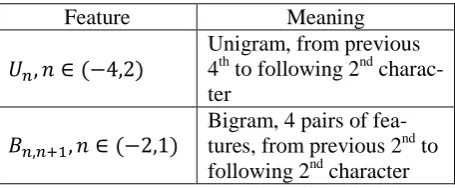
The feature set we employed to measure the similarity of two vertices based on the co-occurrence statistics is the optimized one by Han et al. (2013) for CNER tasks, as denoted in Table 1.
Feature Meaning
𝑈𝑈𝑛𝑛,𝑛𝑛 ∈(−4,2)
Unigram, from previous 4th to following 2nd charac-ter
𝐵𝐵𝑛𝑛,𝑛𝑛+1,𝑛𝑛 ∈(−2,1)
[image:2.595.302.530.413.507.2]Bigram, 4 pairs of fea-tures, from previous 2nd to following 2nd character
Table 1: Feature set for measuring vertices simi-larity in graph construction and training CRF model.
After the graph construction on both labeled and unlabeled data, we use the sparsity inducing penalty (Das and Smith, 2012) label propagation algorithm to induce trigram level label distribu-tions from the constructed graph, which is based on the Junto toolkit (Talukdar and Pereira, 2010).
3.2 CRF Training
𝑃𝑃𝜃𝜃(𝑦𝑦|𝑥𝑥)∝ 𝑒𝑒𝑥𝑥𝑒𝑒 � � 𝜆𝜆𝑘𝑘𝑓𝑓𝑘𝑘(𝑒𝑒,𝑦𝑦|𝑒𝑒,𝑥𝑥)
𝑒𝑒∈𝐸𝐸,𝑘𝑘
+ � 𝜇𝜇𝑘𝑘𝑔𝑔𝑘𝑘(𝑣𝑣,𝑦𝑦|𝑣𝑣,𝑥𝑥)
𝑣𝑣∈𝑉𝑉,𝑘𝑘
�
The 𝑓𝑓𝑘𝑘 and 𝑔𝑔𝑘𝑘 are the feature functions and 𝜇𝜇𝑘𝑘 and 𝜆𝜆𝑘𝑘 are the parameters that are trained from specific dataset (Lafferty et al., 2001). The fea-ture set employed in the CRF learning is also the optimized one as shown in Table 1. The training method utilized for the CRF model is a quasi-newton algorithm2. The automatically annotated corpus by the graph based label propagation will affect the trained parameters 𝜇𝜇𝑘𝑘 and 𝜆𝜆𝑘𝑘.
4.
Experiments
4.1 Data
We employ the SIGHAN bakeoff-3 (Levow, 2006) MSRA (Microsoft research of Asia) train-ing and testtrain-ing data as standard setttrain-ing. To testify the effectiveness of the GBSSL method for CRF model in CNER tasks, we utilize some plain (un-annotated) text from SIGHAN bakeoff-2 (Emer-son, 2005) and bakeoff-4 (Jin and Chen, 2008) as external unlabeled data. The data set is intro-duced in Table 2 from the aspect of sentence number.
Bakeoff-3 Corpus External Sentence
Number
Training Testing Unlabeled
[image:3.595.302.532.108.164.2]50,425 4,365 31,640
Table 2: Corpus Information.
4.2 Result Analysis
We set two baseline scores for the evaluation. One baseline is the simple left-to-right maximum matching model (MaxMatch) based on the train-ing data, another baseline is the closed CRF model (Closed-CRF) without using unlabeled data. The employment of GBSSL model into semi-supervised CRF learning is denoted as GBSSL-CRF.
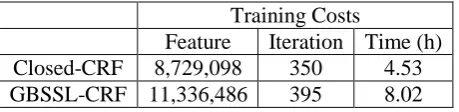
The training costs of the CRF learning stage are detailed in Table 3. The comparison shows that the extracted features grow from 8,729,098 to 11,336,486 (29.87%) due to the external da-taset, and the corresponding iterations and
train-2
http://www.nag.com/numeric/fl/nagdoc_fl23/html/E0 4/e04conts.html
ing hours also grow by 12.86% and 77.04% re-spectively.
Training Costs
Feature Iteration Time (h)
Closed-CRF 8,729,098 350 4.53
GBSSL-CRF 11,336,486 395 8.02
Table 3: Training Cost for CRF Learning.
The evaluation results are shown in Table 4, from the aspects of recall, precision and the har-monic mean of recall and precision (F1-score). The evaluation shows that both the Closed-CRF and GBSSL-CRF models have largely outper-formed baseline-1 model (MaxMatch). As com-pared with the Closed-CRF model, the GBSSL-CRF model yielded a higher performance in pre-cision score, a lower performance in recall score, and finally resulted in a faint improvement in F1 score. Both the GBSSL-CRF and Closed-CRF show higher performance in precision and lower performance in recall value.
Evaluation Scores Total-score Total-R Total-P Total-F
MaxMatch 48.8 59.0 53.4
Closed-CRF 77.95 90.27 83.66
[image:3.595.300.532.376.446.2]GBSSL-CRF 77.84 90.62 83.74
Table 4: Evaluation Results.
To look inside the GBSSL performance on each kind of entity, we denote the detailed evalu-ation results from the aspect of F1-score in Table 5. The detailed evaluation from three kinds of entities shows that both the GBSSL-CRF and Closed-CRF show higher performance in LOC entity type, and lower performance in PER and ORG entities.
Detailed Evaluation
Sub-F-score PER-F LOC-F ORG-F
MaxMatch 61.4 53.1 46.9
Closed-CRF 77.95 88.56 80.88
GBSSL-CRF 78.17 88.39 81.35
Table 5: Detailed Evaluation Results.
Fortunately, the GBSSL model can enhance the CRF learning on the two kinds of difficult entities PER and ORG with the better perfor-mances of 0.28% and 0.58% respectively. How-ever, the GBSSL model decreases the F1 score
[image:3.595.302.530.595.663.2]on LOC entity by 0.19%. The lower performance of GBSSL model on LOC entity may be due to that the unlabeled data is only as much as 62.75% of the training corpus, which is not large enough to cover the Out-of-Vocabulary (OOV) testing words of LOC entity; on the other hand, the un-labeled data also bring some noise into the model.
5.
Related Work
Nadeau (2007) employs the semi-supervised learning method to recognize 100 entity types on English documents with little supervision. Simi-larly, Liao and Veeramachaneni (2009) propose a simple semi-supervised algorithm for English entity recognition. Liu et al. (2011) design an interesting application of the semi-supervised learning model for online tweets document for English NER.
Pham et al. (2012) use semi-supervised learn-ing method of CRFs into the Vietnamese NER task with generalized expectation criteria. Simi-larly, Vo and Ock (2012) utilize a hybrid ap-proach semi-supervised learning apap-proach into the NER task for Vietnamese document.
Wang et al. (2013) and Che et al. (2013) re-cently propose the usage of bilingual constraints to enhance the NER accuracy.
Some advanced technologies of GBSSL methods are introduced in the papers Zhu and Lafferty (2005), Culp and Michailidis (2008), and Zhang and Wang (2011), etc.
6.
Conclusion and Future Work
This paper makes an effort to see the effective-ness of the GBSSL model for the traditional CNER task. The experiments verify that the GBSSL can enhance the state-of-the-art CRF learning models. The improvement score is a little weak because the unlabeled data is not large enough. In the future work, we decide to use larger unlabeled dataset to enhance the CRF learning model.
The feature set optimized for CRF learning may be not the best one for the similarity calcu-lation in graph construction stage. So we will make efforts to select the best feature set for the measuring of vertices similarity in graph con-struction on CNER documents.
In this paper, we utilized the Microsoft re-search of Asia corpus for experiments. We will use more kinds of Chinese corpora for testing, such as CITYU and LDC corpus, etc.
The GBSSL model generally improves the tagging accuracy of the Out-of-Vocabulary
(OOV) words in the test data, which are unseen in the training corpora. In the future work, we plan to give a detailed analysis of the GBSSL model performance on the OOV words for CNER tasks.
Acknowledgements
This work was supported by the Research Com-mittee of the University of Macau (Grant No. 00175-FST and MYRG2015-00188-FST) and the Science and Technology Development Fund of Macau (Grant No. 057/2014/A). The first author was supported by NWO VICI under Grant No. 277-89-002.
References
A. Blum, & Chawla, S. 2001. Learning from labeled and unlabeled data using graph mincuts. In ICML -2001.
Asli Celikyilmaz, Marcus Thint, and Zhiheng Huang. 2009. A graph-based semi-supervised learning for question-answering. In Proceedings of the Joint Conference of the 47th Annual Meeting of the ACL and the 4th International Joint Conference on Nat-ural Language Processing of the AFNLP: Volume 2 - Volume 2 (ACL '09), Vol. 2. Association for Computational Linguistics, Stroudsburg, PA, USA, 719-727.
Wanxiang Che, Mengqiu Wang and Christopher D. Manning. 2013. Named Entity Recognition with Bilingual Constraints. In NAACL 2013.
Mark Culp and George Michailidis. 2008. Graph-Based Semisupervised Learning. IEEE TRANSAC-TIONS ON PATTERN ANALYSIS AND MACHINE INTELLIGENCE, VOL. 30, NO. 1.
Dipanjan Das and Noah A. Smith. 2012. Graph-based lexicon expansion with sparsity-inducing penalties. In Proceedings of NAACL, pages 677-687.
Thomas Emerson. 2005. The Second International Chinese Word Segmentation Bakeoff. Proceedings of the Fourth SIGHAN Workshop on Chinese Lan-guage Processing. Pp. 123-133.
Andrew B. Goldberg and Xiaojin Zhu. 2006. Seeing stars when there aren't many stars: graph-based semi-supervised learning for sentiment categoriza-tion. In Proceedings of the First Workshop on Graph Based Methods for Natural Language Pro-cessing (TextGraphs-1). Association for Computa-tional Linguistics, Stroudsburg, PA, USA, 45-52.
and Intelligent Information Systems. Lecture Notes in Computer Science, Volume 7912, pp 57-68.
J. Lafferty, McCallum, A., Pereira, F.C.N. 2001. Conditional random fields: Probabilistic models for segmenting and labeling sequence data. In: Pro-ceeding of 18th International Conference on Ma-chine Learning, pp. 282–289. Massachusetts.
Gina-Anne Levow. 2006. The Third International Chinese Language Processing Bakeoff: Word Segmentation and Named Entity Recognition. Pro-ceedings of the Fifth SIGHAN Workshop on Chi-nese Language Processing, pages 108–117, Syd-ney.
Wenhui Liao and Sriharsha Veeramachaneni. 2009. A Simple Semi-supervised Algorithm For Named En-tity Recognition. Proceedings of the NAACL HLT Workshop on Semi-supervised Learning for Natu-ral Language Processing, pages 58–65.
Xiaohua Liu , Shaodian Zhang , Furu Wei , Ming Zhou. 2011. Recognizing Named Entities in Tweets. Proceedings of the 49th Annual Meeting of the Association for Computational Linguistics: Human Language Technologies.
G. Jin, and X. Chen. 2008. The fourth international CLP bakeoff: Chinese word segmentation, named entity recognition and Chinese pos tagging. In:
Sixth SIGHAN Workshop on CLP, pp. 83–95.
Elaine Marsh, and Dennis Perzanowski. 1998. MUC-7 Evaluation of IE Technology: Overview of Re-sults. Technical report.
Xinnian Mao; Yuan Dong; Saike He; Sencheng Bao; Haila Wang. 2008. Chinese Word Segmentation and Named Entity Recognition Based on Condi-tional Random Fields. Proceedings of the Sixth SIGHAN Workshop on Chinese Language Pro-cessing. pp. 90-93.
David Nadeau. 2007. Semi-Supervised Named Entity Recognition-Learning to Recognize 100 Entity Types with Little Supervision. PHD thesis. Univer-sity of Ottawa
Thi-Ngan Pham, Le Minh Nguyen, and Quang-Thuy Ha. 2012. Named Entity Recognition for Vietnam-ese Documents Using Semi-supervised Learning Method of CRFs with Generalized Expectation Criteria. In Proceedings of the 2012 International Conference on Asian Language Processing. IEEE Computer Society, Washington, DC, USA, 85-88.
Hyunjung Shin, N. Jeremy Hill, and Gunnar R¨atsch. 2006. Graph Based Semi-Supervised Learning with Sharper Edges. ECML 2006, LNAI 4212, pp. 402– 413.
Amarnag Subramanya, Slav Petrov, and Fernando Pereira. 2010. Efficient graph-based semi-supervised learning of structured tagging models. In Proceedings of the 2010 Conference on
Empiri-cal Methods in Natural Language Processing (EMNLP '10). Association for Computational Lin-guistics, Stroudsburg, PA, USA, 167-176.
Partha Pratim Talukdar and Fernando Pereira. 2010. Experiments in Graph-based Semi-Supervised Learning Methods for Class-Instance Acquisition.
Proceedings of the 48th Annual Meeting of the As-sociation for Computational Linguistics, pages 1473–1481.
E. F. Tjong Kim Sang. 2002. Introduction to the CoNLL-2002 Shared Task: Language-Independent Named Entity Recognition. CONLL-02.
E. F. Tjong Kim Sang; De Meulder, Fien. 2003. In-troduction to the CoNLL-2003 shared task: Lan-guage-independent named entity recognition.
CoNLL-2003.
Duc-Thuan Vo, Cheol-Young Ock. 2012. A Hybrid Approach of Pattern Extraction and Semi-supervised Learning for Vietnamese Named Entity Recognition. Lecture Notes in Computer Science
Volume 7653, 2012, pp 83-93.
Junhui Wang and Xiaotong Shen. 2007. Large Margin Semi-supervised Learning. Journal of Machine Learning Research.
Mengqiu Wang, Wanxiang Che, Christopher D. Man-ningy. 2013. Effective Bilingual Constraints for Semi-supervised Learning of Named Entity Rec-ognizers. In AAAI-2013.
Xiaofeng Yu; Wai Lam; Shing-Kit Chan; Yiu Kei Wu; Bo Chen. 2008. Chinese NER Using CRFs and Logic for the Fourth SIGHAN Bakeoff. Proceed-ings of the Sixth SIGHAN Workshop on Chinese Language Processing. pp. 102-105.
Xiaodong Zeng; Derek F. Wong; Lidia S. Chao; Isa-bel Trancoso. 2013. Graph-based Semi-Supervised Model for Joint Chinese Word Segmentation and Part-of-Speech Tagging. ACL 2013.
Zheng-Jun Zha; Tao Mei; Jingdong Wang; Zengfu Wang; Xian-Sheng Hua. 2008. Graph-based semi-supervised learning with multi-label. Multimedia and Expo, 2008 IEEE International Conference on, pp.1321-1324.
Changshui Zhang, Fei Wang. 2011. Graph-based semi-supervised learning. Frontiers of Electrical and Electronic Engineering in China. Volume 6, Issue 1, pp 17-26.
Suxiang Zhang; Ying Qin; Juan Wen; Xiaojie Wang. 2006. Word Segmentation and Named Entity Recognition for SIGHAN Bakeoff3. Proceedings of the Fifth SIGHAN Workshop on Chinese Lan-guage Processing, pages 158–161.
Twenty-Third international joint conference on Ar-tificial Intelligence (IJCAI'13), Francesca Rossi (Ed.). AAAI Press 1896-1902.
Hai Zhao; Chunyu Kit. 2008. Unsupervised Segmen-tation Helps Supervised Learning of Character Tagging for Word Segmentation and Named Entity Recognition. Proceedings of the Sixth SIGHAN Workshop on Chinese Language Processing. pp. 106-111.
Junsheng Zhou; Liang He; Xinyu Dai; Jiajun Chen. 2006. Chinese Named Entity Recognition with a Multi-Phase Model. Proceedings of the Fifth SIGHAN Workshop on Chinese Language Pro-cessing, pages 213–216.
Xiaojin Zhu. 2005. Semi-Supervised Learning with Graphs. PHD thesis. CMU-LTI-05-192.
X. Zhu, & Lafferty, J. 2005. Harmonic mixtures: combining mixture models and graph-based meth-ods for inductive and scalable semi-supervised learning. In ICML-2005.