ListNet-based MT Rescoring
†Jan Niehues,∗Quoc Khanh Do,∗Alexandre Allauzen and†Alex Waibel †Karlsruhe Institute of Technology, Karlsruhe, Germany
∗LIMSI-CNRS, Orsay, France
†[email protected] ∗[email protected]
Abstract
The log-linear combination of different features is an important component of SMT systems. It allows for the easy in-tegartion of models into the system and is used during decoding as well as forn -best list rescoring. With the recent suc-cess of more complex models like neural network-based translation models, n-best list rescoring attracts again more attention. In this work, we present a new technique to train the log-linear model based on the ListNet algorithm. This technique scales to many features, considers the whole list and not single entries during learning and can also be applied to more complex mod-els than a log-linear combination.
Using the new learning approach, we im-prove the translation quality of a large-scale system by 0.8 BLEU points during rescoring and generate translations which are up to 0.3 BLEU points better than other learning techniques such as MERT or MIRA.
1 Introduction
Nowadays, statistical machine translation is the most promising approach to translate from one natural language into another one, when sufficient training data is available. While there are several powerful approaches to model the translation pro-cess, nearly all of them rely on a log-linear com-bination of different models. This approach al-lows the system an easy integration of additional models into the translation process and therefore a great flexibility to address the various issues and the different language pairs.
The log-linear model is used during decoding and forn-best list rescoring. Recently, the success of rich but computationally complex models, such
as neural network based translation models (Le et al., 2012), leads to an increased interest in rescor-ing. It was shown that the n-best list rescoring is an easy and efficient way to integrate complex models.
From a machine learning perspective the log-linear model is used to solve a ranking problem. Given a list of candidates associated with different features, we need to find the best ranking accord-ing to a reference rankaccord-ing. In machine translation, this ranking is, for example, given by an automatic evaluation metric. One promising approach for this type of problems is the ListNet algorithm (Cao et al., 2007), which has already been applied suc-cessfully to the information retrieval task. Using this algorithm it is possible to train many features. In contrast to other algorithms, which work only on single pairs of entries, it considers the whole list during learning. Furthermore, in addition to train the weights of a linear combination, it can be used for more complex models such as neural networks.
In this paper, we present an adaptation of this al-gorithm to the task of machine translation. There-fore, we investigate different methods to normal-ize the features and adapt the algorithm to directly optimize a machine translation metric. We used the algorithm to train a rescoring model and com-pared it to several existing training algorithms.
In the following section, we first review the re-lated work. Afterwards, we introduce the ListNet algorithm in Section 3. The adaptation to the prob-lem of rescoring machine translation n-best lists will be described in the next section. Finally, we will present the results on different language pairs and domains.
2 Related Work
The first approach to train the parameters of the log-linear combination model in statistical ma-chine translation was the minimum error rate
ing (MERT) (Och, 2003). Although new meth-ods have been presented, this is still the standard method in many machine translation systems. One problem of this technique is that it does not scale well with many features. More recently, Watan-abe et al. (2007) and Chiang et al. (2008) pre-sented a learning algorithm using the MIRA tech-nique. A different technique, PRO, was presented in (Hopkins and May, 2011). Additionally, sev-eral techniques to maximize the expected BLEU score (Rosti et al., 2011; He and Deng, 2012) have been proposed. The ListNet algorithm, in contrast, minimizes the difference between the model and the reference ranking. All techniques have the ad-vantage that they can scale well to many features and an intensive comparison of these methods is reported in (Cherry and Foster, 2012).
The problem of ranking is well studied in the machine learning community (Chen et al., 2009). These methods can be grouped into pointwise, pairwise and listwise algorithms. The PRO algo-rithm is motivated by a pairwise technique, while the work presented in this paper is based on the listwise algorithm ListNet presented in (Cao et al., 2007). Other methods based on more complex models have also been presented, for example (Liu et al., 2013), which uses an additive neural net-work instead of linear models.
3 ListNet
The ListNet algorithm (Cao et al., 2007) is a list-wise approach to the problem of ranking. Every list of candidates that need to be ranked is used as an instance during learning. The algorithm has already been successfully applied to the task of in-formation retrieval.
In order to use the listwise approach for learn-ing, we need to define a loss function that consid-ers a whole list. The idea in the ListNet algorithm is to define two probability distributions respec-tively on the hypothesized and reference ranking. Then a metric that compares both distributions can define the loss function. In this case, we will learn a scoring function that defines a probability distri-bution over the possible permutations of the candi-date list which is similar to the reference ranking.
For a given set of m candidate lists l =
{l(1), . . . , l(m)}, each listl(i)contains a set ofn(i)
features vectorsx(i)={x(i)
1 . . . , x(ni()i)}associated
to a set of reference scoresy(i)={y(i)
1 . . . , yn(i()i)},
wheren(i)is the number of elements in the listl(i).
The aim is then to find a functionfωthat assigns a score to every feature vectorx(ji). This function is fully defined by its set of parametersω. Using the vector of scores z(i) = {fω(x(i)
1 ). . . , fω(x(ni()i))}
and the reference scoresy(i), a listwise loss
func-tion must be defined to learn the funcfunc-tionfω. Since the number of permutations is n!hence prohibitive, Cao et al. (2007) suggests to replace the probability distribution over all the permuta-tions by the probability that an object is ranked first. This can be defined as:
Ps(j) = Pnexp(sj)
k=1exp(sk), (1) where sj is a score assigned to the j-th entry of the list, eitherzj(i) oryj(i). Then a loss function is defined by the cross entropy to compare the dis-tribution of the reference ranking with the induced ranking:
L(y(i), z(i)) =−Xn
j=1
Py(i)(j) log(Pz(i)(j)) (2)
The gradient of the loss function with respect to the parametersωcan be computed as follows:
∆ω = δL(yδω(i), z(i)) = (3)
− n
(i)
X
j=1
Py(i)(x(ji))
δfω(x(ji)) δω
+ Pn(i) 1
j=1exp(fω(x(ji))) n(i)
X
j=1
exp(fω(x(ji)))δfω(x
(i)
j ) δω
4 Rescoring
In this work, we used a log-linear model to rescore the hypothesis of the n-best lists. The log-linear model selects the hypothesis translations eˆi of source sentencefiaccording to Equation 4.
ˆ
ei= argmax j∈{1...n(i)}
K
X
k=1
ωkhk(eji, fi) (4)
In this case, the sets of candidate listsl are the n-best lists generated for the development data. The scoresx(ji) = {h1(eji, fi). . . hK(eji, fi)}are the features of the translation hypothesis ranked in positionjfor the sentencei. The features include conventional scores calculated during decoding, as well as additional models such as neural network translation models.
4.1 Score normalization
The scores (x(ji))k are, for example, language model log-probabilities. Since the language model probabilities are calculated as the product of sev-eral n-gram probabilities, these values are typi-cally very small. Therefore, the log-probabilities are negative numbers with a high absolute value. Furthermore, the range of feature values may greatly differ. This can lead to problems in the cal-culation ofexp(fω(x(ji))). Therefore, we investi-gated two techniques to normalize the scores, fea-ture normalization and final score normalization
In the feature normalization, all values of scores observed on the development data are rescaled into the range of[−1,1]using a linear transformation. Let mk = mini,j{(x(ji))k} denote the minimum value of the featurekobserved on the development set and similarlyMkfor the maximum. The orig-inal scores are replaced by their rescaled version
(ˆx(ji))kas follows:
(ˆx(ji))k = 2∗(x
(i)
j )k−(Mk+mk)
Mk−mk (5)
The same transformation based on the minimal and maximal feature values on the development data is applied to the test data.
When using the final score normalization, we normalize the resulting scores fω(x(ji)). This is done separately for everyn-best list. We calculate the highest absolute valueMiby:
Mi = n
(i)
max
j=1(|fω(x (i)
j )|) (6)
Then we use the rescaled scores denotedfω and defined as follows:
fω(x(ji)) =fω(x(ji))∗ Mr
i, (7)
where r is the desired target range of possible scores.
Although both methods could be applied to-gether, we did only use one of them, since both methods have similar effects.
If not stated differently, we use the feature nor-malization method in our experiments.
4.2 Metric
To estimate the weights, we need to define a prob-ability distributionPy associated to the reference rankingyfollowing Euqation 1. In this work, we propose a distribution based on machine transla-tion evaluatransla-tion metrics.
The most widely used evaluation metric is BLEU (Papineni et al., 2002), which only pro-duces a score at the corpus level. As proposed by Hopkins and May (2011), we will use a smoothed sentence-wise BLEU score to generate the refer-ence ranking. In this work, we use the BLEU+1 score introduced by Liang et al. (2006). When using sj = BLEU(x(ji)) in Equation 1, whe get the follwing defintion of the probability distribu-tionPy:
Py(i)(x(ji)) =
exp(BLEU(x(ji))) Pni
j0=1exp(BLEU(x(ji0)) (8)
However, the raw use of BLEU+1 may lead to a very flat probability distribution, since the dif-ference in BLEU among translation candidates in then-best list is in general relatively small. Mo-tivated by initial experiments, we use instead the BLEU+1 percentage of each sentence.
4.3 Training
Since the loss function defined in Equation 2 is dif-ferentiable and convexw.r.tthe parametersω, the stochastic gradient descent can be applied for op-timization purpose. The model is trained by ran-domly selecting sentences from the development set and by applying batch updates after rescoring ten source sentences. The training process ends af-ter 100,000 batches and the final model is selected according to its performance on the development data. The learning rate was empirically selected using the development data. We investigated fixed learning rates around 1 as well as dynamically up-dating the learning rate.
5 Evaluation
translation task of WMT 2015 for the German– English language pair in both directions. The sec-ond is the task of translating English TED lec-tures into German using the data from the IWSLT 2015 evaluation campaign (Cettolo et al., 2014). The systems using the ListNet-based rescoring were submitted to this evaluation campaigns and when evaluated using the BLEU score they were all ranking within the top 3. Before discussing the results, we summarize the translation systems used for experiments along with the additionnal features that rely on continuous space translation models.
5.1 Systems
The baseline system is an in-house implementa-tion of the phrase-based approach. The system used to generate n-best lists for the news tasks is trained on all the available training corpora of the WMT 2015 Shared Translation task. The sys-tem uses a pre-reordering technique and facilitates several translation and language models. A full system description can be found in (Cho et al., 2015). The German to English baseline system uses 19 features and the English to German sys-tems uses 22 features. Both syssys-tems are tuned on news-test2013 which also serves to train the rescoring step using ListNet. The news-test2014 is dedicated for evaluation purpose. On both sets, 300-best lists are generated.
In addition to baseline features, we also analyze the influence of features calculated on the n-best list after decoding. Since we only need to calcu-late the scores for the entries in then-best lists and not for all partial derivations considered during de-coding, we can use more complex models.
For the English to German translation task, we used neural network translation models as intro-duced in (Le et al., 2012). This model decomposes the sequence of phrase pairs proposed by the trans-lation system in two sequences of source and tar-get words respectively, synchronized by the seg-mentation into phrase pairs. This decomposition defines four different scores to evaluate a hypoth-esis. In such architecture, the size of the output vocabulary is a bottleneck when normalized dis-tributions are needed. For efficient computation, these models rely on a tree-structured output layer called SOUL (Le et al., 2011). An effective al-ternative, which however only delivers unnormal-ized scores, is to train the network using the Noise
Contrastive Estimation (Gutmann and Hyv¨arinen, 2010; Mnih and Teh, 2012) denoted by NCE in the rest of the paper. In this work, we used these both solutions as well as their combination.
For the German to English translation task, we added a source side discriminative word lexicon (Herrmann, 2015). This model used a multi-class maximum entropy classifier for every source word to predict the translation given the context of the word. In addition, we used a neural network trans-lation model using the technique of RBM (Re-stricted Boltzman Machine)-based language mod-els (Niehues and Waibel, 2012).
The baseline system for the TED translation task uses the IWSLT 2015 training data. The system was adapted to the domain by using lan-guage model and translation model adaptation techniques. A detailed description of all models used in this system can be found in (Slawik et al., 2014). Overall, the baseline system uses 23 dif-ferent features. The system is tuned on test2011 and test2012 was used to evaluate the different ap-proaches. In the additional experiments, n-best lists generated for dev2010 and test2010 are used as additional training data for the rescoring.
5.2 Other optimization techniques
For comparison, experimental results include per-formance obtained with the most widely used al-gorithms: MERT, KB-MIRA (Cherry and Foster, 2012) as implemented in Moses (Koehn et al., 2007), along with the PRO algorithm. For the latter, we used the MegaM1 version (Daum´e III,
2004). All the results correspond to three random restarts and the weights are chosen according to the best performance on the development data.
5.3 WMT – English to German
The results for the English to German news trans-lation task are summarized in Table 1. The transla-tions generated by the phrase-based decoder reach a BLEU score of 20.19. We compared the pre-sented approach with MERT, KB-MIRA and PRO. KB-MIRA and MERT improve the performance by at most 0.3 BLEU points. In contrast, the PRO technique and the ListNet algorithm presented in this paper improve the translation quality by 0.8 BLEU points to 21 BLEU points.
Using the NCE-based or SOUL-based neural network translation models improve the
Baseline NCE SOUL SOUL+NCE
System Dev Test Dev Test Dev Test Dev Test
Baseline 20.19
MERT 20.63 20.52 21.24 20.92 21.36 20.84 21.36 20.94
KB-MIRA 20.64 20.38 21.51 20.96 21.65 20.83 21.71 21.06
PRO 20.17 21.01 21.04 21.25 21.18 21.31 21.14 21.34
[image:5.595.125.476.63.159.2]ListNet 19.95 20.98 21.00 21.51 21.02 21.54 21.14 21.63
Table 1: WMT Results for English to German
Baseline SDWL SDWL+RBMTM
System Dev Test Dev Test Dev Test
Baseline 27.77
MERT 28.18 27.80 28.24 27.65 28.23 27.64
KB-MIRA 28.23 28.06 28.18 28.00 28.00 27.88
PRO 27.38 28.01 27.56 28.14 28.68 28.04
ListNet 28.00 27.87 27.89 28.18 27.94 28.28
Table 2: WMT Results for German to English
mance up to 21.31 using one of the existing algo-rithms. Again, the best performance was reached using the PRO algorithm. If we use the ListNet algorithm, we can improve the translation score to 21.54 BLEU points. For this condition, this algo-rithm outperforms the other by 0.2 BLEU point. When using the two models, the ListNet algorithm achieves an additional gain of 0.1 BLEU point. Moreover, we can observe that MERT and KB-MIRA always yield the best results on the devel-opment set, whereas BLEU scores on the test set are lower. The opposite trend is observed with ListNet2showing a better generalization power.
In summary, in all conditions, the ListNet algo-rithm outperforms MERT and KB-MIRA. Only in one condition the PRO algorithm generates trans-lations with a BLEU score as high as the List-Net algorithm. The ListList-Net algorithm outperforms to the best other algorithms by up to 0.3 BLEU points. The baseline translation is improved by 0.8 BLEU points with only conventional features, and by 1.4 BLEU points when using additional mod-els. Furthmore, as shown by the lower scores on the development data, the ListNet algorithm seems to be less prone to overfitting.
5.4 WMT – German to English
The German to English news translation task re-sults are shown in Table 2. The baseline sys-tem yields a BLEU score of 27.77 on the test
2and with PRO to a lesser extent
set. This is slightly outperformed by the List-Net algorithm by 0.1 BLEU point. In this con-figuration, the KB-MIRA-based rescoring and the PRO algorithm slightly outperform the ListNet algorithm by 0.2 BLEU points. MERT gener-ates a BLEU score worse than the ListNet algo-rithm. When adding the source discriminative word lexicon (SDWL) only or adding this model and the RBM-based translation model, the ListNet based algorithm outperforms again all other mod-els. While the other algorithms could only gain slightly from these models, the ListNet-based op-timization improves the BLEU score up to 28.28 points. This is the best performance reached on this task with a 0.1 BLEU point improvement over other optimization algorithms.
5.5 TED – English to German
In addition to the experiments on the news domain, we performed experiments on the task of translat-ing English TED talks into German. The results of these experiments are summarized in Table 3.
Baseline extra Dev Data
System Dev Test Dev Test
Baseline 23.67
MERT 27.69 23.46 25.63 23.36
KB-MIRA 27.47 23.19 25.65 23.76
PRO 26.67 23.10 25.00 23.65
[image:6.595.193.404.61.159.2]ListNet 27.37 23.51 25.49 24.08
Table 3: TED Results for English to German
In addition to the integration of additional fea-tures, the rescoring technique also allows an easy facilitation of additional development data. For this task, additional development data is available. Therefore, we also trained all rescoring algorithms on the concatenation of the original development data and the additional two development sets.
The KB-MIRA and PRO algorithm can facili-tate this data and generate translation with a higher BLEU score. In contrast, when using the MERT algorithm, the BLEU score is not improved by the additional data. Therefore, the KB-MIRA algo-rithm performs better than MERT and PRO and can improve the baseline system by 0.1 BLEU points. With the ListNet algorithm it is possible to select translations with a BLEU score that is 0.6 points better than system trained on the smaller development set. The ListNet rescoring improves the baseline system by 0.4 BLEU points and the best other learning algorithm, KB-MIRA, by 0.3 BLEU points.
5.6 Convergence of the ListNet algorithm
To assess the convergence speed of the ListNet al-gorithm, the Figure 1 plots the evolution of the BLEU+1 score measured on the development set for the English to German translation task. We can observe a fast convergence along with a satisfac-tory stability. This is an important characteristic of this algorithm in comparison with the randomness exhibited by some usual tuning algorithm such as MERT.
5.7 Score normalization
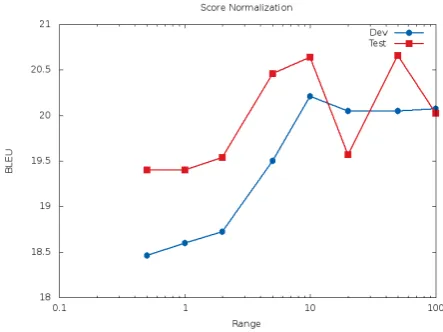
On the German to English translation task, we compared the normalization of the features used in the previous experiments with normalizing the final score as described in Section 4.1. We eval-uated different target feature ranges between 0.5 and 100. The results for these experiments are summarized in Figure 2.
Figure 1: Evolution of the BLEU+1 score mea-sured on the development set as a function of the number of training sentences.
As shown in the graph, if the range of possible scores is too low, no learning is possible. The best performance on the development is reached at a value of ten with 20.21 BLEU points on the de-velopment data and 20.64 on the test data. This is also nearly the best performance on the test data.
In comparison, the feature normalization achieves a BLEU score of 19.95 on the develop-ment data and 20.98 on the test data as shown in Table 1. Although the normalization of the final score can outperform the feature normalization on the development data, the feature normalization performs best on the test data in this task.
6 Conclusion
[image:6.595.308.530.207.375.2]Figure 2: Score normalization
more complex models than the log-linear model used in most machine translation systems.
Using this technique translation quality is im-proved as measured in BLEU scores on large scale translation tasks. Without any additional feature, we improved the BLEU score by 0.8 points and 0.1 points compared to the initial translations. Fur-ther 0.6 BLEU points was gained by using ad-ditional models in the rescoring. The algorithm outperformed the MERT training in all configura-tions and other algorithms in most configuraconfigura-tions. Moreover, experimental results show that our ap-proach is less prone to overfitting which is an im-portant issue of many optimization techniques.
Acknowledgments
The project leading to this application has received funding from the European Union’s Horizon 2020 research and innovation programme under grant agreement n◦ 645452.
References
Z. Cao, T. Qin, T.-Y. Liu, M.-F. Tsai, and H. Li. 2007. Learning to rank: from pairwise approach to listwise
approach. InProceedings of the 24th international
conference on Machine learning, ICML’07, pages 129–136, New York, NY, USA. ACM.
M. Cettolo, J. Niehues, S. Stker, L. Bentivogli, and M. Federico. 2014. Report on the 11th iwslt
eval-uation campaign. InProceedings of the 11th
Inter-national Workshop on Spoken Language Translation (IWSLT 2014), Lake Tahoe, California, USA.
W. Chen, T. Liu, Y. Lan, Z. Ma, and H. Li. 2009. Ranking measures and loss functions in learning to
rank. InAdvances in Neural Information Processing
Systems 22, pages 315–323.
Colin Cherry and George Foster. 2012. Batch tun-ing strategies for statistical machine translation. In
Proceedings of the North American Chapter of the Association for Computational Linguistics: Human Language Technologies (NAACL-HLT), pages 427– 436, Montr´eal, Canada, June.
D. Chiang, Y. Marton, and P. Resnik. 2008. On-line large-margin training of syntactic and structural translation features. InProceedings of the Confer-ence on Empirical Methods in Natural Language Processing (EMNLP 2008), Honolulu, Hawaii, USA.
E. Cho, T. Ha, J. Niehues, T. Herrmann, M. Mediani, Y. Zhang, and A. Waibel. 2015. The karlsruhe in-stitute of technology translation systems for the wmt
2015. InProceedings of the Tenth Workshop on
Sta-tistical Machine Translation (WMT 2015), Lisboa, Portugal.
H. Daum´e III. 2004. Notes on CG and LM-BFGS optimization of logistic regression.
Michael Gutmann and Aapo Hyv¨arinen. 2010. Noise-contrastive estimation: A new estimation principle for unnormalized statistical models. In Yeh Whye
Teh and Mike Titterington, editors, Proceedings
of th International Conference on Artificial Intel-ligence and Statistics (AISTATS), volume 9, pages 297–304.
X. He and L. Deng. 2012. Maximum expected bleu training of phrase and lexicon translation models. In
Proceedings of the 50th Annual Meeting of the As-sociation for Computational Linguistics(ACL 2012), pages 292–301, Jeju, Korea.
Teresa Herrmann. 2015.Linguistic Structure in Statis-tical Machine Translation. Ph.D. thesis, Karlsruhe Institute of Technology.
M. Hopkins and J. May. 2011. Tuning as ranking. In
In Proceedings of the 2011 Conference on Empirical Methods in Natural Language Processing.
P. Koehn, H. Hoang, A. Birch, C. Callison-Burch, M. Federico, N. Bertoldi, B. Cowan, W. Shen, C. Moran, R. Zens, C. Dyer, O. Bojar, A. Constantin, and E. Herbst. 2007. Moses: Open source toolkit for statistical machine translation. InProceedings of the 45th Annual Meeting of the Association for Com-putational Linguistics (ACL 2007), Prague, Czech Republic.
Hai-Son Le, Alexandre Allauzen, and Franc¸ois Yvon. 2012. Continuous space translation models with
neural networks. In Proceedings of the North
American Chapter of the Association for Computa-tional Linguistics: Human Language Technologies (NAACL-HLT), pages 39–48, Montr´eal, Canada, June. Association for Computational Linguistics. P. Liang, A. Bouchard-Cˆot´e, D. Klein, and B. Taskar.
2006. An end-to-end discriminative approach to ma-chine translation. InProceedings of the 44th Annual Meeting of the Association for Computational Lin-guistics (ACL 2006), pages 761–768, Sydney, Aus-tralia.
L. Liu, T. Watanabe, E. Sumita, and T. Zhao. 2013. Additive neural networks for statistical machine translation. InProceedings of the 51st Annual Meet-ing of the Association for Computational LMeet-inguistics (ACL 2013), Sofia, Bulgaria, Bulgaria.
Andriy Mnih and Yeh Whye Teh. 2012. A fast and simple algorithm for training neural probabilistic
language models. In Proceedings of the
Interna-tional Conference of Machine Learning (ICML). J. Niehues and A. Waibel. 2012. Continuous space
language models using restricted boltzmann
ma-chines. In Proceedings of the Ninth International
Workshop on Spoken Language Translation (IWSLT 2012), Hong Kong.
F.J. Och. 2003. Minimum error rate training in sta-tistical machine translation. In Proceedings of the 41th Annual Meeting of the Association for Compu-tational Linguistics (ACL 2003), Sapporo, Japan. K. Papineni, S. Roukos, T. Ward, and W.-jing Zhu.
2002. Bleu: a method for automatic evaluation of machine translation. InProceedings of the 40th An-nual Meeting of the Association for Computational Linguistics (ACL 2002), pages 311–318, Philadel-phia, Pennsylvania.
A.-V.I. Rosti, B. Zhang, S. Matsoukas, and
R. Schwartz. 2011. Expected bleu training
for graphs: Bbn system description for wmt11
system combination task. In Proceedings of the
Sixth Workshop on Statistical Machine Translation (WMT 2011), pages 159–165, Edinburgh, UK. I. Slawik, M. Mediani, J. Niehues, Y. Zhang, E. Cho,
T. Herrmann, T. Ha, and A. Waibel. 2014. The kit
translation systems for iwslt 2014. InProceedings
of the 11th International Workshop on Spoken Lan-guage Translation (IWSLT 2014), Lake Tahoe, USA. T. Watanabe, J. Suzuki, H. Tsukada, and H. Isozaki. 2007. Online large-margin training for statistical
machine translation. In Proceedings of the