Chapter 3b
Realizing Just-in-Time Personalization – A
Technology Overview
Owen Conlan, Cormac Hampson, Kevin Koidl, Stefan
Göbel, Florian Mehn
Introduction
Digital Game-based Learning (DGBL) strives to maintain a balance between learning effectiveness and the inherent motivational experi-ence of playing a game. The main challenges lie in ensuring the learning offered is embedded in the gameplay in such a way that it does not interrupt the flow of the gaming experience. This may be achieved by tightly integrating the gaming environment with the educational mate-rial, but such tight coupling leads to poor reusability as the gameplay, story narrative and learning material are difficult to separate. In 80Days the responsibilities for gameplay, storytelling and learning are separated into three engines that interoperate to deliver a cohesive learning ex-perience through a compelling gaming setting.
The learning offered in 80Days is tailored to the learner’s individual skills and needs. This form of dynamic personalization presents several technological challenges, such as implicitly acquiring information about the learner, cooperating with the story engine to ensure the narrative evolves to accommodate appropriate learning objectives and perform-ing adaptations in a timely and consistent manner.
This chapter focuses on the operation of the Learning Engine, specifi-cally how it models learners and make adaptive recommendations to the Game Engine. The chapter also discusses the interoperation be-tween the Learning Engine and Story Engine to ensure the game meets the needs of the learner.
ensuring that the pedagogical premise of the educational elements of the game and the gameplay elements are sufficiently intertwined to present a holistic experience. A common failing of Digital Game-based Learning has been the lack of integration of these elements. This often leads to a fractured experience for the learner with the educational elements appearing as dull interludes in the otherwise exciting game. Simply combining traditional technology enhanced learning techniques with a game does not automatically produce a motivational learning experience. The flow of experience is often interrupted by the learning material, which appears to be flat and non-interactive when compared with the gaming experience. However, there is a compelling reason for combining games and learning and it stems from the inherent motiva-tion that most games inspire. The learner is driven to complete the game by the feeling of satisfaction that comes with successfully master-ing the in-game challenges. Every computer game exhibits some form of learning activity, albeit quite informal. For example, a player must learn the controls of the game, details of the game setting and how to interact successfully with non-player characters (NPCs). As these skills are learned as part of the gameplay and are integral to success in the game, players are willing to invest time in learning them. The vision for successful Digital Game-based Learning is that the educational skills learned through the game should be seen as just as integral to success-fully completing the game.
Assuming that an appropriately compelling means can be found to integrate the educational skills and game skills, there exists a fundamen-tal problem – no two learners have exactly the same needs or prior learning experience. ELearning typically suffers from high dropout rates. This is for a variety of reasons, but the material not meeting the learner’s needs and their lack of motivation rate highly for not complet-ing a course. If appropriately combincomplet-ing eLearncomplet-ing material with an engaging computer game helps to resolve the motivation issue, then how can the material not meeting the needs of the learner be ad-dressed?
to a sound theoretical foundation, adaptive education requires quite demanding technological realizations of theories and models. Over the past number of years, a variety of intelligent and adaptive educational systems have been introduced. To date, these systems have focused largely on adaptively ordering and presenting learning tasks.
Intelligent, adaptive, and personalized tutoring systems were developed by different researchers; a detailed review on such technologies was published by Brusilovsky (1999), general reference frameworks are described, for example, by De Bra (1999) or Albert and Mori (2001). Techniques of adaptation and individualisation are primarily adaptive presentation, adaptive navigation support, and adaptive problem solv-ing. In the framework of the ELEKTRA project (Kickmeier-Rust et al, 2006) a new terminology was introduced because game-based ap-proaches to learning are substantially different to traditional eLearning approaches The new concepts, which are tailored to learning environ-ments with large degrees of freedom, are adaptivity on macro and mi-cro levels (Kickmeier-Rust & Albert, 2010; Kickmeier-Rust et al., 2007). Macro-adaptivity refers to traditional techniques of adaptation such as adaptive presentation and adaptive navigation on the level of learning objects (or learning situations in a DGBL). Generally, macro-adaptive interventions are based on a fixed learner model (e.g. traits) or adapta-tion model (e.g. pedagogical implicaadapta-tions) and on typical (knowledge) assessments (via test items). Micro-adaptive interventions, on the other hand, are non-invasive (meaning that an overall narrative is not com-promised) and affect the presentation of a specific learning object or learning situation.
occurs within the various learning situations as opposed to around them. Micro-adaptivity creates challenges of its own due to the nature of the experience of game play, and the impact that game world changes can have on a player’s experience.
Micro-adaptation allows the details of a learning situation to be tailored to the specific needs of a learner. Macro-adaptation allows the sequence of learning situations to be reordered and more learning situations added to accommodate more learning objectives. This form of adapta-tion requires close coordinaadapta-tion with the storytelling elements of the game to ensure the story remains coherent. Both of these forms of adaptation may be performed dynamically as part of the game. The macro-adaptation tends to happen on a slightly longer time frame as the need for more or fewer learning objectives emerges. The micro-adaptation happens rapidly as the learner interacts with the game. In both forms the information about the learner and their needs must be inferred through observing their behaviour and interaction with the game. Interrupting the game to explicitly query the learner about their needs would break the immersion of the game and disrupt its flow. There are a number of technical challenges that must be addressed in order to introduce micro- and macro-adaptation into DGBL –
1. The modeling of the learner must be implicit and time effi-cient. It should be possible to model several facets of the learner, such as their knowledge, gameplay skills and motiva-tion in a timely manner.
2. Micro-adaptation should be able to personalize a learning situa-tion to meet the needs of a learner. These adaptasitua-tions again should be timely and consistent with the story elements of that situation.
3. Macro-adaptation should able to introduce more learning ob-jectives into the game in order to meet the learner’s evolving needs. The introduction of these learning objectives may re-quire the modification of the storyline to ensure a contiguous narrative experience.
learner. The danger is that immersion may be broken and the flow of experience disrupted.
Introducing the Story Engine and Learning Engine
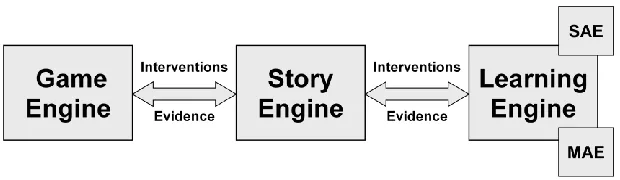
In order to ensure that consistency is not compromised the compo-nents responsible for the learning and storytelling need to work in tan-dem. In 80Days the components responsible are the Learning Engine (LE) and Story Engine (SE), respectively. They are separately imple-mented and maintained logic engines that operate within their respec-tive remits. However, it is important that they cooperate closely to ensure this consistency is maintained. Broadly speaking the Story En-gine is responsible for ensuring the sequence of learning situations chosen produces a sensible storyline. The Learning Engine is responsi-ble for the micro- and macro-adaptation decisions that pertain to learn-ing. These may impact the sequencing of learning situations when it is determined that more learning objectives are required. The LE has two main areas in which it performs adaptations – skills and motivation. Skills relate to learning outcomes that may be gained by the learner through a learning situation. Motivation relates to the degree of immer-sion and involvement experienced by the user whilst learning and play-ing through the game.Figure 3b-1. Simplified 80Days Architecture
In 80Days the effectiveness of the different engines were assessed in two demonstrators. The first, known as Lizard, was developed through several iterations and was evaluated in authentic learning settings. Its primary focus was to assess the appropriateness of the micro-adaptations offered through a compelling and appealing game. The second demonstrator, know as Bat Cave, was a technical tool used to assess the potential of macro-adaptation to adapt to the changing needs of a learner by adding additional learning objectives to a game. This tool was assessed by validating that the additional learning situations added to cover these learning objectives remained consistent to the storyline being presented. Lizard involved integration of all three main engines, Game, Story and Learning, whilst Bat Cave focused predomi-nantly on the latter two.
The Four-Stage Approach to Just-in-Time
Personalization
The nature of the game evidence sent from the Game Engine (GE) is game specific and consists of player actions, movements, and task suc-cesses or failures. This information however is not immediately useful for educational adaptation, requiring a degree of inference by the Learning Engine (LE). Inference within the LE is the first step in the Four-Stage Approach to Just-in-Time Personalization employed to provide effective non-invasive adaptation. The four stages employed are inference, context accumulation, adaptation constraint, and adapta-tion selecadapta-tion. Further details on the background to the four stage ap-proach are detailed in Peirce 2008.
enabling it to be employed for different games with minimal alteration. A key example of this is the abstraction of skills provided through the Skill Assessment Engine (SAE). The SAE effectively maps user actions within the game to skill evidence, and further generates a probabilistic skill model for the learner. More information on the SAE is detailed in the next section.
The second stage of the adaptation process involves accumulating game and learner evidence. In consideration of the large quantity of evidence accumulated, potentially dozens of items per second, the use of XML based models, a traditional approach in many Adaptive Hypermedia Systems such as APeLS (Conlan, 2004), becomes impractical due to manipulation and reasoning speed. Consequently all data is accumulat-ed in a working memory providaccumulat-ed by the Drools rule engine. The use of the Drools rule engine provides an efficient means to reason over large data sets using declarative logic.
In order to perform adaptation within the GE the LE must have an a priori abstracted understanding of the adaptations possible. Within the LE these adaptations are negotiated with the Story Engine (SE) and are represented as Adaptive Elements. An Adaptive Element consists of an identifier which represents the corresponding skill and type of interven-tion such as “B2337_CE” (B2337 being the skill identifier and CE be-ing the identifier for the intervention type). Based on these identifiers the SE can decide which dialog should be rendered in the game engine. An example Adaptive Element in the 80 Days would be the Non Player Character (NPC) Feon giving a cognitive hint such as, “Okay, that’s Budapest – the capital of Hungary.”
The following are the benefits of using Adaptive Elements:
Educational adaptation does not need to be concerned with re-alizing adaptations
Facilitates the independent authoring of the game engine and the adaptation logic
of adaptation is achieved through adaptation rules that examine the accumulated learner data and the available Adaptive Elements.
The Skill Assessment Engine
Knowledge Space Theory (KST), introduced by Doignon and Fal-magne (Doignon 1985), provides a theoretical framework within which the knowledge or skill state of a learner can be determined. It is based on a prerequisite skill structure that describes the relationships between different skills. For example, a learner should typically be able multiply whole numbers before they can multiply decimal numbers. If the learner exhibits evidence of being able to multiply decimal numbers it may be assumed that they can also multiply whole numbers. Such probabilistic reasoning enables a system to infer a learner’s skill state based on partial evidence (Conlan 2006).
The fundamental approach taken in KST is to reduce the number of possible pieces of evidence needed about a learner to an optimal set. In this way the Knowledge State of a learner may be assessed through the minimum number of inferences, thus achieving maximum efficiency. This is only possible by examining the domain in which the learning is occurring and identifying the underlying prerequisite relationships that exist between concepts. This is a time consuming and expert task that involves describing a learning domain, such as mathematics, in terms of formal prerequisite relationships.
Specific educational tasks, such as the learner interacting with a virtual experiment, are broken down into specific sub-tasks. Success or failure in these sub-tasks forms evidence that facilitates the probabilistic up-date of the learner’s model. The certainty is dependent on the level of inference required. However, as only partial evidence is needed to as-sess a skill state it can be done very efficiently. When applied to DEGs KST has the potential to provide the basis of a time sensitive approach to modeling a learner’s acquisition of knowledge and skills [].
skills must be done in an implicit fashion so as not to negatively impact their flow through the game.
The domain specific skills to be acquired in the 80Days game were organized according to KST into a prerequisite knowledge structure, which was represented as a binary matrix and then parsed by the SAE at design time. The resultant skills file was then loaded into the run-time component of the SAE. Previously the SAE was limited to work-ing with modestly sized knowledge structures due to scalability issues with the initial algorithm implemented. This meant that in the ELEKTRA game (Peirce 2008) the SAE was limited to a knowledge structure of just 25 skills. However in the 80Days game a more effi-cient simplified updating algorithm was developed and incorporated into the SAE. This meant that knowledge structures of much larger sizes could now be updated efficiently at runtime, with the 80Days game containing a knowledge structure of 156 skills. Furthermore, the current version of the SAE can accommodate knowledge structures much larger than this if required.
During the game, the user faces various learning challenges, with spe-cific educational rules triggered depending on their interactions with learning objects, such as maps and flood prevention simulators. Learn-ing objects are traditionally seen as static pieces of content, usually HTML, with associated metadata. In 80Days a learning object is an interactive experience that is woven into the game narrative. Each learning object has skills associated with it, thus if a rule relating to a learning object is fired through a learner’s interaction with the game, the SAE runs its algorithm to determine which skills have increased or decreased in probability.
If a user is performing badly at a specific task then the associated skills will have their probabilities decreased in the SAE. If these probabilities drop below a specified threshold then a related intervention may be triggered in the game (typically through NPC dialogue or in-game dis-play) to help the user overcome this task and acquire the relevant knowledge. Likewise if a user is performing well at a task, the associ-ated skill probabilities are increased within the SAE. If these probabili-ties exceed a pre-determined value, the user is then deemed to have acquired these skills.
GE is not noticeable to the user. For the purposes of the work presented here, below 200ms is the definition of Just-in-Time. The adjustment in skill probabilities is taken into account in stage two of the four stage approach to Just-in-Time Personalization, where all evidence from the game and user is accumulated. Thus any change in skill probabilities has influence over which adaptive interventions are eventually presented to the user within the game environment.
The Motivation Assessment Engine
As illustrated in the previous section the assessment of the learner’s skills during the runtime of the 80 Days game is essential for the Learn-ing Engine (LE) to recommend appropriate cognitive interventions to assist the learner. This selection of interventions is based on the in-ferred skill state or knowledge of the learner. In addition to the cogni-tive assessment within the LE, 80Days supports the assessment of motivational aspects also. This functionality required the development of a separate engine to sit alongside the Skill Assessment Engine (SAE) called the Motivation Assessment Engine (MAE). The MAE recom-mends motivational interventions as it assesses the learner’s attention and confidence. Similar to the SAE, both of the motivational aspects, attention and confidence are managed in a probabilistic model.
or from a driven pace to a hectic pace. The result of a change in the game pace could be the introduction of time limits, or specifically in 80 Days, the introduction of additional UFO’s within the game that apply pressure to achieve the mission goals as fast as possible.
To conclude, the MAE uses three different types of evidence to assess the motivational aspects of the learner. First, the time between different actions within specific learning situations such as changing the flight direction of the UFO after receiving a cognitive hint or remaining idle for a specific time frame. Second, the amount of skill updates leading to a probability decrease of at least one skill. Finally, the update history of the motivational aspects can lead to a change in game pace.
Personalizing the Story
Story Description Language - ICML
In order to describe interactive stories and Storytelling-based applica-tion scenarios, much research has been invested into the development of the ICML format (INSCAPE Markup Language). ICML was devel-oped within the INSCAPE project (Balet, 2007), has successfully been used in other projects and was further advanced for Story-based DEG’s in 80Days.
The global aim of ICML is to provide not only a standardized and comprehensive description language for a specific storytelling frame-work, but also a good basis for a standard for any Interactive Storytel-ling applications in general. Used as the underlying data format for the Storytelling platform/framework, ICML describes the entire structure of the story in a declarative way. In its first version (ICML V1.0), each ICML document was separated into three top-level nodes, which dis-tinguish different levels of narrative structures and their building primi-tives: Content, story and strategies.
The content node contains a global listing of logical content elements which are part of the story. The mapping to their physical source (e.g. image URL) is done by the framework. Each content element node includes a type description (sound, image, 3d model, etc.), the actions (‘play’, ’walk to’, ’talk’, etc.) and properties.
contains references to all content elements which are part of the scene and their size, position, etc. in that specific scene. In contrast, the ac-tion set node contains the high level story logic expressed as condi-tion/action rules.
The strategies node contains a list of strategies. A strategy tells the sys-tem about corrective actions to be taken in case of a specific perform-ance situation. In other words: it is a rule-base for triggering some methods that may influence the story flow at any point in time during the entire performance of the story
A strategy is comparable to an action set, with the difference that it describes global, story wide rules and doesn’t refer to a particular scene. The strategies concept has been introduced within INSCAPEs’ Story Pacing research topic whose main purpose was to guarantee a fluent and suspenseful experience in the performance of a highly interactive story by assigning the author certain control over time conditions and duration.
Story Engine
The Story Engine is responsible for executing and performing the in-teractive stories. The Narration Controller (Story Engine) forms the core of the overall runtime system. It interprets the created stories en-coded in ICML described above and executes them by building an executable story graph out of it. During runtime, the graph is traversed by following the transitions from scene to scene – being evaluated at each step of the Narration Controller’s main loop. If a transition is executed, the Narration Controller is responsible for informing the Player component (the Game Engine in the 80Days approach) about a change of the current scene. On the other side, the Player has to inform the Narration Controller about user events (game evidence from the GE), which has to be processed by the Narration Controller and/or directly passed to the Learning Engine (LE). Taking into account these user events, the Narration Controller traverses the action set for every scene, evaluates the conditions and informs the Player/GE about the actions to be executed.
Narra-tion Controller to find the ‘best’ next state and to decide which scene is loaded next.
Hence, the key challenge is to find a fair balance between the initially created story and the ‘exceptions’ caused by user interactions (unfoseen or at least not intended by the author). As an example in the re-mainder of this section, a tour through a museum is used. In this case, examples for such exceptions are wrong paths (not following the in-structions of a virtual guide), skipped stations (passing artefacts without interacting), too long or short interactions at artefacts (causing prob-lems with external and internal time constraints), etc. The following list provides some of the rules, ordered by priority:
1. External time constraints have the first priority. In the reference example of a story-driven museum tour for young visitors (each pupil explores the museum on his own; no guided tour in a group) the typical period of a museum visit represents a good example of such a fixed external time constraint. A teacher is unlikely to just say ‘let’s enjoy the interactive tour, walk around and explore the world of dinosaurs by yourself’, but rather add constraints such as ‘let’s meet all together in 1h at the same place’).
2. Dramaturgic aspects and story models. Correlating to the charac-teristics and the rules-of-thumb story models and narrative struc-tures, plot points should be set at specific times, introductionary explanations shouldn’t take too much time, the story climax shouldn’t be acquired too early, etc.
Cooperation between the Story Engine and Learning Engine
The communication between the Story Engine (SE) and Learning En-gine (LE) is bi-directional. To help support this communication the SE sends a specific ID together with a parameter as a message to the LE. Based on the ID and the parameter, the LE can determine the Learning Situation, Learning Action and in appropriate cases the success or fail-ure of the Learning Action. The received information is then used to perform updates in both the Skill Assessment Engine (SAE) and Moti-vational Assessment Engine (MAE). If specific skill probabilities or motivational probabilities, such as attention and confidence, reach a predefined threshold, the LE sends a message with an ID and parame-ter relating to a recommendation. The SE then receives this message and determines the exact dialog match from the recommendation sent by the LE. This avoids the possibility that the same dialogue is dis-played twice to the learner. After the SE has sent the selected recom-mendation dialogue to the GE the LE is informed about which dia-logue was selected. This information is used for a further probability update on the related skill (as the user will have received a hint relating to the skill), although this specific update will not prompt the sending of a further recommendation.
It is important to note that this communication has to be very fast in order to provide the appropriate recommendation at the right time. The flying mission within the 80 Days game is one example in which a recommendation which arrives too late could be confusing to the learner. For example if the learner is flying in the wrong direction for a specific time period the LE will issue a recommendation. However if the recommendation arrives too late the learner may have already cor-rected the flight direction which would mean the recommendation would be incorrect.
Meeting the Challenges of Game-based Learning
This chapter has introduced three main technical challenges of Digital Game-based learning, namely implicitly modeling the learner; providing detailed micro-adaptations to adjust individual learning situations; and offering macro-adaptation that can adjust the number of learning situa-tions in order to introduce more learning objectives. Across these chal-lenges timeliness and consistency must be adhered to. In other words, everything presented to the learner must remain coherent, flow natu-rally and be offered without any slow down in the gaming experience. The Learning Engine has been discussed as the component of 80Days that is responsible for meeting these challenges. It achieves these by cooperating with the Story and Game Engines. Specifically, the coop-eration with the Story Engine must ensure that macro-adaptation is performed in a manner consistent with the storyline being told.Modeling the learner is divided into two sub-components of the Learn-ing Engine – the Skill and Motivation Assessment Engines. The chap-ter has described how these engines operate in order to dechap-termine in-formation about the learner in a timely manner. Moreover, it has dis-cussed the four-stage process that takes this modeled information and recommends appropriate adaptive interventions to be rendered to the user in the Game Engine.
References
Albert, D. & Mori, T. (2001). Contributions of cognitive psychology to the future of e-learning. Bulletin of the Graduate School of Educa-tion, Hiroshima University, Part I (Learning and Curriculum De-velopment), 50, 25-34.
Brusilovsky, P. (1999) Adaptive and Intelligent Technologies for Web-based Education. In C. Rollinger and C. Peylo (eds.), Special Issue on Intelligent Systems and Teleteaching, Künstliche Intelligenz, 4, 19-25.
eLearning service based on the multi-model, metadata-driven ap-proach,” in Lecture Notes in Computer Science in proceedings of the Third International Conference on Adaptive Hypermedia and Adaptive Web-Based Systems, Springer, Eindhoven,The Nether-lands, pp. 291 - 295. Retrieved August 12, 2009, from http://www.tara.tcd.ie/handle/2262/22608
Conlan, O., Hampson, C., O'Keeffe, I., Heller, J. (2006). Using Knowledge Space Theory to support Learner Modeling and Personalization, World Conference on E- Learning in Corporate, Government, Healthcare, and Higher Education, Hawaii, USA. De Bra, P. (1999). Design Issues in Adaptive Hypermedia Application
Development, Proceedings of the Second Workshop on Adaptive Systems and User Modeling on the World Wide Web, pp. 29-39, Toronto and Banff, Canada, 1999. (Editors P. Brusilovsky and P. De Bra, available as CSN 99/07, TUE, or at http://wwwis.win.tue.nl/asum99/.)
Doignon, J.-P., and Falmagne, J.-C. (1985). Spaces for the assessment of knowledge. International Journal of Man-Machine Studies, 23, 175-196.
Kickmeier-Rust, M., Schwarz, D., Albert, D., Verpoorten, D. & Cas-taigne, J. (2006) “M.: The ELEKTRA project: Towards a new learning experience,” in M3 – Interdisciplinary aspects on digital media & education, Vienna: Österreichische Computer Gesell-schaft,
Kickmeier-Rust, M., Peirce, N., Conlan, O., Schwarz, D. et al. (2007) “Immersive Digital Games: The Interfaces for Next-Generation E-Learning?,” in C Stephanidis (eds), Universal Access in Hu-man-Computer Interaction. Applications and Services, Lecture Notes in Computer Science, Springer Berlin Heidelberg, Berlin, Heidelberg, pp. 647–656. Retrieved from http://dx.doi.org/10.1007/978-3-540-73283-9_71
Kickmeier-Rust, M & Albert, D. (2010) “Micro-adaptivity: protecting immersion in didactically adaptive digital educational games.” Journal of Computer Assisted Learning, vol. 26, no. 2, pp. 95-105. MacKenzie, I.S. and Colin, W. (1993). "Lag as a determinant of human