LIMSI @ WMT’13
Alexandre Allauzen1,2, Nicolas P´echeux1,2, Quoc Khanh Do1,2, Marco Dinarelli2, Thomas Lavergne1,2,Aur´elien Max1,2,Hai-Son Le3,Franc¸ois Yvon1,2
Univ. Paris-Sud1and LIMSI-CNRS2
rue John von Neumann, 91403 Orsay cedex, France
{firstname.lastname}@limsi.fr
Vietnamese Academy of Science and Technology3, Hanoi, Vietnam [email protected]
Abstract
This paper describes LIMSI’s submis-sions to the shared WMT’13 translation task. We report results for French-English, German-English and Spanish-English in
both directions. Our submissions use
n-code, an open source system based on bilingual n-grams, and continuous space
models in a post-processing step. The main novelties of this year’s participation are the following: our first participation to the Spanish-English task; experiments with source pre-ordering; a tighter integra-tion of continuous space language mod-els using artificial text generation (for Ger-man); and the use of different tuning sets according to the original language of the text to be translated.
1 Introduction
This paper describes LIMSI’s submissions to the shared translation task of the Eighth Workshop on Statistical Machine Translation. LIMSI partici-pated in the French-English, German-English and Spanish-English tasks in both directions. For this evaluation, we used n-code, an open source
in-house Statistical Machine Translation (SMT) sys-tem based on bilingualn-grams1, and continuous
space models in a post-processing step, both for translation and target language modeling.
This paper is organized as follows. Section 2 contains an overview of the baseline systems built withn-code, including the continuous space
mod-els. As in our previous participations, several steps of data pre-processing, cleaning and filter-ing are applied, and their improvement took a non-negligible part of our work. These steps are sum-marized in Section 3. The rest of the paper is de-voted to the novelties of the systems submitted this
1http://ncode.limsi.fr/
year. Section 4 describes the system developed for our first participation to the Spanish-English trans-lation task in both directions. To translate from German into English, the impact of source pre-ordering is investigated, and experimental results are reported in Section 5, while for the reverse di-rection, we explored a text sampling strategy us-ing a10-gram SOUL model to allow a tighter
in-tegration of continuous space models during the translation process (see Section 6). A final section discusses the main lessons of this study.
2 System overview
n-code implements the bilingualn-gram approach
to SMT (Casacuberta and Vidal, 2004; Mari˜no et al., 2006; Crego and Mari˜no, 2006). In this framework, translation is divided in two steps: a source reordering step and a (monotonic) transla-tion step. Source reordering is based on a set of learned rewrite rules that non-deterministically re-order the input words. Applying these rules result in a finite-state graph of possible source reorder-ings, which is then searched for the best possible candidate translation.
2.1 Features
Given a source sentence s of I words, the best
translation hypothesisˆtis defined as the sequence
ofJwords that maximizes a linear combination of
feature functions:
ˆt= arg max t,a
( M X
m=1
λmhm(a,s,t) )
(1)
where λm is the weight associated with feature
functionhmandadenotes an alignment between
source and target phrases. Among the feature functions, the peculiar form of the translation model constitutes one of the main difference be-tween the n-gram approach and standard
phrase-based systems.
In addition to the translation model (TM), four-teen feature functions are combined: a target-language model; fourlexicon models; six lexical-ized reordering models(Tillmann, 2004; Crego et al., 2011) aimed at predicting the orientation of the next translation unit; a “weak” distance-based distortion model; and finally aword-bonus model and atuple-bonus modelwhich compensate for the system preference for short translations. The four lexicon modelsare similar to the ones used in stan-dard phrase-based systems: two scores correspond to the relative frequencies of the tuples and two lexical weights are estimated from the automatic word alignments. The weight vector λis learned
using the Minimum Error Rate Training frame-work (MERT) (Och, 2003) and BLEU (Papineni et al., 2002) measured onnt09(newstest2009) as the optimization criteria.
2.2 Translation Inference
During decoding, source sentences are represented in the form of word lattices containing the most promising reordering hypotheses, so as to repro-duce the word order modifications introrepro-duced dur-ing the tuple extraction process. Hence, only those reordering hypotheses are translated and are intro-duced using a set of reordering rules automatically learned from the word alignments. Part-of-speech (POS) information is used to increase the gen-eralization power of these rules. Hence, rewrite rules are built using POS, rather than surface word forms (Crego and Mari˜no, 2006).
2.3 SOUL rescoring
Neural networks, working on top of conventional
n-gram back-off language models (BOLMs), have
been introduced in (Bengio et al., 2003; Schwenk et al., 2006) as a potential means to improve dis-crete language models (LMs). As for our last year participation (Le et al., 2012c), we take advantage of the recent proposal of Le et al. (2011). Using a specific neural network architecture (the Struc-tured OUtput Layeror SOUL model), it becomes possible to estimaten-gram models that use large
vocabulary, thereby making the training of large neural network LMs (NNLMs) feasible both for target language models and translation models (Le et al., 2012a). We use the same models as last year, meaning that the SOUL rescoring was used for all systems, except for translating into Spanish. See section 6 and (Le et al., 2012c) for more details.
3 Corpora and data pre-processing
Concerning data pre-processing, we started from our submissions from last year (Le et al., 2012c) and mainly upgraded the corpora and the associ-ated language-dependent pre-processing routines. We used in-house text processing tools for the to-kenization and detoto-kenization steps (D´echelotte et al., 2008). Previous experiments have demon-strated that better normalization tools provide bet-ter BLEU scores: all systems are thus built using the “true-case” scheme.
As German is morphologically more complex than English, the default policy which consists in treating each word form independently is plagued with data sparsity, which severely impacts both training (alignment) and decoding (due to un-known forms). When translating from German into English, the German side is thus normalized using a specific pre-processing scheme (Allauzen et al., 2010; Durgar El-Kahlout and Yvon, 2010) which aims at reducing the lexical redundancy by (i) normalizing the orthography, (ii) neutralizing most inflections and (iii) splitting complex com-pounds. All parallel corpora were POS-tagged with the TreeTagger (Schmid, 1994); in addition, for German, fine-grained POS labels were also needed for pre-processing and were obtained us-ing the RFTagger (Schmid and Laws, 2008).
For Spanish, all the availaible data are tokenized using FreeLing2 toolkit (Padr´o and Stanilovsky,
2012), with default settings and some added rules. Sentence splitting and morphological analysis are disabled except for del → de el and al → a el.
Moreover, a simple “true-caser” based on upper-case word frequency is used, and the specific Spanish punctuation signs ”¿” and ”¡” are removed and heuristically reintroduced in a post-processing step. All Spanish texts are POS-tagged also using Freeling. The EAGLES tag set is however sim-plified by truncating the category label to the first two symbols, in order to reduce the sparsity of the reordering rules estimated byn-code.
For the CommonCrawl corpus, we found that many sentences are not in the expected language. For example, in the French side of the French-English version, most of the first sentences are in English. Therefore, foreign sentence pairs are filtered out with a MaxEnt classifier that usesn
-grams of characters as features (n is between 1
and 4). This filter discards approximatively 10%
of the sentence pairs. Moreover, we also observe that a lot of sentence pairs are not translation of each other. Therefore, an extra sentence alignment step is carried out using an in-house implementa-tion of the tool described in (Moore, 2002). This last step discards approximately 20% of the cor-pus. For the Spanish-English task, the same filter-ing is applied to all the available corpora.
4 System development for the Spanish-English task
This is our first participation to the Spanish-English translation task in both directions. This section provides details about the development of
n-code systems for this language pair.
4.1 Data selection and filtering
The CommonCrawl and UN corpora can be con-sidered as very noisy and out-of-domain. As de-scribed in (Allauzen et al., 2011), to select a subset of parallel sentences, trigram LMs were trained for both Spanish and English languages on a subset of the available News data: the Spanish (resp. glish) LM was used to rank the Spanish (resp. En-glish) side of the corpus, and only those sentences with perplexity above a given threshold were se-lected. Finally, the two selected sets were in-tersected. In the following experiments, the fil-tered versions of these corpora are used to train the translation systems unless explicitly stated.
4.2 Spanish language model
To train the language models, we assumed that the test set would consist in a selection of recent news texts and all the available monolingual data for Spanish were used, including the Spanish Giga-word, Third Edition. A vocabulary is first defined by including all tokens observed in the News-Commentary and Europarl corpora. This vocab-ulary is then expanded with all words that occur more than 10 times in the recent news texts (LDC-2007-2011 and news-crawl-2011-2012). This pro-cedure results in a vocabulary containing 372k words. Then, the training data are divided into 7 sets based on dates or genres. On each set, a standard 4-gram LM is estimated from the vocab-ulary using absolute discounting interpolated with lower order models (Kneser and Ney, 1995; Chen and Goodman, 1998). The resulting LMs are then linearly interpolated using coefficients chosen so
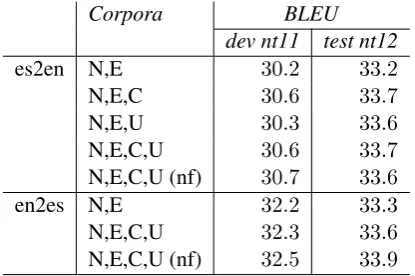
Corpora BLEU
dev nt11 test nt12
es2en N,E 30.2 33.2
N,E,C 30.6 33.7
N,E,U 30.3 33.6
N,E,C,U 30.6 33.7
N,E,C,U (nf) 30.7 33.6
en2es N,E 32.2 33.3
N,E,C,U 32.3 33.6
[image:3.595.313.521.62.200.2]N,E,C,U (nf) 32.5 33.9
Table 1: BLEU scores achieved with different sets of parallel corpora. All systems are base-linen-code with POS factor models. The
follow-ing shorthands are used to denote corpora, : ”N” stands for News-Commentary, ”E” for Europarl, ”C” for CommonCrawl, ”U” for UN and (nf) for non filtered corpora.
as to minimise the perplexity evaluated on the de-velopment set (nt08).
4.3 Experiments
All reported results are averaged on 3 MERT runs. Table 1 shows the BLEU scores obtained with dif-ferent corpora setups. We can observe that us-ing the CommonCrawl corpus improves the per-formances in both directions, while the impact of the UN data is less important, especially when combined with CommonCrawl. The filtering strat-egy described in Section 4.2 has a slightly posi-tive impact of +0.1 BLEU point for the Spanish-to-English direction but yields a 0.2 BLEU point decrease in the opposite direction.
For the following experiments, all the available corpora are therefore used: News-Commentary, Europarl, filtered CommonCrawl and UN. For each of these corpora, a bilingual n-gram model
is estimated and used byn-code as one individual model score. An additionnal TM is trained on the concatenation all these corpora, resulting in a to-tal of 5 TMs. Moreover,n-code is able to handle additional “factored” bilingual models where the source side words are replaced by the correspond-ing lemma or even POS tag (Koehn and Hoang, 2007). Table 2 reports the scores obtained with different settings.
In Table 2, big denotes the use of a wider
context for n-gram TMs (n = 4,5,4 instead
of3,4,3respectively for word-based, POS-based
Condition BLEU dev nt11 test nt12
es2en base 30.3 33.5
pos 30.6 33.7
big-pos 30.7 33.7
big-pos-lem 30.7 33.8
en2es base 32.0 33.4
pos 32.3 33.6
big-pos 32.3 33.8
[image:4.595.336.498.62.106.2]big-pos-pos+ 32.2 33.4
Table 2: BLEU scores for different configuration of factored translation models. Thebigprefix de-notes experiments with the larger context for n
-gram translation models.
models yields a significant BLEU improvement, as well as using a wider context forn-gram TMs.
Since Spanish is morphologically richer than En-glish, lemmas are introduced only on the Span-ish side. An additionnal BLEU improvement is achieved by adding factored models based on lem-mas when translating from Spanish to English, while in the opposite direction it does not seem to have any clear impact.
For English to Spanish, we also experimented with a 5-gram target factored model, using the whole morphosyntactic EAGLES tagset, (pos+in Table 2), to add some syntactic information, but this, in fact, proved harmful.
As several tuning sets were available, experi-ments were carried out with the concatenation of nt09tont11as a tuning data set. This yields an im-provement between 0.1 and 0.3 BLEU point when testing on nt12when translating from Spanish to English.
4.4 Submitted systems
For both directions, the submitted systems are trained on all the available training data, the cor-pora CommonCrawl and UN being filtered as de-scribed previously. A word-based TM and a POS factored TM are estimated for each training set. To translate from Spanish to English, the system is tuned on the concatenation of the nt09tont11 datasets with an additionnal4-gram lemma-based
factored model, while in the opposite direction, we only usent11.
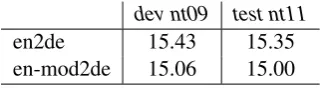
dev nt09 test nt11
en2de 15.43 15.35
[image:4.595.79.285.62.199.2]en-mod2de 15.06 15.00
Table 3: BLEU scores for pre-ordering experi-ments with an-code system and the approach pro-posed by (Neubig et al., 2012)
5 Source pre-ordering for English to German translation
While distorsion models can efficiently handle short range reorderings, they are inadequate to capture long-range reorderings, especially for lan-guage pairs that differ significantly in their syn-tax. A promising workaround is the source pre-ordering method that can be considered similar, to some extent, to the reordering strategy imple-mented inn-code; the main difference is that the
latter uses one deterministic (long-range) reorder-ing on top of conventional distortion-based mod-els, while the former only considers one single model delivering permutation lattices. The pre-ordering approach is illustrated by the recent work of Neubig et al. (2012), where the authors use a discriminatively trained ITG parser to infer a sin-gle permutation of the source sentence.
In this section, we investigate the use of this pre-ordering model in conjunction with the bilin-gualn-gram approach for translating English into
German (see (Collins et al., 2005) for similar ex-periments with the reverse translation direction). Experiments are carried out with the same settings as described in (Neubig et al., 2012): given the source side of the parallel data (en), the parser is estimated to modify the original word order and to generate a new source side (en-mod); then a SMT system is built for the new language pair (en-mod
→de). The same reordering model is used to re-order the test set, which is then translated with the en-mod→desystem.
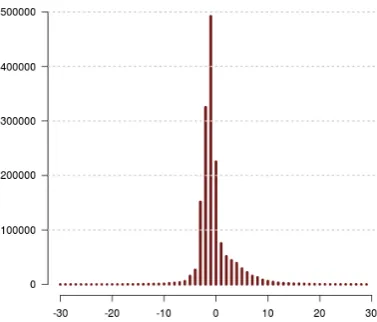
occur-Figure 1: Histogram of token movement size ver-sus its occurrences performed by the model Neu-bigon the source english data.
rences), which can be already taken into account by the standard reordering model of the baseline system. This is reflected also by the following statistics: surprisingly, only16% of the total
num-ber of sentences are changed by the pre-ordering model, and the average sentence-wise Kendall’sτ
and the average displacement of these small parts of modified sentences are, respectively,0.027and 3.5. These numbers are striking for two reasons: first, English and German have in general quite different word order, thus our experimental con-dition should be somehow similar to the English-Japanese scenario studied in (Neubig et al., 2012); second, since the model is able to perform pre-ordering basically at any distance, it is surprising that a large part of the data remains unmodified.
6 Artificial Text generation with SOUL
While the context size for BOLMs is limited (usu-ally up to 4-grams) because of sparsity issues,
NNLMs can efficiently handle larger contexts up to10-grams without a prohibitive increase of the
overall number of parameters (see for instance the study in (Le et al., 2012b)). However the major bottleneck of NNLMs is the computation cost dur-ing both traindur-ing and inference. In fact, the pro-hibitive inference time usually implies to resort to a two-pass approach: the first pass uses a conven-tional BOLM to produce ak-best list (thekmost
likely translations); in the second pass, the prob-ability of a NNLM is computed for each hypoth-esis, which is then added as a new feature before thek-best list is reranked. Note that to produce the k-best list, the decoder uses a beam search strategy
to prune the search space. Crucially, this pruning does not use the NNLMs scores and results in po-tentially sub-optimalk-best-lists.
6.1 Sampling texts with SOUL
In language modeling, a language is represented by a corpus that is approximated by a n-gram
model. Following (Sutskever et al., 2011; Deoras et al., 2013), we propose an additionnal approxi-mation to allow a tighter integration of the NNLM: a10-gram NNLM is first estimated on the training
corpus; texts then are sampled from this model to create an artificial training corpus; finally, this arti-ficial corpus is approximated by a4-gram BOLM.
The training procedure for the SOUL NNLM is the same as the one described in (Le et al., 2012c). To sample a sentence from the SOUL model, first the sentence length is randomly drawn from the empirical distribution, then each word of the sen-tence is sampled from the10-gram distribution
es-timated with the SOUL model.
The convergence of this sampling strategy can be evaluated by monitoring the perplexity evolu-tion vs. the number of sentences that are gener-ated. Figure 2 depicts this evolution by measuring perplexity on thent08set with a step size of 400M sampled sentences. The baseline BOLM (std) is estimated on all the available training data that consist of approximately 300M of running words. We can observe that the perplexity of the BOLM estimated on sampled texts (generated texts) de-creases when the number of sample sentences in-creases, and tends to reach slowly the perplex-ity of the baseline BOLM. Moreover, when both BOLMs are interpolated, an even lower perplex-ity is obtained, which further decreases with the amount of sampled training texts.
6.2 Translation results
[image:5.595.73.262.62.223.2]190 200 210 220 230 240 250 260 270 280
2 4 6 8 10 12
ppx
[image:6.595.77.283.62.184.2]times 400M sampled sentences artificial texts artificial texts+std std
Figure 2: Perplexity measured on nt08 with the baseline LM (std), with the LM estimated on the sampled texts (generated texts), and with the inter-polation of both.
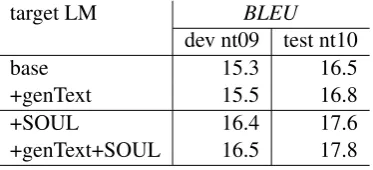
Therefore, to translate from English to German, the submitted system includes three BOLMs: one trained on all the monolingual data, one on artifi-cial texts and a third one that uses the freely avail-abledeWackcorpus3(1.7 billion words).
target LM BLEU
dev nt09 test nt10
base 15.3 16.5
+genText 15.5 16.8
+SOUL 16.4 17.6
[image:6.595.322.506.62.172.2]+genText+SOUL 16.5 17.8
Table 4: Impact of the use of sampled texts.
7 Different tunings for different original languages
As shown by Lembersky et al. (2012), the original language of a text can have a significant impact on translation performance. In this section, this effect is assessed on the French to English translation task. Training one SMT system per original lan-guage is impractical, since the required informa-tion is not available for most of parallel corpora. However, metadata provided by the WMT evalua-tion allows us to split the development and test sets according to the original language of the text. To ensure a sufficient amount of texts for each con-dition, we used the concatenation of newstest cor-pora for the years 2008, 2009, 2011, and 2012, leavingnt10for testing purposes.
Five different development sets have been cre-ated to tune five different systems. Experimental results are reported in Table 7 and show a drastic
3http://wacky.sslmit.unibo.it/doku.php
baseline adapted
original language tuning
cz 22.31 23.83
en 36.41 39.21
fr 31.61 32.41
de 18.46 18.49
es 30.17 29.34
all 29.43 30.12
Table 5: BLEU scores for the French-to-English translation task measured on nt10 with systems tuned on development sets selected according to their original language (adapted tuning).
improvement in terms of BLEU score when trans-lating back to the original English and a significant increase for original text in Czech and French. In this year’s evaluation, Russian was introduced as a new language, so for sentences originally in this language, the baseline system was used. This sys-tem is used as our primary submission to the eval-uation, with additional SOUL rescoring step.
8 Conclusion
In this paper, we have described our submis-sions to the translation task of WMT’13 for the French-English, German-English and Spanish-English language pairs. Similarly to last year’s systems, our main submissions use n-code, and
continuous space models are introduced in a post-processing step, both for translation and target lan-guage modeling. To translate from English to German, we showed a slight improvement with a tighter integration of the continuous space lan-guage model using a text sampling strategy. Ex-periments with pre-ordering were disappointing, and the reasons for this failure need to be better understood. We also explored the impact of using different tuning sets according to the original lan-guage of the text to be translated. Even though the gain vanishes when adding the SOUL model in a post-processing step, it should be noted that due to time limitation this second step was not tuned ac-cordingly to the original language. We therefore plan to assess the impact of using different tuning sets on the post-processing step.
Acknowledgments
[image:6.595.89.276.355.440.2]References
Alexandre Allauzen, Josep M. Crego, ˙Ilknur Durgar El-Kahlout, and Franc¸ois Yvon. 2010. LIMSI’s statis-tical translation systems for WMT’10. InProc. of the Joint Workshop on Statistical Machine Transla-tion and MetricsMATR, pages 54–59, Uppsala, Swe-den.
Alexandre Allauzen, Gilles Adda, H´el`ene Bonneau-Maynard, Josep M. Crego, Hai-Son Le, Aur´elien Max, Adrien Lardilleux, Thomas Lavergne, Artem Sokolov, Guillaume Wisniewski, and Franc¸ois Yvon. 2011. LIMSI @ WMT11. InProceedings of the Sixth Workshop on Statistical Machine Transla-tion, pages 309–315, Edinburgh, Scotland, July. As-sociation for Computational Linguistics.
Yoshua Bengio, R´ejean Ducharme, Pascal Vincent, and Christian Janvin. 2003. A neural probabilistic lan-guage model.JMLR, 3:1137–1155.
Francesco Casacuberta and Enrique Vidal. 2004. Ma-chine translation with inferred stochastic finite-state transducers. Computational Linguistics, 30(3):205– 225.
Stanley F. Chen and Joshua T. Goodman. 1998. An empirical study of smoothing techniques for lan-guage modeling. Technical Report TR-10-98, Com-puter Science Group, Harvard Un iversity.
Michael Collins, Philipp Koehn, and Ivona Kucerova. 2005. Clause restructuring for statistical machine translation. In Proceedings of the 43rd Annual Meeting of the Association for Computational Lin-guistics (ACL’05), pages 531–540, Ann Arbor, Michigan.
Josep M. Crego and Jos´e B. Mari˜no. 2006. Improving statistical MT by coupling reordering and decoding. Machine Translation, 20(3):199–215.
Josep M. Crego, Franois Yvon, and Jos B. Mari˜no. 2011. N-code: an open-source Bilingual N-gram SMT Toolkit. Prague Bulletin of Mathematical Lin-guistics, 96:49–58.
Daniel D´echelotte, Gilles Adda, Alexandre Allauzen, Olivier Galibert, Jean-Luc Gauvain, Hlne Maynard, and Franois Yvon. 2008. LIMSI’s statistical translation systems for WMT’08. In Proc. of the NAACL-HTL Statistical Machine Translation Work-shop, Columbus, Ohio.
Anoop Deoras, Tom´aˇs Mikolov, Stefan Kombrink, and Kenneth Church. 2013. Approximate inference: A sampling based modeling technique to capture com-plex dependencies in a language model. Speech Communication, 55(1):162 – 177.
Ilknur Durgar El-Kahlout and Franois Yvon. 2010. The pay-offs of preprocessing for German-English
Statistical Machine Translation. In Marcello Ferico, Ian Lane, Michael Paul, and Franois Yvon, ed-itors,Proceedings of the seventh International Work-shop on Spoken Language Translation (IWSLT), pages 251–258.
Reinhard Kneser and Herman Ney. 1995. Improved backing-off for m-gram language modeling. In Pro-ceedings of the International Conference on Acous-tics, Speech, and Signal Processing, ICASSP’95, pages 181–184, Detroit, MI.
Philipp Koehn and Hieu Hoang. 2007. Factored trans-lation models. In Proceedings of the 2007 Joint Conference on Empirical Methods in Natural guage Processing and Computational Natural Lan-guage Learning (EMNLP-CoNLL), pages 868–876.
Hai-Son Le, Ilya Oparin, Alexandre Allauzen, Jean-Luc Gauvain, and Franc¸ois Yvon. 2011. Structured output layer neural network language model. In Pro-ceedings of ICASSP’11, pages 5524–5527.
Hai-Son Le, Alexandre Allauzen, and Franc¸ois Yvon. 2012a. Continuous space translation models with neural networks. In NAACL ’12: Proceedings of the 2012 Conference of the North American Chap-ter of the Association for Computational Linguistics on Human Language Technology.
Hai-Son Le, Alexandre Allauzen, and Franc¸ois Yvon. 2012b. Measuring the influence of long range de-pendencies with neural network language models. InProceedings of the NAACL-HLT 2012 Workshop: Will We Ever Really Replace the N-gram Model? On the Future of Language Modeling for HLT, pages 1– 10, Montr´eal, Canada.
Hai-Son Le, Thomas Lavergne, Alexandre Al-lauzen, Marianna Apidianaki, Li Gong, Aur´elien Max, Artem Sokolov, Guillaume Wisniewski, and Franc¸ois Yvon. 2012c. Limsi @ wmt12. In Proceedings of the Seventh Workshop on Statisti-cal Machine Translation, pages 330–337, Montr´eal, Canada.
Gennadi Lembersky, Noam Ordan, and Shuly Wint-ner. 2012. Language models for machine trans-lation: Original vs. translated texts. Comput. Lin-guist., 38(4):799–825, December.
Jos´e B. Mari˜no, Rafael E. Banchs, Josep M. Crego, Adri`a de Gispert, Patrick Lambert, Jos´e A.R. Fonol-losa, and Marta R. Costa-Juss`a. 2006. N-gram-based machine translation. Computational Linguis-tics, 32(4):527–549.
Graham Neubig, Taro Watanabe, and Shinsuke Mori. 2012. Inducing a discriminative parser to optimize machine translation reordering. In Proceedings of the 2012 Joint Conference on Empirical Methods in Natural Language Processing and Computational Natural Language Learning, pages 843–853, Jeju Island, Korea, July. Association for Computational Linguistics.
Franz Josef Och. 2003. Minimum error rate training in statistical machine translation. InACL ’03: Proc. of the 41st Annual Meeting on Association for Compu-tational Linguistics, pages 160–167.
Llu´ıs Padr´o and Evgeny Stanilovsky. 2012. Freeling 3.0: Towards wider multilinguality. InProceedings of the Language Resources and Evaluation Confer-ence (LREC 2012), Istanbul, Turkey, May. ELRA.
Kishore Papineni, Salim Roukos, Todd Ward, and Wei-Jing Zhu. 2002. BLEU: a method for automatic evaluation of machine translation. In ACL ’02: Proc. of the 40th Annual Meeting on Association for Computational Linguistics, pages 311–318. Associ-ation for ComputAssoci-ational Linguistics.
Helmut Schmid and Florian Laws. 2008. Estima-tion of condiEstima-tional probabilities with decision trees and an application to fine-grained POS tagging. In Proceedings of the 22nd International Conference on Computational Linguistics (Coling 2008), pages 777–784, Manchester, UK, August.
Helmut Schmid. 1994. Probabilistic part-of-speech tagging using decision trees. In Proc. of Interna-tional Conference on New Methods in Language Processing, pages 44–49, Manchester, UK.
Holger Schwenk, Daniel D´echelotte, and Jean-Luc Gauvain. 2006. Continuous space language models for statistical machine translation. In Proc. COL-ING/ACL’06, pages 723–730.
Ilya Sutskever, James Martens, and Geoffrey Hinton. 2011. Generating text with recurrent neural net-works. In Lise Getoor and Tobias Scheffer, editors, Proceedings of the 28th International Conference on Machine Learning (ICML-11), ICML ’11, pages 1017–1024, New York, NY, USA, June. ACM.