Syntax and Semantics in Quality Estimation of Machine Translation
Rasoul Kaljahi†‡, Jennifer Foster†, Johann Roturier‡ †NCLT, School of Computing, Dublin City University, Ireland
{rkaljahi, jfoster}@computing.dcu.ie ‡Symantec Research Labs, Dublin, Ireland {johann roturier}@symantec.com
Abstract
We employ syntactic and semantic infor-mation in estimating the quality of ma-chine translation from a new data set which contains source text from English customer support forums and target text consisting of its machine translation into French. These translations have been both post-edited and evaluated by professional translators. We find that quality estima-tion using syntactic and semantic informa-tion on this data set can hardly improve over a baseline which uses only surface features. However, the performance can be improved when they are combined with such surface features. We also introduce a novel metric to measure translation ade-quacy based on predicate-argument struc-ture match using word alignments. While word alignments can be reliably used, the two main factors affecting the per-formance of all semantic-based methods seems to be the low quality of seman-tic role labelling (especially on ill-formed text) and the lack of nominal predicate an-notation.
1 Introduction
The problem of evaluating machine translation output without reference translations is called quality estimation (QE) and has recently been the centre of attention (Bojar et al., 2014) following the seminal work of Blatz et al. (2003). Most QE studies have focused on surface and language-model-based features of the source and target. The quality of translation is however closely related to the syntax and semantics of the languages, the for-mer concerning fluency and the latter adequacy.
While there have been some attempts to utilize syntax in this task, semantics has been paid less
attention. In this work, we aim to exploit both syntax and semantics in QE, with a particular fo-cus on the latter. We use shallow semantic analy-sis obtained via semantic role labelling (SRL) and employ this information in QE in various ways in-cluding statistical learning using both tree kernels and hand-crafted features. We also design a QE metric which is based on the Predicate-Argument structure Match (PAM) between the source and its translation. The semantic-based system is then combined with the syntax-based system to evalu-ate the full power of structural linguistic informa-tion. We also combine this system with a baseline system consisting of effective surface features.
A second contribution of the paper is the release of a new data set for QE.1This data set comprises
a set of 4.5K sentences chosen from customer sup-port forum text. The machine translation of the sentences are not only evaluated in terms of ade-quacy and fluency, but also manually post-edited allowing various metrics of interest to be applied to measure different aspects of quality. All exper-iments are carried out on this data set.
The rest of the paper is organized as follows: after reviewing the related work, the data is de-scribed and the semantic role labelling approach is explained. The baseline is then introduced, fol-lowed by the experiments with tree kernels, hand-crafted features, the PAM metric and finally the combination of all methods. The paper ends with a summary and suggestions for future work. 2 Related Work
Syntax has been exploited in QE in various ways including tree kernels (Hardmeier et al., 2012; Kaljahi et al., 2013; Kaljahi et al., 2014b), parse probabilities and syntactic label frequency (Avramidis, 2012), parseability (Quirk, 2004) and POS n-gram scores (Specia and Gim´enez, 2010).
1The data will be made publicly available - seehttp://
www.computing.dcu.ie/mt/confidentmt.html
Turning to the role of semantic knowledge in QE and MT evaluation in general, Pighin and M`arquez (2011) propose a method for ranking two translation hypotheses that exploits the projection of SRL from a sentence to its translation using word alignments. They first project the SRL of a source corpus to its parallel corpus and then build two translation models: 1) translations of proposi-tion labelling sequences in the source to its projec-tion in the target and 2) translaprojec-tions of argument role fillers in the source to their counterparts in the target. The source SRL is then projected to its machine translation and the above models are forced to translate source proposition labelling se-quences to the projected ones. Finally the confi-dence scores of these translations and their reach-ability are used to train a classifier which selects the better of the two translation hypotheses with an accuracy of 64%. Factors hindering their clas-sifier are word alignment limitations and low SRL recall due to the lack of a verb or the loss of a predicate during translation.
In MT evaluation, where reference translations are available, Gim´enez and M`arquez (2007) use semantic roles in building several MT evaluation metrics which measure the full or partial lexical match between the fillers of same semantic roles in the hypothesis and translation, or simply the role label matches between them. They conclude that these features can only be useful in combination with other features and metrics reflecting different aspects of the quality.
Lo and Wu (2011) introduce HMEANT, a man-ual MT evaluation metric based on predicate-argument structure matching which involves two steps of human engagement: 1) semantic role an-notation of the reference and machine translation, 2) evaluating the translation of predicates and ar-guments. The metric calculates the F1 score of
the semantic frame match between the reference and machine translation based on this evaluation. To keep the costs reasonable, the first step is car-ried out by amateur annotators who were mini-mally trained with a simplified list of 10 thematic roles. On a set of 40 examples, the metric is meta-evaluated in terms of correlation with human judgements of translation adequacy ranking, and a correlation as high as that of HTER is reported.
Lo et al. (2012) propose MEANT, a variant of HMEANT, which automatizes its manual steps using 1) automatic SRL systems for (only) verb
predicates, 2) automatic alignment of predicates and their arguments in the reference and ma-chine translation based on their lexical similarity. Once the predicates and arguments are aligned, their similarities are measured using a variety of methods such as cosine distance and even Me-teor and BLEU. In computation of the final score, the similarity scores replace the counts of correct and partial translations used in HMEANT. This metric outperforms several automatic metrics in-cluding BLEU, Meteor and TER, but it signifi-cantly under-performs HMEANT and HTER. Fur-ther analysis shows that automatizing the second step does not affect the performance of MEANT. Therefore, it seems to be the lower accuracy of the semantic role labelling that is responsible.
Bojar and Wu (2012) identify a set of flaws with HMEANT and propose solutions for them. The most important problems stem from the su-perficial SRL annotation guidelines. These prob-lems are exacerbated in MEANT due to the auto-matic nature of the two steps. More recently, Lo et al. (2014) extend MEANT to ranking tions without a reference by using phrase transla-tion probabilities for aligning semantic role fillers of the source and its translation.
3 Data
We randomly select 4500 segments from a large collection of Symantec English Norton forum text.2 In order to be independent of any one MT
system, we translate these segments into French with the following three systems and randomly choose 1500 distinct segments from each.
• ACCEPT3: a phrase-based Moses system
trained on training sets of WMT12 releases of Europarl and News Commentary plus Symantec translation memories
• SYSTRAN: a proprietary rule-based system augmented with domain-specific dictionaries
• Bing4: an online translation system
These translations are evaluated in two ways. The first method involves light post-editing by a professional human translator who is a native
2http://community.norton.com
3http://www.accept.unige.ch/Products/
D_4_1_Baseline_MT_systems.pdf
4
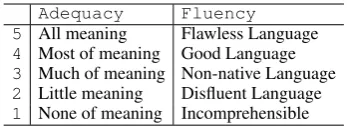
Adequacy Fluency 5 All meaning Flawless Language
4 Most of meaning Good Language
3 Much of meaning Non-native Language
2 Little meaning Disfluent Language
[image:3.595.94.268.61.124.2]1 None of meaning Incomprehensible
Table 2: Adequacy/fluency score interpretation
French speaker.5 Each sentence translation is then
scored against its post-edit usingBLEU6(Papineni
et al., 2002), TER (Snover et al., 2006) and
METEOR(Denkowski and Lavie, 2011), which are the most widely used MT evaluation metrics. Fol-lowing Snover et al. (2006), we consider this way of scoring MT output to be a variation of human-targeted scoring, where no reference translation is provided to the post-editor, so we call them
HBLEU,HTERandHMETEOR. The average scores for the entire data set together with their standard deviations are presented in Table 1.7
In the second method, we asked three profes-sional translators, who are again native French speakers, to assess the quality of MT output in terms of adequacy and fluency in a 5-grade scale (LDC, 2002). The interpretation of the scores is given in Table 2. Each evaluator was given the entire data set for evaluation. We therefore col-lected three sets of scores and averaged them to obtain the final scores. The averages of these scores for the entire data set together with their standard deviations are presented in Table 1. To be easily comparable to human-targeted scores, we scale these scores to the [0,1] range, i.e. ad-equacy/fluency scores of 1 and 5 are mapped to 0 and 1 respectively and all the scores in between are accordingly scaled.
The average Kappa inter-annotator agreement for adequacy scores is 0.25 and for fluency scores 0.19. However, this measurement does not dif-ferentiate between small and large differences in agreement. In other words, the difference between
5The post-editing guidelines are based on the
TAUS/CNGL guidelines for achieving “good enough” quality downloaded from https://evaluation. taus.net/images/stories/guidelines/taus- cngl-machine-translation-postediting-guidelines.pdf.
6Version 13a of MTEval script was used at the segment
level which performs smoothing.
7Note thatHTERscores have no upper limit and can be
higher than 1 when the number of errors is higher than the segment length. In addition, the higherHTERindicates lower translation quality. To be comparable to the other scores, we cut-off them at 1 and convert to1-HTER.
1-HTER HBLEU HMeteor Adq Flu
1-HTER - - - -
-HBLEU 0.9111 - - -
-HMeteor 0.9207 0.9314 - -
-Adq 0.6632 0.7049 0.6843 -
-Flu 0.6447 0.7213 0.6652 0.8824
-Table 3: Pearsonrbetween pairs of metrics on the entire 4.5K data set
scores of 5 and 4 is the same as the difference between 5 and 2. To account for this, we use weighted Kappa instead. Specifically, we consider two scores of difference 1 to represent 75% agree-ment instead of 100%. All the other differences are considered to be a disagreement. The aver-age weighted Kappa computed in this way is 0.65 for adequacy and 0.63 for fluency. Though the weighting used is quite strict, the weighted Kappa values are in the substantial agreement range.
Once we have both human-targeted and manual evaluation scores together, it is interesting to know how they are correlated. We calculate the Pearson correlation coefficientrbetween each pair of the five scores and present them in Table 3. HBLEU
has the highest correlation with both adequacy and fluency scores among the human-targeted metrics.
HTER on the other hand has the lowest correla-tion. Moreover, HBLEU is more correlated with fluency than with adequacy which is the opposite to HMeteor. This is expected according to the definition of BLEU and Meteor. There is also a high correlation between adequacy and fluency scores. Although this could be related to the fact that both scores are from the same evaluators, it indicates that if either the fluency and adequacy of the MT output is low or high, the other tends to be the same.
The data is split into train, development and test sets of 3000, 500 and 1000 sentences respectively.
4 Semantic Role Labelling
[image:3.595.308.531.62.125.2]1-HTER HBLEU HMeteor Adequacy Fluency
Average 0.6976 0.5517 0.7221 0.6230 0.4096
Standard Deviation 0.2446 0.2927 0.2129 0.2488 0.2780
Table 1: Average and standard deviation of the evaluation scores for the entire data set
this respect mainly due to a lack of such resources. The only available gold standard resource is a small set of 1000 sentences taken from Europarl (Koehn, 2005) and manually annotated with Prop-bank verb predicates (van der Plas et al., 2010). van der Plas et al. (2011) attempt to tackle this scarcity by automatically projecting SRL from the English side of a large parallel corpus to its French side. Our preliminary experiments (Kaljahi et al., 2014a), however, show that SRL models trained on the small manually annotated corpus have a higher quality than ones trained on the much larger projected corpus. We therefore use the 1K gold standard set to train a French SRL model. For En-glish, we use all the data provided in the CoNLL 2009 shared task (Hajiˇc et al., 2009).
We use LTH (Bj¨orkelund et al., 2009), a dependency-based SRL system, for both the En-glish and French data. This system was among the best performing systems in the CoNLL 2009 shared task and is straightforward to use. It comes with a set of features tuned for each shared task language (English, German, Japanese, Spanish, Catalan, Czech, Chinese). We compared the per-formance of the English and Spanish feature sets on French and chose the former due to its higher performance (by 1 F1point).
It should be noted that the English SRL data come with gold standard syntactic annotation. On the other hand, for our QE data set, such anno-tation is not available. Our preliminary experi-ments show that, since the SRL system heavily relies on syntactic features, the performance con-siderably drops when the syntactic annotation of the test data is obtained using a different parser than that of the training data. We therefore re-place the parses of the training data with those ob-tained automatically by first parsing the data us-ing the Lorg PCFG-LA parser8(Attia et al., 2010)
and then converting them to dependencies using
Stanfordconverter (de Marneffe and Manning, 2008). The POS tags are also replaced with those output by the parser. For the same reason, we
re-8
https://github.com/CNGLdlab/LORG-Release.
place the original POS tagging of the French 1K data with those obtained by the MElt tagger (De-nis and Sagot, 2012).
The English SRL achieves 77.77 and 67.02 la-belled F1 points when trained only on the training
section of PropBank and tested on the WSJ and Brown test sets respectively.9 The French SRL is
evaluated using 5-fold cross-validation on the 1K data set and obtains an F1average of 67.66. When
applied to the QE data set, these models identify 9133, 8875 and 8795 propositions on its source side, post-edits and MT output respectively.
5 Baseline
We compare the results of our experiments to a baseline built using the 17 baseline features of the WMT QE shared task (Bojar et al., 2014). These features provide a strong baseline and have been used in all three years of the shared task. We use support vector regression implemented in the
SVMLighttoolkit10 with Radial Basis Function
(RBF) kernel to build this baseline. To extract these features, a parallel English-French corpus is required to build a lexical translation table us-ing GIZA++ (Och and Ney, 2003). We use the Europarl English-French parallel corpus (Koehn, 2005) plus around 1M segments of Symantec translation memory.
Table 4 shows the performance of this system (WMT17) on the test set measured by Root Mean Square Error (RMSE) and Pearson correlation co-efficient (r). We only report the results on predict-ing four of the metrics introduced above, omittpredict-ing
HMeteordue to space constraints. C andγ pa-rameters are tuned on the development set with re-spect tor. The results show a significant differ-ence between manual and human-targeted metric prediction. The higherrfor the former suggests that the patterns of these scores are easier to learn. The RMSE seems to follow the standard deviation
9Although the English SRL data are annotated for noun
predicates as well as verb predicates, since the French data has only verb predicate annotations, we only consider verb predicates for English.
of the scores as the same ranking is seen in both. 6 Tree Kernels
Tree kernels (Moschitti, 2006) have been success-fully used in QE by Hardmeier et al. (2012) and in our previous work (Kaljahi et al., 2013; Kal-jahi et al., 2014b), where syntactic trees are em-ployed. Tree kernels eliminate the burden of man-ual feature engineering by efficiently utilizing all subtrees of a tree. We employ both syntactic and semantic information in learning quality scores, using the SVMLight-TK11, a support vector
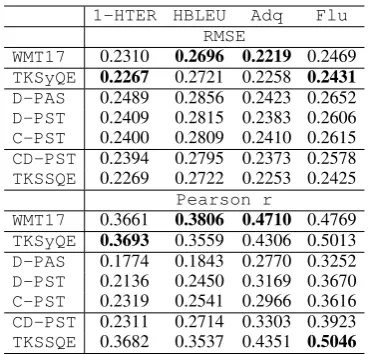
ma-chine (SVM) implementation of tree kernels. We implement a syntactic tree kernel QE sys-tem with constituency and dependency trees of the source and target side, following our previous work (Kaljahi et al., 2013; Kaljahi et al., 2014b). The performance of this system (TKSyQE) is shown in Table 4. Unlike our previous results, where the syntax-based system significantly out-performed theWMT17baseline,TKSyQEcan only beat the baseline in HTER and fluency prediction, with neither difference being statistically signifi-cant and it is below the baseline for HBLEU and adequacy prediction.12 It should be noted that in
our previous work, a WMT News data set was used as the QE data set which, unlike our new data set, is well-formed and in the same domain as the parsers’ training data. The discrepancy between our new and old results suggests that the perfor-mance is strongly dependent on the data set.
Unlike syntactic parsing, semantic role la-belling does not produce a tree to be directly used in the tree kernel framework. There can be var-ious ways to accomplish this goal. We first try a method inspired by thePAS format introduced by Moschitti et al. (2006). In this format, a fixed number of nodes are gathered under a dummy root node as slots of one predicate and 6 arguments of a proposition (one tree per predicate). Each node dominates an argument label or a dummy label for the predicate, which in turn dominates the POS tag of the argument or the predicate lemma. If a proposition has more than 6 arguments they are ignored, if it has fewer than 6 arguments, the extra slots are attached to a dummy null label. Note that these trees are derived from the dependency-based SRL of both the source and target side (Figure
11
http://disi.unitn.it/moschitti/Tree-Kernel.htm
12We use paired bootstrap resampling Koehn (2004) for
statistical significance testing.
1-HTER HBLEU Adq Flu
RMSE
WMT17 0.2310 0.2696 0.2219 0.2469
TKSyQE 0.2267 0.2721 0.2258 0.2431 D-PAS 0.2489 0.2856 0.2423 0.2652
D-PST 0.2409 0.2815 0.2383 0.2606
C-PST 0.2400 0.2809 0.2410 0.2615
CD-PST 0.2394 0.2795 0.2373 0.2578
TKSSQE 0.2269 0.2722 0.2253 0.2425
Pearson r
WMT17 0.3661 0.3806 0.4710 0.4769
TKSyQE 0.3693 0.3559 0.4306 0.5013
D-PAS 0.1774 0.1843 0.2770 0.3252
D-PST 0.2136 0.2450 0.3169 0.3670
C-PST 0.2319 0.2541 0.2966 0.3616
CD-PST 0.2311 0.2714 0.3303 0.3923
[image:5.595.324.509.60.237.2]TKSSQE 0.3682 0.3537 0.4351 0.5046
Table 4: RMSE and Pearson r of the 17 base-line features (WMT17) and tree kernel systems;
TKSyQE: syntax-based tree kernels, D-PAS: dependency-basedPAS tree kernels of Moschitti et al. (2006), D-PST, C-PST and CD-PST: dependency-based, constituency-based proposi-tion subtree kernels and their combination,
TKSSQE:syntactic-semantic tree kernels
1(a)). The results are shown in Table 4 (D-PAS). The performance is statistically significantly lower than the baseline.13
In order to encode more information in the trees, we propose another format in which proposition subtrees (PST) of the sentence are gathered un-der a dummy root node. A dependency PST (Fig-ure 1(b)) is formed by the predicate label under the root dominating its lemma and all its argu-ments roles. Each of these nodes in turn dominates three nodes: the argument word form (the predi-cate word form for the case of a predipredi-cate lemma), its syntactic dependency relation to its head and its POS tag. We preserve the order of arguments and predicate in the sentence.14 This system is named
D-PSTin Table 4. Tree kernels in this format sig-nificantly outperform D-PAS. However, the per-formance is still far lower than the baseline.
The above formats are based on dependency trees. We try another PST format derived from constituency trees. These PSTs (Figure 1(c)) are the lowest common subtrees spanning the predi-cate node and its argument nodes and are gath-ered under a dummy root node. The argument role
13Note that the only lexical information in this format is
the predicate lemma. We tried replacing the POS tags with argument word forms, which led to a slight degradation.
14This format is chosen among several other variations due
(a)D-PAS (b)D-PST (c)C-PST (d)D-TKSSQE (e)C-TKSSQE
Figure 1: Semantic tree kernel formats for the sentence: Can anyone help?
labels are concatenated with the syntactic non-terminal category of the argument node. Predi-cates are not marked. However, our dependency-based SRL is required to be converted into a based format. While constituency-to-dependency conversion is straightforward us-ing head-findus-ing rules (Surdeanu et al., 2008), the other way around is not. We therefore ap-proximate the conversion using a heuristic we call (D2C).15As shown in Table 4, the system built
us-ing these PSTsC-PSTimproves overD-PSTfor hutargeted metric prediction, but not man-ual metric prediction. However, when they are combined in CD-PST, we can see improvement over the highest scores of both systems, except for HTER prediction for Pearsonr. The fluency prediction improvement is statistically significant. The other changes are not statistically significant.
An alternative approach to formulating seman-tic tree kernels is to augment syntacseman-tic trees with semantic information. We augment the trees in
TKSyQEwith semantic role labels. We attach se-mantic roles to dependency labels of the argument nodes in the dependency trees as in Figure 1(d). For constituency trees, we use the D2C heuristic to elevate roles up the terminal nodes and attach the labels to the syntactic non-terminal category of the node as in Figure 1(e). The performance of the resulting system,TKSSQE, is shown in Ta-ble 4. It substantially outperforms its counterpart,
CD-PST, all differences being statistically signif-icant. However, compared to the plain syntactic tree kernels (TKSyQE), the changes are slight and inconsistent, rendering the augmentation not use-ful. We consider this system to be our
syntactic-15This heuristic (D2C) recursively elevates the argument
role already assigned to a terminal node (based on the dependency-based argument position) to the parent node as long as 1) the argument node is not a root node or is not tagged as aPOS(possessive), 2) the role is not anAM-NEG,
AM-MODorAM-DISadjunct, and 3) the argument does not dominate its predicate’s node or another argument node of the same proposition.
1-HTER HBLEU Adq Flu
RMSE
WMT17 0.2310 0.2696 0.2219 0.2469 HCSyQE 0.2435 0.2797 0.2334 0.2479
HCSeQE 0.2482 0.2868 0.2416 0.2612
Pearson r
WMT17 0.3661 0.3806 0.4710 0.4769 HCSyQE 0.2572 0.3080 0.3961 0.4696
HCSeQE 0.1794 0.1636 0.2972 0.3577
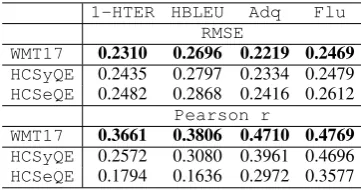
Table 5: RMSE and Pearsonrof the 17 baseline features (WMT17) and hand-crafted features
semantic tree kernel system.
7 Hand-crafted Features
In our previous work (Kaljahi et al., 2014b), we experiment with a set of hand-crafted syntactic features extracted from both constituency and de-pendency trees on a different data set. We apply the same feature set on the new data set here. The results are reported in Table 5. The performance of this system (HCSyQE) is significantly lower than the baseline. This is opposite to what we ob-serve with the same feature set on a different data set, again showing that the role of data is funda-mental in understanding system performance. The main difference between these two data sets is that the former is extracted from a well-formed text in the news domain, the same domain on which our parsers and SRL system have been trained, while the new data set does not necessarily contain well-formed text nor is it from the same domain.
[image:6.595.325.506.200.295.2]se-1 Number of propositions 2 Number of arguments
3 Average number of arguments per proposition 4 Sum of span sizes of arguments
5 Ratio of sum of span sizes of arguments to sentence length
6 Proposition label sequences
7 Constituency label sequences of proposition elements 8 Dependency label sequences of proposition elements 9 Percentage of predicate/argument word alignment
mapping types
Table 6: Semantic feature types
quence (feature type 6) is the concatenation of ar-gument roles and predicate labels of the propo-sition with their preserved order (e.g. A0-go.01-A4). Similarly, constituency and dependency la-bel sequences (feature types 4 and 5) are extracted by replacing argument and predicate labels with their constituency and dependency labels respec-tively. Feature type 9 consists of three features based on word alignment of source and target sentences: number of non-aligned, one-to-many-aligned and many-to-one-one-to-many-aligned predicates and arguments. The word alignments are obtained us-ing the grow-diag-final-and heuristic as they performed slightly better than other types.16
As in the baseline system, we use SVMs to build the QE systems using these hand-crafted features. The nominal features are binarized to be usable by SVM. However, the set of possible feature values can be large, leading to a large number of binary features. For example, there are more than 5000 unique proposition label sequences in our data. Not only does this high dimensionality reduce the efficiency of the system, it can also affect its per-formance as these features are sparse. To tackle this issue, we impose a frequency cutoff on these features: we keep only frequent features using a threshold set empirically on the development set.
Table 5 shows the performance of the system (HCSeQE) built with these features. The semantic features perform substantially lower than the syn-tactic features and thus the baseline, especially in predicting human-targeted scores. Since these fea-tures are chosen from a comprehensive set of se-mantic features, and as they should ideally capture adequacy better than general features, a probable reason for their low performance is the quality of
16It should be noted that a number of features in addition
to those presented here have been tried, e.g. the ratio and dif-ference of the source and target values of numerical features. However, through manual feature selection, we have removed features which do not appear to contribute much.
the underlying syntactic and semantic analysis.
8 Predicate-Argument Match (PAM) Translation adequacy measures how much of the source meaning is preserved in the translated text. Predicate-argument structure or semantic role la-belling expresses a substantial part of the meaning. Therefore, the matching between the predicate-argument structure of the source and its transla-tion could be an important clue to the translatransla-tion adequacy, independent of the language pair used. We attempt to exploit predicate-argument match (PAM) to create a metric that measures the trans-lation adequacy.
The algorithm to compute PAM score starts by aligning the predicates and arguments of the source side to its target side using word align-ments.17 It then treats the problem as one of SRL
scoring, similar to the scoring scheme used in the CoNLL 2009 shared task (Hajiˇc et al., 2009). As-suming the source side SRL as a reference, it com-putes unlabelled precision and recall of the target side SRL with respect to it:
UP rec= ##aligned preds and their argstarget side preds and args
URec= ##aligned preds and their argssource side preds and args
Labelled precision and recall are calculated in the same way except that they also require argu-ment label agreeargu-ment. UF1 andLF1 are the
har-monic means of unlabelled and labelled scores re-spectively. Inspired by the observation that most source sentences with no identified proposition are short and can be assumed to be easier to translate, and based on experiments on the dev set, we assign a score of 1 to such sentences. When no proposi-tion is identified in the target side while there is a proposition in the source, we assign a score of 0.5. We obtain word alignments using the Moses toolkit (Hoang et al., 2009), which can gener-ate alignments in both directions and combine them using a number of heuristics. We try in-tersection, union, source-to-target only, as well as the grow-diag-final-and heuristic, but only the source-to-target results are reported here as they slightly outperform the others.
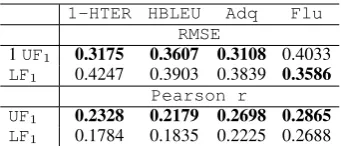
Table 7 shows the RMSE and Pearson r for each of the unlabelled and labelled F1against
ade-17We also tried lexical and phrase translation tables for this
1-HTER HBLEU Adq Flu RMSE
1UF1 0.3175 0.3607 0.3108 0.4033
LF1 0.4247 0.3903 0.3839 0.3586
Pearson r
UF1 0.2328 0.2179 0.2698 0.2865
[image:8.595.96.267.61.134.2]LF1 0.1784 0.1835 0.2225 0.2688
Table 7: RMSE and Pearsonrof PAM unlabelled and labelled F1 scores as estimation of the MT
evaluation metrics
1-HTER HBLEU Adq Flu
RMSE
PAM 0.2414 0.2833 0.2414 0.2661
HCSeQE 0.2482 0.2868 0.2416 0.2612
HCSeQEpam 0.2445 0.2822 0.2370 0.2575
Pearson r
PAM 0.2292 0.2195 0.2787 0.3210
HCSeQE 0.1794 0.1636 0.2972 0.3577
HCSeQEpam 0.2387 0.2368 0.3571 0.3908
Table 8: RMSE and Pearsonrof PAM scores as features, alone and combined (PAM)
quacy and also fluency scores on the test data set.18
According to the results, the unlabelled F1 (UF1)
is a closer estimation than the labelled one. Its Pearson correlation scores are overall competitive to the hand-crafted semantic features (HCSeQEin Table 5): they are better for the automatic metric cases but lower for manual ones. However, the RMSE scores are considerably larger. Overall, the performance is not comparable to the baseline and other well performing systems. We investigate the reasons behind this result in the next section.
Another way to employ the PAM scores in QE is to use them in a statistical framework. We build a SVM model using all 6 PAM scores The per-formance of this system (PAM) on the test set is shown in Table 8. The performance is consider-ably higher than when the PAM scores are used directly as estimations. Interestingly, compared to the 47 semantic hand-crafted features (HCSeQE), this small feature set performs better in predicting human-targeted metrics.
We add these features to our set of hand-crafted features in Section 7 to yield a new sys-tem (HCSeQEpamin Table 8). All scores improve
compared to the stronger of the two components. However, only the manual metric prediction im-provements are statistically significant. The per-formance is still not close to the baseline.
18Precision and recall scores were also tried. Precision
proved to be the weakest estimator, whereas recall scores were highest for some settings.
8.1 Analyzing PAM
Ideally, PAM scores should capture the adequacy of translation with a high accuracy. The results are however far from ideal. There are two fac-tors involved in the PAM scoring procedure, the quality of which can affect its performance: 1) predicate-argument structure of the source and target side of the translation, 2) alignment of predicate-argument structures of source and target. The SRL systems for both English and French are trained on edited newswire. On the other hand, our data is neither from the same domain nor edited. The problem is exacerbated on the trans-lation target side, where our French SRL system is trained on only a small data set and applied to machine translation output. To discover the con-tribution of each of these factors in the accuracy of PAM, we carry out a manual analysis. We ran-domly select 10% of the development set (50 sen-tences) and count the number of problems of each of these two categories.
We find only 8 cases in which a wrong word alignment misleads PAM scoring. On the other hand, there are 219 cases of SRL problems, in-cluding predicate and argument identification and labelling: 82 cases (37%) in the source and 138 cases (63%) in the target.
We additionally look for the cases where a translation divergence causes predicate-argument mismatch in the source and translation. For ex-ample, without sacrificing is translated into sans impact sur(without impact on), a case of transpo-sition, where the source side verb predicate is left unaligned thus affecting the PAM score. We find only 9 such cases in the sample, which is similar to the proportion of word alignment problems.
[image:8.595.81.281.196.292.2]1-HTER HBLEU Adq Flu RMSE
WMT17 0.2310 0.2696 0.2219 0.2469
SyQE 0.2255 0.2711 0.2248 0.2419
SeQE 0.2249 0.2710 0.2242 0.2404
SSQE 0.2246 0.2696 0.2230 0.2402
SSQE+WMT17 0.2225 0.2673 0.2202 0.2379 Pearson r
WMT17 0.3661 0.3806 0.4710 0.4769
SyQE 0.3824 0.3650 0.4393 0.5087
SeQE 0.3884 0.3648 0.4447 0.5182
SSQE 0.3920 0.3768 0.4538 0.5196
[image:9.595.78.282.61.196.2]SSQE+WMT17 0.4144 0.3953 0.4771 0.5331
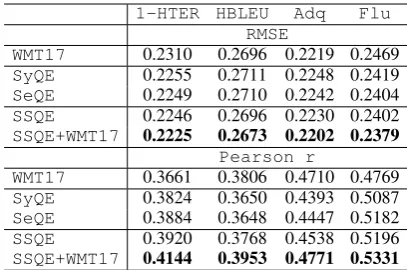
Table 9: RMSE and Pearsonrof the 17 baseline features (WMT17) and system combinations
as predicates in the SRL training data, titles, etc.), and the remaining 2 due to spelling errors mislead-ing the SRL system. Among the target side sen-tences, most of the cases are due to the sentence structure (65 or 68%) and only 14 (15%) cases are caused by an SRL error. In 13 cases, no verb pred-icate in the source is translated correctly. Among the remaining cases, two are due to untranslated spelling errors in the source and the other two due to tokenization errors misleading the SRL system. These numbers show that the main reason lead-ing to the sentences without verbal predicates is the sentence structure. This problem can be al-leviated by employing nominal predicates in both sides. While this is possible for the English side, there is currently no French resource where nomi-nal predicates have been annotated.
9 Combining Systems
We now combine the systems we have built so far (Table 9). We first combine syntax-based and semantic-based systems individually. SyQE
is the combination of the syntactic tree kernel system (TKSyQE) and the hand-crafted features (HCSyQE). Likewise, SeQE is the combination of the semantic tree kernel system (TKSSQE) and the semantic hand-crafted features including PAM features (HCSeQEpam). These two systems are
combined inSSQEbut without syntactic tree ker-nels (TKSyQE) to avoid redundancy withTKSSQE
as these are the augmented syntactic tree kernels. We finally combineSSQEwith the baseline.
SyQE significantly improves over its tree ker-nel and hand-crafted components. It also outper-forms the baseline in HTER and fluency predic-tion, but is beaten by it in HBLEU and adequacy prediction. None of these differences are
statis-tically significant however. SeQE also performs better than the stronger of its components. Except for adequacy prediction, the other improvements are statistically significant. This system performs slightly better than SyQE. Its comparison to the baseline is the same as that ofSyQE, except that its superiority to the baseline in fluency prediction is statistically significant.
The full syntactic-semantic system (SSQE) also improves over its syntactic and semantic compo-nents. However, the improvements are not statisti-cally significant. Compared to the baseline, HTER and fluency prediction perform better, the latter being statistically significant. HBLEU prediction is around the same as the baseline, but adequacy prediction performance is lower, though not statis-tically significantly.
Finally, when we combine the syntactic-semantic system with the baseline system, the combination continues to improve further. Com-pared to the stronger component however, only the HTER and fluency prediction improvements are statistically significant.
10 Conclusion
We introduced a new QE data set drawn from cus-tomer support forum text, machine translated and both post-edited and manually evaluated for ad-equacy and fluency. We used syntactic and se-mantic QE systems via both tree kernels and hand-crafted features. We found it hard to improve over a baseline, albeit strong, using such information which is extracted by applying parsers and seman-tic role labellers on out-of-domain and unedited text. We also defined a metric for estimating the translation adequacy based on predicate-argument structure match between source and target. This metric relies on automatic word alignments and semantic role labelling. We find that word align-ment and translation divergence only have minor effects on the performance of this metric, whereas the quality of semantic role labelling is the main hindering factor. Another major issue affecting the performance of PAM is the unavailability of nom-inal predicate annotation.
Acknowledgments
This research has been supported by the Irish Research Council Enterprise Partnership Scheme (EPSPG/2011/102) and the computing infrastruc-ture of the CNGL at DCU. We thank the reviewers for their helpful comments.
References
Mohammed Attia, Jennifer Foster, Deirdre Hogan, Joseph Le Roux, Lamia Tounsi, and Josef van Gen-abith. 2010. Handling unknown words in statistical latent-variable parsing models for Arabic, English and French. In Proceedings of the 1st Workshop on Statistical Parsing of Morphologically Rich Lan-guages.
Eleftherios Avramidis. 2012. Quality estimation for Machine Translation output using linguistic analysis and decoding features. In Proceedings of the 7th WMT.
Collin F. Baker, Charles J. Fillmore, and John B. Lowe. 1998. The Berkeley Framenet project. In Proceed-ings of the 36th ACL.
Anders Bj¨orkelund, Love Hafdell, and Pierre Nugues. 2009. Multilingual semantic role labeling. In Pro-ceedings of the Thirteenth Conference on Computa-tional Natural Language Learning: Shared Task. John Blatz, Erin Fitzgerald, George Foster, Simona
Gandrabur, Cyril Goutte, Alex Kulesza, Alberto Sanchis, and Nicola Ueffing. 2003. Confidence estimation for Machine Translation. InJHU/CLSP Summer Workshop Final Report.
Ondˇrej Bojar and Dekai Wu. 2012. Towards a predicate-argument evaluation for MT. In Proceed-ings of the Sixth Workshop on Syntax, Semantics and Structure in Statistical Translation.
Ondrej Bojar, Christian Buck, Christian Federmann, Barry Haddow, Philipp Koehn, Johannes Leveling, Christof Monz, Pavel Pecina, Matt Post, Herve Saint-Amand, Radu Soricut, Lucia Specia, and Aleˇs Tamchyna. 2014. Findings of the 2014 workshop on Statistical Machine Translation. InProceedings of the 9th WMT.
Marie-Catherine de Marneffe and Christopher D. Man-ning. 2008. The Stanford typed dependencies representation. In Proceedings of the COLING Workshop on Cross-Framework and Cross-Domain Parser Evaluation.
Pascal Denis and Benoˆıt Sagot. 2012. Coupling an annotated corpus and a lexicon for state-of-the-art pos tagging. Lang. Resour. Eval., 46(4):721–736. Michael Denkowski and Alon Lavie. 2011. Meteor
1.3: Automatic metric for reliable optimization and evaluation of machine translation systems. In Pro-ceedings of the 6th WMT.
Jes´us Gim´enez and Llu´ıs M`arquez. 2007. Linguistic features for automatic evaluation of heterogenous mt systems. InProceedings of the Second Workshop on Statistical Machine Translation.
Jan Hajiˇc, Massimiliano Ciaramita, Richard Johans-son, Daisuke Kawahara, Maria Ant`onia Mart´ı, Llu´ıs M`arquez, Adam Meyers, Joakim Nivre, Sebastian Pad´o, Jan ˇStˇep´anek, Pavel Straˇn´ak, Mihai Surdeanu, Nianwen Xue, and Yi Zhang. 2009. The conll-2009 shared task: Syntactic and semantic dependencies in multiple languages. InProceedings of the Thir-teenth Conference on Computational Natural Lan-guage Learning: Shared Task, pages 1–18.
Christian Hardmeier, Joakim Nivre, and J¨org Tiede-mann. 2012. Tree kernels for machine translation quality estimation. In Proceedings of the Seventh WMT.
Hieu Hoang, Philipp Koehn, and Adam Lopez. 2009. A unified framework for phrase-based, hierarchical, and syntax-based statistical machine translation. In
Proceedings of the International Workshop on Spo-ken Language Translation (IWSLT).
Rasoul Kaljahi, Jennifer Foster, Raphael Rubino, Jo-hann Roturier, and Fred Hollowood. 2013. Parser accuracy in quality estimation of machine transla-tion: a tree kernel approach. InInternational Joint Conference on Natural Language Processing (IJC-NLP).
Rasoul Kaljahi, Jennifer Foster, and Johann Roturier. 2014a. Semantic role labelling with minimal re-sources: Experiments with french. In Third Joint Conference on Lexical and Computational Seman-tics (*SEM).
Rasoul Kaljahi, Jennifer Foster, Raphael Rubino, and Johann Roturier. 2014b. Quality estimation of english-french machine translation: A detailed study of the role of syntax. InInternational Conference on Computational Linguistics (COLING).
Philipp Koehn. 2004. Statistical significance tests for machine translation evaluation. In Proceedings of EMNLP.
Philipp Koehn. 2005. Europarl: A Parallel Corpus for Statistical Machine Translation. InConference Pro-ceedings: the tenth Machine Translation Summit. LDC. 2002. Linguistic data annotation specification:
Assessment of fluency and adequacy in chinese-english translations. Technical report.
Chi-kiu Lo and Dekai Wu. 2011. Meant: An inex-pensive, high-accuracy, semi-automatic metric for evaluating translation utility via semantic frames. In
Proceedings of the 49th Annual Meeting of the Asso-ciation for Computational Linguistics: Human Lan-guage Technologies - Volume 1.
Chi-kiu Lo, Anand Karthik Tumuluru, and Dekai Wu. 2012. Fully automatic semantic mt evaluation. In
Chi-kiu Lo, Meriem Beloucif, Markus Saers, and Dekai Wu. 2014. Xmeant: Better semantic mt eval-uation without reference translations. In Proceed-ings of the 52nd Annual Meeting of the Association for Computational Linguistics (Volume 2: Short Pa-pers), June.
Llu´ıs M`arquez, Xavier Carreras, Kenneth C. Litkowski, and Suzanne Stevenson. 2008. Se-mantic role labeling: An introduction to the special issue.Comput. Linguist., 34(2):145–159, June. Alessandro Moschitti, Daniele Pighin, and Roberto
Basili. 2006. Tree kernel engineering for propo-sition re-ranking. In Proceedings of Mining and Learning with Graphs (MLG).
Alessandro Moschitti. 2006. Making tree kernels prac-tical for natural language learning. InProceedings of EACL.
Franz Josef Och and Hermann Ney. 2003. A sys-tematic comparison of various statistical alignment models. Comput. Linguist., 29(1):19–51.
Martha Palmer, Daniel Gildea, and Paul Kingsbury. 2005. The proposition bank: An annotated cor-pus of semantic roles. Computational Linguistics, 31(1):71–106.
Kishore Papineni, Salim Roukos, Todd Ward, and Wei-Jing Zhu. 2002. Bleu: a method for automatic eval-uation of machine translation. InProceedings of the ACL, pages 311–318.
Daniele Pighin and Llu´ıs M`arquez. 2011. Automatic projection of semantic structures: An application to pairwise translation ranking. InProceedings of the Fifth Workshop on Syntax, Semantics and Structure in Statistical Translation, pages 1–9.
Chris Quirk. 2004. Training a sentence-level machine translation confidence measure. InProceedings of LREC.
Matthew Snover, Bonnie Dorr, Richard Schwartz, Lin-nea Micciulla, and John Makhoul. 2006. A study of translation edit rate with targeted human annotation. InProceedings of AMTA.
Lucia Specia and Jes´us Gim´enez. 2010. Combining confidence estimation and reference-based metrics for segment level MT evaluation. InProceedings of AMTA.
Mihai Surdeanu, Richard Johansson, Adam Meyers, Llu´ıs M`arquez, and Joakim Nivre. 2008. The conll-2008 shared task on joint parsing of syntactic and semantic dependencies. InProceedings of the Twelfth Conference on Computational Natural Lan-guage Learning.
Lonneke van der Plas, Tanja Samardˇzi´c, and Paola Merlo. 2010. Cross-lingual validity of propbank in the manual annotation of french. InProceedings of the Fourth Linguistic Annotation Workshop, LAW IV ’10.