Using Technology Transfer to Advance Automatic Lemmatisation for
Setswana
Hendrik J. Groenewald
Centre for Text Technology (CTexT)
North-West University
Potchefstroom 2531, South Africa
[email protected]
Abstract
South African languages (and indigenous African languages in general) lag behind other languages in terms of the availability of lin-guistic resources. Efforts to improve or fast-track the development of linguistic resources are required to bridge this ever-increasing gap. In this paper we emphasize the advantages of technology transfer between two languages to advance an existing linguistic technology/re-source. The advantages of technology transfer are illustrated by showing how an existing lemmatiser for Setswana can be improved by applying a methodology that was first used in the development of a lemmatiser for Afrikaans.
1
Introduction
South Africa has eleven official languages. Of these eleven languages, English is the only lan-guage for which ample HLT resources exist. The rest of the languages can be classified as so-called “resource scarce languages”, i.e. lan-guages for which few digital resources exist. However, this situation is changing, since re-search in the field of Human Language Techno-logy (HLT) has enjoyed rapid growth in the past few years, with the support of the South African Government. Part of this development is a strong focus on the development of core linguistic re-sources and technologies. One such a techno-logy/resource is a lemmatiser.
The focus of this article is on how technology transfer between two languages can help to im-prove and fast track the development of an exist-ing lexist-inguistic resource. This is illustrated in the way that an existing lemmatiser for Setswana is improved by applying the method that was first used in the development of a lemmatiser for Afrikaans.
The rest of this paper is organised as follows: The next section provides general introductory
information about lemmatisation. Section 3 provides specific information about lemmatisa-tion and the concept of a lemma in Setswana. Section 4 describes previous work on lemmatisa-tion in Afrikaans. Seclemmatisa-tion 5 gives an overview of memory based learning (the machine learning techniques used in this study) and the generic ar-chitecture developed for machine learning based lemmatisation. Data requirements and the data preparation process are discussed in Section 6. The implementation of a machine learning based lemmatiser for Setswana is explained in Section 7, while some concluding remarks and future dir-ections are provided in Section 8.
2
Lemmatisation
Automatic Lemmatisation is an important pro-cess for many applications of text mining and natural language processing (NLP) (Plisson et al, 2004). Within the context of this research, lem-matisation is defined as a simplified process of morphological analysis (Daelemans and Strik, 2002), through which the inflected forms of a word are converted/normalised under the lemma or base-form.
morph-emes are removed by stemming than lemmatisa-tion. Given this general background, it would therefore be necessary to have a clear under-standing of the inflectional affixes to be removed during the process of lemmatisation for a particu-lar language.
There are essentially two approaches that can be followed in the development of lemmatisers, namely a rule-based approach (Porter, 1980) or a statistically/data-driven approach (Chrupala, 2006). The rule-based approach is a traditional method for stemming/lemmatisation (i.e. affix stripping) (Porter 1980; Gaustad and Bouma, 2002) and entails the use of language-specific rules to identify the base-forms (i.e. lemmas) of word forms.
3
Lemmatisation in Setswana
The first automatic lemmatiser for Setswana was developed by Brits (2006). As previously men-tioned, one of the most important aspects of de-veloping a lemmatiser in any language is to define the inflectional affixes that need to be re-moved during the transformation from the sur-face form to the lemma of a particular word. In response to this question, Brits (2006) found that only stems (and not roots) can act independently as words and therefore suggests that only stems should be accepted as lemmas in the context of automatic lemmatisation for Setswana.
Setswana has seven different parts of speech. Brits (2006) indicated that five of these seven classes cannot be extended by means of regular morphological processes. The remaining two classes, namely nouns and verbs, require the im-plementation of alternation rules to determine the lemma. Brits (2006) formalized rules for the al-terations and implemented these rules as regular expressions in FSA 6 (Van Noord, 2002), to cre-ate finite stcre-ate transducers. These finite stcre-ate transducers generated C++ code that was used to implement the Setswana lemmatiser. This lem-matiser achieved a linguistic accuracy figure of 62,17%, when evaluated on an evaluation subset of 295 randomly selected Setswana words. Lin-guistic accuracy is defined as the percentage of words in the evaluation set that was correctly lemmatised.
4
Lia
: Lemmatiser for Afrikaans
In 2003, a rule-based lemmatiser for Afrikaans (called Ragel – “Reëlgebaseerde Afrikaanse Grondwoord- en Lemma-identifiseerder”) [Rule-Based Rootand Lemma Identifier for Afrikaans]
was developed at the North-West University (RAGEL, 2003). Ragel was developed by using traditional methods for stemming/lemmatisation (i.e. affix stripping) (Porter, 1980; Kraaij and Pohlmann, 1994) and consists of language-spe-cific rules for identifying lemmas.
Although no
formal evaluation of
Ragel
was done, it
ob-tained a disappointing linguistic accuracy
figure of only 67% in an evaluation on a
ran-dom 1,000 word data set of complex words.
This disappointing result motivated the
de-velopment of another lemmatiser for
Afrikaans.
This “new” lemmatiser (named Lia – “Lemma-identifiseerder vir Afrikaans” [Lemmatiser for Afrikaans]) was developed by Groenewald (2006). The difference between Ragel and Lia is that Lia was developed by using a so-called data driven machine learning method. Machine learn-ing requires large amounts of annotated data. For this purpose, a data set consisting of 73,000 lemma-annotated words were developed. Lia achieves a linguistic accuracy figure of 92,8% when trained on this data set. This result con-firms that the machine learning based approach outperforms the rule-based approach for lemmat-isation in Afrikaans.
The increased linguistic accuracy figure ob-tained with the machine learning based approach motivated the research presented in this paper. Since Ragel and the rule-based Setswana lem-matiser obtained comparable linguistic accuracy figures, the question arises whether the applica-tion of machine learning techniques, together with the methodology and architecture developed for Lia, can also be utilised to improve on the linguistic accuracy figure obtained by the Set-swana rule-based lemmatiser.
5
Methodology
5.1 Memory Based Learning
similar example(s) (the k-nearest neighbours) as the category of the new test example. In case of a tie amongst categories, a tie-breaking resolution method is used.
The memory based learning system on which Lia is based, is called TiMBL (Tilburg Memory-Based Learner). TiMBL was specifically de-veloped with NLP tasks in mind, but it can be used successfully for classification tasks in other domains as well (Daelemans et al, 2007).
5.2 Architecture
Start
Choose Algorithm
Compute Statistics on Training Data
Store Data in Memory
Classify Evaluation
Data
Generate Lemma
Lemma
Evaluation Data Training
Data
Process
Decision
[image:3.595.77.247.232.572.2]Data Key
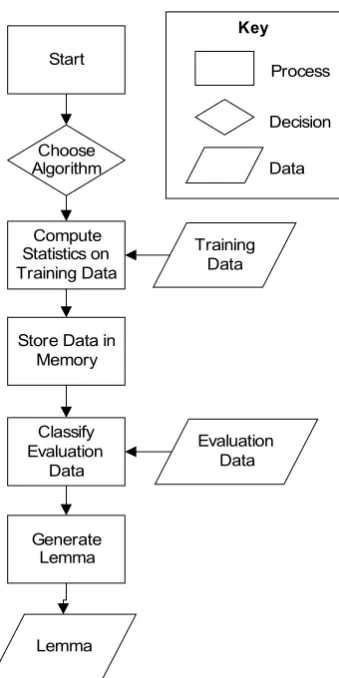
Figure 1. Generic Architecture of the Machine Learning Based Lemmatiser.
The architecture presented in this subsection was first developed and implemented for Lia, the ma-chine learning based lemmatiser for Afrikaans. This same architecture was used for the develop-ment of the machine learning based lemmatiser for Setswana. The first step in this “generic” ar-chitecture consists of training the system with data. During this phase, the training data is ex-amined and various statistical calculations are computed that aid the system during classifica-tion. This training data is then stored in memory
as sets of data points. The evaluation instance(s) are then presented to the system and their class is computed by interpolation to the stored data points according to the selected algorithm and al-gorithm parameters. The last step in the process consists of generating the correct lemma(s) of the evaluation instance(s), according to the class that was awarded during the classification process. The generic architecture of the machine learning based lemmatiser is illustrated in Figure 1.
6
Data
6.1 Data Size
A negative aspect of the Machine Learning method for developing a lemmatiser is that a large amount of lemma-annotated training data is required. Currently, there is a data set available that contains only 2,947 lemma-annotated Set-swana words. This is the evaluation data set con-structed by Brits (2006) to evaluate the perform-ance of the rule-based Setswana lemmatiser. A data set of 2,947 words is considered to be very small in machine learning terms.
6.2 Data Preparation
Memory based learning requires that lemmatisa-tion be performed as a classificalemmatisa-tion task. The training data should therefore consist of feature vectors with assigned class labels (Chrupala, 2006). The feature vectors for each instance con-sist of the letters of the inflected word. The class labels contain the information required to trans-form the involved word trans-form from the inflected form to the lemma.
The class labels are automatically derived by determining the character string (and the position thereof) to be removed and the possible replace-ment string during the transformation from word-form to lemma. This is determined by firstly ob-taining the longest common substring between the inflected word and the manually identified lemma. Once the longest common substring is known, a comparison of the remaining strings in the inflected word form and the lemma indicates the strings that need to be removed (as well as the possible replacement strings) during the transformation from word form to lemma. The positions of the character string to be removed are annotated as L (left) or R (right).
Inflected Word-Form Manually Identified Lemma
Longest Common Substring
Automatically Derived Class
matlhwao letlhwao hwao Lma>le
menoganya menoga menoga Rya>
[image:4.595.85.511.82.148.2]itebatsa lebala ba Lit>lRtsa>la
Table 1. Data Preparation and Classes.
For example, Table 1 shows that the class of “matlhwao” is Lma>le. This means that the string “ma” needs to be replaced by the string “le” (at the left hand side of the word) during the transformation from the inflected form “matlh-wao” to the lemma “letlh“matlh-wao”. Accordingly, the class of the word “menoganya” is Rya>, denot-ing the strdenot-ing “ya” should be removed at the right-hand side of the inflected form during lem-matisation. In this particular case, there is no re-placement string. Some words like “itebatsa” un-dergo alterations to both sides of the inflected form during lemmatisation. The class Lit>lRtsa>la indicates that the string “it” must be replaced at the left-hand side of the word with the letter “l”, while the string “tsa” should be re-placed with the string “la” at the right-hand side of the word.
An example of the training of data of the lem-matiser is shown in Figure 2. The data is presen-ted in C4.5 format (Quinlan, 1993) to the memory based learning algorithm, where each feature is separated by a comma. The algorithm requires that every instance must have the same number of features. In order to achieve this, it was decided that each instance should contain 20 features. 20 features were chosen, since less than 1% of the words in the data contained more than 20 letters. All instances were formatted to con-tain 20 features by adding underscores to the words that contained less than 20 features. The result of this process is displayed in Figure 2.
_,_,_,_,_,_,_,_,_,_,t,s,o,g,a,t,s,o,g,a,0 _,_,_,_,_,_,_,_,_,_,e,d,i,m,o,l,a,n,y,a,Rnya> _,_,_,_,_,_,_,_,_,_,_,_,_,d,i,n,y,e,p,o,Ldi>
_,_,_,_,_,_,_,_,_,_,t,s,i,s,e,d,i,t,s,e,Ltsisedi>Rse>la
Figure 2. Training Data in C4.5 Format.
7
Implementation
Each of the 2,947 lemma-annotated words in the evaluation data of the rule-based Setswana lem-matiser was formatted in C4.5 format. The data was then split up further into a training data set,
consisting of 90% of all the data, with an evalu-ation set consisting of 10% of all the data. A ma-chine learning based lemmatiser was trained (by utilising default parameter settings) and evalu-ated with these two datasets. This lemmatiser ob-tained an accuracy figure of 46.25%. This is a disappointing result when compared to the lin-guistic accuracy figure of 62.71% obtained with the rule-based Setswana lemmatiser when evalu-ated on the same data set. Algorithmic parameter optimisation with PSearch (Groenewald, 2008) resulted in an improved accuracy figure of 58.98%. This represents an increase of 12.73%, but is still less than the accuracy figure obtained by the rule-based lemmatiser.
Error analysis indicated that in some cases the class predicted by TiMBL is conspicuously wrong. This is evident from instances shown in Table 2, where the assigned classes contain strings that need to be removed that is not present in the inflected forms.
Inflected Word
Correct Class Assigned Class
tlamparele Re>a Lmm>bRele>a phologileng Rileng>a Regileng>a
Table 2. Instances with Incorrectly Assigned Classes.
Inflected
Word Assigned Class Class Distribution
tlamparele Lmm>bRele>a
0 0.934098 Re>a 1.82317 Rele>a 0.914829 Lmm>bRele>a 1.96103
phologileng
Regileng>a Rileng>a 3.00014 Relang>a 1.24030
Regileng>a 4.20346
Table 3. Instances Containing Additional Class Distribution Information.
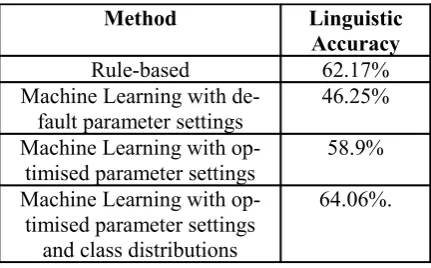
character “a” at the right-hand side of the word. However, the inflected word “phologileng” does not contain the string “egileng”, which means that the assigned class is sure to be incorrect. This problem was overcome by utilizing the TiMBL option (+v db) that adds class distribu-tion in the nearest neighbour set to the output file. The result of this is an additional output that contains the class distribution information shown in Table 3. The class distribution information contains the nearest classes with their associated distances from the involved evaluation instance. A post-processing script that automatically re-cognises this type of incorrectly assigned class and replaces the incorrect class with the second most likely class (according to the class distribu-tion) was developed. The result of this was a fur-ther increase in accuracy to 64.06%. A summary of the obtained results is displayed in Table 4.
Method Linguistic Accuracy
Rule-based 62.17%
Machine Learning with de-fault parameter settings
46.25%
Machine Learning with op-timised parameter settings
58.9%
Machine Learning with op-timised parameter settings
and class distributions
[image:5.595.71.287.322.456.2]64.06%.
Table 4. Summary of Results.
8
Conclusion
The best results obtained by the machine learn-ing based Setswana lemmatiser was a llearn-inguistic accuracy figure of 64.06%. This represents an in-crease of 1.9% on the accuracy figure obtained by the rule-based lemmatiser. This seems to be a small increase in accuracy compared to the 25.8% increase obtained when using a machine learning based method for Afrikaans lemmatisa-tion. The significance of this result becomes evident when considering the fact that it was ob-tained by training the machine learning based Setswana lemmatiser with a training data set consisting of only 2,652 instances. This data set is very small in comparison with the 73,000 in-stances contained in the training data of Lia. The linguistic accuracy figure of 64.06% further-more indicates that a machine learning based lemmatiser for Setswana that yields better results than a rule-based lemmatiser can be developed
with a relatively small data set. We are confident that further increases in the linguistic accuracy figure will be obtained by enlarging the training data set. Future work will therefore entail the employment of bootstrapping techniques to an-notate more training data for improving the lin-guistic accuracy of the machine learning based Setswana lemmatiser.
The most important result of the research presented in this paper is, however, that existing methodologies and research can be applied to fast-track the development of linguistic resources or improve existing linguistic resources for re-source-scarce languages, a result that is espe-cially significant in the African context.
Acknowledgments
The author wishes to acknowledge the work of Jeanetta H. Brits, performed under the supervi-sion of Rigardt Pretorius and Gerhard B. van Huyssteen, on developing the first automatic lemmatiser for Setswana.
References
David W. Aha, Dennis Kibler and Marc K. Albert. 1991. Instance-Based Learning Algorithms. Ma-chine Learning, 6:37-66.
Jeanetta H. Brits. 2006. Outomatiese Setswana Lemma-identifisering ‘Automatic Setswana Lem-matisation’. Master’s Thesis. North-West Uni-versity, Potchefstroom, South Africa.
Gregorz Chrupala. 2006. Simple Data-Driven Con-text-Sensitive Lemmatization. Proceedings of SEPLN 2006.
Walter Daelemans, Antal Van den Bosch, Jakub Zavrel and Ko Van der Sloot. 2007. TiMBL: Tilburg MemoryBased Learner. Version 6.1, Ref-erence Guide. ILK Technical Report 07-03.
Walter Daelemans and Helmer Strik. 2002. Actieplan Voor Het Nederlands in de Taal- en Spraaktechno-logie: Prioriteiten Voor Basisvoorzieningen.
Report for the Nederlandse Taalunie. Nederlandse Taalunie.
Tomaž Erjavec and Saso Džeroski. 2004. Machine Learning of Morphosyntactic Structure: Lemmat-ising Unknown Slovene Words. Applied Artificial Intelligence, 18(1):17-40.
Tanja Gaustad and Gosse Bouma. 2002. Accurate Stemming of Dutch for Text Classification.
Language and Computers, 45 (1):104-117.
Hendrik J. Groenewald. 2008. PSearch 1.0.0. North-West University, Potchefstroom, South Africa. Wessel Kraaij and Renee Pohlmann. 1994. Porter’s
Stemming Algorithm for Dutch.
Informatiewetenschap 1994: Wetenschaplike bijdraen aan de derde STINFON Conferentie. 1(1):167-180.
Joel Plisson, Nada Lavrac and Dunja Mladenić. 2004. A Rule-based Approach to Word Lemmatization.
Proceedings C of the 7th International Multi-Con-ference Information Society IS 2004, 1(1):83-86. Martin Porter. 1980. An Algorithm for Suffix
Strip-ping. Program, 14 (3):130-137.
John R. Quinlan. 1993. C4.5: Programs for Machine Learning. Morgan Kaufmann, San Mateo, USA. RAGEL. 2003. Reëlgebaseerde Afrikaanse
Grondwoord- En Lemma-identifiseerder 'Rule-based Afrikaans Stemmer and Lemmatiser.
http://www.puk.ac.za/opencms/export/PUK/html/f akulteite/lettere/ctext/ragel.html.> 11 January 2009.