D S Sharma, R Sangal and A K Singh. Proc. of the 13th Intl. Conference on Natural Language Processing, pages 198–207, Varanasi, India. December 2016. c2016 NLP Association of India (NLPAI)
Twitter Named Entity Extraction and Linking
Using Differential Evolution
Utpal Kumar Sikdar and Bj¨orn Gamb¨ack
Department of Computer and Information Science Norwegian University of Science and Technology
Trondheim, Norway
{sikdar.utpal,gamback}@idi.ntnu.no
Abstract
Systems that simultaneously identify and classify named entities in Twitter typically show poor recall. To remedy this, the task is here divided into two parts: i) named en-tity identification using Conditional Ran-dom Fields in a multi-objective frame-work built on Differential Evolution, and ii) named entityclassificationusing Vector Space Modelling and edit distance tech-niques. Differential Evolution is an evo-lutionary algorithm, which not only opti-mises the features, but also identifies the proper context window for each selected feature. The approach obtains F-scores of 70.7% for Twitter named entity extraction and 66.0% for entity linking to the DB-pedia database.
1 Introduction
Twitter has established itself as one of the most popular social networks, with about 320 million active users daily generating almost 500 million short messages,tweets, with a maximum length of 140 characters (Twitter, 2016). The language used is very noisy, with tweets containing many gram-matical and spelling mistakes, short form of the words, multiple words merged together, special symbols and characters inserted into the words, etc. Hence it is difficult to analyse and monitor all types of tweets, and the vast number of tweets: specific messages may need to be filtered out from millions of tweets. Named entity extraction plays a vital role when filtering out relevant tweets from a collection. It is also useful for pre-processing in many other language processing tasks, such as machine translation and question-answering.
The paper is organized as follows: Section 2 describes related work on Twitter named entity recognition and linking. The actual Twitter name
identification methodology and different features used are presented in Section 3. Section 4 focuses on classification of the identified named entities and their linking to DBpedia. Experimental results and a discussion of those appear in Section 5 and Section 6, respectively, while Section 7 addresses future work and concludes.
2 Related Work
The noisiness of the texts makes Twitter named entity (NE) extraction a challenging task, but sev-eral approaches have been tried: Li et al. (2012) introduced an unsupervised strategy based on dy-namic programming; Liu et al. (2011) proposed a semi-supervised framework using a k-Nearest Neighbors (kNN) approach to label the Twitter names and gave these labels as an input feature to a Conditional Random Fields, CRF (Lafferty et al., 2001) classifier, achieving almost 80% ac-curacy on their own annotated data. Supervised models have been applied by several authors, e.g., Ritter et al. (2011) who applied Labeled LDA (Ra-mage et al., 2009) to recognise possible types of the Twitter names, and also showed that part-of-speech and chunk information are important com-ponents in Twitter NE identification.
A shared task challenge was organized at the ACL 2015 workshop on noisy user-generated text (W-NUT) (Baldwin et al., 2015), with two sub-tasks: Twitter named entity identification and clas-sification of those named entities into ten differ-ent types. Of the eight systems participating, the best (Yamada et al., 2015) achieved an F1 score
of 70.63% for Twitter name identification and 56.41% for classification, by combining super-vised machine learning with high quality knowl-edge obtained from several open knowlknowl-edge bases such as Wikipedia. Akhtar et al. (2015) used a strategy based on differential evolution, getting F1
scores of 56.81% for identification and 39.84% for classification.
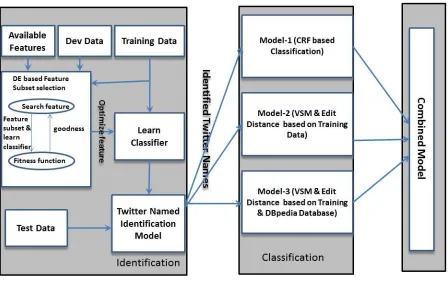
Figure 1: Twitter Named Identification and Classification system.
The challenge was repeated at W-NUT 2016 (Strauss et al., 2016), with ten participating teams. The best system (Limsopatham and Collier, 2016) used a bidirectional Long Short-Term Memory (LSTM) recurrent neural network model, obtain-ing F-scores of 65.89% for Twitter name iden-tification and 52.41% for the classification task. Another system (Sikdar and Gamb¨ack, 2016) uti-lized a CRF classifier built on a large feature set to get the second highest F-score on identification: 63.22%, but lower (40.06%) on classification.
A specific shared task on Twitter named en-tity recognition and linking (NEEL) to DBpedia was held at the #Microposts2016 workshop (Rizzo et al., 2016), with the problem defined as to identify named entities from the tweets (called ‘Strong typed mention match’) and to link them to the DBpedia database (‘Strong link match’). DBpedia extracts structured information from Wikipedia and links different Web data sets to Wikipedia data, allowing for sophisticated queries against Wikipedia. The DBpedia knowledgebase is available in 125 languages, with the English ver-sion describing 4.58 million items, out of which 4.22 million are classified in a consistent ontology. Five teams participated in the #Microposts2016 NEEL challenge. However, most of the
sys-tems suffered from very low recall values in the Twitter NE identification task and were actu-ally unable to efficiently recognise Twitter names: Two knowledge-based approaches (Caliano et al., 2016; Greenfield et al., 2016) achieved F-scores of 26.7% and 31.9%, respectively, due to recall values of 18.8% and 24.0%. Two other systems (Ghosh et al., 2016; Torres-Tram´on et al., 2016) produced recall values of 28.9% and 24.2%. The best system (Waitelonis and Sack, 2016) achieved recall, precision and F-measure values of 49.4%, 45.3% and 47.3%. In this system, each token is mapped to gazetteers that are developed from the DBpedia database. Tokens are discarded if they match with stop words or are not nouns.
Figure 2: Chromosome representation of five available features; three are present and two absent.
3 Twitter Named Entity Identification
Twitter named entities are first extracted using a supervised machine learning approach, namely CRF in a Differential Evolution (DE) setting. However, Twitter names contain a lot of noise, making it difficult to identify them directly from the texts, so some words are segmented: words containing special characters (e.g., #, @, ), words containing a lower-case letter followed by a upper-case letter (e.g., ‘realDonaldTrump’ is split into real, Donald and Trump), letters followed by digits, etc. This section first briefly introduces Multi-objective Differential Evolution and then describes the DE-based Twitter name identifica-tion procedure (the left side of Figure 1).
3.1 Multi-objective Differential Evolution Differential Evolution (Storn and Price, 1997) is a parallel direct search method over complex, large and multi-modal landscapes, and in gen-eral provides near-optimal solutions to an opti-mization problem. In DE, the parameters of the search space are encoded in the form of strings called chromosomes. A collection of N such strings is called a population, and is denoted by D-dimensional parameter vectors Xi,G =
[x1,i,G, x2,i,G, . . . , xD,i,G] , i = 1,2, . . . , N for
each generationG. The initial vector population is chosen randomly, which covers different points in the search space.
For multi-objective optimization, more than one objective or fitness function is associated with each chromosome. These objective values rep-resent the degrees of goodness of the string. DE generates new parameter vectors (“mutation”) by adding the weighted difference between two pop-ulation vectors to a third vector. The mutated vector’s parameters are then mixed (“crossover”) with the parameters of another predetermined vec-tor, the target vector. For selection, theseN trial vectors are merged with the current population, and the best N solutions are chosen from these 2×N candidate solutions based on domination,
non-domination, and crowding distance. The pro-cesses of mutation, fitness computation, crossover and selection are executed for a pre-selected max-imum number of generations.
3.2 DE-based Named Entity Extraction When extracting named entities, suppose that there are a number of available features F1(−m, n), F2(−m, n), . . . FK(−m, n), where K represents the total number of features, while m and n denote the preceding and succeeding context window lengths of each feature. Differ-ential Evolution aims to find the relevant features along with proper context windows and learn a classifier using these features to optimize two objective functions: precision and recall.
Each DE chromosome represents the number of features along with their context windows, so the length of the chromosome is D = K ×3. Each feature consists of one bit and two integer values: the bit represents presence or absence of a feature (1 or 0), two integer values denote the length of the preceding and succeeding context windows (0–5). The algorithm proceeds as follows:
Chromosome Initialization: All chromosomes in the first population generation are initialized with random values within the search space. The bit position feature value of ‘0’ indicates that the particular feature is not participating in construct-ing the classifier and ‘1’ indicates that the feature is present in constructing the classifier using the context features. The chromosome initialization is shown in Figure 2, where featuresF1,F3 andF5
are present, and featuresF2andF4are absent.
Fitness Computation: More than one fitness function can be associated with each chromosome. Suppose thatkfeatures are present in the chromo-some and that the context window for each feature is denoted by Fp(−mp, np) where 1 ≤ p ≤ k. In Figure 2, the preceding and succeeding context window lengths ofF1,F3andF5are respectively
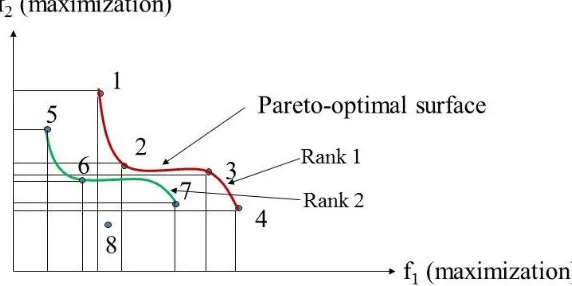
Figure 3: Dominated and non-dominated solutions. Here solutions 1, 2, 3 and 4 are non-dominating in relation to each other (rank 1). Solutions 5, 6 and 7 are also non-dominating to each other (rank 2), while solution 8 is dominated by at least one solution from rank 1 or rank 2.
trained on thekfeatures along with their context features, and the DE search capability maximizes the two objective values precision and recall. Mutation: A mutant vectorVi,G+1 is generated
for each target vectorXaccording to
Vi,G+1=Xr1,G+Fmu×(Xr2,G−Xr3,G)
where{r1, r2, r3} ∈ {1,2, . . . , N}) are randomly generated indices,Fmu∈[0,1]a mutation factor, andGresp.G+1the current and next generations. Crossover: Crossover is introduced to increase the diversity of the mutant parameter vector: the parameters of the mutant vectorVi,G+1 are mixed
with the parameters of the target vector Xi,G to generate a trail vectorUi,G+1:
Ui,G+1= (ui,1,G+1, ui,2,G+1, . . . , ui,D,G+1)
where forj= 1,2, . . . , D,
ui,j,G+1= (
vi,j,G+1 :rdj ≤Cr or j=jrd xi,j,G :rdj > Cr and j6=jrd
whererdj ∈ [0,1]is a randomly generated float-ing point value,Cr ∈ [0,1]is the crossover con-stant, andjrd∈ {1,2, . . . , D}a randomly chosen index ensuring that the trail vector gets at least one parameter from the mutant vector.
Selection: To select the N best chromosomes for the next generation G+ 1, the trial popula-tion is merged with the current populapopula-tion. These 2×Nsolutions are ranked based on domination and non-domination relations in the objective function space. A solution non-dominated if at least one
of the objective values is better than another solu-tion. If all objective values of a solution are better than another solution, the latter solution is dom-inated. All the non-dominated solutions form a Pareto-optimal front (Deb, 2001), as exemplified in Figure 3. The top ranked solutions are added to the next generation population until the total num-ber of solutions is equal toN. If the number of so-lutions of a particular rank is> N, the crowding distance sorting algorithm (Deb, 2001) is applied to discard the excess solutions.
Termination Condition: The processes of mu-tation, crossover, fitness computation and selec-tion are executed for Gmax generations. A set of non-dominated solutions is obtained on the final Pareto optimal front from the last generation popu-lation. None of these solutions is better compared to the others, and each of them represents a set of optimal feature combinations. The last generation population contains rank 1 solutions where some are good with respect to recall and others with re-spect to precision. Here, the solutions with highest F-scores are selected, but any criterion can be used based on user preferences.
3.3 Twitter Named Entity Features
A range of different features are utilised to extract named entities from the noisy text. All features (except part-of-speech) are domain independent, and most of them are binary (yes/no) flags:
• Local context (F1): The preceding and
suc-ceeding words of the current token.
• Word prefix (F2) and suffix (F3): Up to 4
• Special character followed by token (F4): If
a special character (e.g., @, #) follows the to-ken, this binary flag is set.
• Gazetteer list (F5): A named entity list is
ex-tracted from the training data and F5
indi-cates if the current token is on that list.
• Last (F6) and first word (F7): The token is
the last/first word of the sentence.
• Alphanumeric (F8), all digit (F9): The token
contains only alphanumerics or digits.
• Single capital (F10), capital inner (F11),
ini-tial capital (F12), and all capital (F13): The
token contains only one single capital letter, any capital letter in inner position, starts with a capital letter, or contains only capitals.
• Stop word match (F14): The current word
matches with a stop word.
• Word normalization (F15): Tokens with
simi-lar word shapes may belong to the same class. Word mapped to its equivalent class: each capital letter in the token is mapped to A, small letters to a, and digits to 0. Other char-acters are kept unaltered.
• Word frequency (F16): Whether the word’s
frequency is greater than a certain threshold (the threshold values were set to 10 for train-ing data and to 5 for development/test data).
• Word previously occurred (F17): If the
cur-rent word occurred earlier in the corpus.
• Word length (F18): The word length is
greater than some threshold (e.g.,≥5).
• Part-of-speech (F19): Part-of-speech tags
from the TweeboParser1.
• Dynamic (F20): The output label(s) of the
previous token(s).
4 Twitter NE Classification and Linking
The previous section described how Twitter named entities are identified using CRF and Differential Evolution. In this section, the identified Twit-ter named entities are classified into seven prede-fined categories (Thing, Event, Character, Loca-tion, OrganizaLoca-tion, Person and Product) and linked to the DBpedia database. Three models are built for classification of Twitter names. The outputs of these three models are later merged using a priority-based approach (precision value). Finally, the classified Twitter names are linked to DBpedia. The three Twitter named entities classification models are composed as follows.
1http://www.cs.cmu.edu/˜ark/TweetNLP/
Model-1: A CRF-based supervised classifica-tion technique is simply used to predict the classes of the Twitter names. All the extracted Twitter names from the DE-based approach are used as a feature in this model. So the model is developed with this feature along with the previous and next two context words of the current word.
Model-2: Model-2 is developed based on train-ing datasets. Each type of traintrain-ing instances (Twit-ter names) is stored in a unique document whose class is one of the seven predefined categories. Af-ter removing all stop words and special characAf-ters from the tweets, the remaining non-entity words are stored in a separate document. Each extracted Twitter name from the DE-based approach is con-sidered as a query (search keyword). The follow-ing steps are used to classify Twitter names.
1. Retrieve the top-100 documents for each query using a Vector Space Model (Salton et al., 1975) based on cosine similarity.
2. Calculate edit distance (also called Leven-shtein distance) between the query and each of the retrieved documents.
3. Assign the closest document’s class to the query, where the closest document is the one with minimum edit distance to the query. The class of an entity is retrieved using Lucene.2
Model-3: Model-3 is based on the DBpedia and training datasets. From the DBpedia ontology classes,3 the datasets are mapped to the seven
predefined categories and the same technique as described in Model-2 is applied. We extracted rdf-schema#label items from the csv files (e.g., African Volleyball Championship) and stored each in a unique document whose class is one of the seven predefined categories. In Model-3, the train-ing data is merged with the DBpedia datasets.4
Combined Model: The extracted Twitter named entity classes are merged based on the priority of the above models. The priorities are given to the models based on the precision value of the devel-opment data. Suppose, for example, that Model-3 has the highest priority followed by Model-2 and Model-1. Voting in the ensemble is then carried out as follows: If Model-3 is unable to identify the
2https://lucene.apache.org/core/3_5_0/
contributions.html
3http://mappings.dbpedia.org/server/
ontology/classes/
4Using the csv format of the DBpedia database.
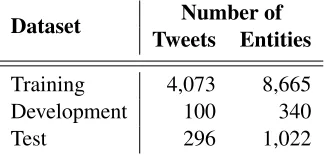
Dataset Tweets EntitiesNumber of
Training 4,073 8,665 Development 100 340
[image:6.612.109.271.41.120.2]Test 296 1,022
Table 1: Statistics of the NEEL2016 datasets
class of an entity (i.e., if it identifies it as belong-ing to the ‘not-Entity’ document class), the entity is passed to Model-2. If Model-2 also fails to iden-tity the class of the eniden-tity, the class of the eniden-tity is assigned by Model-1.
A knowledge-based technique is used to link the Twitter named entities to DBpedia database. In the training data, for each entity a link was pro-vided. In DBpedia, for each rdf-schema#label, a link was assigned. When the class of an entity (Twitter name) is extracted using the above mod-els, the corresponding link is maintained based on training or DBpedia datasets, and the link is as-signed to that particular entity. If no link is found, a NIL link is assigned to the entity.
5 Experiments and Results
The approach was tested on the NEEL2016 datasets (Rizzo and van Erp, 2016). The statis-tics of the datasets are given in Table 1. This data was used to train a CRF-based classifier as base-line and then to build all the models of the full DE-based system, for Twitter named entity identi-fication as well as for categorization and DBpedia linking, as described in turn below.
5.1 Baseline Model
To obtain a baseline model, the CRF-based ma-chine learning approach was applied to identify and classify the Twitter named entities using the features described in Section 3.3 and the same evaluation scorer as in the NEEL2016 challenge.
After building a classifier on the training data, the recall (R), precision (P), and F1-measure
val-ues of the development datasets were 36.20%, 69.9% and 47.7% (as also shown in the first row of Table 3 below). The low F-score is due to the poor recall. The baseline approach was also evaluated on the unseen test data, obtaining recall, precision and F1 scores of 23.7%, 50.7% and 32.3%. The
performance on the test data is similar to that on the development data because of the bad recall.
In order to increase the data for available for training the models, the development data was merged with the training data. This also increases the number of named entities in the gazetteer list (feature F5) and the statistics that some of the
other features are based on. When the same model is built by merging the training and development data, and evaluated on the test data, the results are improved considerably, with recall, precision and F-measure values of 55.6%, 69.7% and 61.9%.
5.2 Twitter NE Identification Experiments To enhance recall and F-score, Twitter names are first identified using the multi-objective DE-based technique. In a second step, the identified Twit-ter named entities are classified using vector space modelling and edit distances.
A baseline model for identification of Twitter names was built using the features described in Section 3.3. When trained on the training data and evaluated on the development data, the model shows recall, precision and F1-scores of 56.1%,
87.5% and 68.4%, respectively, as given in the ‘Dev Data’ column of Table 2.
To improve on these results, a Differential Evolution-based feature selection technique was used to identify named entities in noisy text. For Twitter named entity identification, the parameters of the DE were set as follows:
• N (population size) = 100,
• Cr(probability of crossover) = 0.5,
• Gmax(number of generation) = 100, and
• Fmu(mutation factor) = 0.5.
The best feature set along with the context fea-tures was determined based on development data. The selected features along with context features are F1(−3,4), F5(−1,0), F6(0,1), F8(−1,0),
F11(0,1), F12(−2,2), F14(−2,1), F17(−2,1),
F19(−2,1)andF20(−1,0). This setup achieved
recall, precision and F-measure values of 79.9%, 93.8% and 86.3% on the development data. The performance of the system increases almost 18 F-measure points over the baseline model.
To fairly evaluate the approach, it was applied to the unseen test data using the selected features along with the context features, giving the re-call, precision and F1-scores of 73.9%, 89.2% and
Training set Training Data Training + Dev Data
Test set Dev Data Test Data Test Data
Method R P F1 R P F1 R P F1
[image:7.612.132.486.40.102.2]Baseline (CRF-based) 56.1 87.5 68.4 48.4 81.8 60.8 79.3 88.2 83.5 DE-based identification 79.9 93.8 86.3 73.9 89.2 80.8 81.3 90.8 85.7
Table 2: Twitter Named Entity Identification results
When merging the development data with the training data and building a model using selected features, the recall, precision and F-measure val-ues are 81.3%, 90.8% and 85.7%, respectively, also improving on the scores obtained by the base-line model. The results show that the multi-objective DE-based approach efficiently identifies Twitter names from noisy text.
5.3 Twitter NE Classification Experiments In the next step, the identified Twitter names ex-tracted using the multi-objective DE-based ap-proach were classified. Three models were built to classify the Twitter named entities into the seven categories described at the beginning of Section 4. In the first model (Model-1), the identified Twit-ter named entities are passed through a CRF-based supervised classifier. The recall, precision and F-measure values given in Table 3 are 38.8%, 40.7% and 39.8%, respectively, showing that the recall is increased over the baseline model (Section 5.1), which simultaneously identifies and classifies the named entities.
Another Twitter named classification model (Model-2) was built using VSM and edit dis-tance techniques based on training data, giving re-call, precision and F-scores of 27.9%, 87.2% and 42.3%. The probable reason for the low perfor-mance is that sufficient examples (instances) may not be found in the training data.
When the Model-2 approach was applied to the DBpedia database (Model-3), the recall, precision and F-scores are 67.4%, 86.7% and 75.8%, respec-tively. Model-3 achieves one of the best results among all the models and also outperforms all ex-isting approaches, as shown in Table 3.
All the models were blindly evaluated on the test data (the second set of R-P-F1 scores given
in Table 3). The Model-3 results show that its performance is far better than all other present state-of-the-art approaches. It achieves recall, pre-cision and F-measure values of 50.8%, 76.1% and 60.9%, respectively. Even though the per-formance of Model-3 on the development data is
only slightly better than the best existing system, KEA (Waitelonis and Sack, 2016), the gap in per-formance on the test data is a lot larger, since the KEA system tries to increase the recall value as much as possible without controlling the precision value. As a result, KEA’s performance on the test data is fairly bad.
In the last model (Combined Model), the out-puts of the three models are merged, increasing the F-score almost 5 points compared to Model-3 on the test data. The precision, recall and F1
-scores of the Combined Model are 65.3%, 67.1% and 66.2%, respectively (see Table 3). Hence the Combined Model produces the best results com-pared to all the other models as well as to all the #Microposts2016 systems.
When merging the development data with the training data (the third set of R-P-F1scores in
Ta-ble 3), the performances of Model-1 and Model-2 are better than Model-3 because many examples in the test data are seen in the development data and these two models are developed based on train-ing instances, while Model-3 classifies the Twit-ter names based on the DBpedia database. Here, the Combined Model also achieves the best results among all the approaches, with precision, recall and F-score of 69.7%, 71.7% and 70.7%.
5.4 Twitter NE Linking Experiments
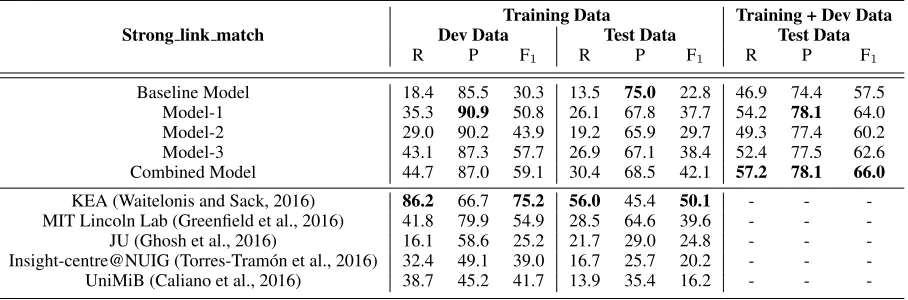
To link the classified Twitter names, we use a knowledge-based approach (utilizing either train-ing data or the DBpedia database). The DBpedia links for Models 1 and 2 reported in Table 4 are based on training data. These models achieve bet-ter precision values than the state-of-the-art sys-tems. In Model-3, the links are retrieved from the DBpedia database. The performance of Model-3 is better than the first and second models. The re-call, precision and F-measure values of Model-3 on the test data are 26.9%, 67.1% and 38.4%.
Strong typed mention match Dev DataTraining dataTest Data Training + Dev DataTest Data
R P F1 R P F1 R P F1
Baseline Model 36.2 69.9 47.7 23.7 50.7 32.3 55.6 69.7 61.9
Model-1 38.8 40.7 39.8 32.8 33.8 33.3 64.5 66.3 65.4
Model-2 27.9 87.2 42.3 27.8 86.9 42.2 49.3 91.0 64.0
Model-3 67.4 86.7 75.8 50.8 76.1 60.9 52.5 76.6 62.3
Combined Model 75.3 79.0 77.1 65.3 67.1 66.2 69.7 71.7 70.7
KEA (Waitelonis and Sack, 2016) 66.0 57.2 61.3 49.4 45.3 47.3 - - -MIT Lincoln Lab (Greenfield et al., 2016) 28.7 58.7 38.6 24.0 47.4 31.9 - - -JU (Ghosh et al., 2016) 35.3 41.1 38.0 28.9 33.8 31.2 - - -UniMiB (Caliano et al., 2016) 17.8 54.5 26.8 18.8 46.2 26.7 - - -Insight-centre@NUIG (Torres-Tram´on et al., 2016) 35.5 33.4 34.4 24.2 24.9 24.6 - -
-Table 3: Twitter Named Entity Classification results (‘Baseline Model’: using all features)
Strong link match Dev DataTraining DataTest Data Training + Dev DataTest Data
R P F1 R P F1 R P F1
Baseline Model 18.4 85.5 30.3 13.5 75.0 22.8 46.9 74.4 57.5
Model-1 35.3 90.9 50.8 26.1 67.8 37.7 54.2 78.1 64.0
Model-2 29.0 90.2 43.9 19.2 65.9 29.7 49.3 77.4 60.2
Model-3 43.1 87.3 57.7 26.9 67.1 38.4 52.4 77.5 62.6
Combined Model 44.7 87.0 59.1 30.4 68.5 42.1 57.2 78.1 66.0
KEA (Waitelonis and Sack, 2016) 86.2 66.7 75.2 56.0 45.4 50.1 - - -MIT Lincoln Lab (Greenfield et al., 2016) 41.8 79.9 54.9 28.5 64.6 39.6 - - -JU (Ghosh et al., 2016) 16.1 58.6 25.2 21.7 29.0 24.8 - - -Insight-centre@NUIG (Torres-Tram´on et al., 2016) 32.4 49.1 39.0 16.7 25.7 20.2 - - -UniMiB (Caliano et al., 2016) 38.7 45.2 41.7 13.9 35.4 16.2 - - -Table 4: Twitter Named Entity Linking results (‘Baseline Model’: using all features)
a higher F-score than the KEA system (Waitelo-nis and Sack, 2016) due to lower recall. How-ever, when development data are merged with the training data for the model building, the Combined Model again gives the best test data results among all the systems, achieving recall, precision and F-measure values of 57.2%, 78.1% and 66.0%.
6 Discussion
The task is divided into two parts: identification of Twitter named entities, and classification and linking to DBpedia. For the NE identification, a Conditional Random Fields classifier is used in a Differential Evolution framework. DE selects fea-tures randomly and lets the CRF classifier train on these features in order to optimize the feature se-lection based on fitness values on the development data. Hence, the CRF classifier runs many times based on the size of the population and the number of generation given as parameters to the Differen-tial Evolution. So the learning time depends on the training data size, number of features, number of class, etc. Here, the training time is reduced since the training data size, number of features,
and number of classes are small. To increase the speed, a multi-threading approach was also used for CRF learning.
When running the CRF classifier for the iden-tification task using all the features described in Section 3.3, the performance (baseline model) is low because the model fails to efficiently retrieve Twitter names. To enhance the performance on the identification task, the DE setting was used, since it identifies near optimal features based on its search capability.
[image:8.612.79.533.40.186.2] [image:8.612.82.536.220.370.2]standard annotation. For example, ‘InAbuDhabi’ (split as‘In Abu Dhabi’ which is closer to ‘Abu Dhabi’) is tagged as a location, but in gold anno-tation it is not considered to be a Twitter name.
The output of the entity linking to DBpedia was also analysed. The linking performance is not good because many entities with links are not in the DBpedia database. For example, ‘The-ForceAwakens’ (split as ‘The Force Awakens’) is correctly identified as a Twitter named entity by the system, but that name along with a link is not in DBpedia (Release 2014). Another cause of er-rors is that many entities and their corresponding links simply are not identified at all by the system.
7 Conclusion
In this paper, we propose a system for Twitter named entity extraction and linking to DBpedia. Twitter names are first identified from the noisy texts using a multi-objective technique based on Differential Evolution and a range of different fea-tures. The most important features are identified along with their context features. In a second step, the identified Twitter named entities are classified and linked to the DBpedia database. For classi-fication of Twitter names, a vector space model and edit distance techniques are used, achieving results outperforming both a tough baseline model and other state-of-the-art systems.
In the future, we will experiment with other datasets and try to collect more examples along with contextual information to reduce misclassi-fications. It would also be interesting to apply the approach described here to tweet named entity ex-traction for under-resourced languages, such as the languages of India.
Furthermore, we will develop other entity ex-traction models to perform ensemble classifica-tion using a multi-objective approach, and exper-iment with tree-based structured learning (Yang and Chang, 2015) for the task of linking Twitter named entities to DBpedia.
Acknowledgements
We are most grateful for some very useful com-ments from several anonymous reviewers, that helped to substantially improve the paper.
Many thanks also to the NEEL 2016 shared task organisers (Rizzo et al., 2016) for collecting, an-notating and publishing the data.
References
Md Shad Akhtar, Utpal Kumar Sikdar, and Asif Ek-bal. 2015. IITP: Multiobjective differential evolu-tion based Twitter named entity recognievolu-tion. In Pro-ceedings of the 53rd Annual Meeting of the Associ-ation for ComputAssoci-ational Linguistics and the 7th In-ternational Joint Conference on Natural Language Processing, pages 106–110, Beijing, China, July. ACL. Workshop on Noisy User-generated Text.
Timothy Baldwin, Marie Catherine de Marneffe, Bo Han, Young-Bum Kim, Alan Ritter, and Wei Xu. 2015. Shared tasks of the 2015 workshop on noisy user-generated text: Twitter lexical normaliza-tion and named entity recogninormaliza-tion. InProceedings of the 53rd Annual Meeting of the Association for Computational Linguistics and the 7th International Joint Conference on Natural Language Processing, pages 126–135, Beijing, China, July. ACL. Work-shop on Noisy User-generated Text.
Davide Caliano, Elisabetta Fersini, Pikakshi Man-chanda, Matteo Palmonari, and Enza Messina. 2016. UniMiB: Entity linking in tweets using Jaro-Winkler distance, popularity and coherence. In Proceedings of the 6th Workshop on Making Sense of Microposts (#Microposts2016), pages 60– 72, Montr´eal, Canada, April.
Kalyanmoy Deb. 2001. Multi-objective Optimiza-tion Using EvoluOptimiza-tionary Algorithms. John Wiley & Sons, Chichester, England.
Souvick Ghosh, Promita Maitra, and Dipankar Das. 2016. Feature based approach to named entity recognition and linking for tweets. InProceedings of the 6th Workshop on Making Sense of Micro-posts (#MicroMicro-posts2016), pages 74–76, Montr´eal, Canada, April.
Kara Greenfield, Rajmonda Caceres, Michael Coury, Kelly Geyer, Youngjune Gwon, Jason Matterer, Alyssa Mensch, Cem Sahin, and Olga Simek. 2016. A reverse approach to named entity extraction and linking in microposts. In Proceedings of the 6th Workshop on Making Sense of Microposts (#Micro-posts2016), pages 67–69, Montr´eal, Canada, April.
John D. Lafferty, Andrew McCallum, and Fernando C. N. Pereira. 2001. Conditional Random Fields: Probabilistic models for segmenting and labeling se-quence data. In Proceedings of the 18th Interna-tional Conference on Machine Learning, pages 282– 289, Williamstown, Maryland, USA, June.
Chenliang Li, Jianshu Weng, Qi He, Yuxia Yao, An-witaman Datta, Aixin Sun, and Bu-Sung Lee. 2012. TwiNER: Named entity recognition in targeted Twit-ter stream. InProceedings of the 35th International Conference on Research and Development in Infor-mation Retrieval, pages 721–730, Portland, Oregon, August. ACM SIGIR.
Nut Limsopatham and Nigel Collier. 2016. Bidirec-tional LSTM for named entity recognition in Twit-ter messages. In Proceedings of the 26th Inter-national Conference on Computational Linguistics, pages 145–152, Osaka, Japan, December. ACL. 2nd Workshop on Noisy User-generated Text.
Xiaohua Liu, Shaodian Zhang, Furu Wei, and Ming Zhou. 2011. Recognizing named entities in tweets. In Proceedings of the 49th Annual Meeting of the Association for Computational Linguistics: Human Language Technologies, volume 1, pages 359–367, Portland, Oregon, June. ACL.
Daniel Ramage, David Hall, Ramesh Nallapati, and Christopher D. Manning. 2009. Labeled LDA: A supervised topic model for credit attribution in multi-labeled corpora. InProceedings of the 2009 Conference on Empirical Methods in Natural Lan-guage Processing, pages 248–256, Singapore, Au-gust. ACL.
Alan Ritter, Sam Clark, Mausam, and Oren Etzioni. 2011. Named entity recognition in tweets: An ex-perimental study. InProceedings of the 2011 Con-ference on Empirical Methods in Natural Language Processing, pages 1524–1534, Edinburgh, Scotland, August. ACL.
Giuseppe Rizzo and Marieke van Erp. 2016. Named Entity rEcognition and Linking (NEEL) challenge.
http://microposts2016.seas.upenn.
edu/challenge.html.
Giuseppe Rizzo, Marieke van Erp, Julien Plu, and Rapha¨el Troncy. 2016. Making sense of micro-posts (#Micromicro-posts2016) Named Entity rEcognition and Linking (NEEL) challenge. In Proceedings of the 6th Workshop on Making Sense of Micro-posts (#MicroMicro-posts2016), pages 50–59, Montr´eal, Canada, April.
Gerard Salton, A. Wong, and C. S. Yang. 1975. A vec-tor space model for automatic indexing. Communi-cations of the ACM, 18(11):613–620, November. Utpal Kumar Sikdar and Bj¨orn Gamb¨ack. 2016.
Feature-rich Twitter named entity recognition and classification. In Proceedings of the 26th Inter-national Conference on Computational Linguistics, pages 164–170, Osaka, Japan, December. ACL. 2nd Workshop on Noisy User-generated Text.
Rainer Storn and Kenneth Price. 1997. Differen-tial Evolution — a simple and efficient heuristic for global optimization over continuous spaces. Journal of Global Optimization, 11(4):341–359, December.
Benjamin Strauss, Bethany E. Toma, Alan Ritter, Marie Catherine de Marneffe, and Wei Xu. 2016. Results of the WNUT16 named entity recogni-tion shared task: Twitter lexical normalizarecogni-tion and named entity recognition. In Proceedings of the 26th International Conference on Computational Linguistics, pages 138–144, Osaka, Japan, Decem-ber. ACL. 2nd Workshop on Noisy User-generated Text.
Pablo Torres-Tram´on, Hugo Hromic, Brian Walsh, Bahareh R. Heravi, and Conor Haye. 2016. Kanopy4Tweets: Entity extraction and linking for Twitter. In Proceedings of the 6th Workshop on Making Sense of Microposts (#Microposts2016), pages 64–66, Montr´eal, Canada, April.
Twitter. 2016. Company information, June.
https://about.twitter.com/company.
J¨org Waitelonis and Harald Sack. 2016. Named en-tity linking in #tweets with KEA. InProceedings of the 6th Workshop on Making Sense of Micro-posts (#MicroMicro-posts2016), pages 61–63, Montr´eal, Canada, April.
Ikuya Yamada, Hideaki Takeda, and Yoshiyasu Take-fuji. 2015. Enhancing named entity recognition in Twitter messages using entity linking. In Proceed-ings of the 53rd Annual Meeting of the Association for Computational Linguistics and the 7th Interna-tional Joint Conference on Natural Language Pro-cessing, pages 136–140, Beijing, China, July. ACL. Workshop on Noisy User-generated Text.
Yi Yang and Ming-Wei Chang. 2015. S-MART: Novel tree-based structured learning algorithms applied to tweet entity linking. InProceedings of the 53rd An-nual Meeting of the Association for Computational Linguistics and the 7th International Joint Confer-ence on Natural Language Processing, volume 1, pages 504–513, Beijing, China, July. ACL.