Vector Space and Language Models for Scientific Document Summarization
John M. Conroy
IDA Center for Computing Sciences 17100 Science Drive
Bowie, MD 20708, USA [email protected]
Sashka T. Davis
IDA Center for Computing Sciences 17100 Science Drive
Bowie, MD 20708, USA [email protected]
Abstract
In this paper we compare the performance of three approaches for estimating the latent weights of terms for scientific document sum-marization, given the document and a set of citing documents. The first approach is a term-frequency (TF) vector space method utilizing a nonnegative matrix factorization (NNMF) for dimensionality reduction. The other two are language modeling approaches for predict-ing the term distributions of human-generated summaries. The language model we build ex-ploits the key sections of the document and a set of citing sentences derived from auxil-iary documents that cite the document of in-terest. The parameters of the model may be set via a minimization of the Jensen-Shannon (JS) divergence. We use the OCCAMS algo-rithm (Optimal Combinatorial Covering Algo-rithm for Multi-document Summarization) to select a set of sentences that maximizes the term-coverage score while minimizing redun-dancy. The results are evaluated with standard ROUGE metrics, and the performance of the resulting methods achieve ROUGE scores ex-ceeding those of the average human summa-rizer.
1 Introduction
The volume of the scientific literature is vast and in-creasing. It is commonly impossible for researchers to read all the papers published even in their own specialty, thus it is natural to apply text summariza-tion methods to scientific literature. The problem we consider is to summarize a scientific paper that has been cited multiple times, given the paper (reference
paper) and a set of citing papers. Note that the citing papers give additional insights into the impact of the results presented in the original paper and also how the paper is perceived by colleagues. Following the approach of Qazvinian et al. (Qazvinian and Radev, 2008), we use the citing papers to help inform the summary, but also build a language model to cover the major sections of the paper such as the abstract and the results sections. Thus, we form a summary pooling information from the paper and how other authors citing the paper view the contributions of the paper.
The summarization system we consider for this task consists of the following components:
1. Data Preprocessing and Segmentation
The reference document is processed, the in-dividual sections of the paper (when present) are isolated and extracted, and the document is then sentence split.
2. Term Selection
Terms are formed with stemmed word bigrams whose mutual information is significantly high. 3. Latent Term Weight Estimation
We explore two distinct approaches:
(a) A Vector Space Modelbased on a term-frequency (TF) matrix representation of the document and a nonnegative matrix factorization (NNMF) approximation for rank reduction.
(b) A Bigram Language Model built on the selected bigrams for each document sec-tion. The global language model is a
convex combination of the section mod-els. Each term is given a weight, which is an estimate of the probability that a term would occur in a human-generated sum-mary.
4. Sentence Selection
We use the OCCAMS algorithm (Optimal Combinatorial Coverage Algorithm for Multi-Document Summarization) to select the sen-tences.
In this paper, we use the Biomedical Summariza-tion data1 recently released by the National Insti-tute of Standards (NIST) to evaluate our approaches. The Biomedical data consists of 20 documents ( ref-erencepapers), each with 10 documents that cite it (citationpapers), a human-generated summary, and set of citation sentences extracted from the citation papers. (The citation sentences are the sentences of the citation papers that refer to the reference docu-ments.)
In section 3 we describe in details how these data were preprocessed for the summarization task.
2 Related Work
In (Teufel and Moens, 2002) the authors use rhetor-ical status of statements in a scientific article to pro-duce a summary. They use machine learning to identify rhetorical structure and produce extracted sentences from the source document by filling in a template to produce a summary. In (Qazvinian and Radev, 2008) the authors use the citation network to produce a summary of a scientific article and thereby put the focus on what other authors wrote about a paper as the prominent information to include in a summary of a paper in the scientific literature. They thus summarize a scientific document by what other authors have written about the document. In con-trast with (Teufel and Moens, 2002) and (Qazvinian and Radev, 2008), in this paper, we use the sections of the document and machine learning to estimate the relative importance of the sections of the docu-ment as well as the citing sentences that reflect what other authors write about the referenced document. Jensen-Shannon (JS) divergence correlate as well or
1http://www.nist.gov/tac/2014/BiomedSumm.
better with human judgments of a summary’s qual-ity than ROUGE scoring for multidocument summa-rization (Lin et al., 2006). In (Louis and Nenkova, 2009) the authors demonstrated that JS divergence between automatically generated summaries and the distribution of terms of the document yields a met-ric for evaluating summaries without the need for human-generated summaries. These results suggest that JS-divergence is correlated with the intrinsic quality of a summary. We therefore employ JS-divergence and use both the provided human sum-maries, and optionally the extracted text, to learn the distribution of terms as would be used in a human-generated summary.
3 Data Segmentation and Preprocessing Each document from the NIST Biomedical collec-tion contains one reference paper, a set of tion papers, and an annotation file containing cita-tion sentences (citances). The vast majority of the biomedical papers (both reference and citation pa-pers) had a common structure. All but two of the papers contained a well-definedAbstractor a Sum-marysection; most papers contained aResults sec-tion; and all concluded with aReference Bibliogra-physection. We removed the Reference Bibliogra-phy because its content is inappropriate for summa-rization. The body of the reference paper was par-titioned into three parts: abstract, results and other. The abstract and the result parts contained the body of theAbstract (or Summary) and the Results sec-tions, respectively, if they were present. All remain-ing sections2 of the paper were extracted and were used for forming the other part of the paper. We also extracted the citances from the annotation file into a separate part, called citations. We used the en-tire body of the reference paper except theReference Bibliographyand the citations part to build the vec-tor space model, and we used the abstract, results, other, and citations parts for the language model ap-proach for latent term weight estimation.
We trimmed the sentences of the abstract, results, other, and citations parts to remove quoted, paren-thetical or citation text. Doing this trimming
im-2Some papers contained subject specific sections or
proves the fidelity of the summarization. Finally, all parts of the paper were segmented into individual sentences.
4 Term Selection
Term selection first begins by finding a good back-ground model and then using it to select a set of stemmed word bigrams that occursignificantly more often than expected, specifically, we calculate the frequency of each stemmed bigram in a document set as well as the frequency of the stemmed bigram in a background corpus of biomedical abstracts from PubMed (National Institute of Health, 2014). We employ theG−statistic, which is equivalent to a mu-tual information statistic. This statistic was first sug-gested by Ted Dunning (Dunning, 1993) to identify “surprise words” and in context of summarization, Lin and Hovy (Lin and Hovy, 2000) referred to them as “signature terms.” The statistic computes likeli-hood ratio and thep-value is computed under the as-sumption null hypothesis that a given term occurs with the same probability in the background as the document set.
Here, instead of finding a small set of topic signa-ture terms as proposed by (Lin and Hovy, 2000), we use Dunning’s statistic to remove terms for which the p-value is 0.001 or larger. For this threshold about 40% of the bigrams will remain in lieu of a topic signature model where10−50bigrams remain.
5 Sentence Selection
We use the OCCAMS algorithm (Davis et al., 2012) to select sentences for the final summary. OCCAMS uses techniques from combinatorial optimization (approximation schemes for budgeted maximal cov-erage and the knapsack problems) to select a set of minimally overlapping sentences, whose combined weight of terms covered is maximized. OCCAMS views the document as a set of sentences. Each sentence is viewed as a set of terms. The input to the algorithm is the sentences of the document; the lengths of the sentences, measured as the number of words; and the latent weights of the terms, computed in sections 6 and 7, for the two models we study. (Conroy et al., 2013) gives an improved version of the original OCCAMS algorithm (Davis et al., 2012) that computes four potential summaries and chooses
the one of maximal combined term-weight cover-age as the final summary. OCCAMS has a mini-mal sentence length parameter that one can use to discard sentences whose lengths (number of words) falls below the specified minimal-length threshold. The biomedical documents we summarized had a higher-than-average sentence length, and we used a threshold of 10 words per sentence, to generate our result summaries. Summaries containing longer sentences improve readability of the summaries gen-erated (sentences containing nine words or less were discarded), while shorter sentences improve scores computed by automatic metrics.
6 Vector Space Model
The paper (Conroy et al., 2013) investigated the per-formance of a variety of vector space models to-gether with a variety of algebraic dimensionality reduction techniques (LSA, LDA, and NNMF) to summarize multi-lingual documents. In this paper we consider a simple and well known vector space model for text, namely the term frequency model, and explore the use of NNMF to derive improved term weights for scientific document summariza-tion. To build a term-by-sentence matrix we use the abstract, results, citances, and other parts of the ref-erence paper, which is equivalent to taking the en-tire body of the paper excluding theReference Bib-liogrpahy. We use only bigram terms with high mutual information to form the terms of the docu-ment. The(i, j)th component of the matrixAis the frequency of theith term in the jth sentence. We use the MATLABTMnnmf()function, with 100 ran-dom restarts and the alternating least squares option, to compute a rank k approximation of the column stochastic matrix derived from the term-sentence matrixA by scaling the columns to sum to 1. Let
˜
Abe this column stochastic matrix and the NNMF of this matrix gives A˜ ≈ W H, where W and H
are nonnegative and W hask columns and H has
krows. The weights of the terms given to the OC-CAMS algorithm are chosen to be the row sums of
W H.
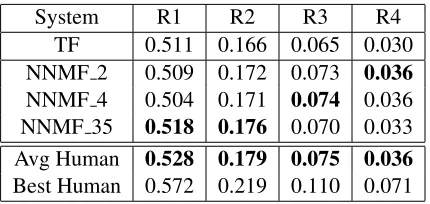
System R1 R2 R3 R4 TF 0.511 0.166 0.065 0.030 NNMF 2 0.509 0.172 0.073 0.036
NNMF 4 0.504 0.171 0.074 0.036 NNMF 35 0.518 0.176 0.070 0.033 Avg Human 0.528 0.179 0.075 0.036
[image:4.612.79.294.53.155.2]Best Human 0.572 0.219 0.110 0.071
Table 1: Vector Space Model based on TF and NNMF
approximations for all values ofk ∈ [1,50]but did not observe improvements of the score beyond the scores shown in Table 1. Our experiments show that the NNMF rank approximation of the matrix re-sults in improved ROUGE scores compared to the baseline TF. It is also worth noting that the ROUGE scores of the best rank approximations are close to those of the averaged human ROUGE scores.
7 A Language Modeling Approach for Scientific Document Summarization We consider a language modeling approach to es-timate the importance of the terms in the referenced document to be summarized. This model is designed to estimate the probability that a term will occur in a human-generated summary of the referenced doc-ument. As described in section 3 a referenced docu-ment may be divided into abstract, results, and other parts and these in addition to the citances represent the “components” of the document, which are used to build the language model for the referenced doc-ument.
Specifically, we let p(i,jd) be the estimate of the probability that term ioccurs in document compo-nentj for the referenced documentd.The estimate ˆ
p(i,jd) is computed by the maximum likelihood esti-mate using the counts, and we then have
X
i
ˆ
p(i,jd)= 1.
The probability that termiwill occur in a human-generated summary of documentdis given byqi(d)
and we estimated it for the purposes of training it in one of two ways. The first is simply the max-imum likelihood model which sums the frequency observed in the human-generated summaries and
then normalizes to form a probability distribution. We denote this estimate asqˆi(d).
The second estimate for qi(d) uses a discount model and has a free parameterλ(d)with0≤λ(d)≤
1, which is used to compute a convex combina-tion of the estimatesqˆand the estimated probability distribution formed by human selected “referenced sentences.” The referenced sentences are those sen-tences in the reference document that best support the information given in the citances and were se-lected by the humans as they were gathering infor-mation to create their summaries. We letrˆi(d)be the maximum likelihood estimate that termioccurs in a reference sentence. The discount model estimate of
q(d)is then given by
˜
q(d)=λˆr(d)+ (1−λ)ˆq(d).
While discount model provides an opportunity to smooth estimates, we defer its study to a later pa-per since 10 document sets proved insufficient to demonstrate a significant improvement.
7.1 Training the Language Model
We model the distribution of the terms in the hu-man summaries as a simple mixture of the document components. As such, we expect that for a given document setd there exists a set of parametersαi
fori= 1,2, ..., kwherekis the number of compo-nents in the document set, such that
τ(α, λ) =X
i
αip(i,jd)≈q˜(d). (7.1.1)
Solving this equation in the least squares sense for both the parameters α and λ is the classical method of canonical correlation (Seber, 2004). Al-ternatively, we could seek to minimize a divergence function such as JS, i.e.,
[α, λ] =argmin JSD(X
i
αip(i,jd),q˜(d)).
of the probability that a term will occur in a human-generated summary given the component decompo-sition and the training data. The optional smooth-ing parameter,λused for mixing human summaries with the set of human extracts can be forced to 1 and the optimal α can be computed from approxi-mating the human abstract bigram distribution alone giving the term-weights for the unsmoothed proba-bilities. In addition to the term-weights, recall that a background model is used to discard bigrams with low mutual information as was described in section 4. The low mutual information terms are thus given a weight of 0.
7.2 Two Simple Language Models
Before discussing results of an optimized language model, we consider the special case of equal weight-ing of each document section. Recall that the sec-tions of interest for summarization were limited to the abstract, results, other parts, and the citing sen-tences from the documents that reference the doc-ument to be summarized. We consider the follow-ing two simple language models on the set of sig-nificantly high mutual information bigrams. In the first model we build a language model by combin-ing the four sections into one (LM1), and in the sec-ond model we compute the maximum likelihood for each section of the document combine them with equal weighting (LM4equal). The ROUGE-1, 2, 3, and 4 scores of LM1 and LM4equal as well as the
best and average of the nine human summarizer scores are given in Table 7.2. The lengths of both the machine and human generated summaries were limited to 250 words. Each of the differences be-tween the ROUGE scores of LM1and LM4equalare statistically significant at or above the 99% confi-dence level. We note that LM1 performs
compara-bly with TF baseline, whose term weights differ only by a scale factor. Furthermore, the equal weighting model scores higher than the average human and sig-nificantly better than even the NNMF methods given in section 6. Finally, we note that LM4opt,the lan-guage model that results via the JS optimization de-scribed in section 7.1, gives a slight improvement in each of the ROUGE scores, but there is no sta-tistically significant difference between the ROUGE scores for LM4optand LM4equal.
To measure the stability of the weighting
coef-System R1 R2 R3 R4
LM1 0.511 0.169 0.067 0.031
LM4equal 0.559 0.210 0.095 0.052
[image:5.612.317.534.53.141.2]LM4opt 0.562 0.216 0.100 0.055 Avg Human 0.528 0.179 0.075 0.036 Best Human 0.572 0.219 0.110 0.071 Table 2: ROUGE Results for Three Language Models and a Comparison to Human Performance
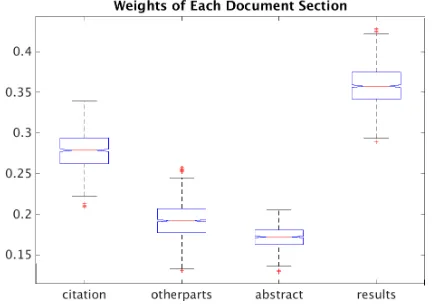
Figure 1: Language Model Coefficients for Document Sections
ficients learned by the optimization we performed 1000 trials of the optimization. In each trial a ran-dom subset of 10 of the reference papers and ci-tances were chosen to perform the JS optimization. Figure 1 gives a notched box plot of the result of the experiment. The experiment demonstrates that the result section is given a significantly higher weight than the citations. Surprisingly the abstract is given the lowest weight. Note that the median abstract length of a doucment is about 145 words while hu-man generated summaries are 250 words. Clearly, the human summarizers, having the freedom to write a summary longer than the median abstract length, chose to focused on the results section and the ci-tances and did not draw mainly from the abstract.
8 Conclusions
[image:5.612.319.536.196.350.2]terms for scientific document summarization3 that exploit the underlying structure of the document. Our vector space model uses the TF representation of the text and a low rank approximation of the term-sentence matrix using NNMF. The TF vector space model is a good basic model, but we showed that it benefits from low rank NNMF approxima-tion. The ROUGE scores of the summaries com-puted with NNMF exceeded those of the basic TF and were close to the average human ROUGE score. However given the humanly generated segmentation of a scientific paper (the sections abstract, result, other, and citances of the document) gives rise to a stronger language model that we show achieves a performance exceeding that of the average human in four ROUGE measures.
Acknowledgments
The authors would like to thank Jeff Kubina for his selection of the background corpus, PubMed, which was used in this work. In addition, we like to thank Dianne P. O’Leary and Judith D. Schlesinger for fruitful discussion and feedback on the training sum-maries. Finally, we thank Julie M. Conroy for her editing of this paper and for the suggestions by Jeff Kubina and Libby Beer, all of which made for a clearer and stronger paper.
References
John M. Conroy, Sashka T. Davis, Jeff Kubina, Yi-Kai Liu, Dianne P. O’Leary, and Judith D. Schlesinger. 2013. Multilingual Summarization: Dimensionality Reduction and a Step Towards Optimal Term Cover-age. InMultiLing Workshop, pages 55–63.
Sashka T. Davis, John M. Conroy, and Judith D. Schlesinger. 2012. OCCAMS - An Optimal Combina-torial Covering Algorithm for Multi-document Sum-marization. In Jilles Vreeken, Charles Ling, Mo-hammed Javeed Zaki, Arno Siebes, Jeffrey Xu Yu, Bart Goethals, Geoffrey I. Webb, and Xindong Wu, ed-itors, ICDM Workshops, pages 454–463. IEEE Com-puter Society.
Ted Dunning. 1993. Accurate methods for the statistics of surprise and coincidence. Computational Linguis-tics, 19(1):61–74.
3The models were applied to the NIST Biomedical Summa-rization data.
Chin-Yew Lin and Eduard Hovy. 2000. The automated acquisition of topic signatures for text summarization. In Proceedings of the 18th conference on Computa-tional linguistics, pages 495–501, Morristown, NJ, USA. Association for Computational Linguistics. Chin-Yew Lin, Guihong Cao, Jianfeng Gao, and Jian-Yun
Nie. 2006. An information-theoretic approach to au-tomatic evaluation of summaries. In Proceedings of the Main Conference on Human Language Technology Conference of the North American Chapter of the As-sociation of Computational Linguistics, HLT-NAACL ’06, pages 463–470, Stroudsburg, PA, USA. Associa-tion for ComputaAssocia-tional Linguistics.
Annie Louis and Ani Nenkova. 2009. Automatically evaluating content selection in summarization without human models. In Proceedings of the 2009 Confer-ence on Empirical Methods in Natural Language Pro-cessing, pages 306–314, Singapore, August. Associa-tion for ComputaAssocia-tional Linguistics.
The National Institute of Health. 2014. Pubmed.
http://www.ncbi.nlm.nih.gov/pubmed.
Vahed Qazvinian and Dragomir R. Radev. 2008. Sci-entific paper summarization using citation summary networks. InProceedings of the 22Nd International Conference on Computational Linguistics - Volume 1, COLING ’08, pages 689–696, Stroudsburg, PA, USA. Association for Computational Linguistics.