Pragmatic Rejection
∗ Julian J. Schl¨oder and Raquel Fern´andez Institute for Logic, Language and ComputationUniversity of Amsterdam
[email protected],[email protected]
Abstract
Computationally detecting the accepting/rejecting force of an utterance in dialogue is often a com-plex process. In this paper we focus on a class of utterances we callpragmatic rejections, whose rejection force arises only by pragmatic means. We define the class of pragmatic rejections, present a novel corpus of such utterances, and introduce a formal model to compute what we call rejections-by-implicature. To investigate the perceived rejection force of pragmatic rejections, we conduct a crowdsourcing experiment and compare the experimental results to a computational simulation of our model. Our results indicate that models of rejection should capture partial rejection force.
1 Introduction
Analysing meaning in dialogue faces many particular challenges. A fundamental one is to keep track of the information the conversing interlocutors mutually take for granted, theircommon ground(Stalnaker, 1978). Knowledge of what is—and what is not—common ground can be necessary to interpret elliptical, anaphoric, fragmented and otherwise non-sentential expressions (Ginzburg, 2012). Establishing and maintaining common ground is a complicated process, even for human interlocutors (Clark, 1996). A basic issue is to determine which proposals in the dialogue have been accepted and which have been
rejected: Accepted proposals are committed to common ground; rejected ones are not (Stalnaker, 1978). An important area of application is the automated summarisation of meeting transcripts, where it is vital to retrieve only mutually agreed propositions (Galley et al., 2004).
Determining the acceptance or rejection function of an utterance can be a highly nontrivial matter (Walker, 1996; Lascarides and Asher, 2009) as the utterance’s surface form alone is oftentimes not ex-plicit enough (Horn, 1989; Schl¨oder and Fern´andez, 2014). Acceptance may merely be inferable from arelevant next contribution(Clark, 1996), and some rejections require substantial contextual awareness and inference capabilities to be detected—for example, when the intuitive meaning of ‘yes’ and‘no’
is reversed, as in (1), or when the rejection requires some pragmatic enrichment, such as computing presuppositions in (2):1
(1) A: TVs aren’t capable of sending. B: Yes they are.
rejection
(2) A: You can reply to the same message. B: I haven’t got [the] message.
presupposition failure
Our main concern in this paper are rejections like (2) whose rejection force can only be detected by pragmatic means. Aside from presupposition failures, we are particularly concerned with rejections related to implicatures: either rejections-of-implicatures or rejections-by-implicature as in the following examples of scalar implicatures:2
∗The research presented in this paper has been funded by the European Community’s Seventh Framework Programme
(FP7/2007-2013) under grant agreement no. 567652ESSENCE: Evolution of Shared Semantics in Computational Environments
(http://www.essence-network.com/).
1Examples from the AMI Meeting Corpus (Carletta, 2007).
2Examples from the British National Corpus (BNC) (Burnard, 2000).
(3) A: That’s brilliant.
B: Well I thought that was quite good.
good, not necessarily brilliant
(4) A: It was good weren’t it? B: It’s brilliant.
not merely good
In both examples, B’s utterances do not seem to (fully) agree with their antecedent: In (3) B can be taken to implicate‘good not brilliant’, thereby disagreeing with A’s assertion; in (4), B can be taken to reject the same implicature attributed to A. We consider both examples to be what we callpragmatic rejections: utterances whose rejection force is indeterminable by purely semantic means. A particular feature of such rejections is that they areprima facienot in logical contradiction with their antecedent. Yet, as pointed out by Walker (2012), a widespread consent identifies rejection force with contradicting content.
We proceed as follows: In the next section, we give a more comprehensive account of what we intro-duced in the previous paragraph, offer a precise definition of the termpragmatic rejection, and discuss some associated problems. Afterwards, we review related literature, both on the topic of rejection com-puting and on the pragmatics of positive and negative answers. The main contributions of our work are a novel corpus of pragmatic rejections (Section 4), a formal model to compute rejections-by-implicature (Section 5), and a crowdsourcing experiment to gather agreement/disagreement judgements. In Section 6, we present the results of this experiment and compare them to a computational simulation of our model. We summarise our findings and conclude in Section 7.
2 Pragmatic Rejection
A commonly held view on rejection states that a speech event constitutes a rejecting act if and only if it is inconsistent in the dialogue context (e.g., in the formal model of Schl¨oder and Fern´andez, 2014). Under that conception, rejection is typically modelled as asserting the negative of a contextually salient proposition. However, as observed by Walker (1996, 2012), this does not give the full picture. A perfectly consistent utterance can have rejection force by a variety ofimplicatedinconsistencies:3
(5) A: We’re all mad, aren’t we? ∀x:M(x)
B: Well, some of us. ∃x:M(x)
not (necessarily) all of us ∃x:¬M(x)
(6) A: Check to see if your steak’s burning. B(s)
B: Well something’s bloody burning. ∃x:B(x)
not (necessarily) my steak ¬B(s)
(7) A: Maybe three days. t= 3
B: Three or four days. t= 3∨t= 4
not (necessarily) three ¬(t= 3)
(8) A: [Abbreviations are used] now in narrative and dialogue. N ∧D
B: Well, in dialogue it’s fine. D
not (necessarily) in narrative ¬N
What is remarkable about these rejections is that they are not only consistent with their antecedent, but are in fact informationally redundant—they are mere implications of the antecedent and as such intuitively innocuous. On the other hand, it is unexpected that a contradicting implicature4 can arise at all: Since implicatures can be cancelled by prior context, the occurrence of an inconsistent implicature is unexpected from a theoretical standpoint (Walker, 1996).
3Examples from the BNC (Burnard, 2000).
Already Horn (1989) observed that some rejections are not semantic in nature, leading him to coin the termmetalinguistic negation. Examples include rejections of implicatures, as in (9) and (10), or of presuppositions as in (11):5
(9) A: It’s your job.
your job alone
B: It’s our job.
(10) A: Three or four days.
exact value unknown
B: Well, four.
(11) A: Put a special colour of the buttons.
there are buttons
B: But we don’t have any buttons. Rejections of implicatures are also (semantically) consistent with their antecedent, though they need not be informationally redundant, and rejections of presuppositions only become inconsistent once the pre-supposition has been computed. These examples are also not accounted for by the standard approach: neither can their rejection force be determined by a simple search for inconsistency, nor do these rejec-tions amount to asserting the negative of their antecedent. In (9), B cannot be said to assert that it is not her job, she just takes offence to the connotation that it is her’s alone, and in (11), B also cannot be taken to assert that there shouldnotbe a special colour on the buttons. An interesting case of rejections-of-implicatures are utterances that are taken to be more general than their addressee is willing to accept. In the following examples, the offending implicature arises because B expected (or wanted) A to be more specific; the lack of specificity gives rise to a generalising implicature:6
(12) A: You like country. country in general
B: But not all country. (13) A: You love soap.B: I love lovely soaps.soaps in generalnot all soaps
Example (13) is a particular case where it is both an implicature that is rejected, and an implicature that does the rejecting: A’s utterance is pragmatically enriched to a general interpretation by B, exactly as in (12), but instead of explicitly rejecting this, Aimplicatesthe rejecting‘not all’.
In general, when we speak of arejection(or more generally ofrejection force), we mean an answer to an earlier assertion or proposal that signals the speaker’s refusal to add the assertion/proposal’s content to the common ground. In particular, we exclude replies to questions from our study, since a negative answer to a polar question has a different influence on the common ground: it adds the negative coun-terpart of the question’s propositional content. From now on we say that an utterance is a pragmatic rejection if it has rejection force, but is semantically consistent with what it is rejecting. We restrict our discussion to the three types exemplified above: rejection-by-implicature, rejection-of-implicature and rejection-of-presupposition.7 We are concerned with the task of determining which utterances are (pragmatic) rejections,i.e., given a (consistent) utterance, how can we determine if it has rejecting force?
3 Related Work
A typical area of interest for rejection computing is the summarisation of multiparty meeting transcripts (Hillard et al., 2003; Hahn et al., 2006; Schl¨oder and Fern´andez, 2014) and online discussions (Yin et al., 2012; Misra and Walker, 2013). This body of work has identified a number of local and con-textual features that are helpful in discerning agreement from disagreement. However, their models—if explicated—rarely take pragmatic functions into account. Also, the task of retrieving rejections remains a computational challenge; Germesin and Wilson (2009) report high accuracy in the task of classifying utterances intoagreement / disagreement / other, but have0%recall of disagreements.
Walker (1996, 2012) first raised the issue ofimplicature rejection. Building on Horn’s (1989) land-mark exposition on negation and his discussion ofmetalinguisticrejections, she describes a new class of utterances which are not in contradiction with their antecedent, but nevertheless have rejection force. Her prototypical example is ‘A: There’s a man in the garage.’ – ‘B: There’s something in the garage.’
(similar to our (6)), where B’s utterance is clearly implied by A’s, but rejecting by virtue of a Quantity
5Examples (9) and (11) from the AMI Corpus (Carletta, 2007), and (10) from the BNC (Burnard, 2000). 6Example (12) from the Switchboard Corpus (Godfrey et al., 1992) and (13) from the BNC (Burnard, 2000).
implicature. An example where the rejecting speaker adds a disjunction, similar to our (7) (‘A: Maybe three days.’ – ‘B: Three or four days.’), was already discussed by Grice (1991, p. 82), though he did not make an explicit connection to rejectionsby implicatures,8 even though he mentions that there are rejectionsof implicatures. Walker (2012) is concerned with the question of why a rejecting implicature is not cancelled by prior context, and proposes to stratify the grounding process into different levels of
endorsement, where a tacit endorsement does not have cancellation force.
Potts (2011) and de Marneffe et al. (2009) have investigated a phenomenon similar to pragmatic rejection: They study answers to polar questions which are indirectin that they do not contain a clear
‘yes’ or‘no’ and therefore their intended polarity must be inferred—sometimes by pragmatic means. They describe answers that require linguistic knowledge—such as salient scales—to be resolved; these are similar to our examples (3) and (4). Potts (2011) reports the results of a crowdsourcing experiment where participants had to judge whether an indirect response stood for a‘yes’or a‘no’answer. He then analyses indirect responses by their relativestrengthcompared to the question radical. His experimental data shows that a weaker item in the response generally indicates a negative answer (‘A: Did you manage to read that section I gave you?’ – B: ‘I read the first couple of pages.’), while a stronger item in the response generally indicates a positive answer (‘A: Do you like that one?’ – ‘B: I love it.’). The former result corresponds to our rejection-by-implicature, while the latter is in contrast to our intuitions on rejection-of-implicature. As mentioned, our focus lies with rejections of assertions rather than answers to polar questions. Since the results of Potts and colleagues do not straightforwardly generalise from polar questions to assertions, we have adapted their methodology to conduct a study on responses to assertions; we return to this in Section 6.
4 A Corpus of Pragmatic Rejections
To our knowledge, there is currently no corpus available which is suitable to investigate the phenomenon of pragmatic rejection. We assembled such a corpus from three different sources: the AMI Meeting Corpus (Carletta, 2007), the Switchboard corpus (Godfrey et al., 1992) and the spoken dialogue section of the British National Corpus (Burnard, 2000). Since, generally, rejection is a comparatively rare phe-nomenon,9 pragmatic rejections are few and far between. As indicated above, we consider an utterance apragmatic rejectionif it has rejection force, but is not (semantically) in contradiction to the proposal it is rejecting. As it is beyond the current state of the art to computationally search for this criterion, our search involved a substantial amount of manual selection. We assembled our corpus as follows:
• The AMI Meeting Corpus is annotated with relations between utterances, loosely calledadjacency pairannotation.10 The categories for these relations includeObjection/Negative Assessment
(NEG)andPartial Agreement/Support (PART). We searched for allNEGandPARTadjacency
pairs where the first-part wasnotannotated as a question-type (Elicit-*) dialogue act, and
man-ually extracted pragmatic rejections.
• The Switchboard corpus is annotated with dialogue acts,11including the tagsarandarpindicating (partial) rejection. We searched for all turn-initial utterances that are annotated asarorarpand
manually extracted pragmatic rejections.
• In the BNC we used SCoRE (Purver, 2001) to search for words or phrases repeated in two adjacent utterances, where the second utterance contains a rejection marker like‘no’, ‘not’or turn-initial
‘well’; for repetitions with‘and’in the proposal or‘or’in the answer; for repetitions with an exis-tential quantifier‘some*’in the answer; for utterance-initial‘or’; and for the occurrence of scalar
8His (mostly unrelated) discussion centres on the semantics and pragmatics of the conditional‘if.’ He remarks in passing that replying‘X or Y or Z’to‘X or Y’rejects the latter, although “not as false but asunassertable” (his emphasis).
9Schl¨oder and Fern´andez (2014) report145rejections of assertions in Switchboard, and679in AMI; as the BNC contains mainly free conversation, rejections are expected to be rare dispreferred acts (Pomerantz, 1984). We also note that Walker (1996) did not report any “implicature rejections” or rejections-of-presupposition from her dataset.
implicatures by manually selecting scales and searching for the adjacent occurrence of different phrases from the same scale,e.g.,‘some – all’or‘cold – chilly’. We manually selected pragmatic rejections from the results.
Using this methodology, we collected a total of59pragmatic rejections. We categorised16 of those as rejections-of-implicature,33as rejections-by-implicature,4as both rejectinganimplicature and reject-ing by one, and6 as rejections-of-presupposition. All examples used in Section 2 are taken from our corpus.12 While this small corpus is the first collection of pragmatic rejections we are aware of, we note that it is ill-suited for quantitative analysis: On one hand, we cannot be sure that the annotators of the Switchboard and AMI corpora were aware of pragmatic rejection and therefore might have not treated them uniformly—in fact, that we found pragmatic rejections in AMI annotated asNEGand asPART
sup-ports this. On the other hand, our manual selection might not be balanced, since we cannot make any claims to have surveyed the corpora, particularly the BNC, exhaustively. In particular, that we did not find any rejections-by-presupposition should not be taken as an indication that the phenomenon does not occur.
5 Computing Rejections-by-Implicature
In this section we focus on the rejections-by-implicature. We contend that rejections-of-implicatures and rejections-of-presuppositions can be adequately captured by standard means to compute implicatures and presuppositions. For example in van der Sandt’s (1994) model, a rejection can address the whole informational content, including pragmatic enrichment, of its antecedent utterance. However, it is a challenge to formally determine the rejection force of a rejection-by-implicature (Walker, 2012). We present a formal model that accounts for rejections-by-implicature and directly generalises on approaches that stipulate rejection as inconsistency. As a proof of concept, we discuss an implementation of our model in a probabilistic framework for simulation.
5.1 Formal Detection
The examples for rejection-by-implicature we found share some common characteristics: they are all informationally redundant, and they are all rejections by virtue of a Quantity implicature (Grice, 1975).13 The crucial observation is that they are in fact not only informationally redundant, but are strictly less
informative than their antecedent utterance, if we were to consider both individually. Recall the examples from Section 2,e.g.:
(8) A: [Abbreviations are used] now in narrative and dialogue. N∧D
B: Well, in dialogue it’s fine. D
not (necessarily) in narrative ¬N
Now, the Quantity implicature can be explained by the loss of information: The less informative utterance expresses that the speaker is unwilling to commit to any stronger statement. The rejecting implicature is not cancelled because the rejecting speaker does not ground the prior utterance—does not make it part of her individual representation of common ground—and hence it has no influence on the implicatures in her utterance. This is partially modelled by theories making use of structured contexts, e.g., KoS (Ginzburg, 2012) or PTT (Poesio and Traum, 1997). In such models, an utterance would be marked as pending until grounded (or rejected) by its addressee. However, this raises a complication in how exactly the pending utterances influence implicature computation: For the implicature‘not in narrative’to arise in example (8) above, A’s utterance must be taken into account. Hence the utterance’s informational content is available to compute an implicature, but unable to cancel it. Instead of resolving this tension,
we present an account that sidesteps the problem of cancellation altogether by utilising the informational redundancy of rejections-by-implicature.
An informationally redundant utterance servesa priori no discourse function, therefore some ad-ditional reasoning is required to uncover the speaker’s meaning (Stalnaker, 1978). In particular, an utterance mayappear to be informationally redundant, but only because the speaker’s context has been misconstrued: If we attribute too narrow a context to the utterance, it might justseemredundant. Hence we propose the following: If an utterance is informationally redundant, its informational content should be evaluated in the (usually wider)prior context,i.e., in the context where the preceding utterance was made. If, then, the utterance turns out to be less informative than its antecedent, it is a pragmatic re-jection. We call the enlargement of the context thepragmatic step. Note that the pragmatic step itself makes no reference to any implicatures or to the rejection function or the utterance, thereby avoiding the cancellation problem.
We claim that this easily extends current models that adhere to arejection as inconsistencyparadigm. As a demonstration, we present the appropriate account in possible world semantics. LetJ·K·stand for the context update function, mapping sets of possible worlds to smaller such sets:JuKcis the information
state obtained by utteringuinc. We now describe when utteranceu2rejects the previous utteranceu1.
For brevity, writec1 for the context in whichu1 is uttered, andc2 = Ju1Kc1 foru2’s context. Then we can attempt a definition:
u2rejectsu1if(Ju2Kc2 =∅)∨(Ju2Kc2 =c2∧Ju2Kc1 )Ju1Kc1).
That is, u2 has rejecting force if it is a plain inconsistency (reducing the context to absurdity), or if
it is informationally redundant (does not change the context) and is properly less informative than its antecedent (would result in a larger context set if uttered in the same place). If we stipulate that the context update function captures pragmatic enrichment,i.e., computes implicatures and presuppositions, then we capture the other pragmatic rejections by the inconsistency condition.
However, a technicality separates us from the complete solution: The rejecting utteranceu2 might
be—and frequently is—non-sentential and/or contain pronominal phrases relating tou1. That means that
it actually cannot be properly interpreted in the prior context: the informational content ofu1is required
after all. Consider for example the following rejection-by-implicature:
(14) A: Four. Yeah. x= 4
B: Or three. x= 4∨x= 3
not (necessarily) four ¬(x= 4)
Here, B’s utterance requires the contextual information of A’s previous turn to have the meaning‘four or three.’ To account for this, we need to separate the context into acontext of interpretation(the discourse context, including everything that has been said) and a context of evaluation(the information against which the new proposition is evaluated) and only do the pragmatic step on the evaluative context. Now, our model for rejection in possible world semantics reads as:
u2rejectsu1 if(Ju2Kd2,e2 =∅)∨(Ju2Kd2,e2 =e2∧Ju2Kd2,e1 )Ju1Kd1,e1).
Whered1andd2are the interpretative contexts in whichu1 andu2 are uttered, respectively, ande1and e2are the corresponding evaluative contexts. Here,JuKd,emaps an utteranceu, an interpretative context dand an evaluative contexteto an evaluative context: The context obtained by interpretinguindand updatingewith the result.
from thejoint beliefsand use the former to facilitate utterance interpretation. This roughly corresponds to our separation of interpretative and evaluative context.
This characterisation of rejection describes all semantic rejections, understood as inconsistencies, and adds the rejections-by-implicature via the pragmatic step. It does not overcommit either: An acceptance, commonly understood, is either more informative than its antecedent (a relevant next contribution), or informationally redundant when mirroring the antecedent utterance,14 but then notlessinformative in the prior context. This includes the informationally redundant acceptance which puzzled Walker (1996):
(15) A: Sue’s house is on Chestnut St. B: on Chestnut St.
Walker (1996) claims that (15) is informationally redundant and less informative than the antecedent, hence it is expected to be an implicature rejection—but factually is a confirmation. Our model solves the issue: If B’s non-sentential utterance is enriched by the interpretative context in the aftermath of A’s utterance, it hasexactlythe informational content of its antecedent, and therefore is correctly predicted to be accepting.
5.2 Computational Simulation
The probabilistic programming language Church (Goodman et al., 2008) has been put forward as a suit-able framework to model pragmatic reasoning. As a proof of concept, we have implemented our formal model on top of an implementation of Quantity implicatures by Stuhlm¨uller (2014). The implementa-tion models two classically Gricean interlocutors: Speakers reason about raimplementa-tional listener behaviour and vice versa. Stuhlm¨uller’s (2014) original model simulated scalar implicatures; we adapted his model to capture the‘and’/‘or’implicatures of examples (7) and (8).
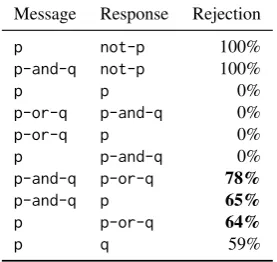
Message Response Rejection
p not-p 100%
p-and-q not-p 100%
p p 0%
p-or-q p-and-q 0%
p-or-q p 0%
p p-and-q 0%
p-and-q p-or-q 78%
p-and-q p 65%
p p-or-q 64%
[image:7.595.375.514.389.520.2]p q 59%
Table 1: Probabilities (1000 sam-ples) that a pragmatically reasoning speaker would recognise a rejection. The world in our model has two states,pandq, that can each
be true or false. The speaker’s vocabulary is{neither, p, q, not-p, not-q, p-or-q, p-and-q}. The listener guesses the
state of the world as follows: Given a message, the listener rea-sons by guessing a rational speaker’s behaviour given a rational listener; ‘guessing’ is done via sampling functions built into the programming language. For example, the messagep-and-q
un-ambiguously communicates thatp∧q, because no rational listener would conclude fromp-and-qthat¬por¬q. On the other hand, p-or-qis taken to communicatep∧ ¬qand¬p∧qin about40%
of samples each and p∧q in about 20% of samples, since all three states are consistent with the message, but a rational speaker would rather choosep-and-qinp∧qbecause it is unambiguous.
The messagepinduces the belief thatp∧ ¬qin roughly 65% of samples, andp∧qin the remaining
35%. Again this is due to the fact thatp∧ ¬qis indeed best communicated byp, whereasp∧qis better
communicated by p-and-q—the listener cannot exclude thatq holds but thinks it less likely than ¬q
because different speaker behaviour would be expected ifqwere true.
For the implementation of rejection-by-implicature, we proceed as follows: Given a proposal and a response, obtain a belief by sampling a state of the world consistent with rational listener behaviour when interpreting theresponse: this is evaluating the response in the prior context,i.e., computing what would happen if the speaker would utter the response instead of the proposal. Then check if this belief could have also been communicated by the proposal; ifnot, then the response is less informative (because it is consistent with more beliefs) than the proposal, and the model judges the response as rejecting. In each sample, the model makes a binary choice on whether it judges the response as rejecting or accepting.
We report some test runs of the simulation in Table 1, where for each proposal–response pair we computed1000samples. We observe that semantic rejections (i.e., inconsistencies) are assigned rejection
In the following dialogues, speaker A makes a statement and speaker B reacts to it, but rather than simply agreeing or disagreeing by saying Yes/No, B responds with something more indirect and complicated. For instance:
A: It looks like a rabbit. B: I think it’s like a cat.
Please indicate which of the following options best captures what speaker B meant in each case: • B definitely meant to agree with A’s statement.
• B probably meant to agree with A’s statement. • B definitely meant to disagree with A’s statement. • B probably meant to disagree with A’s statement.
In the sample dialogue above the right answer would be “B definitely meant to disagree with A’s statement.” Cautionary note: in general, there is no unique right answer. However, a few of our dialogues do have obvious right answers, which we have inserted to help ensure that we approve only careful work.
Figure 1: CrowdFlower prompt with instructions, adapted from Potts (2011).
force with 100% confidence, and utterances intuitively constituting acceptances are never considered rejections. Some of the acceptances might be rejections-of-implicatures (being strictly more informative than the message they are replying to), but since our model does not pragmatically enrich the message, these are not found. In fact, it is not clear to us when, without further context or markers, replyingp
(orp-and-q) top-or-qis an acceptance-by-elaboration or a rejection-of-implicature:15, are required to
make the distinction; this also fits our experimental results below. An implicature like p-or-q ¬p
needs to be computed elsewhere if at all.
Implicature rejections are not assigned100%rejection force due to the probabilistic model for prag-matic reasoning. Since, per the model, the utterancep-or-qinduces the belief thatp∧qin at least some
samples, the listeners cannot always recognize thatp-or-qis an implicature rejection ofp-and-q. In
fact, the confidence that something is an implicature rejection scales with how well—how often—the implicature itself is recognized. Replying qtopis computed to be a rejection, because in the modelq
implicates that¬p, as every utterance is taken to be about the state of bothpandq.16 In fact, replyingq topis also a rejection-of-implicature, aspalso implicates¬q. However, as pointed out above, our model
does not capture this.
6 Annotation Experiment
In order to investigate the perceived rejection force of pragmatic rejections, we conducted an online annotation experiment using the corpus described in Section 4.
6.1 Setup
We adapted and closely followed the experimental setup of Potts (2011). The annotators were asked to rank the dialogues in our corpus on a 4-point scale: ‘definitely agree’, ‘probably agree’, ‘probably disagree’ and‘definitely disagree’. The instructions given to the participants, recruited on the crowd-sourcing platform CrowdFlower,17 are recorded in Figure 1. Like Potts (2011), we curated our corpus for the purposes of the annotation experiment by removing disfluencies and agrammaticalities to ensure that the participants were not distracted by parsing problems, as well as any polarity particles (including
‘yeah’and‘no’) in the response utterance.
To ensure the quality of the annotation, we included some agreements and semantic disagreements as control items in the task.18Participants who ranked a control agreement as disagreeing or vice versa were excluded from the study. Some control items were chosen to require a certain amount of competence
15We hypothesise that more subtle cues, particularly intonation and focus
16Due to this closed world assumption, we cannot say that this is a Relevance implicature. 17http://www.crowdflower.com
Rejection- by-implicature of-implicature both of-presupp. Total
or and generalise restrict scalar or generalise scalar
Raw number 12 5 2 3 11 1 8 7 4 6 59
Judged disagreeing 58% 17% 0% 26% 51% 21% 61% 42% 40% 68% 47%
Std. deviation 0.31 0.22 0 0.10 0.38 – 0.30 0.35 0.34 0.37 0.34
Table 2: Average percentage of‘probably/definitely disagreeing’judgements by category.
in discerning agreement from disagreement. For example, (16) is an agreement despite the negative polarity particle‘no’appearing, and (17) is an agreement move that requires an inference step with some substantial linguistic knowledge; (18) is an example for clear-cut agreement.
(16) A: I think wood is not an option either.
B: No, wood’s not an option. (17) A: We can’t fail.B: We fitted all the criterias.(18) A: It’s a giraffe.B: A giraffe okay. We added20control agreements and10control disagreements to our corpus of pragmatic rejections, and presented each participant9dialogues at a time:6pragmatic rejections and3control items. Thereby we constructed 10sets of dialogues, each of which was presented to30different participants. We filtered out participants who failed any of our control items from the results. The amount of filtered judgements was as high as33% on some items. Polarity reversals like (16) were particularly effective in filtering out careless participants: Failure to recognise a polarity reversal shows a lack of contextual awareness, which is vital to judge pragmatic rejections.
6.2 Results and Discussion
For each item, we computed the percentage of participants who judged it as having rejecting force,i.e., as either‘probably disagree’or‘definitely disagree’; see Table 2 for an overview of the results by category. To better understand our results, we classified the rejections-by/of-implicatures further by the implicature that gives rise to the rejection. We found the following sub-types in our dataset:
Rejections by means of an implicature:
– or-implicature as in (7): ‘A: Maybe three days.’ – ‘B: Three or four days.’
– and-implicature as in (8): ‘A: . . . in narrative and dialogue.’ – ‘B: Well, in dialogue.’
– generalisingimplicature as in (6):‘A: . . . your steak’s burning.’ – ‘B: Well, something’s burning.’
– restrictingimplicature as in (5):‘A: We’re all mad.’ – ‘B: Some of us.’19
– scalarimplicature as in (3):‘A: That’s brilliant.’ – ‘B: [it] was quite good.’
Rejections of an implicature:
– or-implicature as in (10): ‘A: Three or four days.’ – ‘B: Well, four.’
– generalisingimplicature as in (12):‘A: You like country’ – ‘B: But not all country.’
– scalarimplicature as in (4):‘A: It was good weren’t it?’ – ‘B: It’s brilliant.’
Overall, about half of all judgements we collected deemed an item to have rejection force. These judge-ments were again split roughly 50-50 into‘probably disagree’and‘definitely disagree.’ When a judge-ment did not indicate rejection force, ‘probably agree’ was the preferred category, chosen in78% of
‘agree’ judgements. However, we saw substantial variation in the judgements when categorising the pragmatic rejections as above.20
Most notably, the two rejections by generalising implicature were never judged to have rejection force. Our hypothesis is that this is due to the fact that the surface form of these implicatures repeats some central phrase from their antecedent, and they are therefore taken to agreepartially, which leads
19While this example could technically be considered a scalar implicature, we takeall-someto be a special case of removing information; one can also restrict by adding adjectives to disagree with a universal statement, as in (13): ‘A: You love [all] soap.’ – ‘B: I love lovely soaps.’
them to be judged as‘probably agree.’ For example, in the rejection by a generalising implicature (6), the interlocutors are apparently considered to agree on ‘somethingburning.’ The same observation holds for rejections byand-implicature,e.g., in (8) the interlocutors might be judged to agree on the ‘usagein dialogue.’ In contrast, rejections byor-implicature and by scalar implicature stand out as being judged disagreeing more often:58%and51%, respectively. In our corpus, the surface form of such implicatures does not typically involve the repetition of a phrase from their antecedent. As a case in point, the rejection by or-implicature (14)‘A: Four. Yeah.’ – ‘B: Or three.’ was judged to have rejection force much more frequently (86%) than the similar (7)‘A: Maybe three days.’ – ‘B: Three or four days.’(40%) where B repeats part of A’s proposal.21 We think that other linguistic cues from the utterances’ surface forms, as well as the information structure the subjects read off the written dialogue, also had an influence on the perceived force of the responses. In particular, we attribute the high percentage of judged disagreements in the rejections of generalising implicatures (61%) to them being typically marked with the contrast particle‘but’—a well known cue for disagreement (Galley et al., 2004; Misra and Walker, 2013)
The rejections-of-presuppositions received the overall largest amount of rejection force judgements (68%). This is in accordance with previous work that has treated them in largely the same way as typical explicit rejections (Horn, 1989; van der Sandt, 1994; Walker, 1996). In particular, all rejections-of-presuppositions in our corpus correspond to utterances annotated asNegative Assessmentin the AMI
Corpus. That even these utterances received a substantial amount of ‘probably agree’judgements puts the overall results into context: The subjects show a noticeable tendency to choose this category.
The experimental results in Table 2 should not be compared quantitatively with the simulation out-come in Table 1, Section 5.2. The judgement scale in the experiment is in no direct relation with the prob-abilistic reasoning in the simulation. Qualitatively speaking, however, the experiment shows a difference in how rejections byor- andand-implicatures are perceived, whereas the simulation yields nigh-identical results for these two. This could be due to linguistic cues simply not present in the simulation, and due to participants in the experiment choosing‘probably agree’when they perceivedpartialagreement in a dialogue. In contrast to such ‘partial’ judgements, our formal model considers agreement/disagreement as a binary distinction and infers full disagreement from slight divergences in informational content. We conclude from the experiment that this binary assumption should be given up, also in the probabilistic implementation, where the probabilities represent uncertainty about the world rather than the kind of partial agreement/disagreement that seems to be behind our experimental results.
7 Conclusion and Further Work
We have laid out the phenomenon of pragmatic rejection, given it a general definition, and assembled a small corpus of such rejections. While we cannot give a full formal treatment of pragmatic rejection here, our formal model improves over extant work by capturing rejections-by-implicature. A simula-tion of the model has shown that it yields theoretically desirable results for agreements and semantic disagreements and predicts rejection force of rejections-by-implicature. Compared to our annotation experiment, however, the model lacks sophistication in computing what is apparently perceived as par-tial agreement/disagreement. The pragmatic rejections we collected were judged to have rejection force only about half of the time, and otherwise our subjects showed a preference for the category‘probably agree.’We tentatively attribute this to linguistic cues, related to the surface form of some pragmatic re-jections, which led the annotators to consider them partial agreements. We leave a deeper investigation into these cues, including intonation and focus, to further work
In sum, while our model accounts for more data than previous approaches, we conclude that a more sophisticated model for rejection should give up the agree/disagree binary and account for utterances that fall inbetween; the data and analysis we presented here should be helpful to guide the development of such a model. Computing partial rejection force, particularly which partof an antecedent has been accepted or rejected, is part of our ongoing work.
References
Burnard, L. (2000). Reference Guide for the British National Corpus (World Edition). Oxford University Com-puting Services.
Carletta, J. (2007). Unleashing the killer corpus: experiences in creating the multi-everything AMI Meeting Corpus.Language Resources and Evaluation 41(2), 181–190.
Clark, H. H. (1996).Using language. Cambridge University Press.
Galley, M., K. McKeown, J. Hirschberg, and E. Shriberg (2004). Identifying agreement and disagreement in conversational speech: Use of Bayesian networks to model pragmatic dependencies. InProceedings of ACL’04. Germesin, S. and T. Wilson (2009). Agreement detection in multiparty conversation. InProceedings of the 2009
international conference on Multimodal interfaces.
Ginzburg, J. (2012). The Interactive Stance. Oxford University Press.
Godfrey, J. J., E. C. Holliman, and J. McDaniel (1992). SWITCHBOARD: Telephone Speech Corpus for Research and Development. InProceedings of ICASSP’92.
Goodman, N. D., V. K. Mansinghka, D. M. Roy, K. Bonawitz, and J. B. Tenenbaum (2008). Church: a language for generative models. InProceedings of Uncertainty in Artificial Intelligence.
Grice, H. P. (1975). Logic and conversation. InSyntax and Semantics,Vol. 3, pp. 41–58. Acad. Press. Grice, H. P. (1991).Studies in the Way of Words. Harvard University Press.
Hahn, S., R. Ladner, and M. Ostendorf (2006). Agreement/disagreement classification: Exploiting unlabeled data using contrast classifiers. InProceedings of HLT-NAACL 2006.
Hillard, D., M. Ostendorf, and E. Shriberg (2003). Detection of agreement vs. disagreement in meetings: training with unlabeled data. InProceedings of HLT-NAACL 2003.
Horn, L. R. (1989).A Natural History of Negation. University of Chicago Press.
Lascarides, A. and N. Asher (2009). Agreement, disputes and commitments in dialogue. Journal of Seman-tics 26(2), 109–158.
de Marneffe, M.-C., S. Grimm, and C. Potts (2009). Not a simple yes or no: Uncertainty in indirect answers. In Proceedings of the SIGDIAL 2009 Conference.
Misra, A. and M. Walker (2013). Topic independent identification of agreement and disagreement in social media dialogue. InProceedings of the SIGdial 2013 Conference.
Poesio, M. and D. Traum (1997). Conversational actions and discourse situations. Computational Intelli-gence 13(3), 309–347.
Pomerantz, A. (1984). Agreeing and disagreeing with assessments: Some features of preferred/dispreferred turn shapes. InStructures of Social Action. Cambridge University Press.
Potts, C. (2011). The indirect question-answer pair corpus. http://compprag.christopherpotts.net/iqap. html. Accessed: 2014-11-24.
Purver, M. (2001). SCoRE: A tool for searching the BNC. Technical Report TR-01-07, Department of Computer Science, King’s College London.
van der Sandt, R. A. (1994). Denial and negation.Unpublished manuscript, University of Nijmegen.
Schl¨oder, J. J. and R. Fern´andez (2014). The role of polarity in inferring acceptance and rejection in dialogue. In Proceedings of the SIGdial 2014 Conference.
Stalnaker, R. (1978). Assertion. InSyntax and Semantics,Vol. 9, pp. 315–332. Academic Press.
Stuhlm¨uller, A. (2014). Scalar Implicature. http://forestdb.org/models/scalar-implicature.html.
Ac-cessed: 2014-11-24.
Walker, M. A. (1996). Inferring acceptance and rejection in dialogue by default rules of inference. Language and Speech 39(2-3), 265–304.
Walker, M. A. (2012). Rejection by implicature. InProceedings of the Annual Meeting of the Berkeley Linguistics Society.