Using Positional Suffix Trees to Perform Agile Tree Kernel Calculation
Gustavo Henrique Paetzold
University of Sheffield / Sheffield, United Kingdom [email protected]
Abstract
Tree kernels have been used as an efficient solution for many tasks, but are difficult to calculate. To address this problem, in this paper we introduce the Positional Suf-fix Trees: a novel data structure devised to store tree structures, as well as theMFTK
andEFTK algorithms, which use them to estimate Subtree and Subspace Tree Ker-nels. Results show that the Positional Suf-fix Tree can store large amounts of trees in a scalable fashion, and that our algorithms are up to 22 times faster than the state-of-the-art approach.
1 Introduction
A tree kernel is a type of convolution kernel that represents as features the substructures that com-pose a tree. They can be interpreted as a func-tion K(T1,T2), of which the value is a
similar-ity measure between tree structures T1 and T2.
Recently, tree kernels have become popular, and shown to be an efficient solution in tasks such as Question Classification (Moschitti, 2006), Re-lation Extraction (Zelenko et al., 2003), Named Entity Recognition (Culotta and Sorensen, 2004), Syntactic Parsing (Collins and Duffy, 2002), Se-mantic Role Labeling (Moschitti, 2006), SeSe-mantic Parsing (Moschitti, 2004), Glycan Classification (Yamanishi et al., 2007) and Plagiarism Detection (Son et al., 2006).
However efficient, tree kernels can be very difficult to calculate in a reasonable amount of time. CalculatingK(T1,T2)usually requires many
verifications between node labels and can eas-ily achieve quadratic complexity. Although algo-rithms of much lower complexity have been pro-posed (Moschitti, 2006), their performance can still be unsatisfactory in solving problems which involve large datasets.
In this paper, we present the findings of an on-going work which focuses on proposing faster al-gorithms for the calculation of tree kernels. Our strategy uses a time-space tradeoff: we reduce processing time by querying syntactic patterns stored in a Positional Suffix Tree (PST), a novel data structure devised for the storage of trees and graphs. We introduce the the MFTK and EFTK
algorithms, which use PST’s to calculate Subtree (ST) and Subspace Tree Kernels (SST). Our ex-periments show that, while theMFTKalgorithm is over 3.5 times faster than the state-of-the-art algo-rithm, theEFTKalgorithm is over 22 times faster. We also demonstrate that PST’s grow in log-linear fashion, scaling well to large tree datasets.
2 Positional Suffix Trees
In order for us to create faster algorithms for the calculation of tree kernels, we have conceived the Positional Suffix Tree: an adaptation of the well known Suffix Tree (Weiner, 1973). Its goal is to store tree structures, such as syntactic parses, and allow efficient search for patterns in them. In other words, it is a tree that stores other trees. To avoid confusion, throughout the rest of the paper we will refer to PST nodes as “trie nodes”.
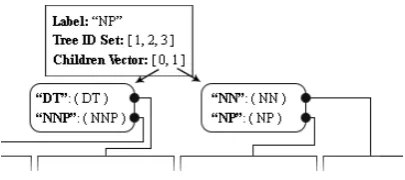
Each trie node of the PST represents a tree node of a certain label in a given position. In con-stituency parses, for an example, a trie node could represent an “NP” (Noun Phrase) node as the left-most child of an “S” (Sentence) node. A PST trie node is composed of the following components:
• Label: The identifier of the tree node being represented, such as “DT”.
• Tree ID Set: A set containing the identi-fiers of each and every tree added to the PST which contains the tree node in question.
• Children: A vector of sizen, wherenis the
the tree node in question. In each position
iof the children vector is stored a hash struc-tureHthat maps the set of tree node labelsL
to the trie nodes that represent them. TheL
set contains all the labels of child nodes ob-served in positioniparented by the tree node in question.
[image:2.595.96.266.221.271.2]As an example, consider the trie node that repre-sents the “NP” node highlighted in the three parse trees of Figure 1.
[image:2.595.80.283.334.424.2]Figure 1: Parse trees with “NP” node
Figure 2 illustrates such trie node.
Figure 2: Valid PST trie node
Differently from standard Suffix Trees, the PST node labels can be of any hashable type, any node can have one or more children, and the ordering of a trie node’s children is not determined by the alphabetical order of their labels, but rather the po-sition in which the children nodes appear in each tree individually.
3 Tree Kernel Modeling
Our algorithms calculate two types of kernels: the Subtree and the Subspace Tree Kernels. Given two tree structures, the Subtree Kernel (Vishwanathan and Smola, 2004) represents the overlap of “sub-trees” between them, which consist of every non-leaf node along with all its descendants. The Sub-space Kernel (Collins and Duffy, 2002), on the other hand, represents the overlap of “subspace trees”, which are all subtrees and their general-ized versions, where some or all of their leaves can be non-terminals. While theEFTK algorithm explores those definitions directly, the MFTK al-gorithm explores the ST/SST model of Moschitti
(2006), in which the kernel value between two trees is represented as:
K(T1,T2) =
∑
n1∈NT1
∑
n2∈NT2
4(n1,n2) (1)
Where NTi is the set of nodes of tree Ti, and
4(n1,n2) is a function that represents the
simi-larity between nodesn1andn2, subject to the
fol-lowing rules:
• 4(n1,n2) =0 ifn16=n2
• 4(n1,n2) =α ifn1=n2and bothn1andn2
are leaf nodes.
• Otherwise:
4(n1,n2) =α
nc(n1)
∏
j=1
σ+4 cnj1,c
j n2
(2)
Whereαis a decay factor andσ∈ {0,1}. When σ =0, K(T1,T2) calculates the ST Kernel, and
whenσ =1, the SST Kernel.
4 Algorithms
4.1 PST Storing Algorithm
The recursive algorithm below adds a nodeNt of a given tree identified by ID in position i of the children vector of trie nodeNpst.
AlgorithmAddNode(Nt,ID,i,Npst): 1. C=Npst.Children
2. L=Nt.Label 3. ifLinC[i]: 4. thenN=C[i][L]
5. else N= new PSTNode()
6. N.Label =L
7. C[i][L] =N
8. AddIDinN.TreeIDSet 9. for jin[0,kNt.Childrenk]: 10. Ct =Nt.Children[j] 11. AddNode(Ct,ID, j,N)
4.2 TheMFTKAlgorithm
maps the subtrees’ IDs to its respective tree Tj. The algorithm below creates a valid PST and M
map.
AlgorithmCreatePST(Ti,T1, ... ,Tn):
1. PST = new PST()
2. M= new Hash() 3. foriin[1,n]:
4. forcinTi.Nodes:
5. ID= new ID()
6. AddNode(c,ID, 0,PST.Root)
7. M[ID] =i
8. returnPST,M
Given a PST, a map M, α and a
σ ∈ {0,1}, the following algorithm calculates
K(Ti,{T1,T2, ... ,Tn−1,Tn}).
AlgorithmScore(PST,M,Ti,{T1, ... ,Tn},α,σ): 1. K= new Hash()
2. for jin[1,n]:
3. K[j] = 0
4. forcinTi.Nodes:
5. Ss=MFTK(c,PST.Root, 0,α,σ, nil) 6. forMatchinSs.Keys:
7. S=Ss[Match]
8. K[M[Match]] +=S
9. returnK
The functionMFTK, described in the algorithm below, uses the PST to estimate kernel values. It receives a tree nodeNt, a trie nodeNpst, a position
i, parametersα andσ and an auxiliary static hash
Ss. It returns a hashSs[Nt] which maps a subtree IDMatchto its ST/SST score.
AlgorithmMFTK(Nt,Npst,i,α,σ,Ss): 1. ifSsis nil:
2. thenSs= new Hash() 3. Ss[Nt] = new Hash()
4. Cpst =Npst.Children[i][Nt.Label] 5. forIDinCpst.TreeIDSet: 6. Ss[Nt] =α
7. for jin[0,kNt.Childrenk]: 8. Ntc=Nt.Children[j]
9. MFTK(Ntc,Cpst, j,α,σ,Ss)
10. Miss={Ss[Nt].Keys}-{Ss[Ntc].Keys} 11. forIDinSs[Ntc].Keys:
12. Ss[Nt][ID] *=σ +Ss[Ntc][ID] 13. forIDinMiss:
14. Ss[Nt][ID] *=σ
15. returnResult=Ss[Nt]
4.3 TheEFTKAlgorithm
The EFTK (Even Faster Tree Kernel) algorithm uses a very unique strategy: instead of using the model of Moschitti (2006), it calculates the num-ber of common subtrees between two tree struc-tures directly. TheEFTKcan only calculate the ST Kernel. It employs the sameCreatePSTandScore
routines described in Section 4.2, but instead of theMFTKfunction, it applies the one below.
AlgorithmEFTK(Nt,Npst,i,Ss): 1. Cpst =Npst.Children[i][Nt.Label] 2. ifSsis nil:
3. thenSs=Cpst.TreeIDSet 4. else Ss=Ss∩Cpst.TreeIDSet 5. for jin[0,kNt.Childrenk]: 6. Ct =Nt.Children[j]
7. ifCt.Label inCpst.Children[j].Keys: 8. thenEFTK(Ct,Cpst, j,Ss)
9. else Ss={}
10. Result= new Hash() 11. forIDinSs:
12. Result[ID] = 1 13. returnResult
5 Experiments
5.1 Performance Comparison
In this experiment, we conduct a performance comparison between the MFTK and EFTK algo-rithms, the baseline QTK (Quadratic Tree Kernel) and the state-of-the-art FTK (Fast Tree Kernel), both of which were proposed by Moschitti (2006). We have chosen to estimate the processing time taken by the algorithms to calculate the kernel val-ues between the constituency parses produced by the Stanford Parser (Klein and Manning, 2003) of 500 test and 5452 training questions. The datasets were devised for the task of Question Classifica-tion (Li and Roth, 2002). The algorithms were im-plemented in Python, and ran in a computer with a quad-core IntelR Core i7-4500U 1.8GHz and
8Gb of RAM running at 1600MHz. Since the time taken by both FTK andMFTKto calculate ST and SST kernels do not vary, we choose to present the performance results for ST kernel calculation only. Figure 3 illustrate the results obtained for increas-ing portions of the trainincreas-ing set, and Figure 4 the average time taken to calculateK(Ti,Ti) forTi of different node sizes.
Figure 3: Processing time over different portions of the dataset
Figure 4: Processing time over trees of different node sizes
the EFTK algorithm is on average 22.15 times faster. It can also be noticed that, while the pro-cessing time ofEFTKgrows almost linearly as the number of nodes rise, the FTK shows a square-like behavior, which is also outperformed by the
MFTKalgorithm.
5.2 Storage Scalability
In this experiment, we evaluate how well Po-sitional Suffix Trees scale with respect to large datasets. To that purpose, we chose to store a dataset of 200k constituency parses of sentences taken from Wikipedia and Simple Wikipedia (Paetzold and Specia, 2013) in a PST, and collect statistics about its size. The PST was implemented in Python and the script ran in the same computer used in the experiment of Section 5.1. Figure 5 shows the number of trie nodes in the PST as the number of stored trees rise, and Figure 6 illustrates the average number of new PST trie nodes added after each tree is stored.
[image:4.595.309.532.61.179.2]It is noticeable that the curve in Figure 5 shows a convergence pattern, which is in conformity with what is observed in Figure 6, where it is shown that the number of average new nodes tends to converge to an ever lower amount. Such phenom-ena provide evidence that the PST can indeed store
Figure 5: Number of trie nodes over the numbers of trees stored
Figure 6: Average number of new trie nodes over the number of trees stored
large amounts of tree structures in a scalable fash-ion, since the more trees are added, the less it needs to grow to represent them.
6 Conclusions and Future Work
In this paper we have introduced the Positional Suffix Tree, a data structure designed to store trees and graphs, and also two algorithms which use them to estimate Subtree and Subspace Tree Ker-nel values: theMFTKand theEFTK.
Our experiments revealed that, while theMFTK
algorithm calculates both ST and SST Kernels in nearly half an order of magnitude faster than state-of-the-art algorithms, the EFTK algorithm calcu-lates ST Kernels over an order of magnitude faster. We have also found that the PST provides a scal-able storage solution for syntactic parse trees.
In the future we intend to devise algorithms for other kernels, such as the Partial Tree Kernel (Moschitti, 2006), and also explore ways to cal-culate approximate, faster to estimate, versions of such kernels.
Acknowledgments
[image:4.595.309.525.223.352.2] [image:4.595.73.289.226.342.2]References
Michael Collins and Nigel Duffy. 2002. New rank-ing algorithms for parsrank-ing and taggrank-ing: Kernels over discrete structures, and the voted perceptron. In Pro-ceedings of the 40th Annual Meeting on Association for Computational Linguistics, ACL ’02, pages 263– 270, Stroudsburg, PA, USA. Association for Com-putational Linguistics.
Aron Culotta and Jeffrey Sorensen. 2004. Dependency tree kernels for relation extraction. InProceedings of the 42nd Meeting of the Association for Compu-tational Linguistics (ACL’04), Main Volume, pages 423–429, Barcelona, Spain, July.
Dan Klein and Christopher D. Manning. 2003. Accu-rate unlexicalized parsing. InIn Proceedings of the 41st Annual Meeting of the Association for Compu-tational Linguistics, pages 423–430.
Xin Li and Dan Roth. 2002. Learning question classi-fiers. InProceedings of the 19th International Con-ference on Computational Linguistics - Volume 1, COLING ’02, pages 1–7, Stroudsburg, PA, USA. Association for Computational Linguistics.
Alessandro Moschitti. 2004. A study on convolution kernels for shallow semantic parsing. In Proceed-ings of the 42Nd Annual Meeting on Association for Computational Linguistics, ACL ’04, Stroudsburg, PA, USA. Association for Computational Linguis-tics.
Alessandro Moschitti. 2006. Efficient convolution kernels for dependency and constituent syntactic trees. In ECML, pages 318–329, Berlin, Germany, September. Machine Learning: ECML 2006, 17th European Conference on Machine Learning, Pro-ceedings.
Gustavo H. Paetzold and Lucia Specia, 2013. Pro-ceedings of the 9th Brazilian Symposium in Infor-mation and Human Language Technology, chapter Text Simplification as Tree Transduction.
Jeong-Woo Son, Seong-Bae Park, and Se-Young Park. 2006. Program plagiarism detection using parse tree kernels. InProceedings of the 9th Pacific Rim International Conference on Artificial Intelligence, PRICAI’06, pages 1000–1004, Berlin, Heidelberg. Springer-Verlag.
S V N Vishwanathan and Alex Smola. 2004. Fast ker-nels for string and tree matching.
Peter Weiner. 1973. Linear pattern matching algo-rithms. In Proceedings of the 14th Annual Sym-posium on Switching and Automata Theory (Swat 1973), SWAT ’73, pages 1–11, Washington, DC, USA. IEEE Computer Society.
Yoshihiro Yamanishi, Francis Bach, and Jean-Philippe Vert. 2007. Glycan classification with tree kernels.
Bioinformatics, 23(10):1211–1216.
Dmitry Zelenko, Chinatsu Aone, and Anthony