Translating Negation: Induction, Search And Model Errors
Federico Fancellu and Bonnie Webber School of Informatics
University of Edinburgh 11 Crichton Street, Edinburgh
f.fancellu[at]sms.ed.ac.uk,bonnie[at]inf.ed.ac.uk
Abstract
Statistical Machine Translation systems show considerably worse performance in translating negative sentences than positive ones (Fan-cellu and Webber, 2014; Wetzel and Bond, 2012). Various techniques have addressed the problem of translating negation, but their un-derlying assumptions have never been vali-dated by a proper error analysis. A related paper (Fancellu and Webber, 2015) reports on a manual error analysis of thekindsof errors involved in translating negation. The present paper presents ongoing work to discover their causesby considering which, if any, are in-duction,searchormodelerrors. We show that standardoracle decoding techniques provide little help due to the locality of negation scope and their reliance on a single reference. We are working to address these weaknesses using a chart analysis based on oracle hypotheses, guided by the negation elements contained in a source span and by how these elements are ex-pected to be translated at each decoding step. Preliminary results show chart analysis is able to give a more in-depth analysis of the above errors and better explains the results of the manual analysis.
1 Introduction
In recent years there has been increasing interest in improving the quality of SMT systems over a wide range of linguistic phenomena, including corefer-ence resolution (Hardmeier et al., 2014) and modal-ity (Baker et al., 2012). Negation, however, is a problem that has still not been researched thor-oughly (section 2).
Our previous study (Fancellu and Webber, 2015) takes a first step towards understanding why nega-tion is a problem in SMT, through manual analysis of the kinds of errors involved in its translation. Our error analysis employs a small set of standard string-based operations, applying them to the semantic el-ements involved in the meaning of negation (section 3).
The current paper describes our current work on understanding the causes of these errors. Focussing on the distinction between induction, search and
model errors, we point out the challenges in trying to use existing techniques to quantify these three types of errors in the context of translating negation.
Previous work on ascribing errors to induction, search, or model has taken an approach using ora-cle decoding, i.e. forcing the decoder to reconstruct the reference sentence as a proxy to analyse its po-tentiality. We show however that this technique does not suit well semantic phenomena withlocalscope (such as negation), given that a conclusion drawn on the reconstruction of an entire sentence might refer to spans not related to these. Moreover, as in pre-vious work, we stress once again the limitation of using a single reference to compute the oracle (sec-tion 4.1)
To overcome these problems, we propose the use of an oracle hypothesis, instead of an oracle sen-tence, that relies uniquely on the negation elements contained in the source span andhow these are ex-pected to be translated in the target hypothesisat a given time during decoding (section 4.2).
Sections 5 and 6 report results of the analysis on a Chinese-to-English Hierarchical Phrase Based
Model (Chiang, 2007). We show that even if it pos-sible to detect the presence of model errors through the use of an oracle sentence, computing an ora-cle hypotheses at each step during decoding offers a more robust, in-depth analysis around the problem of translating negation and helps explaining the er-rors observed during the manual analysis.
2 Previous Work
While recent years have seen work on automatically detecting negation in monolingual texts (Chowdhury and Mahbub, 2012; Read et al., 2012), SMT has mainly considered it a side problem. For this reason, no actual analysis on the type of errors involved in translating negation or their causes has been specif-ically carried out. The standard approach has been to formulate a hypothesis about what can go wrong when translating negation, modify the SMT system in a way aimed at reducing the number of times that happens, and then assume that any increase in BLEU score - the standard automatic evaluation metric used in SMT - confirms the initial hypothe-sis. Collins et al. (2005) and Li et al. (2009) consid-ers negation, along with other linguistic phenomena, as a problem ofstructural mismatchbetween source and target; Wetzel and Bond (2012) considers it in-stead as a problem oftraining data sparsity; finally Baker et al. (2012) and Fancellu and Webber (2014) considers it as amodel problem, where the system needs enhancement with respect to the semantics of negation.
Only a few efforts have tried to investigate errors occurring during decoding. Automatic evaluation metrics are in fact only informative about the qual-ity of the output, but not about the decoding process that produces the output. As such, the most relevant related work are two studies on the main categories of errors during decoding (Auli et al., 2009; Wis-niewski and Yvon, 2013). Both works use the ref-erence sentence as a proxy to generate an oracle hy-pothesis but they differ in the technique they use and in the problem they are interesting analysing. Auli et al. (2009) targets induction errors — i.e. cases where a good translation is absent from the search space — by forcing the decoder to generate the ref-erence sentence with varying translation options (for each source span) and distortion limits. If when
in-creasing the number of target translations considered for each span, the number of references that is pos-sible to fully generate also increases, an induction error has occurred. Results on a French-to-English PBSMT validates this hypothesis.
Wisniewski and Yvon (2013) considers instead oracle decoding as a proxy to distinguish search vs. model errors. If the oracle translation has a model score higher than the 1-best system output, a search error has occurred, since the system could not out-put the hypothesis with the highest probability; in contrast, a model error has occurred when the scor-ing function is unable to rank translations correctly. Here, the oracle translation is generated via ILP by maximising the unigram recall between oracle and reference translation, resembling the work of Ger-mann et al. (2001) on optimal decoding in word-based models. In both Auli et al. (2009) and Wis-niewski and Yvon (2013), almost all the errors dur-ing decoddur-ing are model errors.
A shortcoming of both methods is that neither can generate more than 35% of the references in the test set, by virtue of taking only one particular reference as the oracle, despite there usually being many ways that a source sentence can be translated.
3 Manual Error Analysis
This section briefly summarises the key points of the manual error analysis described in (Fancellu and Webber, 2015), since they also underpin the auto-mated analysis described in section 4. The manual error analysis makes two assumptions:
• the semantic structure of negation can be an-notated in a similar way across different lan-guages, because the essentials of negation are language-independent.
• for analytic languages like English and Chi-nese, a set of string-based operations (deletion,
insertionandreordering) can be used to assess translation errors in the semantics of negation.
nega-tion into its three main components, described be-low, and use them as the target of our analysis.
• Cue, i.e. the word or multi-words unit inher-ently expressing negation (e.g. ‘He is not wash-ing his clothes’)
• Event, i.e. the lexical event the cue directly refers to (e.g. ‘He is not washing his clothes)
• Scope, i.e. all the elements whose falsity would prove the statement to be true (e.g. ‘He is not washing his clothes’); the event is taken to be part of the scope, since its falsity influences the truth value of negation. In the error anal-ysis however, we exclude the event from the scope (since it is already considered per se) and further decompose the scope, to isolate thesemantic fillers in its boundaries (He, his clothes), here taken to be Propbank-like seman-tic roles.
Given that we are combining standard, widely used error categories and language-independent seman-tic elements, we expect the annotation process and the error analysis to be robust and applicable to lan-guages other than English and Chinese.
Results show an in-depth analysis of negation-related errors, where we are able to discern clearly which operations affect which elements and to what extent. We found the cue the element the least prone to translation errors with only four cases of it being deleted during translation. We also found reordering to be the most frequent error category especially for the fillers, given that the SMT system does not pos-sess explicit knowledge of semantic frames and its boundaries.
By making use of the decoding trace, contain-ing the rules used to build the 1-best hypothesis, we could also inspect the causes of deletion and inser-tion. We found that almost all deletion and insertion errors are caused by a wrong rule application that translates a Chinese source span containing nega-tion into an English hypothesis that does not or vice versa. OOV items seemnotto constitute a problem when translating negation. This is important espe-cially in the case of thecue, whose absence means that the whole negation instance is lost. Given that all the cues in the test set have been seen during
training, we also know the system has the ability to
potentiallyreproduce negation on the target side.
4 Automatic Error Analysis
The manual error analysis can only get us as far as analysing the 1-best hypothesis and its building blocks. No explicit information on the causes of these errors can be recovered from the decoding trace only. To address this problem, we introduce two different techniques to analyse and distinguish different kinds of errors occurring at decoding time. First however, we give a more formal definition of the three main categories of decoding-related errors as follows, wheree andp(e)are the optimal trans-lation the decoder can produce, along with its prob-ability while ˆe andp(ˆe) stand for the 1-best output and its probability.
• Search error:e6=ˆeandp(e)>p(ˆe); the 1-best output is not the most probable output, given the model. Search errors are a consequence of the impossibility of exploring the entire search space, where more probable hypothesis may have been pruned.
• Model error: e 6= ˆe and p(e) < p(ˆe); the model scores a semantically sub-optimal trans-lation higher than the optimal one. This is be-cause the scoring function lacks relevant fea-tures or the feafea-tures present have not been prop-erly weighted.
• Induction error: e cannot be generated be-cause its components (phrases or rules) are ab-sent from the search space.
4.1 Constrained Decoding
The first technique involves forcing the decoder to reproduce reference sentences if they contain nega-tion. It reflects the assumption that if the system is able to reconstruct such oracles, it ispotentiallyable to translate negation correctly.
function assigns a score to each of the target hypoth-esis as follows:
sconstrDec =
1 if∃h∈Hp∧h∈Rp
−∞ if6 ∃h∈Hp ∧h∈Rp
wherehis a phrase in the hypothesis phrase setHp
andRpis the set of reference phrases.
Constrained decoding can potentially reveal in-duction errors and distinguish between search and model errors. Following Auli et al. (2009), we try to increase the translation option limit parameter which determines how many target translations are considered for each source span; if larger values lead to the system being able to decode more ref-erences, induction errors are occurring. Using the same heuristics as Wisniewski and Yvon (2013), we can also distinguish between search error vs. model errors by checking whether the oracle has a total model score higher than the previous 1-best output or vice versa.
We also take into consideration the interaction be-tween induction and search errors. A bigger search space would be needed in order to consider more target hypotheses per source span during decoding. Thus we experiment by combining different trans-lation option limits and cube pruning pop limits, where the latter limits the number of hypotheses that can be inserted in each cell’s stack, which in turn in-fluences the size of the search space.
There is however a potential pitfall when applying these heuristics to the analysis of negation-related errors. Chances are in fact that negation does not scope over the entire reference sentence, as exempli-fied in (1), where only the first portion of the source and the last portion in the reference contain an in-stance of negation.
(1) Src: j˘ın´anj¯unq¯u
Jinan military regionm˘ousome
b`u
departmentb`ansh`ıbusinessg¯ongk¯aimake publicsh˘ımake [r`edi˘an]scope
hot spots b`ucuenot r`eeventhot
Ref: [Hotspots]scope notcue hotevent due
to transparent business procedures in Jinan military region
Given that negation can be (and usually is) a se-mantic phenomenon with a local scope, if the
de-coder fails to reproduce (1), one cannot simply con-clude that negation-related elements cannot be re-produced. Moreover, because the oracle translation may involve elements outside the scope of negation, constrained decoding does not permit one to draw any conclusion about the kind of error that has oc-curred in the case of negation.
In order to overcome this problem, we try to iso-late the elements of negation in both source and ref-erence and run constrained decoding on those por-tions only. However, doing so demands we assume that negation is represented similarly in both source and the reference sentences. This is however not dif-ferent from the general problem around oracle de-coding, i.e. considering one reference sentence as the only ground truth. Constrained decoding is in fact an alignment problem, where we try to max-imise the presence of reference segments in decod-ing, giving the source spans. If the reference spans are only paraphrases of the source spans, not direct translations, it is unlikely that the system will be able to reconstruct the oracle. Negation is not an excep-tion, given the many ways that the same negation in-stance can be paraphrased. This is exemplified in (2) where the event is rendered in Chinese as an adjecti-val predicate (l˘ıxi˘ang→‘ideal’) while it is translated non-literally in the reference sentence as a nominal predicate (‘what it should be’).
(2) Src: [...]
[...] [peopler´enmendeof j¯ıngsh´enpsychologyji`ank¯anghealth
h˘en]scope
very b`unotcuel˘ıxi˘angideal event[...][...]
Ref: [...] [people’s psychologi-cal health is]scope notcue [at all]scope
what it should beevent[...]
4.2 Chart Analysis
to know which model component (i.e. score) is the most responsible for a bad ranking of the hypothesis translations.
The approach we sketch out in this section tries to abstract from having a single reference and relies in-stead ofwhat is expectedto be translated at a given time during decoding. The end goal here is to com-puteoracle hypotheses, instead oforacle sentences. We start by formulating four main expectations when translating instances of negation:
1. Thecuehas to be present
2. Theeventhas to be correctly translated 3. Thecuehas to be attached to the correctevent 4. The fillers have to be included in the right scope and connected to the right event in such way that they take the same (or an equivalent) semantic role to the one they had in the source. Expectations (1) and (2) are related to the presence of a given element and allows us to analyse those instances of deletions observed in the manual er-ror analysis; in (3) and (4), we investigate instead whether negation elements are grouped under the correct scope, therefore focusing on reordering er-rors.
If we know at what time during decoding we are translating a negation element, we can make use of these expectations; if a source sentence of length l
contains a negation element in a span S = sn...sm
where 0≤n≤m<land given that cells in the de-coding chart are indexed by the span they cover in the source, we expect that in cell [i-j], wherei≤n
≤m≤j, the target hypotheses must contain a pro-jection of this element and the two must be aligned. Given these two assumptions, a comparison with constrained decoding is quite straight-forward. Meeting these expectations is the same as computing an oracle, but instead of doing it at sentence level, we do that at a hypothesis level (hence the name or-acle hypothesis), that is, for each covered span in the source (here taken to be a cell in the chart).
The scores for each hypothesis in the cell provide detailed information about the presence of model er-rors; since we expect hypotheses that satisfy the four expectations above to be scored (and ranked) higher than those which do not, we can not only calculate
the number of times this is not the case, but we can only see how low in the rankings a good translation is and which features cause this failure. By varying the translation options limit and the cube pruning pop limitparameter, we can also investigate whether these expectations are not met because of search and induction errors. Even if the search space is so vast that it is practically impossible to explore it all, we assume that with a large upper bound of hypotheses per stack, we are able to capture all relevant errors, and if any are not captured, they can be attributed to the ”long tail” of rare occurrences.
The main two challenges at this point are to know (a) which elements in the source are negation ele-ments and (b) whether they are translated correctly in the target hypothesis. In the case of (a) we use the manual annotation presented in (Fancellu and Web-ber, 2015). Future work will try to automate the pro-cess.
Challenge (b) requires a way to compute those expectations on the target (English) side. In or-der to detect the presence of a cue, we build a list of English negation cues from the training data us-ing the exact same heuristics and trainus-ing data as Chowdhury and Mahbub (2012) and check whether a given hypothesis contains a cue from this list. In order to deal with those cases of lexical negation
where cues in the source are rendered as part of the meaning of a word in the target (e.g. zh: b`ut´ong
→ en: ‘different’), we extract a mapping between Chinese cues and these words covertly expressing negation from the manually aligned GALE Chinese-English Word Alignment and Tagging Training data (Li et al., 2012).
In order to recognise the presence of a correct event, it is possible to check whether the hypothesis contains a good translation of the source using bilin-gual dictionaries (e.g. CCEDIT1) and enriching the
results through synonyms (e.g. WordNet) and para-phrases databases (e.g. PPDB (Ganitkevitch et al., 2013)).
To ensure that the cue refers to the right event, we use the Stanford dependency parse (Manning, 2008) and apply it to each of the target (English) hypothe-sis in the cell’s stack to check whether a subordinate-head relation is established between the two. Given
that the Stanford parser does not build a neg rela-tionship from each negation cue to its head event, we just check more in general whether the cue is in a subordinate relationship with the event.
Finally, we use the dependency parse to verify that the fillers are correctly connected to negated event. This is a problem that needs more considera-tion and is therefore left for future work. The correct rendering of the fillers in the negation scope is in fact related to the more general open-problem of preserv-ing predicate-argument structure durpreserv-ing translation.
We are also exploring a second approach where we detect these elements on the English side by gen-erating as many paraphrases as possible from the ref-erence sentences using the same approach of (Zhao et al., 2009) and the PPDB database. We then ex-tract cues, events and fillers from these paraphrases automatically and check whether they are present in the chart hypotheses and they correctly relate to each other.
5 System
We carried out the error analysis on the output of the Chinese-to-English hierarchical phrase based system submitted by the University of Edinburgh for the NIST12 MT evaluation campaign. The system was trained on∼2.1 millions length-filtered segments in the news domain, with 44678806 tokens on the source and 50452704 on the target, with MGIZA++ (Gao and Vogel, 2008) used for alignment. The Chinese side of the training and the test set were segmented using the LDCWordSeg-menter. The system was tuned using MERT (Och, 2003) on the NIST06 set.
The automatic error analysis was carried out on a sub-set of 54 segments the NIST MT08 test set2,
each containing at least an instance of negation on the source side. Although small, this set was considered to be representative given that it clearly shows a pattern in the errors involved in translation negation.
2This sub-set containing only negative sentences was
ex-tracted during the manual evaluation. Out of 1357 segments in the NIST MT08 set, we randomly picked 250 segments and annotate all instances of negation whether present
5 20 100 500
8 10 12 14 16
10 50 200 1000
7 9 11 13 15
tol
reference
reachability
(#)
cpl= 100
cpl= 500
cpl= 1000
cpl= 5000
[image:6.612.315.541.51.240.2]cpl= 10000
Figure 1: Number of reachable oracle negation instances plotted against thetranslation option limit(tol) for each of the fivecube pruning pop limit(cpl).
6 Results
In this section we present the results related to the two methods introduced in sect. 4.
As shown in Figure 1, given the default settings of our decoder (tol: 20; cpl: 1000), we were able to generate only 13 out of 54 references in the test set (24%). Increasing the translation options limit
to 100 leads only to a slight improvement and an upper bound of 16 reachable references (29%). We also did not see any noteworthy interaction between
translation option limitandcube pruning pop limit
(where cplvalues of 500 and 1000 track the graph for a cpl of 5000); if there is no need for a large number of hypotheses to be considered during de-coding to reconstruct the reference, there is also no need for a bigger search space.
analysis approach. We focus on detecting anoracle hypothesisthat contain a right translation of thecue
(therefore satisfying only expectation 1 in sect. 5.2). Our first goal is to identify those cases where the cue is absent in the final cell, since deletion was the only type of error that involved the cue. However, in general, we want to have a measure of how strong our model is when translating the negation cue. A good model should in fact always be able to cor-rectly translate a cue whether present in the source span.
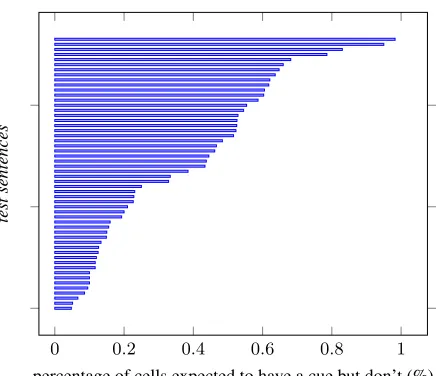
We found that there are a total of 14948 cells for the whole test set where a translation of the cue is ex-pected (i.e. the source contains a cue in the span the cell covers), for an average of ∼277 cells per sen-tence. We found that in 8311 of those cells (∼57%), a projection of the cue is absent, four of which are final, meaning that the cue is absent from four of the hypothesis translations output by the system. How-ever, a per sentence distribution of the cells where the cue is expected but absent (Figure 2) shows that there is at least one cell in a chart containing the correct cue. Conversely, in no chart is the cue is completely absent. This means that in all cases the cue was reproduced at same point but in some, it failed to propagate to the final cell. This shows that chart analysis is useful to explain those cases of cue-related errors found in the manual analysis. We can conclude that the system is alwayspotentiallyable to translate the cue. Given that there is no shortage of rules to translate the cue with default parameters, we can also conclude that, for the negation element here considered, no induction error has occurred. This conclusion is more solid than the one drawn from the constrained decoding approach, since it is based on the analysis of the decoding process for the entire test set.
We also found that in each cell an hypothesis con-taining the right translation of the cue is, on aver-age, ranked highly (2.79, where 0 represents the 1-best hypothesis). Out of the 1100 cases where the 1-best hypothesis and the cue-translationoracle hy-pothesisare not the same, the times the scores of the former are higher than the latter are: 275 for LM score (25%), 730 for the indirect translation prob-ability (66%), 718 for the indirect lexical ity (65.2%), 525 for the direct translation probabil-ity (47.7%) and 435 for the direct lexical probabilprobabil-ity
0 0.2 0.4 0.6 0.8 1
percentage of cells expected to have a cue but don’t (%)
test
[image:7.612.318.537.49.237.2]sentences
Figure 2: Distribution of cells per sentencenotcontaining the expectedcue.
(39.5%). Chart analysis can show us which features are the most responsible formodel errors. We found out that the translation model holds the main respon-sibility for incorrectly ranking hypotheses contain-ing the correct cue projection. Again, this useful form of analysis could not have been carried out us-ingconstrained decodingalone.
Finally, we are left to consider the impact of
search errors in translating the negation cue. We first check whether these are involved in the four cases in which the cue is absent from the system’s output translation, by testing with largercube prun-ing pop limit and translation options limit values. Results shows that even by considering large val-ues (of 10000 and 1000 respectively), no cue trans-lations was found in the final cell of the chart for those sentences where deletion occurs. Enlarging thesearch spacedoes not lead to any more cue trans-lations making it to the final cell of the chart, high-lighting the fact that translation of cue does not in-volvesearch errors.
7 Conclusion
In the present paper, we presented ongoing work on analysing thecausesof the errors involved in trans-lating negation, targeting three main categories: in-duction,searchandmodelerrors.
by forcing the decoder the generate the reference sentence. Conclusions drawn from the references the decoder could reconstruct show that translat-ing negation primarily involve model errors. How-ever, the technique has two important limitations: (a) drawing conclusion from the reachability of an entire reference sentence is not informative when analysing semantic phenomena that usually have a
localscope, such as negation; (b) the oracle is taken to be one reference sentence, while there are usu-ally many ways to translate a sentence correctly and therefore (c) the results obtained applies to only part of the test set and cannot be taken to represent the entire data; (d) being able to generate an oracle does not give any in-depth insight on the each decoding step which is detrimental if we have to explain the results from the manual analysis.
Given these shortcomings, we sketch out an anal-ysis that is able to compute partialoracle hypothe-ses, given the negation elements contained in a source span and four main expectations related to how negation elements should be translated at a given time during decoding. Preliminary results on
cuetranslation show that the system canpotentially
translate all the cues in all the test sentences. No induction or search errors were found meaning that
model errorsare the only category of errors occurred in translating the negation cue. Moreover, a compar-ison between 1-best andoraclehypotheses show that the translation model scores are the main responsi-ble for bad ranking. In general, it was shown that our method is able to give a more in-depth analy-sis of the process of translating negation at decoding time.
8 Future Work
In the present work, we have only presented the gen-eral idea around considering oracle hypotheses in-stead of oracle sentences, along with some prelim-inary results. Further work is however necessary to complete the analysis of the other two elements of negation –eventandfillers.
It is worth remembering several factors can im-pact the kind of errors found in translation. Hier-archical phrase-based models are in fact non-purely syntax driven methods that are able to deal with high levels of reordering. That however also means that
(a) there is no concept of constituent boundaries and (b) when reordering is performed incorrectly there is a high degree of element scrambling. We there-fore accept that system-related proprieties might in-fluence the presence of one error class over another and it will therefore be useful to conduct the same analysis on different models. In the same way, dif-ferent languages will also display difdif-ferent problems and it is therefore necessary to consider the choice of language pair as another variable that can influence the result of such analysis.
9 Acknowledgements
This work was supported by the Accept, MosesCore and GRAM+ grants. The authors would like to thank Adam Lopez for his comments and sugges-tions and the two anonymous reviewers for their feedback.
References
Auli, M., Lopez, A., Hoang, H., and Koehn, P. (2009). A systematic analysis of translation model search spaces. In Proceedings of the Fourth Workshop on Statistical Machine Transla-tion, pages 224–232.
Baker, K., Bloodgood, M., Dorr, B. J., Callison-Burch, C., Filardo, N. W., Piatko, C., Levin, L., and Miller, S. (2012). Modality and nega-tion in SIMT use of modality and neganega-tion in semantically-informed syntactic MT. Computa-tional Linguistics, 38(2):411–438.
Blanco, E. and Moldoval, D. (2011). Some Issues on Detecting Negation from Text. InProceedings of the 24th Florida Artificial Intelligence Research Society Conference (FLAIRS-24), pages 228–233, Palm Beach, FL, USA.
Collins, M., Koehn, P., and Kuˇcerov´a, I. (2005). Clause restructuring for statistical machine trans-lation. In Proceedings of the 43rd annual meet-ing on association for computational lmeet-inguistics, pages 531–540.
Fancellu, F. and Webber, B. (2014). Applying the semantics of negation to SMT through n-best list re-ranking. EACL 2014, page 598.
Fancellu, F. and Webber, B. (2015). Translating negation: A manual error analysis. In Work-shop On Extra-Propositional Aspects of Meaning (ExProM) in Computational Linguistics - NAACL ’15.
Ganitkevitch, J., Van Durme, B., and Callison-Burch, C. (2013). Ppdb: The paraphrase database. InHLT-NAACL, pages 758–764.
Gao, Q. and Vogel, S. (2008). Parallel implementa-tions of word alignment tool. In Software Engi-neering, Testing, and Quality Assurance for Nat-ural Language Processing, pages 49–57.
Germann, U., Jahr, M., Knight, K., Marcu, D., and Yamada, K. (2001). Fast decoding and optimal decoding for machine translation. In Proceed-ings of the 39th Annual Meeting on Association for Computational Linguistics, pages 228–235. Hardmeier, C., Tiedemann, J., and Nivre, J. (2014).
Translating pronouns with latent anaphora resolu-tion. InNIPS 2014 Workshop on Modern Machine Learning and Natural Language Processing. Koehn, P., Hoang, H., Birch, A., Callison-Burch, C.,
Federico, M., Bertoldi, N., Cowan, B., Shen, W., Moran, C., Zens, R., et al. (2007). Moses: Open source toolkit for statistical machine translation. InProceedings of the 45th annual meeting of the ACL on interactive poster and demonstration ses-sions, pages 177–180.
Li, J.-J., Kim, J., Kim, D.-I., and Lee, J.-H. (2009). Chinese syntactic reordering for adequate gen-eration of Korean verbal phrases in Chinese-to-Korean SMT. InProceedings of the Fourth Work-shop on Statistical Machine Translation, pages 190–196.
Li, X., Grimes, S., and Strassel, S. (2012). Gale chinese-english word alignment and tagging training part 3. Technical report, Philadelphia: Linguistic Data Consortium.
Manning, C. (2008). Generating typed dependency parses from phrase structure parses.
Morante, R. and Blanco, E. (2012). *SEM 2012 shared task: Resolving the scope and focus of negation. InProceedings of the First Joint Con-ference on Lexical and Computational Semantics-Volume 1: Proceedings of the main conference and the shared task, and Volume 2: Proceedings of the Sixth International Workshop on Semantic Evaluation, pages 265–274.
Och, F. J. (2003). Minimum error rate training in statistical machine translation. InProceedings of the 41st Annual Meeting on Association for Com-putational Linguistics-Volume 1, pages 160–167. Read, J., Velldal, E., Øvrelid, L., and Oepen, S.
(2012). Uio 1: constituent-based discriminative ranking for negation resolution. InProceedings of the First Joint Conference on Lexical and Compu-tational Semantics-Volume 1: Proceedings of the main conference and the shared task, and Volume 2: Proceedings of the Sixth International Work-shop on Semantic Evaluation, pages 310–318. Wetzel, D. and Bond, F. (2012). Enriching parallel
corpora for statistical machine translation with se-mantic negation rephrasing. InProceedings of the Sixth Workshop on Syntax, Semantics and Struc-ture in Statistical Translation, pages 20–29. Wisniewski, G. and Yvon, F. (2013). Oracle
decoding as a new way to analyze phrase-based machine translation. Machine translation, 27(2):115–138.