NICT at WAT 2015
Chenchen Ding, Masao Utiyama, Eiichiro Sumita Multilingual Translation Laboratory
National Institute of Information and Communications Technology 3-5 Hikaridai, Seikacho, Sorakugun, Kyoto, 619-0289, Japan
{chenchen.ding, mutiyama, eiichiro.sumita}@nict.go.jp
Abstract
Translation systems of our NICT team at the 2nd Workshop on Asian Translation (WAT 2015) are described in this paper. We participated in two translation tasks: Japanese-to-English (JE) and Korean-to-Japanese (KJ). A baseline phrased-based (PB) statistical machine translation (SMT) system in Moses was used. On JE transla-tion, two pre-reordering approaches were applied: a simplereverse preorderingand a dependency-based approach. On KJ translation, the processing was purely con-ducted on character-level. Evaluation re-sults show that even simple approaches can improve JE and KJ PB SMT signifi-cantly. These techniques can be easily ap-plied in practice because of the simplicity.
1 Introduction
Statistical machine translation (SMT) techniques have been well developed and widely applied in practice. Linguistic knowledge-free SMT frame-works, such as phrase-based (PB) SMT (Koehn et al., 2003) and hierarchical phrase-based SMT (HIERO) (Chiang, 2007), handle many translation tasks efficiently as long as sufficient training data prepared. Further, sophisticated syntactically-driven approaches (Neubig, 2013) give better per-formance than PB SMT and HIERO on difficult translation tasks (Neubig, 2014).
At the 2nd Workshop on Asian Translation (WAT 2015) (Nakazawa et al., 2015), our in-tention is to test the efficiency of several sim-ple techniques for Japanese-to-English (JE) and Korean-to-Japanese (KJ) translation, specifically, pre-reordering approaches for JE translation and character-based processing for KJ translation. On JE translation, we found the simple reverse pre-ordering approach proposed by Katz-Brown and
Collins (2008) performed as well as a well-designed dependency-based approach, in improv-ing a PB SMT baseline. Considerimprov-ing the simplic-ity of the reverse preordering, we think the ap-proach should be used more widely for JE trans-lation. On KJ translation, we found even a pure character-based approach outperformed the orga-nizer’s baseline a lot, due to the similarity of the two languages on their vocabularies and syntaxes. We give descriptions of the approaches in the fol-lowing sections.
2 Pre-reordering for JE Translation
As Japanese and English have dramatically differ-ent word orders, the performance ofword reorder-ingaffects translation results significantly. Among different lines of researches, pre-reordering has been widely applied in practice and still studied in recent researches (de Gispert et al., 2015; Hoshino et al., 2015).
For the JE translation task of WAT 2015, we test two pre-reordering approaches. The first one is the reverse preordering (REV-REO) pro-posed by Katz-Brown and Collins (2008) for the NTCIR-7 JE Patent MT translation task. Another one is a recently proposed dependency-based ap-proach (DEP-REO) (Ding et al., 2015)1with well-designed rules. We select the two approaches be-cause they are on two extremes, that REV-REO is an approach needs no syntactic analysis at all, while the DEP-REO makes a good use of the de-pendency structure of Japanese sentences. As both approaches have been described in detail in their original papers, We do not give repeated descrip-tions but just state several details in experiments.
For DEP-REO, the processes were completely identical to the experiments in Ding et al. (2015), where the tool chain of MeCab2 andCaboCha3
1
A non-refereed version in Japanese is Ding et al. (2014a). 2
http://taku910.github.io/mecab/
3http://taku910.github.io/cabocha/
42
(Kudo and Matsumoto, 2002) based on IPA sys-tem for Japanese morphemes was used. For REV-REO, an important point is toavoid the reorder-ing across punctuations4. In the experiments, we used four marks to compose the punctuation set: U+002C5, U+FF0C6, U+30017, and U+30028. For the Japanese topic markerwa, which plays the key role of the approach, we did not judge it only by the surface form, but also referred to the spe-cific tagjoshi, kakarijoshi9.
3 Character-based KJ Translation
As Korean and Japanese share so many similar features, we tried a purely character-based ap-proach in WAT 2015. The process was identical to Ding et al. (2014b). Specifically, no morpho-logical analysis or text normalization10were con-ducted except (unicode) characters were separated using spaces. The original space is replaced by a <sp> tag and the original tab is replaced by a <tab>tag11. The processes were applied consis-tently on training and test sets.
We found even the above-mentioned trivial pro-cess led to satisfactory performance on KJ trans-lation. We further found a post-processing of bracket balancing (because the data contain many brackets) could give a slight improvement in per-formance. We will describe the process in the fol-lowing Section 4.
4 Experiment and Evaluation
We used the PB SMT system inMoses12(Koehn et al., 2007) for JE and KJ translation tasks. Ba-sically, we used identical settings as the organizer used in the baseline. However, there were several differences as follows.
• We used SRILM13 (Stolcke, 2002) for
lan-4
otherwise the reordering will become excessive. 5i.e., the ordinary comma.
6
“fullwidth comma”, the Chinese comma. 7
“ideographic comma”, the Japaneset¯oten. 8
“ideographic full stop”, the Japanesekuten.
9Because the DEP-REO is totally based on the IPA sys-tem, we also used the system for REV-REO. Actually100%
of the surface formwawere tagged asjoshi, kakarijoshiby
MeCabin our experiments. 10
We only introduce the minimum rewriting to replace the “|”, “[”, “]” to full-width characters for Moses’ decoder.
11
The spaces mainly appeared on the Korean side due to its orthography. Those occasional spaces on the Japanese side were also replaced with tags.
12
http://www.statmt.org/moses/
13http://www.speech.sri.com/projects/
srilm/
DL BLEU RIBES BASELINE 20 16.95 .6356
+DEP-REO
0 17.77 .6512 3 17.54 .6520
6 17.80 .6545
9 17.60 .6488 12 17.79 .6497 15 17.74 .6499
+REV-REO
0 15.16 .6556 3 16.08 .6586 6 17.58 .6707
9 18.02 .6751
[image:2.595.323.508.61.256.2]12 17.78 .6733 15 17.54 .6691
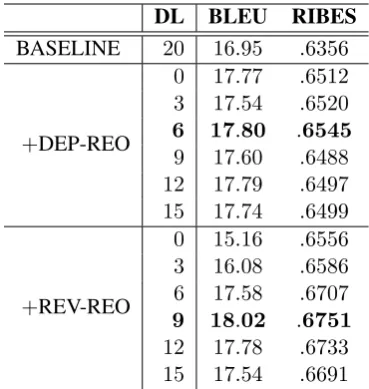
Table 1: Devtest set BLEU score and RIBES on JE translation.
DL BLEU RIBES
+Lex.-Reo.
0 66.79 .9222 3 66.64 .9221 6 66.80 .9228
−Lex.-Reo. 0 66.74 .9221 +Bracket Balanc. 0 66.98 .9224
Table 2: Devtest set BLEU score and RIBES on KJ translation (morpheme level, byMeCab).
guage model training (interpolated modified Kneser-Ney discounting;5-gram on English for JE translation and9-gram on Japanese for KJ translation).
• We usedMeCab(IPA) andCaboChato pro-cess Japanese sentences in JE translation.
• We used no tools for Korean and Japanese morphological analysis in KJ translation, in-stead, themax-phrase-lengthwere set to9in translation model training.
We selected the optimal distortion limit (DL) in PB SMT decoding by indoor experiments14 and used the selected setting in the final submissions.
Table 1 shows the experimental results of DEP-REO and REV-DEP-REO on JE devtest set. The ex-cellent performance of REV-REO is impressive. However, REV-REO needs a proper DL to reach its best performance, while DEP-REO has a more
14In KJ translation, we measured the results on morpheme-level by applyingMeCabon outputs (after<sp>and<tab>
Local Evaluation Organizer Evaluation BLEU RIBES BLEU RIBES HUMAN BASELINEorganizer, DL=20 – – 18.45 .6451 – BASELINEindoor, DL=20 18.09 .6435 18.09 .6397 – BASELINEindoor+DEP-REODL=6 18.99 .6644 18.98 .6599 +16.000 BASELINEindoor+REV-REODL=9 18.96 .6870 18.96 .6845 +6.500
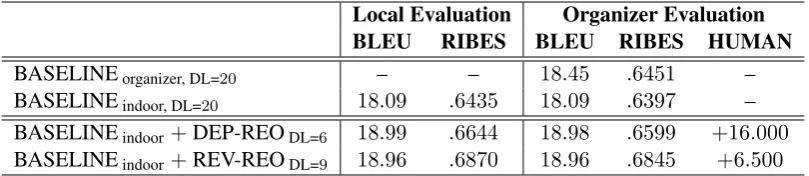
Table 3: Evaluation of our submission on JE translation compared with the organizer’s PB SMT baseline.
Local Evaluation Organizer Evaluation BLEU RIBES BLEU RIBES HUMAN BASELINEorganizer, DL=0,+Lex.-Reo. – – 69.73 .9408 – BASELINEindoor, DL=0,−Lex.-Reo. 70.94 .9428 70.92 .9427 +8.250
+Bracket Balancing 71.12 .9429 71.11 .9429 +10.500
Table 4: Evaluation of our submission on KJ translation compared with the organizer’s PB SMT baseline.
stable performance across different DLs. The phe-nomenon is in agree to Ding et al. (2015).
Table 2 shows the experimental results on KJ translation results. We tested different DLs of0, 3, and6with the lexicalized orientation reordering model (+Lex.-Reo.). The performance has only quite slight changes under different DLs. We also tested the monotone translation (DL= 0) without reordering model (−Lex.-Reo.). The change on performance is still insignificant. So a pure mono-tone translation is enough for KJ and a reordering model helps little. The phenomenon is in agree to Ding et al. (2014b).
We have observed there are many brackets in the data of KJ translation task. The translations of brackets are not consistent in training data and PB SMT cannot handle bracket pairs well in decod-ing. We used a simple post-processing for bracket balancing according to the following steps.
1. Getting1,000-best list for each output15;
2. Selecting the m-th candidate, where m is min(arg min
n
|#Ln−#Rn|);#Lnand#Rnare
counts of “(” and “)” in then-th candidate;
3. Inserting untranslated source-side “)” to the selected candidate after the translated parts of its preceding character16, when
(a) its paired “(” on source side is translated to a “(” on target side;
15
We used thedistinctoptions of Moses, so there were less than1,000candidates.
16based on the alignment information given byMoses.
(b) it has no paired “(” on source side but follows numbers / alphabets.
The described brackets balancing brought a gain about +0.2 BLEU scores on devtest set, which is larger than the effect of DL and reorder-ing models. We consider specific post-processreorder-ing will improve KJ translation more.
The evaluation results of our submission are listed in Table 3 and Table 4. Our local eval-uation on automatic measures had slight but not significant differences compared with the orga-nizer’s in cases. On JE translation, our baseline was a little lower than the organizer’s baseline, as the experimental settings were not totally identi-cal to the organizer’s ones, we think the differ-ence is acceptable. Both REV-REO and DEP-REO improved the baseline (ours) approximately one point on BLEU score, but REV-REO gave a larger improvement on RIBES. On KJ translation, the listed scores are all based on theMeCab’s anal-ysis. Our baseline, i.e., a character-based one, out-performed the organizer’s baseline more than one BLEU score and the bracket balancing still gave a further improvement around+0.2BLEU scores.
baseline performs better than organizer’s baseline and post-processing gives further improvement.
5 Discussion
From the evaluation results, we have observed that simple (or, na¨ıve) approaches can give satisfactory improvement for a PB SMT baseline. We show ex-amples of REV-REO and DEP-REO in Fig. 1 and Fig. 2, respectively. JE and KJ translation exam-ples are shown in Table 5 and Fig. 3, respectively. On JE translation, in our opinion, the REV-REO approach should be used as a new baseline in fu-ture, due to its simplicity and efficiency. The REV-REO only needs morphological analysis, which is needed after all for a general SMT task. As the Japanese topic markerwa is available across dif-ferent POS systems17, the REV-REO is actually an approach with strong ability of generalization18.
On KJ translation, we illustrated character-based processing led to good performance due to the similarity of the two languages. Actually, our approach is more like a transliteration pro-cess rather than a translation propro-cess. Although an SMT system gives satisfactory performance on KJ translation, we would like to state several issues for KJ SMT in practice.
• Although the syntaxes are similar between Korean and Japanese, there are differences in collocations of verbs and postpositions (case markers)19. Specific process or stronger models are needed for correct translation if such a collocation is over a long-range.
• Negation is purely realized by suffixes20 in Japanese, but can be realized by both suf-fixes21and prefixes22in Korean. So, reorder-ing is needed when a Korean negative prefix is translated into Japanese, unless we have
17Of course, the specific tag is different. 18
We believe (although we have not done experiments) the REV-REO should work for Korean-to-English translation task as well because Korean has a topic marker(n)eunwhich is very similar to Japanesewa.
19
Here are examples for some common verbs. Japanese
noruand Koreantada, both have the meaning ofto ride;noru
requires a dative markernibuttadarequires an accusative marker(r)eul(the equivalent Japanese accusative marker is
wo). Japanesenaruand Koreantoeda, both have the mean-ing ofto become;narurequires a dative markernibuttoeda
requires a nominative markeri / ga(the equivalent Japanese nominative marker isga).
20
Analyzed as auxiliary verbs, e.g.,nai,nu,mai, etc. 21
Analyzed as auxiliary verbs, e.g.,anta,anida, etc. 22Analyzed as adverbs, e.g.,anandmot.
a translation table covering all the negation forms of all the verbs. Specific process is also needed for this phenomenon.
• Specific named entity recognition / tion modules are needed for correct transla-tion of proper nouns.
6 Conclusion
We have described the translation systems of NICT team for JE and KJ translation task at WAT 2015). Although the approaches we used are very simple, their efficiency has been proved by the evaluation. We expect these techniques to be more widely applied in the community of Asian NLP.
References
David Chiang. 2007. Hierarchical phrase-based trans-lation.Computational Linguistics, 33(2):201–228.
Adri`a de Gispert, Gonzalo Iglesias, and Bill Byrne. 2015. Fast and accurate preordering for SMT us-ing neural networks. InProc. of NAACL-HLT, pages 1012–1017.
Chenchen Ding, Keisuke Sakaushi, Hirona Touji, and Mikio Yamamoto. 2014a. Dependency tree-based pre-reordering rules for statistical Japanese-to-English machine translation. InProc. of ANLP, pages 963–966. (In Japanese).
Chenchen Ding, Masao Utiyama, Mitsuo Yoshida, and Mikio Yamamoto. 2014b. Model learning form par-allel documents: Korean-japanese smt. InProc. of ANLP, pages 820–823. (In Japanese).
Chenchen Ding, Keisuke Sakanushi, Hirona Touji, and Mikio Yamamoto. 2015. Inter-, intra-, and extra-chunk pre-reordering for statistical Japanese-to-English machine translation. ACM Transactions on Asian Language Information Processing, x(x):x. (Accepted, to appear).
Sho Hoshino, Yusuke Miyao, Katsuhito Sudoh, Kat-suhiko Hayashi, and Masaaki Nagata. 2015. Dis-criminative preordering meets Kendall’s Tau max-imization. In Proc. of ACL (Short Papers), pages 139–144.
Jason Katz-Brown and Michael Collins. 2008. Syn-tactic reordering in preprocessing for Japanese →
English translation: MIT system description for NTCIR-7 patent translation task. InProc. of NTCIR, pages 409–414.
Philipp Koehn, Franz Josef Och, and Daniel Marcu. 2003. Statistical phrase-based translation. InProc. of HTL-NAACL, pages 48–54.
また 提案
psrf
は
変調 型
psrf
より 構造 が 簡単 で ある
ある で 簡単 が 構造 より
psrf
型 変調
は
psrf
提案 また
reverse reverse
[image:5.595.142.467.68.159.2]topic marker
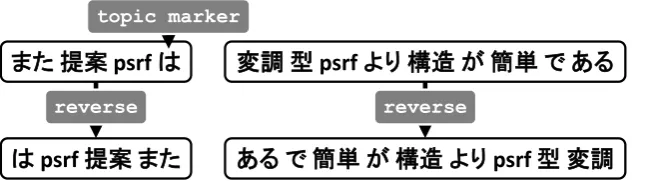
Figure 1: Example of REV-REO. The original Japanese sentence at the top is segmented after the topic marker and the morphemes within each segment are reversed.
また
提案
psrf
は
構造 が
簡単 で ある
変調 型
psrf
より
また
は 提案
psrf
が 構造
で ある 簡単
より 変調 型
psrf
また
提案
psrf
は
変調 型
psrf
より
構造 が
簡単 で ある
[image:5.595.131.464.227.381.2]morpheme-level reordering chunk-level reordering
Figure 2: Example of DEP-REO. The original Japanese sentence at the top is reordered on both chunk-and morpheme-level based on its dependency structure.
[image:5.595.87.525.574.646.2]BASELINE the proposed psrf psrf modulation type than the simple structure REV-REO the proposed psrf is simple structure than psrf modulation type DEP-REO the proposed psrf structure is simpler than psrf modulation type REFERENCE and , the proposed psrf has simpler structure than that of modulated psrf
Table 5: JE translation examples. The inputs for BASELINE, REV-REO, and DEP-REO are the original Japanese sentence at the top of Fig. 1 (and Fig. 2), reordered Japanese sentence at the bottom of Fig. 1, and reordered sentence at the bottom of Fig. 2, respectively.
제 조 장 치
( 5 0 )
에 는 도 시 하 지 않 은 냉 각 기 구 도 설 치 되 어 있 어
製 造 装 置
( 5 0 )
에 는
図 示
하 지 않 은
冷 却 機 構
도
設 置
되 어 있 어
製 造 装 置 5 0 に は 、 図 示 し な い 冷 却 機 構 も 設 け ら れ て い て
Philipp Koehn, Hieu Hoang, Alexandra Birch, Chris Callison-Burch, Marcello Federico, Nicola Bertoldi, Brooke Cowan, Wade Shen, Christine Moran, Richard Zens, Chris Dyer, Ondrej Bojar, Alexandra Constantin, and Evan Herbst. 2007. Moses: Open source toolkit for statistical machine translation. In Proc. of ACL, pages 177–180.
Taku Kudo and Yuji Matsumoto. 2002. Japanese dependency analysis using cascaded chunking. In Proc. of CoNLL, pages 63–69.
Toshiaki Nakazawa, Hideya Mino, Isao Goto, Gra-ham Neubig, Sadao Kurohashi, and Eiichiro Sumita. 2015. Overview of the 2nd workshop on Asian translation. InProc. of WAT.
Graham Neubig. 2013. Travatar: A forest-to-string machine translation engine based on tree transduc-ers. InProc. of ACL (Conference System Demon-strations), pages 91–96.
Graham Neubig. 2014. Forest-to-string SMT for Asian language translation: NAIST at WAT 2014. InProc. of WAT, pages 20–25.