An Empirical Study on Development Set Selection Strategy
for Machine Translation Learning
∗Cong Hui12, Hai Zhao12†, Yan Song3, Bao-Liang Lu12 1Center for Brain-Like Computing and Machine Intelligence
Department of Computer Science and Engineering, Shanghai Jiao Tong University 2MOE-Microsoft Key Laboratory for Intelligent Computing and Intelligent Systems
Shanghai Jiao Tong University, 800 Dong Chuan Rd., Shanghai 200240, China 3Department of Chinese, Translation and Linguistics, City University of Hong Kong
[email protected], {zhaohai,blu}@cs.sjtu.edu.cn
Abstract
This paper describes a statistical machine translation system for our participation for the WMT10 shared task. Based on MOSES, our system is capable of translat-ing German, French and Spanish into En-glish. Our main contribution in this work is about effective parameter tuning. We discover that there is a significant perfor-mance gap as different development sets are adopted. Finally, ten groups of devel-opment sets are used to optimize the model weights, and this does help us obtain a sta-ble evaluation result.
1 Introduction
We present a machine translation system that rep-resents our participation for the WMT10 shared task from Brain-like Computing and Machine In-telligence Lab of Shanghai Jiao Tong University (SJTU-BCMI Lab). The system is based on the state-of-the-art SMT toolkit MOSES (Koehn et al., 2007). We use it to translate German, French and Spanish into English. Though different develop-ment sets used for training parameter tuning will certainly lead to quite different performance, we empirically find that the more sets we combine to-gether, the more stable the performance is, and a development set similar with test set will help the performance improvement.
2 System Description
The basic model of the our system is a log-linear model (Och and Ney, 2002). For given source
lan-∗
This work was partially supported by the National Natu-ral Science Foundation of China (Grant No. 60903119, Grant No. 60773090 and Grant No. 90820018), the National Basic Research Program of China (Grant No. 2009CB320901), and the National High-Tech Research Program of China (Grant No.2008AA02Z315).
†
corresponding author
guage strings, the target language stringtwill be
obtained by the following equation,
ˆ
tI1 = arg max tI
1
{pλm
1 (t
I 1 |sJ1)}
= arg max tI
1
{ exp[
PM
m=1λmhm(tI1, sJ1)]
P
¯ tI
1exp[
PM
m=1λmhm(¯tI1, sJ1)]
},
wherehm is them-th feature function and λm is
them-th model weight. There are four main parts
of features in the model: translation model, lan-guage model, reordering model and word penalty. The whole model has been well implemented by the state-of-the-art statistical machine translation toolkit MOSES.
For each language that is required to translated into English, two sets of bilingual corpora are pro-vided by the shared task organizer. The first set is the new release (version 5) of Europarl cor-pus which is the smaller. The second is a com-bination of other available data sets which is the
larger. In detail, two corpora, europarl-v5 and
news-commentary10 are for German, europarl-v5
and news-commentary10 plus undoc for French
and Spanish, respectively. Details of training data are in Table 1. Only sentences with length 1 to 40 are acceptable for our task. We used the larger set for our primary submission.
We adopt word alignment toolkit GIZA++ (Och and Ney, 2003) to learn word-level alignment with
its default setting andgrow-diag-final-and
param-eters. Given a sentence pair and its corresponding word-level alignment, phrases will be extracted by using the approach in (Och and Ney, 2004). Phrase probability is estimated by its relative frequency in the training corpus. Lexical reordering is deter-mined by using the default setting of MOSES with msd-bidirectional parameter.
For training the only language model (English), the data sets are extracted from monolingual parts
of both europarl-v5 and news-commentary10,
sentences words(s) words(t)
de small 1540549 35.76M 38.53M
large 1640818 37.95M 40.64M
fr small 1683156 44.02M 44.20M
large 8997997 251.60M 228.50M
es small 1650152 43.17M 41.25M
large 7971200 236.24M 207.79M
Table 1: Bilingual training corpora from Ger-man(de), French(fr) and Spanish(es) to English.
which include 1968914 sentences and 47.48M
words. And SRILM is adopted with 5-gram,
in-terpolate and kndiscount settings (Stolcke, 2002) .
The next step is to estimate feature weights by optimizing translation performance on a develop-ment set. We consider various combinations of 10 development sets with 18207 sentences to get a stable performance in our primary submission.
We use the default toolkits which are provided by WMT10 organizers for preprocessing (i.e., to-kenize) and postprocessing (i.e., detokenize, re-caser).
3 Development Set Selection
3.1 Motivation
Given the previous feature functions, the model weights will be obtained by optimizing the follow-ing maximum mutual information criterion, which can be derived from the maximum entropy princi-ple:
ˆ
λM1 = arg max λM
1
{
S
X
i=1
logpλM
1 (ti |si)}
As usual, minimum error rate training (MERT) is adopted for log-linear model parameter estimation (Och, 2003). There are many improvements on MERT in existing work (Bertoldi et al., 2009; Fos-ter and Kuhn, 2009), but there is no demonstration that the weights with better performance on the development set would lead to a better result on the unseen test set. In our experiments, we found that different development sets will cause signifi-cant BLEU score differences, even as high as one percent. Thus the remained problem will be how to effectively choose the development set to obtain a better and more stable performance.
3.2 Experimental Settings
Our empirical study will be demonstrated through German to English translation on the smaller cor-pus. The development sets are all development sets and test sets from the previous WMT shared translation task as shown in Table 2, and labeled as dev-0 to dev-9. Meanwhile, we denote 10 batch
sets from batch-0 to batch-9 where the batch-iset
is the combination of dev- sets from dev-0 to dev-i.
The test set isnewstest2009, which includes 2525
sentences, 54K German words and 58K English
words, and news-test2008, which includes 2051
sentences, 41K German words and 43K English words.
id name sent w(de) w(en)
dev-0 dev2006 2000 49K 53K
dev-1 devtest2006 2000 48K 52K
dev-2 nc-dev2007 1057 23K 23K
dev-3 nc-devtest2007 1064 24K 23K
dev-4 nc-test2007 2007 45K 44K
dev-5 nc-test2008 2028 45K 44K
dev-6 news-dev2009 2051 41K 43K
dev-7 test2006 2000 49K 54K
dev-8 test2007 2000 49K 54K
[image:2.595.73.292.61.160.2]dev-9 test2008 2000 50K 54K
Table 2: Development data.
3.3 On the Scale of Development Set
[image:2.595.307.532.275.428.2]id 09-dev 09-batch 08-dev 08-batch
0 16.46 16.46 16.38 16.38
1 16.67 16.25 16.66 16.44
2 16.74 16.20 16.94 16.22
3 16.15 16.83 16.18 17.02
4 16.44 16.73 16.64 16.89
5 16.50 16.97 16.75 17.13
6 17.15 17.03 17.67 17.24
7 16.51 17.00 16.34 17.09
8 17.03 16.97 17.15 17.22
9 16.25 16.99 16.24 17.26
Table 3: BLEU scores on the two test
sets(newstest2009 & news-test2008), which use two data set sequences(dev- sequence & batch- se-quence) to optimize model weights.
de-en fr-en es-en
18.90 24.30 26.40
Table 4: BLEU scores of our primary submission.
3.4 On BLEU Score Difference
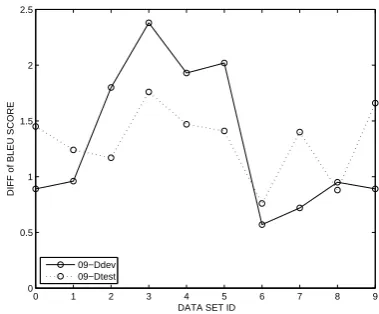
To compare BLEU score differences between test set and development set, we consider two groups of BLEU score differences, For each development
set, dev-i, the BLEU score difference will be
com-puted betweenb1 from which adopts itself as the
development set and b2 from which adopts test
set as the development set. For the test set, the BLEU score difference will be computed between
b0
1from which adopts each development set, dev-i,
as the development set andb0
2 from which adopts
itself as the development set.
These two groups of results are illustrated in Figure 2 (the best score of the test set under self
tuning, newstest2009 is 17.91). The dotted lines
have the inverse trend with the dotted in Figure 1(because the addition of these two values is con-stant), and the solid lines have the same trend with the dotted, which means that the good per-formance is mutual between test set and
develop-ment sets: if tuning usingAset could make a good
result overBset, then vice versa.
3.5 On the Similarity between Development Set and Test Set
This experiment is motivated by (Utiyama et al., 2009), where they used BLEU score to measure the similarity of a sentences pair and then ex-tracted sentences similar with those in test set to
0 1 2 3 4 5 6 7 8 9 0
0.5 1 1.5 2 2.5
DATA SET ID
DIFF of BLEU SCORE
[image:3.595.318.508.71.228.2]09−Ddev 09−Dtest
Figure 2: The trend of BLEU score differences
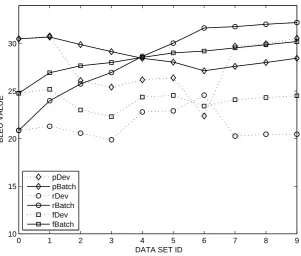
construct a specific tuning set. In our experiment, we will try to measure data set similarity instead. Given two sets of sentences, one is called as candi-date(cnd) set and the other reference(ref) set. For any cnd sentence, we let the whole ref set to be its reference and then multi-references BLEU score is computed for cnd set. There comes a problem that the sentence penalty will be constant for any cnd sentence, we turn to calculate the average length
of whose sentences which have commonn-gram
with the given cnd sentence.
Now we may define three measures. The mea-sure which uses dev- and batch- sets as cnd sets
and news-test2009 set as ref set is defined as
precision-BLEU , and the measure which uses the above sets on the contrary way is defined as recall-BLEU. Then F1-BLEU is defined as the harmonic mean of precision-BLEU and recall-BLEU. These results are illustrated in Figure 3. From the fig-ure, we find that F1-BLEU plays an important role to predict the goodness of a development set, F1-BLEU scores of batch- sets have an ascending curve and batch data set sequence will cause a sta-ble good test performance, the point on dev- sets which has high F1-BLEU(eg, dev-0,4,5) would also has a good test performance.
3.6 Related Work
model, translation phrase table, lexicons model and factored translation model, few of them pay attention to the domain adaptation on the develop-ment set. For future work we consider to use some machine learning approaches to select sentences in development sets more relevant with the test set in order to further improve translation performance.
4 Conclusion
In this paper, we present our machine translation system for the WMT10 shared task and perform an empirical study on the development set selection. According to our experimental results, Choosing different development sets would play an impor-tant role for translation performance. We find that a development set with higher F1-BLEU yields better and more stable results.
References
Nicola Bertoldi, Barry Haddow, and Jean Baptiste Fouet. 2009. Improved Minimum Error Rate Train-ing in Moses. The Prague Bulletin of Mathematical Linguistics, 91:7–16.
George Foster and Roland Kuhn. 2009. Stabiliz-ing minimum error rate trainStabiliz-ing. In Proceedings of the 4th Workshop on Statistical Machine Trans-lation(WMT), Boulder, Colorado, USA.
Rejwanul Haque, Sudip Kumar Naskar, Josef Van Gen-abith, and Andy Way. 2009. Experiments on Do-main Adaptation for EnglishłHindi SMT. In7th In-ternational Conference on Natural Language Pro-cessing(ICNLP), Hyderabad, India.
Philipp Koehn and Josh Schroeder. 2007. Experiments in domain adaptation for statistical machine transla-tion. InProceedings of the 2nd Workshop on Sta-tistical Machine Translation(WMT), Prague, Czech Republic.
Philipp Koehn, Hieu Hoang, Alexandra Birch, Chris Callison-Burch, Marcello Federico, Nicola Bertoldi, Brooke Cowan, Wade Shen, Christine Moran, Richard Zens, Chris Dyer, Ondrej Bojar, Alexan-dra Constantin, and Evan Herbst. 2007. Moses: Open source toolkit for statistical machine trans-lation. In Proceedings of the 45th Annual Meet-ing of the Association for Computational LMeet-inguis- Linguis-tics(ACL), Prague, Czech Republic.
Preslav Nakov and Hwee Tou Ng. 2009. NUS at WMT09: domain adaptation experiments for English-Spanish machine translation of news com-mentary text. InProceedings of the 4th Workshop on Statistical Machine Translation(WMT), Singapore.
Preslav Nakov. 2008. Improving English-Spanish sta-tistical machine translation: Experiments in domain
adaptation, sentence paraphrasing, tokenization, and recasing. In Proceedings of the 3rd Workshop on Statistical Machine Translation(WMT), Columbus, Ohio, USA.
Franz Josef Och and Hermann Ney. 2002. Discrimina-tive training and maximum entropy models for sta-tistical machine translation. In Proceedings of the 40th Annual Meeting of the Association for Compu-tational Linguistics(ACL), Philadelphia, Pennsylva-nian, USA.
Franz Josef Och and Hermann Ney. 2003. A sys-tematic comparison of various statistical alignment models. Computational Linguistics, 29(1):19–51.
Franz Josef Och and Hermann Ney. 2004. The align-ment template approach to statistical machine trans-lation.Computational Linguistics, 30(4):417–449.
Franz Josef Och. 2003. Minimum error rate training in statistical machine translation. InProceedings of the 41th Annual Meeting of the Association for Compu-tational Linguistics(ACL), Sapporo, Japan.
Michael Paul, Andrew Finch, and Eiichiro Sumita. 2009. NICT@ WMT09: model adaptation and transliteration for Spanish-English SMT. In Pro-ceedings of the 4th Workshop on Statistical Machine Translation(WMT), Singapore.
Andreas Stolcke. 2002. SRILM: an extensible lan-guage modeling toolkit. In7th International Con-ference on Spoken Language Processing(ICSLP), Denver, Colorado, USA.
0 1 2 3 4 5 6 7 8 9 15
15.5 16 16.5 17 17.5 18
DATA SET ID
BLEU SCORE
[image:5.595.129.455.90.352.2]09−dev 09−batch 08−dev 08−batch
Figure 1: The BLEU score trend in Tabel 3, we will see that the batch lines output a stable and good performance.
0 1 2 3 4 5 6 7 8 9
10 15 20 25 30
DATA SET ID
BLEU VALUE
pDev pBatch rDev rBatch fDev fBatch
Figure 3: The precision(p), recall(r) and F1(f) BLEU score on the dev(Dev) and batch(Batch) sets based
[image:5.595.147.449.448.704.2]