BBN System Description for WMT10 System Combination Task
Antti-Veikko I. Rosti and Bing Zhang and Spyros Matsoukas and Richard Schwartz Raytheon BBN Technologies, 10 Moulton Street, Cambridge, MA 02138, USA
{arosti,bzhang,smatsouk,schwartz}@bbn.com
Abstract
BBN submitted system combination out-puts for Czech-English, German-English, Spanish-English, French-English, and All-English language pairs. All combinations were based on confusion network decod-ing. An incremental hypothesis alignment algorithm with flexible matching was used to build the networks. The bi-gram de-coding weights for the single source lan-guage translations were tuned directly to maximize the BLEU score of the decod-ing output. Approximate expected BLEU was used as the objective function in gra-dient based optimization of the combina-tion weights for a 44 system multi-source language combination (All-English). The system combination gained around 0.4-2.0 BLEU points over the best individual systems on the single source conditions. On the multi-source condition, the system combination gained 6.6 BLEU points.
1 Introduction
The BBN submissions to the WMT10 system combination task were based on confusion net-work decoding. The confusion networks were built using the incremental hypothesis alignment algorithm with flexible matching introduced in the BBN submission for the WMT09 system combi-nation task (Rosti et al., 2009). This year, the system combination weights were tuned to max-imize the BLEU score (Papineni et al., 2002) of the 1-best decoding output (lattice based BLEU tuning) using downhill simplex method (Press et al., 2007). A 44 system multi-source combina-tion was also submitted. Since the gradient-free optimization algorithms do not seem to be able to handle more than 20-30 weights, a gradient ascent to maximize an approximate expected BLEU
ob-jective was used to optimize the larger number of weights.
The lattice based BLEU tuning may be imple-mented using any optimization algorithm that does not require the gradient of the objective function. Due to the size of the lattices, the objective func-tion evaluafunc-tion may have to be distributed to mul-tiple servers. The optimizer client accumulates the BLEU statistics of the 1-best hypotheses from the servers for given search weights, computes the fi-nal BLEU score, and passes it to the optimiza-tion algorithm which returns a new set of search weights. The lattice based tuning explores the en-tire search space and does not require multiple de-coding iterations with N-best list merging to ap-proximate the search space as in the standard min-imum error rate training (Och, 2003). This allows much faster turnaround in weight tuning.
Differentiable approximations of BLEU have been proposed for consensus decoding. Tromble et al. (2008) used a linear approximation and Pauls et al. (2009) used a closer approximation called CoBLEU. CoBLEU is based on the BLEU for-mula but the n-gram counts are replaced by ex-pected counts over a translation forest. Due to the min-functions required in converting the n-gram counts to matches and a non-differentiable brevity penalty, a sub-gradient ascent must be used. In this work, an approximate expected BLEU (Exp-BLEU) defined over N-best lists was used as a differentiable objective function. ExpBLEU uses expected BLEU statistics where the min-function is not needed as the statistics are computed off-line and the brevity penalty is replaced by a dif-ferentiable approximation. The ExpBLEU ing yields comparable results to direct BLEU tun-ing ustun-ing gradient-free algorithms on combina-tions of small number of systems (fewer than 20-30 weights). Results on a 44 system combination show that the gradient based optimization is more robust with larger number of weights.
This paper is organized as follows. Section 2 reviews the incremental hypothesis alignment algorithm used to built the confusion networks. Decoding weight optimization using direct lattice 1-best BLEU tuning and N-best list based Exp-BLEU tuning are presented in Section 3. Exper-imental results on combining single source lan-guage to English outputs and all 44 English out-puts are detailed in Section 4. Finally, Section 5 concludes this paper with some ideas for future work.
2 Hypothesis Alignment
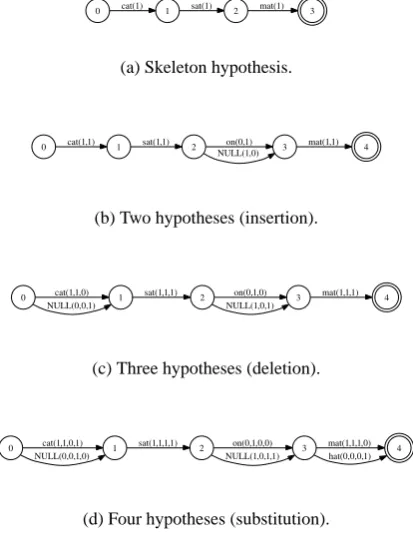
The confusion networks were built by using the incremental hypothesis alignment algorithm with flexible matching introduced in Rosti et al. (2009). The algorithm is reviewed in more detail here. It is loosely related to the alignment performed in the calculation of the translation edit rate (TER) (Snover et al., 2006) which estimates the edit distance between two strings allowing shifts of blocks of words in addition to insertions, dele-tions, and substitutions. Calculating an exact TER for strings longer than a few tokens1is not compu-tationally feasible, so thetercom2software uses heuristic shift constraints and pruning to find an upper bound of TER. In this work, the hypothe-ses were aligned incrementally with the confusion network, thus using tokens from all previously aligned hypotheses in computing the edit distance. Lower substitution costs were assigned to tokens considered equivalent and the heuristic shift con-straints oftercomwere relaxed3.
First, tokens from all hypotheses are put into equivalence classes if they belong to the same WordNet (Fellbaum, 1998) synonym set or have the same stem. The 1-best hypothesis from each system is used as the confusion network skeleton which defines the final word order of the decod-ing output. Second, a trivial confusion network is generated from the skeleton hypothesis by gen-erating a single arc for each token. The align-ment algorithm explores shifts of blocks of words that minimize the edit distance between the cur-rent confusion network and an unaligned
hypothe-1
Hypotheses are tokenized and lower-cased prior to align-ment. Tokens generally refer to words and punctuation.
2
http://www.cs.umd.edu/˜snover/tercom/
current version 0.7.25.
3This algorithm is not equivalent to an incremental
TER-Plus (Snover et al., 2009) due to different shift constraints and the lack of paraphrase matching
3
0 cat(1) 1 sat(1) 2 mat(1)
(a) Skeleton hypothesis.
4 0 cat(1,1) 1 sat(1,1) 2 NULL(1,0)on(0,1) 3 mat(1,1)
(b) Two hypotheses (insertion).
4 0 cat(1,1,0) 1
NULL(0,0,1) 2
sat(1,1,1) on(0,1,0) 3 NULL(1,0,1)
mat(1,1,1)
(c) Three hypotheses (deletion).
4 0 cat(1,1,0,1) 1
NULL(0,0,1,0) 2
sat(1,1,1,1) on(0,1,0,0) 3 NULL(1,0,1,1)
mat(1,1,1,0) hat(0,0,0,1)
[image:2.595.313.520.75.352.2](d) Four hypotheses (substitution).
Figure 1: Example of incrementally aligning “cat sat mat”, “cat sat on mat”, “sat mat”, and “cat sat hat”.
sis. Third, the hypothesis with the lowest edit dis-tance to the current confusion network is aligned into the network. The heuristically selected edit costs used in the WMT10 system were 1.0 for insertions, deletions, and shifts, 0.2 for substitu-tions of tokens in the same equivalence class, and 1.0001 for substitutions of non-equivalent tokens. An insertion with respect to the network always results in a new node and two new arcs. The first arc contains the inserted token and the second arc contains a NULL token representing the missing token from all previously aligned hypotheses. A substitution/deletion results in a new token/NULL arc or increase in the confidence of an existing to-ken/NULL arc. The process is repeated until all hypotheses are aligned into the network.
‘NULL’ token between nodes 2 and 3 as seen in Figure 1(c). The fourth hypothesis matches all but the final token ‘hat’ which becomes a substitution for ‘mat’ in Figure 1(d). The binary vectors in the parentheses following each token show which system generated the token aligned to that arc. If the systems generatedN-best hypotheses, a frac-tional increment could be added to these vectors as in (Rosti et al., 2007). Given these system spe-cific scores are normalized to sum to one over all arcs connecting two consecutive nodes, they may be viewed as system specific word arc posterior estimates. Note, for 1-best hypotheses the scores sum to one without normalization.
Given system outputs E = {E1, . . . , ENs},
an algorithm to build a set of Ns confusion networks C = {C1, . . . , CNs} may be written
as:
forn= 1toNsdo
Cn ⇐ Init(En) {initialize confusion net-work from the skeleton}
E0 ⇐ E −E
n{set of unaligned hypotheses}
whileE0 6=∅do
Em ⇐ arg minE∈E0Dist(E, Cn)
{compute edit distances}
Cn ⇐ Align(Em, Cn) {align closest hy-pothesis}
E0 ⇐ E0 −E
m {update set of unaligned hypotheses}
end while end for
The set ofNsconfusion networks are expanded to separate paths with distinct bi-gram contexts and connected in parallel into a big lattice with com-mon start and end nodes with NULL token arcs. A prior probability estimate is assigned to the sys-tem specific word arc confidences connecting the common start node and the first node in each sub-network. A heuristic prior is estimated as:
pn=
1
Z exp(−100 en Nn
) (1)
whereen is the total cost of aligning all hypothe-ses when using system n as the skeleton, Nn is the number of nodes in the confusion network be-fore bi-gram expansion, andZ is a scaling factor to guarantee pn sum to one. This gives a higher prior for a network with fewer alignment errors and longer expected decoding output.
3 Weight Optimization
Standard search algorithms may be used to findN -best hypotheses from the final lattice. The score for arclis computed as:
sl= log
XNs
n=1
σnsnl
+λL(wl|wP(l)) +ωS(wl)
(2) where σn are the system weights constrained to sum to one, snl are the system specific arc pos-teriors, λis a language model (LM) scaling fac-tor,L(wl|wP(l))is the bi-gram log-probability for the token wl on the arc l given the token wP(l) on the arcP(l)preceding the arcl,ω is the word insertion scaling factor, and S(wl) is zero if wl is a NULL token and one otherwise. The path with the highest total score under summation is the 1-best decoding output. The decoding weights
θ={σ1, . . . , σNs, λ, ω}are tuned to optimize two
objective functions described next.
3.1 Lattice Based BLEU Optimization
Powell’s method (Press et al., 2007) on N-best lists was used in system combination weight tun-ing in Rosti et al. (2007). This requires multiple decoding iterations and merging the N-best lists between tuning runs to approximate the full search space as in Och (2003). To speed up the tuning process, a distributed optimization method can be used. The lattices are divided into multiple chunks each of which are loaded into memory by a server. A client runs the optimization algorithm relying on the servers for parallelized objective function evaluation. The client sends a new set of search weights to the servers which decode the chunks of lattices and return the 1-best hypothesis BLEU statistics back to the client. The client accumulates the BLEU statistics from all servers and computes the final BLEU score used as the objective func-tion by the optimizafunc-tion algorithm. Results similar to Powell’s method can be obtained with fewer it-erations by using the downhill simplex method in multi-dimensions (Amoeba) (Press et al., 2007). To enforce the sum to one constraint of the sys-tem weightsσn, the search weights are restricted to [0,1] by assigning a large penalty if any cor-responding search weight breaches the limits and these restricted search weights are scaled to sum to one before the objective function evaluation.
gener-ated. The300-best hypotheses are re-scored using a 5-gram LM and another set of re-scoring weights are tuned on the development set using the stan-dardN-best list based method. Multiple random restarts may be used in both lattice and N-best list based optimization to decrease chances of finding a local minimum. Twenty sets of initial weights (the weights from the previous tuning and 19 ran-domly perturbed weights) were used in all experi-ments.
3.2 Approximate Expected BLEU
Optimization
The gradient-free optimization algorithms like Powell’s method and downhill simplex work well for up to around 20-30 weights. When the number of weights is larger, the algorithms often get stuck in local optima even if multiple random restarts are used. The BLEU score for a 1-best output is defined as follows:
BLEU =
4 Y
n=1 P
imni
P
ihni
!14
φ 1−
P
iri
P
ih1i
! (3)
where mni is the number of n-gram matches be-tween the hypothesis and reference for segment
i,hn
i is the number ofn-grams in the hypothesis, ri is the reference length (or the reference length closest to the hypothesis if multiple references are available), andφ(x) = min(1.0, ex)is the brevity penalty. The first term in Equation 3 is a harmonic mean of then-gram precisions up ton= 4. The selection of 1-best hypotheses is discrete and the brevity penalty is not continuous, so the BLEU score is not differentiable and gradient based op-timization cannot be used. Given a posterior dis-tribution over all possible decoding outputs could be defined, an expected BLEU could be optimized using gradient ascent. However, this posterior dis-tribution can only be approximated by expensive sampling methods.
A differentiable objective function overN-best lists to approximate the BLEU score can be de-fined using expected BLEU statistics and a con-tinuous approximation of the brevity penalty. The posterior probability for hypothesisjof segmenti
is simply the normalized decoder score:
pij =
eγSij
P
keγSik
(4)
whereγ is a posterior scaling factor andSij is the total score of hypothesisjof segmenti. The
terior scaling factor controls the shape of the pos-terior distribution: γ >1.0moves the probability mass toward the 1-best hypothesis and γ < 1.0
flattens the distribution. The BLEU statistics in Equation 3 are replaced by the expected statistics; for example, mˆni = P
jpijmij, and the brevity penaltyφ(x)is approximated by:
ϕ(x) = e
x−1
e1000x+ 1+ 1 (5)
ExpBLEU has a closed form solution for the gra-dient, provided the total decoder score is differen-tiable.
The penalty used to restrict the search weights corresponding to the system weights σn in gradient-free BLEU tuning is not differentiable. For expected BLEU tuning, the search weightsςn are unrestricted but the system weights are ob-tained by a sigmoid transform and normalized to sum to one:
σn=
δ(ςn)
P
mδ(ςm)
(6)
whereδ(ςn) = 1/(1 +e−ςn).
The expected BLEU tuning is performed onN -best lists in similar fashion to direct BLEU tuning. Tuned weights from one decoding iteration are used to generate a newN-best list, the newN-best list is merged with theN-best list from the previ-ous tuning run, and a new set of weights are op-timized using limited memory Broyden-Fletcher-Goldfarb-Shanno method (lBFGS) (Liu and No-cedal, 1989). Since the posterior distribution is affected by the size of theN-best list and differ-ent decoding weights, the posterior scaling factor can be set for each tuning run so that the perplex-ity of the posterior distribution given the merged
N-best list is constant. A target perplexity of 5.0 was used in the experiments. Four iterations of bi-gram decoding weight tuning were performed using300-best lists. The final300-best list was re-scored with a 5-gram and another set of re-scoring weights was tuned on the development set.
4 Experimental Evaluation
System outputs for all language pairs with glish as the target were combined. Unpruned En-glish bi-gram and 5-gram language model com-ponents were trained using the WMT10 corpora:
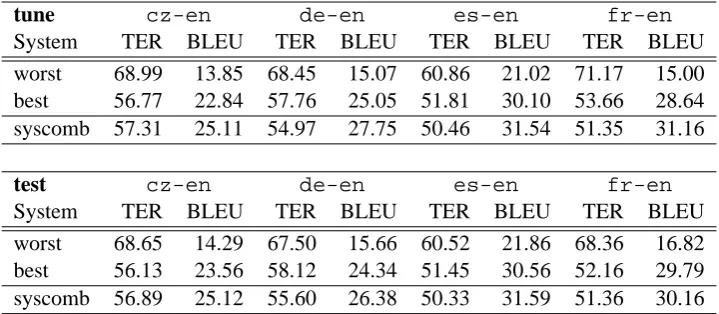
tune cz-en de-en es-en fr-en
System TER BLEU TER BLEU TER BLEU TER BLEU
worst 68.99 13.85 68.45 15.07 60.86 21.02 71.17 15.00 best 56.77 22.84 57.76 25.05 51.81 30.10 53.66 28.64 syscomb 57.31 25.11 54.97 27.75 50.46 31.54 51.35 31.16
test cz-en de-en es-en fr-en
System TER BLEU TER BLEU TER BLEU TER BLEU
[image:5.595.119.479.62.219.2]worst 68.65 14.29 67.50 15.66 60.52 21.86 68.36 16.82 best 56.13 23.56 58.12 24.34 51.45 30.56 52.16 29.79 syscomb 56.89 25.12 55.60 26.38 50.33 31.59 51.36 30.16
Table 1: Case insensitive TER and BLEU scores onsyscombtune(tune) andsyscombtest(test) for combinations of outputs from four source languages.
LTW, NYT, and Headlines+Datelines. In-terpolation weights for the ten components were tuned so as to minimize perplexity on thenewstest2009-ref.endevelopment set. The LMs used modified Kneser-Ney smoothing. On the multi-source condition (xx-en) another LM was trained from the system outputs and in-terpolated with the general LM using an interpola-tion weight 0.3 for the LM trained on the system outputs. This LM is referred to as biasLM later. A tri-gram true casing model was trained using all available English data. This model was used to restore the case of the lower-case system combi-nation output.
All six 1-best system outputs on cz-en, 16 outputs on de-en, 8 outputs on es-en, and 14 outputs on fr-en were combined. The lat-tice based BLEU tuning was used to optimize the bi-gram decoding weights and N-best list based BLEU tuning was used to optimize the 5-gram re-scoring weights. Results for these single source language experiments are shown in Table 1. The gains onsyscombtunewere similar to those on
syscombtest for all but French-English. The tuning set contained only 455 segments but ap-peared to be well matched with the larger (2034 segments) test set. The characteristics of the indi-vidual system outputs were probably different for the tuning and test sets on French-English transla-tion. In our experience, optimizing system com-bination weights using the ExpBLEU tuning for a small number of systems yields similar results to lattice based BLEU tuning. The lattice based BLEU tuning is faster as there is no need for mul-tiple decoding and tuning iterations. Using the bi-asLM on the single source combinations did not
xx-en tune test
System TER BLEU TER BLEU
worst 71.17 13.85 68.65 14.29 best 51.81 30.10 51.45 30.56 lattice 43.15 35.72 43.79 35.29 expBLEU 44.07 36.91 44.35 36.62 +biasLM 43.63 37.61 44.50 37.12
Table 2: Case insensitive TER and BLEU scores on syscombtune (tune) and syscombtest
(test) forxx-encombination. Combinations us-ing lattice BLEU tunus-ing, expected BLEU tunus-ing, and after adding the system output biased LM are shown.
yield any gains. The output for these conditions probably did not contain enough data for biasLM training given the small tuning set and small num-ber of systems.
Finally, experiments combining all 44 1-best system outputs were performed to produce a multi-source combination output. The first experi-ment used the lattice based BLEU tuning and gave a 5.6 BLEU point gain on the tuning set as seen in Table 2. The ExpBLEU tuning gave an additional 1.2 point gain which suggests that the direct lattice based BLEU tuning got stuck in a local optimum. Using the system output biased LM gave an addi-tional 0.7 point gain. The gains on the test set were similar and the best combination gave a 6.6 point gain over the best individual system.
5 Conclusions
de-coding. The confusion networks were built us-ing an incremental hypothesis alignment algo-rithm with flexible matching. The bi-gram de-coding weights for the single source conditions were optimized directly to maximize the BLEU scores of the 1-best decoding outputs and the 5-gram re-scoring weights were tuned on 300-best lists. The BLEU gains over the best individual system outputs were around 1.5 points oncz-en, 2.0 points onde-en, 1.0 points on es-en, and 0.4 points on fr-en. The system combination weights onxx-enwere tuned to maximize Exp-BLEU, and a system output biased LM was used. The BLEU gain over the best individual system was 6.6 points. Future work will investigate tuning of the edit costs used in the alignment. A lattice based ExpBLEU tuning will be investigated. Also, weights for more complicated functions with addi-tional features may be tuned using ExpBLEU.
Acknowledgments
This work was supported by DARPA/IPTO Con-tract No. HR0011-06-C-0022 under the GALE program.
References
Christiane Fellbaum, editor. 1998. WordNet: An
Elec-tronic Lexical Database. MIT Press.
Dong C. Liu and Jorge Nocedal. 1989. On the limited memory method for large scale optimization.
Math-ematical Programming, 45(3):503–528.
Franz J. Och. 2003. Minimum error rate training in statistical machine translation. In Proceedings of the
41st Annual Meeting of the Association for Compu-tational Linguistics, pages 160–167.
Kishore Papineni, Salim Roukos, Todd Ward, and Wei-Jing Zhu. 2002. BLEU: a method for automatic evaluation of machine translation. In Proceedings
of the 40th Annual Meeting of the Association for Computational Linguistics, pages 311–318.
Adam Pauls, John DeNero, and DanKlein. 2009. Con-sensus training for conCon-sensus decoding in machine translation. In Proceedings of the 2009 Conference
on Empirical Methods in Natural Language Pro-cessing, pages 1418–1427.
William H. Press, Saul A. Teukolsky, William T. Vet-terling, and Brian P. Flannery. 2007. Numerical
recipes: the art of scientific computing. Cambridge
University Press, 3rd edition.
Antti-Veikko I. Rosti, Spyros Matsoukas, and Richard Schwartz. 2007. Improved word-level system com-bination for machine translation. In Proceedings of
the 45th Annual Meeting of the Association of Com-putational Linguistics, pages 312–319.
Antti-Veikko I. Rosti, Bing Zhang, Spyros Matsoukas,
and Richard Schwartz. 2009. Incremental
hy-pothesis alignment with flexible matching for build-ing confusion networks: BBN system description for WMT09 system combination task. In
Proceed-ings of the Fourth Workshop on Statistical Machine Translation, pages 61–65.
Matthew Snover, Bonnie Dorr, Richard Schwartz, Lin-nea Micciula, and John Makhoul. 2006. A study of translation edit rate with targeted human annotation. In Proceedings of the 7th Conference of the
Associa-tion for Machine TranslaAssocia-tion in the Americas, pages
223–231.
Matthew Snover, Nitin Madnani, Bonnie Dorr, and
Richard Schwartz. 2009. Fluency, adequacy, or
HTER? exploring different human judgments with a tunable MT metric. In Proceedings of the Fourth
Workshop on Statistical Machine Translation, pages
259–268.
Roy W. Tromble, Shankar Kumar, Franz Och, and
Wolfgang Macherey. 2008. Lattice minimum
bayes-risk decoding for statistical machine transla-tion. In Proceedings of the 2008 Conference on
Em-pirical Methods in Natural Language Processing,