
The Dynamic-to-Static Conversion of Dynamic Fault Trees
Using Stochastic Dependency Graphs and Stochastic
Activity Networks
Gabriele Manno1, Ferdinando Chiacchio2, Francesco Pappalardo3 1Department of Mathematics and Informatics, University of Catania, Catania, Italy 2Department of Electric, Electronic and Computer Engineering, University of Catania, Catania, Italy
3Department of Drug Sciences, University of Catania, Catania, Italy Email: [email protected], [email protected], [email protected]
Received December 1,2012; revised January 4, 2013; accepted February 12, 2013
ABSTRACT
In this paper a new modeling framework for the dependability analysis of complex systems is presented and related to dynamic fault trees (DFTs). The methodology is based on a modular approach: two separate models are used to handle, the fault logic and the stochastic dependencies of the system. Thus, the fault schema, free of any dependency logic, can be easily evaluated, while the dependency schema allows the modeler to design new kind of non-trivial dependencies not easily caught by the traditional holistic methodologies. Moreover, the use of a dependency schema allows building a pure behavioral model that can be used for various kinds of dependability studies. In the paper it is shown how to build and integrate the two modular models and to convert them in a Stochastic Activity Network. Furthermore, based on the construction of the schema that embeds the stochastic dependencies, the procedure to convert DFTs into static fault trees is shown, allowing the resolution of DFTs in a very efficient way.
Keywords: Dynamic Fault Tree; Stochastic Dependency Graphs; Stochastic Activity Network; Continuous Time
Markov Chain
1. Introduction
Nowadays, technology and technological systems are fun- damental constituents of any industrial process. In such a context, the demand of more effective and precise risk assessments and performability evaluations has high- lighted the necessity of adequate, specific dependability evaluation techniques and methods. In fact, such de- pendability techniques and methods have to be able to effectively capture the behavior of modern systems, sub- systems and components which could be characterized by interdependencies and interactions. Many methodolo- gies have been formulated to achieve these objectives and implement efficient solution techniques. Among these, Dynamic Fault Tree (DFT) [1,2] stands out for its char- acteristics including: a valid formalism, a high level lan- guage of description and several resolution algorithms. For these reasons DFT has became a benchmark for many other modeling framework for the dependability.
Many efforts have been made to address the following main issues: 1) the problem of the state space explosion of the equivalent Continuous Time Markov Chain (CTMC) [3-7]; and 2) the need of a more generalized formalism to tackle various kind of complex systems and able to per-
form different dependability studies [8-18]. In [12] a powerful framework able to tackle general dependencies is presented. However, dependencies can be implemented only through connections (i.e., denoted as triggers) be- tween the elements of the Fault Tree. In this way, com- plex relationships can be added abusing of the Fault Tree notation, which can, in the end, results in an explosion of the tree.
The main motivation of this work is to expand the modeling power capabilities of dependability tools, such as DFTs, and maintain a high level formalism of descrip- tion. The issues addressed in this paper concern: 1) the lack of the general modeling techniques to include sto- chastic dependencies between events not directly related by a fault (i.e., a more general approach to model state- dependent components behavior); and 2) the handling of general sojourn time distributions, non-Markovian proc- esses (e.g. time delays), inhibitions, multiple failure modes, etc.
a stochastic Dependency Graph (DG) and a generic fault schema. Hence, dependability measures are evaluated through the combination of the information provided by these two models.
The framework results incredibly flexible because the DG and the fault schema are independent. The former embeds the dependencies among the components, the latter embeds the system fault logic. Moreover, this last one can be constructed in several ways (i.e. FT, RBD, Event Tree, etc.). In this way, it is possible to generate a behavioral model on the basis of the information con- tained in the DG and compute many Reward Functions (RF; like the reliability, availability, reliability with re- pair, conditional probabilities, etc.) attaching the infor- mation derived from the system fault schema.
In this paper is presented an application of this model- ing framework and a practical case study to convert DFT will be shown: the stochastic dependencies of the DFT will be captured by the DG model, while the system fault logic will be described by a static Fault Tree (FT). In the following this modular model is referred as a Stochastic Dependency Graph Fault Tree (DGFT).
The objectives of this methodology can be listed as follow:
Create a more flexible approach for the dependability modeling in presence of state-dependent components behavior;
Model new dependencies logics that are not expressed through the dynamic gates of the DFT;
Assess various dependability studies using one single model;
Evaluate dependability measures of complex systems by the mean of analytical and simulating methods easily retrievable from the high level models.
The remainder of the paper is structured as follow: in Section 2 a general description of DGs’ basic elements is given and a general mathematical expression stating the state-dependent transition rate of components with expo- nential behavior is given; in Section 3 is presented the general procedure to convert DFTs in DGFTs and the subsequent lower level conversion that is needed to cal- culate the RF; Section 4 is concerned with the derivation of the intermediate level models; in Section 5 a case study (taken from the literature) [10] is solved to show the DFT to DGFT conversion and the resolution proce- dure; Section 6 reports conclusion and future works.
2. Stochastic Dependency Graphs
A DG is a model that highlights stochastic dependencies between components. The elements of a DG are nodes, direct links and dependency gates. Each component is represented by a node and nodes are linked together by the mean of direct links and dependency gates. Connec- tions represent stochastic relationships among compo-
nents. Components not affected by stochastic dependen- cies are drawn as isolated nodes while components sub- jected to dependencies will be drawn as nodes intercom- nected by direct links and gates.
It is worth to distinguish between parents and child components. Parents components are components whose the entering in a particular state force some change in the parameter of the sojourn time distribution (or more gen- erally the entire distribution law) of the child component. A node can be both a parent and a child for some other node.
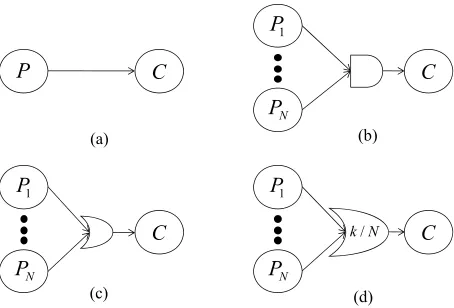
Among all the kind of dependencies some basic de- pendency types are reported in this paper: elementary,
AND, OR and k/N:
An elementary dependency exist between a parent
and a child component if a change in the state of the parent forces a change in the child sojourn time dis- tribution;
In an AND dependency gate the child is affected from its parents if all them are in a specific state;
In an OR dependency gate the child is affected if at least one of its parents is in a specific state;
In a k/N dependency gate the change is dictated from all the combinations of the N parents where k of them are in a specific state. It generalizes the AND and OR
dependency gates in the case that k is respectively equal to N and one. In the case that both k and N are equal to one the dependency gate is further reduced to an elementary dependency link.
Generally the specific state is represented by the failed state. Figure 1 shows the graphical representation of the
four kinds of dependencies introduced above.
For a DG constituted by any combination of the basic elements above introduced, qualitative MCS (or DMCS in case of dynamic dependencies) can be derived. They can be used to specify the reactivation conditions in the- behavioral model (see Section 4).
P C
1
P
N
P
C
1
P
N
P
C
1
P
N
P
C
N k/
a) b)
c) d)
(a) (b)
[image:2.595.310.537.546.700.2](c) (d)
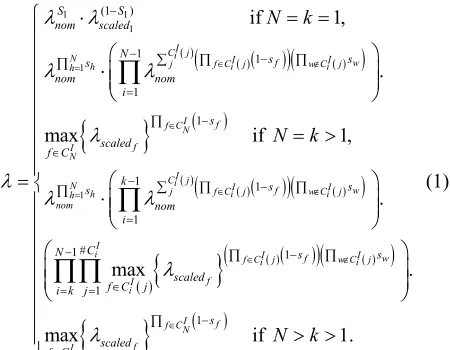
In the following a mathematical expression to calcu- late the system-state-dependent failure rate of a compo- nent under a k/N dependency gate is shown. The results refer only to exponential sojourn time distribution but they can be further generalized.
Let us consider a system with two state components (i.e. “working-failed” or “UP-DOWN”). Let us denote with si the state of the generic i-th component: si can as-
sume two values, one or zero standing respectively for working and failed. Let us define the set I as the set of all input component indexes. Let say h as the generic ele- ment of I. Thus, I
h: h 1, 2, , N
.Let call CiI as the set of all the subset of I of cardinal-
ity i, with . The cardinality of the generic
set CiI is defined as #CiI. Let us denote each subsets of
CiI with CiI(j), with , #CiI. In this way each
subset CiI(j) represents a collection of input indexes. The current failure rate (i.e., dependent on the current parents state configuration) of the child component is given by:
1, 2, ,
i
j N
1, 2,
1 1 1 1 1 (1 ) 1 1 1 1 1 1 1 1 if 1, .max if 1,
.
max I Ci j
N h j f CiI j f w CiI j w h I f f CN f I N I Ci j
N j f CI j f w CI j w
i i h h nom f I i S S nom scaled
N s s
s nom nom i s scaled f C
k s s
s
nom i
scaled f C j
N k N k
# 1 1 1 .max if 1.
I
i f CI j f w CI j w
i i I f f CN f I N C
N s s
i k j
s scaled
f C N k
(1)where λnom and scaledf are the failure rate of the child
component when: no dependency effects are present
(nominal) and when subjected to the dependency effects
of the parent f (scaled).
It is necessary to specify that when λnom is equal to zero (e.g. SPARE in cold stand-by or SEQ) the formula 00 is equal to one and that when
f
scaled
is equal to infi- nite (e.g. FDEP gate) the formula ∞0 is also equal to one (this is not mathematically correct but allows a compact representation of the expression above).
Equation (1) is the most general form to assess the current failure rate of a child component given the state of its parents. It is suitable for each of the dependency gate discussed above.
Equation (1) is enough general to model systems where the failure rate of the child component assumes different values depending on the kind of failed parent (e.g. a repeated component in a SPARE and a FDEP gate). In this case the impact on the failure rate of the
child can be different depending on which parent forces the dependency logic. The operator max is used to ad- dress situations where the predominant effect must be chosen.
To model some other relationship between parents and child (e.g. modeling joint effects does not require the max operator) other gates can be introduced, thus gener- alizing the model for any circumstance.
If a DG is composed of a cascade of gates, Equation (1) must be evaluated in a bottom-up procedure. To this end, the possible states of the gates need to be estimated as well as the transition rates determined from these states (Table 1).
3. DFT-DGFT Conversion
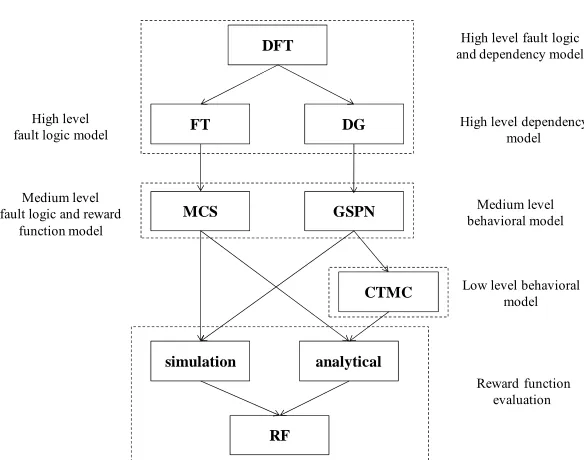
In this section the general approach to convert a DFT in a DGFT model is described. The procedure is carried in three steps (Figure 2): the construction of the FT and the
DG model (i.e., the high level models); the construction of the behavioral model and the calculation of the MCS (i.e., the medium level models); and the estimation of the RFs.
In the first step the stochastic dependencies included in the logic of SPARE, FDEP and SEQ gates are designed through the DG model. In this way, all the dynamic gates can be replaced by the appropriate static gates (i.e., pre- serving the fault logic). This is not the case of the PAND gate since no stochastic dependencies are introduced by this gate (i.e., it describes a kind of fault time depend- ency). A procedure to solve models including this gate is reported in Section 4.
[image:3.595.63.288.319.494.2]The second step consists in the construction of the medium level models. A model representing the behavior of the system can be constructed on the basis of the DG model. For instance it can be expressed by Generalized Stochastic Petri Nets (GSPN) [14,15,19]. GSPNs are a powerful tool due to the possibility to conduct simula- tions and convert them in CTMCs. Also more general
Table 1. DG reduction: Ai component name; SAi component
state; SAi = 1 “UP; SAi “DOWN”; λi failure rate of child
component if parent i is failed.
DG DMCS Gate state (GS)
AND A Ai j max
SA SAi, j
OR AiAj SA SAi· j
k N 2
k A Ai jA Ai zA Aj z
max SA SAi, j
·
max SA SAi, z
·
High level fault logic and dependency model
DFT
FT DG
GSPN
CTMC MCS
simulation analytical
RF
Medium level behavioral model
Low level behavioral model
Reward function evaluation Medium level
fault logic and reward function model
High level dependency model High level
[image:4.595.151.443.76.306.2]fault logic model
Figure 2. DFT-DGFT conversion framework.
est from a dependability point of view and can be evalu- ated through any other fault schema.
Discrete Event Simulation (DES) [16-21] models can be used and, in this case, the DG provides a dependency matrix and mathematical expressions (such as (1)) used to update the system-state-dependent distribution law of the system components.
4. Medium Level Models
Medium level models are used to represent the behavior and the fault logic of the system. The behavioral model is built using the knowledge contained in the DG model. A special class of GSPN—Stochastic Activity Networks (SAN) [19]—were used in this work. Elements of a SAN are: instantaneous and timed activities, input and output gates, places and extended places. A more complete dis- cussion regarding SAN models can be found in [19]. The modeling approach is component based. Each component is represented by a place whose marking specifies its state (e.g. one token “UP”; zero token “DOWN”). For each state a component can assume, an activity representing its shifting among these states must be created. Each activity can be reactivated regarding the change of the marking of the model. To this end, it includes a reactivation predicate that is used to assess if the conditions specified by the DMCS, of the sub-DG of the current modeled component, have changed (i.e., DMCS can be automatically converted in a if statement). Two situations must be distinguished: The medium level of the fault model is then extracted
in order to evaluate the set of states of the system that concur to the calculation of the RF. This operation is trivial since the FT, obtained at the previous stage, is free of complex formalisms and can be solved via the Mini- mal Cut Set (MCS) [22]. In some case instead of calcu- lating the MCS, it can be convenient to create the GSPN model of the FT and link it to the GSPN behavioral model. Models concerning with general type of RFs and with fault time dependencies (e.g. PAND gates) can re- quire the construction of this other medium level model.
The RF is finally calculated by joining the two me- dium level models. The solution can be achieved via the conversion of the GSPN model to a CTMC or obtained via simulation.
Generally, analytical solutions are preferred, but in cases where 1) the state space is too big; 2) the dynamic behavior of the system is too complex; 3) general sojourn time distributions are used, a solution based on simula- tion can be obtained with precision dependent on the simulating time (i.e., number of batches).
In the case of non-repairable components, the reacti-
vationpredicate is based only on the DMCS (Table
1). Figure 2 represents schematically the DFT conversion
and the resolution process of a DGFT. If the DGFT is used as a stand-alone methodology the procedure starts from the second level of the process depicted in Figure 2.
In the case the fault schema used is not a FT, no differ- ences are encountered in the resolution of the model. In fact the MCS represent just that set of condition of inter-
If the system consists of repairable components, apart the DMCS, it must be included all the conditions due to the repair of the parents (Table 2).
Table 2. DMCS Vs reactivation predicate: reliability. Ai component name; PAi component place; mark (PAi == 1) “UP; mark
(PAi == 0) “DOWN”.
DG DMCS Reactivation Statement-Reliability
AND A Ai j
mark PA i 0 & &
mark PA
j 0
OR AiAj
mark PA i 0
mark PA
j 0
k N 2
k A Ai jA Ai zA Aj z
0 & & 0
0 & & 0 0 & & 0
i j
i z j
mark PA mark PA
mark PA mark PA mark PA mark PA
z
added by an and statement to the conditions specified by the DMCS.
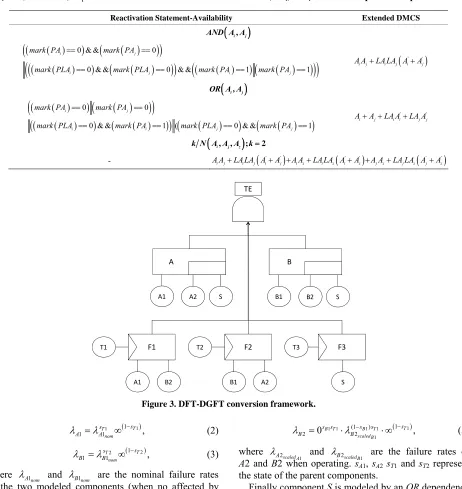
Moreover, a distinction must be made in the case the DG is composed of OR and k/N gates. In fact, given the structure of these gates, reactivation occurs each time a component attached to these gates changes its status (OR) or each time a new k condition is reached by the change of some component attached to a k/N gate. Thus we de- fine another statement, the activation predicate. In the SAN language the activation predicate checks if the state when the activity was last activated match the conditions expressed in the statement itself. This is done to avoid reactivation when not wanted, but the modeler could choose to leave the possibility of reactivation just by set- ting the activation predicate equal to one. The condition to specify in the activation predicate are specified in Table 3.
If a DG is composed of a cascade of gates is possible to evaluate the DMCS following a bottom-up procedure (i.e., from the dependency gates at the lower level to top level).
RFs like the reliability and the availability of the sys- tem are calculated by imposing the MCS conditions cal- culated by the converted static FT. MCS can be attached to the SAN model in the form of an if statement that verifies the marking of the places representing those components concerned in the MCS.
Two issues arise when dealing with reparable compo- nents, more specifically when:
1) The goal is to compute the reliability even in pres- ence of repairs (i.e., components can be repaired if the whole system has not failed);
2) If the system has failed, working components can- not longer fail (i.e., the associated CTMC is a truncated CTMC).
In these cases the behavioral model requires informa- tion about the state of the whole system. To pass this information, two choices are possible: 1) the construction of a SAN model of the FT; 2) include inputgates which disable activities by a statement regarding the occurrence of the MCS.
5. Case Study
In this section an application of the DFT-DGTF conver- sion is shown. Starting from a DFT the equivalent DGFT is built. Successively, using the information contained in the DG model, a SAN model is implemented using the Mobius® software package, developed from the Center for Reliable and High-Performance Computing at the University of Illinois at Urbana-Champaign [18]. Once the MCS are evaluated from the converted FT they are integrated in the SAN model and used to calculate the reliability of the system.
We use a study, from [10], to assess the potentiality of the DGFT methodology due to the presence of repeated events shared among different dynamic gates. All the components are non-repairable characterized by a time to failure exponentially distributed. The DFT of the case study is shown in Figure 3. Its elements are: the basic
events A1, A2, B1, B2, S, T1, T2, T3; the gates A (SPARE gate with an active component: A1; and two spares: A2,
S), B (SPARE gate with an active component: B1; and two spares: B2, S), F1 (FDEP gate with trigger T1 and components A1 and B2), F2 (FDEP gate with trigger T2 and components A1 and B2), F3 (FDEP gate with trigger
T3 and component S), TE (AND gate with gates A, B, F1,
F2, F3 as inputs).
5.1. DG Construction
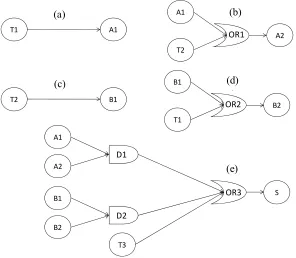
The Construction of the DG of the system requires find- ing the parents of each component. All the components are attached to dynamic gates, thus, no isolated nodes are present in the DG (Figure 4). The model is retrieved
using the procedure stated in Section 4 to convert DFT gates. OR gates are used to model dependencies among different dynamic gates.
A1 and B1 are subject to the dependency effect of T1 and T2. The DG for these two components is then com-posed of an elementary dependency link.
Table 3. DMCS Vs reactivation predicate: availability. Ai component name; PAi component place; mark (PAi == 1) “UP; mark
(PAi == 0) “DOWN”; Ai' a check on the inverse condition must be made; LAi, PLAi are used to represent the past state of Ai.
Reactivation Statement-Availability Extended DMCS
i, j
AND A A
0 & & 0
0 & & 0 & & 1 1
i j
i j i
mark PA mark PA
mark PLA mark PLA mark PA mark PA
j
' '
i j i j i j
A A LA LA AA
i, j
OR A A
0 0
0 & & 1 ( 0 & & 1
i j
i i j
mark PA mark PA
mark PLA mark PA mark PLA mark PA
j
' '
i j i i j
AALA ALA Aj
i, j, z
; 2k N A A A k
-
' '
' '
' '
i j i j i j i z i z i z j z j z j z
A A LA LA AA A A LA LA AA A ALA LA A A
A
A1 A2 S
B
B1 B2 S
S
F3
T3
B2
F1
T1
A1 A2
F2
T2
B1
[image:6.595.69.531.107.596.2]TE
Figure 3. DFT-DGFT conversion framework. 1
1 1
1 1Tnom T ,
s s
A A
(2) 2
2 1
1 T1nom T ,
s s
B B
(3)
where A1nom and B1nom are the nominal failure rates
of the two modeled components (when no affected by any dependency effect). sT1 and sT2 represent the state of the trigger events (i.e., 0 if failed, 1 if not).
The DG of A2 and B2, is represented by an OR de- pendency gate with two inputs: the first one represents the active component of the SPARE and the other the trigger event of the FDEP of the gates they respectively belong to. The simplified expressions of the state-de- pendent failure rates of A2 and B2 are:
1 2 2 1 2
1 2
1 1
2 ,
0A T A T T
scaled A
A
s s s
s s A
(4)
1 1 1 1 1
1 1 (1 )
2 0B T 2scaledBB T T , s s s s s
B B
(5)
where
1 2scaled A A
and
1 2scaledB B
are the failure rates of
A2 and B2 when operating. sA1, sA2sT1 and sT2 represent the state of the parent components.
Finally component S is modeled by an OR dependency gate holding three inputs which stand for: the case the S
is required from the SPARE A, from the SPARE B and the case the trigger T3 occurs. The DG model that em- beds the dependencies of the components A1/A2 (or
B1/B2) on S through the SPARE are represented by an
AND dependency gate, since S is a spare component of the second order (i.e., positioned as a second spare com- ponent in each gate). The simplified expression of the state-dependent failure rate of S is:
2 1 1 2 1 2 3 3
1 2 3 1 1 1 1 1
0D D T D D D D D D T T
scaledD
s s s s s s s s
s s S S
s
A1 T1
B1 T2
A1
A2 T2
B1
B2 T1
S
T3 A1
D1
A2
B1
D2
B2
a) b)
c) d)
e) OR1
OR2
OR3
(a)
(c)
(b)
(d)
[image:7.595.150.446.88.346.2](e)
Figure 4. DG of the DFT in Figure 3. Dependencies affecting: (a) A1; (b) A2; (c) B1; (d 2; (e) S.
where
) B
scaledD
S
ting co
is the failure rate of S when operating as substitu mponents (i.e., the dependency effect is the same under D1 and D2). In this case a bottom-up procedure to retrieve the state-dependent failure rates was used. Thus sD1, sD2, represent the state of the gates
D1 and D2 and sT3 the state of the trigger T3. More spe- cifically sD1max
sA1,sA2
and sD1max
sB1,sB2
with sA2, s ate of A
5.2. FT Construction
B2 respectively the st 2 and B2.
The static representation of the DFT in Figure 3 is
on shown in Figure 5. In this pure fault logic model FDEP
gates are no longer present.
The model results simplified in a top level gate, the
AND of the previous model, that holds two more AND
gates (A and B) with three inputs for each. The two AND
gates result from the conversion of the two SPARE gates of the DFT model. In the general case they should be two
k/N gates but, since the number of active components is equal to one, the rule of Section 4 states that k is equal to N. Thus the gates result simplified in two AND gates.
5.3. Medium Levels Models Construction
Avoid In the SAN behavioral model each comp ent is modeled by the following elements:
PX; place that represent the state of the component X
(i.e., mark (PX) = 1 if UP; o if DOWN). In the fol- lowing with X it is denoted any of the components A1,
A2, B1, B2, S, T1, T2, T3.
A
S A1 A2
B
S B1 B2
[image:7.595.319.528.376.507.2]TE
Figure 5. Static representation of the DFT in Figure 3.
Failure activity: timed activity that represents the fail- i- - ure of the component. In the failure activity are spec fied the failure rate of th component and the reactie vation predicate.
For the sake of clarity it is needed to specify that the notation sX, representing the state of the component X
in any of the Equation from (2) - (6), is substituted with the notation mark (PX).
The reactivation predicate is specified by combining a statement with two sets of conditions: 1) the one aris-ing from the last component that experienced a transi-tion (Table 4); and 2) the one arising from the DMCS
of the DG associated with the component X (Table 5).
Table 4. Additional condition in the reactivation predicate: in p la e ID is stored the identifier number of the last component- place that changed its marking.
c
Place Name ID ID Parents Reactivation Statement
1
PA 1 6
mark ID 6
2
PA 2 1, 7
mark ID 1
mark ID 7
1PB 3 7
mark ID 7
2
PB 4 3, 6
mark ID 3
mark ID 6
PS 5 3, 4, 8 1, 2,
mark ID 1
mark ID 2
mark ID 3
mark ID 4
mark ID 8
1PT 6 - -
2
PT 7 - -
3
PT 8 - -
Table 5. DMCS Vs reactivation predicate: reliability. Mark (PX(i) = 0), “DOWN”; mark (PX(i) = 1), “UP”.
DG DMCS Reactivation Statement—Reliability
1
OR A1T2
mark PA 10
mark PT 20
2OR B1T1
mark PB 10
mark PT 20
D1 A A 1 2 PD1
mark PA 10 & & mark PA 20
D2 B B 1 2 PD2mark PB 10 & & mark PB 20
OR3 D1D2T3 PD PD1 2
mark PT 30
place, shared between all the components, where
tored the id tifier number of the last component- place that changed its ma ing.
: ID;
is s en
rk
The model of a generic component in a SAN model is shown in Figure 6.
The MCS of the FT in Figure 5 is
1 2 1 2
MCSA A B B S (7) This information is used when defin
ck on the marking of the places
ing the RF. In this
case a che PA
PB2 and PS of the SAN behavioral model i tim
o evaluate the reli- in Figure 3.
xponentially
he Mobius® Trans- fo
1, PA2, PB1, s made at the e the RF is willed to be evaluated.
5.4. Evaluation of the RF: Reliability
The goal of the present case study is t ability of the system modeled by the DFT The time to failure of all components is e
[image:8.595.57.283.318.422.2]distributed and the failure rate values can be found in
Table 6. From reference [10] the reliability value of the
system at 100 time units is 0.03126.
The model was resolved analytically (i.e., converting the SAN model in a CTMC) and via simulation. When converted to the low level model t
rmer found 256 states (reduced to 48 in the solving phase). The absorbing states were found to be 8. The
PX
output gate
ID
failure activity component-place
shared identifier
[image:8.595.351.495.402.488.2]Figure 6. SAN model of a generic component. Table 6. Components failure ra
Component Failure Rate λ
te [time unit-1].
A1 0.001
A2 0.005
B1 0.002
B2 0.0035
S 0.005
T1, T2, T3 0.003
reliability value was equal to 3.1 e-002 confirming
the result in [10].
The Simulator results are repo Table 7. Again,
the results found [10] are ma The experiment
was carried out by a laptop with ollowing charac-
teristics: CPU, Intel Core 2 uo 1.83 GHz; RAM, 1.99
6.
e and computationally efficient based on two odels: the Stochastic Dependency c fault schema.
26453
rted in
in tched.
the f D
GB.
Conclusions
This paper introduces a new modeling framework for the dependability assessment of complex stochastic systems. DGFT is a high level modeling methodology easy to use, intuitiv
separated system m Graph and a generi
Table 7. Simulator solver results.
Simulator Batches Mean Conf. Int. CPU time SAN 5e08 3.12e−02 +/−4.76e−05 1608 sec
over DGs can be converted efficiently in their related behavioral model. Furthermore the behavioral model,
f any fault logic, results a very fle
being free o xible mean
to va nd stu
T ain ad ges )
i-bility of building high-level-high-descriptive models very
odified and tha m
towards: 1) the formalization of a
e DGFT automatic conversion in SAN m
RMS.1990.67971
conduct rious depe ability dies.
he m vanta of DGFT are, thus, 1 the poss
close to the real structure of the system; 2) the effective- ness of tackling state-dependent component behaviors; 3) and its convertibility in effective and capable lower level
models that can be easily improved and m t
ake easier the task of estimating dependability measures, perform sensitivity and uncertainty analysis, diagnosis and other assessments.
DGFT can be used as a stand-alone methodology or as a starting point to build SAN models of dependable sys- tems. Moreover, by this methodology, it is possible to solve efficiently DFTs by converting them to their re- lated FT model.
Future works may go
general theory regarding Stochastic Dependency Graphs and their implication in terms of behavioral models; 2) the integration of more advanced tools to resolve fault time dependencies (e.g. dependencies introduced by PAND gates); and 3) th
odels which have shown their potentiality to solve complex dependable systems, both analytically and via simulation, and thus, allowing to model and solve a very general class of complex systems.
REFERENCES
[1] J. B. Dugan and S. J. Bavuso, “Fault Trees and Sequence Dependencies,” Proceedings of Annual Reliability and MaintainabilitySymposium, Los Angeles, 23-25 January 1990, pp. 232-235. doi:10.1109/A
[2] J. B. Dugan and S. J. Ba ynamic Fault-Tree
Models for F r Systems,” IEEE
vuso, “D ault Tolerant Compute
Transactions on Reliability, Vol. 41, No. 3, 1992, pp. 363-377. doi:10.1109/24.159800
[3] S. Amari, G. Dill and E. Howald, “A New Approach to Solve Dynamic Fault Trees,” Annual Reliability and MaintainabilitySymposium, 2003, pp. 374-379.
[4] R. Gulati and J. B. Dugan, “A Modular Approach for Analyzing Static and Dynamic Fault Trees,” Proceedings of Annual Reliability and Maintainability Symposium, Philadelphia, 13-16 January 1997, pp. 57-63.
doi:10.1109/RAMS.1997.571665
[5] M. Lanus, L. Yin and K. S. Trivedi, “Hierarchical Com- position and Aggregation of State-Based Availability and Performability Models,” IEEETransactions onReliabil- ity, Vol. 52, No. 1, 2003, pp. 44-52.
doi:10.1109/TR.2002.805781
[6] B. N. Feinberg and S. S. Chiu, “A Method t
Steady-State Distributions of Large Markov Chains by o Calculate Aggregating States,” OperationsResearch, Vol. 35, No. 2, 1987, pp. 282-290. doi:10.1287/opre.35.2.282
[7] M. Malhotra and K. S. Trivedi, “A Methodology for Formal Specification of Hierarchy
Proceedings of 5th International Workshopin Model Solution,” Petri Nets and Performance Models, (PNPM-1993), Toulouse, 19- 22 October 1999, pp. 258-267.
doi:10.1109/PNPM.1993.393445
[8] S. Distefano and A. Puliafito, “Dynamic Reliability Block
ystems by n Networks,” Reliabil- Diagrams vs Dynamic Fault Trees,” Proceedings of An- nualReliabilityandMaintainabilitySymposiumRAMS’07, Orlando, 22-25 January 2007, pp. 71-76.
[9] A. Bobbio, L. Portinale, M. Minichino and E. Ciancamer- la, “Improving the Analysis of Dependable S
Mapping Fault Trees into Bayesia
ityEngineeringandSystemSafety, Vol. 71, No. 3, 2001, pp. 249-260. doi:10.1016/S0951-8320(00)00077-6 [10] H. Boudali and J. Dugan, “A New Bayesian Network
Approach to Solve Dynamic Fault Trees,” Proceedingsof Annual Reliability and Maintainability Symposium, Al-exandria, 24-27 January 2005, pp. 451-456.
doi:10.1109/RAMS.2005.1408404
[11] H. Boudali and J. B. Dugan, “A Continuous-Time Bayes- ian Network Reliability Modeling, and Analysis Frame- work,” IEEETransactionsonReliability, Vol. 55, No. 1, 2006, pp. 86-97. doi:10.1109/TR.2005.859228
[12] M. Bouissou and J. L. Bon, “A New Formalism That Combines Advantages of Fault-Trees and M
els: Boolean Logic Driven Markov
arkov Mod- Processes,” Relibility EngineeringandSystemSafety, Vol. 82, No. 2, 2003, pp. 149-163. doi:10.1016/S0951-8320(03)00143-1
[13] S. Swaminathan and C. Smidts, “The Event Sequence Diagram Framework for Dynamic Probabilistic Risk As- sessment,” ReliabilityEngineeringandSystemSafety, Vol. 63, No. 1, 1999, pp. 73-90.
doi:10.1016/S0951-8320(98)00027-1
[14] D. Codetta-Raiteri, “The Conversion of Dynamic Fault Trees to Stochastic Petri Nets, as a case of Graph Trans- formation,” ElectronicNotesinElectronicComputerSci- ence, 127, No. 2, 2005, pp. 45-60.
doi:10.1016/j.entcs.2005.02.005 [15] V. Volovoi, “Modeling of System Re
with Aging Tokens,” ReliabilityEngin
liability Petri Nets eeringandSystem Safety, Vol. 84, No. 2, 2004, pp. 149-161.
doi:10.1016/j.ress.2003.10.013
[16] M. Marsaguerra, E. Zio, J. Devooght and P. E. Labeau, “A Concept Paper on dynamic
Carlo Simulation,” Mathematics
Reliability via Monte andComputersinSimu- lation, Vol. 47, No. 2-5, 1998, pp. 371-382.
doi:10.1016/S0378-4754(98)00112-8 [17] E. Zio, M. Marella and L. Podollini, “A
Stochastic Activity
nd L lution: A Con-[18] Mobius. http://www.mobius.illinois.edu/
[19] W. H. Sanders and J. F. Meyer, “
Networks: Formal Definitions and Concepts,” In: H. Hermanns and J.-P. Katoen, Eds., Lectures on Formal Methods and Performance Analysis, Springer Verlag, Berlin, 2002, pp. 315-343.
[20] F. Chiacchio, D. D’Urso, N. Trapani, G. Manno a . Compagno, “Dynamic Fault Trees Reso
scious Trade-Off between Analytical and Simulative Ap-proaches,” Reliability Engineering and System Safety, Vol. 96, No. 11, 2011, pp. 1115-1126.
doi:10.1016/j.ress.2011.06.014
[21] G. Manno, F. Chiacchio, L. Compagno, D. D’Urso and N. Trapani, “Matcarlore: An Integrat
Simulink Tool for the Reliability Assessmed FT and Monte Carlo ent of Dynamic Fault Tree,” Expert Systems with Applications, Vol. 39, No. 12, 2012, pp. 10334-10342.
doi:10.1016/j.eswa.2011.12.020
[22] A. Rauzy, “Binary Decision Diagrams for Reliability Studies,” Handook ofPerformabi
pp. 381-339.
![Table 6. Components failure rate [time unit-1].](https://thumb-us.123doks.com/thumbv2/123dok_us/1582224.704502/8.595.351.495.402.488/table-components-failure-rate-time-unit.webp)