Proc. of the Joint Workshop on Automatic Knowledge Base Construction & Web-scale Knowledge Extraction (AKBC-WEKEX), pages 35–40,
Population of a Knowledge Base for News Metadata
from Unstructured Text and Web Data
Rosa Stern
Univ. Paris 7, Sorbonne Paris Cit´e, France INRIA-Alpage, Paris, France AFP-Medialab, Paris, France [email protected]
Benoˆıt Sagot
INRIA-Alpage, Paris, France [email protected]
Abstract
We present a practical use case of knowl-edge base (KB) population at the French news agencyAFP. The targetKB instances are en-tities relevant for news production and con-tent enrichment. In order to acquire uniquely identified entities over news wires, i.e. tex-tual data, and integrate the resultingKBin the Linked Data framework, a series of data mod-els need to be aligned: Web data resources are harvested for creating a wide coverage entity database, which is in turn used to link entities to their mentions in French news wires. Fi-nally, the extracted entities are selected for in-stantiation in the targetKB. We describe our methodology along with the resources created and used for the targetKBpopulation.
1 An Entity Extraction Methodology for Knowledge Base Population
Current research conducted at the French news agency AFP focuses on the acquisition and storage of knowledge, particularly entities, relevant for the news production and usable as metadata for con-tent enrichment. This objective sets off the need for a dedicated knowledge base (KB) relying on a light-weight ontology of entities mappable to the Linked Data framework. Identification of entities such as persons, organizations and geopolitical en-tities (GPES)1 in unstructured textual data, news
wires in French in our case, underlie the construc-tion and enrichment of such aKB.
1
These entity types are the usual focus of Information Ex-traction systems and are defined among others by the ACE en-tity recognition task (Doddington et al., 2004).
This specific need is met by the KB population task, now well defined within the annual TAC ded-icated track (Ji et al., 2011). KBpopulation indeed
relies on the ability to link entity mentions in tex-tual data to aKBentry (entity linking subtask, hence-forthEL),2which follows pioneer work in entity
dis-ambiguation (Bunescu and Pasca, 2006; Cucerzan, 2007). In a similar way to systems described in Dredze et al. (2010) and Ji & Grishman (2011), we conductELoverAFPnews wires in order to ob-tain relevant entities meant to populate the targetKB, adapting these techniques to French data. This link-ing process is based on Web data extraction for both coverage and the purpose of Linked Data integra-tion, which has become a widely explored trend in news management and publishing projects, such as the ones conducted by the BBC (Kobilarov et al., 2009) or the New York Times (NYT).
Compared to other KB population settings, this knowledge acquisition process is done throughout a sequence of resources and extraction steps rather than in a cyclic way. Instead of considering oneKB
as both an entity resource and the target of the pop-ulation task, the targetKB(AFPMetadata Ontology, henceforth AMO) is viewed as initially empty and progressively augmented with entity instances. This is because the use intended for AMO does not rely on exhaustivity, but on a relevant set of entities men-tioned in the daily news production. This set is not fixeda prioriand must be regularly updated in order to maintain a reflection of entities’ emergence in the news domain. For instance, not all cities in the world
2The consequent
slot filling subtaskassociates these entries to attributes and relations to other entities.
Web Data
Entity Linking component
entities contextual information (Wikipedia)
Entity Knowledge
ID Name
Type URI
Weight Coordinates Country-code
Subtype
Entity Resource (EDB) database schema
Target KB (AMO) ontological model
ID Name
URI
Type Subtype
Extracted entities
1
2 3
AAA news wires unstructured text
Articles
Wikipedia-fr
categories
Location Entries
Geonames
features
DB attributes
Keywords Topics Words Dates Entity co-occurrences
Corpus Occurrences with
[image:2.612.76.539.69.189.2]selection
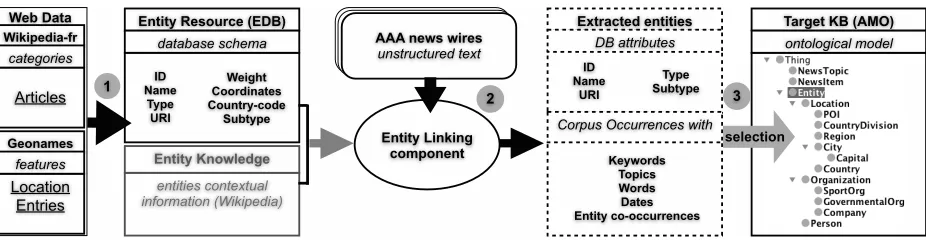
Figure 1: Overview of entity extraction andKBpopulation process
need be instanciated inAMO, but the cityFukushima should become an entry as soon as its part in major events is stated in news wires. The relevant entity set can then be matched to new entries and updates in parallel documentation resources maintained at the
AFP. The KB population process is broken down into several layers of data extraction and alignment, as sketched in Figure 1:
Step 1 The models of GeoNames and Wikipedia are mapped to a unified entity model; extraction from these Web datasets based on this mapping result in an entity database named Aleda, whose schema is presented in section 2, along with its alignement with Wikipedia and GeoNames data models.
Step 2 The Aleda database obtained in Step 1 pro-vides entities for the linking step, where entity men-tions in news wires are aligned with entries from Aleda. This process, along with the use of a joint resource for entity knowledge access, is described in section 3.ELin our particular task also targets the
identification of new entities (i.e. absent from Aleda) and attempts to deal with the problem of possible named entity recognition errors in queries made to the system.
Step 3 The resulting entities aligned in Aleda must be anchored in the target KB, via instantiation of the adequate ontological class. Contextual informa-tion gathered during the entity extracinforma-tion and linking process can be used at this point (section 4).
2 Entity Extraction from Web Data
Step 1 in our architecture is based on two Web datasets: the geographical database GeoNames brings together millions of location identifiers with associated information; Wikipedia is a wide cover-age resource for entities, with continuous updates and article creations for entities involved in current
events. The creation of a large-scale and unified entity resource is achieved by defining a database schema dedicated to entity representation, and by aligning both Wikipedia’s and GeoNames’ model with it. The schema considersPerson, Organization andGPEas types of entries. The building of Aleda therefore relies on the identification of Wikipedia’s and GeoNames’ entries to which one of these types can be assigned.
Wikipedia Exploiting Wikipedia as a large-scale entity resource has been the focus of numerous ef-forts, such as (Balasuriya et al., 2009; Charton and Torres-Moreno, 2010). Each Wikipedia article, re-ferring to an entity, concept or notion, is referenced under a number ofcategories, often fine-grained and specific. A hierarchical or ontological organization of these categories can be inferred (Syed et al., 2008) but a given article is not anchored in a generic con-ceptual class such as an entity type in a straight-forward fashion. The present model alignment thus consists in a mapping from Wikipedia categories to one of the target entity types. Each article mapped to one of these types leads to adding a corresponding entity in Aleda. The selection and typing process of articles as entities makes use of heuristics based on articles’ categories andinfoboxesand is achieved as follows.
infobox and tagged by a category such asBorn in * have been assigned the typePerson, which is there-fore associated to this category). An article is se-lected as referring to an entity by assigning the type with maximal category association to it. If no type can be assigned (when no categories were associ-ated with any type), an article’s infobox whose tem-plate has been typed can provide the information. If the article has no such infobox, no entity is derived from it. Aleda’s schema is filled with attribute val-ues extracted from each selected article: the columns URI, name, weight are mapped to the article’s URL, the normalized name inferred from the article’s ti-tle and the article’s length,3respectively. A joint ta-ble furthermore groups possita-ble variants or labels for each entity; these are inferred from Wikipedia’s redirection and disambiguation pages, which pro-vide aliases for article titles. For person names, addi-tional variants are automatically generated, by iden-tifying the first, possible middle and last names.
GeoNames The model alignment from
GeoNames is fairly straightforward since all its entries are locations. However this database is huge and present some noisy aspects, which we aim at avoiding by limiting the extraction to entities considered relevant for news content enrichment in French. Only GPEs such as countries, cities or country divisions were selected, based on the GeoNames feature provided. Heuristics are then designed for further selection: all GPEs in France are retained, as well as all non-French GPEs with more than 200 inhabitants. Aleda’s schema is filled with values provided by GeoNames for each selected GPE: the columns URI, name, weight, subtype, country-code and coordinates are mapped
to the GeoNames’ entity URL, name, number
of inhabitants, feature (such as P.PPL for popu-lated place), ISO country code and coordinates, respectively. The joint variants table is filled with GeoNames’ labels indicated as French or without language indication.
A unified entity resource of persons, organiza-tions and GPEs4is obtained, with 832,452 uniquely
3
This value is seen as a weight in the extend that an article size can indicate the popularity of an entity relatively to others, particularly in cases of homonymy.
4GPEs extracted from both GeoNames and Wikipedia are
listed and associated by anowl:sameAsrelation.
identified entities (33%, 62% and 5% of type Per-son, GPE and Organization, respectively), associ-ated with 1,673,202 variants.5
3 Text-Entity Alignment: Entity Linking
3.1 Methodology for Entity Linking
The knowledge acquisition step, crucial for the tar-getKBpopulation, consists in entity extraction from a corpus ofAFPnews wires. This is done by aligning
detected entity mentions in news wires with entries the Aleda database introduced in 2. This linking component is based on the learning of a similarity model between entity attributes, including contex-tual ones, and a mention in a given document. It is challenging particularly because of name variation and ambiguity, which can prevent an accurate entity identification. The named entity recognition (NER) module first detects entity mentions, along with a possible type, which become queries for the candi-dates selection among the database entries. The en-try with the highest similarity w.r.t. the mention and the document is chosen. This similarity is computed in a way comparable to a number of linking systems (described and evaluated in Dredze et al. (2010) and Ji & Grishman (2011)) and using the following fea-tures:
Surface similarity The candidate’s name and la-bels, available in the entity database, are compared to the mention (exact, partial, null string match). Candidate attributes The other candidate’s at-tributes available in Aleda, such as its weight (or popularity) and its country-code, can be indicators in cases of ambiguity.
Contextual similarity Entity contextual knowl-edge (associated to the entity resource for the link-ing component in fig. 1) is made available from the corpus of Wikipedia articles. In each article, entity mentions (identified by hyperlinks) are surrounded with information such as the article’s categories (i), the most salient words of the article’s text (ii) and the co-occurring entities in the article (iii). As news items are indexed via keywords and topics from
AFP’s controlled vocabulary lists, (i) are mapped to the document keywords and topics; (ii) and (iii) are
5A comparison with the NLGbAse resource (Charton and
Torres-Moreno, 2010), which has similar objectives, can be found in (Sagot and Stern, 2012). Aleda is freely available at
4
5 {Paris}
_Location 6
{Paris Hilton} _Person_f
{Hilton} _Person_f
{Hilton} _Person_m
[image:4.612.112.259.80.137.2]{Hilton} _Organization
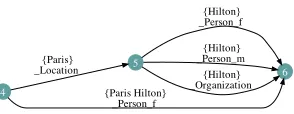
Figure 2: SXPipe/NPoutput for the segmentParis Hilton
compared to the document’s salient words and entity mentions, respectively.
The candidate maximizing the similarity is lected as the mention linking. However, this se-lection should not occur for every query, since (i) a number of entities mentioned in news wires don’t have a corresponding Aleda entry and (ii) the auto-maticNERcan return a number offalse mentions. In the case of (i), theout-of-baseentity (NIL) should be output as a linking result; in (ii), the mention should be discarded and indicate a not-an-entity reading (NAE) rather than give rise to a false link; for the lat-ter eventuality, features indicating ambiguities with the common lexicon are added to the feature set. These cases are part of the training examples and are taken into account in the prediction by including theNILandNAEcandidates in the ranking process. 3.2 Experiments and Evaluation
Experiments and evaluation are conducted over a manually annotated corpus of 96 news items, dated May-June 2009, where each entity mention’s bound-aries and Aleda ID, if relevant, are indicated. Men-tions referring to entities absent from Aleda are identified by a normalized name. The corpus in-cludes 1,476 entity mentions, referring to 610 dis-tinct entities among which 28% are absent from Aleda. The corpus is also annotated with the NER
systemSXPipe/NP6to add examples of false matches to the linking model. More precisely, theNERis ap-plied without complete disambiguation: a number of typing and segmentation alternatives are not re-solved at this level, but rather passed to the linking module. The underlying idea is to leave final entity recognition decisions to a level where knowledge and semantic information about entities are avail-able. Figure 2 illustrates this ambiguity preserva-tion, whereSXPipe/NPbuilds possible readings of a text segment in terms of entity mentions.
In each reading built by the NER module, each
6
http://alpage.inria.fr/∼sagot/sxpipe.html
mention (gold or not) is associated with a set of candidates: all Aleda entries for which the men-tion is a possible variant, as well as NIL and NAE
instances. All mention/candidate pairs are assigned a class, positive for correct links and negative for wrong ones, and form the training set for the link-ing model. A pair consistlink-ing in a false mention and theNAEcandidate is for instance labeled as positive. The training examples are fed to a maximum entropy classifier7with a 10-fold cross-validation. Based on the resulting model, each pair is then ranked accord-ing to the score assigned by the classifier, which amounts to a pointwise ranking strategy. Once men-tions are locally linked to the top-ranked candidates in all readings, the latter must in turn be ranked in or-der to finally disambiguate the current text segment. This ranking is done by assigning to each reading the score of its top-ranked candidate or, when the read-ing contains a sequence of mentions, the minimum of all top-ranked candidates’ scores.
On the evaluation data, the system obtains encour-aging results of linking accuracy (A) over the set of correctly detected entities (NERcolumns), compared to the topTAC-KBpopulation evaluation results over English data with only correct entity mentions (ta-ble 1). The overall task, i.e. of joint entity recogni-tion and linking, is also measured and is not com-parable to equivalent work to the best of our knowl-edge. Results show that the system’s ability to de-tect false entity mentions should be considerably im-proved, but filters out someNERnoise, which could not be the case in a mere sequential system where all detected mentions would be equally handled by the linking module.
Conducted over a corpus of≈400,000 news items of 2009 and 2010 on 16 news topics such as Pol-itics, Economyor Culture, the EL step results in a set of 46,616 distinct identified entities (35%, 50% and 15% of GPEs, persons and organizations), along with information retrieved from Aleda. Moreover, each entity is associated with new information gath-ered at each of its occurrence in the extraction cor-pus. Hence the most frequent association of entities with news features (seeExtracted entitiesin fig. 1) augment the extraction list with useful knowledge for further integration.
7
NER EL JointNER+EL
P R F A (all/NILs) P R F NAE
AFP(French) 0.849 0.768 0.806 0.871/0.597 0.740 0.669 0.702 33%
TopTAC-KBP(English) - - - 0.821/0.891 - - -
-Table 1:NER, linking and joint results
4 TargetKBPopulation and Enrichment
The entities identified during the previous step are made available for the targetKBpopulation. Given the specialized use intended forAMOin further con-tent enrichment, a high precision rate is expected w.r.t. its instances, which requires a phase of hu-man intervention. However this process should not come down to a time costly and off-putting task, and should rely on concrete and systematic valida-tion criteria. The extracted entities are presented to domain specialists in order to assess their relevance w.r.t. the KB. This judgement can leverage various type of information, including the usage of entities in the extraction corpus. Each entity is submitted to validation with its Wikipedia or GeoNames URL, which allows for an unambiguous verification of its identity on the Web. Furthermore, candidates are submitted in reverse frequency order: the mention rate of an entity over a given period can by itself indicate its relevance for aKBintegration.8 The val-idation of less frequent entities can rely in a greater extend on contextual information derived from news features: news topics, keywords, salient words and co-occurring entities can indicate the level of contri-bution of a given entity to the domain, and therefore its usefulness as a KB instance for further content enrichment. Moreover, the news publication dates collected for each occurrence allow to visualize an entity salience in a given period of time, and can in-dicate its emergence as an important news actor at certain event peaks.
Following this process, 5,759 relevant entities were selected. Their concrete integration in AMO
consists in an automatic instantiation within the un-derlying ontological model (seeAMOin fig. 1). The adequate AMO Entity subclass is determined by a straightforward mapping from Aleda entity types to
AMO Entity subclasses. Finer subclasses, such as
8
Roughly 20% of the distinct entities constitute 80% of the total occurrences in corpus (more than 4 million mentions); hence examining most frequent entities quickly allows for an initial population with the most prominent instances.
Location/POI (point of interest) can be instantiated based on GeoNames features associated with the entity (e.g., locations with the GeoNamesmuseum feature are mapped to the POI subclass). The in-stantiation process also considers useful information available on entities: Aleda attributes - the entity normalized name or its geographical coordinates -, are represented in the form of anowl:dataProperty. Knowledge elements extracted from the corpus, such as the news topic with which the entity is most mentioned, give rise toowl:objectProperties(whose domain and range are the considered entity and an adequate instance of the ontology, e.g. thePolitics instance of theNewsTopicclass).
When the process described in section 3 is re-peated over new data, i.e. over the daily news flow, and along with regular updates of the Aleda to take into account new entries, the entities presented to validation can either be new w.r.t. AMO or already present as an instance. In the latter case, the ad-ditional information linked to the entity should be merged with the adequate existing node. Automati-cally identifying the adequate existing instance can be achieved by entity resolution techniques, such as systematic comparison of attribute values. In the case of a new entity, a new instance should be cre-ated as described above. This illustrates the chal-lenge of dynamic enrichment of resources, compa-rable to the automatic detection of neologisms in the general language for lexical resources. This aspect of theKBpopulation is intended to be at the center of further developments of our architecture.
In order to integrate AMO in the Linked Data
(LD) framework, we applied entity resolution via URIs matches with existing LD datasets: all in-stances defining a Wikipedia URL could be linked to the equivalent DBpedia resource; 20% of AMO
instances after the initial population were linked to the NYT data, thus makingAMOa suitable resource
[image:5.612.108.510.71.122.2]References
D. Balasuriya, N. Ringland, J. Nothman, T. Murphy, and J. R. Curran. 2009. Named entity recognition in wikipedia. In People’s Web ’09: Proceedings of the 2009 Workshop on The People’s Web Meets NLP, 10– 18, Suntec, Singapour.
R. Bunescu and M. Pasca. 2006 Using encyclopedic knowledge for named entity disambiguation. In Pro-ceeding of EACL, 6:9–16, Trento, Italy.
E. Charton and J.M. Torres-Moreno. 2010. Nlgbase: a free linguistic resource for natural language process-ing systems. InProceedings of LREC 2010, Valletta, Malta.
S. Cucerzan. 2007. Large-scale named entity disam-biguation based on Wikipedia data. InProceedings of EMNLP-CoNLL, 708–716, Prague, Czech Republic. G. Doddington, A. Mitchell, M. Przybocki, L. Ramshaw,
S. Strassel and R. Weischedel. 2004 The Automatic Content Extraction (ACE) Program–Tasks, Data, and Evaluation. In Proceedings of LREC 2004, 4:837– 840, Lisbon, Portugal
M. Dredze, P. McNamee, D. Rao, A. Gerber, and T. Finin. 2010. Entity Disambiguation for Knowledge Base Population. InProceedings of the 23rd International Conference on Computational Linguistics, Beijing, China.
H. Ji and R. Grishman. 2011. Knowledge Base Popula-tion: Successful Approaches and Challenges. In Pro-ceedings of the Annual Meeting of the Association of Computational Linguistics, Portland (OR), USA. H. Ji, R. Grishman and H. Trang Dang. 2011. An
Overview of the TAC2011 Knowledge Base Popula-tion Track. In Proceedings of Text Analysis Confer-ence (TAC2011),
G. Kobilarov, T. Scott, Y. Raimond, S. Oliver, C. Size-more, M. Smethurst, C. Bizer and R. Lee. 2009. Me-dia Meets Semantic Web - How the BBC Uses DB-pedia and Linked Data to Make Connections. InThe Semantic Web: Research and Applications, Springer. B. Sagot and R. Stern. 2011. Aleda, a free large-scale
entity database for French. In Proceedings of LREC 2012, Istanbul, Turkey.
Z. Syed, T. Finin and A. Joshi. 2008. Wikipedia as an ontology for describing documents. InProceedings of the Second International Conference on Weblogs and Social Media, 136–144, Seattle (WA), USA.
DBpedia.http://dbpedia.org/ GeoNames. Web database:
http://www.geonames.org/ Downloadable data:
http://download.geonames.org/export/ dump/
NYT. The New York Times Linked Data Web site: http://data.nytimes.com/