Research Issues in Multiple Policy Optimization Using Collaborative
Reinforcement Learning
Ivana Dusparic and Vinny Cahill
Distributed Systems Group
Department of Computer Science
Trinity College Dublin
E-mail:
{ivana.dusparic, vinny.cahill}@cs.tcd.ie
Abstract
Self-organizing techniques have successfully been used to optimize software systems, such as optimization of route stability in ad hoc network routing and optimization of the use of storage space or processing power using load bal- ancing. Existing self-organizing techniques typically focus on a single, usually implicitly specijied, system goal and tune systems parameters towards optimally meeting that goal.
In this papel; we consider optimization of large-scale multi-agent ubiquitous computing environments, such as urban trafJic control. Applications in this class are typ- ically required to optimize towards multiple goals simul- taneously. Additionally, these multiple goals can poten- tially be conjicting, change over time, and apply to vari- ous parts of the system such as a single agent, a group of agents, or the system as a whole. In contrast to existing self-organizing systems in which agents are homogeneous to the extent that they are working towards a common goal, agents in these systems are heterogeneous in that they may have di!ering goals. Thus, existing self-organizing opti- mization techniques must be extended to deal with multiple goal optimization and the resulting heterogeneity of agents. In this paper we present a research agenda for extending Collaborative Reinforcement Learning (CRL), an existing self-organizing optimization technique, to support multiple policy optimization.
balancing using Collaborative Reinforcement Learning [6], and player performance in the robot soccer championship RoboCup using evolutionary algorithms [I 11.
The above systems optimize with respect to only one sys- tem policy expressing the single goal of the system. How- ever, the use of self-organizing techniques for the engineer- ing of large real-world decentralized systems requires these techniques to be able to optimize with respect to multiple policies representing multiple goals of these systems. For example, Urban Traffic Control (UTC) applications must deal with optimizing general traffic throughput, but also minimize public transport and emergency vehicle waiting times.
Multiple policies can apply to a system simultaneously, or the system can switch between policies over time, influ- enced by the system's state or environment. These multiple policies can be of differing importance to the system, i.e., they can be of the same importance for system operation and therefore have the same priority, or some policies can have higher priorities than others. Policies can apply to dif- ferent levels of the system; they can be global, i.e., apply to a system as a whole, apply only to parts of the system, i.e., to a specific group of agents, or only to a single agent. in contrast to single-policy systems where agents are homoge- neous and work towards a single common goal, this leads to a situation where agents are heterogeneous. Heterogeneity of agents brings up a number of issues. Agents can compete with each other and be selfish in implementing only their - - own policies. Alternatively, agents implementing different policies could collaborate to meet global system goals even
1. Introduction
if that means temporarily sacrificing performance w.r.t theirand the type of information passed should be modified to include information on the sending and receiving agents' current policies. Agents need to be able to decide which agent's feedback to take into account and to what degree. Techniques used to engineer large-scale multi-agent decen- tralized systems should be able to deal with these character- istics and more generally with heterogeneity of agents.
Our approach to addressing these problems is an exten- sion of the self-organizing technique Collaborative Rein- forcement Learning. Section 2 of this paper presents back- ground on CRL, background on multiple policy optimiza- tion for a single agent using basic reinforcement learning algorithms, and background on applications of RL in Ur- ban Traffic Control that will be our initial application area. Section 3 defines elements of multiple-policy CRL and the relationships between them and discusses the research chal- lenges and implementation decisions we face in extending CRL. Section 4 introduces our approach to answering rel- evant research questions using Urban Traffic Control, and Section 5 concludes the paper.
2. Background
The self-organizing multiple policy optimization tech- nique that we propose has its roots in Reinforcement Learn- ing (RL) [17]. In order to motivate the design decisions and challenges, we provide a summary of basic RL, a cooper- ative multi-agent extension of RL called CRL [6], existing work on multiple-goal learning using RL, and existing work in applying RL to UTC.
2.1.
Collaborative Reinforcement Learning
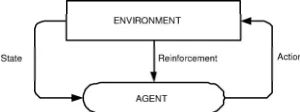
Reinforcement Learning algorithm is a single-agent, sin- gle (implicit) policy, unsupervised learning technique [17]. Decision making is modelled as Markov Decision Process [17]. An agent can be in one of the predefined states in the state set. State set depends on the agent's circumstances relevant to performing w.r.t. the specified goal. Agents are capable of performing actions. Performing an action can leave an agent in the current state, or cause transition to another state in the state space. This transition function is probabilistic. Each action an agent performs is rewarded based on whether the new state is preferred over the state in which the agent was prior to performing the action (see Figure 1). Over time, agents learn the best action to perform lor each particular state, i.e., the action that will maximize their long term reward, the so-called value function [17]. Optimization w.r.t to a particular goal is achieved by agents learning to perform actions that maximize their long term accumulated reward. Most popular algorithms for learning and selecting the best action are Q-Learning and Sarsa [17].
State Action
[image:2.612.349.499.73.129.2]AGENT
Figure 1. Reinforcement Learning
Collaborative Reinforcement Learning [6] extends RL to multi-agent learning. CRL introduces exchange of action rewards between the agents so that agents learn from each other's actions as well (see Figure 2). By exchanging feed- back on actions performed, agents converge towards the so- lution optimal for the system performance, not to their indi- vidually best solutions. This overcomes the lack of central control and global knowledge. CRL has so far been used to implement. only single policy optimization in load bal- ancing, ad-hoc network routing, and urban traffic control [7,61.
ENVIRONMENT
AGENT AGENT
_I_ _I_
[image:2.612.314.535.323.440.2]advertise (feedback)
Figure 2. Collaborative Reinforcement Learn- ing
2.2.
Multiple Policy optimization
2.3.
Reinforcement Learning in UTC
Various reinforcement learning techniques, alone or in combination with other algorithms, have been applied in UTC, but there is currently no fully decentralized imple- mentation that deals with multiple policies. Cunningham et al. [7], Wiering et al. [IS], Abdulhai et al. [I], Pendrith [14], and Camponogara and Kraus [2] apply Q-learning to optimization of a single-policy relating to traffic congestion. Cunningham et a1 base the control decisions on traffic ar- rival rates, Abdulhai uses queue length, Weiring uses cars' own estimates of travel time, while Pendrith's decisions are made centrally based on a single shared policy. Richter et al. [15] use natural actor-critic algorithms, which is a combina- tion of four different reinforcement learning techniques, to optimize traffic volumes. Unlike in other UTC applications of RL, they model the environment as Partially Observable Markov Decision Process (POMDP) [17], where the state of the system is not observable but the probability of the system being in a certain state is calculated and action se- lection is based on that probability. Mikami et al. [13] as well as Yang et al. [19] combine reinforcement learn- ing implemented at local agents (traffic lights) with global centralized genetic algorithms that tune the parameters for local learning. Li et al. [12] introduce four traffic-light con- trol strategies, including the emergency vehicle strategy, but they suggest that the scheduling and planning is performed by a central manager, and they do not provide implementa- tion details.
3. Extension of CRL for Multiple Policies
Multiple policy CRL (MPCRL) will have to combine the characteristics of CRL and multiple policy RL in order to meet the requirements of large-scale decentralized systems with multiple goals. Goals will have to be explicitly stated in system's policies, which opens a number of issues about how to map policy to CRL elements such as state space and reward. Additionally, there are a number of issues arising from introducing multiple policy learning to CRL that will be outlined in this section. However, it is first crucial to identify what exact constructs are involved in this extended learning technique, what are their characteristics, and how do they relate to one another. The first part of this sec- tion provides some definitions of MPCRL constructs and the second part discusses open research questions we will tackle in extending CRL.
3.1.
Elements of Multiple Policy CRL
Large decentralized multi-agent systems whose perfor- mance is to be optimized w.r.t. to multiple policies using MPCRL consists of the following elements:
Set of agents {al
...
a,) where an agent is characterised by the following:-
Agents sense their environment including the en- tities in the environment.-
Agents perform actions that affect the environ- ment.-
Agents receive variable rewards for actions they perform.-
Agents learn the best actions to perform for given environmental conditions and entity characteris- tics, based on the rewards received.-
Agents have means of exchanging feedback and actions learnt with other agents.Sets of entities{e,l
...
e,,) where:-
An entity is part of the environment on whose characteristics agents' actions depend.-
x is a type of entity distinguished from other types of entity by its static characteristics. Poli- cies can assign different priority levels to entity type x.-
Entities have dynamic characteristics that agents are able to sense. Policies can assign different priority levels to entity type x based on its dy- namic characteristics.Set of metrics {ml
...
m,) where each m is a function of the dynamic characteristics that an agent a is capa- ble of sensing about entity e or group of entities E, and optionally a function of time t.Reward r associated with a single action performed by a single agent in a given state, received immediately after the action is performed.
-
The reward is a function of the metrics changed and observed as a result of a performed action.-
Rewards can be positive, in the case where thenew state is preferred over the previous state, or zero or negative, if the previous state was the same or preferred over the new state.
-
The goal of each agent is to maximize the long term reward (value function [17]) received rather than immediate the single action reward.Set of policies {pl
. .
.p,} where:-
Policy can contain the following information:*
policy identifier and description*
list of entity types with which it is concerned where each entity type is associated with one or more metrics required to be observed for the implementation of the policy as well as the optimal value(s) of the metric that the policy is aiming to achieve (minimize, max- imize, reach threshold value, set to true or false)*
list of zero or more policy triggers (agent's states, context conditions, threshold values or patterns).-
Policies must have a priority level, either relative to other policies, or absolute priority for the set of agents.-
Policies can be compatible or in conflict with each other. Two policies are compatible if, as the result of the learning process, an agent's pre- fcrrcd actions for onc policy in all rclcvant statcs are the same as the agent's preferred actions for the other policy in the corresponding states. If this condition is not satisfied, policies are said to be conflicting.Set of agent's state spaces s such that:
-
states are grouped into state space groups S based on the policy to which they are relevant.-
agent's complete state space consists of all possi- ble combinations of all state spaces in all policies that the agent is implementing.3.2. Design and Implementation Challenges
There are number of open issues associated with ap- plying CRL in multi-agent decentralized systems, such as the choice of appropriate rewards for actions performed, and dealing with the uncertainty present due to the lack of global knowledge and relying on sensors to obtain a picture of the world. Additional challenges arise from extending CRL to multiple policies, as this requires taking into account the heterogeneity of agents and the different policies that different agents can be implementing. Our research will focus on these challenges, specifically on the issues outlined in the following paragraphs, relating to three main elements of Multiple Policy CRL: state space, learning process, and collaboration.
STATE SPACE
Should an agent's state space be separate for each pol- icy, or should there be a combined state space for all policies?
-
How does either option influence deploying new policies at an agent? If state spaces are separate then a new policy deployed will have its own sep- aratc statc spacc and should not affcct othcr poli- cies, however if the state spaces are combined, deployment of the new policy will involve chang- ing the existing state space for existing policies to include combinations of the new states relevant to the new policy.-
How does either option influence the complexity of the learning process? A combined state space will be much larger than individual state spaces and we need to investigate the impact of that on the performance of the system, on time needed to perform learning processes, and on quality of the actions learnt.How can we design adequate state space partitioning for a given policy?
-
Should state space partitioning be absolute, i.e., have fixed values, or should it be relative to the metrics observed at other agent's in the system? To illustrate this problem we can use an exam- ple of traffic congestion in UTC. If the system is optimizing for maximum vehicle throughput, the state space should contain information about the number of vehicles waiting at each traffic light. Absolute state partitioning would partition the state space by an actual number of vehicles, for example state A would be 0 to 10 vehicles, state B would be 11 to 50 vehicles and so on. In a relative state partitioning state space would be divided so that state A means high congestion, state B medium congestion, and state C low con- gestion, where high, medium and low will have different numerical values at different times, rel- ative to the count of vehicles at other traffic lights in the system. We need to investigate which state partitioning technique is more efficient in opti- mizing the system's performance.LEARNING
Should learning be done separately per policy or should an agent learn for all policies combined? Inves- tigation of this relates to the above mentioned group- ing of the states by policy or having a combined state space.
-
Does learning separately result in suboptimal be- havior for combined policies? A separate learn- ing process assumes that policies exist in isola- tion and that once an agent executes an action it affects only a single policy. We need to investi- gate how an action chosen to implement a single policy in isolation influence system performance in the presence of other policies.-
How much does the learning for all policies si- multaneously increase the complexity of learn- ing and time needed for convergence towards op- timal behaviour? How does the behaviour that emerges in this way compare to the behaviour obtained by separate learning? We need to inves- tigate if and to what extent we will have to trade off time of convergence vs quality of the solution.What happens with the learning process when policy is triggered and when policy is put on hold? Does it af- fect the learning process for other policies? This ques- tion has to considered both in the case of separate and combined learning.
HETEROGENEITY OF AGENTS
In collaborative self-organizing techniques agents per- form actions, receive feedback from the environment on performing them, and then exchange the information about the feedback received with their neighboring agents. The feedback protocol is relatively straight forward in single policy systems as all agents are working towards a common goal, but in multiple policy optimization the goals of the agent can differ. In order to investigate the implications of heterogeneity of agents we need to answer the following questions on learning process and feedback exchange.
Multiple policy systems can be designed so that indi- vidual agents only have knowledge of the policies they are implementing, or so that each agent has knowl- edge of the policies any agent with which it exchanges feedback is implementing. What are the implications of either design decision on the exchange of the feed- back, calculation of the overall reward that is taking that feedback into account, and quality of the learning outcome?
If agents are aware of each other's policies should they be aware of relative priorities of their policies versus other agent's policies and how does priority specifi- cation affect the feedback protocol, calculation of the reward based on the feedback, and learning process? Agents should be able to learn to perform actions that are the best for the policy with the highest priority, even if they are not currently implementing that pol- icy themselves and even if that policy is in conflict with the policies they are currently implementing, i.e. the action performed might not be optimal for their lo- cal policy. Learning process should prevent greedy lo- cal agents from dragging the system into converging towards suboptimal global performance only because that behaviour optimizes performance of an individual agent.
Answers to any of the above questions relating to state space, learning process and feedback exchange between heterogeneous agents are difficult to predict and should be tackled experimentally.
4. Research Testbed
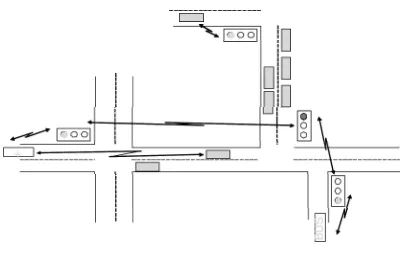
[image:5.612.325.525.503.633.2]Our initial application area for MPCRL is Urban Traffic Control (UTC). Research is currently being done on apply- ing CRL to single policy optimization of traffic through- put in UTC [7]. We believe UTC is a suitable application area for MPCRL because real world adaptive traffic systems have multiple objectives to deal with apart from just maxi- mizing traffic throughput. An example scenario is presented in Figure 3. Traffic lights, modelled as autonomous agents, cooperate in order to minimize the waiting time for vehicles in the system, while simultaneously prioritizing emergency vehicles and public transport vehicles.
Figure 3. Application of Multiple Policy CRL in Urban Traffic Control
discussed in 3.2. The experiments will initially involve a single junction with two or three approaches and two dif- ferent policies, emergency vehicle priority and maximizing traffic throughput. The state space for emergency vehicle policy needs to include the information about the presence of the emergency vehicle at the approach, and the traffic throughput policy state space will contain the information about the number of vehicles queued. We will conduct ex- periments that simulate separate state spaces and learn for each policy (so traffic lights will learn the optimal cyclc based on the length of the queues in one case, and based on the presence of an ambulance in the other case), as well experiments that simulate combined learning (where traffic lights will learn the optimal cycle taking both policies into account). Also, we will vary state space partitioning in this experiment to include queues of different absolute and rel- ative length to test the influence of state space partitioning on learning processes. We will also vary the feedback that approaches exchange to include information about the state space, policies, and policy priorities of the sending and re- ceiving agents, and vary the weight of feedback based on thc policy priority.
Based on the results obtained from these experiments we plan to extended the simulation to include various additional policies on a global, regional or local level, such as priority of cars based on waiting time or on number of passengers, priority of public vehicles based on their timetable, priority of vehicle fleets, priority of traffic from or to certain areas etc.
5. Conclusion
Self-organizing algorithms are suitable for engineering largc scale dcccntralizcd systcms as thcy cnablc system to deal with the lack of global knowledge and central control. We believe these algorithms could find a wider application in engineering decentralized and ubiquitous systems once they are also capable of dealing with optimizing the sys- tem's performance towards multiple policies, rather than a single policy as the majority of existing techniques currently do. We have discussed a specific self-organizing technique CRL and have outlined a number of open research questions that have to be answered in order to apply it to multiple pol- icy optimization. One of the major issues that arises is the heterogeneity of agents, meaning that agents need to col- laborate to optimize global system performance, even if the performance towards their immediate local policy needs to be traded off. Additionally, we need to investigate the im- pact of multiple policies on the learning process, and evalu- ate the quality of system performance in the cases of sepa- rate learning processes for each policy or common learning process that encapsulates all policies simultaneously. In or- der to answer these questions, we will conduct a number
of experiments by simulating multiple policy optimization of Urban Traffic Control systems using various parameters and relationships between MPCRL elements.
References
[I] B. Abdulhai, R. Pringle, and G. Karakoulas. Reinforcement learning for the true adaptive traffic signal control. Journal of Transportation Engineering, 129(3):278-285, MayIJune 2003.
[2] E. Camponogara and W. K. Jr. Distributed learning agents in urban traffic control. In EPIA, pages 324-335,2003. [3] G. D. Caro and M. Dorigo. AntNet: Distributed stigmergetic
control for communication networks. Journal of ArtiJicial Intelligence Research, 9:317-365, December 1998. [4] H. Cuayihuitl, S. Renals, 0. Lemon, and H. Shimodaira.
Learning multi-goal dialogue strategies using reinforcement learning with reduced state-action spaces. In Proc. of Interspeech-ICSLP 2006,2006.
[5] G. Di Caro, F. Ducatelle, and L. M. Gambardella. An- tHocNet: An adaptive nature-inspired algorithm for rout- ing in mobile ad hoc networks. European Transactions on Telecommunications, Special Issue on Self-organization in Mobile Networking, 2005.
[6] J. Dowling. The Decentralised Coordination of Self- Adaptive Components for Autonomic Distributed Systems. PhD thesis, Trinity College Dublin, 2005.
[7] J. Dowling, R. Cunningham, A. Hanington, E. Curran, and V. Cahill. Emergent consensus in decentralised systems us- ing collaborative reinforcement learning. In Self-star Prop- erties in Complex Information Systems, pages 63-80, 2005. [8] D. Fudenberg and J. Tirole. Game theory. The MIT Press,
1991.
[9] Z. Gabor, Z. Kalmar, and C. Szepesvari. Multi-criteria rein- forcement learning. In International Conference on Machine Learning, Madison, WI, July 1998.
[lo] M. Humphrys. Action selection methods using rcinforcc- ment learning. In M. M. M. J.-A. P. J. Maes, P. and S. W. Wilson, editors, From Animals to Animats 4: Proceedings of the Fourth International Conference on Simulation of Adap- tive Behavior, 1996.
[ l 11 M. Leka*. Optimising Multi-agent Cooperation using Evo- lutionary Algorithm. In M. Bielikovk, editor, Proceedings of IITSRC 2005: Student Research Conference in Informat- ics and Information Technologies, Bratislava, pages 49-56. Faculty of Informatics and Information Technologies, Slo- vak University of Technology in Bratislava, April 2005. [12] M. Li, J. Hallam, L. Pryor, S. Chan, and K. Chong. A co-
operative intelligent system for urban traffic problems. In Proceedings of the 1996 IEEE International Symposium on Intelligent Control, September 1996.
[13] S. Mikami and Y. Kakazu. Genetic reinforcement leam- ing for cooperative traffic signal control. In International Conference on Evolutionary Computation, pages 223-228, 1994.
agents, pages 404-411, New York, NY, USA, 2000. ACM Press.
[15] S. Richter, D. Aberdeen, and J. Yu. Natural actor-critic for road traffic optimisation. In Advances in Neural Information Processing Systems.
[16] N. Sprague and D. Ballard. Multiple-goal reinforcement learning with modular sarsa. In International Joint Confer- ence on ArtiJ;cial Intelligence, August 2003.
[17] R. S. Suton and A. G. Barto. Reinforcement Learning: An Introduction. A Bradford Book. The MIT Press, Cambridge, Massachusetts, 2002.
[IS] M. Wiering. Multi-agent reinforcement learning for traffic light control. In Proc. 17th International Con$ on Muchine Learning, pages 1151-1 158. Morgan Kaufmann, San Fran- cisco, CA, 2000.