UnibucKernel: An Approach for Arabic Dialect Identification based on
Multiple String Kernels
Radu Tudor Ionescu and Marius Popescu University of Bucharest
Department of Computer Science 14 Academiei, Bucharest, Romania
[email protected] [email protected]
Abstract
The most common approach in text mining classification tasks is to rely on features like words, part-of-speech tags, stems, or some other high-level linguistic features. Unlike the common approach, we present a method that uses only character p-grams (also known as n-grams) as features for the Arabic Dialect Identification (ADI) Closed Shared Task of the DSL 2016 Chal-lenge. The proposed approach combines several string kernels using multiple kernel learning. In the learning stage, we try both Kernel Discriminant Analysis (KDA) and Kernel Ridge Regres-sion (KRR), and we choose KDA as it gives better results in a10-fold cross-validation carried out on the training set. Our approach is shallow and simple, but the empirical results obtained in the ADI Shared Task prove that it achieves very good results. Indeed, we ranked on the second place with an accuracy of50.91% and a weighted F1 score of 51.31%. We also present improved
results in this paper, which we obtained after the competition ended. Simply by adding more regularization into our model to make it more suitable for test data that comes from a different distribution than training data, we obtain an accuracy of 51.82% and a weightedF1 score of
52.18%. Furthermore, the proposed approach has an important advantage in that it is language independent and linguistic theory neutral, as it does not require any NLP tools.
1 Introduction
It seems natural to use words as basic units in text categorization, authorship identification, plagiarism detection or similar text mining tasks. Perhaps surprisingly, recent results indicate that methods handling the text at the character level can also be very effective (Lodhi et al., 2002; Sanderson and Guenter, 2006; Kate and Mooney, 2006; Popescu and Dinu, 2007; Grozea et al., 2009; Popescu, 2011; Escalante et al., 2011; Popescu and Grozea, 2012; Ionescu et al., 2014; Ionescu et al., 2016). By avoiding to explicitly consider features of natural language such as words, phrases, or meaning, an approach that works at the character level has an important advantage in that it is language independent and linguistic theory neutral. In this context, we present a method based on characterp-grams that we designed for the Arabic Dialect Identification (ADI) Shared Task of the DSL 2016 Challenge (Malmasi et al., 2016). In this task, the participants had to discriminate between Modern Standard Arabic (MSA) and4Arabic dialects, in a 5-way classification setting. A number of18teams have submitted their results on the final test set, and our team (UnibucKernel) ranked on the second place with an accuracy of50.91%and a weightedF1 score
of51.31%. Our best scoring system is based on combining three different string kernels via multiple kernel learning (MKL) (Gonen and Alpaydin, 2011). The first kernel that we considered is thep-grams presence bits kernel1, which takes into account only the presence ofp-grams instead of their frequency.
The second kernel is the (histogram) intersection string kernel2, which was first used in a text mining task
by Ionescu et al. (2014), although it is much more popular in computer vision (Maji et al., 2008; Vedaldi and Zisserman, 2010). The third kernel is derrived from Local Rank Distance3, a distance measure that This work is licensed under a Creative Commons Attribution 4.0 International License. License details: http://creativecommons.org/licenses/by/4.0
1We computed thep-grams presence bits kernel using the open source code provided at http://string-kernels.herokuapp.com 2We computed the intersection string kernel using the open source code provided at http://string-kernels.herokuapp.com 3We computed the Local Rank Distance using the open source code provided at http://lrd.herokuapp.com
was first introduced in computational biology (Ionescu, 2013; Dinu et al., 2014), but it has also shown its application in NLP (Popescu and Ionescu, 2013; Ionescu, 2015). Although characterp-grams have been employed for ADI in several works (Darwish et al., 2014; Zaidan and Callison-Burch, 2014; Malmasi et al., 2015), to the best of our knowledge, none of these string kernels have been previously used for ADI. Interestingly, these kernels have also been used for native language identification (Popescu and Ionescu, 2013; Ionescu et al., 2014; Ionescu et al., 2016), obtaining state-of-the-art performance for several languages, including Arabic.
Two kernel classifiers (Shawe-Taylor and Cristianini, 2004) were considered for the learning task, namely Kernel Ridge Regression (KRR) and Kernel Discriminant Analysis (KDA). The KDA classifier is sometimes able to improve accuracy by avoiding the masking problem (Hastie and Tibshirani, 2003). In a set of preliminary experiments performed on the training set, we found that KDA gives slightly better results than KRR. Hence, all our submissions are based on learning with KDA. Before submitting our results, we have also tuned our string kernels for the task. First of all, we tried out p-grams of various lengths, including blended variants of string kernels as well. The best accuracy was obtained with blended kernels of3 to 6 p-grams. Second of all, we have evaluated the individual kernels and various MKL combinations. The empirical results indicate that combining kernels via MKL can help to improve the accuracy by nearly1%. All these choices played a significant role in obtaining the second place in the final ranking of the ADI Shared Task. After the challenge, as we learned that the test set comes from a different source, we further improved our models just by adding more regularization. Interestingly, our approach treats the text documents simply as strings, since it does not involve any linguistic processing of the text, not even tokenization. Therefore, our method is language independent and linguistic theory neutral. Furthermore, the proposed approach is simple and effective, as it is just based on shallow features (characterp-grams).
The paper is organized as follows. Work related to Arabic dialect identification and to methods based on string kernels is presented in Section 2. Section 3 presents the string kernels that we used in our approach. The learning methods used in the experiments are described in Section 4. Section 5 presents details about experiments, including parameter tuning, combining kernels and results of submitted sys-tems. Finally, we draw our conclusion in Section 6.
2 Related Work
2.1 Arabic Dialect Identification
word and characterp-grams models in order to assess the influence of topic bias. Interestingly, Malmasi et al. (2015) find that characterp-grams are “in most scenarios the best single feature for this task”, even in a cross-corpus setting. Their findings are consistent with our results in the ADI Shared Task of the DSL 2016 Challenge (Malmasi et al., 2016), as we ranked on the second place using solely character p-grams. It is important to remark that the ADI Shared Task data set contains Automatic Speech Recog-nition (ASR) transcripts of Arabic speech collected from the Broadcast News domain (Ali et al., 2016). The fact that the data set may contain ASR errors (perhaps more in the dialectal speech segments) makes the ADI task much more difficult than in previous studies.
2.2 String Kernels
In recent years, methods of handling text at the character level have demonstrated impressive perfor-mance levels in various text analysis tasks (Lodhi et al., 2002; Sanderson and Guenter, 2006; Kate and Mooney, 2006; Popescu and Dinu, 2007; Grozea et al., 2009; Popescu, 2011; Escalante et al., 2011; Popescu and Grozea, 2012; Ionescu et al., 2014; Ionescu et al., 2016). String kernels are a common form of using information at the character level. They are a particular case of the more general con-volution kernels (Haussler, 1999). Lodhi et al. (2002) used string kernels for document categorization with very good results. String kernels were also successfully used in authorship identification (Sander-son and Guenter, 2006; Popescu and Dinu, 2007; Popescu and Grozea, 2012). For example, the system described by Popescu and Grozea (2012) ranked first in most problems and overall in the PAN 2012 Traditional Authorship Attribution tasks. More recently, Ionescu et al. (2016) have used various blended string kernels to obtain state-of-the-art accuracy rates for native language identification.
3 Similarity Measures for Strings
3.1 String Kernels
The kernel function gives kernel methods the power to naturally handle input data that is not in the form of numerical vectors, for example strings. The kernel function captures the intuitive notion of similarity between objects in a specific domain and can be any function defined on the respective domain that is symmetric and positive definite. For strings, many such kernel functions exist with various applications in computational biology and computational linguistics (Shawe-Taylor and Cristianini, 2004). String kernels embed the texts in a very large feature space, given by all the substrings of lengthp, and leave it to the learning algorithm to select important features for the specific task, by highly weighting these features.
Perhaps one of the most natural ways to measure the similarity of two strings is to count how many substrings of lengthpthe two strings have in common. This gives rise to thep-spectrum kernel. Formally, for two strings over an alphabetΣ,s, t∈Σ∗, thep-spectrum kernel is defined as:
kp(s, t) = X v∈Σp
numv(s)·numv(t),
where numv(s) is the number of occurrences of stringv as a substring ins.4 The feature map defined by this kernel associates a vector of dimension |Σ|p containing the histogram of frequencies of all its substrings of lengthp(p-grams) with each string.
A variant of this kernel can be obtained if the embedding feature map is modified to associate a vector of dimension|Σ|p containing the presence bits (instead of frequencies) of all its substrings of lengthp with each string. Thus, the characterp-grams presence bits kernel is obtained:
kp0/1(s, t) = X v∈Σp
inv(s)·inv(t),
where inv(s)is1if stringvoccurs as a substring ins, and0otherwise.
4Note that the notion of substring requires contiguity. Shawe-Taylor and Cristianini (2004) discuss the ambiguity between
In computer vision, the (histogram) intersection kernel has successfully been used for object class recognition from images (Maji et al., 2008; Vedaldi and Zisserman, 2010). Ionescu et al. (2014) have used the intersection kernel as a kernel for strings. The intersection string kernel is defined as follows:
k∩
p(s, t) = X
v∈Σp
min{numv(s),numv(t)},
where numv(s)is the number of occurrences of stringvas a substring ins.
For thep-spectrum kernel, the frequency of ap-gram has a very significant contribution to the kernel, since it considers the product of such frequencies. On the other hand, the frequency of a p-gram is completely disregarded in thep-grams presence bits kernel. The intersection kernel lies somewhere in the middle between thep-grams presence bits kernel andp-spectrum kernel, in the sense that the frequency of ap-gram has a moderate contribution to the intersection kernel. In other words, the intersection kernel assigns a high score to a p-gram only if it has a high frequency in both strings, since it considers the minimum of the two frequencies. Thep-spectrum kernel assigns a high score even when thep-gram has a high frequency in only one of the two strings. Thus, the intersection kernel captures something more about the correlation between thep-gram frequencies in the two strings. Based on these comments, we decided to use only thep-grams presence bits kernel and the intersection string kernel for ADI.
Data normalization helps to improve machine learning performance for various applications. Since the value range of raw data can have large variation, classifier objective functions will not work properly without normalization. After normalization, each feature has an approximately equal contribution to the similarity between two samples. To obtain a normalized kernel matrix of pairwise similarities between samples, each component is divided by the square root of the product of the two corresponding diagonal components:
ˆ
Kij = pKKij ii·Kjj. This is equivalent to normalizing the kernel function as follows:
ˆ
k(si, sj) = p k(si, sj) k(si, si)·k(sj, sj).
To ensure a fair comparison of strings of different lengths, normalized versions of thep-grams presence bits kernel and the intersection kernel are being used. Taking into accountp-grams of different length and summing up the corresponding kernels, new kernels, termedblended spectrum kernels, can be obtained. We have used various blended spectrum kernels in the experiments in order to find the best combination.
3.2 Local Rank Distance
Local Rank Distance (Ionescu, 2013) is a recently introduced distance measure for strings that aims to provide a better similarity than rank distance (Dinu and Manea, 2006). Local Rank Distance (LRD) has already shown promising results in computational biology (Ionescu, 2013; Dinu et al., 2014) and native language identification (Popescu and Ionescu, 2013; Ionescu, 2015).
In order to describe LRD, we use the following notations. Given a string xover an alphabetΣ, the length of x is denoted by |x|. Strings are considered to be indexed starting from position 1, that is x=x[1]x[2]· · ·x[|x|]. Moreover,x[i:j]denotes its substringx[i]x[i+ 1]· · ·x[j−1].
Local Rank Distance is inspired by rank distance (Dinu and Manea, 2006), the main differences being that it usesp-grams instead of single characters, and that it matches eachp-gram in the first string with the nearest equalp-gram in the second string. Given a fixed integerp ≥1, a thresholdm ≥1, and two stringsxandy overΣ, theLocal Rank Distancebetweenx andy, denoted by∆LRD(x, y), is defined through the following algorithmic process. For each positioniinx(1≤i≤ |x| −p+ 1), the algorithm searches for that position j iny (1 ≤ j ≤ |y| − p+ 1) such thatx[i : i+p] = y[j : j+p] and
is that LRD does not impose any mathematically developed global constraints, such as matching thei-th occurrence of a p-gram in x with thei-th occurrence of that same p-gram in y. Instead, it is focused on the local phenomenon, and tries to pair equalp-grams at a minimum offset. To ensure that LRD is a (symmetric) distance function, the algorithm also has to sum up the offsets obtained from the above process by exchangingxandy. LRD is formally defined in (Ionescu, 2013; Dinu et al., 2014).
Interestingly, the search for matchingp-grams is limited within a window of fixed size. The size of this window is determined by the maximum offset parameterm. This parameter must be set a priori and should be proportional to the average length of the strings. We setm = 500in our experiments, which is about twice the average length of the ASR transcripts provided in the training set. In the experiments, the efficient algorithm of Ionescu (2015) is used to compute LRD. However, LRD needs to be used as a kernel function. We use the RBF kernel (Shawe-Taylor and Cristianini, 2004) to transform LRD into a similarity measure:
ˆ kLRD
p (s, t) = e
−∆LRD(s, t)
2σ2 ,
wheresandt are two strings andp is the p-grams length. The parameterσ is usually chosen so that values of ˆk(s, t) are well scaled. In the above equation, ∆LRD is already normalized to a value in the[0,1]interval to ensure a fair comparison of strings of different length. Hence, we setσ = 1in the experiments. The resulted similarity matrix is then squared in order to make sure it becomes a symmetric and positive definite kernel matrix.
4 Learning Methods
Kernel-based learning algorithms work by embedding the data into a Hilbert feature space, and searching for linear relations in that space. The embedding is performed implicitly, that is by specifying the inner product between each pair of points rather than by giving their coordinates explicitly. More precisely, a kernel matrix that contains the pairwise similarities between every pair of training samples is used in the learning stage to assign a vector of weights to the training samples. Letαdenote this weight vector. In the test stage, the pairwise similarities between a test samplexand all the training samples are computed. Then, the following binary classification function assigns a positive or a negative label to the test sample:
g(x) =Xn i=1
αi·k(x, xi),
wherexis the test sample,nis the number of training samples,X ={x1, x2, ..., xn}is the set of training samples,kis a kernel function, andαiis the weight assigned to the training samplexi.
The advantage of using the dual representation induced by the kernel function becomes clear if the dimension of the feature spacemis taken into consideration. Since string kernels are based on character p-grams, the feature space is indeed very high. For instance, using5-grams based only on the28letters of the basic Arabic alphabet will result in a feature space of285 = 17,210,368features. However, our
best model is based on a feature space that includes3-grams,4-grams,5-grams and6-grams. As long as the number of samplesnis much lower than the number of featuresm, it can be more efficient to use the dual representation given by the kernel matrix. This fact is also known as thekernel trick(Shawe-Taylor and Cristianini, 2004).
EGY GLF LAV NOR MSA
Train set 1578 1672 1758 1612 999
[image:6.595.199.400.61.94.2]Test set 315 256 344 351 274
Table 1: The sample distribution per class for the ADI Shared Task training and test sets.
one-versus-all and one-versus-one. We considered the one-versus-all scheme for our Arabic dialect clas-sification task. There are also kernel methods that take the multi-class nature of the problem directly into account, for instance Kernel Discriminant Analysis. The KDA classifier is sometimes able to improve accuracy by avoiding the masking problem (Hastie and Tibshirani, 2003). In the case of multi-class ADI, the masking problem may appear, for instance, when an Arabic dialectAis somehow related to two other Arabic dialectsBandC, in which case the samples that belong to classAcan sit in the middle between the samples of classesBandC. In this case, the class in the middle is masked by the other two classes, as it never dominates. KDA can solve such unwanted situations automatically, without having to identify what dialects are related by any means, such as geographical position or quantitative linguistic analysis. More details about KRR and KDA are given in (Shawe-Taylor and Cristianini, 2004).
5 Experiments and Results
5.1 Data Set
The ADI Shared Task data set (Ali et al., 2016) contains Automatic Speech Recognition (ASR) tran-scripts of Arabic speech collected from the Broadcast News domain. The task is to discriminate between Modern Standard Arabic (MSA) and 4 Arabic dialects, namely Egyptian (EGY), Gulf (GLF), Levan-tine (LAV), and North-African or Maghrebi (NOR). Table 1 shows the sample distribution per class for the training and the test sets. As the samples are not evenly distributed, an accuracy of22.79%can be obtained with a majority class baseline. Another important aspect is that the training and the test set are taken from different sources, and this could alter the performance of a classifier. However, we were unaware of this fact before the submission deadline.
5.2 Parameter Tuning and Implementation Choices
In our string kernels approach, ASR transcripts are treated as strings. Because the approach works at the character level, there is no need to split the texts into words, or to do any NLP-specific processing before computing the string kernels. The only editing done to the texts was the replacing of sequences of consecutive space characters (space, tab, and so on) with a single space character. This normalization was needed in order to prevent the artificial increase or decrease of the similarity between texts, as a result of different spacing.
In order to tune the parameters and to decide what kernel learning method works best, we fixed 10 folds in order to evaluate each option in a10-fold cross-validation (CV) procedure on the training set. We first carried out a set of preliminary experiments to determine the range ofp-grams that gives the most accurate results in the 10-fold CV procedure. We fixed the kernel method to KRR based on the Local Rank Distance kernel (kˆLRD
p ) and we evaluated all thep-grams in the range2-7. The results are illustrated in Figure 1. Interestingly, the best accuracy (64.97%) is obtained with4-grams. Furthermore, experiments with different blended kernels were conducted to see whether combiningp-grams of differ-ent lengths could improve the accuracy. More precisely, we evaluated combinations ofp-grams in three ranges:3-5,4-6and3-6. In the end, the best accuracy (66.43%) was obtained when all thep-grams with the length in the range3-6were combined. Hence, we used blended kernels withp-grams in the range 3-6in the subsequent experiments.
Further experiments were also performed to establish what type of kernel works better, namely the blendedp-grams presence bits kernel (kˆ30/−16), the blendedp-grams intersection kernel (kˆ∩
3−6), or the
ker-nel based on LRD (ˆkLRD
3−6 ). These different kernel representations are obtained from the same data. The
1 2 3 4 5 6 7 8 58 59 60 61 62 63 64 65
The length of p−grams
The 10
−
[image:7.595.179.412.70.225.2]fold CV accuracy rate
Figure 1: Accuracy rates of the KRR based on the LRD kernel withp-grams in the range2-7. The results are obtained in a10-fold cross-validation carried out on the training set.
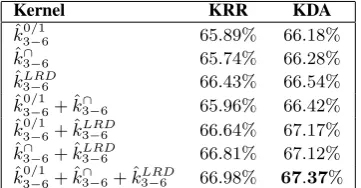
Kernel KRR KDA
ˆ
k0/1
3−6 65.89% 66.18%
ˆ
k∩
3−6 65.74% 66.28%
ˆ
kLRD
3−6 66.43% 66.54%
ˆ
k0/1
3−6+ ˆk∩3−6 65.96% 66.42%
ˆ
k03/−16+ ˆkLRD3−6 66.64% 67.17%
ˆ
k∩
3−6+ ˆkLRD3−6 66.81% 67.12%
ˆ
k0/1
[image:7.595.96.277.281.375.2]3−6+ ˆk∩3−6+ ˆkLRD3−6 66.98% 67.37%
Table 2: Accuracy rates of different blended string kernels combined with either KRR or KDA. The re-sults are obtained in a10-fold cross-validation car-ried out on the training set. The best result is high-lighted in bold.
Dialects EGY GLF LAV NOR MSA
EGY 171 39 50 34 21
GLF 45 112 49 22 28
LAV 43 68 167 36 30
NOR 50 75 40 171 15
MSA 21 34 24 18 177
Table 3: Confusion matrix (on the test set) of KDA based on the sum of the blendedp-grams presence bits kernel and the blended intersec-tion kernel. The regularizaintersec-tion parameter is set to0.8, so theF1score of this model is52.18%.
discriminant function. The most natural way of combining two kernels is to sum them up. Summing up kernels or kernel matrices is equivalent to feature vector concatenation. The kernels were evaluated alone and in various combinations, by employing either KRR or KDA for the learning task. All the results obtained in the10-fold CV carried out on the training set are given in Table 2.
The empirical results presented in Table 2 reveal several interesting aspects about the proposed meth-ods. Regarding the two kernel classifiers, it seems that KDA gives consistently better results, although the difference in terms of accuracy is almost always less than0.5%. The individual kernels obtain fairly similar results. Perhaps surprisingly, the best individual kernel is the kernel based on Local Rank Dis-tance with an accuracy of66.43%when it is combined with KRR, and an accuracy of66.54%when it is combined with KDA. Each and every kernel combination yields better results than each of its individual components alone. For both KRR and KDA, the best accuracy is actually obtained when all three kernels are combined together. Indeed, KRR reaches an accuracy of66.98%when the blendedp-grams presence bits kernel, the blended intersection kernel and the blended LRD kernel are summed up. With the same kernel combination, KDA yields an accuracy of 67.37%. As KDA gives consistently better results in the10-fold CV procedure, we decided to submit three KDA models for the test set. The first submission (run1) is based on the LRD kernel, which seems to be the best one among the individual kernels, although previous works (Ionescu et al., 2014; Ionescu et al., 2016) indicate that the other two kernels obtain better results on native language identification. Influenced by these previous works, we also decided to give a fair chance to the blended p-grams presence bits kernel and the blended intersection kernel. Hence, the second submission (run2) is based on the sum betweenkˆ03−/16andkˆ∩
3−6. Finally, our third submission
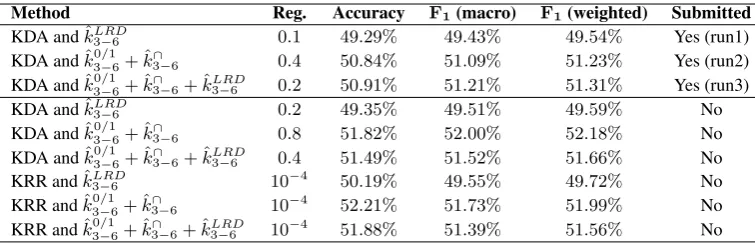
[image:7.595.318.518.298.361.2]Method Reg. Accuracy F1(macro) F1(weighted) Submitted
KDA andˆkLRD
3−6 0.1 49.29% 49.43% 49.54% Yes (run1)
KDA andˆk03−/16+ ˆk3∩−6 0.4 50.84% 51.09% 51.23% Yes (run2) KDA andˆk03−/16+ ˆk3∩−6+ ˆkLRD3−6 0.2 50.91% 51.21% 51.31% Yes (run3) KDA andˆkLRD
3−6 0.2 49.35% 49.51% 49.59% No KDA andˆk03−/16+ ˆk∩
3−6 0.8 51.82% 52.00% 52.18% No KDA andˆk0/1
3−6+ ˆk3∩−6+ ˆkLRD3−6 0.4 51.49% 51.52% 51.66% No KRR andˆkLRD
3−6 10−4 50.19% 49.55% 49.72% No KRR andˆk03/−16+ ˆk∩
3−6 10−4 52.21% 51.73% 51.99% No KRR andˆk0/1
[image:8.595.108.486.61.183.2]3−6+ ˆk3∩−6+ ˆkLRD3−6 10−4 51.88% 51.39% 51.56% No
Table 4: Results for test set C (closed training) of various models based on string kernels. Some models that have not been submitted for the challenge are also included. For each model, the regularization parameter used to control the trade-off between overfitting and underfitting is reported as well.
5.3 Results and Discussion
Table 4 presents our results for the Arabic Dialect Identification Closed Shared Task (test set C) of the DSL 2016 Challenge, along with a few systems that were not submitted for the task. Among the three submissions, the best performance is obtained when all three kernels are combined and KDA is used for learning. The submitted systems were ranked by their weightedF1score, and among the18participants,
our best model obtained the second place with a weightedF1score of51.31%. Nevertheless, the winning
solution is marginally better, with a difference of0.0078%in terms of the weightedF1 score.
A very important remark is that all our submitted systems obtain significantly lower results on the test set than in the10-fold CV procedure carried out on the training set. This could be explained by the fact that the test set comes from a different distribution. As described by Ali et al. (2016), it actually seems that the training and the test sets come from different sources. In this context, regularization plays an important role, as it can be used to reduce the overfitting of the training data. A straightforward exper-iment, in which we simply double the regularization parameter of KDA, proves that all our submitted models yield better results when they are forced to fit less of the training data. Our best weighted F1
score (52.18%) on the test set is obtained by the KDA based on the sum of the blendedp-grams presence bits kernel and the blended intersection kernel. The confusion matrix of this model is given in Table 3. For this model, it takes about12minutes to compute the two kernels, train the KDA classifier and predict the labels on a computer with Intel Core i7 2.3GHz processor and8GB of RAM using a single Core.
Since the training and the test sets come from different distributions, the ADI task can also be regarded as a cross-corpus evaluation task. An interesting remark is that Ionescu et al. (2014) have used KRR and KDA in a cross-corpus setting for native language identification, and they have found that KRR is more robust in such a setting. Thus, we have also included results with KRR instead of KDA, while using the same kernels. The KRR based on the sum of the blendedp-grams presence bits kernel and the blended intersection kernel is the best KRR model on the test set, with a weightedF1 score of51.99%.
6 Conclusion
We have presented a method based on character p-grams for the Arabic Dialect Identification (ADI) Shared Task of the DSL 2016 Challenge (Malmasi et al., 2016). Our team (UnibucKernel) ranked on the second place with a weightedF1 score of51.31%. As we learned that the training and the test sets
come from different distributions (Ali et al., 2016), we were able to further improve our results after the challenge to a weighted F1 score of52.18%, which is better than the winning solution (51.32%). To
improve the results even further, more advanced techniques suitable for the cross-corpus setting, such as semi-supervised or transfer learning, can be employed in future work.
Acknowledgments
References
Ahmed Ali, Najim Dehak, Patrick Cardinal, Sameer Khurana, Sree Harsha Yella, James Glass, Peter Bell, and
Steve Renals. 2016. Automatic dialect detection in arabic broadcast speech.Proceedings of Interspeech, pages
2934–2938.
Fadi Biadsy, Julia Hirschberg, and Nizar Habash. 2009. Spoken Arabic Dialect Identification Using Phonotactic
Modeling. Proceedings of the EACL 2009 Workshop on Computational Approaches to Semitic Languages,
pages 53–61.
Houda Bouamor, Nizar Habash, and Kemal Oflazer. 2014. A Multidialectal Parallel Corpus of Arabic.
Proceed-ings of LREC, pages 1240–1245, may.
Kareem Darwish, Hassan Sajjad, and Hamdy Mubarak. 2014. Verifiably Effective Arabic Dialect Identification. Proceedings of EMNLP, pages 1465–1468.
Liviu P. Dinu and Florin Manea. 2006. An efficient approach for the rank aggregation problem. Theoretical
Computer Science, 359(1–3):455–461.
Liviu P. Dinu, Radu Tudor Ionescu, and Alexandru I. Tomescu. 2014. A rank-based sequence aligner with
applications in phylogenetic analysis. PLoS ONE, 9(8):e104006, 08.
Heba Elfardy and Mona T. Diab. 2013. Sentence Level Dialect Identification in Arabic. Proceedings of ACL,
pages 456–461.
Hugo Jair Escalante, Thamar Solorio, and Manuel Montes-y-G´omez. 2011. Local histograms of character n-grams
for authorship attribution.Proceedings of ACL: HLT, 1:288–298.
Mehmet Gonen and Ethem Alpaydin. 2011. Multiple Kernel Learning Algorithms.Journal of Machine Learning
Research, 12:2211–2268, July.
Cristian Grozea, Christian Gehl, and Marius Popescu. 2009. ENCOPLOT: Pairwise Sequence Matching in Linear
Time Applied to Plagiarism Detection.Proceedings of 3rd PAN WORKSHOP, page 10.
Trevor Hastie and Robert Tibshirani. 2003. The Elements of Statistical Learning. Springer, corrected edition, July.
David Haussler. 1999. Convolution Kernels on Discrete Structures. Technical Report UCS-CRL-99-10, Univer-sity of California at Santa Cruz, Santa Cruz, CA, USA.
Radu Tudor Ionescu, Marius Popescu, and Aoife Cahill. 2014. Can characters reveal your native language? A
language-independent approach to native language identification. Proceedings of EMNLP, pages 1363–1373,
October.
Radu Tudor Ionescu, Marius Popescu, and Aoife Cahill. 2016. String kernels for native language identification:
Insights from behind the curtains. Computational Linguistics, 42(3):491–525.
Radu Tudor Ionescu. 2013. Local Rank Distance.Proceedings of SYNASC, pages 221–228.
Radu Tudor Ionescu. 2015. A Fast Algorithm for Local Rank Distance: Application to Arabic Native Language
Identification. Proceedings of ICONIP, 9490:390–400.
Rohit J. Kate and Raymond J. Mooney. 2006. Using String-kernels for Learning Semantic Parsers. Proceedings
of ACL, pages 913–920.
Huma Lodhi, Craig Saunders, John Shawe-Taylor, Nello Cristianini, and Christopher J. C. H. Watkins. 2002. Text
Classification using String Kernels. Journal of Machine Learning Research, 2:419–444.
Subhransu Maji, Alexander C. Berg, and Jitendra Malik. 2008. Classification using intersection kernel support
vector machines is efficient. Proceedings of CVPR.
Shervin Malmasi, Eshrag Refaee, and Mark Dras. 2015. Arabic Dialect Identification using a Parallel
Multidi-alectal Corpus.Proceedings of PACLING, pages 209–217, May.
Shervin Malmasi, Marcos Zampieri, Nikola Ljubeˇsi´c, Preslav Nakov, Ahmed Ali, and J¨org Tiedemann. 2016. Discriminating between similar languages and arabic dialect identification: A report on the third dsl shared
task. Proceedings of the 3rd Workshop on Language Technology for Closely Related Languages, Varieties and
Marius Popescu and Liviu P. Dinu. 2007. Kernel methods and string kernels for authorship identification: The
federalist papers case.Proceedings of RANLP, September.
Marius Popescu and Cristian Grozea. 2012. Kernel methods and string kernels for authorship analysis. CLEF
(Online Working Notes/Labs/Workshop), September.
Marius Popescu and Radu Tudor Ionescu. 2013. The Story of the Characters, the DNA and the Native Language. Proceedings of the Eighth Workshop on Innovative Use of NLP for Building Educational Applications, pages 270–278, June.
Marius Popescu. 2011. Studying translationese at the character level. Proceedings of RANLP, pages 634–639,
September.
Conrad Sanderson and Simon Guenter. 2006. Short text authorship attribution via sequence kernels, markov
chains and author unmasking: An investigation. Proceedings of the 2006 Conference on Empirical Methods in
Natural Language Processing, pages 482–491, July.
John Shawe-Taylor and Nello Cristianini. 2004. Kernel Methods for Pattern Analysis. Cambridge University
Press.
Andrea Vedaldi and Andrew Zisserman. 2010. Efficient additive kernels via explicit feature maps.Proceedings of
CVPR, pages 3539–3546.
Omar F. Zaidan and Chris Callison-Burch. 2011. The Arabic Online Commentary Dataset: An Annotated Dataset
of Informal Arabic with High Dialectal Content. Proceedings of ACL: HLT, 2:37–41.
Omar F. Zaidan and Chris Callison-Burch. 2014. Arabic dialect identification. Computational Linguistics,