1662 J. Med. Chem. 1991,34,1662-1668
Synthesis and Pharmacological Examination
of
1-(
3-Methoxy-l-methylphenyl)-2-aminopropane
and
5-Methoxy-6-methyl-2-aminoindan:
Similarities
to
3,4-(
Met hy1enedioxy)met hamphetamine (MDMA)
Michael P. Johnson, Stewart P.
Frescas, Robert Oberlender,? and David E. Nichols*
Departments of Medicinal Chemistry and Pharmacognosy, and Pharmacology and Toxicology, School of Pharmacy and Pharmacal Sciences, Purdue University, West Lafayette, Indiana 47907. Received October 12, 1990
The racemate and the enantiomers of 1-(3-methoxy-4-methylphenyl)-2-aminopropane (6) and racemic bmeth- oxy-&methyl-2-aminoindan (11) were teated for stimulus generalization in the two-lever drug-discrimination paradigm. Both 6 and 11 were found to Substitute with high potency in 3,4-(methylenedioxy)methamphetamine (1) and (S)-1-(1,3-benzodioxo1-5-y1)-2-(methylamino)butane (2) trained rats. In the latter assay, both enantiomers of 6 had identical potencies, but their dose-response curves were not parallel. Racemic 6, but not 11, partially substituted for LSD. Racemic 6 and 11 did not substitute in (8)-amphetamine-trained rata. All of the test compounds were potent inhibitors of [SH]-5-HT uptake into synaptosomes in vitro, with the S enantiomer of 6 being most active. Rat brain monoamine levels were unaltered 1 week following a single high dose (10 or 20 mg/kg, sc) of 6 or 11, or two weeks following a subacute d h g regimen (20 mg/kg, BC, twice a day for 4 days). In addition, radioligand-binding parameters in rat brain homogenate with the 5HT uptake inhibitor [aH]paroxetine were unchanged after subacute dosing with either racemic 6 or 11. The resulta indicate that compounds 6 and 1 1 have animal behavioral pharmacology similar to the methylenedioxy compounds 1 and 2, but that they do not induce the serotonin neurotoxicity that haa been observed for the latter two drugs.
In ongoing study of the mechanism of action of 3,4-
(methy1enedioxy)methamphetamine
(1; MDMA;
l R = C H 3 S R = C H ?
2 R = (312CH3 4 R = CHzCH3
"ecstasym), a popular recreational drug, and l-(l,$benzo-
dioxol-5-yl)-2-(methylamino)butane
(2;MBDB), a sub-
stance with similar pharmacology, our efforts have been
directed toward a variety of substituted phenethylamine
derivatives that produce 1-like behavioral effecta in rats.
Our attention was recently drawn to a series of m-
hydroxyamphetamine derivatives first studied by C a r h n
e t al.' That study and others (e.g. refs 2-5) had shown
that 4-methyl-m-tyramine derivatives with either an
a-methyl (3; H77/77)
or an a-ethyl
(4;H75/12) group at-
tached to
the side chain have the ability to acutely deplete
central stores
of dopamine, norepinephrine, and serotonin.
We
were particularly intrigued by these compounds, since
1 possesses pharmacology which could be interpreted as
having certain parallels to that of 3. Furthermore, the
a-ethyl homologue of
1
(2)appears to have a selective
effect on central serotonergic processes similar to what has
been reported regarding the a-ethyl-substituted
4.Although a number of studies of the behavioral phar-
macology of 3 and
4have appeared?' these compounds
have not been examined for 1-like effects. In addition, the
demonstrated long-term serotonin neurotoxicity of
lw
and
p-chloroamphetamine
(5)loJ1suggested that
3and
4might
also produce similar central toxicity.By
drawing
parallelsto the known structure-activity relationships
ofhallu-
cinogen amphetamines, it seemed likely that the
3-0-
methyl derivatives of these compounds might possess in-
teresting central activity. One report that
6had been
identified as an illicit drug in Italy12 seemed to provide
further support
forthese ideas.
*Send all correspondence to Dr. D. E. Nichols, Dept. of Medicinal Chemistry and Pharmacognosy, R. Heine Pharmacy Building, Purdue University, West Lafayette, IN 47097.
Present address: Pharmaceutics and Medicinal Chemistry Department, School of Pharmacy, University of the Pacific, Stockton, CA 95211.
OO22-2623/91 11834-1662$02.50/0
5 R=4-C1 9 10 R=5,6-OCH20- 6 R = 3-OCH3-4-CH3
7 R = 2.5-(WH3)2-4-CH3
8 R = 3 . 4 - O q O -
11 R = 5-OCH3-6CH3
In particular,
6is an analogue of 3 and has a structure
similar to that of
1-(2,5-dimethoxy-4-methyl)-2-amino-
propane
(7;DOM), a potent hallucinogenic amphetamine.
Indeed, compound
6had been shown to be nearly
as
potent
as
7for disruption of behavior in the mouse swim maze
test.13 In preliminary experiments using the drug-dis-
crimination paradigm with a limited number of rata, it
appeared that racemic
6would substitute both in LSD-
and 1-trained rata, actions similar to those of 3,4-(me-
thy1enedioxy)amphetamine
(8).Therefore, we undertook
the preparation of the enantiomers of
6.Previous reports have indicated that rigid analogues of
certain substituted amphetamines, such
as
9and 10, lack
the hallucinogenic and neurotoxic actions of the corre-
sponding amphetamines
5and
8.l4-l6
Therefore, the
2-
(1) Carlsson,
A.;
Lindquist, M.; Wysokowski, J.; Corrodi, H.; Junggren, U. Acta Pharm. Suec. 1970, 7, 293.(2) Carlsson,
A.;
Corrodi, H.; Fuxe, K.; Hokfelt, T. Eur. J. Phar- macol. 1969, 5 , 357.(3) Carlsson, A.; Corrodi, H.; Fuxe, K.; Hokfelt, T. Eur. J. Phar- macol. 1969,5,367.
( 4 ) Fagervall, I.; Kelder, D.; Ross, S. B. Naunyn-Schmiedeberg's Arch. Pharmacol. 1988, 338,143.
( 5 ) Hwang, E. C.; Van Woert, M. H. J . Pharmacol. Exp. Ther.
1980,213, 254.
(6) Lassen, J. B. Psychopharmacology 1977,54, 153. (7) Lassen, J. B. Psychopharmacology 1974,37, 331.
(8) Schmidt, C. J.; Wu, L.; Lovenberg, W. Eur. J. Pharmacol. 1986, 124, 175.
(9) Stone, D. M.; Stahl, D. C.; Hansen, G. R.; Gibb, J. W. Eur. J . Pharmacol. 1986, 128,41.
(10) Harvey, J. A.; McMaster, S. E.; Yunger, L. M. Science 1976, 187, 841.
(11) Fuller,
R.
W.; Snoddy, H. D. Neurophurmacology 1974,13,85. (12) de Zorzi, C.; Cavalli, A. Zacchia 1974, 10, 3.(13) Ho, B. T.; McIsaac, W. M.; An, R.; Tansey, L. W.; Wakler, K. E.; Englert, L. F., Jr.; Noel, M. B. J. Med. Chem. 1970,13,26. (14) Fuller, R. W.; Perry, K. W.; Baker, J. C.; Molley, B. B. Arch.
Int. Pharmacodyn. Ther. 1974,212, 141.
Substituted Propanes and Zndans us MDMA Journal of Medicinal Chemistry, 1991, Vol. 34,
NO.
5 1663Scheme I' Table I. Drug-Discrimination Data for 1-Trained Rata
11 13
14
1 4
-
d,e"""Wy"$
I_ R-6 S-6H3C \ /
RR-151 S.S-1Sb
(a) CHaCH2NO2, NH,OAc, reflux; (b) LiAlH,, (CHSCH2)z0; (c)
W-2 Raney Ni, NaHzPO2, CH3CH20H, A; (d)
(R)-
or (S)-a-phen- ethylamine, benzene, reflux, -HzO; (e) Hz, W-2 Raney Ni, CH3C- HZOH; (f) H2; 10% Pd-C, CH3OH.1 7 1 8
H 3 . y J 9 ; . .
-
I 11H3-
19
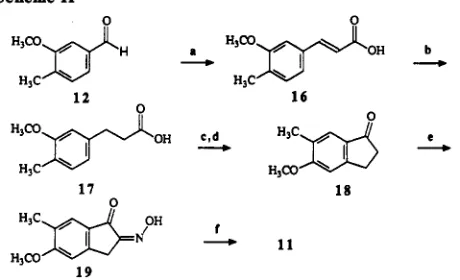
(a) Malonic acid, piperdine, pyridine, reflux; H+; (b) Hz, 10%
Pd-C, CHaCH2OH; (c) oxalyl chloride, benzene, reflux; (d) SnCI,; CH2Clz; (e) isoamyl nitrite, HCI, CH30H; (f) Hz, 10% Pd-C, CH,- COPH, H a O e
aminoindan analogue
5-methoxy-6-methyl-2-aminoindan
(11)
of
6 was also synthesized. These compounds were
evaluated for their discriminative stimulus effects in rata
trained
to discriminate saline from various training drugs:
LSD, 1, 5'-(+)-2,
and (5')-(+)-amphetamine, In addition,
the ability of the test compounds to inhibit synaptosomal
[3H]serotonin uptake and to induce long-term serotonin
neurotoxicity was examined.
Chemistry
Condensation of
3-methoxy-4-tolualdehyde1'J8
(12)
with
nitroethane readily afforded the corresponding nitro-
propene (Scheme
I). The 1-phenyl-2-propanone derivative
14 was then prepared by employing a modification of the
method of Monti et al.,lg
using Raney nickel and sodium
hypophosphite. The phenylpropanone was converted
into
the diastereomeric N-a-phenethyl derivatives
15a and 15b,
which were then catalytically N-debenzylated to yield the
enantiomers of
6.20*21Fuller, R. W.; Wong, D. T.; Snoddy, H. D.; Bymaster, F. P. Eiochem. Pharmacol. 1977,26, 1333.
Nichols, D. E.; Brewster, W. K.; Johnson, M. P.; Oberlender, R.; Riggs, R. M. J. Med. Chem. 1990, 33, 703.
Comins, D. L.; Brown, J. D. J. Org. Chem. 1984, 49, 1078.
Valenta, V.; Protiva, M. Collect. Czech. Chem. Commun. 1977, 42, 2240.
Monti, D.; Gramatica, P.; Speranza, G.; Manitto, P. Tetrahe- dran Lett. 1983,24,417.
Nichols, D. E.; Barfknecht, C. F.; Rusterholz, D. B.; Benington, F.; Morin, R. D. J. Med. Chem. 1973, 16, 480.
dose ED, (95% CI)
compd mg/kg pmol/kg saline
1
6 0.25 1.16
0.50 2.32
1.00 4.64 2.00 9.28
11 0.50 2.34 0.75 3.51 1.00 4.68 2.00 9.36
na Db % SDLc mg/kg rmollkg
8 0 0
0.64d 2.79 2.74
10 1 11 0.59
8 0 50 (0.35-0.99) (1.63-4.60) 8 0 63
8 0 100
8 0 13 0.81 3.77 8 0 25 (0.63-1.02) (2.96-4.79) 8 0 75
8 0 100
"Number of animals tested. bNumber of animals disrupted. 'Percentage of nondisrupted animale that selected the drug lever.
[image:2.616.63.288.49.187.2]Value included for comparison, taken from Nichols et al.16
Table 11. Drug-Discrimination Data for S-2-Trained Rata compd mg/kg pmollkg no Db SDL' mg/kg pmol/kg
dose % EDw (95% CI)
d i n e 8 0 0
s-2 0.79" 3.25
6 0.25 1.16 10 3 13 0.47 2.16
0.50 2.32 10 2 38 (0.32-0.67) (1.51-3.09) 0.75 3.48 8 1 100
0.50 2.34 8 0 38 (0.36-0.88) (1.67-4.13) 1.00 4.68 8 0 75
2.00 9.36 8 0 100
0.50 2.32 11 5 33 (0.29-0.72) (1.36-3.36) 0.75 3.48 7 1 100
0.50 2.32 11 3 38 (0.36-0.88) (1.67-4.13) 1.00 4.64 11 4 75
1.50 6.95 6 2 100
11 0.25 1.17 8 0 13 0.56 2.63
S-(+)-6 0.25 1.16 11 5 17 0.46 2.14
R-(-)-6 0.25 1.16 10 2 33 0.46 2.12
'Number of animale tested. *Number of animals disrupted. 'Percentage of nondisrupted animals that selected the drug lever. dValue included for comparison, taken from Nichols and Oberlender.n
2-Aminoindan
11was prepared by a synthetic route
previously employed
to make substituted 2-amin~indans.'~
This procedure utilized the intramolecular cyclization of
3-(3-methoxy-4-methylphenyl)propionyl
chloride, followed
by treatment of indanone 18 with amyl nitrite in methanol
and HC1
to yield hydroxyimino ketone 19.=
The catalytic
reduction of
19 afforded
11,which was isolated
as
the HCl
salt.
Pharmacology
The racemate and enantiomers of 6 and racemic 11 were
evaluated for their ability to substitute for 2
ina two-lever
drug-discrimination assay. In addition, racemic 6 and 11
were examined in
1-and LSD-trained animals. Racemic
6 and
11were also
tested in animals trained to discriminate
(5')-amphetamine from saline. The ability of the test
compounds to inhibit [3H]-5-HT uptake in vitro was ex-
amined by using the procedure of Steele et
al.23The
neurotoxic potential of racemic
6and
11was evaluated by
examining rat brain monoamines and their metabolite
levels and [3H]paroxetine binding
1week following
an
acute dose (10 or 20 mg/kg, sc) or
2weeks after subacute
dosing
(20mg/kg, sc, twice
aday
for 4days). Changes in
serotonin, its metabolite 5-hydroxyindoleacetic acid
(5-H I M ) , and [3H]paroxetine binding have been found to
(21) Barfknecht, C. F.; Nichols, D. E. Asymmetric synthesis of
(22) Perkin, W. H., Jr.; Robinson, R. J. J . Chem. SOC. 1907, 91, (23) Steele, T. D.; Nichols, D. E.; Yim, G. K. Y. Biochem. Pharam-
phenylisopropylamines. U.S. Patent 4,000,197, Dec. 1976.
1073.
[image:2.616.61.291.255.395.2]1664 Journal of Medicinal Chemistry, 1991, Vol. 34,
No.
5 Johnson et al.Table 111. Drug-Discrimination Data for LSD-Trained Rata
dose EDW .. (95% CI)
compd m d k a rtmol/ka na Db % SDL' m d k z umol/kz
saline 8 0 0
LSD 0.025d 0.058
6 0.50 2.32 8 1 0 PS'
1.00 4.64 8 0 38 2.00 9.28 15 7 75 3.00 13.9 6 5
-
1.00 4.68 10 2 13 2.00 9.36 10 2 38 2.50 11.7 12 4 50 3.00 14.0 7 6
-
11 0.50 2.34 9 0 11 NSt
ONumber of animals tested. bNumber of animals disrupted. Percentage of nondisrupted animals that selected the drug lever. dValue included for comparison, taken from Nichols et al.%
e Indicates partial substitution occurred. 'Indicates no substitution
occurred.
Table
IV.
Drug-Discrimination Data for S-Amphetamine-Trained Ratacompd mg/kg pmol/kg ne Db % SDLc mg/kg pmollkg
saline 8 0 0
5'-AMP 0.3Id 1.69
6 0.25 1.16 8 0 0 NS'
dose EDw (95% CI)
0.50 2.32 9 1 0 1.00 4.64 13 5 0 2.00 9.28 6 5
-
1.00 4.68 10 7 33 1.50 7.02 7 5 50 2.00 9.36 7 7
-
11 0.50 2.34 10 4 17 NS'
"umber of animals tested. bNumber of animals disrupted.
e Percentage of nondisrupted animals that selected the drug lever.
dValue included for comparison, taken from Oberlender and Ni- chols." e Indicates no substitution occurred.
correlate with selective serotonin neurotoxicity following
high doses of certain substituted amphetamine^.^^^^^
Results and Discussion
The results of the drug-discrimination studies in rata are
summarized in Tables I-IV.
Racemic
6
and
11were
found to fully substitute in
1-and 2-trained animals. In
animals trained to discriminate saline from (S)-amphet-
amine, racemic
6
did not substitute, while in LSD-trained
rats
6
gave partial substitution. In contrast,
11did not
substitute in LSD-trained animals. This is similar
to what
is seen with the
3,4-(methy1enedioxy)-substituted
amphetamine
8.For
instance,
8 substitutes in rata trained
to discriminate saline from LSD, consistent with its hal-
lucinogenic actions.28 In contrast, the methylenedioxy
substituted aminoindan 10 did not substitute in LSD-
trained rata,le suggesting that it probably would not have
LSD-like actions in man. Therefore, as
withmethylene-
dioxy-substituted analogues, there appears to be greater
similarity between the drug-discrimination properties of
LSD and
6
than between those of LSD and
11.Another parallel between the pharmacology of the me-
thylenedioxy- and
3-methoxy-4-methyl-substituted
(24) Battaglia, G.; Yeh, S. Y.; O'Hearn, E.; MoiGer, M. E.; K u h T M. T.; De Souza, E. B. J. Pharmacol. Exp. Ther. 1987, 242,
911.
(25) Battaglia, G.; Yeh, S. Y.; De S o w , E. B. Phrmacol. Biochem. Behau. 1988,29, 269.
(26) Nichols, D. E.; Hoffman, A. J.; Oberlender, R. A.; Jacob, P., III; Shulgin, A. T. J. Med. Chem. 1986,29, 2009.
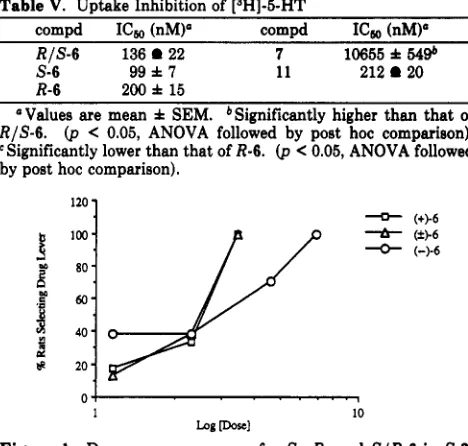
Table V. Uptake Inhibition of [sH]-5-HT
compd ICw (nM)O compd ICw (nM)O
R/S-6 136 22 7 10655
*
549S-6 99 f 7 11 212 20 R-6 200 f 15
aValues are mean f SEM. bSignificantly higher than that of
R/S-6. (p
< 0.05,
ANOVA followed by post hoc comparison). Significantly lower than that of R-6. (p<
0.05, ANOVA followed by post hoc comparison).120
-
*
(+b6*
(*>a*
(-)-6*
20. . . . . . . , "I
1 10
[image:3.616.322.556.49.272.2][Dore1
Figure 1. Dose-response curves for S-, R- and SIR-6 in S-2- trained rats.
The
percent of nondisrupted rats responding onthe
drug lever was plotted versusthe
log dose (pmollkg). The slopee of the linear portion ofthe
dose response curvesare
as follows:amphetamines is stereoselectivity.
It has been previously
found that the more potent enantiomer of 1,2, and 8, in
producing 1-like effects and in inhibiting the neuronal
uptake of [3H]-5-HT, has the
Sabsolute configura-
tion.23~26-28
Similarly, the
Senantiomer of
6
is the more
potent inhibitor of synaptosomal [3H]-5-HT uptake (Table
V). In contrast, it can be seen in Table I1 that both the
S
and the R enantiomers had equal potencies for substi-
tution in S-2-trained rata. However, examination of the
dose-response curves of
S-,
R-, and
rue-6
indicated that
the slope of the curve for
S-and
rue-6
was very similar,
while the slope for
R-6
was
much more shallow (Figure
1).This would suggest that the two enantiomers of
6
are
working by different mechanisms of substitution in S-2-
trained rata. Therefore, the in vitro, but not the in vivo,
results parallel the stereoselectivity for the methylenedi-
oxy-substituted amphetamine.
The short-term monoamine changes measured after high
doses of
6
and
11are similar
to
those occurring in response
to 1 , 2 , 8 , and
As seen in Table VI, the levels of
5-HT and 5-HIAA in the hippocampus and frontal cortex
are significantly decreased at
3
h after a 20 mg/kg (sc) dose
of either
6
or 11. In addition, cortical levels of DA are
significantly increased. This is similar
to previous findings
for
methylenedioxy-substituted
amphetamines
(1and 8),
and the 2-aminoindan
lO.=aIt should be noted that both
6
and
11increased levels of the DA metabolite HVA. In
contrast,
1does not increase HVA, but causes a significant
decrease in the DA metabolite DOPAC.29
Despite similarities, one distinct difference between
these two series of substituted amphetamines (ie
1vs
6 )
S-6, 389; SIR-6, 360; R-6, 129.
(27) Nichols, D. E.; Oberlender, R. A.; In Ecstasy: The Clinical, Pharmacological and Neurotoxicological Effects of the Drug MDMA; Peroutka, S. J., Ed.; Kluwer Academic Publishers: Boston, 1990, pp. 105-132.
(28) Oberlender, R.; Nichols, D. E. Psychopharmacology 1988,95,
71.
(29) Schmidt, C. J.; Levin, J. A.; Lovenberg, W. Biochem. Phar- macol. 1987,36, 747.
(30) Johnson, M. P.; Nichols, D. E. Unpublished resulta.
(31) Johnson, M. P.; Nichols, D. E. Pharmacol. Biochem. Behau.
[image:3.616.60.300.261.438.2]Substituted Propanes and Indam us MDMA Journal of Medicinal Chemistry, 1991, Vol. 34,
No.
5 1666Table
VI.
Monoamine and Metabolite Levels at 3 h Postdrue compd(dose, mg/kd NEa DA DOPAC HVA
5-HT
5-HIAA
Frontal Cortex
saline 543 f 23 63 f 5 36 f 5 61 f 5 459 f 35 223 f 13
6 (20) 585 f 23 120 f 17b 46 f 3 138 f
lob
212 f 40b 139 f gb 11 (20) 558 f 22 113 A 16b 40 f 2 112 f 6b 148 f 22b 146 f 7bsaline 649 f 25 C C C 496 f 28 487 f 25
6 (20) 641 f 26 C C C 238 f 12b 260 f 24b
C 272 f 21b
C C 256 f 14b
11 (20) 646 f 40
"Values are mean f SEM (ng/g wet weight). bSignificantly different than that of saline. (p
<
0.05, ANOVA followed by post hoc Hippocampuscomparison). Below the levels of detection.
Table VII. Monoamine and Metabolite Levels 1 Week following Acute Dosing
compd (dose,
mg/kg) NE" DA DOPAC HVA 5-HT 5-HIAA Frontal Cortex
saline 403f 14 76f 5 46f 8 70 f 4 300f 15 231 f 11
6 (10) 394 f 16 88 f 2 39 f 5 70 t 6 281 f 13 233 f 18
11 (10) 414 f 15 88 f 10 36 f 4 74 f 4 312 f 15 210 f 16 Hippocampus
saline 628 f 42 b b b 311 f 38 496f 36 6 (10) 620 f 33 b b b 255 f 30 460 f 31 11 (10) 633 f 41 b b b 312 f 15 434 f 22
Frontal Cortex
saline 490f10 7 0 f 3 4 5 f 4 7 5 f 8 300f6 236f16 6 (20) 487 f 12 86 f 10 45 f 4 85 f 4 316 f 10 229 f 6
11 (20) 509f 18 81 f 13 35f 4 65 f 2 316 f 4 240t 14 Hippocampus
saline 565 f 19 b b b 435 f 15 428 f 17 6 (20) 578 f 22 b b b 431 f 24 430 f 28
11 (20) 583 f 22 b b b 462 f 18 476 f 12 OValue~ are mean f SEM (ng/g wet weight). bBelow the level of
detection.
is their relative serotonin neurotoxicity. It has been
well-established that acute or subacute high doses of
1,2, 5,or
8result in a selective long-term decrease in brain
5-HT and 5-HIAA.%11*31
Recent studies suggest that this
is due to a selective degeneration of the fine axons origi-
nating from the dorsal raphe nucleus."
In contrast, this
work indicates that neither
6nor
11cause a long-term
depletion of 5-HT or 5-HIAA after single or multiple high
doses. As seen in Table VII, the monoamines and their
metabolite levels were unchanged
1
week after a single
10
or
20
mg/kg (sc) dose. Higher doses of
6were lethal; all
rats administered 40 mg/kg died within 45 min. In ad-
dition, ca.
12%
of the animals given
20
mg/kg of
6
died,
suggesting this dose to be a t the bottom of the dose-le-
thality curve. Therefore, multiple dosing (twice a day for
4 days) of
20
mg/kg
6
or
11was performed and the rats
were sacrificed
2
weeks after the last dose. As seen in
Table VIII, even after multiple dosing, neither the sub-
stituted amphetamine
6nor aminoindan
11resulted in
decreased monoamine levels in the frontal cortex or hip-
pocampus.
In addition, [W]paroxetine-binding parameters
to tissue homogenates were unchanged (Table IX).
Therefore, the present report indicates that unlike some
substituted amphetamines (such
as 1,2,5,and
8)) thetest
compounds
6and
11do not result
inselective degeneration
of serotonin axons.
One other important point should be made regarding
structure-activity relationships. It is apparent from the
(32) O'Hearn, E.; Battaglia, G.;
De
Souza, E. B.; Kuhar, M. J.;(33) Mamounas, L. A.; Molliver, M. E. Exp. Neurol. 1988,102, 23. Mollivar, M. E. J. Neurosci. 1988, 8, 2788.
Table VIII. Monoamine and Metabolite Levels 2 Weeks following Subacute Dosingb
compd NEo DA DOPAC HVA 5-HT 5-HIAA Frontal Cortex
saline 595 i 21 80 f 8 61 f 7 52 f 5 440 f 12 270f 8
6 573 f 6 83 f 8 74 f 6 62 f 7 411 f 10 253 f 12 11 5 6 8 f 12 92 f 5 54 f 7 59 f 4 415f 20 256f 13
Hippocampus
saline 741 f 53 c C C 409 f 38 541 f 43 6 724 f 62 c C C 392 f 21 503 f 28
11 716f33 c C C 434 f 18 518 f 39 OValues are mean A SEM (ng/g wet weight). bAnimals were sacrificed 2 weeks after multiple dosing (20 mg/kg, 2x/day for 4 days). Below the level of detection.
Table
IX.
[3H]Paroxetine Receptor Binding after Subacute Dosin$no. of uptake siteso comDd frontal C O e X hiDDOCamDU8
saline 13.4 f 0.8 16.2 f 0.7 14.9 f 0.6
6 12.3 f 1.0
11 13.6 f 0.8 15.6 f 0.7
"Values are mean f SEM (fmol/mg wet weight). bAnimals were sacrificied 2 weeks after subacute dosing (20 mg/kg, 2x/day for 4 days).
uptake inhibition data (Table V) that o-methoxy substi-
tution can dramatically alter the mechanism of action.
Addition of an o-methoxy
to
6to give
7results in a nearly
2
order of magnitude decrease in the ability to inhibit
[3H]-5-HT uptake. Cheng et
al."have proposed that
hallucinogenic amphetamine derivatives may be classified
either as direct-acting or indirectly-acting. The latter
category includes compounds which induce the release of
neuronal stores of transmitter. The failure of
7and
similar
2,5-dimethoxy-substituted
derivatives to effect releaseM
and the observation that
1,2, 6,and
8interact potently
with the 5-HT uptake carrier suggest that an o-methoxy
on a phenethylamine is a structural feature that dramat-
ically attenuates affinity for the uptake site. Given the
neurotoxicity of certain o-hydroxy-substituted phen-
ethylamines such
as
6-hydro~ydopamine,~
it is tempting
to speculate
that
this
may be an evolutionary development
to protect serotonin neurons against such neurotoxic
compounds.
To summarize, the present study indicates that there
are
anumber
ofpharmacological similarities between the
3,4-(methylenedioxy)- and
3-methoxy-4-methyl-substituted
compounds. This includes their behavioral effects,
asmeasured in the drug-discrimination paradigm, their
ability to inhibit the uptake of [3H]-5-HT, their effects on
(34) Cheng, H. C.; Long, J. P.; Nichols, D. E.; Barfknecht, C. F. J.
[image:4.616.58.297.201.423.2]1666 Journal of Medicinal Chemistry, 1991, Vol. 34, No. 5
brain monoamines a t short time periods, and the stereo-
selectivity of action for the S enantiomer.
Aswith
1and
2,n
the behavioral effects of
6and
11in animals do not
appear to be typical of either stimulants such as amphe-
tamine or hallucinogens such as LSD or
7.It should be
noted that the primary amines
6and 8, in both series,
possess some LSD-like animal behavioral pharmacology.
In contrast, 2-aminoindans
10and
11in both series lack
this effect. Similarly, neither of the 2-aminoindans pro-
duce serotonin neurotoxicity. However, the methylene-
dioxy-substituted amphetamines result in long-term def-
icits in serotonergic markers. In contrast, this action is
not observed in the
methoxymethyl-substituted series
studied here.
Thus, these results suggest that the primary pharma-
cological effects of compounds
6and
11probably occur
through the release of neuronal serotonin. Previously, the
only compounds known to have this action, such as
2or
5, also
induce serotonin neuron degeneration. Therefore,
6
and
11may prove to be useful tools in elucidating the
role of central serotonergic processes.
Experimental Section
Uncorrected melting points were taken on a Mel-Temp ap- paratus. 'H NMR spectra were recorded on a Varian VXR-5OOS spectrometer. Chemical shifta are reported in S values (parts per million). Microanalysis was performed at the Purdue Micro- analysis Laboratory (West Lafayette, IN) or Galbraith Labora- tories (Knoxville, TN), and all values were within 0.4% of those calculated.
l-(3-Methoxy-4-methylphenyl)-2-nitropropne (13). Ni- troethane (300 mL), 7.7 g (100 "01) of ammonium acetate, and
15.0 g (100 mmol) of 3-methoxy-4-methylbenzaldehyde (l2)'"J8 were combined and heated a t reflux in an oil bath for 2.5 h. The excess nitroethane was removed by rotary evaporation and the residue was partioned between CHZClz (2 X 75 mL) and HzO. The organic extracts were combined and dried (NazS04), and the CHzClz was evaporated. Crystallization was induced by dilution of the residual oil in MeOH. The product was recrystallid from MeOH-H20 to yield 17.3 g (83.5%) of a yellow solid; mp 51 "C (lit.' mp 52 "C).
1-(3-Methoxy-4-methylphenyl)-2-propanone (14). W-2 Raney Ni (8.0 g), as a slurry in EXOH, was added to a mechanically stirred solution of 12.0 g (58 mmol) of nitroolefin 13 in 300 mL of 95% EtOH and 150 mL of 0.2 M aqueous acetate buffer (pH
5) contained in a 1-L round-bottom flask.le The flask was sus- pended in a Branson B-220H ultrasonic bath maintained a t 40
OC. While sonication was maintained, 54.0 g (0.61 mol) of Na- HJ'04 in 120 mL of HzO was added at a rate sufficient to maintain moderate Hz evolution. The reaction was stirred with sonication at 40 "C for 1.5 h. The initial mixture had a green tint, which disappeared on completion of the reaction. The catalyst was removed by vacuum filtration through Celite, brine (200 mL) was added to the filtrate, and the solution was extracted with EBO
(3 X 200 mL). The organic layer was washed with 5% NaHCOS and brine and was concentrated under vacuum. The residue was taken up into EBO, dried (MgS04), and filtered and the EBO removed under vacuum. The crude ketone was distilled under vacuum to yield 5.5 g (53.4 %) of 14 as a colorless oil: bp 90 OC (0.4 mmHg) [lit.'* bp 101
"C
(1 mmHg)].(R
,#)-l-( 3-Methoxy-4-methylphenyl)-2-aminopropane Hydrochloride (R/#-B.HCI). A solution of 7.0 g (33.8,mmol) of nitroolefin 13 in 20 mL of -0 was added dropwise to a stirring suspension of 3.6 g (94.9 "01) of LiAlH4 in 150 mL of dry&O.
After the addition, the mixture was heated at reflux on a steam bath for 2.5 h. The excess LiAlH4 was decomposed by slow addition of 10 mL of HzO and the mixture was filtered through Celite. The ethereal filtrate was extracted with 2 N HCl (3 x
75 mL), and the combined aqueous extracts were basified with excess NaOH. The free base was extracted with CHzCl2 (3 x 75
mL), dried (Na#04), filtered, and concentrated by rotary evap- oration. The residual oil was dissolved in absolute ethanol, acidified with concentrated HCl, diluted with EhO, and cooled to yield 4.9 (88.1%) of white crystalline R/S-B.HCI: mp 181
"C
Johnson et al.
(lit.'* mp 181.5-183.5 "C); 'H NMR (CDCld d 8.41 (8, 3, NHs'),
7.06 (d, 1, ArH, J = 7.5 Hz), 6.67 (d, 1, ArH, J = 7.5 Hz), 6.71
(8, 1, ArH), 3.82 (s,3, OCHJ, 3.57 (m, 1, CHN), 3.20 (dd, 1, ArCH2,
J = 5.3, 13.4 Hz), 2.81 (dd, 1, ArCH2, J = 9.3, 13.4 Hz), 2.17 ( 8 ,
3, ArCHS), 1.39 (d, 3, CHS, J = 6.5 Hz).
(R
,R
)-(+)-N-(
1-Phenethy1)- l-(3-met hoxy-4-methyl- phenyl)-2-aminopropane Hydrochloride(R
,.It-
15a.HCl). A solution of 9 g (50 mmol) of ketone 14 and 6.06 g (50 mmol) of (R)-(+)-a-phenethylamine (Aldrich, Milwaukee, WI) in 50 mL of benzene was heated at reflux under Nz for 2 h with continuous HzO removal with a Dean-Stark trap.m*21 The benzene was removed under vacuum, and the residual oil was taken up into30 mL of absolute ethanol and shaken for 24 h with W-2 h e y Ni (2.5 g as a slurry in EtOH) at 50 psig of Hp The catalyst was removed by filtration through Celite and the filtrate was acidified with concentrated HCl. The solvents were removed under vac- uum, and the crude salt was recrystallized from acetone to yield
10.23 g (64.6%) of white crystalline R,R-lSa.HCI: mp 216-217
ArH, J = 7.6 Hz), 7.47 (t, 2, ArH, J = 7.5 Hz), 7.41 (t, 1, ArH, J = 7.4 Hz), 6.99 (d, 1, ArH, J = 7.5 Hz), 6.51 (d, 1, ArH, J =
7.5 Hz), 6.42 (s, 1, ArH), 4.37 (m, 1, ArCHN), 3.72 (8, 3, OCHS),
3.37 (dd, 1, ArCHz, J = 4.4, 13.1 Hz), 3.30 (m, 1, CHN), 2.80 (dd,
1, ArCHz, J = 9.9, 13.1 Hz), 2.15 (8, 3, ArCHS), 1.93 (d, 3, CH,,
J = 6.8 Hz), 1.42 (d, 3, CCHS, J = 6.6 Hz). Anal. (C,&,ClNO) C, H, N.
(S ,S
)-(-)-N-(
1-Phenet hy1)- 1 -( 3-methoxy-4-met hyl- phenyl)-2-aminopropane Hydrochloride (S,S-1SaHCl). Following the above procedure but using 15.1 g (84.7 mmol) of ketone 14 and 10.17 g (84.7 "01) of (SI-(-)-a-phenethylamine yielded 15.01 g (55.9%) of white crystalline S,S-lSa.HCk mp215-216 OC; [a]D -17.04' (c = 2, EtOH). Anal. (ClsH,CINO) C, H, N.
(R)-(-)-1-( 3-Methoxy-4-methylphenyl)-2-aminopropane Hydrochloride (R-6-HCl). A solution of 9.60 g (30.3 mmol) of R,R-lSaHCl dissolved in 100 mL of MeOH was added to 0.9 g of 10% Pd-C (as a slurry in 10 mL of H20) contained in a "L Parr pressure bottle. The mixture was shaken a t 50 psig of Hz for 48 h. The catalyst was removed by fitration through Celite, the solvent was removed by rotary evaporation, and the crude salt was recrystallized from EtOH-Eta0 to yield 5.97 g (91.3%)
of white crystalline R-&HC1; mp 163 "C; [a]D -23.42" (c = 2, HzO). Anal. (CllHlsCINO) C, H, N.
( S ) - ( +)- 1-( 3-Met hoxy-4-met hylphenyl)-2-aminopropane Hydrochloride (S-6.HCl). An exact replication of the above procedure using 15.01 g (47.4 "01) of S,S-lSb-HCl yielded 6.73
g (65.4%) of white crystalline S-6.HCl; mp 163 "C; [a]D +23.30°
3-Methoxy-4-methylcinnamic Acid (16). A mixture of 25
g (167 "01) of 12, malonic acid (31.7 g, 310 mmol), and 1.3 mL of piperidine in 70 mL of pyridine was stirred on a steam bath for 5 h.% The mixture was poured into 400 mL of ice water containing 100 mL of concentrated HC1. The resulting precipitate was collectad by filtration and washed by resuspension in 300 mL of water. The precipitate was then collected, dried, and recrys- tallized from MeOH-HzO to yield 32.0 g (99.7%) of a white crystalline product; mp 181-182 "C; 'H NMR (DMS04-d& 6 7.57
(d, 1, = C H , J = 16.0 Hz), 7.25 ( s , l , ArH), 7.15 (m, 2, ArH), 6.52
3-(3-Methoxy-4-methylphenyl)propanoic Acid (17). Cin- namic acid 16 (29 g, 151 "01) was dissolved in 500 mL of 95%
ethanol and shaken for 6 h in a Parr apparatus a t 60 psig of H2 over 3.0 g of 10% Pd-C. The mixture was then filtered through a Celite pad and concentrated under vacuum. The resulting solid material was recryatallid from MeOH-HTO to give 29.2 g (99.7%)
of a white crytalline solid mp 73-74 "C; H Nh4R (CDCld S 7.05
(d, 1, ArH, J = 7.4 Hz), 6.71 (d, 1, ArH, J = 7.5 Hz), 6.69 (e, 1,
ArH), 3.82 (8, 3, CHsO), 2.94 (t, 2, CHz, J = 7.8 Hz), 2.69 (t, 2,
5-Methoxy-6-methyl-1-indanone (18). Propanoic acid 17 (20 g, 103 mmol) was dissolved in 300 mL of dry benzene containing a few drops of N,iV-dimethylformamide, and 27 mL (209 mmol) "C; ["ID +17.23" (C = 2, EtOH); 'H NMR (CDCls) d 7.67 (d, 2,
(C = 2, HzO). Anal. (C11HIsClNO) C, H, N.
(d, 1, --CH, J = 16.0 Hz), 3.82 (8,3, CHSO), 3.34 (8, 1, OH), 2.15
(8, 3, ArCHs). Anal. (CllH1zOS) C, H.
CHZ, J = 7.8 Hz), 2.18 (8, 3, ArCHS). Anal. (CllH1408) C, H.
Substituted Propanes and Zndans us M D M A
of oxalyl chloride was added dropwise." The mixture was stirred for 4 h a t room temperature and the benzene was removed by rotary evaporation. The crude acid chloride was redissolved in
400 mL of dry dichloromethane and placed in an ice bath. A solution of SnCl, (14.8 mL, 129 mmol) in 50 mL of CH2Clz was added dropwise over 10 min. Stimng was continued for 10 min, the ice bath was removed, and the reaction was allowed to stir for 1
h
The reaction mixture was then p o d over 50 g of crushed ice and the organic layer was washed with 3 N HCl(2 X 100 mL) and water (200 mL). The solution was dried with MgS04, filtered, and passed through a short silica gel pad. After solvent removal the residue was recrystallized from benzenehexanes to yield 13.2 g (72.5%): mp 114-115 OC; 'H NMR (CDClS) d 7.53 ( s , l , ArH),6.84 (s, 1, ArH), 3.92 (a, 3, CH30), 3.07 (t, 2, CH2,
J
= 5.7 Hz),C, H.
2-(Hydroxyimino)-S-methoxy-6-methyl-l-indanone (19).
Indanone 18 (12 g, 68 mmol) was dissolved in 375 mL of MeOH and heated to 45 OC. Isoamyl nitrite (10 mL, 75 "01) was added, and then 7 mL of concentrated HCl was added dropwise over 5
min. After 20 min of stirring an off-white precipitate began to form. Excess isoamyl nitrite and HCl(1 mL of each) were added after 45 min of stirring. The precipitated product was collected by fitration and washed with cold methanol and then ether (100
mL). The filtrate was concentrated by rotary evaporation and the residue was recrystallized from MeOH. The two crops were combined to give 13.6 g (96.9%): mp 212-213 "C; 'H NMR
3.68 (s,2, CHz), 2.18 ( 8 , 3, M H J . Anal. (C11H11N03) C, H, N.
5-Methoxy-6-methyl-2-aminoindan Hydrochloride (1 1).
Hydroxyimino ketone 19 (10 g, 49 mmol) was dissolved by warming in 1 L of acetic acid. Concentrated HzS04 (6 mL, 98
mmol) and 2.5 g of 10% Pd-C were added to this solution. The mixture was shaken at 60 psig of Hz for 18 h.88 The catalyst was then removed by filtration and the mixture was concentrated by rotary evaporation. The residue was dissolved in 400 mL of water and the acidic solution was washed with 3 X 200 mL of ethyl acetate and 200 mL of ether. The aqueous layer was basified with NaOH and the amine was extracted into 3 X 200 mL of di- chloromethane. The organic layer was dried (MgSOJ and filtered, and the solvent was removed by rotary evaporation. The resulting oil was dissolved in EtOH and acidified with concentrated HC1. The resulting HC1 salt was crystallized from EtOH-ether to yield
8.0 g (77.0%): mp 316-317 OC; lH NMR (DMS04-d6) 6 8.27 (a,
3, NHs+), 7.01 (a 1, ArH), 6.85 (e, 1, ArH), 3.93 (m, 1, CH), 3.73
J = 5.3,16.4 Hz), 2.92 (dd, 1, CH,
J
= 7.6, 16.0 Hz), 2.82 (dd, 1,CH, J = 7.6, 16.4 Hz), 2.09 ( 8 , 3, ArCHs). Anal. (CllH16ClNO) C, H, N.
Phrvmacological Methods. A n i s . Male SpragueDawley rats (175-199 g, Harlan Industries, Indianapolis, IN) were either group housed 6 per cage or individually caged in a tempera- ture-controlled room with a 12/12-h light cycle. In drug-dis- crimination experiments, animals were provided with water ad lib, and sufficient supplemental food to maintain 80% of their free-feeding weight. In all other pharmacological experiments rata were given food and water ad lib. Animal dissections were done over ice and the brain areas removed according to the methods of Glowinski and Iverson." The frontal cortex and hippocampal regions from each hemisphere were separated, frozen with liquid nitrogen, and stored a t -70 "C until assayed.
Drug-Diacrimination Studies.
Six
standard operant cham- bers (Coulbourn Instruments) equipped with two response levers, a food pellet delivery system, masking white noise, and a house light were utilized. The chambers were enclosed in ventilated, sound-attenuated cubicles and were controlled by solid-state logic interfaced through a Coulbourn Instruments Dynaport to an IBM-PC.Food
pellets (Bioserve, 45 mg, dustless) were used as positive reinforcement during maintenance sessions.(37) Haworth, R. D.; Perkin, W. H., Jr.; Rankin, J. J. Chem. SOC. 1924,125, 1686.
(38) Nichols, D. E.; Barfknecht, C. F.; Long, J. P.; Strandridge, R. T.; Howell, H. G.; Partyka, R. A.; Dyer, D. C. J. Med. Chem. 1974, 17, 161.
(39) Glowinski, J.; Iverson, L. L. J. Neurochem. 1966, 13, 665.
2.66 (t, 2, CH2,
J
5.7 Hz), 2.23 ( ~ $ 3 , M H & Anal. (CllH1202)(DMSO& 6 7.53 ( 8 , 1, ArH), 7.13 (5, 1 ArH), 3.91 (8, 3, CH30),
( ~ , 3 , CHSO), 3.19 (dd, 1, CH,
J
5.3, 16.0 Hz), 3.13 (dd, 1, CH,Journal of Medicinal Chemistry, 1991, Vol. 34, No. 5 1667
The complete training procedure has been previously de- scribed.% Briefly, rats were trained to discriminate the drug treatment from saline on an FR-50 schedule with l b m i n main- tenance sessions. The training drug and doses (mg/kg) were as follows: 1,1.75; S-2,1.75; LSD tartrate, 0.0s; and (Sl-amphetamhe sulfate, 1.0. All injections were administered ip 30 min prior to testing. To avoid positional preferences, half the animals were trained to press DRUG-L and SAL-R while the other half were trained on DRUG-R and SAL-L.
Test sessions were run once or twice a week with at least two maintenance sessions between each test session. Test sessions were terminated when either 5 min passed or 50 responses were made on a lever, whichever came first. It the rat did not press either lever 50 times he was scored as disrupted and was not included in the calculations. On test days, responding was drug positive if the rats pressed the drug lever 50 times. A rat was only given a test drug if he responded correctly (85% responding on the correct lever) on the previous two maintenance sessions. Following the criteria of Colpaert et al." test data were discarded and the test condition later retested if the rat responded incor- rectly in either of the two subsequent maintenance sessions. I n Vitro [SH]-5-HT Uptake Inhibition. The procedure of Steele et al." was employed with minor modifications. Briefly, the cortical region of the rat brain was homogenized in 15 vol of ice-cold 0.32 M sucrose with a glass mortar with a motor-driven pestle. The homogenate was centrifuged at 1086g a t 4 "C for 10
min. The resulting supernatant was centrifuged a t 1 7 W g for
10 min and the pellet was then resuspended in the same volume of sucrose. Incubations were carried out in a shaking incubator under a 95% 0 2 / 5 % COz atmosphere a t 37 or 0 "C to measure total tissue uptake and nonspecific uptake, respectively. A 5-min
preincubation was begun by adding 0.2 mL of the synaptosomal preparation to test tubes containing 1.65 mL of Oz-saturated Krebs-Henseleit buffer (118 mM NaCl, 4.8 mM KC1, 1.3 mM CaCl,, 1.2 mM KH2P04, 1.2 mM MgS04, 25 mM NaHCOS, 10
mM glucose, 0.6 mM ascorbic acid, and 0.03 mM NazEDTA), 50
pL of drug or buffer, and 50 pL of pargyline (final concentration of 1 pM). Then [3H]-5-HT was added in a 5O-pL aliquot to give a final concentration of 10 nM, and incubations were continued for another 5 min. Incubations were terminated by cooling in ice and then rapidly fiitering through Whatman GF/B fiters with a Brandel cell harvester (Gaithersburg, MD). The filters were washed twice with ice-cold buffer and allowed to air-dry before placing them in plastic scintillation vials. Scintillation cocktail
(10 mL of Budget-Solve, Research Producta Intemational, Mount Prospect, IL) was added, and the vials were sealed and allowed to set for 8 h before counting a t an efficiency of 54%.
[%]Paroxetine Binding to t h e Serotonin Uptake Carrier. The method of Habert et al." was utilized with minor modifi- cations. Brain regions from one hemisphere in neurotoxicity studies were thawed, weighed, and homogenized in 5 mL of 50
mM Tris HC1 with 120 mM NaCl and 5 mM KCl (pH 7.4) with a Brinkman polytron (2 X 20 s, setting 6). The homogenates were centrifuged twice at 3oooOg for 10 min, and the resulting pellet was resuspended in the same volume of buffer.
As
adopted by Battaglia et ala,% the ability of a single saturating concentration(1 nM) of [SH]paroxetine to bind to tissue homogenates was examined. Specific binding was defined as that displaceable with
1 pM fluoxetine. Incubations were commenced by the addition of tissue to the buffer to give a total volume of 2 mL. The tubes were allowed to equilibrate for 1 h at 24 OC before filtering
through
Whatman GF/C filters presoaked with 0.05% PEI, using a cell harvester. The tubea were then washed twice with ice-cold buffer, and the filters were allowed to air-dry before placing them in scintillation vials. Scintillation cocktail was then added, and the vials were allowed to set overnight before counting at an efficiency of 54%.
HPLC with Electrochemical Detection. The brain regions from animals sacrificed 3 h or 1 or 2 weeks following dosing were weighed and homogenized in 0.5 mL of 0.4 N HC104 containing
(40) Colpaert, F. C.; Niemegeers, C. J. E.; Janssen, P. A. J. J.
1668 J. Med. Chem. 1991,34, 1668-1674 0.05% Na&DTA and 0.1% N e O 6 , with a motor-driven Teflon
pestle and Eppendorf 1.5-mL centrifuge tubes. An internal standard of 100 ng/mL of 3-(3,4-dihydroxyphenyl)propionic acid (DHPPA) was
used.
The samples were centrifuged at 14OOOg for 4 min with a tabletop centrifuge. The supernatant was assayed for catecholamines, 5-HT, and their metabolites by injection of50 p L onto a Brownlee C18 analytical column (Anspec, Ann Arbor, MI). The HPLCEC system consisted of a refrigerated autosample (TosoHaas, Philadelphia, PA) and a Model 400 EG&G Princeton electrochemical detector (Princeton, NJ) with a dual electrode potential set at El = -200 mV and E2 = 850 mV versus the Ag/AgCl reference electrode. The mobile phase containing 0.05
M
NaH2P04, 0.03 M citric acid, 0.1 mM Na2EDTA, 0.034% sodium octyl sulfate, and 25% methanol was delivered at a flow rate of 1.0 mL/min. The concentrations of NE, DA, HVA, DO- PAC, 5-HT, and 5-HIAA were determined with the Dynamax Method Manager software (Rainin, Woburn, MA) implemented on an Apple Macintosh SE computer.Statistical Analysis. In drug-discrimination experiments a compound was defied as fully substituting for the training drug if at one or more doees 80% of the animals responded on the drug lever. The EDw and 95% confidence intervals values were de- termined from quantal dose-response curves according to the procedure of Litchfield and Wilc~xon.‘~ Drugs were said to
(42) Litchfeld, J. T., Jr.; Wilcoxon, F. J. J. Pharmucol. Exp. Ther. 1949,96,99.
partially substitute if at the highest dose at leaat 60-79% of the animals responded on the drug lever; no substitution was said to occur if 59% or less of the animals responded a t the highest dose. Percent uptake inhibition was defined as the difference between specific [3H]-5-HT uptake in control and drug tubes divided by control x 100%. The ICw values for uptake inhibition were determined from graded dose-response curves according to the procedure of Tallarida and Murray“
All
comparisons utilized an analysis of variance followed by a post hoc comparison as embodied in the computer program EPISTAT (EPISTAT Services, Richardson, TX).Materials. Pargyline hydrochloride and the HPLC standards were purchased from Sigma Chemical Co. (St. Louis, MO). [SHIParoxetine and [SH]-&HT were obtained at a specific activity of 28.8 and 15.1 Ci/mmol from New England Nuclear (Boston, MA). LSD tartrate was obtained from the National Institute on Drug Abuse. Fluoxetine hydrochloride was graciously provided by Eli Lilly Laboratories (Indianapolis, IN). MDMA.HC1,2.HCl and (S)-amphetamine sulfate were synthesized in our laboratory by using standard procedures.
Acknowledgment.
This
work was supported
by USP-HS Grant
DA-04758 fromthe
National Instituteon Drug
Abuse.
(43) Tallarida, R. J.; Murray,
R.
B. Manual of Pharmacologic Calculations with Computer Program; Springer-Verlag: New York, 1981; Chapter 8.Using Theoretical Descriptors in Quantitative Structure-Activity Relationships:
Some Toxicological Indices
Leland Y. Wilson*
Department of Chemistry, Loma Linda University Riverside, Riverside, California 92515 George
R. Famini
US.
Army Chemical Research, Development and Engineering Center, Aberdeen Proving Ground, Maryland 21010.Received June 15,1990
The application of computational techniques to medicinal chemistry is growing a t a tremendous rate. Quantitative structure-activity relationships (QSAR), which relate biological and toxicological activities to structural features, have been employed widely to correlate structure to activity. A difficulty of this approach has been nonuniformity of parameter seta and the inability to examine contributions across properties and data sets. Linear solvation energy relationships (LSER) developed by Kamlet and Taft circumvent many of the difficulties and successfully utilize a single set of parameters for a wide range of physical, chemical, and biological properties. We have replaced the LSER solvato-chromatic parameters with theoretically determined parameters to permit better a priori prediction of properties. Comparison of the two parameter sets for five biological activities is presented, showing the excellent fit of the theoretically determined parameters.
1.
Introduction
Quantitative
structure-activity relationships (QSAR)have
been
used
extensivelyin
correlatingmolecular
structural
features
ofcompounds to their
biological, chemical, a n d physical properties.The
basic t e n e t of QSAR is t h a tthere
isa
quantitative connection betweenthe
microscopic (molecular structure)and the
macroscopic (empirical) properties (particularly biological activity) of acompound. Furthermore,
this connectioncan
be usedto
predict empirical properties of a compound given its molecularstructure.
One such connection isthe
Linear
free energy relatiomship
(LFER).In
1935
Burkhardtl and
Hammet2
reviewed t h e existence ofLFER’s
a n d in 1937 Hammet3 proposed t h eequation that
bears his name.(1) Burkhardt,
G.
N. Nature 193S, 136,684. (2) Hammett,L.
P. Chem. Reo. 1935, 17, 125-136.2.
Linear Solvation Energy Relationships
Based on solvent
effectLFERs proposed
b yearlier
worker^,^ Kamlet and Taftelo developed a method
for writinglinear
free energyrelationships
involvingsolute/
(3) Hammett, L. P. J. Am. Chem. SOC. 1937,59,96.
(4) Chapman, N. B., Shorter, J.; Eds. Advances in Linear Free Energy Relationships; London, 1972; p 203-280.
(5) Kamlet, M. J.; Taft, R. W.; Abboud., J-L. M. J . Am. Chem.
SOC. 1977,91,8325.
(61 Kamlet. M. . . J.: Taft. R. W.: Abboud. J-L. M.: Abraham, M. H. J. Prog: Org. Chem. 1983,’48, 2877:
(71 Kamlet. . . M. J.: Taft. €2. W. Acta Chem. Scand. 19W5, B39,616. (8) M e t ; M. J.iTaft,’R. W.; Famini, G.
R.;
Doherty, R. M. ActaChem. Scand. 1987, B41,589.
(9) Taft, R. W.; Abraham, M. H.; Famini, G. R.; Doherty,