The Software for Constructing Trails with Local
Restrictions in Graphs
Tatyana Panyukova, Igor Alferov
Department of Mathematical Methods in Economics and Statistics, South Ural State University, Chelyabinsk, Russian Federation Email: [email protected]
Received December 18, 2012; revised March 15, 2013; accepted April 20, 2013
Copyright © 2013 Tatyana Panyukova, Igor Alferov. This is an open access article distributed under the Creative Commons Attribu-tion License, which permits unrestricted use, distribuAttribu-tion, and reproducAttribu-tion in any medium, provided the original work is properly cited.
ABSTRACT
The present research considers the problem of covering a graph with minimal number of trails satisfying the pre-defined local restrictions. The research is devoted to the problem of graph covering by minimal number of trails satisfying some local restrictions. Algotithm of allowed Eulerian cycle construction is considered. The authors showed that it is possible to recognize the system of transitions and solve the problem of constructing the allowable path by linear time. It’s also possible to find allowable Eulerian cycle for Eulerian graph or to proclaim that such a cycle does not exist by the time
O V G E G
. All presented algorithms have the software realization.Keywords: Eulerian Graph; Trail; Transition; Compatible Path; Algorithm
1. Introduction
Lots of problems of finding paths satisfying the different restrictions can be applied to some practical problems. For example for sheet material cutting problem plane graph represents the model of cutting plan, and a path covering all its edges defines the trajectory of cutter. The restriction defined for this problem is lack of intersection of any initial part of path with edges that are not passed yet [1]. Creating the control systems using non-oriented graphs the following problems of constructing the paths with different restrictions can arise. Among them are straight-ahead paths [2]; paths the next edge of which is defined by the given cyclic order on the set of incident edges [3-5]; paths for which it’s necessary to pass some edges in pre-defined order [5].
The restrictions on the order of vertices and edges can be classified as local (the next edge of a path is defined by conditions established at the current vertex or edge [2-8]), and global (Eulerian, Hamiltonian cycles, bidirec- tional double tracing etc.). Most of researches are de- voted to algorithms with local restrictions of edges order in a path. The present research considers the problem of covering a graph with minimal number of trails satisfy-ing the pre-defined local restrictions.
2. Constructing of
T
G-Compatible Path
The generalization of most of particular cases for
prob-lem of simple trail with local restrictions construction and analysis of its computing complexity is made by S.Szeider [7].
Let’s quote the basic definitions and results of this re-search to make the further statements clear. Let’s confine with finite simple graphs. Let’s designate as V G
and
E G the sets of vertices and edges of graph G corre-spondingly. For vertex v V G
let’s define the set
G
E V of all graph G edges incident to vertex v. The degree of vertex v let be designated as ; for let
d v
d0
:
v V G
d v d
d . Let
V G H G if H be
vertex-induced subgraph of graph G i.e. the subgraph received of graph G by deleting of one set of vertices and only all edges incident to vertices of this set.
Restrictions for paths in graph G can be defined in terms of allowed transitions graph.
Definition 1. Let transition graph T vG
for vertex
v V G be a graph vertices of which are the edges
incident to vertex v i.e. G , and set of edges consists of allowed transitions.
V T v E vG
Definition 2. The system of allowed transitions (or shortly, system of transitions) TG is called the set
T v v V GG
where be the transition graph for vertex v.
G
T v
Definition 3. The path for graph G is called -compatible if
0 1 1 k k
P v e v e v
G
Theorem 1 [S. Szeider]. If all graphs of transitions belong either class M of full multipartite graphs or class P of matchings then the problem of TG-compatible trail constructing can be solved by the time O E G
. Oth-erwise this problem is NP-complete.If the system of transitions for a vertex v V G
is a matching then this problem can be reduced to the problem for graph
:
G V G V G v ,
G
i j : i , j
G
E G
E G E v v v v v vv E T v
.If for any vertex v V G
graph T vG
is full mul-tipartite graph then a trail can be constructed by the fol-lowing algorithm.Algorithm TG-Compatible Path Input:
Graph G
V E,
; Vertices x, y the end-vertices of TG-compatible trail;
System of transitions TG:
v V G
T vG
M . Output: The sequence of edges corresponding to TG-compati- ble trail between vertices x and y or the message that such a path does not exist.
Step 1. If vertex x or vertex y is isolated then stop: path does not exist.
Step 2. Delete all isolated vertices from graph G. Step 3. Construct the supplementary graph G as fol-lowing (Figure 1):
Each vertex v V G
should be split into vertices
1, 2, , p v
v v v where p v
be the number of parts of graph T vG
. The edges of corresponding part of graph T vG
and one additional vertex vp v arein-cident to vertex vp;
Add two new vertices w v1
and w v2
, edge
1 2 , and edge
w v w v vp vw vj
for each part ofgraph T vG
, 1 j 2.Step 4. Construct the initial matching for graph G
1,2, , 1 2 p p
v V G p p v
M G v v w v
w v [image:2.595.360.489.592.723.2] .
Figure 1. Illustration how supplementary graph G is con- structed.
Step 5. Find the alternate sequence between vertices x and y that enlarges the cardinality of matching for graph
G. If it’s impossible to find such a sequence then stop (matching M G
has maximal cardinality and graph has no G-compatible path). Otherwise all the edges of found enlarging path except of additional edges of graphT
G produce the -compatible path between vertices x and y. Stop.
G
T
Let’s admit that there is open question in research [7]. This question is about recognition the multipartiteness of graphs T vG
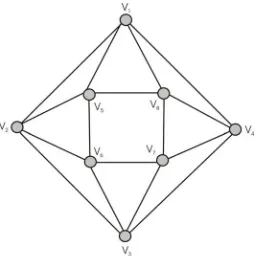
. Problems of constructing the allowed path or set of paths covering all the edges of given graph are not also considered.Let’s illustrate an example of graph G (Figure 2) that algorithm G-COMPATIBLE PATH cannot be used for constructing of paths covering all edges of graph G. Let the following system of transitions is defined for the graph:
T
G
T
v v2 1 , v v1 5
,
v v6 1 , v v1 4
,
v v4 3 , v v3 7
,
v v8 3 , v v3 2
,
v v3 2 , v v2 8
,
v v5 2 , v v2 1
,
v v1 4 , v v4 6
,
v v7 4 , v v4 3
,
v v2 5 , v v5 8
,
v v2 8 , v v8 5
,
v v3 8 , v v8 7
,
v v3 7 , v v7 8
,
v v4 7 , v v7 6
,
v v4 6 , v v6 7
,
v v1 6 , v v6 5
,
v v1 5 , v v5 6
G
.
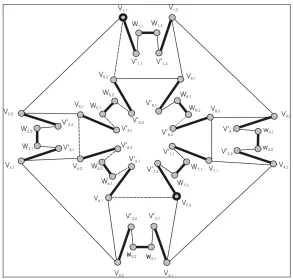
Supplementary graph for finding of -com- patible path between vertices and which con-struction is reviewed on step 3 of algorithm is shown at Figure 3.
G
T
1
v v7
The initial matching M G
is marked by thick lines. The alternate enlarging sequence of edges for this match-ing be
v v1,1 5,2
,
v v5,2 5,2
,
v w5,2 5,2
,
w w5,2 5,1
,
w v5,1 5,1
,
v v5,1 5,1
,
v v5,1 6,2
,
v v6,2 6,2
,
v w6,2 6,2
,
w w6,2 6,1
,
w v6,1 6,1
,
v v6,1 6,1
,
v v6,1 7,2
.Edges of this sequence not belonging the initial match-ing are represented by dash line. These edges form the set
Figure 3. Graph G' received of graph G by additional constructions.
v v1,1 5,2
,
v w5,2 5,2
,
w v5,1 5,1
,
v w6,1
,
v v5,1 6,2
,
v w6,2 6,2
,6,1
v v6,1 7,2
.All edges of this set belonging to graph Gi.e.
v v1, 5
, vertexit’s
possi-
v1
v to vertex v7 ith
5,v6 , v v6, 7 form TG -compatible path from .
Using algor m -COMPATIBLE PATH bl
re 4 shows the software realization of the repre-se
G
T
a
e to construct only simple trail between two different vertices (i.e. a trail where each vertex is presented only once).
Figu
nted algorithm. The bold line marks the found trail be-tween vertices 1 and 4. This trail corresponds the system
Figure 4. Software for compatible path algorithm.
of allowed transitions (see the additional window at right botto
olve the problem of -compatible pa
m side).
However in common the direct use of this algorithm does not allow to s TG
o
th with maximal number of edges constructing. Actu-ally the matching of maximal cardinality f r graph G cannot contain the pairs of edges forming forbidden tran-sition because these edges are incident to one comm vertex of graph G
on . At the same time, in common there may exist TG-compatible path containing such a pair of edges.
For exam e, for graph G presented on Figure 2 the path
pl
v v2 1 , v v1 4 ,
v v4 8 , v v8 1 , v v1 5 , v v5 2in principle cannot be received by constructing the matching of maximal weight for graph G. This path begins from edge v v2 1 and ends by edge v v5 2. These edges form forbidden transition
v v5 2 , 2 1v
, conse-quently, graph G
v s not contain the alternate path with both of these edges.
Thus, the question of multipartite T vG
graph recog-nition is still open as welldoe
as the pro of allowed path co
nstructing of Compatible
Eulerian Trails
blem
nstructing or finding the set of paths covering all the edges of initial graph G.
3. Algorithm for Co
stated in the terms of allowed transitions system [7]. It’s shown that the problem of constructing the allowed path in graph G can be solved by polynomial time if a system of transitions TG consists only of matchings and full multipartite graphs. It’s trivial to recognize if graph of allowed transitions belongs to the class of matchings. If we want recognize if transitions graph belongs to class of full multipartite graphs it’s expedient to use the definition of partition system [3-5,8].
The conception of partition system is used for defini-tion of allowed trail in terms of forbidden transidefini-tions.
Definition 4. Let G
V E,
be a graph. Let P vG
be some partition of set E vG
. Then the partitionsys-tem of graph G be the syst ets
em of s
:
G G
P P v v V G .
Definition 5. Let p P v G
, e f, p. A trail not containing the transitions e v f and f v e can be called PG-comp t se v f and
atible, and ransition
f v dden.
Let's admit that graph of allowed transitio
e are forbi
ns T vG
nsitionsitions unambiguously defines the graph of forbidden tra
v which is the complement of allowed trans graph to full graph. Thus, using definitions 1-3 the prob-lem either with use of allowed transitions or forbidden transitions can be stated.So the partition system is defined on the set of G
T
E v(the set of vertices incident to v). If edges e and e be
1 2
long to one subset then edge e2 cannot be placed after the edge e1 in a trail. Let graph G V E
,
be defined b the adjacency list. Its elements are the structures. Each element of this structure consists of two fields: vertex number vi (this vertex is adjacent to the current one); the number of partition element ci. To define the degree of the current vertex it is enough to count the number of elements of adjacency list.Let’s admit that each edge e belongs to two adjacency lists of vertices vi and
y
j
v (the ends of an edge). But for each vertex edge e belongs to different partition systems.
Input data are represented by the following list vector < list < pair <string, int> > > Graph;
es, each All data are represented by a vector of vertic
first
el pair of
ea
dden transitions
ement of this vector is a list of pairs. The
ch list is a vertex number, the second one is its degree. The other pairs represent the numbers of adjacent vertices and number of corresponding partition set.
On the other side, graph of allowed transitions defined by partition system PG cannot be arbitrary, and belongs to class M of full multipartite graphs: the elements of par-tition P vG
define the parts of graph T vG
M , and set of its edges
, G
:
G
E T e fE v p P v .s
Graph of forbi
,
G v e f p
G
T v in this case will consist of P vG
cliques, this fact can be used forrec-ognition if T v
MAs it was considered earlier,
imal le ils. The ne
using algorithm [9].
algorithm of S. Szeider in
co cting
condition for mmon does not allow constru of allowed trails having max ngth. The most interesting are allowed Eulerian tra cessary and sufficient
G-compatible trails existence is proved by the following theorem [8].
Theorem 2 [A. Kotzig]. Connected Eulerian graph G has PG-compatible Eulerian trail if and only if
P
1
v
2
G G
Ob ously, complexity of checking the con
V p
G
P -com
P v p d v
.
vi dition of
existence of patible Eulerian trail is not more than
G
.t the al
O E
Let’s lis gorithm for construction of compatible tra
G
ut data:
il.
Algorithm P -Compatible Eulerian Trail Inp
Eulerian graph G
V E,
, Transitions system P vG
Output data:
v V G .
Allowed Eulerian cycle k1. Step 1. Let k 0
G
, Gk G.
Step 2. Find a vertex v for w ichh
ment of partit containing t ough to look through
th n x v and count how
m on meets at this list.
C
2
k G
d v .
ion system Step 3. Find ele
maximal number of edges. I ’s en e adjacency list of curre t verte any times each element of partiti hoosing this element we get a class
1 Gk : 1 max Gk
C P v C C C P v .
Step 4. Find any edges e v1
C1 and
e v2 EGk v C1. If it’s possible choose edges and rtices of ore than 2. If set
1
e
2
e incident to ve degree m
EGk v C1 Eu
then stop: there is no G lerian trail. Otherwise go to step 5.
t graph Gk1 by detaching vertex v
P -com tible
Step 5. Construc
pa
, which only edges e1 and e2 are incident, from
ver-edges are kept incident to vertex v. Step 6. Let class C PGk
vto
tex v. The other
contains the edge 2
2 v . Exclude vertices v1 v2 from partition sys-tem. Define
e and
:
1, 2
k k
G G
P v P v C C
.
For further modification of partition system define the fo
Ste
he modified system without any changes. llowing.
p 6.1. All partition systems not containing vertex v are taken to t
Step 6.2. If systems C1 and C2 had been consisted of one edge C1 C2 1 then PGk 1
v : PGk
v
.
Step 6.3. If
1 2 1
C C then
1 : 1
k
G G
P v Pk
v C1 e v .
1 : 1 1 , 2
k k
G G
P v P v C e v C e v
.nstruct
x .
e
2
Step 6.5. Co
1 1
1,2
k k
G G
x V G
P P
Step7. Define the valu
Gk 1
2
E G
k 1
V G
k1 .
r of edges is a constant value and the number of vertices is increased by 1.
Step 8. If , let and go to step 2
fo
rtices Let’s admit that the numbe
Gk 1
0 k k 1
r graph Gk1. Otherwise go to step 9.
Step 9. Choose any vertex v and mark all achievable vertices. If there are unmarked ve go to step 10 oth-erwise stop the received graph Gk1 is Eulerian trail without forbidden transitions.
Step 10. Get vertices v1 and v2 from a list of marked and unmarked vertices of graph Gk1. These vertices are split from vertex v of g G . Unite them to
raph di
0
one vertex v1,2. There we get a mo fied graph Gˆk1. Let k k 1.
Step 11. Choose edges e v1
1,2 C1 nd
2 1,2 1,2 1
e v E v C so that
e e1, 2
E v
1 aE
a
nd
k G
e e1, 2
v2 . If set EGk
v1,2 C vertex v1,2
1 then
P -compatible Eulerian trail. Othe
stop: rwise con-by s
there is no G
struct graph Gk1 plitting fr
2
e are incident to
om vertex
1,2
v Only edges e1 and vertex v1,2
. All other ed are incident to vertex v1,2 and go to step 9.
The following theorem i proved in [9].
Theorem 3. Algorithm PG-compa le Eulerian trail correctly solves the problem of constructing the - co
ges
s
tib
G
P
mpatible Eulerian trail.
That paper also shows that computing complexity of this algorithm is
0,1, , k
G k
k G
O d v O E G V G
.
Thus, the constructed algorithms are resolved by the polynomial time and can be simply realized using stan-dard computing facilities.
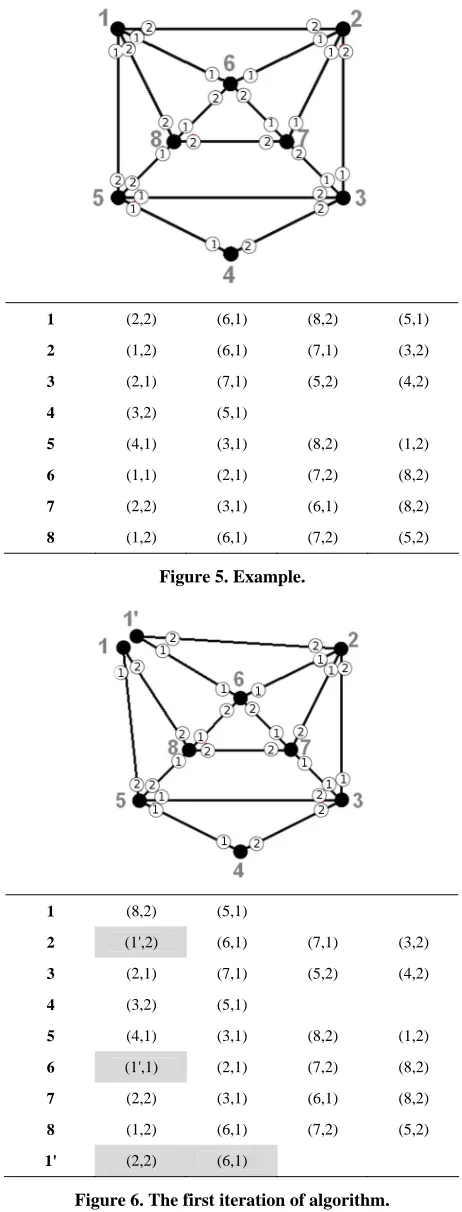
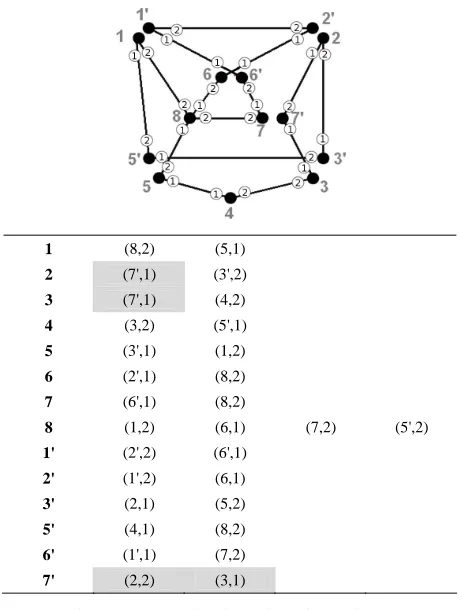
Let’s consider the allowed trail construction for a graph on Figure 5. Let its transitions system is as shown in a table below. The numbers in white circles show the number of partition system the edge belongs for each vertex.
Let’s construct allowed Eulerian cycle beginning and ending at vertex 1. At the first iteration the first vertex is split. To simplify the illustration let’s consider the “short version” of vertex splitting (the example of “full version” is presented on Figure 3). Figure 6 and table show graph with split vertex 1 and a list of connectivity where
1 (2,2) (6,1) (8,2) (5,1)
2 (1,2) (6,1) (7,1) (3,2)
3 (2,1) (7,1) (5,2) (4,2)
(6 ) (8 )
4 (3,2) (5,1)
5 (4,1) (3,1) (8,2) (1,2)
6 (1,1) (2,1) (7,2) (8,2)
7 (2,2) (3,1) ,1 ,2
[image:5.595.307.538.85.691.2]8 (1,2) (6,1) (7,2) (5,2)
Figure 5. Example.
1 (8,2) (5,1)
2 (1',2) (6,1) (7,1) (3,2)
3 (2,1) (7,1) (5,2) (4,2)
4 (3,2) (5,1)
5 (4,1) (3,1) (8,2) (1,2)
6 (1',1) (2,1) (7,2) (8,2)
7 (2,2) (3,1) (6 ) (8 ) ,1 ,2
8 (1,2) (6,1) (7,2) (5,2)
1' (2,2) (6,1)
Figure e first tion of ithm.
new or modified ents are y.
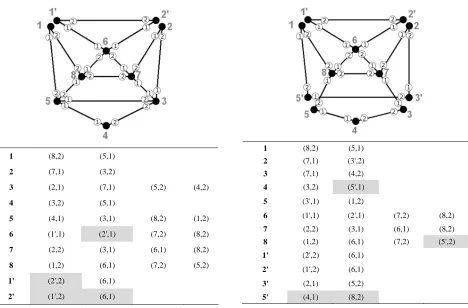
Fi 12 tables r them represent all other iterations of algorithm.
6. Th itera algor
[image:5.595.308.536.88.376.2]1 (8,2) (5,1)
2 (7,1) (3,2)
3 (2,1) (7,1) (5,2) (4,2)
4 (3,2) (5,1) ) (1 )
5 (4,1) (3,1) (8,2 ,2
6 (1',1) (2',1) (7,2) (8 )
) (5 ) ,2
7 (2,2) (3,1) (6,1) (8,2)
8 (1,2) (6,1) (7,2 ,2
1' (2',2) (6,1)
[image:6.595.67.535.79.387.2]2' (1',2) (6,1)
Figure 7. The second iteration of algorithm.
1 (8,2) (5,1)
2 (7,1) (3',2)
3 (7,1) (4,2)
4 (3,2) (5,1)
5 (4,1) (3',1) (8,2
1 (8,2) (5,1)
2 (7,1) (3',2)
3 (7,1) (4,2)
4 (3,2) (5',1)
5 (3',1) (1,2)
(7 ) (8 ) (6 ) (8 ) (7 )
6 (1',1) (2',1) ,2 ,2
7 (2,2) (3,1) ,1 ,2
8 (1,2) (6,1) ,2 (5',2)
1' (2',2) (6,1)
2' (1',2) (6,1)
3' (2,1) (5,2)
5' (4,1) (8,2)
Figure 9. The forth iteration of algorithm.
1 (8,2) (5,1)
2 (7,1) (3',2)
3 (7,1) (4,2)
4 (3,2) (5',1)
5 (3',1) (1,2) ) (1 )
(7 ) (8 ) ) (8 ) ) (5 )
,2
6 (1',1) (2',1) ,2 ,2
7 (2,2) (3,1) (6,1 ,2
8 (1,2) (6,1) (7,2 ,2
1' (2',2) (6,1)
2' (1',2) (6,1)
3' (2,1) (5,2)
6 (2',1) (8,2)
7 (2,2) (3,1) (6 ) (8 ) (7 ) (5 )
',1 ,2
8 (1,2) (6,1) ,2 ',2
1' (2',2) (6',1)
2' (1',2) (6,1)
3' (2,1) (5,2)
5' (4,1) (8,2)
6' (1',1) (7,2)
[image:6.595.55.539.88.729.2] [image:6.595.65.538.410.722.2]1 (8,2) (5,1)
2 (7',1) (3',2)
3 (7',1) (4,2)
4 (3,2) (5',1)
5 (3',1) (1,2)
(7 ) (5 )
6 (2',1) (8,2)
7 (6',1) (8,2)
8 (1,2) (6,1) ,2 ',2
1' (2',2) (6',1)
2' (1',2) (6,1)
3' (2,1) (5,2)
5' (4,1) (8,2)
6' (1',1) (7,2)
[image:7.595.61.296.64.713.2]7' (2,2) (3,1)
Figure 11. The sixth iteration of algorithm.
1 (8',2) (5,1)
2 (7',1) (3',2)
3 (7',1) (4,2)
4 (3,2) (5',1)
5 (3',1) (1,2)
6 (2',1) (8',2)
7 (6',1) (8,2)
8 (7,2) (5',2)
1' (2',2) (6',1)
2' (1',2) (6,1)
3' (2,1) (5,2)
5' (4,1) (8,2)
6' (1',1) (7,2)
7' (2,2) (3,1)
8' (1,2) (6,1)
Figure 12. The las ation of algorith
In result graph is split i simple cycle. I ssible to cons t allowed Eul cycle beginning at any its vertex. r example, the wing cycle b ing at vertex 1 n be constructe
It’s possible to recognize the system of transitions and to solve the problem of constructing the allowable path by linear time. It’s also possible to find -allowable Eulerian cycle for Eulerian graph or to oclaim that such a cycle does not exist. This problem be solved by the time
t iter m.
nto a t’s po
truc erian
Fo follo eginn
ca d:
1 2 6 8 1 5 3 2 7 3 4 5 8 7 6 1.
G
P
pr can
G
O V G E G using hm -
compatible Eulerian trail.
4. Acknowledgements
The research is supported by the Ministry of Education and Science of Russian Federation, contract 14.B37.21. 0395.
REFERENCES
[1] T. Panyukova, “Cover with Ordered Enclosing for Flat Graphs,” Electronic Notes in Discrete Mathematics, Vol. 28, 2007, pp. 17-24. doi:10.1016/j.endm.2007.01.004
algorit PG
[2] T. Pisanski, T. W. Tucker and A. Zitnik, “Straight-Ahead walks in Eulerian Graphs,” Discrete Mathematics, Vol. 281, No. 1-3, 2004, pp. 237-246.
doi:10.1016/j.disc.2003.09.011
[3] H. Fleischner, “Eulerian Graphs and Related Topics,” Part 1, Vol. 1, Elsevier,Amsterdam, 1990.
[4] H. Fleischner, “Eulerian Graphs and Related Topics,” Part 1, Vol. 2, Elsevier,Amsterdam, 1991.
[5] H. Fleischner, L. W. Beineke and R. J. Wilson, “Eulerian Graphs, Selected Topics in Graph Theory 2,” Academic Press, London, New York, 1983, pp. 17-53.
[6] D. Chebikin, “On k-Edge-Ordered Graphs,” Discrete Ma- thematics, Vol. 281, No. 1-3, 2004, pp. 115-128. doi:10.1016/j.disc.2003.09.004
[7] S. Szeider, “Finding Paths in Graphs Avoiding Forbidden Transitions,” Discrete Applied Mathematics, Vol. 126, No. 2-3, 2003, pp. 261-273.
doi:10.1016/S0166-218X(02)00251-2
[8] A. Kotzig, “Moves without Forbidden Transitions in a Graph,” Matematický Časopis,Vol. 18, No. 1, 1968, pp. 76-80.
[9] T. A. Panyukova, “The Paths with Local Restrictions,”
[image:7.595.57.288.83.388.2]