An Algorithm for Making Value-Based
Strategic Decisions
Palamarchuk, Victor
2013
Online at
https://mpra.ub.uni-muenchen.de/54384/
–
An Algorithm for Making Value-Based Strategic Decisions
Victor P. Palamarchuk 1
The latest tendency has been featuring an increase in the number of Russian
companies that follow the principles of Value-Based Management(VBM), which is
essentially a synergetic combination of corporate finance and strategic management. Strategic
decisions are the principal driving force of a company‟s value growth. Thus, the situation
calls for an understanding and adequate evaluation of correlation between changes in a
company‟s value and strategic decisions. A key to such understanding lies in accurate
definition and differentiation of such notions as “a company‟s fair value” and “a company‟s investment value”. The paper contains an analysis of these fundamental definitions for appraisal of a business, which further serves as a basis for making strategic value-based
decisions. The suggested algorithm to control a company‟s value substantiates the following: Logic and procedure for preparation and implementation of strategic decisions;
Differentiation and interrelation between strategic and operational decisions in a
company‟s value-based management;
Expediency and conditions for use of two intrinsically- different approaches to
strategic decision-making (namely, the creative approach and the trade-off approach);
Approaches to financial assessment and modeling of strategic decisions.
Keywords: value-based strategic decisions, value vs. cost, NPV
1
Doctor of Economics; Professor of the Limitovsky Chair of Corporate Finance, Investment
Planning and Assessment at the Higher School of Finance and Management of the Russian
Presidential Academy of National Economics and Public Administration (RANEPA);
Coordinating Director for MBA Finance Program of the RANEPA Higher School of Finance
International Journal of Advanced Multidisciplinary Research and Review (ISSN 2330-1201)
Volume 1, No.:1, 2013 Winter Page: 78
Value vs. Cost: We will start with terminology – thus, we understand „value‟ as the
productive potential of a company, which is expressed in the form of the company‟s
capability to generate a free cash flow for owners. Value is measured by discounting the
expected cash flows as of the moment of appraisal, taking into account the risk connected
with uncertainty in obtaining future results.
In Russian literature, the term „value‟ is more often construed as „cost‟ rather than „value‟. This accounts for a confusion in notions. Many people now tend to take the terms as
synonyms, which one can apply at his/her own discretion. In fact, what we essentially need is
a clear definition and differentiation between these two notions. It is not the terms themselves
that are of importance, but rather the core of the matter. After all, we need to find out what the
managers should strive to make higher for shareholders: value or cost?
In the financial science, as well as in economics in general, the basic “unit of meaning” is the choice as made by market participants including investors, company owners,
company management, companies (as systems striving to increase their stability and to
achieve expanded production), and the market in general. The economic science assumes that
any subject of the market makes its choice (in other words, makes decisions) on the basis of
assessed economic benefit. A decision is considered an “economically beneficial” one when
value of the expected results is higher than the value of the rejected alternatives. On the other
hand, the said value of the rejected alternatives is essentially the cost. It should be borne in
mind that the cost is determined as the best of the possible rejected alternatives (rather than
just any of such alternatives). Thus, cost is an alternative value(2). An interesting fact is that
in English „an opportunity‟ means „a chance‟, i.e. „opportunity cost‟ means „cost of lost chances‟. Thus, value and cost are not synonyms; these are essentially opposed notions – an inseparable couple accompanying any decision-making process.
A company‟s value and strategic decisions: A strategic decision is a decision which
determines a new principal path for the company‟s development, a change in the company‟s productive potential. The fundamental tie between a company‟s value and strategic decisions
consists in that the value changes at the moment when such strategic decisions are made, or
omitted, in conditions of a changing structure and behavior of the external and internal
International Journal of Advanced Multidisciplinary Research and Review (ISSN 2330-1201)
Volume 1, No.:1, 2013 Winter Page: 79
development and its potential change, too. A key to the understanding and adequate
evaluation of the change in value resulting from the strategic decision made lies in accurate
definition and differentiation of such notions as “a company‟s fair value” and “a company‟s investment value”.
A company‟s value without taking into account the decision is often referred to as „value of the company “as is”‟; what is meant here is that this is a value, which is determined
by results achieved in the past, and does not take into account the potential for future growth.
We believe that this approach is not quite correct and may entail incorrect evaluation of
strategic decisions made. Therefore, it is essential that there be a clear understanding of the
notion of a company‟s value without taking into account the decision made – that is, fair value of the company. Fair value is a basic notion in business appraisal, and is essentially a
judgment of the most probable price of the company in a hypothetical transaction of its
purchase and sale, which is equally acceptable for the buyer and for the seller. Here, the buyer
and the seller are also hypothetical, typical for the market, and equally informed. All this
means that the value and cost of such an abstract transaction for each of the parties are equal,
whereas in actual transactions they are always different. Fair value is a judgment of price of
an even exchange; this is a transaction of zero efficiency, NPV is zero both for the buyer and
for the seller. The determination of fair value provides a basis for the science and practice of a
business assessment. This is a price, at which control over business would change hands in an
absolutely efficient market. It should be noted that in a well-developed stock market the price
of an asset, on the whole, corresponds to its fair value. At any specific moment of time, price
of shares may, under the influence of various market behavior factors, deviate from the
fair-value level. Appraisal of a business by an informed appraiser or manager may as well be
referred to as „fair value‟ solely as a judgment by such appraiser or manager; it becomes
confirmed only when the assumptions, which were used by such appraiser or manager for
appraisal, are accepted, in negotiations, by such persons or parties, for which such appraisal
was made. Thus, the fair value reflects the potential of a company, but only before the
decision under consideration is made.
Investment value reflects the changed potential of a company with the made decision
taken into account. To make an informed strategic decision, one usually has to evaluate
several strategic alternatives. Investment value is the value of an investment (strategic)
International Journal of Advanced Multidisciplinary Research and Review (ISSN 2330-1201)
Volume 1, No.:1, 2013 Winter Page: 80
According to NPV concept, an increase in value resulting from making the strategic
decision is expressed using the following formula:
NPV = Vi- Vf, (1),
where:
NPV= Net Present Value of the strategic decision;
Vi= investment value of the company;
Vf, = strategic value of the company.
When does a company need to make strategic decisions? When there is a gap between
structure and dynamics of the external environment and the structure and dynamics of the
internal environment. Working-out and implementation of a company‟s development strategy
are closely connected with financial issues relating to appraisal of the company. Strategy,
marketing, operation management, and finance management are the components that are
closely interconnected in business appraisal and management; however, this is the strategic
decisions that are determinant for growth of a company‟s value.
It should be noted that value-based management of business is essential not solely for
big stock market participants, but for any company, which is able to generate cash flows for
owners. Managing a company efficiently is possible only if the management, in making
decisions (first and foremost, strategic ones), is governed by the general target quantitative
parameter, the latter being the growth of the business value for owners.
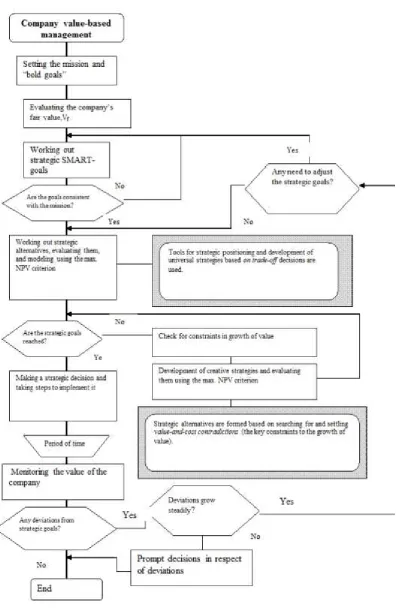
An algorithm for business value management: Figure 1 shows an algorithm for
business value management demonstrating the logic of choosing and implementing a strategy
and tying together the consecutively tackled issues of business appraisal (up to the moment of
making a decision), analysis of its strategic positions, detection of strategic alternative, their
evaluation, financial modeling, and monitoring the value in the course of implementation of
the strategy.
Setting the mission and “bold goals”: The process of strategic value management starts
with goal-setting. Several publications on strategic management (1) state that work on a
company‟s strategy should start with setting and decomposing a general goal, with a
requirement to conform to SMART criteria. In our opinion, in a situation of strategic
uncertainty, and before a clear understanding of the company‟s position is achieved, setting
specific SMART-conforming goals or objectives is inexpedient and even may lead to adverse
International Journal of Advanced Multidisciplinary Research and Review (ISSN 2330-1201)
Volume 1, No.:1, 2013 Winter Page: 81
At the initial stage, only general goals may be set, such as the mission of the company, the
formulation of intentions, and a descriptive and visible representation of the mission in the
International Journal of Advanced Multidisciplinary Research and Review (ISSN 2330-1201)
[image:7.595.102.507.124.736.2]Volume 1, No.:1, 2013 Winter Page: 82
International Journal of Advanced Multidisciplinary Research and Review (ISSN 2330-1201)
Volume 1, No.:1, 2013 Winter Page: 83
The company‟s estimated fair value (Vf) is always a basic estimate, which is used as a
basis for comparison with variants of steps to take, which are under consideration. This is an
evaluation of the company, which reflects the company‟s potential in terms of receiving
income without changing the existing strategy, management system, and structure of the
company. Also, the fair value takes into account potential for growth (including the strategic
flexibility); thus, fair value of a company may be represented in the form of the following
formula:
Vf = Vop + Vst(2)
where:
Vf= Fair value of the company;
Vop= Operating value of the company; and
Vst= Strategic value of the company.
Splitting the fair value of the company into operating value and strategic value is
determined by the corresponding splitting of the company‟s assets2
.
Operating assets of the company include the assets-in-place, which generate cash
flows at present time, without taking into account new strategic decisions or investments.
Strategic assets are the assets, resources and competences, which enable the company
to make strategic decisions or investments now or in the future, under certain circumstances.
Strategic assets are not generating any cash flows now; however, they are of value, which can
be measured using the real option technology.
Evaluation of the company‟s fair value is a result of an integrated evaluation of the
situation and its development prospects, and involves the analysis of:
Market conditions;
Competitive position of the company;
2Traditionally, a company‟s value is subdivided into base value an
d added value; the base
value is linked to the available assets, whereas the added value is linked with values generated
by new investments. We believe that such interpretation is less efficient, because, first, it
mixes together the value of the company before and after making the decision, and, second,
the growth potential is correlated only with new investments (in spite of the fact that the
International Journal of Advanced Multidisciplinary Research and Review (ISSN 2330-1201)
Volume 1, No.:1, 2013 Winter Page: 84
Financial performance.
Besides, it includes forecasting the company‟s future incomes (based on generalization
of the analysis) and risks connected with uncertainty of receiving such incomes.
Currently, many companies (especially those engaging the services of consulting
firms) use a wide range of tools for analysis of market conditions and the company‟s
competitive position. Some of the well-known models, such as Porter‟s five forces, the value
chain (M. Porter) (3), the positioning matrices (GE, BKG, Ansoff Matrix),(1), the strategic
canvas (Ch. Kim& R. Mauborgne)(7) etc. have become an attribute of strategic analysis for
companies striving for competitive success. Unfortunately, one can often see these tools used
formally and unsystematically; results of the analysis are not tied into an integrated picture
and do not end up in evaluation of value, which is an integral parameter characterizing the
company‟s strategic position and potential in a quantitative way. As a result, multi-page
reports on market position and prospects of a company fail to enable the company‟s management to find out strategic alternatives for the company‟s development, to evaluate and
compare them, and to make an economically justified strategic choice.
To obtain the required result, it is essential that the analysis of qualitative
non-financial factors and quantitative non-financial factors, which determine the company‟s value, be
tied up into an integrated non-contradictory system. Principal attention in the analysis of
market forces and competitive positions should be given to driving factors and constraints of
value. Therefore, the analysis should be tied with such parameters as growth rate and return
on investments, since these are the principal factors determining a company‟s value.
An integrated analysis of the company‟s strategic positions allows the following: Detecting the principal and most probable path for the company‟s future
development if the existing strategy is preserved;
Estimating the company‟s value if the existing strategy is preserved;
Detecting the principal opportunities and threats; finding out discrepancies
between the desired and the forecasted future situation; and
Detecting and formulating the principal strategic alternatives, and setting the
International Journal of Advanced Multidisciplinary Research and Review (ISSN 2330-1201)
Volume 1, No.:1, 2013 Winter Page: 85
Strategic SMART-goals are expressed in the form of quantitative strategic objectives,
such as growth of the company‟s value, market share, sales, return on invested capital, etc.
Reaching the strategic goals should be consistent with the company‟s mission and
implementation of “bold goals”. The goal-setting process is iterative.
Working out universal strategic decisions based on the positioning: Further we
proceed with detection and analysis of alternative variants of goal-reaching strategies under
the existing conditions and constraints. Approaches to the working-out of strategic decisions
based on positioning are developed and described in a number of publications on strategic
management (1,3,4). The essence of such approaches consists in the formation of the “choice
space” with the help of several well-known positioning matrices, on the basis of analysis of the market situation and competitive position. Such matrices allow reducing the uncertainty
and seeing the situation as a whole and choosing one of the recommended strategies. Such
strategic decisions are based on a trade-off in the choice of priorities between:
Low costs and differentiation;
Growth of sales (market share) and increase in returns on invested capital;
Rate of return and liquidity;
Diversification and focusing;
Others.
For the majority of situations, these approaches are efficient and have already proven
their viability. However, under conditions when competition in the market is high, and the
rivals are able to respond promptly and flexibly, selection of a strategy based on standard
recommendations may be predictable for the rivals, and growth of value may level off or
continue for a very short period of time. When standard universal strategic decisions do not
allow bridging the gap between the high strategic goals of a company and its current state of
development, then searching for creative strategic decisions becomes expedient and
necessary. Analysis of a number of successful strategies allows making a conclusion that
there are certain objective laws governing the search for such decisions and certain typical
decision techniques. The main principle of creative strategic decisions consists in that such a
decision results not in a trade-off between the detected opposed priorities, interests, ways or
International Journal of Advanced Multidisciplinary Research and Review (ISSN 2330-1201)
Volume 1, No.:1, 2013 Winter Page: 86
constraint for the growth of the company‟s value. To detect the major value growth constraint,
a diagnostic algorithm is needed.
Diagnostics of constraints to the growth of a company‟s value: The task of value
diagnostics is to detect constraints for the value, i.e. the factors that restrain the growth of
value or result in its destruction. The principal area under consideration is the
value-versus-cost choice, which is made by stakeholders (buyers, suppliers, employees, creditors,
investors) in respect of the company (5).One should consider the actual alternatives and
choice problems, which every stakeholder encounters in the process of making a decision. On
the other hand, in the course of diagnostics, one considers the value-versus-cost choice, which
the company, as a system striving to enhance its stability, makes in respect of the existing and
potential stakeholders. Such expansion of the “field of view” allows re-focusing the analysis
from rivals to alternatives, from customers to non-customers in the area under consideration,
and detecting the company‟s major problems. The picture of the situation becomes clear when a fixed cause-and-effect relation between the problems is established. For this purpose, a
decision tree of problems is prepared, using which one can, following a certain algorithm, find
out cause-and-effect relations and detect the root problem (6). Diagnostics of the problems
enables one to avoid dissipating efforts on all problems of the company and to focus on
solving the major problem. If the root problem is not solved because the way to solve it is not
known or the previously used ways failed to return a positive result, this means that the
problem has an underlying contradiction, which should be detected and eliminated. To
achieve this, the problem should be presented in the form of a contradiction/conflict (in
terminology of E. Goldratt) (6), and a model for solving the problem should be prepared. In
this case, no trade-offs are accepted as a solution, because a trade-off is a variant that fails to
bring the required result or the result is negligent.
Working out creative strategies: Elimination of the value-vs-cost contradiction may be
referred to as an innovation of value, which brings forth creative strategies resulting in a
considerable growth of the company‟s value. Innovation of value takes place when the
company eliminates or reduces the impact of factors causing competition in its niche, thus
reducing the costs. Value for buyers grows as a result of creation and development of factors,
which have never before been offered by the industry under consideration. Thus, the company
eliminates the need to make a choice between differentiation and costs by offering a
International Journal of Advanced Multidisciplinary Research and Review (ISSN 2330-1201)
Volume 1, No.:1, 2013 Winter Page: 87
Evaluation and financial modeling of strategic alternatives: After detecting and
formulating the alternative variants of the company‟s strategy, the company proceeds to the
final stage of working out the strategy, this being the evaluation and financial modeling of
sttrategic alternatives, which allows choosing the best option for the investment and financial
strategy, giving the company the maximum added value. The choice of the most valuable
alternative is made following the NPV maximization criterion.
A critically important is the statement that the value of a strategic alternative under
consideration should be higher than the company‟s strategic value net of the decision to be made, which includes the best potential alternatives for the company‟s development (among
them strategical flexibility), since the decision, when made, will cut off an entire “branch”
from the company‟s tree of decisions. Usually, there are attempts to compare the decision or project under consideration with the company‟s value “as is”; in this case, efficiency of the
decision to be made is overestimated, and an invariably positive result is obtained. In the
suggested structure of making strategic decision, the standard “bar” is raised.
First, strategic alternatives have to be shaped. The financial model, in its structure,
input parameters, evaluation criteria, and a set of modeling capabilities, shall be accurately
consistent with the task of comparing strategic alternatives. The financial model shall be
formatted to solve the task of strategic choice. It is not the details that matter, but the accuracy
of formulated alternatives. The necessary and sufficient thing is a limited set of enlarged input
data, to which oppositions are found in the strategic alternatives under consideration. In the
course of evaluating the strategic alternatives for a company‟s development, it is expedient to use evaluation models, which allow separating the modeling of investment decisions and
financial decisions (8). First, an evaluation of investment alternatives is done, and a decision
in respect of choosing the best of them is made; then, financial restrictions are imposed. This
allows modeling the situation and finding the optimum financial strategy for the company.
After accepting the strategy, a package of measures for implementation of the selected
strategic variants is developed, and reference indicators are detailed, which are used to control
the implementation of the company‟s strategy.
Monitoring and operating management of the company‟s value is carried out within
the accepted strategy, with a focus on reaching strategic objectives.
To create an efficient system for company value-based management, an operating
International Journal of Advanced Multidisciplinary Research and Review (ISSN 2330-1201)
Volume 1, No.:1, 2013 Winter Page: 88
such a model is the current monitoring of the company‟s value and budgeting. Therefore, it must include a rather large number of input parameters, and allow analysing and evaluating
data per periods, by creating data archives. This model is very important, and is required to
constantly monitor the dynamics of the company‟s value and make operating decisions over
the entire range of the company‟s activities. Target criteria for this model include strategic
references for the implemented strategy, since the major task is to detect and eliminate
deviations from the set strategic objectives and to provide signals on increase of
value-versus-cost gaps calling for a new strategic decision.
The above value-based management algorithm allow tying up, into an integrated
logical process, the principal attributes of strategic value managents, such as goal-setting,
strategic positioning and selection of alternatives, methods and techniques of searching for
strategic decision, financial appraisal of the company and its development alternatives, criteria
for making strategic decisions, and control over implementation of the strategy.
References
Thompson, A.A., Strickland, A.J. (1998) Strategic Management. Crafting & Implementing
Strategy, Moscow: UNITY Publishers
Palamarchuk, V.P., (2007) „How you name your boat, so it will float: Criteria for making
management decision: Company‟s value growth or cost growth‟, Rossiyskoye
Predprinimatelstvo (Russian Entrepreneurship)
Porter, M. E. (2005) Competitive Advantage Creating and Sustaining Superior Performance,
Moscow: Alpina Business Books,
Collis, D., Montgomery, C. (2007) Corporate Strategy: A Resource-Based Approach,
Мoscow: Olymp-Bysiness CJSCPalamarchuk V.P. (2007) „Meeting the expectations: The value-and-cost approach in interaction between managers and stakeholders of the
company‟, Rossiyskoye Predprinimatelstvo (Russian Entrepreneurship) 2: 73-78.
Dettmer, W. (2007) Goldratt‟s Theory of Constraints: A Systems Approach to Continuous
Improvement, Мoscow: Alpina Business Books LLC
Kim, W. Chan, Mauborgne, R. (2005) Blue Ocean Strategy: How to Create Uncontested
Market Space and Make Competition Irrelevant, Мoscow: HIPPO Publishers
Copeland, T., Koller, T., Murrin, J. (2005) Valuation: Measuring and managing the value of