Delocalization of Acoustic Waves in a One-Dimensional
Random Dimer Media
S. Brezini1, A. Brezini2
1Batenco Research Group, Oran, Algeria
2Département de Chimie, Faculté des Sciences, Université d’Oran, Es Senia, Algeria
Email: [email protected]
Received November 18, 2012; revised December 20, 2012; accepted January 1,2013
Copyright © 2013 S. Brezini, A. Brezini. This is an open access article distributed under the Creative Commons Attribution License, which permits unrestricted use, distribution, and reproduction in any medium, provided the original work is properly cited.
ABSTRACT
The propagation of classical waves in one-dimensional random media is examined in presence of short-range correla- tion in disorder. A classical analogous of the Kronig-Penney model is proposed by means a chain of repeated sub-sys- tems, each of them constituted by a mass connected to a rigid foundation by a spring. The masses are related to each other by a string submitted to uniform tension. The nature of the modes is investigated by using different transfer matrix formalisms. It is shown that in presence of short-range correlation in the medium which corresponds to the RD model- the localization-delocalization transition occurs at a resonance frequency c. The divergence of near c is stud-
ied, and the critical exponent that characterizes the power-law behavior of near c is estimated. Moreover an ex-
act analytical study is carried out for the delocalization properties of the waves in the RD media. In particular, we pre- dict the resonance frequency at which the waves can propagate in the entire chain. The transmission properties of the system are numerically studied using a statistical procedure yielding various physical magnitudes such the transmission coefficient, the localization length and critical exponents. In particular, it is shown that the presence of correlation in disorder restores a large number of extended Bloch-likemodes in contradiction with the general conclusion of the lo- calization phenomenon in one-dimensional systems with correlated disorder.
Keywords: Acoustic Wave; Disorder; Localizatiuon; Random Dimer
1. Introduction
More than a half century ago, Anderson [1] introduced the concept of localization induced by disorder. Pre- sumably, the most relevant achievement in this field is the one-parameter scaling theory (1PS) [2,3]. The main results may be summarized as follows:
- the existence of a critical dimension d2 such for
d d , all the electronic states are localized.
- the transition from localized to extended states occurs
only for d2.
- the transition is continuous.
Nowadays, these conclusions are of universal validity and supported by strong experimental evidences (for a review see [3-5]). Indeed, the results for the one-dimen- sional disordered case were anticipated earlier from the Mott and Twose’s theorem [6].
Physically, the destructive quantum interferences ap- pear to be the fundamental mechanism of localization induced by disorder. Thus it becomes cleaver to expect
similar observation of the localization effects in other wave propagation phenomena [for a review see Ref. 7], namely classical wave equations [8] and other light scat- tering experiments [9]. As reported by Maynard [10], classical waves may offer easier and more direct realiza- tion for the observation of the Anderson localization in 1D disordered systems.
However, almost of this aspect holds only for uncor- related disorder. In this context over the last couple of decades, convincing arguments revealed that short range correlations in disorder may have spectacular and unex- pected effects [11]. In particular the existence of infi- nitely bands of extended states has been demonstrated for the electronic problem. This finding has cast some doubt on the validity of the Mott and Twose’s theorem [6]. Probably, the unexpected feature is probably the possible constructive effect of disorder.
super-lattices [16,17] revealing the existence of truly extended states supported by experimental evidences [18]. The main idea is the presence of the RDM within a short length correlation restores the tunnel effect which competes with disorder and is strong enough to create the condition of delocalization. Obviously, these conclusions hold only for the quantum case since the competition between de-structive interference and tunnel effect is the major cause leading to the localization or delocalization of the elec-tronic states. Therefore, it is relevant to look for the mechanism of delocalization for the classical wave propa-gation.
Although a great interest has been given to the elec- tronic case, very few has been done for the classical ana- log. Moreover periodic systems are known to have some bearing in modeling of engineering structures. In the fol- lowing paper, a classical analog of the Anderson local- ization model is examined. In particular, a classical wave propagation in random media is investigated through a structure displaying a one-dimensional character. The conditions to breakdown the localization phenomenon and to restore the propagations of wave are suggested. The opportunity to control this feature opens new and relevant perspectives for technological purposes.
In this context, the purpose of the present paper is to examine the interplay between the effects of topological disorder and short range order on the propagation of classical waves by means of an analytical model for the case of a quasi-one-dimensional string loaded by N mass- spring systems has introduced by Richoux et al. [20].
In the following paper, a classical analog of the Ander- son localization model is examined A quasi-one-dimen- sional string is loadedby N masses, each one fixed to a spring. Disorderis introduced onto the system by consid- ering masses, springs and/or latticespacing as random variables. The wave propagationis formulated in terms of the transfer matrix. The transmission coefficient and the Lyapunovexponent is computed for different situa-
tions, yielding the frequency spectrumand the localiza- tion length. Both analytical results and numerical simula- tions have been performedfor the ordered as well as dis- ordered cases. The conditions to breakdown the local- ization phenomenon and to restore the propagations of wave are suggested.
2. Theoretical Model
In the following, we consider treat the transverse vibra- tions y x t
, of an infinite tight string having an ho- mogeneous density submitted to a uniform tension0 and connected to a grounding rigid foundation. The
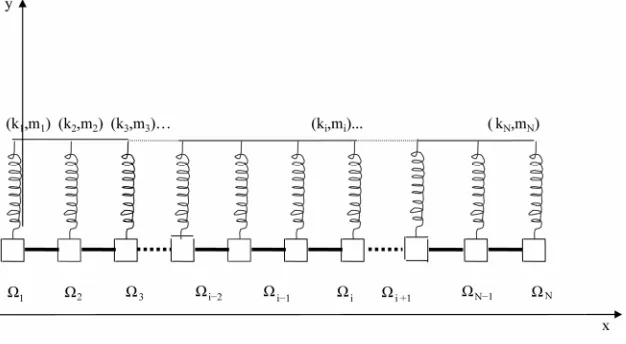
string is loaded by elementary cells constituted by a mass-spring system along. The n-th cell is characterized by two physical parameters: the mass n and the linear
stiffness constant n. The masses nare located at the
lattice point n T
N
m
k m
x along the x-axis between two fixed ends at x0 and x L and the lattice spacing is de- noted by dnxn1xn (see Figure 1). The above
model simulates a one-dimensional classical lattice. We focus our attention to the propagation of transverse wave in the vertical plane. The wave amplitude y at the longitudinal coordinate x is solution of the general wave propagation equation in space:
2
2
2 n n
n
y x
K y x x x y x
x
(1)with
K v
and v T0
(2)
Here K and stands for the wave vector and the wave (or sound) velocity through the whole system re- spectively. is the fundamental frequency to be deter- mined.
v
The quantity n associated to each delta peak corre-
[image:2.595.143.456.554.726.2]sponds to the vibration mode defined by [21]:
2 22
0 0
1 n 1
n n n
n k k m T T
(3)
where: 2 n n n k m
(4)
The term n is the free frequency of the nth cell
while the parameter n may be understood as an effec-
tive delta peak strength. The inverse 1 n
has the physi- cal meaning of a characteristic length translating the bearing of the associated string.
The wave Equation (1) represents a perfect analogy with the electronic Kronig-Penney model, namely:
2 2
2
2 n n n
x
x x x E x
m x
(5)Randomness may be introduced in different ways: dis- order in mass and/or stiffness, referred to the cellular disorder, and/or disorder in position through the symbol
, i.e. the so-called topological disorder. Moreover as reported by Maynard [10] the equivalence between the classical and quantum models is achieved under the con- dition that the potential may be approximated by a series of delta functions if the masses are sufficiently small in extent (~few hundred of mg).
For the n-th region within the interval
1
nd x n d, the solution of Equation (1) is a su- perposition of forward and backward scattering waves:
nexp i
nexp i
y x A kx B kx (6) where AnandBn are the amplitude coefficients.
The transfer matrix Tn relating the amplitudes
be-tween two successive cells is defined by:
1 1 n n n n n A A T B B (7)
For convenience, we introduce the reflection the trans- mission amplitudes rN and tN of the system, assum-
ing that the incident amplitude as unity. Following this description, y x
obeys to the boundary conditions:
exp i
exp i
, 0exp i ,
N N
kx r kx x
y x
t kx x
L (8)
The amplitudes An and n through the initial and final amplitudes can be linearly expressed using bound- ary conditions in a close expression giving the total trans- fer matrix
B
M N of the whole system, such as:
10 N N M N r
(9)
with
1 ni N
M N
Then, the transmission coefficient tN2, describ-
ing the wave propagation, may be numerically computed via the relation:
2 22
M
(11)
The knowledge of enables one to determine the nature of the propagating modes by means the normal- ized Lyapunov exponent given by the ratio [ ]:
1 log 2
L
(12) being the localization length.
3. Results
3.1. Ballistic Case
For the particular situation where all the strength n
vanish, i.e. all the frequencies are identical 2 0 0
0
k m
and the existence of a 0, a spectacular phenome- non occurs. Equation (1) reduces to:
2
2
2 0
y x
K y x x
which describes the free wave propagation. The trans- mission coefficient reaches it maximum value, inde- pendently from the system length. Consequently, the wave propagates freely through the string leading to the so-called ballistic regime.
3.2. Ordered Case
A proper understanding of the effect of the disorder on the band structures of the modes of vibration requires the knowledge of the ordered limit case. Towards this end it is convenient to take advantage of the -function limit, the wave propagation equation may be handled within the framework of the Poincaré map representation relat- ing two successive lattice points. According to Bellissard
et al. [22], defining , Equation (1) may
be exactly transformed into a simple site description: n
y y x n d
n y 1 1 1 n n n n y M y y
(13)
with:
2
1 0
n n
M
(14)
where
cos sin
2
n
n Kd Kd
K
(15)
yields the frequency spectrum [18].
T
(10)and forbidden frequencies is then:
cos sin 1
2
Kd Kd
K
(16)
Setting tg 2K
, it simplifies to:
cos Kd cos
(17) whose solutions are:π π 2
Kd n
Kd n
(18)
For the n-th allowed bands, the frequencies obey to:
1
π 2tg 1 π2 n K K
d n (19)
Since we are considering the ordered limit, the pa- rameters n are identical to the same value .
In Equation (19), the term 2tg1
2K
measures
the width of a forbidden band Δω. It may be written as:
2 2 1
2 0
2tg k v
T n A B n (20)
Moreover if the upper limit of the band is well deter- mined, the limit of lower limit frequency appears to be challenging from the physical point of view by treating analytically the amplitude of the wave and determining the band edge as well. Towards this end let us start with the relation:
i i 1 i i 11 e e
e 1 e
Kd Kd
n n n
Kd Kd
n n n n
A u u
B u u
(21)
For convenience, setting:
n An B
(22) and
n An Bn
(24) it reduces to in the limit Kd1:
1 i
n n Kdn n
n
(25)
1 i 2
n n Kdn n un
(26)
or in the continuum limit,
d i d n K n n (27)
d i 2
d
n
n K n u
n d
n (28)
n being solution of the equation:
2 2 2 2 d 2i d nn K u n n
d n
(29)
As usual, for propagating wave of type
n
N exp i
N n
d :
1 2 2 2 1 K K d
(30)
The sign of the variable 2 enables one to discrimi-
nate the nature of the propagating wave; if 0, ω belongs to an allowed band and if 0 to a forbidden one. Thus the condition 0 determines the lower band edge low since we are concerned by the limit of
low frequencies, namely:
4 2
1 1
low low
2 0
d v d
(31)
Obviously we have retained only the positive solution,
i.e:
2 2
2
low 2 2 2
d
2v 4v d
1
(32)
3.3. Random Dimer Disordered Case
Let us consider now a set of two unit cells separated by a distance d and distributed at random along the x axis. Thus Equation (1) becomes:
2 2 2 d d n n n y xK y x x
x x d y x
(34)In the following topological disorder, all the cells are identical, i.e. constituted by the same mass m and the same spring with stiffness k. Thus all the variables n are equal: 2 2 0 1 k T
(35)
The wave equation Equation (34) may be solved for a one dimer cell located at xn0 and x d n1 :
exp i
exp i
for 0
y x A Kx B Kx
x
(36-a)
exp i
exp i
for 0
y x A Kx B Kx
x d
(36-b)
exp i
y x Kx for x d (36-c) Matching the wave amplitudes at xn = 0 and x d n1
yields:
2 2
2
1 i exp exp i
2 4
A iKd Kd
K K
(37)
Setting
2K
through the exponential representation via:
1 i β
1
12i exp i
(38)with the boundary conditions: π
0 2
and
10 0
lim lim 0
K K K
(39)
The coefficient A may written as:
1 2
exp i 2
2exp i
A Kd Kd (40)
Defining:
exp i 2
A A Kd (41)
the transmission coefficient is then:
2 2
1 2
2 4 2 2
1 2 1 cos 2
A A
Kd
(42)
and 1
K
for all the acoustical wave having wave vec- tor where:
πn
K d K n (43)
Here the delocalization condition may formulated in term of the coefficient A by;
exp iKd iexp iKd sin Kd 1 (45)
or equivalently:
2
cos sin
1 sin cos sin 0
Kd Kd
Kd Kd Kd
Surprisingly, the first equation is the same as the initial equation defining the frequency spectrum.
This result is quite different from the condition ob- tained by Hilke et al. [27] obtained for the electronic case.
It could also be written by using A:
12
2exp i 2
Kd
1 (46)Physically, as long as the condition (11) is fulfilled, the wave does not feel the random character of the media since the distance between a double sequence is a multi- ple of its wavelength. This in turn is only a proper char- acteristic of the dimer cell as usual.
In order to appreciate more deeply the nature of such waves, a proper understanding requires the knowledge on the behavior of the divergence of the localization length. Towards this end, let us consider a zero-order approxi- mation to the overall transmission coefficient of the ran- dom media. Namely, we compute the transmission coef- ficient of each double sequence and just multiply them together [21]. Within such approximation, all the multi- ple reflections and interference effects are neglected.
This assumption is expected to hold so long we are con- cerned by modes having frequencies close to the reso- nance. Thus the reflection coefficient has a small magni- tude and moreover the presence of off-diagonal random- ness provides a small contribution from internal multiple reflections and transmissions. Therefore the transmitted amplitude is:
1
N i o
i N
y T y
(47)Here yN denotes the transmitted amplitude corre-
sponding to an incident amplitude o. i stands for the
transmission coefficient of each double sequence. Ac- cording to [28], the localization length is defined by:
y T
1 1ln N
o
y
ς N
y
(48)
Substitution of Equation (12) in Equation (13) yields:
12 ln ς
(49)
The coefficient A in the limit of K close to Knmay
be expanded to a second order approximation:
21 i n n
A K K K K
(50) where the parameters and are given by:2
d
(51)
2 2
1 i
2 6 n
d
k k
(52)with:
2
d k
(53)
Thus, the localization length becomes:
2
2 12 ln 1 2 Re K Kn
(54)
In the limit of vanishing K K n, i.e. close to an “ex-
tended” state, the localization length scales as:
2n
ς
(56)The critical exponent for the localization length is then
2
. To our knowledge such exponent is found ana- lytically for the first time for the case of the propagation of classical wave. A similar result has been found for the vibrational modes in harmonic chains of N masses re- lated by springs with correlated disorder [24] and diluted disorder [25]. It appears therefore that this prediction strongly indicates its universal character.
3.4. The Commute Resonance ωc
i.e. one which the linear stiffness constant and mass take only two values, {kA and mA} and {kB and mB}
with the additional constraint that the kB and mB val-
ues appear only in pairs of neighboring cells of the chain (dimer) but distributed at random locations along the chain. To predict the origin of possible resonance fre- quency c, we improve from analytical consideration
that yields the frequency c in terms of the mass n
and the linear stiffness constant n. As indicating Equa-
tion (13), there are four different kind of transfer matrix
m k
, ,
AA AB BA
M M M and MBB random chain
Typically the transfer matrices associated to the host and dimer unit cells are defined by:
2 1
1 0
2 1
and
1 0
A AA
B BB
a M
a M
(20)
In particular, at c the two formulas for aA and
B
a crossover, nameely aA
c aB
c . Hence, the resulting matrix elements become identical and conse- quently, MAA
c
and MBB
c commute. Physi- cally, the incident propagating mode becomes insensitive to the difference between the host and impurity cells since they act in the same local diffusive way. The pro- pagating media is felt as an ordered lattice, with identical effective delta peak strength c A
c B
c e frequency c . Th
referred as the commuting frequency, can be determined analytically, from the condition:
AA c BB c
M M (21.a)
i.e.
2 A B
c
A B
k k
m m
(21.c)
At this commuting resonance frequency c, the two
indiscernible unit cells present similar properties leading to deterministic features. This finding appears in agree- ment with the case of electron in superlattices in presence of dimer as reported by Gomez et al. [30]. In particular, they related the origin of the resonance to the commuting properties of the binary individual unit cells. We have also to notice that the existence of the set of extended modes in a mini band around the resonance frequency
c
provides from the smooth transition since the recur- sive matrix elements are very close together, in other words aA
c aB
c .This typical feature is completely preserved in the cor- responding uncorrelated disorder since there is no dif- ference between the host and impurity unit cells as origi- nally reported by Ishii [31] for the random KP model. The commuting condition (Equation (21)) leads to the same resonant statements, as previously demonstrated by
Hilke et al. [26], T. Hakobyan et al. [30] and Gomez et al. [31].
Finally, an interesting feature takes place on the com- muting resonance with the presence of periodic ampli- tude at the commuting frequency c, justifying the ex- tended Bloch diffusive character of the corresponding propagating resonant mode. Moreover combined effects occur near this particular resonance since the vibration mode is sensitive to the unit cells [A] and [B]. Such dis- order localizes the Bloch-like extended modes within a mini band around c, giving rise to a soft transition.
4. Conclusions
The propagation of classical waves in random media has been studied by using an analogous with the electronic disordered Kronig-Penney model to observe the phe- nomenological aspects of the Anderson localization. We have examined the wave propagation through a system constituted by a quasi-one-dimensional string loaded by
N mass-spring systems. In the light of analytical results, relevant conclusions have been obtained.
The presence of short range correlation in disorder lead to the existence of delocalized modes of vibration well defined at well defined frequencies within the band spectrum.
Moreover the behavior of the localization length around these frequencies exhibits a divergence with a critical exponent which has been found equal to 2. The same value has been obtained previously by Datta et al. [24] in other situations suggesting strongly its universal character for the classical analog of the Anderson model.
In this description, two particular frequencies charac- terize the corresponding the ordered case: the fundamen- tal frequency vanishes the Kronig-Penney analytical equation, i.e. a
0 while the free frequency 0settles down the ballistic regime i.e. Sin- gular behavior happens around the free frequency
00.
n
0
since the spatial extent length diverges, i.e.
2 0
L
pointing out the Bloch-like modes.
Dimers can be constructed with a new interesting way that preserves the ballistic regime even in presence of pairing configuration. The Bloch-like extended states are restored in controversies with the general belief that no periodic wave function exist in the well known random dimer model. Another resonance appears at the commut- ing frequency. This describes an additional delocalization process since its corresponding extended eigenstates are fundamentally different.
simple method[32]. As discovered recently, symmetry of random potential (for instance the mirror symmetry in 1D Anderson model causes a nontrivial mechanism of tunnelling even at macroscopic distances for a localized wave packet [33]. Unlike quantum tunnel- ling through a regular potential barrier, which occurs only at the energies lower than the barrier height, the suggested mechanism of tunnelling exists even for weak white-noise-like scattering potentials. The possible rela- tion between the resonance frequency of acoustic wave in random dimer disordered, observed in this work and symmetry of the random stiffness is an open question.
V x V x
REFERENCES
[1] P. W. Anderson, “Absence of Diffusion in Certain Ran-dom Lattices,” Physical Review, Vol. 109, No. 5, 1958, pp. 1492-1505. doi:10.1103/PhysRev.109.1492
[2] E. Abrahams, P. W. Anderson, D. C. Licciardello and T. V. Ramakrishnan, “Scaling Theory of Localization: Ab- sence of Quantum Diffusion in Two Dimensions,” Phy- sical Review Letters, Vol. 42, No. 10, 1979, pp. 673-676. doi:10.1103/PhysRevLett.42.673
[3] P. L. Lee and T. V. Ramakrishnan, “Disordered Elec- tronic Systems,” Reviews of Modern Physics, Vol. 57, No. 2, 1985, pp. 287-337. doi:10.1103/RevModPhys.57.287 [4] B. L. Altshuler, P. A. Lee and R. A. Webb, “Mesoscopic
Phenomena in Solids,” Elsevier, Amsterdam, 1991. [5] C. W. J. Beenhakker, “Random-Matrix Theory of Quan-
tum Transport,” Reviews of Modern Physics, Vol. 69, No. 3, 1997, pp. 731-808.
doi:10.1103/RevModPhys.69.731
[6] N. F. Mott and W. D. Twose, “The Theory of Impurity Conduction,” Advances in Physics, Vol. 10, No. 38, 1961, pp. 107-163. doi:10.1080/00018736100101271
[7] P. Sheng, “Scattering and Localization of Classical Waves in Random Media,” World Scientific, Singapore, 1990.
[8] S. He and J. D. Maynard, “Detailed Measurements of Inelastic Scattering in Anderson Localization,” Physical Review Letters, Vol. 57, No. 25, 1986, pp. 3171-3174. doi:10.1103/PhysRevLett.57.3171
[9] S. John, “Electromagnetic Absorption in a Disordered Medium near a Photon Mobility Edge,” Physical Review Letters, Vol. 53, No. 22, 1984, pp. 2169-2172.
doi:10.1103/PhysRevLett.53.2169
[10] J. D. Maynard, “Acoustical Analogs of Condensed-Matter Problems,” Reviews of Modern Physics, Vol. 73, No. 2, 2001, pp. 401-417.
doi:10.1103/RevModPhys.73.401
[11] M. M. Millonas, “Fluctuations and Order: The New Syn- thesis,” MIT Press, Boston, 1997.
[12] D. H. Dunlap, H. L. Wu and P. Phillips, “Absence of Lo- calization in a Random-Dimer Model,” Physical Review Letters, Vol. 65, No. 1, 1990, pp. 88-91.
doi:10.1103/PhysRevLett.65.88
[13] H. L. Wu and P. Phillips, “Repulsive Binary Alloys and
the Absence of Localization: Application to Fibonacci Lattices and Molecularly Based Electronic Filters,” Jour- nal of Chemical Physics, Vol. 93, 1990, p. 7369. doi:10.1063/1.459411
[14] H. L. Wu and P. Phillips, “Polyaniline Is a Random- Dimer Model: A New Transport Mechanism for Con- ducting Polymers,” Physical Review Letters, Vol. 66, No. 10, 1991, pp. 1366-1369.
doi:10.1103/PhysRevLett.66.1366
[15] H. L. Wu and P. Phillips, “Localization and Its Absence: A New Metallic State for Conducting Polymers,” Science, Vol. 252, No. 5014, 1991, pp. 1805-1812.
doi:10.1126/science.252.5014.1805
[16] A. Sanchez, E. Macia and F. Dominguez-Adame, “Sup- pression of Localization in Kronig-Penney Models with Correlated Disorder,” Physical Review B, Vol. 49, No. 1, 1994, pp. 147-157. doi:10.1103/PhysRevB.49.147 [17] E. Diez, R. Gomez-Alcala, F. Dominguez-Adame, A.
Sanchez and G. P. Bermann, “Coherent Carrier Dynamics in Semiconductor Superlattices,” Physics Letters A, Vol. 240, No. 1-2, 1998, pp. 109-111.
doi:10.1016/S0375-9601(98)00023-1
[18] V. Bellani, E. Diez, R. Hey, L. Toni, L. Tarricone, G.B. Parravicini, F. Dominguez-Adame and R. Gomez Alcala, Physical Review Letters, Vol. 82, 1999, p. 2159.
doi:10.1103/PhysRevLett.82.2159
[19] O. Richoux, C. Depollier and J. Hardy, “Propagation of Mechanical Waves in a One-Dimensional Nonlinear Dis- ordered Lattice,” Physical Review E, Vol. 73, No. 2, 2006, Article ID: 026611. doi:10.1103/PhysRevE.73.026611 [20] O. Richoux, C. Depollier, J. Hardy and A. Brezini, “Ef-
fects of Disorder and Nonlinearity on the Propagation of Classical Waves,” Journal of the Acoustical Society of America, Vol. 103, 1988, p. 2949.
doi:10.1121/1.422232
[21] O. Richoux, “Thèse de Doctorat,” Université du Maine, Le Mans, 1999.
[22] J. Bellisard, A. Formoso, R. Lima and D. Testard, “Qua- siperiodic Interaction with a Metal-Insulator Transition,” Physical Review B, Vol. 26, No. 30, 1982, pp. 3024-3030. doi:10.1103/PhysRevB.26.3024
[23] G. Theodorou and M. H. Cohen, “Extended States in a One-Demensional System with Off-Diagonal Disorder,” Physical Review B, Vol. 13, No. 10, 1982, pp. 4597-4601. doi:10.1103/PhysRevB.13.4597
[24] P. K. Datta and K. Kundu, “Energy Transport in One- Dimensional Harmonic Chains,” Physical Review B, Vol. 51, No. 10, 1995, pp. 6287-6295.
doi:10.1103/PhysRevB.51.6287
[25] S. S. Albuquerque, F. A. B. F. de Moura and M. L. Lyra, “Vibrational Modes in Harmonic Chains with Diluted Disorder,” Physica A: Statistical Mechanics and Its Ap- plications, Vol. 357, No. 1, 2005, pp. 165-172.
doi:10.1016/j.physa.2005.05.059
“Magneto-Polarons in a Two-Dimensional Electron In-version Layer on InSb,” Physical Review Letters, Vol. 50, No. 10, 1983, pp. 754-757.
doi:10.1103/PhysRevLett.50.754
[28] X. Huang, X, Wu and C. Gong, “Periodic Wave Func- tions and Number of Extended States in Random Dimer Systems,” Physical Review B, Vol. 55, No. 17, 1997, pp. 11018-11021. doi:10.1103/PhysRevB.55.11018
[29] M. Hilke, J. C. Flores and F. Dominguez-Adame, “Com-ment on ‘Periodic Wave Functions and Number of Ex- tended States in Random Dimer Systems’,” Physical Re-view B, Vol. 58, No. 13, 1998, pp. 8837-8838.
doi:10.1103/PhysRevB.58.8837
[30] T. Hakobyan, D, Hakobyan, A. Sedrakyan, I. Gomez and F. Dominguez-Adame, “Delocalization of States in Two- Component Superlattices with Correlated Disorder,” Phy-
sical Review B, Vol. 61, No. 17, 2000, pp. 11432-11436. doi:10.1103/PhysRevB.61.11432
[31] I. Gomez, F. Dominguez-Adame and E. Diez, “Nature of the Extended States in Random Dimer-Barrier Superlat-tices,” Physica B: Condensed Matte, Vol. 324, No. 1-4, 2002, pp. 235-239. doi:10.1016/S0921-4526(02)01319-4 [32] K. Ishii, “Localization of Eigenstates and Transport Phe-
nomena in the One-Dimensional Disordered System,” Progress of Theoretical Physics Supplement, Vol. 53, 1973, pp. 77-138. doi:10.1143/PTPS.53.77
[33] S. Sil, S. N. Karmakar, R. K. Moitra and A. Chakrabarti, “Extended States in One-Dimensional Lattices: Applica- tion to the Quasiperiodic Copper-Mean Chain,” Physical Review B, Vol. 48, No. 6, 1993, pp. 4192-4195.