Development of Organic Acids and Volatile Compounds
in Cider during Malolactic Fermentation
Hongfei ZHAO1, Fang ZHOU 1, Piotr DZIUGAN 2, Yonghong YAO1, Jiatao ZHANG1, Zhaolin LV 1 and Bolin ZHANG1
1College of Biological Science & Biotechnology, Beijing Forestry University, Beijing, P.R. China;
2Institute of Fermentation Technology & Microbiology, Technical University of Lodz, Lodz, Poland
Abstract
Zhao H., Zhou F., Dziugan P., Yao Y., Zhang J., Lv Z., Zhang B. (2014): Development of organic acids and
volatile compounds in cider during malolactic fermentation. Czech J. Food Sci., 32: 69–76.
The effect of malolactic fermentation (MLF) on the flavour quality of cider was examined. Leuconostoc mesenteroides subsp. mesenteroides Z25 was used to start MLF taking place at 25°C for 12 days after the completion of alcoholic fermentation (AF) by Saccharomyces cerevisiae. Strain Z25 showed good activity in starting MLF of cider with 10% alcoholic concentration. The content of malic acid, whose high concentration gives negative organoleptic character-istics to the cider, dropped significantly from 4.0 g/l to 0.25 g/l via MLF. The concentration of lactic acid increased significantly from 0.99 g/l to 3.50 g/l, contributing to volatile acidity. The acetic acid content of the ciders was 0.74 g/l. Among 51 volatile compounds detected by GC-MS, higher alcohols, esters, and carbonyl compounds were formed in ciders through MLF. The total concentration of aromatic substances doubled compared to the controls. The occurrence of MLF started by strain Z25 enabled the cider containing more volatile compounds and an acceptable adjustment of organic acids. This is the first report on using L. mesenteroides subsp. mesenteroides strain Z25 to start the MLF of apple wine improving the flavour quality of the cider produced.
Keywords: cider; malolactic fermentation; GC-MS; volatile components
Cider is made of apples. This process consists of two successive biological fermentations. The first one is alcoholic fermentation (AF) which changes sugar into ethanol by yeast strains, and the other one is malol-actic fermentation (MLF), during which l-malic acid is converted into l-lactic acid. Generally, MLF is an important factor for many ciders and wines (Jarvis
et al. 1995). It reduces the acidity which is the most consistent effect, influences microbial stability, and also impacts on the sensory characteristics of the cider (Pan et al. 2005; Reuss et al. 2010).
Traditional spontaneous MLF is uneasy to control and unable to achieve a satisfactory effect. To achieve a good effect, inoculation with LAB starter has been widely adopted in the cider production. This process is usually performed by Lactobacillus, Pediococcus, and
Oenococcus (Herve et al. 2004; Hernandez-Orte et
al. 2009). Among the bacterial strains, most of them belong to the O. oeni species since they are typical strains and considered to adapt to the low pH and high ethanol concentration conditions (Herrero et al. 1999; Rosi et al. 2003; Nehme et al. 2008; Hernandez-Orte
et al. 2009). Agouridis et al. (2008) utilised immobi-lised cells of O. oeni to start MLF, and it was indicated that the growth of O. oeni during MLF enhances the wine flavour and complexity through the production of additional metabolites. Herrero et al. (2000) re-ported that O. oeni revealed a high rate of malic acid consumption, and that it could produce cider with a lower acetic acid content and a higher concentration of alcohols after MLF. However, very few studies focused on Leuconostoc mesenteroides to start MLF.
In this study, L. mesenteroides subsp. mesenteroides
Z25 was introduced to fermented cider after AF. The
70
aims of this work were to examine: (1) the degrada-tion of malic acid of the cider; (2) the changes of main organic acids; and (3) the effects of strain Z25 on the cider volatile compounds.
MATERIAL AND METHODS
Strains and inoculum preparation. S. cerevisiae
Y13 was a typical cider yeast strain previously selected in our laboratory. The optimum AF conditions had already been established (data not shown). Strain Y13 was maintained at 4°C in YPD agar (10 g/l yeast extract, 20 g/l glucose, 20 g/l and 1.8% agar, pH 6.5 ± 0.1). The inoculum for fermentation was prepared in YPD broth at 25°C in the course of 30 hours.
L. mesenteroides subsp. mesenteroides Z25 was used to start the cider MLF. Strain Z25 was kept at 4°C in MRS (Man, Rogosa, and Sharpe) agar. For fermentation, strain Z25 was cultured in 500 ml flasks at 30°C for 24 hours. The MRS medium was centrifuged at 6000 g for 10 minutes. The cells were collected and washed twice in saline solution, and then resuspended in sterile water immediately before inoculation.
Alcoholic fermentation (AF) conditions. Con-centrated apple juice (1.32 g/l, 60 °Brix, bright and enzymatically treated) was supplied by the Xi’Ao Food and Beverage Company (Hebei, China). It was diluted with distilled water to 25 °Brix, pH 3.5 (adjusted by malic acid), and then treated with SO2 (50 mg/l). The treated apple juice was left at room temperature for 4 h before use.
AF was carried out in two bioreactors (10-l capac-ity). The optimum fermentation conditions were as follows: 6% inoculation scale (107 CFU/ml), pH 3.5,
25 °Brix of the initial sugar content, and incubation at 20°C for 14 days. The alcohol content was about 8.5% at the end of the fermentation. The yeast was removed by centrifugation (4000 g at 4°C for 10 min), and then the supernatant was filtered through filter membrane (pore size 0.45 μm). The whole process was conducted under sterile conditions. The obtained cider was used for MLF.
Malolactic fermentation (MLF) conditions. The MLF was started with strain Z25. The fermentation conditions were: 10% inoculation scale (108 CFU/ml),
8.5% alcohol content (v/v), 4.0 g/l malic acid, and incubation at 20°C. The cider was transferred into two bioreactors at the same time. One of the bioreactors was inoculated with strain Z25, and the other one without strain Z25 was used as the control under the same conditions. Samples were taken every two
days to determine the development of organic acids and strain Z25.
Changes of softness index. The softness index is an important indicator to evaluate the quality of cider (Zhu 1992). The softness index was calculated according to the following formula:
SI = C1 – (C2 + C3)
where:
C1 – alcoholic strength (%)
C2 – concentration of total acidity (g/l) C3 – concentration of tannin (g/l)
Alcoholic strength, total acidity, and tannin con-centration were measured according to a previous report (Del Campo et al. 2005).
Determintion of organic acids. Malic, lactic, and acetic acids, the main organic acids in cider, were de-termined by high-performance liquid chromatography (HPLC, Agilent 1200; Agilent, Santa Clara, USA). The samples were filtered immediately through a 0.45 µm membrane. The separation was achieved on a Phe-nomenex C18 column (5 µm × 4.6 mm × 250 mm) at ambient temperature. The mobile phase consisted of water with 1% methanoic acid and 3% methanol, the flow rate was 0.6 ml/minute. The detection was performed at 215 nm and the sample injection vol-ume was 10 µl.
Determination of volatile compounds. Volatile compounds in the ciders were analysed using a Agilent 7890A gas chromatography (GC) system coupled to a Agilent 5973C mass spectrometer (MS). The col-umn employed was Agilent HP-INNOWax (30 m × 0.25 mm × 0.25 µm). Chromatographic conditions were as follows, the initial temperature 40°C; pro-gram rate of 3°C/min, final temperature 220°C, and 250°C for the injector temperature and 280°C for the detector temperature. MS conditions were: interface temperature 250°C, He flow 0.8 ml/min, EI source temperature 190°C, and injection volume 1 μl. The analyses were performed in the electron impact (EI) mode, ionistion voltage was 70 eV. The mass range was 29–540 amu.
Bacterial enumeration. The viable cells of strain Z25 were counted by plate on MRS agar anaerobi-cally incubated at 30°C for 48 hours. The results were expressed as log CFU/ml.
Statistical analysis. All experiments were per-formed three times. Microsoft Office Excel 2010 and SPSS (17.0) system software were used for the data analysis. One-way ANOVA and independent-samples
RESULTS AND DISCUSSION
Changes of softness index. As shown in Table 1, the value of the softness index increased from 4.65 to 5.25 after MLF. The total acidity decreased sig-nificantly from 3.56 to 3.01 g/l (P < 0.01). Acidity is an important property of apple cider, too much acid, however, will influence the quality of cider. In this study, the total acidity level was reduced by 15.4%, which might result in a smoother taste of the product. It has been reported that fruit wine of a good quality usually has the softness index value over 5.0 (Zhu 1992). In the present work, the value of the softness index could reach 5.25 after MLF, which was over 5.0 and within the acceptable levels. Thus, strain Z25 is a good starter in starting MLF.
an excessive level of acetic acid might influence the final quality of the cider.
O. oeni is commonly used in starting MLF. However, few reports focus on L. mesenteroides, especially in cider making (Herve et al. 2004; Agouridis et al. 2008). In this study, L. mesenteroides subsp. mesen-teroides Z25 was used to start MLF. Strain Z25, like
O. oeni, could grow well in cider conditions with a low pH, high SO2,and at alcohol concentrations and had a good capacity of malic acid conversion like O. oeni as reported by Herrero et al. (2000). It could give cider soft taste after MLF.
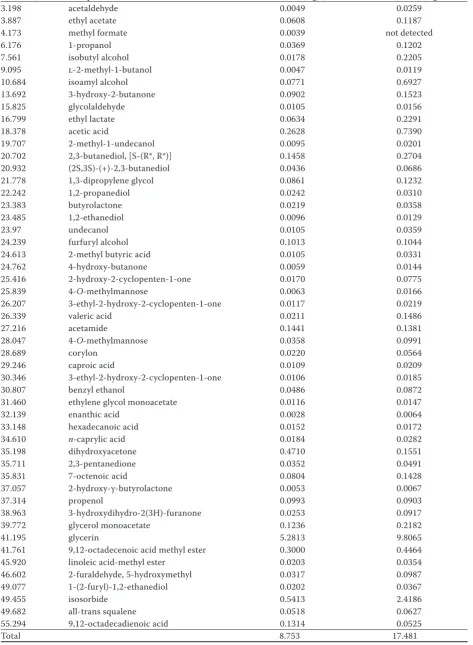
Determination of volatile compounds. The volatile compounds from the ciders are shown in Figure 2. 51 volatile substances were detected and are listed in Table 2, including 10 esters, 15 alcohols, 7 acids, 8 ketones, other aldehydes, phenols, fatty acids, terpene. The concentrations of most volatile com-pounds were higher after MLF than in control. The results were similar to those obtained with O. oeni
(Villière et al. 2001; Agouridis et al. 2008). Most of these compounds have been widely reported as contributing to the fruity aroma of fermented bev-erages (Jarvis et al. 1995; Madrera et al. 2008; Hernandez-Orte et al. 2009).
Role of strain Z25 in the release and formation of volatile compounds
Higher alcohols. Alcohols, considered to be linked to amino acid metabolism, have some influence on the flavour of cider to a certain extent (Madrera
[image:3.595.308.530.83.284.2]et al. 2008). Generally, the concentrations of higher
Table 1. The changes of softness index
Alcohol
(%) Tannin (g/l) Total acidity (g/l) Softness index
After MLF 8.5 0.259 3.01 5.23
Before MLF 8.5 0.282 3.56 4.65
MLF – malolactic fermentation
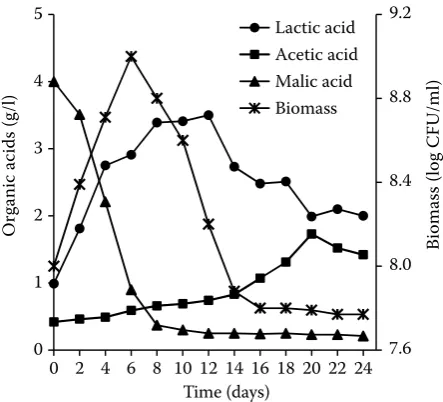
Determination of organic acids. MLF is considered as positive from the organoleptic point of view, since lactic acid is weaker than malic acid. As shown in Figure 1, the concentration of malic acid decreased significantly (P < 0.01) from the first day to the 8th day (4.0–0.37
g/l), and then it changed only slowly. Meanwhile, a dramatic increase occurred in the concentration of lactic acid and volatile acidity during the first 8 days. The concentration of lactic acid increased from 0.98 on day 1 to 3.5 g/l on day 12 (Figure 1) (P < 0.01). The growth of strain Z25 reached its maximum on day 6 (9 log CFU/ml). The data from Figure 1 revealed that both the degradation of malic acid and the synthesis of lactic acid were positively correlated with the growth of strain Z25. Clearly, some malic acid was converted to lactic acid by strain Z25. The degradation of malic acid and therefore the lowering of total acidity are major demands for good cider products (Versari et al. 1999). As shown in Figure 1, a rapid increase of acetic acid took place after 12 days. It also indicated that the decomposition of lactic acid and synthesis of acetic acid present definite relativity after 12 days. According to previous studies, acetic acid synthesis was realised by the oxidation of lactic acid but not by the glycometabolism of LAB (Herrero et al. 1999; Maicas& Natividad 2000). Therefore, the MLF fermentation was stopped on day 12 because
7.6 8.0 8.4 8.8 9.2
0 1 2 3 4 5
0 2 4 6 8 10 12 14 16 18 20 22 24
Biomass (log CFU/ml)
Organic acids (g/l)
Time (days)
[image:3.595.64.289.319.378.2]Lactic acid Acetic acid Malic acid Biomass
72
Table 2. Compound identification and content
R.T (min) Compounds Cider (AF)(mg/l) Cider (MLF) (mg/l)
3.198 acetaldehyde 0.0049 0.0259
3.887 ethyl acetate 0.0608 0.1187
4.173 methyl formate 0.0039 not detected
6.176 1-propanol 0.0369 0.1202
7.561 isobutyl alcohol 0.0178 0.2205
9.095 l-2-methyl-1-butanol 0.0047 0.0119
10.684 isoamyl alcohol 0.0771 0.6927
13.692 3-hydroxy-2-butanone 0.0902 0.1523
15.825 glycolaldehyde 0.0105 0.0156
16.799 ethyl lactate 0.0634 0.2291
18.378 acetic acid 0.2628 0.7390
19.707 2-methyl-1-undecanol 0.0095 0.0201
20.702 2,3-butanediol, [S-(R*, R*)] 0.1458 0.2704
20.932 (2S,3S)-(+)-2,3-butanediol 0.0436 0.0686
21.778 1,3-dipropylene glycol 0.0861 0.1232
22.242 1,2-propanediol 0.0242 0.0310
23.383 butyrolactone 0.0219 0.0358
23.485 1,2-ethanediol 0.0096 0.0129
23.97 undecanol 0.0105 0.0359
24.239 furfuryl alcohol 0.1013 0.1044
24.613 2-methyl butyric acid 0.0105 0.0331
24.762 4-hydroxy-butanone 0.0059 0.0144
25.416 2-hydroxy-2-cyclopenten-1-one 0.0170 0.0775
25.839 4-O-methylmannose 0.0063 0.0166
26.207 3-ethyl-2-hydroxy-2-cyclopenten-1-one 0.0117 0.0219
26.339 valeric acid 0.0211 0.1486
27.216 acetamide 0.1441 0.1381
28.047 4-O-methylmannose 0.0358 0.0991
28.689 corylon 0.0220 0.0564
29.246 caproic acid 0.0109 0.0209
30.346 3-ethyl-2-hydroxy-2-cyclopenten-1-one 0.0106 0.0185
30.807 benzyl ethanol 0.0486 0.0872
31.460 ethylene glycol monoacetate 0.0116 0.0147
32.139 enanthic acid 0.0028 0.0064
33.148 hexadecanoic acid 0.0152 0.0172
34.610 n-caprylic acid 0.0184 0.0282
35.198 dihydroxyacetone 0.4710 0.1551
35.711 2,3-pentanedione 0.0352 0.0491
35.831 7-octenoic acid 0.0804 0.1428
37.057 2-hydroxy-γ-butyrolactone 0.0053 0.0067
37.314 propenol 0.0993 0.0903
38.963 3-hydroxydihydro-2(3H)-furanone 0.0253 0.0917
39.772 glycerol monoacetate 0.1236 0.2182
41.195 glycerin 5.2813 9.8065
41.761 9,12-octadecenoic acid methyl ester 0.3000 0.4464
45.920 linoleic acid-methyl ester 0.0203 0.0354
46.602 2-furaldehyde, 5-hydroxymethyl 0.0317 0.0987
49.077 1-(2-furyl)-1,2-ethanediol 0.0202 0.0367
49.455 isosorbide 0.5413 2.4186
49.682 all-trans squalene 0.0518 0.0627
55.294 9,12-octadecadienoic acid 0.1314 0.0525
73
alcohols range from 0.14 g/l to 0.42 g/l (Zoecklein
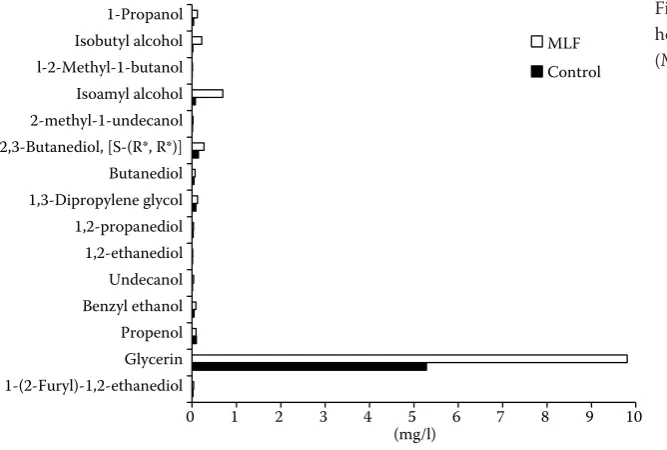
et al. 1995; Madrera et al. 2008). In this study, pro-panol, isobutyl alcohol, propenol, 2-methyl-butanol, isoamyl alcohol, 2-methyl-1-undecanol, undecanol, benzyl ethanol, 1-(2-furyl)-1,2-ethanediol, 1,2-pro-panediol, and glycerin were detected. Significant increments were determined in the total amount of higher alcohols after MLF as compared with control. The increments were mainly due to isoamyl alcohol (about 0.69 mg/l). More specifically, there was no significant difference (P > 0.05) between propenol and 1,2-propanediol, but with 1-propanol, isobutyl alcohol, isoamyl alcohol, and isobutyl alcohol signifi-cant (P < 0.01) increases occurred (Figure 3). The sum of the average concentration of higher alcohols was 0.275 mg/l, which contributes to the cider without
off-odours. Glycerin as the main volatile component was detected. There was a significant (P < 0.05) in-crease in the concentration of glycerin, which could rise to 9.8 mg/l after MLF. This value was similar to those given in other reports (Santos et al. 2004). Glycerol may improve the fruity character of the cider, but has no direct effect on its aroma.
Esters. Esters are important aroma components in cider, constituting a major group of desirable flavour compounds. As shown in Figure 4, 10 esters were detected in the cider samples, including ethyl lactate, maple lactone, butyrolactone, ethylene glycol-monoacetate, 2-hydroxy-γ-butyrolactone, glycerol monoacetate, 9,12-octadecadienoic acid-methylester, linoleic acid methyl, ethyl acetate, and methyl for-mate. After MLF, methyl formate was not detected
Fig. 2 GC/MS chromatogram of aroma components in cider without MLF
Fig. 3 GC/MS chromatogram of aroma components in cider after MLF
0 10 20 30 40 50 (min)
0 10 20 30 40 50 (min)
20
18
16
14
12
10
8
20
18
16
14
12
[image:5.595.62.496.82.548.2]10
Figure 2. GC/MS chromato-gram of aroma components in cider (a) without and (b) after malolactic fermentation (a)
74
but there was a significant (P < 0.05) increase in the concentration of ethyl acetate. No significant differ-ences (P > 0.05) were observed between the concen-trations of 2-hydroxy-γ-butyrolactone and ethylene glycol-monoacetate. However, for other 6 esters, there were significant (P < 0.05) increases after MLF. Ethyl lactate is an important aroma compound produced during MLF. Its production should be coupled to lactic acid formation. In this work, its concentration increased from 0.063 mg/l to 0.229 mg/l.
Esters are formed by yeasts during fermentation in a reaction between alcohols, fatty acids, co-enzyme A (CoASH), and an ester synthesising enzyme. Some previous reports showed that ethyl acetate was the dominant ester, its concentration being generally in the range from 50 mg/l to 100 mg/l (Nedovic et al. 2000; Agouridis et al. 2008). In this work, glycerol monoacetate, ethyl lactate, and 9,12-octadecadienoic acid-methylester were the main esters, whereas the concentration of ethyl acetate was only 0.118 mg/l.
This is different from the data obtained with O. oeni
reported by Herrero et al. (2000), who observed a higher concentration of ethyl acetate (about 18 mg/l), which was the main ester.
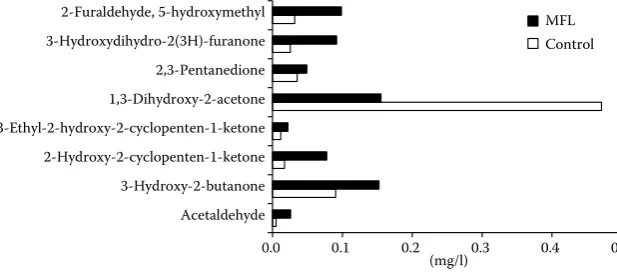
Carbonyl compounds. About 8 kinds of carbonyl compounds were detected in this study, including acetaldehyde, 3-hydroxy-2-butanone, 4-hydroxy-butanone, 2-hydroxy-2-cyclopentene-1-ketone, 3-methyl-2-hydroxy-2-cyclopentene-1-ketone, 1,3-di-hydroxy-2-acetone, 2,3-pentanedione, and 3-hydroxy-dihydro-2-(3H)-furanone. No distinct change in the concentrations of these carbonyl compounds occurred after MLF, except that the concentration of 1,3-dihydroxy-2-acetone decreased (Figure 5).
The most important carbonyl compounds in cider are acetaldehyde and 2,3-pentanedione. In our research, a significant increase took place (P < 0.05) in the concentrations of both acetaldehyde and 2,3-pentanedione. Acetaldehyde is considered as an off-flavour compound, but its level in this
0 1 2 3 4 5 6 7 8 9 10
1-(2-Furyl)-1,2-ethanediol Glycerin Propenol Benzyl ethanol Undecanol 1,2-ethanediol 1,2-propanediol 1,3-Dipropylene glycol Butanediol 2,3-Butanediol, [S-(R*, R*)] 2-methyl-1-undecanol Isoamyl alcohol l-2-Methyl-1-butanol Isobutyl alcohol 1-Propanol
(mg/l)
[image:6.595.64.398.85.310.2]MLF Control
Figure 3. The comparison of alco-hols between malolactic fermentation (MLF) cider and control
0.0 0.1 0.2 0.3 0.4 0.5
Linoleic acid methyl ester 9,12-Octadecenoic acid methyl ester Glycerol monoacetate
2-Hydroxy-γ-butyrolactone
Ethylene glycol monoacetate Corylon Butyrolactone Ethyl lactate Methyl formate Ethyl acetate
(mg/l) MLF Control
Figure 4. The comparison of esters between
[image:6.595.65.333.611.757.2]work was far below the acceptable value (100 mg/l) (Zoecklein et al. 1995). This was similar to its lev-els reported in previous research (Agouridis et al. 2005). Compared with O. oeni followed by Nedovic
et al. (2000), the concentrations of acetaldehyde and 2,3-pentanedione were lower and diacetyl was not detected in this study.
Others. Other compounds, like acetamide, isosorb-ide, and some fatty acids were present in high con-centrations in the MLF ciders. They also contribute to the aroma of the ciders at some level. Additionally methanol, which is harmful to human health,was not detected in this work.
In this study, strain Z25 exhibited a similar ability as O. oeni. The addition of this strain to the fer-mented cider improved the levels of benzyl ethanol and glycerin which are compounds contributing to the well-known floral aroma via MLF performance. Moreover, the levels of ethyl acetate, ethyl lactate, 3-hydroxy-2-butanone, butyrolactone, furfuryl alco-hol, 4-hydroxy-butanone, dihydroxyacetone, isoamyl alcohol, 2,3-butanediol, and isosorbide were also promoted. Most of these compounds have been widely reported as contributing to the fruity aroma of fermented beverages because of the presence of the strain mentioned (Sumby et al. 2010).
In summary, strain Z25, like O. oeni species, can be used in the cider production because of its MLF performance. By sensory, the ciders which undergo MLF, possess the characteristics of softer and but-tery taste, thus being more fresh and full-bodied.
Acknowledgments. The authors appreciate Xi’Ao Food and Beverage Company, Raoyang County, Hebei, China, for providing concentrated apple juice and partial technical assistance in this study.
References
Agouridis N., Bekatorou A., Nigam P. (2005): Malol-actic fermentation in wine with Lactobacillus casei cells
immobilized on delignified cellulosic material. Journal of Agricultural and Food Chemistry, 53: 2546–2551. Agouridis N., Kopsahelis N., Plessas S. (2008):
Oeno-coccus oeni cells immobilized on delignified cellulosic material for malolactic fermentation of wine. Bioresource Technology, 99: 9017–9020.
Del Campo G., Santos J.I., Berregi I., Munduate A. (2005): Differentiation of Basque cider apple juices from different cultivars by means of chemometric techniques. Food Control, 16: 551–557.
Hernandez-Orte P., Cersosimo M., Loscos N., Cacho J., Farcia-Moruno E., Ferreira V. (2009): Aroma devel-opment from non-floral grape precursors by wine lactic acid bacteria. Food Research International, 42: 773–781. Herrero M., Garcia L.A, Diaz M. (1999): Organic
ac-ids in cider with simultaneous inoculation of yeast and malolactic bacteria: effect of fermentation temperature. Journal of the Institute of Brewing, 105: 229–232. Herrero M., Laca A., Garcia L.A. (2000): Controlled
malolactic fermentation in cider using Oenococcus oeni immobilized in alginate beads and comparison with free cell fermentation. Enzyme and Microbial Technology,
28: 35–41.
Herve A., Costello P.J., Remize F. (2004): Saccharomyces cerevisiae–Oenococcus oeni interactions in wine: current knowledge and perspectives. International Journal of Food Microbiology, 93: 141–154.
Jarvis B., Forster M.J., Kinsella W.P. (1995): Factors affecting the development of cider flavor. Journal of Ap-plied Bacteriology, 79: 5–18.
Madrera R.R., Hevia A.G., Garcia N.P. (2008): Evolu-tion of aroma compounds in sparkling ciders. LWT-Food Science and Technology, 41: 2064–2069.
Maicas S., Natividad A. (2000): Malolactic fermentation in wine with high densities of non-proliferating Oenococ-cus oeni. World Journal of Microbiology and Biotechnol-ogy, 16: 805–810.
Nedovic V.A., Durieux A., Van Nederveldec L. (2000): Continuous cider fermentation with co-immobilized yeast and Leuconostoc oenos cells. Enzyme and Microbial Technology, 26: 834–839.
0.0 0.1 0.2 0.3 0.4 0.5
Acetaldehyde 3-Hydroxy-2-butanone 2-Hydroxy-2-cyclopenten-1-ketone 3-Ethyl-2-hydroxy-2-cyclopenten-1-ketone 1,3-Dihydroxy-2-acetone 2,3-Pentanedione 3-Hydroxydihydro-2(3H)-furanone 2-Furaldehyde, 5-hydroxymethyl
(mg/l)
[image:7.595.66.375.81.219.2]MFL Control
76
Nehme N., Mathieu F., Taillandier P. (2008): Quantita-tive study of interactions between Saccharomyces cerevi-siae and Oenococcus oeni strains. Journal of Industrial Microbiology Biotechnology, 35: 685–693.
Pan H., Xu Y., Li J. (2005): Study of malolactic fermentation techniques in cider product. Chinese Journal of Food Science, 26: 109–113.
Reuss R.M., Stratton J.E., Smith D.A. (2010): Malolac-tic fermentation as a technique for the deacidification of hard apple cider. Journal of Food Science, 75: 74–78. Rosi I., Fia G., Canuti V. (2003): Influence of different pH
values and inoculation time on the growth and malolactic activity of a strain of Oenococcus oeni. Australian Journal of Grape and Wine Research, 9: 194–199.
Santos J.P., Arroyo T., Aleixandre M., Lozano J., Sayago I., , García M., Fernándeza M.J., Arésa L., Gutiérreza J., Cabellosb J.M., Gilb M., Horrilloa M.C. (2004): A comparative study of sensor array and GC–MS: application to Madrid wines characterization. Sensors and Actuators B: Chemical, 102: 299–307.
Sumby K.M., Grbin P.R., Jiranek V. (2010): Microbial modulation of aromatic esters in wine: Current knowl-edge and future prospects. Food Chemistry, 121: 1–16. Versari A., Parpinello G.P., Cattaneo M. (1999):
Leu-conostoc oenos and malolactic fermentation in wine: a review. Journal of Industrial Microbiology and Biotech-nology, 23: 447–455.
Villière A., Arvisenet G., Lethuaut L., Prost C., Sé-rot T. (2012): Selection of a representative extraction method for the analysis of odourant volatile composition of French cider by GC–MS–O and GC×GC–TOF–MS. Food Chemistry, 131: 1561–1568.
Zoecklein W.B., Fugelsang C.K., Gump H.B., Nury S.F. (1995): Wine Analysis and Production. Chapman & Hall, New York.
Zhu B.Y. (1992): Wine Science and Technology. China Light Industry Press, Beijing: 15–18.
Received for publication March 21, 2013 Accepted after corrections June 6, 2013
Corresponding author: