Nutritional Value of the Protein of Consumer Carp
Cyprinus carpio
L.
Krystyna A. SKIBNIEWSKA
1, Janusz ZAKRZEWSKI
1, Jan KŁOBUKOWSKI
2,
Henryk BIAŁOWIĄS
3, Barbara MICKOWSKA
4, Janusz GUZIUR
1, Zbigniew WALCZAK
5and Józef SZAREK
61Chair of Foundations of Safety, 2Chair of Human Nutrition and 6Chair of Pathophysiology,
Forensic Veterinary Medicine & Administration, University of Warmia & Mazury in Olsztyn, Olsztyn, Poland; 3Institute of Ichthyobiology and Aquaculture, Gołysz, Poland, 4Małopolska Centre of Food Monitoring, Agricultural University in Kraków, Krakow, Poland, 5Chair of Food Technology and Nutrition, Technical University in Koszalin, Koszalin, Poland
Abstract
Skibniewsk K.A., Zakrzewski J., Kłobukowski J., Białowiąs H., Mickowska B., Guziur J., Walczak Z., Szarek J. (2013): Nutritional value of the protein of consumer carp Cyprinus carpio L.Czech J. Food Sci., 31: 313–317.
The nutritional value of the protein of carp from breeding technologies currently employed in Poland (semi-extensive, low-intensive and high-intensive ones) was evaluated. The total protein content was from 16.9% to 18.6% and did not diverge from the content of this nutrient in other fish species. The protein of the studied carps was characterised by a high content of exogenous amino acids, considerably exceeding their amount compared to the standard protein, irrespective of the area of breeding or the production intensity level. The dominant amino acids were histidine, me-thionine, and cysteine, phenylalanine and tyrosine, lysine and threonine. The amino acid limiting the nutritional value of protein was valine, yet the values of calculated limiting amino acid indices were high. Carp meat should be treated as a source of full-value protein.
Keywords:amino acid profile; fish; food of standard value
Carps are among the most commonly bred fish in the world (FAO 2010; Fishery…. 2012). Accord-ing to Guziur (2005), carps have been kept in Central Europe for 10 centuries. In 2009 total carp production in the European Union amounted to 70,761 t, which constituted 5% of the entire European aquaculture production. It is produced in 15 countries out of the 20 member countries (http://ec.europa.eu/...). In 2009, around 97% of carp production came from 6 countries, mainly Poland, Czech Republic, Germany and Hungary and in lower amounts from France and Lithuania.
Further eastward enlargement of the EU will cause an increase in the importance of carp in the EU aquaculture. In this respect it should be stressed that Eastern Europe is the second most important region after Asia, where carp plays a dominant role in the inland fishing industry.
In 2009, the world’s per capita mean annual consumption of fisheries and aquaculture products was about 16 kg and in the European Union it reached about 11 kg. In the Czech Republic the consumption in 2009 was 5.5 kg/per capita/year with less than 1.5 kg of the fresh water ones
(Situačni a výhledová správa2011). In Poland, the fish consumption in 2007 was nearly 11 kg annually (http://ec.europa.eu/...).
Protein is among basic nutrients in the human diet. The latest Polish references for an adult are 0.8 g/kg BM/day (Jarosz & Bułhak-Jachymczyk 2008). It is stressed that not only the amount but also the quality of protein is of fundamental im-portance for the proper functioning of the body. Fish protein belongs to the group of the highest quality, comparable with standard protein, i.e. chicken egg protein. Although information on the nutritive values of fish protein is widely known, there are few papers devoted to its composition and papers concerning carp are scarce. The aim of the research was to evaluate, on the basis of amino acid composition, the nutritional value of protein of carp from breeding technologies cur-rently employed in Poland.
MATERIAL AND METHODS
In October 2007, 30 consumable carps were caught from each of the six pond farms located in various areas of Poland. The farms applied the carp breed-ing technologies currently employed in Poland.
Semi-extensive breeding, natural technology (farms F1 and F2) is based on feeding the fish with natural feed without additional feeding. This technology is considered to be human- and envi-ronment-friendly, though of low efficacy. Because of the uncontrolled inflow of biogenes from wa-tercourses, cultivated fields and farms into ponds, classic extensive breeding virtually does not exist in Poland and Europe. For this reason, the term “semi-extensive” was adopted in our studies.
Low intensive technology (farms F3 and F4). Apart from the natural feed, fish receive cereals at the time of summer intensive feeding. The content of natural feed in the carp feed ration is high and amounts to 50%, depending on the fertility of the pond and the stock density. This breeding system has been reported in 95–98% of pond farms in Poland (also in Central Europe – Czech Republic, Hungary, Germany), ac-counting for almost 90% of the yield in Poland.
High intensive technology (farms F5 and F6) is uncommon in Poland and is conducted in warm power plant cooling water, for example. Fish are kept at great density and fed exclusively high-protein granulated feeds with a minimal content of natural feed.
Samples of 15 fishes were caught on each farm from two weight groups: S (carp aged 2 years plus, of the weight of 0.8 to 1 kg/head) and D (carp aged three years plus, of the weight of 1–2 kg/head). The fish were killed and boned immediately after being caught. They were then frozen at –21°C and stored at –18°C until analyses were carried out.
To perform chemical analyses, the fillets were heated slightly at room temperature without al-lowing a leak to appear, after which a slice was cut out from the dorsal to the abdominal side, ca. 5 cm wide, without skin and bones. The col-lected muscle samples were comminuted with a knife, homogenised (PRO350, time 40", speed 11 000 rpm; BIOEKO, Kraków, Poland) and ca. 1.5 g was weighed out to determine the protein content in muscle tissue by the Kjeldahl method (using the 6.25 conversion factor).
To determine the amino acid composition of fish protein, 5 g of the sample was collected from five randomly selected homogenisates of muscle tissue of fish in each type, then the material from fish from the same farm was combined, rehomogenised and dried by aeration at 30°C.
Liquid-phase hydrolysis of powdered samples was performed in 6M HCl containing 0.5% phenol at 110°C for 24 h under an argon atmosphere. The hydrolysates were lyophilised, dissolved in sodium citrate pH 2.2 and filtered through a 0.45 mm syringe filter. Sulphur-containing amino acids were analysed as oxidation products obtained by performic acid oxidation of HCl hydrolysates. Amino acids were determined by ion-exchange chromatography using an AAA400 automatic amino acid analyser (Ingos, Prague, Czech Re-public), with a strong cation ion-exchanger and a sodium-citrate elution buffer system followed by post-column derivatisation with ninhydrin and spectrophotometric detection at λ = 570 and 440 nm, according to the standard protocol of the manufacturer (Ingos, Prague, Czech Republic). For calibration, a standard amino acid solution (Sigma, St. Louis, USA) was used.
RESULTS AND DISCUSSION
The studied fish contained ca. 17–19% of total protein (Table 1), which does not diverge from the content of this nutrient in the meat of other fish and slaughter animal species. Polak-Juszczak and Adamczyk (2009) reported that the protein content in fish acquired from the waters of the Vis-tula Lagoon ranged from 16.6% (herring) to 19.5% (pikeperch). The lowest protein content obtained in the quoted study was found in the meat of eel (14.5%), which was caused by the very high fat content in the carcasses of this fish species (28.9%).
The nutritional value of protein in a food prod-uct, also including fish protein, is conditioned by its amino acid composition. The main attention is paid to the amino acids which the human organism is unable to synthesise, the so-called “exogenous” amino acids. They include histidine (an indispen-sable amino acid for children), threonine, lysine, leucine, isoleucine, phenylalanine, methionine, tryptophan, and valine (Peckenpaugh 2011).
The total content of exogenous amino acids (with-out tryptophan) and relatively exogenous amino
ac-ids was much higher than the value for the standard protein (26.5 g/100 g protein). Szlinder-Richert
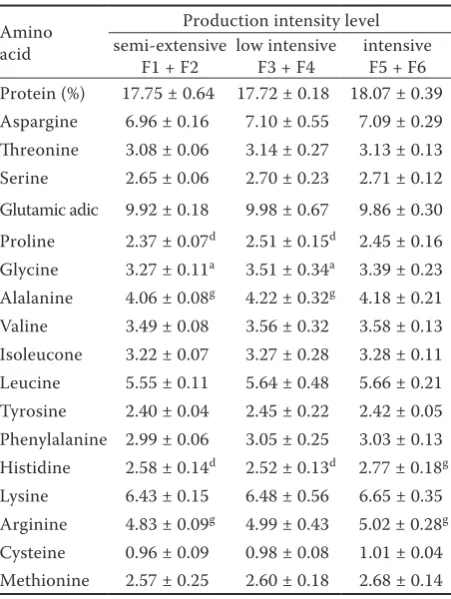
et al. (2011) obtained the value of this protein in-dex ca. 8.0–12.0 g/100 g protein higher than that presented above (43.8 g/100 g carp protein). The analysed protein of the studied carp samples was characterised by a high content of lysine, leucine, aromatic amino acids – phenylalanine and tyrosine, sulphur amino acids – methionine and cysteine as well as histidine. In each case, the contents of exog-enous amino acids presented above are lower than those obtained by Szlinder-Richert et al. (2011) for the protein of both saltwater fish (salmon, her-ring, cod, sole) and freshwater fish (carp, sea trout). No statistically significant differences were found between the contents of threonine, valine, leucine, isoleucine, phenylalanine, lysine, and methionine in the protein of fresh carp, irrespective of the breed-ing intensification level (Table 1). A slightly higher content of histidine and arginine was recorded in the protein of carp bred using an intensive produc-tion level. It was also observed that the degree of carp breeding intensity did not affect the content of endogenous amino acids – aspartic acid, glutamic acid, serine and relatively exogenous amino acids – tyrosine and cysteine.
The basic index useful for evaluation of the nu-tritional value of protein in food products is the limiting amino acid index (CS – chemical score), in which the lowest content of a given exogenous amino acid in relation to its content in the standard protein is determined. This amino acid is called the amino acid limiting the nutritional value of a given protein (Gronowska-Senger 2004).
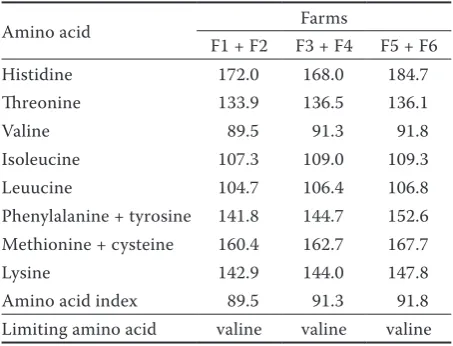
[image:3.595.64.290.440.740.2]The contents of all exogenous amino acids in the analysed carp protein in relation to their content in protein of the standard (WHO/FAO/UNU 2007), expressed in percentage units, exceeded the value of 100 by up to several dozen percent (Table 2). This relationship was not found only in the case of valine for protein of carps caught on all the fish farms. The values of CS indices for this amino acid ranged from 83.6% (F4) to 98.7% (F3). This indicated that the amino acid limiting the nutri-tional value of the protein of the studied carps was valine, yet it must be stressed that the obtained CS values for this exogenous amino acid must be considered very high. This is important because deficiencies of valine can cause disorders in the coordination of movements, body mass decrease, lack of appetite (Gertig & Przysławski 2006) and its appropriate amount has a positive effect on the Table 1. Mean total protein content (%) and amino acid
composition of carp protein (g/100 g of protein)
Amino acid
Production intensity level semi-extensive
F1 + F2 low intensive F3 + F4 intensive F5 + F6 Protein (%) 17.75 ± 0.64 17.72 ± 0.18 18.07 ± 0.39 Aspargine 6.96 ± 0.16 7.10 ± 0.55 7.09 ± 0.29 Threonine 3.08 ± 0.06 3.14 ± 0.27 3.13 ± 0.13 Serine 2.65 ± 0.06 2.70 ± 0.23 2.71 ± 0.12 Glutamic adic 9.92 ± 0.18 9.98 ± 0.67 9.86 ± 0.30 Proline 2.37 ± 0.07d 2.51 ± 0.15d 2.45 ± 0.16
Glycine 3.27 ± 0.11a 3.51 ± 0.34a 3.39 ± 0.23
Alalanine 4.06 ± 0.08g 4.22 ± 0.32g 4.18 ± 0.21
Valine 3.49 ± 0.08 3.56 ± 0.32 3.58 ± 0.13 Isoleucone 3.22 ± 0.07 3.27 ± 0.28 3.28 ± 0.11 Leucine 5.55 ± 0.11 5.64 ± 0.48 5.66 ± 0.21 Tyrosine 2.40 ± 0.04 2.45 ± 0.22 2.42 ± 0.05 Phenylalanine 2.99 ± 0.06 3.05 ± 0.25 3.03 ± 0.13 Histidine 2.58 ± 0.14d 2.52 ± 0.13d 2.77 ± 0.18g
Lysine 6.43 ± 0.15 6.48 ± 0.56 6.65 ± 0.35 Arginine 4.83 ± 0.09g 4.99 ± 0.43 5.02 ± 0.28g
Cysteine 0.96 ± 0.09 0.98 ± 0.08 1.01 ± 0.04 Methionine 2.57 ± 0.25 2.60 ± 0.18 2.68 ± 0.14
normal functioning of dendritic cells, especially in people with hepatic cirrhosis (Kakazu et al. 2007). The calculated values of the CS index also indicate that almost 100% of the exogenous amino acids from carp protein can be used for synthesis of systemic proteins.
Valine is the amino acid limiting the nutritional value of the protein of the studied carps when analysis was determined by the production inten-sification level. The values of the CS index calcu-lated for this amino acid differed slightly: 91.3% in the case of low intensive breeding, 89.5% for semi intensive breeding, and 91.8% for intensive breeding (Table 2). The highest percentage con-tents of amino acids in relation to their concon-tents in the standard protein were found for histidine, sulphur amino acids, aromatic amino acids, lysine, and threonine and these values were much higher than 100.
The high content of lysine (an amino acid in which proteins of cereals and processed cereal products are deficient) seems to be particularly positive with regard to using carp protein in hu-man nutrition. It must be stressed here that these products are in the bases of all food pyramids developed to date. This means that they are rec-ommended for the most frequent consumption, therefore an adequate supply of lysine from other food product groups must be provided in food rations. This is important because deficiencies of this amino acid in diet can cause muscular atrophy, bone decalcification and putrescine and cadaverine formation as a result of putrefaction
processes occurring in the human large intestine (Gertig & Przysławski 2006). However, care must be taken that the lysine supply in the food ration is not too high because this reduces the risk of heart disease and neoplasms resulting from changed metabolism (Peckenpaugh 2011).
The optimum level of leucine in the human body was found to prevent neurological disorders (Couce Pico et al. 2006). Moreover, leucine helps to main-tain the proper body mass, as it causes a 25% re-duction in the fat mass in the body and improves the indices of glucose and cholesterol metabolism (Zhang et al. 2007). The high content of aromatic amino acids (phenylalanine + tyrosine) in the pro-tein of the studied carp should not pose any risk to people without disorders in the oxidation of pheny-lalanine to tyrosine. It has been demonstrated that a diet devoid of, or poor in, tyrosine contributes to an increase in the requirement for phenylalanine above current nutritional recommendations (Hsu
et al. 2006).
The amount of consumed sulphur amino acids is of interest in the context of the occurrence of chronic diseases, such as cardiovascular diseases, Alzheimer’s disease, and diabetes. Methionine in the organism is converted to homocysteine, whose raised level in blood serum leads to hyperhomocysteinaemia, a heart disease with symptoms emerging in the case of an elevated plasma cholesterol concentration (Hashimoto et al. 2007). Moreover, a high consumption of proteins containing methionine and cysteine increases calcium losses, leading to a substantial decrease in mineral density and bone mass (Thorpe etal. 2008). This is not a problem because of the amount of fish consumption in the world and in Eastern European countries. On the other hand, deficiencies of methionine can lead to liver degeneration and a weakened immunity system (Gertig & Przysławski 2006).
CONCLUSIONS
[image:4.595.63.290.101.274.2]The protein of the studied carps was characterised by a high content of exogenous amino acids, con-siderably exceeding their amount in the standard protein used, irrespective of the area of breeding or the production intensity level. The dominant amino acids in the protein of the studied carps were histidine, methionine and cysteine, phenylalanine and tyrosine, lysine and threonine. The amino acid limiting the nutritional value of the protein of Table 2. Values of the limiting amino acid index (%)
Amino acid Farms
F1 + F2 F3 + F4 F5 + F6
Histidine 172.0 168.0 184.7
Threonine 133.9 136.5 136.1
Valine 89.5 91.3 91.8
Isoleucine 107.3 109.0 109.3
Leuucine 104.7 106.4 106.8
Phenylalanine + tyrosine 141.8 144.7 152.6 Methionine + cysteine 160.4 162.7 167.7
Lysine 142.9 144.0 147.8
Amino acid index 89.5 91.3 91.8
Limiting amino acid valine valine valine
the analysed carp was valine, yet the values of the calculated limiting amino acid indices were high (by ca. 1.5–12.5% lower than the content of valine in the standard).
Despite quantitatively substantial carp produc-tion in Poland, it is still a product consumed only once a year, on Christmas Eve. Because of the high nutritional value of the protein of this fish, its consumption during the rest of the year should be strongly promoted.
References
Couce Pico M.I., Castineiras Ramos D.E., Boveda Fontan M.D., Iglesias Rodriguez A.J., Cocho de Juan J.A., Fraga Bermudez J.M. (2007): Advances in the diagnosis and treatment of maple syrup urine dis-ease: experience in Galicia (Spain). Anales de Pediatria, 67: 337–343.
FAO Fisheries and Agriculture Department (2010): The State of World Fisheries and Aquaculture. FAO UN, Rome. Available at http://www.fao.org/docrep/013/ i1820e/i1820e00.htm (accessed 29/10/2012).
Fishery and Aquaculture Statistics 2010 (2012): FAO Year-book. ftp://ftp.fao.org/FI/CDrom/CD_yearbook_2010/ navigation/index_intro_e.htm (accessed 29/10/2012). Gertig H., Przysławski J. (2006): Bromatologia. PZWL,
Warsaw.
Gronowska-Senger A. (2004): Podstawy biooceny żywności. Wydawnictwo SGGW, Warsaw.
Guziur J. (2005): History of pond fisheries in Poland. In: Lehr J.H. (ed.): Water Encyclopedia. Oceanography, Meteorology, Physics and Chemistry, Water Law, and Water History, Art, and Culture. Wiley-Blackwell, New York: 718–722.
Hashimoto T., Shinohara Y., Hasegawa H. (2007): Ho-mocysteine metabolism. Yakugaku Zasshi, 127: 1579–1592. Hsu J.W., Goonewardene L.A., Rafii M., Ball R.O., Pen-charz P.B. (2006): Aromatic amino acid requirements in
healthy men measured by indicator amino acid oxidation. American Journal of Clinic Nutrition, 83: 82–88. Jarosz M., Bułhak-Jachymczyk B. ( 2008): Normy żywie-
nia człowieka. PZWL, Warszawa.
Kakazu E., Kanno N., Ueno Y., Shimosegawa T. (2007): Extracellular branched-chain amino acids, especially valine, regulate maturation and function of monocyte-derived dendritic cells. Journal of Immunology, 179: 7137–7146.
Peckenpaugh N.J. (2011): Podstawy żywienia i dietotera-pia. Elsevier Urban & Partner, Wrocław.
Polak-Juszczak L., Adamczyk M. (2009): Jakość i skład białka ryb z Zalewu Wiślanego. Żywność. Nauka. Tech-nologia. Jakość, 3(64): 75–83.
Situačni a výhledová zpráva. (2011): Ryby. Ministerstvo zemědělství, Praha, Česká republika. Available at http:// eagri.cz/public/web/file/138731/RYBY_2011.pdf (ac-cessed 29/10/2012).
Szlinder-Richert J., Usydus Z., Malesa-Ciećwierz M., Polak-Juszczak L., Ruszczyńska W. (2011): Ma-rine and farmed fish on the Polish market: Comparison of the nutritive value and human exposure to PCDD/Fs and other contaminants. Chemosphere, 85: 1725–1733. Thorpe M., Mojtahedi M.C., Chapman-Novakofski K., McAuley E., Evans E.M. (2008): A positive association of lumbar spine bone mineral density with dietary pro-tein is suppressed by a negative association with propro-tein sulphur. Journal of Nutrition, 138: 80–85.
WHO/FAO/UNU (2002): Protein and amino acid require-ments in human nutrition. Report of joint WHO/FAO/ UNU expert consultation. WHO Technical Report, Series 935. WHO, Geneva.
Zhang Y., Guo K., LeBlanc R.E., Loh D., Schwartz G.J., Yu Y.H. (2007): Increasing dietary leucine intake reduces diet-induced obesity and improves glucose and cholesterol metabolism in mice via multimechanisms. Diabetes, 56: 1647–1654.
http://ec.europa.eu/fisheries/documentation/publications/ pcp_pl.pdf (accessed 8/6/2012).
Received for publication August 25, 2012 Accepted after corrections November 6, 2012
Corresponding author: