in the last decade, we have witnessed considerable changes in the structure of large industrial businesses towards a higher concentration. This development was driven by the increase of the competitive pres-sure due especially to the globalisation of markets. considering the European agri-food chains, the proc-ess of structural changes took place most apparently in the retail sector. Also, the trend of a further growth of large industrial food processors received much
at-tention by the media and the scientific community. however, not that much attention was focussed on the importance of small and medium-scale businesses in the agri-food complex.
in agriculture, where small and medium-scale busi-nesses prevail, the concentration process was not that visible. one reason for this has been the common Agricultural Policy (cAP), which is claimed to have had a conservation impact on the farms’ structure.
Scientific information
Structural changes in the German agri-food complex:
the end of small and medium enterprises?
Strukturální změny v německého zemědělsko-potravinářského
komplexu: konec malých a středních podniků?
Miroslava BAVOROVÁ
Martin Luther University, Halle-Wittenberg, Germany
abstract: The article describes the concentration process, structural changes and competitiveness in the german agri-food sector over the last decade. This descriptive analysis aims to outline the developments at the individual stages of the food chain and to identify the challenges the sector will face in the upcoming years. The study is based mainly on the data published by the german Statistical office and the zMP1, and the evaluation of the primary and secondary literature
sour-ces. The data shows that small and medium-sized enterprises were sustainable alongside the large ones and have played an important role in the german agriculture and food processing sectors in the recent years. Various business strategies can be expected to make the coexistence of small and large-scale enterprises also possible in the future.
Key words: business structure, structural change, concentration process
abstract: Článek podává přehled o koncentračním procesu, strukturálních změnách a konkurenceschopnosti německého zemědělsko-potravinářského komplexu. cílem této deskriptivní analýzy je popis a rozbor vývoje na jednotlivých stupních řetězce výroby potravin v posledním desetiletí a identifikace problémů, kterým bude tento sektor pravděpodobně čelit v příštích letech. Studie čerpá z dat německého statistického úřadu a zMP1 a z primární a sekundární literatury. Data
ukazují, že malé a střední podniky zaujímaly v posledních letech důležitou pozici v německém zemědělství a potravinářství. Je možné očekávat, že nové konkurenční strategie těchto podniků umožní jejich koexistenci s velkými podniky i v dalších letech.
Klíčová slova: obchodní struktura, strukturální změna, koncentrační procesu
however, especially since the EU enlargement in 2004 and 2007, and during the preparations for it, the EU policy began to change. The aim of the changes was mainly to decrease the costs of the cAP and to in-crease the competitiveness of European agriculture in the world market. Due to these changes, agricultural producers will increasingly face the market forces, and thus further changes towards more competitive structures are expected. Moreover, some branches of agricultural production are expected to reallo-cate to the most appropriate regions for that given production.
in this article, the development of the german agri-food sector in recent years is described. one aim is to consider if there has also been a place for small and medium-scale businesses in the market, which is characterised by a fierce competition. The situation of the german agri-food sector is unique due to the german unification in 1990. Since then, businesses have evolved under the same market and institutional condition in the old and the new federal states. however, the impact of the past dependency is still obvious when comparing, e.g. the average farm acreages. The main aim of this article is to provide an overview of the structure of enterprises in the german agri-food chain. Thereby, we especially elaborate on the differences between the product chains and between the regions. The stage of agricultural pro-duction is considered in more detail when comparing the food industry to the retail.
The article begins by positioning the agri-food sector in the german economy. Thereafter, the struc-ture, structural change and competitiveness of the single stages of the sector, namely the agriculture, food processing and retail stages, are described and discussed. in the following section, the process of
vertical integration is considered. Finally, conclu-sions are derived.
Structure and Structural chanGe in the German aGri-food Sector
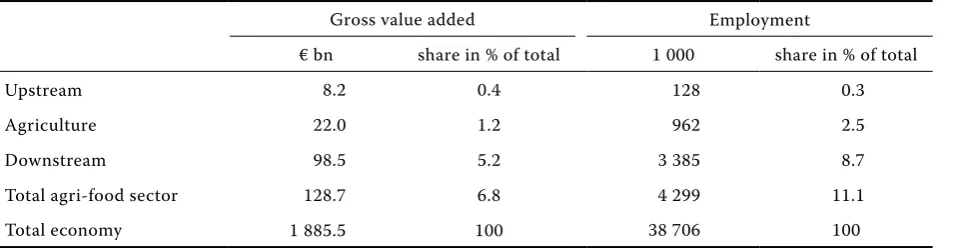
The agri-food sector, which involves agriculture input suppliers, agriculture producers, food and fibre processors and food retailers, is an important economic sector in germany; the gross value added (gVA) of the sector accounted for 6.8% of the total german economy in 2000. Turning to the labour market, the agri-food sector is even more important. in 2000, approximately 4.3 million people, or 11.1% of the total labour force, were employed in the agri-food sector (Table 1).2
agriculture
As depicted in Table 1, agriculture contributed by 1.2% to the gVA of the german economy in 2000. With 962 000 employees, the sector represented 2.5% of the total workforce.
This article focuses particularly on the main com-modities and their value chains. With 11.8% or €4699 mill of the total gross Agricultural output (gAo), the cereal sector is the most important crop sector in german agriculture. here, wheat is the most relevant commodity. considering the livestock production, 20% of the gAo was comprised of milk, with the production value of €7992 mill, and 14.8% by pork in 2006 (zMP 2008a, b). Milk and pork are thus the most important livestock commodities in german agriculture.
2There are no more recent data available that consider the whole agri-food chain. We decided to present these data;
[image:2.595.65.543.569.693.2]otherwise, the importance of the upstream and downstream sectors could not be shown. We do not use newer data for agriculture from other sources, as the statistics always differ.
Table 1. importance of the agri-food sector in germany in 2000
gross value added Employment
€ bn share in % of total 1 000 share in % of total
Upstream 8.2 0.4 128 0.3
Agriculture 22.0 1.2 962 2.5
Downstream 98.5 5.2 3 385 8.7
Total agri-food sector 128.7 6.8 4 299 11.1
Total economy 1 885.5 100 38 706 100
Farm structure according to thecultivated area
[image:3.595.147.496.66.263.2]considering the acreage of farms, a dual structure of enterprises exists in german agriculture. in the new federal states, enterprises with more than 100 ha land cultivate about 90% of the total agricultural area (Figure 1). This structure, dominated by large-scale agricultural enterprises, is the heritage of the socialist system and its collectivist agriculture. on the other hand, in the old federal states, small-scaled enter-prises with less than 100 ha land prevail. not only are there structural differences between the old and new federal states, but also between the old federal states. one reason for this is the different ancestral law. in some of the states, the land is inherited by the oldest child and in others; the inherited land is split between all children. The latter situation implicates a small structured agriculture. Bavaria e.g. is the federal
state the most dominated by small-scale farms, where 84% of the land was cultivated by farmers with less than 100 ha in 2007.
The farm structure did not change greatly in the five new federal states between 2003 and 2007 (Figure 2). in the old federal states, however, within the time span of 4 years, the land cultivated by farmers with more than 100 ha increased significantly. The highest increase took place in the rhineland Palatinate and Lower Saxony (by 8% and 7%, respectively), while in Bavaria, with its traditional small-structured farms, the increase in land cultivated by farmers with more than 100 ha was the lowest (ca. 3%); however, an increase in part-time farming was shown (DBV 2008).
[image:3.595.132.473.571.729.2]in the old federal states, the number of farms smaller than 40 ha decreased and the number of farms larger than 40 ha increased in 1990. This so-called growth Figure 1. Share of the farm area cultivated by farms cultivating less than 100 ha and by more than 100 ha in the federal states, germany, 2007
*new federal states Source: zMP (2008c)
Meckl. West. Pomerania* Saxony-Anhalt* Brandenburg* Thuringia* Saxony* Saarland Schleswig holstein Lower Saxony rhineland Palatinate hessen Baden-Württenberg north rhine-Westphalia Bavaria
less 100 ha more 100 ha 0 20 40 60 80 100%
0
2 000 4 000 6 000 8 000 10 000
< 100 ha > 100 ha < 100 ha > 100 ha
New federal states Old federal sates
1
00
0
ha
2003 2007
Figure 2. Area cultivated by german farms divided according to acreage, 2003 and 2007
swell increased to 75 ha in 2007 (DBV 2008), and it can be expected that this trend will continue in the upcoming years. Small farmers who want to carry on in the market are developing new business strategies. Then, e.g. farms with small acreage expand their livestock production or cultivate specialised crops. Another strategy is to look for an additional income and to become part-time farmers. The statistics shows an increasing number of part-time farmers within the small structured farms in germany (DBV 2008).
Pig farm structure
in pig production, a considerable structural change towards a higher concentration has occurred in the last few years. The number of pork producers decreased by about 23% between 2001 and 2005 (zMP 2008b). Thereby, the number of producers with the stock lower than 200 pigs decreased by nearly 30%, while a 6% decrease in the number of producers with 200 and more pigs took place.
in 2007, there were 80 500 farms producing more than 27 millions pigs in germany (zMP 2008b). Farms with a stock larger than 1000 pigs amounted to 10%
of all farms and produced 55% of the pigs produced in germany (Figure 3).
Pig production is concentrated in the federal states of Lower Saxony and north rhine-Westphalia, which have a 30% and 24%, respectively, share of the german pig production. As the farm growth is not limited by the acreage in the pig sector, there is not such a clear division in the structure between the old and new federal states that can be considered in the case of the farm size according to cultivated land.
Dairy farm structure
Figure 4 depicts the structure of dairy farms in germany, where 101 200 farms bred 4.026 mill. milking cows in 2007. About 76% of milk producing farmers bred herds smaller than 49 milking cows and produced about 42% of germany’s milk (Figure 4).
The difference in the allocation and structure of milk farmers between the old and new federal states is remarkable. in the old federal states, there were 97 000 milk producers compared to 4200 in the new federal states in 2007 (zMP 2008). The average number of milking cows per 1 farmer was 34 in the old states
0
10
20
30
40
50
60
[image:4.595.142.452.65.223.2]1-9
10-99
100-199
200-399
400-999
1,000 and more
Pigs per farm
Figure 3. Share of farms and pigs according to stock size, germany, 2007 Source: zMP (2008b)
0 10 20 30 40 50 60%
1–9
10–99
100–199
200–399
400–999
1 000 and more
Pi
gs
p
er
fa
rm
Farms in % Pigs in %
0
10
20
30
40
50
1-9
10-29
30-49
50-99
100-199
200 and more
1–9
10–29
30–49
50–99
100–199
200 and more
M
ilk
c
ow
s p
er
fa
rm
0 10 20 30 40 50%
[image:4.595.120.426.576.735.2]Farms in % Pigs in %
and 185 in the new federal states. Between 2005 and 2007, the number of milk producers decreased by about 8% in the old and by nearly 9% in the new federal states (Figure 5).
There are large differences in efficiency between farms in germany. in the more competitive environ-ment for dairy farms that has been created by the cAP changes, a reallocation of milk production towards the more efficient farmers can be expected.
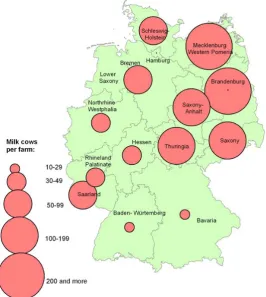
The competitiveness of a region is given by the location factors such as the grassland share and the part of grassland that could be used as arable land. The latter is important considering the development of crop prices in the world market. if the prices in the world market increase, the opportunity costs of using the land for feed production would become higher. The next factor important for competitive-ness is the farm structure. As depicted in the map above, the average farm size differs considerably between regions in germany, especially between the new member states and the old member states. The old member states in the northern part show larger-scaled dairy farms compared to the federal states in the South.
The competitiveness of milk production in the new federal states will depend on the development of the two following factors. First, there is a low share of land
that can be used solely as grassland. By constantly high prices for crops in the world market, the opportunity costs for milk production would become too high. consequently, milk production would be dislocated from these areas. Second, the large scale structure of dairy farms increases their competitiveness, as dairy farms become more efficient when increasing in scale (Lassen et al. 2008). growth in size is less costly in the new federal states compared to the old states, which exhibit more small-structured farms. The prices of land rent are significantly lower in the new states, however, production cost are higher, especially in the case of work input.
The dairy farms in the old federal states located in the north of germany have an extensive grassland area. This makes them predisposed for milk produc-tion. Production costs are also lower compared to other german regions. The dairy farms in this region are large–scale, though the fertilizer regulation is a limiting factor for increasing the concentration of milking cows breeding in the north-west region (Latacz-Lohman and hemme 2008).
The small structured dairy farms in Southern germany operate with cost disadvantages in scale. Their competitiveness in the future will highly de-pend on the ability of the sector to undertake struc-tural changes. The advantages of regions in Southern
[image:5.595.174.441.433.731.2]
germany come from the innovative and competitive dairy industry (Latacz-Lohman and hemme 2008).
in the European context, german dairy farms rep-resent an average considering their production costs (Latacz-Lohman and hemme 2008). countries such as the czech republic or Poland produce milk for comparatively lower costs. For example, the czech farmers’ production costs for 1 kg milk are half that of the farms in Southern germany. Farmers in Switzerland, Finland and Austria produce milk at higher costs than german farmers. After abolishing the milk quota, the reallocation towards countries with lower production costs can be expected if the new policy measures do not change the situation (Latacz-Lohman and hemme 2008).
food industry
The german food and drink industry, which proc-esses agricultural products into a high quality food fit for consumption, employed more than 530 000 people and generated a nominal turnover of €155 billion by more than 5800 companies in 2008. This makes the food and drink industry the fifth largest economic sector in germany, after the electricity industry, automotive, mechanical engineering and chemical industries.
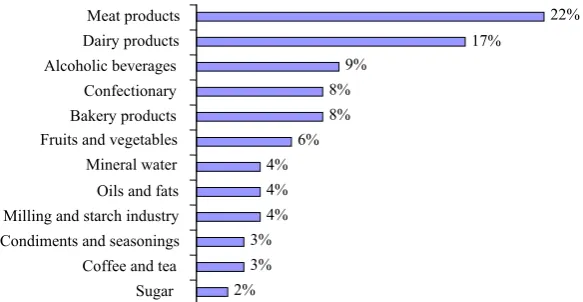
Figure 6 shows the major branches’ share in the total turnover in 2007. The major part of the turnover was generated by the meat and dairy industries (22% and 17%, respectively). The bakery industry stands for 8% and the milling and starch industry for 4% of the total food and drink industry turnover, which makes the bread chain the most important crop processing chain.
one of most intensively discussed factors when considering food industry competitiveness in both the European and the global context is its business structure. in spite of intensive structural changes
towards a higher concentration in the sector over the last decade, the food and drink industry is dominated by medium-sized businesses in germany. indeed, 75% of the enterprises operating in the industry have less than 100 employees. in the future, a further develop-ment towards a more concentrated business structure can be expected. This process is driven, among other things, by the internationalisation of food markets and the price-conscious consumers.
Structure and concentration process in the meat processing sector
The first and second level meat sectors are primarily small-to-medium sized. in 2006, each slaughterhouse (meat processing establishment) employed, in average, 78 (82) people and generated the revenue of €47.9 m (€17.5 m) (zMP 2008b). The share of 10 largest slaugh-terhouses in germany amounted to 54.5% of the total revenues in the sector in 2004 (BMVEL 2007). The largest companies, Tönnies, Vion Food group and Westfleisch, are relatively small compared with the largest European enterprises (Theuvsen and Ebneth 2005) (Figure 7).
compared to the first processing level, the con-centration was lower on the meat processing level. here, the 10 largest processors’ share in the total revenues was 24.4%. For the future, the concentra-tion processes are expected to intensify due to the increased competition. remarkable over-capacities and under-utilisation of fixed assets result in com-petitive disadvantages of german meat companies towards foreign competitors.
The increasing price pressure and the consum-ers’ expectations for meat safety and quality are the challenges the processor will soon face. Vertically-integrated companies are expected to meet these challenges more efficiently, which helps them to achieve the competitive advantage.
17%
9% 8% 8% 6% 4% 4% 4% 3% 3% 2%
22% Meat products
Dairy products Alcoholic beverages Confectionary Bakery products Fruits and vegetables
[image:6.595.139.431.72.223.2]Mineral water Oils and fats Milling and starch industry Condiments and seasonings Coffee and tea Sugar
Structure and concentration process in the dairy processing sector
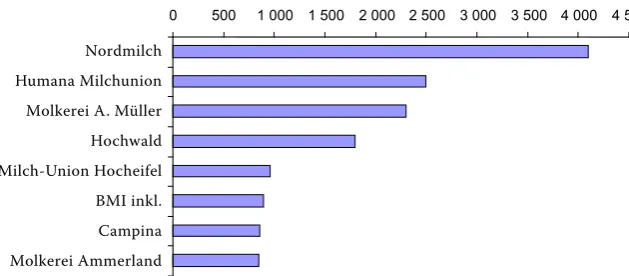
The german dairy sector amounted to 17% of the food processing sector’s revenues in 2007, with its revenue increasing by 8.5% from 2000 to 2005 (BMVEL 2002, 2007). The sector is characterised by a few large companies (mostly organised as cooperatives) and a considerable number of medium-sized dairies. The two biggest german dairies are the cooperatives nordmilch and humana, which are among ten largest dairies in Europe (Theuvsen and Ebneth 2005). in 1999, 10 biggest dairies generated the turnover share of 32% in the sector. This share increased to 41% in 2005. The total number of dairies decreased from 251 in 2000 to 198 in 2006 (21.1%) (Figure 8).
The EU cAP reform will influence the future com-petitiveness of the german dairy industry in the world market. on one hand, the declining milk prices will reduce the milk cost for dairy companies; on the other hand, export prices will decline as a result of the policy changes. As the internationalisation strategies of the large retailers will increase the competitive pressure, ongoing structural changes can be expected in the
dairy sector. compared to its European competitors, the german dairy industry is still relatively small-struc-tured. new mergers and acquisitions are expected in the sector in the near future, and the transformation of the sector into an oligopoly is predicted (Bridts and Köttl 2003). Some predictions expect the number of dairies in germany to decline to about thirty companies in the next decade (Theuvsen and Ebneth 2005). The small and medium-sized dairies must further specialise their production on high value-added products, e.g. cheese, to increase their competitiveness in the market and to follow the product differentiation strategy.
Structure and concentration process in the wheat processing sector
[image:7.595.133.478.69.229.2]The wheat to bread chain is the most important crop processing chain. The revenue share in the total food processing sector amounted to 4% for milling and 8% for the bakery sector in 2007. The revenues in the milling sector increased by 24% between 2000 and 2005, and the revenues in the bakery sector increased by 17% at the same time (BMVEL 2002, 2007). The 10 largest mills generated 47%, and the 10 biggest Figure 7. Largest slaughter enterprises according to the number of slaughtered pigs per year, germany 2007
Source: zMP (2008)
0 2 4 6 8 10 12
B.& C. Tönnies Vion Food Group Westfleisch D&S Fleisch Vogler-Fleisch Heinz Tummel Böseler Goldschmaus
Gausepohl Fleisch
Slaughtered pigs (millions per year)
B.& c. Tönnies Vion Food group Westfleisch D&S Fleisch Vogler-Fleisch heinz Tummel Böseler goldschmaus gausepohl Fleisch
Slaughtered pigs (millions per year)
Figure 8. Largest dairies according to the amount of processed milk per year, germany 2007
0 500 1 000 1 500 2 000 2 500 3 000 3 500 4 000 4 500 Nordmilch
Humana Milchunion Molkerei A. Müller Hochwald Milch-Union Hocheifel BMI inkl. Campina Molkerei Ammerland
processed milk (milions kg per year)Processed milk (millions kg per year)
[image:7.595.130.445.608.746.2]bakeries generated 25% of the sectors’ total revenue in 2004 (BMVEL 2007). There are three types of bak-eries present in the bakery sector: industrial, chain and craft bakeries. Large industrial bakeries supply the retailers. The price pressure is immense in this sector and the concentration process is ongoing. chain bakeries sell their products in their own shops, with the concentration process leading to a higher average number of shops per company. The third type of bak-eries is represented by small-scale craft bakbak-eries with one or a few shops. Product prices in craft bakeries are higher compared to industrial bakeries.
overall, the concentration process will continue, and especially the number of craft bakeries can be expected to decline. As bread is generally a fresh product with a very limited duration, the market for bakery products is not yet that internationalised, and the pressure from foreign competitors is not as high as in the meat sector. Vertical integration between farmers, mills and bakeries is considered an influen-tial strategy to increase the competitive advantage, especially of large-scale bakeries.
retail structure and concentration process
The sector’s total revenues increased by 1.8% in 2007, to €221 bn in 2008. of this amount, food rev-enues accounted for €161 bn in 2008, up 2% from 2007 (Agra-Europe 2009a).
The fierce price competition in the market influ-ences the food retail structure considerably. Discount chains and supermarkets with more than 800 m2 of
display area are the most important players in the german food market, controlling the total of 81% of its turnover in 2004 (BVL 2005). Small supermarkets (100–800 m2), as well as small shops have to list their
losses of the food distribution channel share gradually: in 2004, they lost 0.4% of the food markets’ turnover. Sales in the retail sector have risen in the recent years, but the productivity per 1 m has declined.
Food retailing is dominated by a few large enter-prises. The market share of three biggest food retailers was 47%, and the market share of ten biggest food retailers accounted for 86% in 2008. To the top 30 retailers, 97% of the branch total revenues were al-lotted. The concentration has become quite stable in recent years, and no significant changes are expected in the near future (Agra-Europe 2009b). As germany becomes saturated, the process of discount chain ex-pansion will come to its end in the next few years.
in 2008, the market leader was the EDEKA group, with total revenue of €37.6 bn, and an increase of 2.6% compared to 2007. The second biggest player was the
rEWE group, with the total revenue of €34 bn and the revenue increase of 5%. METro, with €31.6 bn was the third biggest retailer in germany. The germany’s biggest discounter, Aldi, achieved the total revenues of €24.5 bn, which means an increase of 0.9% (Agra-Europe 2009c).
Vertical inteGration
in the previous section of the report, it was shown that the vertical integration may influence the com-petitiveness of enterprises on all stages of the agri-food chain. This cooperative strategy can strengthen the position of german agri-food businesses in the extremely competitive, globalised markets. in the following section, the process of verticalisation in the sector is described, with an emphasis on the business relationships between farmers and processors.
Farmers and processors can choose from a variety of organisational alternatives when organising their business relationships. These range from the spot market, where business partners are fully independent and negotiate every transaction separately, to vertical integration with joint ownership of resources on a farm or processor level. in between these options, hybrid forms of relationships (hybrid governance structures) exhibit different levels of vertical inte-gration and various forms of contracts (Williamson 1985). in addition to the increasing efficiency, some authors identify rising requirements concerning the product quality and traceability as a driver of the food supply chain integration (Lawrence et al. 2001).
in the pork and beef supply chains, spot markets, repeated transactions in long-term relationships and marketing contracts prevail. german farmers have the freedom to choose between alternative marketing channels and organisational forms. Many farmers still reject a stricter vertical coordination. however, the study by Schulze et al. shows that despite the strong rejection of contracts, there is a clear willingness to cooperate more closely with a buyer if the latter turns out to be a good business partner. The currently low level of trust between farmers and slaughterhouses has resulted in a number of problems in the german meat industry, e.g. the failed attempts to successfully introduce the advanced carcass grading and the sal-monella monitoring systems.
the competitive vertical integrated structures have already emerged (Windhorst 2004).
The introduction of certification systems and au-tomated sorting technologies in large-scale slaugh-terhouses has reduced the need for contracts and the vertical integration in the meat supply chains and to support more flexible market structures characterised by strong pricing pressures (Schulze et al. 2006).
The exchange relationships between milk farm-ers and dairies are institutionalised by marketing contracts with duration between approximately two to five years. Because of the perishability of milk and the high frequency of transactions, the contracts are of a longer term. This causes a higher dependency between the farmer and the dairy factory, as in some cases, farmers feel exploited by the dairy factories. Some farmers’ initiatives attempt to gain independence from the dairies by looking for alternative buyers.
Wheat is mostly gathered through land traders, who sell it to the first-stage processors (mills). often, farmers sell bread wheat to the same trader for many years; however, they do not have any contracts or ob-ligations. A minor part of the total wheat production is sold directly to the mill. in this case, mostly one-year contracts between the farmers and mills exist. The advantage of a closer cooperation for farmers is mostly higher prices. The mill has the possibility to set the cultivation technology and thus to determine the wheat quality.
concluSionS
Differences in the farm structure between regions in germany are apparent in the sectors where the main production factor is land, e.g. crop production and dairy production. compared to these sectors, the pig production structure shows a different picture. over the course of the cAP-related liberalisation, the real-location of production to regions with competitive advantages is expected. Lower land costs count as the main advantages of the new federal states. The tradi-tional ties of the farmers’ families to land ownership in regions with small-scale agriculture in Southern germany seem to hamper structural change in these areas. The option the farmers choose in these regions is a part-time agriculture, sometimes also called the “hobby agriculture”. This is farming without expecting it to be one’s primary source of income.
The future competitiveness of farms will be influ-enced, among other factors, by the competitiveness of the food processing industry. As demonstrated by the dairy chain example, the strong dairy industry in the South of germany contributes to an increase in
competitive advantages of the small-scaled farmers in the region. in spite of the concentration process that has taken place during the last decade, the majority of german food industry processors are small and medium-scaled companies. however, the development of a dual structure in most of the con-sidered processing sectors can be identified. on one hand, there are small-scale companies, often craft businesses such as bakeries or butcheries. Many of the craft businesses do not seem intent on growing. These businesses compete to a large degree based on product differentiation and product quality. And while their existence is not endangered by globalisa-tion, they do need to employ various strategies to stay competitive despite the lower prices offered by the larger businesses, and they have to satisfy local consumers. on the other hand, a comparatively low number of large industrial processors have a strong position in the market. The strategy of these busi-nesses is to increase their market share and profit from the economies of scale. Most of the industrial processors are so-called global players, and a fierce competition takes place in “their” market. Mergers and acquisitions characterise the development of large industrial processors. in this process, espe-cially the middle-sized companies are disappearing. As the unlimited growth on the horizontal level is restricted by the economic and juridical reasons (e.g. by cartel law), the vertical integration has become more important in the recent years for increas-ing competitiveness, especially of the large-scaled businesses.
The most concentrated stage of the german agri-food chain is the retail sector. Since german consumers are particularly price-conscious, discounters have especially increased their market share over the last decade. Based on their strong bargaining power, the food retail chain more or less fixes the purchase prices for food prod-ucts. The retail sector is, however, aware that if, due to this price policy, an oligopolistic structure were to develop in the food industry, the retailers would lose their powerful position in the agri-food chain.
referenceS
Agra-Europe (2009a): Länderberichte 3 – Deutschland. Kaum Wachstum im Lebensmittelhandel. Agra-Europe 16/09.
Agra-Europe (2009b): Länderberichte – Deutschland. hoher Konzentrationsgrad im Lebensmittelhandel halt an. Agra-Europe 42/09.
Bridts c., Köttl P. (2003): Steht die Milchwirtschaftvor der heissen Phase ihres Konzentrationsprozesses? M&A intern, zeitschrift der hypoVereinsbank, 9: 8–15. BVE (2009): german Food and Drink industry. Facts and
Figures. BVE, Berlin.
BVL (2005): Bundesverband des Deutschen Lebensmit-telhandels. Available at http://www.lebensmittelhan-del-bvl.de
DBV (2003, 2008): Situationsbericht 2004 (2009). Trends und Fakten zur Landwirtschaft. Deutscher Bauernver-band, Berlin.
Lassen B., isermeyer F., Friedrich c. (2008): Milchproduk-tion im Übergang – eine Analyse von regionalen Poten-zialen und gestaltungsspielräumen. Arbeitsberichte aus der vTi-Agrarökonomie, Braunschweig.
Latacz-Lohmann U., hemme T. (2008): Milcherzeugung nach der Quote. in: Vorträge zur hochschultagung 2008 der Agrar- und Ernährungswissenschaftlichen Fakultät der christian-Albrechts-Universität zu Kiel, Schriften-reihe der Agrar- und Ernährungswissenschaftlichen Fakultät der Universität Kiel, nr. 113: 27–36.
Lawrence J.D., Schroeder T.c., hayenga M.L. (2001): Evolv-ing producer-packer-customer linkages in the beef and
pork industries. review of Agricultural Economics, 23: 370–385.
Schulze B., Spiller A., Theuvsen L. (2006): More Verti-cal coordination in Pork Production Supply chains? The german Experience. iAMA conference, Buenos Aires.
Theuvsen L., Ebneth o. (2005): internationalization of cooperatives in the Agribusiness: concepts of Meas-urement and their Application. in: Theurl T., Meyer E.c. (eds.): Strategies for cooperation. Aachen, Shaker, pp. 395–419.
Williamson o.E. (1985): The Economic institutions of capitalism. Free Press, new York.
Windhorst h.W. (2004): ohne Anpassung keine zukunft. DLg-Mitteilungen, 5: 20–23.
zMP (2008a): zMP-Marktbilanz Milch 2008. Bonn. zMP (2008b): zMP-Marktbilanz Vieh und Fleisch 2008.
Bonn.
zMP (2008c): zMP-Marktbilanz getreide, Ölsaaten, Fut-termittel 2008. Bonn.
Arrived on 27th January 2010
Contact address:
Miroslava Bavorová, Martin-Luther-Universität halle-Wittenberg, naturwissenschaftliche Fakultät iii, institut für Agrar- und Ernährungswissenschaften, 06099 halle (Saale), germany