research communications
Acta Cryst.(2018). E74, 1569–1573 https://doi.org/10.1107/S2056989018013658
1569
Received 11 September 2018 Accepted 25 September 2018
Edited by C. Rizzoli, Universita degli Studi di Parma, Italy
Keywords:crystal structure; thiazole derivative; hydrogen bonds; Hirshfeld surface analysis.
CCDC reference:1869597
Supporting information:this article has supporting information at journals.iucr.org/e
Crystal structure and Hirshfeld surface analysis of
(
Z
)-4-chloro-
N
000-(4-oxothiazolidin-2-ylidene)-benzenesulfonohydrazide monohydrate
Nikhila Pai,aSabine Forob and B. Thimme Gowdaa,c*
a
Department of Chemistry, Mangalore University, Mangalagangotri 574 199, Mangalore, India,bInstitute of Materials Science, Darmstadt University of Technology, Alarich-Weiss-Str. 2, D-64287, Darmstadt, Germany, andcKarnataka State Rural Development and Panchayat Raj University, Gadag 582 101, India. *Correspondence e-mail: [email protected]
The asymmetric unit of the title thiazole derivative containing a sulfonyl-hydrazinic moiety, C9H8ClN3O3S2H2O, consists of two independent molecules
and two water molecules. The central parts of the molecules are twisted as both the molecules are bent at both the S and N atoms. In the crystal, N—H N, N— H O, C—H O and O—H O hydrogen-bonding interactions connect the molecules, forming layers parallel to theabplane. Two-dimensional fingerprint plots associated with the Hirshfeld surface show that the largest contributions to the crystal packing come from O H/H O (32.9%) and H H (22.6%) interactions.
1. Chemical context
Sulfonamides are of interest as this class of compounds exhibits a wide array of biological activities such as antitumor, antibacterial, diuretic and hypoglycaemic activities (Kamalet al., 2007). It has been reported that incorporation of hydrazine moieties increases the carbonic anhydrase inhibition activity (Winumet al., 2005). Along with the sulfonamide group, the presence of the 2-hydrazino-thiazole moiety enhances the pharmacological activities. The thiozoyl group is of interest because of its medicinal use in antitumor (Hollaet al., 2003; Kappeet al., 2004), hyposensitive (Dashet al., 1980), anti-HIV (Pattet al., 1992), antimicrobial and anticancer agents (Fre`reet al., 2003). Sulfonylhydrazines and their derivatives can easily be prepared and are stable. We report herein the synthesis and structure of the title compound, which is a new thiazole compound containing a sulfonylhydrazinic moiety.
2. Structural commentary
The asymmetric unit of the title compound contains two independent molecules and two water molecules (Fig. 1). The C8—O3 and C17—O6 bond lengths of 1.202 (5) A˚ , 1.218 (6) A˚ , respectively, are consistent with C O double-bond character. Similarly, the values of the C7—N2 and C16— N5 bond lengths [1.285 (5) and 1.276 (5) A˚ , respectively] are
close to that of a typical C N double bond, while the longer C7—N3 and C16—N6 bond lengths of 1.370 (5) and 1.381 (5) A˚ , respectively, are consistent with the normal C—N single bonds, indicating that the compound exists in the Schiff base form. Further, the N1—N2 and N4—N5 bond lengths of 1.440 (5) and 1.442 (5) A˚ , respectively, and the S1—N1 and S3—N4 bond lengths of 1.644 (4) and 1.649 (4) A˚ , respec-tively, are in agreement with single-bond character.
The central parts of both molecules are twisted as they are bent at the S (S1 and S3) and N (N2 and N5) atoms as indi-cated by the C1—S1—N1—N2 and S1—N1—N2—C7 torsion angles of 57.0 (3) and 111.8 (3), respectively, and by the C10—S3—N4—N5 and S3—N4—N5—C16 torsion angles of 57.6 (3) and 109.7 (3), respectively. The sulfonylhydrazide
bond exists in the synclinal conformation preferred by aromatic sulfonamides (Purandaraet al., 2017), with C—S— N—N torsion angles of 57.0 (3) and 57.6 (3) in the two
independent molecules. The geometrical parameters for the thiazole and benzene rings are within the expected ranges and comparable with those of other substituted thiazoles or benzenesulfonylhydrazide derivatives (Zaharia et al., 2010). The C7—S2—C9 and C16—S4—C18 angles in the two mol-ecules have the same value of 91.4 (2), and it is similar to the
angles typically observed in thiazole derivatives (Formet al., 1974). The thiazole rings are approximately planar (r.m.s. deviations of 0.011 and 0.029 A˚ for S2/N3/C7–C9 and S4/N6/ C16–C18, respectively), and form dihedral angles of 26.18 (15) and 37.19 (12) with the aromatic ring of the p
-chloro-phenylsulfonyl groups.
3. Supramolecular features
In the crystal, the two independent molecules are linked into dimers by pairs of N—H N hydrogen bonds, forming rings with anR2
2(8) graph-set motif. These dimers are connected by
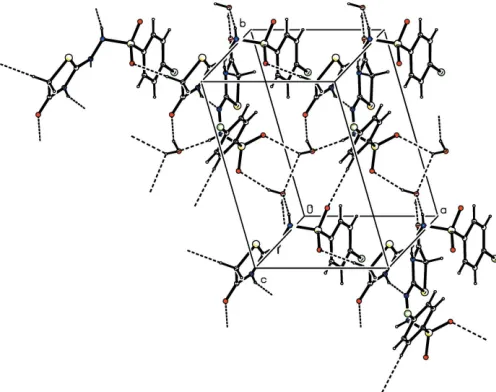
C—H O hydrogen bonds involving the thiazole C—H and a sulfonyl O atom into chains running parallel to the a axis
(Table 1, Fig. 2). The water molecules are involved both in the enforcement of the dimers through N—H O and O—H O hydrogen bonds, formingR3
3(9) rings, and in inter-chain O—
H O hydrogen-bonding interactions, forming layers parallel to theabplane.
4. Database survey
Although a search in the Cambridge. Structural Database (CSD, Version 5.39, update of August 2018; Groom et al., 2016) revealed several reports of the crystal structure of sulfonamides and thiazole (Gowdaet al., 2008, 2009), there are only a few reports on the crystal structures of sulfonyl-hydrazides functionalized by thiazole groups (Zahariaet al., 2010). Comparison of the structure of the title compound with that of N0
-(5-acetyl-4-methyl-4,5-dihydrothiazol-2-yl)benz-enesulfonohydrazide (Zahariaet al., 2010) indicates that the electron-withdrawing chloro group does not impart sufficient inductive effect to reduce the electron density on the benzene ring, and that the ability of the aromatic C—H groups to participate in C—H O interactions is very much reduced.
1570
Paiet al. C9H8ClN3O3S2H2O Acta Cryst.(2018). E74, 1569–1573
[image:2.610.47.296.70.248.2] [image:2.610.313.562.82.213.2]research communications
Table 1
Hydrogen-bond geometry (A˚ ,).
D—H A D—H H A D A D—H A
N1—H1N O7i 0.84 (2) 2.07 (2) 2.900 (6) 168 (4) N3—H3N N5ii 0.85 (2) 2.07 (2) 2.895 (5) 162 (4) C9—H9B O2ii 0.97 2.42 3.236 (6) 141 N4—H4N O8 0.85 (2) 1.95 (2) 2.788 (6) 168 (4) N6—H6N N2iii 0.85 (2) 1.97 (2) 2.808 (5) 170 (4) C15—H15 O1iv 0.93 2.55 3.355 (5) 145 O7—H71 O5 0.82 (2) 2.08 (3) 2.868 (5) 162 (6) O7—H72 O6iv 0.82 (2) 1.99 (2) 2.810 (5) 174 (6) O8—H81 O4ii 0.82 (2) 2.35 (6) 2.987 (6) 136 (7) O8—H81 O7ii 0.82 (2) 2.50 (7) 3.034 (7) 124 (7) O8—H82 O3iii 0.83 (2) 2.37 (3) 3.159 (7) 159 (8)
[image:2.610.315.563.522.718.2]Symmetry codes: (i)x1;yþ1;z; (ii)x1;y;z; (iii)xþ1;y;z; (iv)x;y1;z.
Figure 2
The molecular packing of the title compound, with hydrogen bonds (Table 1) shown as dashed lines.
Figure 1
Partial double-bond character is observed between the hydrazinyl N atom and the adjacent benzothiazole moiety in 2-[2-(3-nitrobenzenesulfonyl)hydrazinyl]-1,3-benzothiazole (Morscheret al., 2018). The orientation of the thiazole ring in the title compound is similar to that of (Z)-methyl 2-[(Z )-4-oxo-2-(2-tosylhydrazono)thiazolidin-5-ylidene]acetate and (Z)-methyl-2-[(Z )-2-(ethylimino)-4-oxo-3-(phenylamino)thia-zolidin-5-ylidene]acetate (Hassanet al., 2016). The molecule of N0-{3-[3-(trifluoromethyl)phenyl]-1,3-thiazol-2(3H
)-yl-idene}benzenesulfonohydrazide (Chenet al., 2015) is observed to have a Schiff base conformation.
5. Hirshfeld Surface Analysis
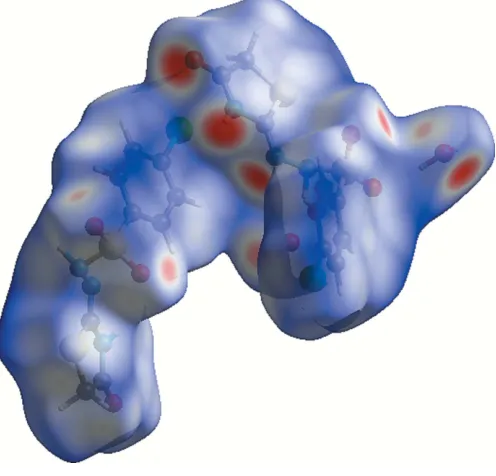
In order to explore the role of weak intermolecular inter-actions in the crystal packing, Hirshfeld surfaces (dnorm) and
related fingerprint plots were generated using Crystal-Explorer17.5 (McKinnon et al., 2007; Spackman et al., 2008; Spackman & Jayatilaka, 2009; Wolff et al., 2012). The three-dimensional molecular Hirshfeld surfaces were generated using a high standard surface resolution over a colour scale of
0.6355 to 1.5137 a.u. fordnorm. To identify the normalized
contacts, the dnorm function is used, which is expressed as;
dnorm= (diri vdw
)/ri vdw
+ (dere vdw
)/re vdw
(Shitet al., 2016), wheredianddeare the distances from internal and external
atoms to the Hirshfeld surface andri vdw
andre vdw
are the van der Waals radii of the atoms inside and outside the surface. On the Hirshfeld surfaces mapped overdnorm(Fig. 3), strong N—
H N and S—O H interactions are observed as red spots close to atoms N5, N6 and O6. Furthermore, the two-dimen-sional fingerprint plots indicate that the largest contributions are from O H/H O contacts, which contribute 32.9% to the Hirshfeld surface (Fig. 4a) with di + de 1.9 A˚ . The
presence of water molecules in the unit cell provides the largest contribution to the stability of the crystal packing. The next largest contributor is from H H interactions, which contribute 22.6%. A single sharp spike can be seen in the middle region of the plot, at di= de= 0.9 A˚ (Fig. 4b). The
N H contacts, which refer to N—H N interactions, contribute 5.3% to the surface. Two sharp spikes havingdi+de
= 1.8 A˚ (Fig. 4c) are observed. The C H contacts contribute 5.9% to the Hirshfeld surface, featuring a wide region withdi+
de= 3.1 A˚ (Fig. 4d). The different interatomic contacts and
percentage contributions to the Hirshfeld surface are Cl H/ H Cl (8.3%), S H/H S (6.1%), Cl O/O Cl (3.0%), Cl C/C Cl (2.4%), S O/O S (1.7%), and C O/O C (1.6%) as depicted in the fingerprint plots (Fig. 5a–f).
research communications
Acta Cryst.(2018). E74, 1569–1573 Paiet al. C
[image:3.610.314.565.71.217.2]9H8ClN3O3S2H2O
1571
Figure 3
View of the Hirshfeld surface mapped overdnorm.
Figure 4
The two dimensional fingerprint (FP) plot for the title compound, delineated into (a) O H/H O, (b) H H, (c) N H/H N and (d) C H/H C interactions. dnorm surfaces for each plot indicating the
[image:3.610.48.296.489.727.2] [image:3.610.115.556.501.710.2]relevant surface patches associated with the specific contacts are shown on the left.
Figure 5
[image:3.610.313.563.508.695.2]6. Synthesis and crystallization
4-Chloro-N0
-(4-oxo-4,5-dihydro-1,3-thiazol-2-yl)1-sulfonohydrazide was prepared by adding 4-chloro benzene-sulfonyl chloride (0.02 mol) under stirring to a solution of thiosemicarbazide (0.02 mol) in 5% aqueous NaOH solution (20 ml). The reaction mixture was stirred at room temperature for 1 h, then diluted twofold with water and neutralized with glacial acetic acid. The solid 2-(4-chlorobenzene-1-sulfonyl)-hydrazine-1-carbothioamide (A) obtained was crystallized from acetic acid. Monochloroacetic acid (0.01 mol) and anhydrous sodium acetate (0.04 mol) were added to A
(0.01 mol) in glacial acetic acid. The reaction mixture was refluxed for 8–10 h and the completion of the reaction was checked by TLC. The reaction mixture was then poured into cold water. The resulted precipitate of the title compound was separated by vacuum filtration. Prismatic colourless single crystals of the title compound were grown from a mixture of acetonitrile-DMF (5:1v/v) by slow evaporation of the solvent. The purity of the compound was checked by TLC and char-acterized by IR spectroscopy. The characteristic IR absorp-tions observed at 3095.9, 1639.5, 1458.7, 1343.2, 1139.4, and 1215.7 cm1correspond to N—H, C O, C N, S O asym-metric and symasym-metric, and C—S absorptions, respectively. The
1
H and 13C spectra of the title compound are as follows:
1
H (400MHz, DMSO-d6);3.45 (d, 2H, –CH2), 7.68–7.86 (m,
4H, Ar—H), 10.01 (s, 1H), 11.96 (s, 1H).13C NMR (400 MHz, DMSO-d6);36.8, 128.4, 129.1, 131.1,132.5, 133.9, 137.2, 165.4,
185.5.
7. Refinement
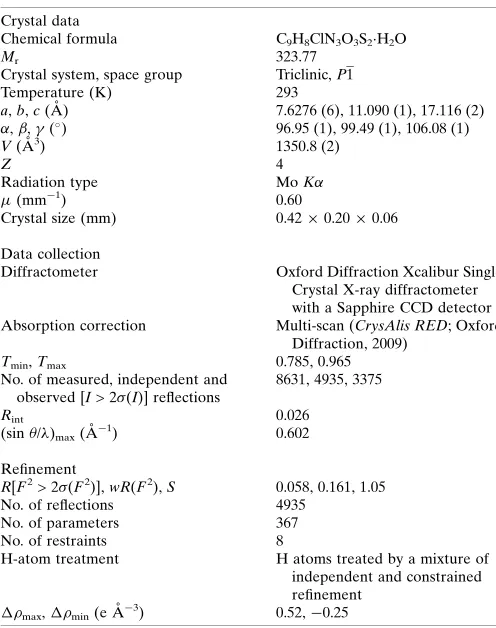
Crystal data, data collection and structure refinement details are summarized in Table 2. H atoms bonded to C were posi-tioned with idealized geometry using a riding model with C— H = 0.93 A˚ (aromatic) or 0.97 A˚ (methylene). The H atoms of the NH groups and the H atoms of the water molecules were located in a difference-Fourier map and later refined with the N—H and O—H bond lengths constrained to be 0.86 (2) and 0.82 (2) A˚ , respectively. All H atoms were refined with isotropic displacement parameters set at 1.2Ueqof the parent
atom.
Acknowledgements
The authors thank the SAIF, Panjab University, for use of the NMR facility.
Funding information
NP thanks the Department of Science and Technology, Government of India, New Delhi, for a research fellowship under its PURSE Program and BTG thanks the University Grants Commission, Government of India, New Delhi, for a special grant under a UGC–BSR one-time grant to faculty.
References
Chen, W., Wang, H.-A., Wei, W., Li, Y.-X., Hua, X.-W., Song, H.-B., Yu, S.-J. & Li, Z.-M. (2015).Chin. J. Struct. Chem.34, 503–509. Dash, B., Patra, M. & Praharaj, S. (1980).Indian J. Chem.19B, 894–
897.
Form, G. R., Raper, E. S. & Downie, T. C. (1974).Acta Cryst.B30, 342–348.
Fre`re, S., Thie´ry, V., Bailly, C. & Besson, T. (2003).Tetrahedron,59, 773–779.
Gowda, B. T., Foro, S., Babitha, K. S. & Fuess, H. (2008).Acta Cryst. E64, o2190.
Gowda, B. T., Foro, S., Nirmala, P. G. & Fuess, H. (2009).Acta Cryst. E65, o2763.
Groom, C. R., Bruno, I. J., Lightfoot, M. P. & Ward, S. C. (2016).Acta Cryst.B72, 171–179.
Hassan, A. A., Mohamed, N. K., El-Shaieb, K. M. A., Tawfeek, H. N., Bra¨se, S. & Nieger, M. (2016).J. Heterocycl. Chem.53, 46–50. Holla, B. S., Malini, V. K., Rao, B. S., Sarojini, K. B. & Kumari, N. S.
(2003).Eur. J. Med. Chem.38, 313–318.
Kamal, A., Khan, M. N. A., Srinivasa Reddy, K. & Rohini, K. (2007). Bioorg. Med. Chem.15, 1004–1013.
Kappe, O. C. (2004).Angew. Chem. Int. Ed.43, 6250–6284. McKinnon, J. J., Jayatilaka, D. & Spackman, M. A. (2007).Chem.
Commun.pp. 3814–3816.
Morscher, A., de Souza, M. V. N., Wardell, J. L. & Harrison, W. T. A. (2018).Acta Cryst.E74, 673–677.
Oxford Diffraction (2009).CrysAlis CCDandCrysAlis RED. Oxford Diffraction Ltd., Abingdon, England.
1572
Paiet al. C9H8ClN3O3S2H2O Acta Cryst.(2018). E74, 1569–1573
[image:4.610.314.562.90.404.2]research communications
Table 2
Experimental details.
Crystal data
Chemical formula C9H8ClN3O3S2H2O
Mr 323.77
Crystal system, space group Triclinic,P1
Temperature (K) 293
a,b,c(A˚ ) 7.6276 (6), 11.090 (1), 17.116 (2) ,,() 96.95 (1), 99.49 (1), 106.08 (1)
V(A˚3) 1350.8 (2)
Z 4
Radiation type MoK
(mm1) 0.60
Crystal size (mm) 0.420.200.06
Data collection
Diffractometer Oxford Diffraction Xcalibur Single Crystal X-ray diffractometer with a Sapphire CCD detector Absorption correction Multi-scan (CrysAlis RED; Oxford
Diffraction, 2009) Tmin,Tmax 0.785, 0.965 No. of measured, independent and
observed [I> 2(I)] reflections
8631, 4935, 3375
Rint 0.026
(sin/ )max(A˚
1) 0.602
Refinement
R[F2> 2(F2)],wR(F2),S 0.058, 0.161, 1.05 No. of reflections 4935
No. of parameters 367
No. of restraints 8
H-atom treatment H atoms treated by a mixture of independent and constrained refinement
max,min(e A˚
3
) 0.52,0.25
Patt, W. C., Hamilton, H. W., Taylor, M. D., Ryan, M. J., Taylor, D. G. Jr, Connolly, C. J. C., Doherty, A. M., Klutchko, S. R., Sircar, I., Steinbaugh, B. A., Batley, B. L., Painchaud, C. A., Rapundalo, S. T., Michniewicz, B. M. & Oslon, S. C. (1992).J. Med. Chem.35, 2562–2572.
Purandara, H., Foro, S. & Thimme Gowda, B. (2017).Acta Cryst.E73, 1683–1686.
Sheldrick, G. M. (2008).Acta Cryst.A64, 112–122. Sheldrick, G. M. (2015).Acta Cryst.C71, 3–8.
Shit, S., Marschner, C. & Mitra, S. (2016).Acta Chim. Slovenica,63, 129–137.
Spackman, M. A. & Jayatilaka, D. (2009).CrystEngComm,11, 19–32.
Spackman, M. A., McKinnon, J. J. & Jayatilaka, D. (2008). CrystEngComm,10, 377–388.
Spek, A. L. (2009).Acta Cryst. D65, 148–155.
Winum, J. Y., Dogne´, J. M., Casini, A., de Leval, X., Montero, J. L., Scozzafava, A., Vullo, D., Innocenti, A. & Supuran, C. T. (2005).J. Med. Chem.48, 2121–2125.
Wolff, S. K., Grimwood, D. J., McKinnon, J. J., Turner, M. J., Jayatilaka, D. & Spackman, M. A. (2012). Crystal Explorer3.1. University of Western Australia.
Zaharia, V., Curticapenan, M., Palibroda, N., Vlasa, M. & Silvestru, A. (2010).Rev. Roum. Chim.55, 831–841.
research communications
Acta Cryst.(2018). E74, 1569–1573 Paiet al. C
supporting information
sup-1
Acta Cryst. (2018). E74, 1569-1573
supporting information
Acta Cryst. (2018). E74, 1569-1573 [https://doi.org/10.1107/S2056989018013658]
Crystal structure and Hirshfeld surface analysis of (
Z
)-4-chloro-
N
′
-(4-oxothia-zolidin-2-ylidene)benzenesulfonohydrazide monohydrate
Nikhila Pai, Sabine Foro and B. Thimme Gowda
Computing details
Data collection: CrysAlis CCD (Oxford Diffraction, 2009); cell refinement: CrysAlis RED (Oxford Diffraction, 2009); data reduction: CrysAlis RED (Oxford Diffraction, 2009); program(s) used to solve structure: SHELXS2013 (Sheldrick, 2008); program(s) used to refine structure: SHELXL2014 (Sheldrick, 2015); molecular graphics: PLATON (Spek, 2009); software used to prepare material for publication: SHELXL2014 (Sheldrick, 2015).
(Z)-4-Chloro-N′-(4-oxothiazolidin-2-ylidene)benzenesulfonohydrazide monohydrate
Crystal data
C9H8ClN3O3S2·H2O Mr = 323.77
Triclinic, P1
a = 7.6276 (6) Å
b = 11.090 (1) Å
c = 17.116 (2) Å
α = 96.95 (1)°
β = 99.49 (1)°
γ = 106.08 (1)°
V = 1350.8 (2) Å3
Z = 4
F(000) = 664
Dx = 1.592 Mg m−3
Mo Kα radiation, λ = 0.71073 Å Cell parameters from 2682 reflections
θ = 2.8–27.8°
µ = 0.60 mm−1 T = 293 K Prism, colourless 0.42 × 0.20 × 0.06 mm
Data collection
Oxford Diffraction Xcalibur Single Crystal X-ray
diffractometer with a Sapphire CCD detector Radiation source: Enhance (Mo) X-ray Source Rotation method data acquisition using ω scans Absorption correction: multi-scan
(CrysAlis RED; Oxford Diffraction, 2009)
Tmin = 0.785, Tmax = 0.965
8631 measured reflections 4935 independent reflections 3375 reflections with I > 2σ(I)
Rint = 0.026
θmax = 25.4°, θmin = 2.8° h = −9→5
k = −13→13
l = −20→20
Refinement
Refinement on F2
Least-squares matrix: full
R[F2 > 2σ(F2)] = 0.058 wR(F2) = 0.161 S = 1.05 4935 reflections 367 parameters 8 restraints
Hydrogen site location: mixed
H atoms treated by a mixture of independent and constrained refinement
w = 1/[σ2(F
o2) + (0.0767P)2 + 1.1929P]
where P = (Fo2 + 2Fc2)/3
(Δ/σ)max = 0.001
Δρmax = 0.52 e Å−3
supporting information
sup-2
Acta Cryst. (2018). E74, 1569-1573
Special details
Geometry. All esds (except the esd in the dihedral angle between two l.s. planes) are estimated using the full covariance matrix. The cell esds are taken into account individually in the estimation of esds in distances, angles and torsion angles; correlations between esds in cell parameters are only used when they are defined by crystal symmetry. An approximate (isotropic) treatment of cell esds is used for estimating esds involving l.s. planes.
Fractional atomic coordinates and isotropic or equivalent isotropic displacement parameters (Å2)
x y z Uiso*/Ueq
supporting information
sup-3
Acta Cryst. (2018). E74, 1569-1573
H11 1.0191 0.6482 0.3273 0.071* C12 0.9484 (6) 0.6473 (4) 0.4349 (3) 0.0605 (12) H12 1.0383 0.7233 0.4607 0.073* C13 0.8276 (6) 0.5797 (4) 0.4762 (3) 0.0540 (11) C14 0.6935 (6) 0.4666 (5) 0.4392 (3) 0.0611 (12) H14 0.6137 0.4207 0.4682 0.073* C15 0.6792 (6) 0.4226 (4) 0.3595 (3) 0.0566 (11) H15 0.5875 0.3474 0.3339 0.068* C16 0.7281 (5) 0.6717 (4) 0.1146 (2) 0.0438 (9) C17 0.8171 (6) 0.8523 (5) 0.0550 (3) 0.0575 (12) C18 0.8040 (7) 0.7499 (5) −0.0134 (3) 0.0652 (13) H18A 0.9219 0.7657 −0.0308 0.078* H18B 0.7080 0.7488 −0.0586 0.078* O7 0.9751 (5) 0.1699 (4) 0.1821 (3) 0.0766 (10) H71 0.880 (5) 0.191 (6) 0.182 (4) 0.092* H72 0.933 (8) 0.112 (4) 0.143 (3) 0.092* O8 0.3062 (6) 0.4099 (6) 0.2195 (4) 0.1111 (16) H81 0.195 (4) 0.390 (7) 0.199 (4) 0.133* H82 0.303 (12) 0.472 (5) 0.250 (4) 0.133*
Atomic displacement parameters (Å2)
U11 U22 U33 U12 U13 U23
supporting information
sup-4
Acta Cryst. (2018). E74, 1569-1573
N5 0.052 (2) 0.044 (2) 0.042 (2) 0.0137 (16) 0.0069 (16) 0.0037 (16) N6 0.057 (2) 0.051 (2) 0.0315 (18) 0.0168 (17) 0.0033 (16) 0.0056 (16) C10 0.038 (2) 0.039 (2) 0.058 (3) 0.0082 (18) 0.0031 (18) 0.0137 (19) C11 0.056 (3) 0.050 (3) 0.061 (3) −0.003 (2) 0.008 (2) 0.020 (2) C12 0.059 (3) 0.039 (3) 0.068 (3) −0.001 (2) −0.006 (2) 0.013 (2) C13 0.057 (3) 0.047 (3) 0.058 (3) 0.021 (2) 0.001 (2) 0.014 (2) C14 0.057 (3) 0.059 (3) 0.063 (3) 0.007 (2) 0.017 (2) 0.015 (2) C15 0.043 (2) 0.047 (3) 0.072 (3) 0.0000 (19) 0.016 (2) 0.006 (2) C16 0.038 (2) 0.050 (3) 0.040 (2) 0.0146 (18) 0.0011 (17) 0.0015 (19) C17 0.052 (3) 0.072 (3) 0.047 (3) 0.016 (2) 0.010 (2) 0.011 (2) C18 0.072 (3) 0.073 (3) 0.049 (3) 0.016 (3) 0.018 (2) 0.011 (2) O7 0.077 (3) 0.065 (2) 0.093 (3) 0.030 (2) 0.013 (2) 0.0167 (19) O8 0.056 (2) 0.146 (5) 0.131 (4) 0.030 (3) 0.029 (3) 0.013 (3)
Geometric parameters (Å, º)
Cl1—C4 1.744 (4) S3—O5 1.441 (3) S1—O1 1.422 (3) S3—N4 1.649 (4) S1—O2 1.438 (3) S3—C10 1.759 (5) S1—N1 1.644 (4) S4—C16 1.746 (4) S1—C1 1.770 (4) S4—C18 1.812 (5) S2—C7 1.741 (4) O6—C17 1.218 (6) S2—C9 1.808 (5) N4—N5 1.442 (5) O3—C8 1.202 (5) N4—H4N 0.850 (19) N1—N2 1.440 (5) N5—C16 1.276 (5) N1—H1N 0.842 (19) N6—C17 1.353 (6) N2—C7 1.285 (5) N6—C16 1.381 (5) N3—C7 1.370 (5) N6—H6N 0.851 (19) N3—C8 1.374 (5) C10—C11 1.389 (6) N3—H3N 0.851 (19) C10—C15 1.390 (6) C1—C6 1.377 (6) C11—C12 1.369 (7) C1—C2 1.385 (6) C11—H11 0.9300 C2—C3 1.389 (6) C12—C13 1.368 (6)
C2—H2 0.9300 C12—H12 0.9300
C3—C4 1.366 (6) C13—C14 1.380 (6) C3—H3 0.9300 C14—C15 1.368 (6) C4—C5 1.379 (6) C14—H14 0.9300 C5—C6 1.381 (6) C15—H15 0.9300 C5—H5 0.9300 C17—C18 1.498 (7) C6—H6 0.9300 C18—H18A 0.9700 C8—C9 1.503 (6) C18—H18B 0.9700 C9—H9A 0.9700 O7—H71 0.82 (2) C9—H9B 0.9700 O7—H72 0.82 (2) Cl2—C13 1.737 (5) O8—H81 0.82 (2) S3—O4 1.426 (3) O8—H82 0.83 (2)
supporting information
sup-5
Acta Cryst. (2018). E74, 1569-1573
O2—S1—N1 105.77 (19) O4—S3—C10 107.8 (2) O1—S1—C1 108.45 (19) O5—S3—C10 108.6 (2) O2—S1—C1 107.88 (19) N4—S3—C10 109.61 (18) N1—S1—C1 108.64 (18) C16—S4—C18 91.4 (2) C7—S2—C9 91.4 (2) N5—N4—S3 112.3 (3) N2—N1—S1 113.6 (3) N5—N4—H4N 106 (3) N2—N1—H1N 106 (3) S3—N4—H4N 97 (3) S1—N1—H1N 107 (3) C16—N5—N4 112.6 (3) C7—N2—N1 111.2 (3) C17—N6—C16 117.8 (4) C7—N3—C8 117.6 (4) C17—N6—H6N 124 (3) C7—N3—H3N 122 (3) C16—N6—H6N 117 (3) C8—N3—H3N 119 (3) C11—C10—C15 119.4 (4) C6—C1—C2 120.4 (4) C11—C10—S3 120.0 (3) C6—C1—S1 119.8 (3) C15—C10—S3 120.6 (3) C2—C1—S1 119.8 (3) C12—C11—C10 120.1 (4) C1—C2—C3 119.6 (4) C12—C11—H11 119.9 C1—C2—H2 120.2 C10—C11—H11 119.9 C3—C2—H2 120.2 C13—C12—C11 119.7 (4) C4—C3—C2 119.0 (4) C13—C12—H12 120.1 C4—C3—H3 120.5 C11—C12—H12 120.1 C2—C3—H3 120.5 C12—C13—C14 121.2 (5) C3—C4—C5 122.1 (4) C12—C13—Cl2 119.4 (4) C3—C4—Cl1 118.6 (3) C14—C13—Cl2 119.4 (4) C5—C4—Cl1 119.2 (3) C15—C14—C13 119.4 (4) C4—C5—C6 118.7 (4) C15—C14—H14 120.3 C4—C5—H5 120.7 C13—C14—H14 120.3 C6—C5—H5 120.7 C14—C15—C10 120.3 (4) C1—C6—C5 120.2 (4) C14—C15—H15 119.9 C1—C6—H6 119.9 C10—C15—H15 119.9 C5—C6—H6 119.9 N5—C16—N6 118.7 (4) N2—C7—N3 119.3 (4) N5—C16—S4 129.9 (3) N2—C7—S2 128.6 (3) N6—C16—S4 111.3 (3) N3—C7—S2 112.1 (3) O6—C17—N6 124.2 (4) O3—C8—N3 123.9 (4) O6—C17—C18 124.6 (4) O3—C8—C9 125.7 (4) N6—C17—C18 111.2 (4) N3—C8—C9 110.4 (4) C17—C18—S4 108.0 (3) C8—C9—S2 108.4 (3) C17—C18—H18A 110.1 C8—C9—H9A 110.0 S4—C18—H18A 110.1 S2—C9—H9A 110.0 C17—C18—H18B 110.1 C8—C9—H9B 110.0 S4—C18—H18B 110.1 S2—C9—H9B 110.0 H18A—C18—H18B 108.4 H9A—C9—H9B 108.4 H71—O7—H72 98 (6) O4—S3—O5 119.9 (2) H81—O8—H82 94 (7)
supporting information
sup-6
Acta Cryst. (2018). E74, 1569-1573
O1—S1—C1—C6 −22.2 (4) O4—S3—C10—C11 23.0 (4) O2—S1—C1—C6 −154.2 (4) O5—S3—C10—C11 154.4 (3) N1—S1—C1—C6 91.6 (4) N4—S3—C10—C11 −93.5 (4) O1—S1—C1—C2 158.0 (3) O4—S3—C10—C15 −157.6 (3) O2—S1—C1—C2 26.0 (4) O5—S3—C10—C15 −26.3 (4) N1—S1—C1—C2 −88.2 (4) N4—S3—C10—C15 85.8 (4) C6—C1—C2—C3 −1.2 (6) C15—C10—C11—C12 −0.4 (7) S1—C1—C2—C3 178.6 (3) S3—C10—C11—C12 179.0 (4) C1—C2—C3—C4 −0.1 (6) C10—C11—C12—C13 0.6 (7) C2—C3—C4—C5 1.2 (7) C11—C12—C13—C14 0.2 (7) C2—C3—C4—Cl1 −177.7 (3) C11—C12—C13—Cl2 −179.1 (3) C3—C4—C5—C6 −1.1 (7) C12—C13—C14—C15 −1.2 (7) Cl1—C4—C5—C6 177.9 (4) Cl2—C13—C14—C15 178.1 (4) C2—C1—C6—C5 1.4 (7) C13—C14—C15—C10 1.3 (7) S1—C1—C6—C5 −178.4 (4) C11—C10—C15—C14 −0.6 (7) C4—C5—C6—C1 −0.3 (7) S3—C10—C15—C14 −179.9 (4) N1—N2—C7—N3 −176.1 (3) N4—N5—C16—N6 −179.6 (3) N1—N2—C7—S2 5.0 (5) N4—N5—C16—S4 0.8 (5) C8—N3—C7—N2 178.3 (4) C17—N6—C16—N5 −174.4 (4) C8—N3—C7—S2 −2.6 (5) C17—N6—C16—S4 5.3 (5) C9—S2—C7—N2 −179.0 (4) C18—S4—C16—N5 174.5 (4) C9—S2—C7—N3 2.0 (3) C18—S4—C16—N6 −5.1 (3) C7—N3—C8—O3 −178.6 (4) C16—N6—C17—O6 177.6 (4) C7—N3—C8—C9 1.6 (5) C16—N6—C17—C18 −2.1 (5) O3—C8—C9—S2 −179.7 (4) O6—C17—C18—S4 178.5 (4) N3—C8—C9—S2 0.0 (5) N6—C17—C18—S4 −1.8 (5) C7—S2—C9—C8 −1.1 (3) C16—S4—C18—C17 3.9 (3)
Hydrogen-bond geometry (Å, º)
D—H···A D—H H···A D···A D—H···A
N1—H1N···O7i 0.84 (2) 2.07 (2) 2.900 (6) 168 (4)
N3—H3N···N5ii 0.85 (2) 2.07 (2) 2.895 (5) 162 (4)
C9—H9B···O2ii 0.97 2.42 3.236 (6) 141
N4—H4N···O8 0.85 (2) 1.95 (2) 2.788 (6) 168 (4) N6—H6N···N2iii 0.85 (2) 1.97 (2) 2.808 (5) 170 (4)
C15—H15···O1iv 0.93 2.55 3.355 (5) 145
O7—H71···O5 0.82 (2) 2.08 (3) 2.868 (5) 162 (6) O7—H72···O6iv 0.82 (2) 1.99 (2) 2.810 (5) 174 (6)
O8—H81···O4ii 0.82 (2) 2.35 (6) 2.987 (6) 136 (7)
O8—H81···O7ii 0.82 (2) 2.50 (7) 3.034 (7) 124 (7)
O8—H82···O3iii 0.83 (2) 2.37 (3) 3.159 (7) 159 (8)