Agrienvironmental measures were applied since 2004 as a part of the rural Development Plan (rDP) in order to support the environmental dimension of the multifunctional role of agriculture. The main objective of agrienvironmental measures is to support the environmentally acceptable farming methods, the application of soil protection measures and the renewal of ecostabilization factors in agricultural land, as well as the protection and preservation of biodiversity in agriculture.
The project measure “Agrienvironment and animal welfare conditions” in 2004–2006 programming pe-riod was the one that attracted the highest number of applications.
METHODOLOGY
The basic data for the analysis of businesses that participated in the agrienvironmental programme (AEP) rDP 2004–2006 originated from the question-naire survey which took place in summer 2007. The questionnaire contained a number of questions related to the activities of the AEP participants, as regards the use of subsidization resources, the structure of land fund, the parameters of crop production, the motivation and issues related to writing of projects, environmentally friendly farming practices and waste management. The target group consisted of partici-pants under the Measure no 5 “Agrienvironment and
The agrienvironmental programme in Slovakia,
in 2004–2006
Agroenvironmentálny program na Slovensku v rokoch 2004–2006
M. Brodová
Research Institute of Agricultural and Food Economics, Bratislava,
Slovak Republic
Abstract: Main objective of the agrienvironmental measures is to support the environmentally acceptable farming methods, the application of soil protection methods, as well as the protection and maintaining of biodiversity in agricultu-ral landscape. The project measure Agrienvironment and animal welfare conditions in the 2004–2006 programming period was the one that attracted the highest number of applications. The total area of land farmed in compliance with the require-ments under the agrienvironmental measure represented about one fifth of the total area of agricultural land in Slovakia by the end of 2006. The largest portion of the area has been farmed by legal persons. The article presents the evaluation of the selected data in a questionnaire survey among businesses involved in the agrienvironmental programme, mostly related to the structure of land fund, employment, motivation, production and diversity of farm coverage.
Key words: agrienvironmental programme, questionnaire survey, production, sales, landscape coverage of a farm
Abstrakt: hlavným cieľom agroenvironmentálnych opatrení je podpora environmentálne prijateľných spôsobov hospo-dárenia na pôde, uplatňovanie pôdoochranných opatrení a takisto ochrana a uchovanie biodiverzity v poľnohospodárskej krajine. V programovom období 2004–2006 bol Agroenvironment a životné podmienky zvierat najžiadanejším projektovým opatrením Plánu rozvoja vidieka. celková výmera pôdy obhospodarovanej v súlade s požiadavkami agroenvironmentálneho opatrenia predstavovala ku koncu roka 2006 približne pätinu z celkovej poľnohospodárskej pôdy na Slovensku. najväčšiu časť tejto výmery obhospodarujú právnické osoby. Príspevok obsahuje vyhodnotenie vybraných údajov dotazníkového prieskumu subjektov zapojených do agroenvironmentálneho programu, najmä vo vzťahu k štruktúre pôdneho fondu, zamestnanosti, motivácii, produkcii a diverzite pokryvu farmy.
animal welfare conditions” in the rural Development Plan for 2004–2006.
Questionnaires were delivered to 757 participants in the Agrienvironmental Programme (AEP) and re-quested numerical data describing the condition as of 31st December 2006. Some 68.3% of questionnaires were completed and returned, which represents 517 respondents who chose to participate in the survey. Participants in the survey included 198 agricultural cooperatives, 164 limited liability companies, 136 private farmers and 13 joint stock companies.
Most participants in the survey were located in the Prešov (28.4%) and Banská Bystrica region (21.6%), and the least number (1.9%) came from the Bratislava region.
The following statistical methods were used in the evaluation of questionnaires:
– Pearson χ2 goodness-of-fit test, – Methods of descriptive statistics – Shannon diversity index (ShDi).
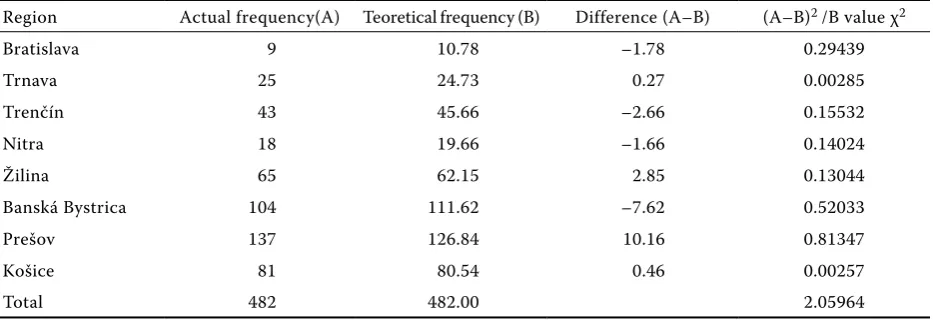
Pearson χ2 goodness-of-fit test was used to test the match of empirical distribution f(x) (collection of enti-ties in the AEP which took part in the questionnaire survey) with the theoretical model g(x) (collection of all participants in the AEP). The distributions were determined by frequency tables. The match or the difference is formally expressed by the hypotheses
H0 :f(x) = g(x)
H1 : f(x) ≠ g(x)
The resulting p-value (0.956) was larger than 0.05 value(α = 0.05), therefore, the H0 hypothesis could be confirmed, at the significance level of 0.05 and the number of all AEP entities by regions matched the number of entities which took part in the question-naire survey.
The value of χ2 = 2.059, critical sector is limit-ed from below by the quantile χ2
[image:2.595.66.533.583.743.2]1-α (c-1) = χ2 0.95 (7) = 14.1. Since χ2 < 14.1, we can confirm the match of both distributions at the significance level of 0.05 (Table 1).
The Shannon’s Diversity Index (SHDI) quantifies the diversity of landscape area that depends on two key components – the number of different types of land cover and their proportional distribution.
The ShDi value is rising with increasing number of landscape cover types and/or if the proportional dis-tribution of various types of land covers is balanced. The ShDi could be treated as a relative index which allows comparison of various types of land areas or to compare changes of land areas in time.
RESULTS AND DISCUSSION
over the period of three years, the area of agricul-tural land in organic farming system grew three times which represents 5.6% of the total area of agricultural land in the Sr (according to the LPiS). The priority of the Action Plan for Development of organic Farming in the Sr until 2010 was to increase the area of land for organic farming to at least 5% of the total area. This objective was fulfilled. The research brought some evidence that the practice of organic farmers is also based on a specific approach to nature, which is an essence of non-conventional farming. Another interesting finding was the extent to which the or-ganic farmers valued non-production functions of their agricultural activities (zagata 2007). The con-sumers’ interest in organic products is increasing in the developed states. This results in the increasing consumption of organic foodstufs that have got a higher nutritious value given mainly by the higher
Table 1. calculation of χ2 value
region Actual frequency(A) Teoretical frequency (B) Difference (A–B) (A–B)2 /B value χ2
Bratislava 9 10.78 –1.78 0.29439
Trnava 25 24.73 0.27 0.00285
Trenčín 43 45.66 –2.66 0.15532
nitra 18 19.66 –1.66 0.14024
Žilina 65 62.15 2.85 0.13044
Banská Bystrica 104 111.62 –7.62 0.52033
Prešov 137 126.84 10.16 0.81347
Košice 81 80.54 0.46 0.00257
Total 482 482.00 2.05964
content of magnesium and ferrum, a higher hygienic quality given by the growing without pesticides and usually also a lower content of nitrates in the organic products. The organic products embody usually a higher technological quality, because they are easier to store and not in the least a higher sensory quality (Živělová, Jánský 2007).
The land area where the conditions of the basic scheme farming were maintained represented 15.8% of the total area of agricultural land. A substantial part of this area of agricultural land was included in the sub-measure protection against erosion of arable land and grassing of arable land.
The largest areas of agricultural land in the Agrienvironment, in breakdown by regions (all sub-measures) were concentrated in the Prešov (29.8%) and Banská Bystrica region (20.4%) and the smallest area was located in the nitra region (2.4%).
The highest percentage of the total area of agri-cultural land per region in the basic scheme and in the organic farming was recorded in the Prešov region (basic scheme 32.9%, organic farming 12%), and the lowest percentage was recorded in productive land in the nitra region (basic scheme 1.7%, organic farming 0.7%).
As of 31st December 2007, the Agricultural Payment Agency paid out SKK 4.12 billion in subsidies to those businesses which implemented the Agrienvironment measure. The main bulk of this amount (28.2%) was allocated to the Prešov region.
Structure of land fund and employment
The area of land farmed by enterprises that took part in the questionnaire survey represented some 513,000 ha. The largest part (52%) of this area was
farmed by cooperatives, followed by limited liability companies (36%) and joint stock companies (almost 6%). overall, this means that of the AEP subjects that took part in the questionnaire survey, some 94.17% of land were farmed by legal persons. natural persons involved in the AEP and in questionnaire survey farmed at 5.83% of the agricultural land with the highest concentration in the Košice region.
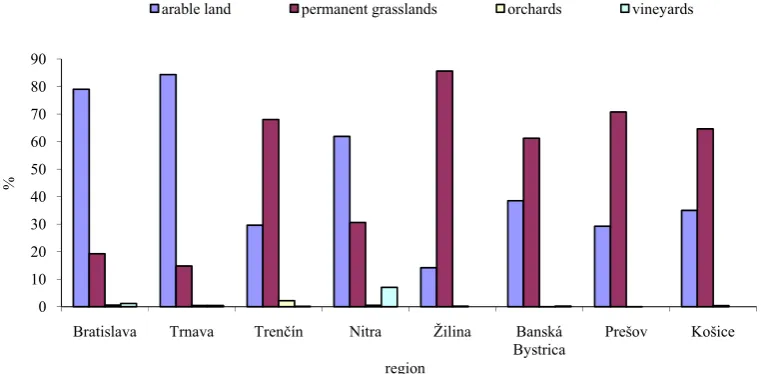
The structure of land fund in the AEP in the area of the surveyed agricultural subjects consisted of arable land – 34.4%, permanent grasslands – 65%, orchards – 0.3%, and vineyards – 0.2%.
The highest share of arable land in the total area of agricultural land in the AEP was recorded in the Trnava, Bratislava and nitra regions, while the high-est share of permanent grasslands was found in the Žilina region (Figure 1).
An argument often brought forward in favour of the agrienvironmental support is an increase in labour employed compared to the conventional way of land management.
The average number of employees per 100 ha stood at 3.28 in subjects that took part in the questionnaire survey, which represents about 52% of the average number of workers per 100 ha in the nitra region. The lowest average value (2.37) was found in the Košice region that represents 72.3% of the average value for the total sample of respondents.
in breakdown by legal forms of business, the lowest average number of employees per 100 ha (2.56) was recorded in the group of limited liability companies and joint stock companies, and the highest value (3.71) was recorded in the group of private farmers. This suggests a higher proportion of manual labour and lesser availability of production technology in this group.
0 10 20 30 40 50 60 70 80 90
Bratislava Trnava Trenþín Nitra Žilina Banská
Bystrica Prešov Košice
%
region
[image:3.595.111.497.547.734.2]arable land permanent grasslands orchards vineyards
The increasing share of manual labour in crop pro-duction after joining the AEP was reported by 35.8% of the total number of respondents. in breakdown by regions, 55.6% of respondents in the Bratislava region and 50% in the nitra region stated that the necessity of manual labour grew after they introduced the AEP. 56.8% of respondents stated no change most of them were located in the Trenčín, Banská Bystrica and Žilina regions. The reduction of manual labour was recorded by 7.4% respondents, most of them in the Trnava region.
increased need for manual labour in animal pro-duction after joining the AEP was reported by 21.2% respondents, most of them in Žilina and Košice re-gions.
in the category of animal production, the share of respondents who did not report any change in the need for manual labour after joining the AEP was higher (74%). The highest growth of manual labour in animal production was reported by subjects in the Košice (27.16%) and Žilina regions (26.15%), and the lowest growth was reported in the nitra region (5.56%).
in the percentage terms, the share of manual la-bour in crop production grew in average by 5.9% for the entire collection. in breakdown by regions, the highest growth was recorded in the nitra region (14.17%) and the lowest in the Trnava region (2.68%). The average growth in the need for manual labour in animal production was lower than in the case of crop production (growth by 3.44%). The highest growth of need for manual labour was recorded in the Bratislava region (17.5%).
The support to less favoured areas is part of the second priority in the rDP – protection and im-provement of rural environment. According to the rDP 2004–2006, the preservation of cultural land-scape and protection of environment in these areas is closely related to agrienvironmental support, because most agricultural businesses in less favoured areas were expected to join the AEP. 61% of the surveyed agricultural subjects in the AEP farmed at less fa-voured areas, or received subsidies for less fafa-voured areas. The highest percentage (17.7%) of respondents farming in less favoured areas was recorded in the Prešov region. Also, of the total number of respond-ents in less favoured areas, most were located in the Prešov region (29.15%).
Motivation and project preparation
The key motivation for 53.1% of respondents to join the AEP was the utilisation of natural conditions. Most respondents who stated the above were located in the
Žilina, Trenčín and Košice region. 39% of respondents joined the AEP for economic reasons, most of them located in the Trnava and nitra regions. About 1% of respondents cited other reasons which were mostly related to the continuity of organic farming in the period after the accession to the EU.
State institutions (Ministry of Agriculture and Agricultural Payment Agency -APA) were the main source of information on the AEP, for both legal and for natural persons. however, natural persons received information from more diversified sources than legal persons, largely through communication with the neighbouring entities, through media and contacts with non-profit organisations.
Prior to the EU accession, some 35% of the AEP subjects used state environmental payments (60% carried out grassing, 53% land reclamation meas-ures and 25% of subjects were involved in organic farming).
in breakdown by legal forms of business, the co-operatives held the highest portion (18.2%) in the environmental activities in the past. on the other hand, the number of private farmers benefiting from environmental payments was relatively low (7.6% of the total number of subjects which used environ-mental subsidies before the EU accession); although their number increased almost 10 times after the EU accession.
80% of the total number of respondents stated that the entire area included in the AEP was rented out by land owners. This incurs risks related to the land rental for at least 5 years, as stipulated by the eligibility criteria for the agrienvironmental subsidy.
80% of the respondents did not state any issues re-lated to rental of land included in AEP. however, 20% of the respondents cited reasons mostly related to: – breach of the rental contract by land owner - land
owners do not respect
– rental contracts and request the land to be released for alternative use, or they want to sell the rented land,
– reluctance of land owners to enter into contracts for longer periods (5 and more years),
– excessive requirements of land owners associated with the amount of rent,
– new ground plans of development in municipali-ties.
Almost 8% of respondents mentioned difficult project preparation.
The most frequent reasons included:
– excessive bureaucracy associated with project preparation,
– problems regarding issuing certificates on the oc-currence of the protected biotops,
– lack of willingness on the part of the APA employ-ees to provide a more detailed information and the incomplete methodology which was constantly changing and revised,
– short period from publication of the call until the date of project submission.
Most of the subjects (60%) used the services provided by private consultancy agencies to prepare the project and 28.4% of subjects prepared the projects them-selves. 7.8% of respondents used services of the state funded consultancy agencies and 3.7% of agricultural subjects used services of other institutions.
in breakdown by legal form of business, the services provided by agencies not funded by state were used mostly by legal persons. Private farmers were the smallest group to use these services. on the other hand, the highest portion of private farmers prepared their projects by themselves (39.7%).
one of the objectives of the rural Development Programme for 2007–2013 is the physical growth of the land area in agrienvironmental programme to 650 000 ha.
The largest part of agricultural subjects (49.8%) stated they plan to continue their involvement in the AEP without any change, 35.6% expect the area/AEP activities to expand – mostly subjects farming in the
Tn and KE regions. only 2.3% of the AEP partici-pants plan to discontinue the AEP activities - they were mostly concentrated in the lowland productive regions.
Production and sales
The agrienvironmental support as part of the rural Development Programme has been based on the rule of financial compensation. This is caused by the limitations in the process of production, i.e. the compensation of lower income due to the limited production intensity and additional costs associ-ated with the required activities beyond the scope of good farming practices. A participant in the AEP must adopt these practices in the total area farmed by his/her holding, including the areas that are not covered by the AEP.
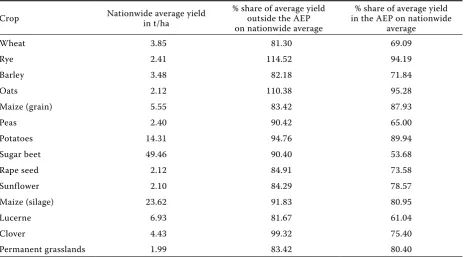
[image:5.595.68.533.488.745.2]The size of payment takes into account the differ-ence in production for the normal use of arable land and the methods that are adopted under the AEP. The difference is reduced by the amount of saved costs – less fertilizers – max. 80% of the annual dose of nitrogen organic fertilizers determined by the rules of good farming practices, and the pesticide doses (only by the permission of central and Testing institute in Agriculture) with added costs related to the higher labour consumption that is necessary to comply with the conditions for farming of arable land. The AEP
Table 2. Percentage of the main crop average yields outside the AEP and in the AEP on the nationwide average (nation-wide average in t/ha = 100)
crop nationwide average yield in t/ha % share of average yield outside the AEP on nationwide average
% share of average yield in the AEP on nationwide
average
Wheat 3.85 81.30 69.09
rye 2.41 114.52 94.19
Barley 3.48 82.18 71.84
oats 2.12 110.38 95.28
Maize (grain) 5.55 83.42 87.93
Peas 2.40 90.42 65.00
Potatoes 14.31 94.76 89.94
Sugar beet 49.46 90.40 53.68
rape seed 2.12 84.91 73.58
Sunflower 2.10 84.29 78.57
Maize (silage) 23.62 91.83 80.95
Lucerne 6.93 81.67 61.04
clover 4.43 99.32 75.40
Permanent grasslands 1.99 83.42 80.40
farming is expected to achieve reduced crop yields – 20% in the case of wheat, 25% for barley and 30% for rape.
The average yields for the main crops grown by the respondents (although these were crops grown on areas not covered by the AEP, but the rules of good farming practice are also mandatory for these areas) were lower than the nationwide average published by the So Sr. The difference was even higher in case of crop yields in the areas covered by the AEP (Table 2).
The most significant difference in the average crop yields in areas outside the AEP and in the AEP was recorded in the sugar beet crop yield. in average, the crop yield in the AEP areas was by 40.6% lower than in the areas (outside the AEP) where the rules of good farming practice had to be observed. The dif-ferences of more than 20% were recorded in the case of lucerne and clover. The difference in the average crop yield for the key market crops (wheat, barley, oil rape) ranged from 10 to 15%.
The comparison of the average crop yields in Slovakia (published by the So Sr) shows that the key agricultural crops grown on the AEP land experienced a lower yield than the crops grown on the non-AEP land. The only exception was oats and rye grown on the non-AEP land. compared to the average for Slovakia, the lowest crop yield on the non-AEP land was recorded in the case of wheat (-18.7%), and the lowest crop yield on the AEP land was recorded in the case of sugar beet (-46.32%). For the key market
commodities grown on the AEP land, the crop yield of wheat was lower by 31% than the Slovak average, by 28.2% in the case of barley, and by 26.4% in the case of oilseed rape.
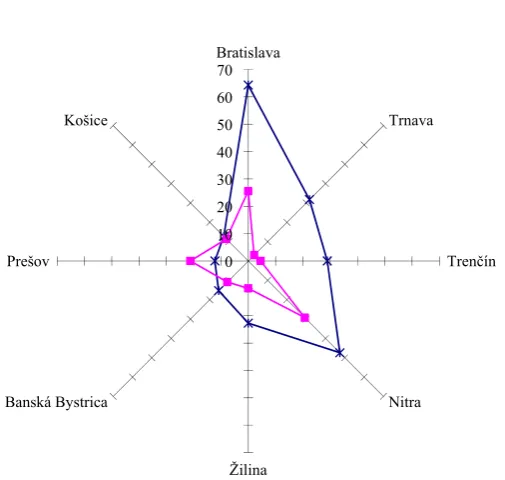
The sales figures were based on the findings in a collection of 399 AEP respondents, in breakdown by regions and legal form of business. The average amount of sales of own products and services (sales) in the whole collection of respondents stood at SKK 17 530 per hectare of agricultural land, although there were significant differences between regions.
The sales in the group of legal persons achieved almost SKK 19 000 per hectare of agricultural land and the highest sales per hectare were recorded in the Bratislava (SKK 64 270 per hectare of ag. land) and in the nitra regions (SKK 47 460 per hectare of ag. land). The average sales achieved by natural persons (private farmers) stood at SKK 13 120 per hectare of ag. land, although, the highest sales in breakdown by regions were again achieved in the nitra and Bratislava regions (Figure 2). relatively high sales were also recorded by private farmers in the Prešov region (SKK 21 210 per hectare of ag. land), while the legal persons farming in the same region posted the worst results in this group (only 64% of average sales per hectare in the group of legal persons).
of the total number of respondents, 87.7% gener-ate their sales in animal production, 78.7% sell crop production and 50.4% provide services in agriculture. The lowest share of respondents (only 3%) reported sales in forestry activities. The agritourism services are
0 10 20 30 40 50 60 70 Bratislava
Trnava
Trenþín
Nitra
Žilina Banská Bystrica
Prešov Košice
[image:6.595.175.428.494.734.2]legal persons natural persons
provided by 7.5% respondents, with the highest per-centage in the Žilina and Banská Bystrica regions.
The highest share of respondents in the group of legal persons was found in the category of subjects that carry out 3 economic activities (24.6% of the total number of respondents) and the lowest share (1%) was recorded in the category with 8 activities. The highest percentage share in the group of natural persons was represented by the category with one economic activity.
Diversity of agricultural landscape
one of the reasons for introduction of the agrienvi-ronmental subsidy is the important task of agriculture in forming the rural landscape and its diversity. The biodiversity was significantly reduced, especially in the lowland areas that were subject to intensive farming (not compliant with the good farming practices) and also in the mountain areas where the valuable agrie-cosystems are on the decline due to the abandonment of agricultural landscape. The AEP has supported biodiversity, as well as the diversity of landscape area by requesting compliance with the established condi-tions for balanced crop rotation without mono cultures (which means that any intensive crops – cereals, oil seed crops and root crops must not exceed the area of 50% of arable land subject to farming).
Diversity of the individual subjects involved in the AEP was established by means of the ShDi. The ShDi value is rising with the increasing number of landscape cover types and/or in the case of the un-balanced proportional distribution of various types of land covers.
The categories of land covers were used to deter-mine the ShDi, namely the areas sown with cereals, maize, legumes, root crops, oil seed crops,
multian-nual feeding crops, permanent grasslands, vineyards, orchards, vegetables, and other areas.
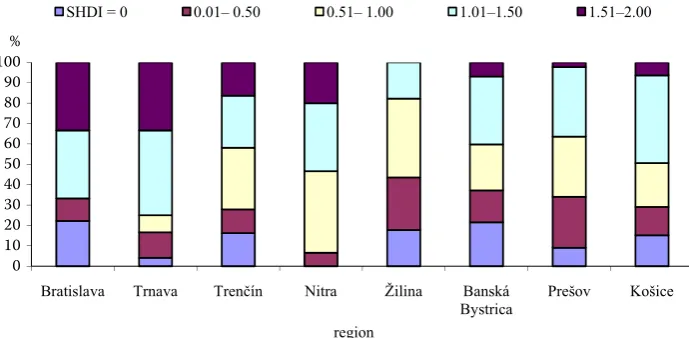
Most of the respondents (17.6%) that took part in the questionnaire survey achieved the ShDi value ranging from 1.26 to 1.50 which has been ranked as a relatively high diversity. The ShDi values above 1.50 represent a high degree of diversity. This value was achieved by 7.5% of subjects that joined the AEP.
zero ShDi was found with 14.4% of subjects. This means that their farmed area is covered by a homog-enous land cover. This applies especially to the farms of private farmers (8%) who specialize in cattle or sheep rearing and the total area of their farmed land is covered with permanent grasslands (especially in the Žilina and Banská Bystrica regions). Some 5.5% of legal persons also achieved zero diversity of farm land cover. These are mostly enterprises in the Banská Bystrica, Žilina and Trenčín regions (Figure 3).
The ShDi value less than 1 was achieved by 45% of the total number of respondents and values higher than 1 were reported by 40.6% of respondents.
The average size of land parcel in the monitored collection of the AEP subjects represented 15.66 ha. The average size of land blocks in the Trenčín, nitra and Prešov regions were below that level, and the low-est level was recorded in the Banská Bystrica region (10.77 ha) where a substantial portion of agricultural land was classified as a slope or sheer (slope inclina-tion above 12°). The condiinclina-tions for protecinclina-tion against erosion stipulate the acceptable size of land block. This means that the land with slope inclination of 3–10% (i.e. 2– 6°) and land parcels larger than 30 ha must be split into smaller blocks, using at least 10 meters wide stabilisation grass strips.
The largest average size of a land block was recorded in the Trnava region (26.3 ha), where more than 80%
0% 10% 20% 30% 40% 50% 60% 70% 80% 90% 100%
Bratislava Trnava Trenþín Nitra Žilina Banská
Bystrica Prešov Košice
region
[image:7.595.156.501.559.728.2]SHDI = 0 0.01– 0.50 0.51– 1.00 1.01–1.50 1.51–2.00
Figure 3.Percentage share of subjects in the AEP according to the ShDi value Source: Questionnaire survey riAFE 2007
of agricultural land achieved a slope inclination of 0–7°. These are flat or slightly sloping areas with a lower risk of surface erosion.
The average size of land block ranged from 5 to 10 ha in 32% of subjects. For 89% of subjects, the average size of a land block did not exceed 30 ha. in general, this is considered to be a limit size for a parcel with an increased risk of negative effects caused by water erosion. on the positive side, the land blocks smaller than 30 ha contribute to landscaping patterns. Also important is the combination of land blocks and natural and semi-natural ecostabilization compo-nents (windbreaks, tree alleys, shrubberies, etc.). This largely contributes to the diversity and attractivity of the landscape and also has a positive impact on the biodiversity of habitats on agricultural land.
CONCLUSION
Agrienvironment has been an rDP project measure that attracted the highest number of applications in 2004–2006. The total area of land farmed in compli-ance with the requirements under the agrienviron-mental measure represented some 17.4% of the total area of agricultural land in Slovakia by the end of 2006 and about 16% of the total number of agricul-tural subjects. The largest part of this area is farmed by legal persons which represent 94.17% of the area farmed by enterprises that joined the AEP and took part in the questionnaire poll. natural persons who joined the AEP and took part in the questionnaire poll farmed at 5.83% of the agricultural land. Most subjects in the agrienvironmetal programme are located in less favoured areas.
one of the objectives of the rural Development Programme for 2007–2013 is the physical growth of the land area in the agrienvironmental programme to 650 000 ha. Almost half of the agricultural subjects plan to continue operating under the AEP without any change and about one third of respondents expect to expand the area or their operations under the AEP.
The agrienvironmental support within the rural Development Programme is based on the rule of financial compensation which results from the limi-tations in production process.
The average yields for main crops grown by the respondents (although these were crops grown on areas not covered by the AEP, but the rules of good farming practice are also mandatory for these areas) were lower than the nationwide average published by the So Sr. The difference was even higher in case of crop yields in the areas covered by the AEP.
one of the reasons behind the introduction of the agrienvironmental support was the important task of agriculture in the formation of rural landscape and its diversity.
The diversity of the AEP subjects was ranked, using the ShDi. The ShDi value is rising with the increas-ing number of landscape cover types and/or in the case of the unbalanced proportional distribution of various types of land covers.
Almost one quarter of respondents who took part in the survey achieved the ShDi value above 1.25 which might be evaluated as a fairly high diversity of farm cover. The ShDi values above 1.5 describe a high degree of diversity which was achieved by 7.5% of subjects involved in the AEP.
REFERENCES
Božík M., Brodová M., Molčanová J., Fitz M. (2007): Environmentálne politiky a ich vplyv na ekonomiku poľnohospodárskych produkčných systémov (En-vironmental policies and their impact on econom-ics of agricultural production systems). VÚEPP, Bratislava; iSBn 978-80-8058-481-8.
Ministry of Agriculture of the Slovak republic (2004): rural Development Plan 2004–2006. Available at http://www.land.gov.sk/index.php? naviD=116&id=62
Ministry of Agriculture of the Slovak republic (2007): rural Development Programme of the Slovak re-public 2007–2013. Available at http://www.land. gov.sk/en/index.php?naviD=1&id=19
zagata L. (2007): Bio cash-cow? context and content of czech organic farming. Agricultural Economics. – czech, 53 (1): 45–53.
Živělová i., Jánský J. (2007): The conditions of or-ganic market development. Agricultural Economics – czech, 53 (9): 403–410.
Arrived on 27th november 2008
Contact address:
Martina Brodová, research institute of Agriculture and Food Economics, Trenčianska 55, 824 80 Bratislava, Slovak republic