The present Common Agricultural Policy (CAP) faces demanding objectives. Not only in the view-point of their content, but also whether there will be a political will to fulfill these aims. In the light of the subject aspects, the present aims are oriented in two pivotal areas – two basic pillars. The first pillar of the Common Agricultural Policy is based on fulfillment of the production competitiveness of the European agricultural model. The content of the second pillar is linkage of the development agriculture with rural regions development. The sense of the measures
of both pillars is the sustenance of social stability in the agrarian sector and in the countryside, and fulfillment of a social order, which exists in relation to agriculture and the country.
The quality and ways of realization of measures leading to the fulfillment of the above mentioned aims will depend, among others, at present more than before, on the following processes:
– Economical approaches – based on knowledge of problems (relevant, well-founded, thorough and well processed information of the matter-of-fact
Structural changes of incomes of agricultural producers
based on knowledge approach
Strukturální změny příjmů zemědělských producentů založené
na znalostním přístupu
I. BOHÁČKOVÁ
Czech University of Agriculture, Prague, Czech Republic
Abstract: The paper is focused on the actual problems of agricultural producers’ incomes. Currently these become one of the monitored descriptors of maintaining of social stability in agriculture and in the countryside. There is not judged the height and the income development in the article, but the attention is paid to their structure. Concretely, the relation between incomes, which come from the entrepreneurial activity of producers, and the supports, which farmers get in the frame of the Common Agrarian Policy, is monitored. The aim is to draw attention to the possibility of a certain future dis-proportion towards strengthening of subsidiary means in the total incomes, which could dampen the own entrepreneurial activities. At the same time, it is necessary in this context to solve also methodological aspects of income level monitoring in agriculture. The European Union (Eurostat) makes available several variants of monitoring. Nevertheless, it is essential that the methodology was unambiguous and transparent, so that the incomes in agrarian sector could be unambiguously quantified. Last but not least, the attention is called to a strong influence of the knowledge approach within fulfillment of the European agricultural model.
Key words: agrarian sector, incomes of agricultural producers, subsidiary means, methodology of income monitoring, in-come structure, knowledge approach to fulfillment of European agricultural model
Abstrakt: Příspěvek je zaměřen na aktuální problematiku příjmů zemědělských producentů. Tyto se v současné době staly jedním ze sledovaných deskriptorů udržování sociální stability v zemědělství a na venkově. Ve stati není posuzována výše a vývoj příjmů, ale pozornost je zaměřena na jejich strukturu. Konkrétně je sledován vztah mezi příjmy, které pocházejí z podnikatelské aktivity producentů, a podporami, které zemědělci dostávají v rámci Společné zemědělské politiky. Smyslem je upozornit na možnost určité budoucí disproporce ve směru posilování podpůrných prostředků v celkových příjmech, která by mohla tlumit vlastní podnikatelské aktivity. Zároveň je třeba v této souvislosti řešit i metodické aspekty sledování příjmové úrovně v zemědělství. Evropská unie (Eurostat) dává k dispozici několik variant sledování. Přitom je nutné, aby metodika byla jednoznačná a transparentní, aby příjmy v agrárním sektoru mohly být jednoznačně kvantifikovány. V ne-poslední řadě je pak upozorňováno na silný vliv znalostního přístupu při naplňování evropského modelu zemědělství.
character) – both knowledge of sector problems for agrarian-political decision making and knowledge used individually in the conditions of every entre-preneurial subject, whose aim is the prosperity. – Second side is then at the sector level a political will
to use that knowledge. If there is a rumour about “political” activities towards agriculture, mostly it is dealt with the side of financing, when member states of the European Union are not quite uniform in the opinion what dimension the agricultural financing should represent. Among the active states in this question, there belong first of all the Great Britain, France and Germany, but also opinions of other countries, including the new ten, are indispensable. It is quite dangerous to narrow discussions about the problems of agriculture “only” to the area of financing, despite the fact that this area belongs to the most important. It can be assumed that no less significant area for success of agrarian policy is the support of entrepreneurial “independence” of agricultural enterprises, the choice of tools which would strengthen this enterprise, and not on the contrary to dampen it, as it is just in case of the EU subsidiary policy (Svatošová et al. 2005).
At any level and in any area, it is not possible to make correct decisions without deep knowledge of problems resulting from the analysis of a state, possibilities and ways which can be used to fulfill the set aims.
AIMS AND METHODOLOGY
Sustenance of social stability of agriculture and the countryside concerns in fact the sustenance of the desirable income level of agricultural producers (rural inhabitants). We get to the basic question, with which the agricultural policy deals at both the Union and the national levels, it means – how to ensure a corresponding income level for farmers in present conditions. If we stem from the basic presumption that if we want to react correctly, to make efficient economic decisions, we have to know well the prob-lems, it is possible to state in the area of agricultural incomes, that we do not have an absolutely exact information (Boháčková 2004).
In the frame of the agrarian policy of all member states of the EU-15, in connection with incomes in agriculture, the very “frequent” term is so-called in-come disparity, i.e. the lag of the amount of inin-comes behind incomes in other sectors. Nevertheless, so that we could speak about objectively existing disparity (or parity), we have to evidence this statement with
clear arguments resulting from values obtained by objective methods and investigations. Within incomes monitoring in the European Union, the sources are following:
– the information network of agricultural account-ing
– the agricultural summary account
– and data from a specific project which refers to incomes of agricultural households
Methods of determination differ logically and the results, which are obtained in these investigations, are different as well. So, it is possible to state that the Community’s statistical tools do not provide any sufficiently reliable information about disposable incomes at this time which would enable to analyze objectively the income level of agricultural producers, and on which research activities could be based.
Despite the above mentioned, the countries of the former EU-15 have a big advantage within monitoring incomes in agrarian sector that they take information about enterprises, which are mostly businesses of the family farm type, i.e. they are firms comparable in principle. It is valid there that a receiver of incomes is the firm as well as its owner (or the owner’s fam-ily). In this case, it is possible (although with a cer-tain inexactness) to realize a comparison of income level of agricultural owners as a social group with other social groups. In the new countries of EU-25 (except Malta and Cyprus), this advantage, thanks to the decisive importance of firms of legal entity type (agricultural cooperatives and business companies) already does not exists.
Only farms of private farmers are comparable with the “old” countries in that sense. Business companies and agricultural cooperatives have to markedly dif-ferentiate the firm income from the co-operative farmer’s income (owner, employee of the coop) or from the income of a member of business company (owner, employee), which is his/her wages for done work.
If we want to examine the income level of agricul-tural producers in the Czech Republic, at first we have to decide about the following:
– Who we will consider as an agricultural producer a) whether we will personify the agricultural enter-prise and link the income to the entrepreneurial subject, which reaches these incomes
the firm; and contrary to that income of private farmers in family farms is identical with the farm income.
– What methodology will be accepted for examining of the income categories. In principle, theoretically there are several possibilities of obtaining informa-tion. Above all, these information are provided by the VÚZE (the Research Institute of Agricultural Economics), partly in frame of the investigation of economic results according to the standard output on the base of the EU methodology, and partly ac-cording to the information provided by the financial accounting. It would be ideal to determinate the income categories by means of the Agrocensus of the Czech Statistic Office, however, it does not examine them because of the reluctance of respondents. There are the following problems in investigation of income amount of agricultural producers: a) Enterprises of agricultural cooperatives and
busi-ness company types examine economic results according to principles of financial accounting, i.e. on base of variance of yields and costs. It is known that yields cannot be identified with incomes. At the same time, data from the fi-nancial accounting in agricultural enterprises are synthetic, aggregated, so it is not possible to distinguish the character of incomes or their kinds.
b) On contrast, enterprises of the family firm type examine incomes on the base of variance of real incomes and it is possible to distinguish (although contrary to the former EU-15 only very superfi-cially) the particular types of incomes.
c) For unification and possibility of comparison, the EU unified standard methodology is applied
in examining economic results, which does not distinguish the type of the agricultural enterprise and does not take into account certain specifica-tions of this type (see above).
If we accept as one of the main objectives of the EU agricultural policy the security of stability and growth of incomes of agricultural enterprises includ-ing reducinclud-ing income disparity, first of all we have to know these incomes. We have to know their real amount, to analyze their structure, their resources, possibilities of their growth and so on. Than agrarian policy measures can be real and effective.
RESULTS
In evaluation of the income level of agricultural producers, it is necessary to examine:
– amount of income – income structure
Until now, including the present time, in frame of agrarian policy in the area of incomes of agricultural producers, the primary attention has been paid to the amount of incomes. It resulted from the objective of reducing income agricultural disparity in comparison with other resorts.
No less important it is also to examine the income structure of structural changes which happen in pro-ducers’ incomes. The importance of this monitoring stems from the fact that agricultural producers will be interested in such income possibilities which will represent in their income structure a real or a po-tential dominant entry. Others, from the viewpoint of amount of less attractive income activity, will be on the edge of their interest.
Subsidiary means
52
11 23 17 23 25
27 48
89 77 83 77 75
73
0% 10% 20% 30% 40% 50% 60% 70% 80% 90% 100%
1989 1995 1999 2000 2001 2002 2003
incomes from enterprises subsidiary means
100 90 80 70 60 50 40 30 20 10 0 %
incomes from enterprises subsidiary means Subsidiary means
89 48
77
83 77 75 73
1989 1995 1999 2000 2001 2002 2003 52
11 23 17 23 25
[image:3.595.111.421.551.745.2]27
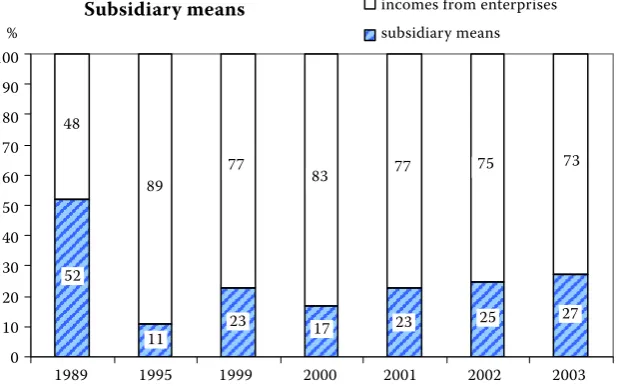
In context with the so much discussed question of subsidy policy in frame of the CAP of the EU, it is then important in frame of total incomes to monitor a relation between incomes from entrepreneurial activ-ity and incomes whose character is the character of subsidiary financial resources (subsidies). If we apply the above mentioned on Czech conditions and treat an agricultural enterprise as the receiver of incomes in examining of their structure, it would be possible to stem from the following information sources: 1) From standard indicators measuring the rate of
support of agrarian sector according to the OECD monitoring methodology and expressing the share of subsidiary means in incomes of agricultural producers. Then both enterprises with the char-acter of family farm and enterprises of legal entity type are included in the agricultural producers. A
basic indicator is the relative indicator of produc-tion support estimate (% OPP) which evaluates the level of supports by their share in the total incomes, possibly it provides data about the sup-port structure (Figure 1).
[image:4.595.79.520.70.247.2]2) From monitoring of economic results according to the EU standard output (reported on the “Reports on State of Agriculture” since 2001) reached in en-terprises of legal entities and individuals separately (differences in ownership character are respected) (Figure 2).
3) From economic results monitored by the financial accounting. In this case, the incomes of family farms cannot be compared with the “incomes” of legal entities because of a completely different methodology of finding of economic results. In frame of taking data about legal entities’ incomes,
Individuals
71,5 66,9 73,3
28,5 33,1 26,7
0% 10% 20% 30% 40% 50% 60% 70% 80% 90% 100%
2001 2002 2003
incomes from enterprises subsidiary means 28.5 100 90 80 70 60 50 40 30 20 10 0 33.1
71.5 66.9 73.3 incomes from enterprises subsidiary means Individuals
%
26.7
Legal entities
88,9 88,7 78,5
11,1 11,3 21,5
0% 10% 20% 30% 40% 50% 60% 70% 80% 90% 100%
2001 2002 2003
incomes from enterprises subsidiary means 11.1 100 90 80 70 60 50 40 30 20 10 0 11.3
88.9 88.7 78.5 incomes from enterprises subsidiary means Legal entity
%
[image:4.595.132.452.553.743.2]21.5
Figure 2. The incomes structure according to the EU standard output in 2001-2003 in legal entities and individuals in agriculture
Subsidiary means
21 25 18 14 21 20 19 21 18
79 75 82 86 79 80 81 79 82
0% 10% 20% 30% 40% 50% 60% 70% 80% 90% 100%
1995 1996 1997 1998 1999 2000 2001 2002 2003 incomes from enterprises subsidiary means 100 90 80 70 60 50 40 30 20 10 0 %
incomes from enterprises subsidiary means Subsidiary means
79 75 82 86 79 80 81 79 82
1995 1996 1997 1998 1999 2000 2001 2002 2003
21 25 18 14 21 20 19 21 18
it is not possible to find out real incomes, let alone their structure. In case of individuals, these data are disposable and they have been monitored since 1995 (Figure 3).
CONCLUSION
From the above mentioned, two relevant facts re-sult:
– If we treat an agricultural enterprise as such (not its owner) as the receiver of incomes, because of the possible comparison, there are obvious dif-ferences in results characterizing the structure of the reached incomes. The share of subsidiary financial means in the total incomes differs in use of particular methodologies. Extra-significant it is in enterprises of individuals when a more significant share of subsidies in the total incomes is reported from the EU standard output methodology, e.g. in 2003 it is 26.7%, while according to the accounting, it is only 19%. Other problem seems to be the unity of results of the EU methodology and the financial accounting with the results of the methodology of the % OPP calculation. For example in 2003 accord-ing to the EU, the share of subsidies in incomes of legal entities was 21.5%, of individuals 26.7%, but according to % OPP this share was 27% which is a value exceeding both mentioned. From that it results that in the meantime, it is not possible to ascertain what real share in agricultural incomes
the subsidies represent and what share belongs to the results of own entrepreneurial activities. This share can be only estimated in an interval.
– The second problem resulting from the first one is than the fact that if the EU agrarian policy wants to send concrete signals towards agriculturists in the income area, it has to have a clear and true information. With their knowledge, it is then pos-sible to deliberate whether the share of subsidies in incomes has a corresponding weight or on the contrary it dampens the entrepreneurial activity; or the height is insufficient; whether the significant part of incomes stems from agricultural or non-agricultural activities and so on. If this knowledge exists, then the concrete aimed agrarian-political measures can be suggested.
REFERENCES
Boháčková I. (2004): Selected problems of Czech agriculture integration in CAP EU – support of incomes of agricultural producers). Collection of scientific papers from international scientific con-ference Európska integrácia – výzva pre Slovensko. Nitra; ISBN 80-8069-356-0, CD (in Czech). Svatošová L., Boháčková I., Hrabánková M. (2005):
Regional development from position of structural policy. Scientific monograph, České Budějovice; ISBN 80-7040-749-2 (in Czech).
Arrived on 1st February 2006
Contact address: