Off-grid photovoltaic system for illumination
P. Kouřím, M. Libra, V. Poulek
Department of Physics, Faculty of Engineering, Czech University of Life Sciences Prague,
Prague, Czech Republic
Abstract
Kouřím P., Libra M., Poulek V. (2015): Off-grid photovoltaic system for illumination. Res. Agr. Eng., 61: 106–110.
The off-grid photovoltaic (PV) system with batteries and with the LED light source was constructed and tested in in laboratory conditions. The PV system is used for emergency illumination and it is independent of the electric grid. The PV system is suitable for example in agriculture in store, in horse barn or in outdoors place. Description of the con-struction and testing is presented in this paper as well as results of the tests. The PV system was self-sufficient during the summer and autumn period till the November 3, 2011. Since November the illumination mode was modified. The illumination intensity was lowered, the discharging speed was decreased.
Keywords: solar energy; PV system; energy accumulation
The usage of the solar energy is possible in more fields of agricultural engineering. Hassanain (2011) and Ivanova et al. (2012) describe its usage for drying. The off-grid photovoltaic (PV) systems are usually installed for energy supply in locations where the grid is missing or where the device must be self-sufficient. The PV system needs no fuels supply, unlike the combustion engine. The energy accumulation into the batteries is simpler in the case of the off-grid PV system. System is suitable for energy supplying of various equipment or science instruments in the off-gridconditions. Various on-grid and off-on-grid PV systems were constructed and tested in the past and the results were published regularly (Poulek, Libra 1998, 2000). Recently, the off-grid PV system for illumination was con-structed. The energy saving light source with light emitting diodes was used and the PV system was tested in the laboratory. This paper presents the re-sults of its construction and testing.
The aim of our research was to construct an off-grid PV LED lighting system, to optimize the parameters of energy accumulation and to verify its functionality
and reliability of the above mentioned PV system in the long-term operation (2 years and more).
LED lighting is a very promising technique be-cause of the large energy savings and other benefits. Detailed studies of the effectiveness and efficiency of LEDs are described in the reports (Bryan et al. 2008). Innovative design of energy-saving LED il-lumination is described also in patents (Norman, McCollough 2008; Chan, Sze Keun 2009).
MATERIAL AND METHODS
Suitable light sources. The energy saving light
more slowly discharged in this case. There was an assumption that the large volume production will decrease the price.
Incandescent lamps are discharging the batter-ies too fast. The tungsten filament inside the bulb emits the light according to the Planck‘s radiation law. The efficiency is approx. 3% and the lifetime is only 1,000 hours. The discharge light sources (for example fluorescent lamps) have efficiency approx. 18% and the lifetime approximately 5,000 hours.
The LED is a suitable light source. The diodes emit blue spectral lines and the other spectral lines in the visible spectrum are generated by luminophore. The resulting colour of the light is white (Fig. 1).
Construction of the PV system. Small off-grid
PV system designated for illumination in our labo-ratory was constructed. Fig. 1 shows the outdoor
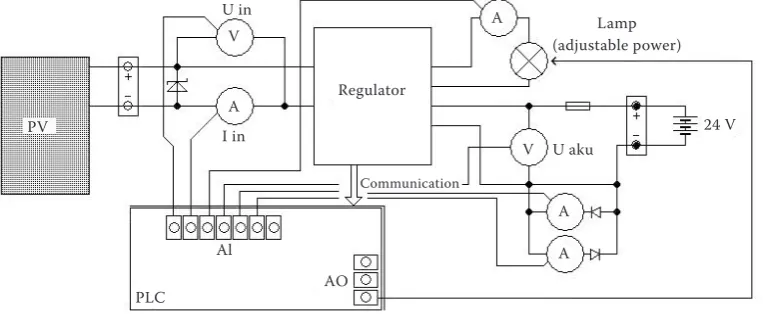
section. The batteries were located in the labora-tory as well as the recharging unit and program-mable unit (PLC). Data were collected on the mem-ory card and visual supervision enabled using the web interface. Fig. 2 shows scheme of the studied PV system. The nominal power of each diode was 1 W, the total number of diodes was 30. The max. total output power was 30 W during the operation and it could be influenced by ratio between switch on and switch off at higher frequency. The recharg-ing unit C2415 (Yueqrecharg-ing Kampa Electric Co., Ltd., Wenzhou, China) was used for the batteries charg-ing. This unit controlled the recharging and it also secured the over-voltage and under-voltage pro-tection. The PV panel based on the monocrystal-line silicon with max. output power of 170 Wp was used for the recharging of lead gel batteries EnerSys (12 V, 105 A.h). Two batteries were connected in series and the no load voltage was approx. 28 V if fully charged. The max. value of accumulated en-ergy was approximately 2,5kWh.
The construction of the PV system was realised in the year 2011 and the operation data collection started in August 2011.
RESULTS AND DISCUSSION
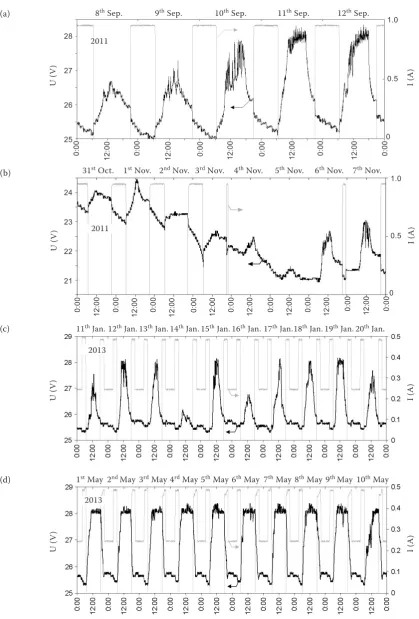
[image:2.595.63.291.95.295.2]Initially, the illumination mode started at 21:00 and finished the next day at 6:30. The daily illumi-nation time was almost 10 h and the output pow-er was 30 W. Fig. 3a shows the dependence of the batteries voltage on the time during few selected summer days, Fig. 3b shows the dependence of the batteries voltage on the time during few selected
Fig. 2. Scheme of the off-grid PV system
[image:2.595.106.488.563.720.2]PV – photovoltaic panel; U– voltage; I – current; PLC – programable unit; U aku – battery voltage
Fig. 1. Outdoor section of the off-grid PV system
PV
U in
U aku
24 V Lamp
(adjustable power)
I in V
V A
A A
A Al
AO Regulator
Communication
Fig. 3. Dependence of the batteries voltage and electric current supplying the light source on the time during (a) selected summer, (b) autumn, (c) winter and (d) spring days
Sep. – September, Oct. – October, Nov. – November, Jan. – January, U – voltage, I – current, t – time (a)
(b)
(c)
(d)
U (
V
)
U (
V
)
U (
V
)
U (
V
)
t (h)
I (A)
I (A)
I (A)
I (A)
2011
2011
2013
2013
8th Sep. 9th Sep. 10th Sep. 11th Sep. 12th Sep.
31st Oct. 1st Nov. 2nd Nov. 3rd Nov. 4th Nov. 5th Nov. 6th Nov. 7th Nov.
11th Jan. 12th Jan. 13th Jan. 14th Jan. 15th Jan. 16th Jan. 17th Jan. 18th Jan. 19th Jan. 20th Jan.
1st May 2nd May 3rd May 4rd May 5th May 6th May 7th May 8th May 9th May 10th May
0:00
0:00
0:00
0:00
0:00 0:00
0:00
0:00 0:00
0:00
0:00
0:00
0:00 0:00
0:00
1.0 0.5
0 1.0
0.5
0
12:00
12:00
12:00 12:00
12:00
12:00
12:00
12:00 12:00
12:00
12:00 12:00
12:00
24
23
22
21 28
27
26
autumn days. The batteries were charged during the day by the PV panel and they were discharg-ing durdischarg-ing the night by the light source, the elec-tric current of the light source is shown as well. Till the November 3, 2011 the charging and discharg-ing were in a balance. It is clearly shown that the batteries were recharged during the day and they were discharged during the night. The voltage leap at the light source switching on and switching off presented in Fig. 3a,b. The voltage oscillations dur-ing rechargdur-ing were caused by the difference be-tween measuring during the recharging pulse or otherwise. Smaller oscillations during discharging are due to the measurement accuracy.
The calculations according to the previous meas-urements (Libra et al. 2010) show that during the whole year a PV panel is capable of supplying ener-gy of more than 150 kWh. If the light source would be switched on for 10 h/day, the energy of aproxi-mately 110 kWh would be needed for a whole year, the efficiency of the batteries being approximately 70%. According to the calculation, the PV system could be self-sufficient and it was self-sufficient during the summer period till autumn. But no ad-ditional energy can be stored, if the batteries are fully charged. During the winter period the time of sunlight is shorter and the angle of the solar radia-tion is lower (Poulek, Libra 2010). Ageing, energy losses and decreasing of the batteries capacity must
to be also taken into the consideration. That is the reason, why the PV system was not self-sufficient after November 3, 2011 (Fig. 3b). For that reason, the illumination mode was changed. The light source was shining during the evenings and morn-ings with 50% of the illumination capacity and dur-ing the night with 30% of the illumination capacity. The illumination intensity was controlled by the ratio between switching on and switching off time at the higher frequency. The balance between the charging and discharging was restored and thus PV system was operating reliably within next years.
Fig. 3c,d shows the dependence of the batteries voltage and electric current of the light source on the time during few selected winter days and few se-lected spring days. The data were taken after chang-ing of the illumination mode. There the situation in the winter period (Fig. 3c) and in the spring period (Fig. 3d) is seen during the year 2013. No problems with the under-voltage protection were observed af-ter the modification of the illumination mode (lower illumination intensity and output power).
Economic calculation states that the entire sys-tem can be bought for a price of 800 EUR. Re-chargeable batteries (approximately 440 EUR), PV panel (about 140 EUR), the light source (about 100 EUR), programmable unit (approx. 40 EUR). If the lamp is lighting 13 h/day to an average of 40% power (Fig. 3d), daily energy consumed is about 0.16 kWh and 60 kWh/year; this amount of energy from the network costs approximately 12 EUR/year. In five years of operation, which is about the life of the battery, the system would thus save about 60 EUR. It is therefore clear that its use cannot be motivated by saving money on energy, but because the grid unavailability.
The PV system was installed by our colleagues at the hospital in Vietnam, where there is insecure electricity supply. The system is effective there be-cause of the greater intensity of solar radiation and the technical skills of the population and safe with regard to low voltage.
[image:4.595.76.277.92.334.2]Similar off-grid PV systems were constructed ac-cording to our experience in the Czech Republic (Fig. 4). Analogous off-grid PV system was tested by other researches (Sağlam et al. 2010). Svoboda et al. (2007) and Brinkhaus et al. (2011) describe much larger off-grid PV systems. Muńoz-García et al. (2013) describe water harvesting using the Peltier modules powered by accumulated solar photovoltaic energy, Hsieh et al. 2013 describe Fig. 4. Similar off-grid PV system used in the Czech
battery charging by photovoltaic high-frequency pulses.
CONCLUSION
The off-grid PV system for illumination has been constructed. Its usage is suitable for example in ag-riculture in the store, horse barn or outdoor places. The testing started in spring 2011. The PV system was self-sufficient till the November 3, 2011. Since November the illumination mode was modified. The illumination intensity was lowered, the dis-charging speed was decreased. After the optimiza-tion of the operating mode, the off-grid PV system was operating reliably during following 2 years.
Based on the calculations proceeded and real measured data the operation mode was gradually modified. The operation mode of the PV system was then self-sustaining and after two years of con-tinuous operation it worked reliably.
In the future, the batteries will degrade gradually reducing their capacity substantially within a few years so it will be necessary to either re-adjust the lighting mode or replace the batteries. The opera-tion life of lead-acid batteries is about 5 years. The authors plan to continue to collect the data and on that basis will formulate further conclusions.
References
Brinkhaus M., Jarosch D., Kapischke J. (2011): All year power supply with off-grid photovoltaic system and clean seasonal power storage. Solar Energy, 85: 2488–2496.
Bryan M.M. et al. (2008): LED Street Lighting. Application Assessment Report #0727, Department of Energy, USA. Hassanain A.A. (2011): Drying sage (Salvia officinalis L.) in
passive solar dryers. Research in Agricultural Engineer-ing, 57: 19–29.
Hsieh H.I., Shih S.F., Hsieh J.H., Wang C.H. (2013): Photo-voltaic high-frequency pulse charger for lead-acid battery under maximum power point tracking. International Journal of Photoenergy. Available at http://www.hindawi. com/journals/ijp/2013/687693
Chan S.K. (2009): Solar powered LED street lamp with auto-matic light control. European Patent 2.017.525.A1. Ivanova T., Havrland B., Hutla P., Muntean A. (2012):
Dry-ing of cherry tree chips in the experimental biomass dryer with solar collector. Research in Agricultural Engineering, 58: 16–23.
Libra M., Sedláček P., Mareš J., Poulek V. (2010): Porovnání PV systémů s pevným a proměnným sklonem PV panelů. Jemná mechanika a optika, 55: 270–271.
McCollough N.D. (2008): Photoelectric controller for electric street lighting. US Patent 7.369.056.B2.
Muńoz-García M.A., Moreda G.P., Raga-Arroyo M.P., Marín-González O. (2013): Water harvesting for young trees using Peltier modules powered by photovoltaic solar energy. Computers and Electronics in Agriculture, 93: 60–67. Poulek V., Libra M. (1998): New solar tracker. Solar Energy
Materials and Solar Cells, 51: 113–120.
Poulek V., Libra M. (2000): A new low cost tracking ridge concentrator. Solar Energy Materials and Solar Cells, 61: 199–202.
Poulek V., Libra M. (2010): Photovoltaics, Theory and Practice of Solar Energy Utilization. Prague, ILSA.
Sağlam S., Ekren N., Erdal H. (2010): Controlling of grid connected photovoltaic lighting system with fuzzy logic. Solar Energy, 84: 256–262.
Svoboda V., Wenzl H., Kaiser R., Jossen A., Baring-Gould I., Manwell J., Lundsager P., Bindner H., Cronin T., Nørgaard P. (2007): Operating conditions of batteries in off-grid renewable energy systems. Solar Energy, 81: 1409–1425.
Received for publication September 23, 2014 Accepted after correction January 23, 2015
Corresponding author:
Prof. Ing. Martin Libra, CSc., Czech University of Life Sciences Prague, Faculty of Engineering, Department of Physics, Kamýcká 129, Prague 6-Suchdol, Czech Republic