Current farming in the Tropics and Subtropics world has undergone many changes. All farm power experts agree that the most obvious benefits of mechanization, e.g. using new machines, are their substitution benefits, their ability to reduce costs of production by replacing draught animals, human labour.
The mechanization on the Fully Mechanized Technolo-gy level has become the most intensive input in the mo-dern agriculture. However, even Hand-tool and Draught Animal technologies get ever more sophisticated tools or machines (carried or animal drawn) that represent
quite important inputs (HAVRLAND, KAPILA 2000)
and their cost component become often dominant. Best measure of benefit of mechanization is the net economic benefit derived from its incremental investments in me-chanization – that is, the extra output of production and net of input costs, which can weigh the cost foregoing their use in any other way.
In this article the importance of economic mechaniza-tion inputs in context with reasonably conceived tech-nology and precision farming principles is highlighted. Such a technology does not need to be a top one in the sense of sophisticated implements however should be logically doted with relevant operations implemented under the condition of optimum profit at reasonable (mi-nimum) costs. The cost ↔ profit relation approach is the leading concept although not the only one.
The complexity of such a competitive technology is apparent and, under conditions of modern farming, requires a tool to facilitate its construction and to cre-ate possibility for simulating its alternatives with their assessment by use of proper criteria. A kind of ATMP computer program could satisfy the above objective.
The program must be rigorously backed by a conveni-ently constructed theoretical base, provided with reli-able updated data and supported by practical experience of its user.
When considering the cost of production, it is usu-ally best to study machinery and labour costs together, since expenditures from machinery use can usually be expected to result in some reductions in the labour costs. However the isolated costs are not an optimum indicator because their impact on the production (expressed in gross or net margin) has not been taken into account.
Concept of the ATMP prefers the agricultural producer – farmer regardless the level on which he farms –
small-scale up to large-small-scale. For instance (HAVRLAND 2000)
notes that in his work in Uzbekistan the farmer’s ap-proach to the costing problem is almost similar to that which is typical for farmers in the developed countries. However they lack any kind of data and proper instruc-tion to transform their interests into a reasonably concei-ved costing approach.
The main goal of the above program consists in hel-ping farmers (directly or through extension consultant) to appreciate the role of costing of operations and/or, when possible, substituting one (cheaper) operation by other (likely more expensive) in the context with the final impact on economy of the respective technology or the whole farm.
Direct use of the program by farmers can be con-strained through their difficult access to the computer – both the software and hardware, and problems of un-derstanding it. In these cases extension workers are the main target group for the Program which must assist the farmer with proper projecting services to get his
INFORMATION
Background information for the agricultural technology
management program (ATMP) AGRO-EXPERT
B. H
AVRLANDCzech University of Agriculture, Prague, Czech Republic
ABSTRACT: Economic efficiency in farming is achieved as a result of manager’s skills and proper technologic equipment avai-lable on the farm suitable for carrying out husbandry operations. Applying skilled management to the whole business of farming is of an extraordinary importance, too. The manager should be equipped with more or less sophisticated software that would make his decision making process more professional and adequate to (generaly) production conditions. Such software (program) will allow proving his technological conception by economic calculations and proper tests. An Agricultural Technology Management Program AGRO-EXPERT has been conceived and is discussed in this paper. The authors analyze situation in appearance of such programs and conditions/information necessary for their correct (adequate) functions.
farming on a sustainable level including both appropri-ate technologic solution and economic approach to the farming.
LITERATURE ANALYSIS
Experience has shown that machinery and equipment are the major cost items in farm business. William
Ed-wards (WILLIAM 1989) writes that in America good
[image:2.595.71.532.52.617.2]managers have been able to control machinery and power costs per hectare however some cost items are just estimated on more or less reliable basis. A range of simple calculators to help to design technologies and calculate machinery and implements used, are available on the market and some schools and organization are offering some free programs.
Further we can see an example of the Iowa Crop
Management Database (CMD) (SWOBODA 2001). The
D-base helps farmers make comparisons of corn and soybean yields for different tillage practices (including no-tillage technologies) and to establish realistic yield goals. Further, crop nutrient recommendations and market forecasts relevant to recorded (gathered) manure nutrient information, analyses of enterprise costs and profitability, maintaining restricted pesticide use infor-mation and much more are possible thanks to the above CDM. The program is very flexible – allowing for as much or as little information as each producer’s record-keeping system requires. The database includes soil survey data for 97 of Iowa’s 99 counties and is designed in a way that producers only have to enter information once to generate every calculation, plan, and report.
Producers can use the Iowa CMD for their decision-making process purposes and recording crop information
in any farming operation. TORDSEN (1997) says the
pro-gram can organize information, produce tables, and keep records from the whole farm down to sub-field levels.
KAVKA (1994) has a similar program, which
ad-dresses the local needs of the Czech Republic. A lot of calculators available on the market address the cost ana-lysis tools for mechanical technologies. Technologies fa-cilitated by animal and human power are not addressed. AGSE does not seem to have addressed this problem. They seem to stop at ensuring that tools, implements and power sources are made available to the farmers although they do agree that aspects of controlling costs are vital. So far there are no indications that their plight in this field has been addressed.
Thus, although such programs are available, we have noticed that these tools do not address the needs and requirements of the developing countries where farmers use a whole range of technological levels to produce food. In view of this serious pitfall on the service market the ATMP program has been conceived as an adaptation of Kavka’s program with added properties that address the farming in the developing countries with respect to its specific conditions. The objective is to help farmers in developing countries make smart decisions about what capacity to invest and how to get the maximum from their investments.
BRIEF PROGRAM DESCRIPTION
The program is conceived as technical-economic facilitator that should make easier the life of extension workers at their advisory work when designing agricul-tural technologies for farmers. It must also be designed as user friendly. The main principle of farmer’s work is to respect the equipment facilities available at the farm (or possibility to acquire them) and farm main economic parameters.
The main outputs of the above program will be a reasonable (appropriate) technology for growing main crops, and possibility of comparison of different crops on basis of their budgets (crop budgets). The
main criterion for the comparison will be a net margin the farmer gets from its crop. Agronomic requirements as well as environmental aspects are included in the technology conception, which ensures sustainability of the farming.
The program is conceived so that technologies on diff-erent technological levels can be designed. This require-ment is so respected that growing of an individual crop is alternatively formulated with operations and their sequences relevant to the respective technology. The in-puts (including the equipment) are assigned so that their availability and possibility to get it from outside charac-terizes the technological level.
There are critics of the idea that a precise assess-ment of animal draught and hand-tool technologies for small-scale subsistence farming in the tropical and subtropical countries is practical. We can find plenty of counter-arguments because under such conditions even large farms rely upon hand or animal draught operations instead of mechanized ones the later being much more expensive than the former ones.
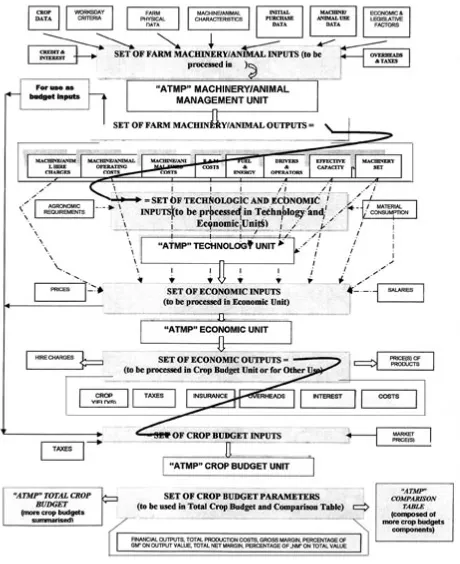
The program implementation will respect actual conditions in the field and, in its extreme form, it can be used only as a hardware (forms filled in by pencil). Fig. 1 gives a better idea about the program structure.
Background information for the ATMP
Machinery especially use in relation to costing pro-cedures and price calculation requires a comprehensive theoretical base. However, its outputs are highly im-pacted by the reliability of the information background given by the locality, i.e. prices of inputs and salaries, market prices and transport costs and, last but not least, type of technology applied. The information can be re-grouped in couple of categories as follows.
1. Data required for selection and costing of agri-cultural machinery
It encompasses all necessary data impacting the costs calculations. They represent a base for the costing ope-rations and pricing the product.
1. Data for agro-zones (Table 1), especially:
Climate: should reflect a minimum five-year ave-rage. It has an influence on possible working days for field operations during a month, which in turn influences the size and number of power units and im-plements needed to meet the requirements for timely operations;
Soils: influence the choice and size of power and implements to meet draught requirements and determi-ne the operations determi-necessary to obtain optimum growth conditions;
Crops, cropping patterns and cropping calendars: are the major sources of information for calculation of size and number of power units and implements for produc-tion operaproduc-tions. But their importance is sometimes overemphasized. The next Table 1 shows data on crops necessary for crop optimum growing.
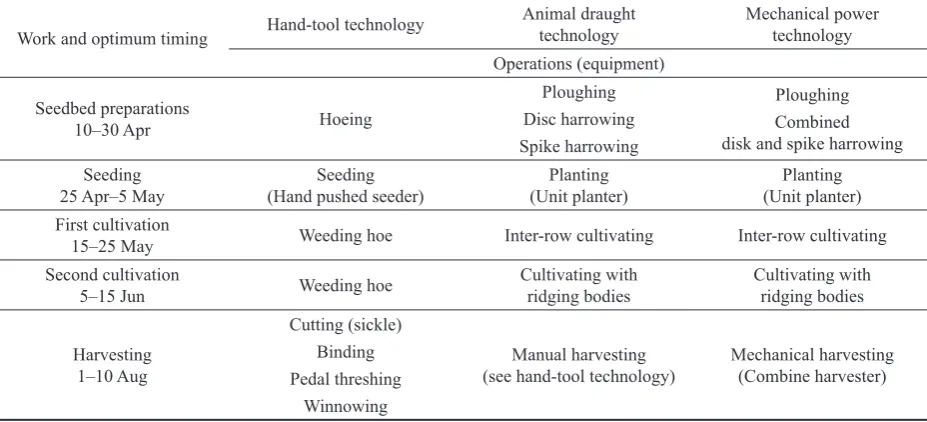
1. Interaction of cropping pattern and type of tech-nology and its influence on equipment to be used is demonstrated by the Table 2.
2. General economic data: provide figures and coeffi-cients required for mechanisation cost calculation proce-dures; especially prices, depreciation and interest rates, salaries, insurance and taxes.
3. Specific data for technologies employed: Specific data refer to those that are directly related to the produc-tion technology employed (hand-tool, draught animal or mechanical power technology). In many areas, two or single farm unit while in other areas, only one tech-nology prevails in existing farming systems. They are namely:
– Hand-tool technology; – Draught animals;
– Mechanical power technology;
– Mixed technologies: most frequent case of technolo-gic solution of farming.
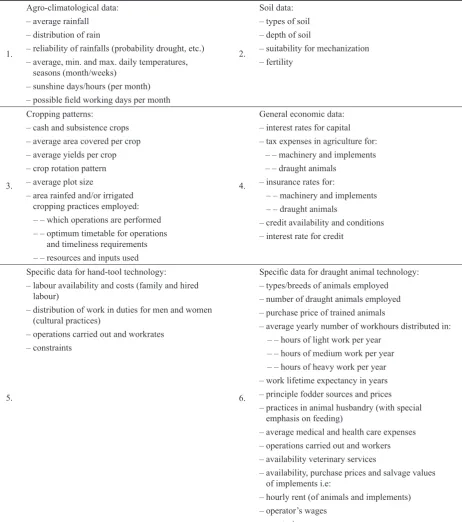
All possible data that must be available before a com-prehensive, reliable and practically-oriented ATMP pro-gram is set up are reviewed in the following Table 3. 2. Costing procedures
They have to respect main features within specific groups of costs and their calculations should be provi-ded with locally recognized coefficients and normatives based upon relevant standards and laws. E.g.:
– Fixed costs; – Variable costs;
– Coefficients and rates for calculations. 3. Calculation procedures
They differ according to group of machines. Draught animals as well as human power represent particular groups.
– Tractor, self propelled and stationary motorized machinery: cost calculation sheets have similar algorithm being the costs regrouped in 9 groups. Unitary costs per hour or hectare are normally in-Table 1. Examples of data on optimum growing conditions for crops
Crop Rainfall range (mm/yr)
Daily temperature
(oC)
Altitude
(m) Soils
Sowing, planting (plants/ha)
Seed rate (kg/ha)
Suitable crop rotation
Crop cycle in days (d) or years (yr)
Alfalfa 750–1,270 21–27 700–2,800
sandy loam to clay;deep, fertile
broadcasted 17–22
grain or fibre crops
210–240 or 4 yr
Maize 600–1,200 14–30 < 2,200
fertile alluvial or loam soils
10,000–20,000 12–32
gr
ai
ns
,
le
gu
m
es
,
fibre, tobacco,
[image:4.595.65.537.70.227.2]grass 90–200 d
Table 2. Sample of cropping patterns (sorghum after alfalfa) with operations for three technological levels
Work and optimum timing Hand-tool technology
Animal draught
technology Mechanical power technology Operations (equipment)
Seedbed preparations
10–30 Apr Hoeing
Ploughing Disc harrowing Spike harrowing
Ploughing Combined disk and spike harrowing Seeding
25 Apr–5 May (Hand pushed seeder)Seeding (Unit planter)Planting (Unit planter)Planting First cultivation
15–25 May Weeding hoe Inter-row cultivating Inter-row cultivating
Second cultivation
5–15 Jun Weeding hoe Cultivating withridging bodies Cultivating withridging bodies
Harvesting 1–10 Aug
Cutting (sickle) Binding Pedal threshing
Winnowing
Manual harvesting
[image:4.595.66.530.550.761.2]dicated, possibility of costs per production unit is reserved;
– Implements, harnesses and tools: cost calculation sheet for implements and tools specifically contain only fixed costs (including repair & maintenance); fuel (feed) and salaries are reserved for power units including animals;
– Draught animals: cost calculation sheet contains 8 groups;
– Human power: in principle its calculation procedure should be the same as at other units. However, its
managerial role must be considered, too. Drivers and operators provide main contributions of human labour, but at Hand-tool operations the human power replaces mechanical/animal power.
Approach to the problem
[image:5.595.68.531.70.593.2]The desirability of sustainable technology can be judged from the viewpoint of the individual farmers concerned or from that of the government of the coun-try in question. A government will be concerned with Table 3. Data required for design and costing of agricultural technologies
1.
Agro-climatological data: – average rainfall – distribution of rain
– reliability of rainfalls (probability drought, etc.) – average, min. and max. daily temperatures, seasons (month/weeks)
– sunshine days/hours (per month) – possible field working days per month
2.
Soil data: – types of soil – depth of soil
– suitability for mechanization – fertility
3.
Cropping patterns:
– cash and subsistence crops – average area covered per crop – average yields per crop – crop rotation pattern – average plot size
– area rainfed and/or irrigated cropping practices employed:
– – which operations are performed – – optimum timetable for operations and timeliness requirements – – resources and inputs used
4.
General economic data: – interest rates for capital – tax expenses in agriculture for:
– – machinery and implements – – draught animals
– insurance rates for:
– – machinery and implements – – draught animals
– credit availability and conditions – interest rate for credit
5.
Specific data for hand-tool technology: – labour availability and costs (family and hired labour)
– distribution of work in duties for men and women (cultural practices)
– operations carried out and workrates – constraints
6.
Specific data for draught animal technology: – types/breeds of animals employed – number of draught animals employed – purchase price of trained animals
– average yearly number of workhours distributed in: – – hours of light work per year
– – hours of medium work per year – – hours of heavy work per year – work lifetime expectancy in years – principle fodder sources and prices – practices in animal husbandry (with special emphasis on feeding)
– average medical and health care expenses – operations carried out and workers – availability veterinary services
– availability, purchase prices and salvage values of implements i.e:
– hourly rent (of animals and implements) – operator’s wages
the more large-scale effects on regional or national levels of appropriate technologies (e.g. unemployment or balance of payments, environment friendly, others), while the farmer will be more concerned with how it effects his production, etc. Often these approaches can be opposing ones – national interests may not coinci-de with those of the individual farmer. Ultimately, a government can greatly influence the degree to which technologies will take place by policy and financial measures.
1. Farmer’s interest concerning Mechanical Power Technology
Mechanical Power Technology (MPT) is a very in-tensive level of the farming in which machines and implements comprise more than 40% of the total fixed
costs (KRAMER 1991). For the farmer, implementation
of such intensive forms in a particular phase of his acti-vities becomes interesting when:
– labour costs become significantly higher than fore-seeable costs (all-in) using machinery;
– labour is in short supply, especially in periods of peak activity;
– working animals become too expensive or are not available when needed;
– it will lead to an increase in cultivable area, either by an increase in total area or by increased cropping in-tensity;
– the climatic and soil conditions are such that only limited periods for cultivation are possible;
– losses can be limited to reasonable levels, e.g. harvest-ing losses, storage losses, etc.;
– the quality of the work can be improved.
These factors give some indication of how difficult it can be to decide if the MPT is worthwhile or not. A meaningful solution can only be found after the circumstances of each case have been considered. All methods to increase the output and available working period of manual labour should be explored first: higher wages, better organization, piece or contract work, better tool, transport time and motion studies, grazing rights, further work, etc.
2. Role of the background information for ATMP There is a considerable potential for improvements of the farming system by introducing methods and tools, which could enhance professional capacity of both the
extension workers and farmers (KREPL 2001) too. This
can be facilitated by ATMP.
The program will provide a blueprint for success when launching new agricultural ventures. It will lead to simplification in advising farmers based on both the availability of technological information (particularly on machinery sets and agronomic requirements) and very quick economic (costs) calculations. Also, pre-prepared model technologies worked out on the basis of reliable background information will be available as facilitator for a quick setting up appropriate technologies on
diffe-rent technological levels. They only need to be modified (adapted) to the local conditions. They represent an ac-cumulated experience from many experts available for others. Nonetheless, professional level and personal ex-perience of extension workers and farmers remain very important factors necessary for sound results.
3. Economic efficiency in farming
Economic efficiency in farming is achieved as a result of skills and efficiency in carrying out many husbandry operations, and by applying skilled management to the
whole business of farming (SRNEC 2000).
So far as the higher technological level is concerned, good management involves:
– choice of enterprises that blend well together and are right for all the local conditions;
– careful judging farming systems and technologic le-vels suitable for the locality and selection of optimum ones;
– adapting the farming to the actual economic situation of the enterprise in view of possible credit or leasing liens and/or eventual inter-farm co-operation;
– taking into account all climate, soil, crop, cropping pattern and market characteristics to better adapt the farming parameters;
– selection of a set of equipment suited to the needs of the farm;
– employment of sound operating techniques for using both individual machines and matched sets of equip-ment. Cases where some tractors are being bought with oversized equipment are very frequent. This type of mismatching puts the machines at risk; – attention to detailed setting and adjustment to suit
soil, crop and weather conditions;
– well-planned system of maintenance and overhaul to ensure that the equipment is always in good working condition. Maintenance costs, which must be covered all the times, even if the tractor is operating success-fully.
It needs hardly to be said that the last three of the abo-ve items depend for their execution on a sound labour management policy. No more than a passing comment can be made on some of these aspects, but choice of equipment and operating techniques are the pivots of the ATMP program.
References
HAVRLAND B., 2000. Mission Report of the Farm Mechaniza-tion Specialist. Taskent – Brussels, EU Commission, Report from TACIS FDUZ9804: 45.
HAVRLAND B., KAPILA P., 2000. Technological aspects of extension service in developing countries. Agric. Trop. Subtrop., 33: 3–9.
KAVKA M., 1994. Podnikatelské záměry v zemědělství. Praha, IVV MZe: 56.
KREPL V., 2001. Manpower Development in Agricultural Engi-neering in Developing Countries. Paper from Conference on International Agricultural Research for Development “Deuts-cher Tropentag” Oct. 9–11 (Proc. on CD-ROM). University of Bonn: 248.
SRNEC K., 2000. Pluralistic Approach of Savings. Agric. Trop. Subtrop., 33: 28–34.
SWOBODA R., 2001. Figuring Crop Production Costs – MCS2 Iowa Crop Management Database (CMD). [Publication for extension services, last revised March 2001.]
TORDSEN C., 1997. Release of Iowa Crop Management Data, November 1997: 190.
WILLIAM E., 1989. Estimating Farm Machinery Costs: Machinery Management Series. [ISU extension publication # Pm-710.]
Received for publication February 14, 2003 Accepted after corrections December 22, 2003
Corresponding author:
Doc. Ing. BOHUMIL HAVRLAND, Česká zemědělská univerzita v Praze, Institut tropického a subtropického zemědělství, 165 21 Praha 6-Suchdol, Česká republika
tel.: + 420 224 382 186, fax: + 420 234 381 829, e-mail: [email protected]
Základní informace pro manažerský program AGRO-EXPERT
ABSTRAKT: Ekonomická efektivnost zemědělských činností je dosahována jako průsečík manažerských znalostí a vhodného technologického zařízení, které je k dispozici na farmě. Kvalitní řízení celého faremního „businessu“ má také výjimečnou dů-ležitost. Manažer by měl být vybaven více méně sofistikovaným softwarem, který by jeho rozhodovací proces učinil profesio-nálnějším a adekvátnějším k (obecně) výrobním podmínkám. Takový software umožní prověření jeho technologické koncepce pomocí rychlých ekonomických propočtů a testů. V článku je představen jeden ze softwarů – Zemědělský technologicko-ma-nažerský program AGRO-EXPERT, který byl koncipován a sestaven. Autor analyzuje existenci podobných programů ve světě a podmínky i informace pro jejich správnou (adekvátní) funkci.