The redox potential of a system, such as dough, is established by substances that possess oxidis-ing and reducoxidis-ing properties. Practical experience has shown that for the best baking performance a definite optimum degree of oxidation exists for every flour. Since this optimum potential is seldom encountered naturally, certain oxidising agents are commonly used both in the mill and in the bakery to improve the baking quality of flours.
In countries where the law permits it, the treat-ment of flour with minute amounts of oxidising agents is an established practise. The effect of oxidising compounds is twofold: flour improve-ment and bleaching. Flour improveimprove-ment refers to the changes in the rheological properties of the dough. Flour bleaching is due to the destruction of its yellow pigments, and it results in whiter flour and bread.
Oxidation generally affects the farinogram or mixogram of wheat flour only slightly (P�������
1971). Its effect can be clearly demonstrated by extension tests (measured by the extensigraph or the alveograph). An increase in the resistance and a decrease in the extensibility of flour-water dough depends on the type, the amount of the agent, and the reaction time. These phenomena are correlated with a decrease in the thiol content (M�������� & H����� 1959).
According to the Czech Food Law No. 110/97 and its declaration No. 298/97 the flour treatment may be performed with ascorbic acid (AsA) declared as E 300. AsA, although being itself a reducing agent, can exert an oxidising effect on the dough proper-ties after its oxidation by atmospheric oxygen. The oxidation product, dehydro-�-ascorbic acid (DHA), can oxidise glutathione under the influence of a specific enzyme. The determination of thiol groups in the dough supports the conclusion that AsA is effective only if oxygen is present and its effect in the resting fermenting dough is greatly reduced
Effect of Ascorbic Acid on the Rheological Properties
of Wheat Fermented Dough
M���� HRUŠKOVÁ1 and D��� NOVOTNÁ2
1Department of Carbohydrate Chemistry and Technology, Institute of Chemical Technology,
Prague, Czech Republic; 2ODKOLEK Company, Prague, Czech Republic
Abstract
H������� M., N������ D. (2003): Effect of ascorbic acid on the rheological properties of wheat fermented dough. Czech J. Food Sci., 21: 137–144.
The effect of ascorbic acid on the rheological properties of wheat fermented dough from forty three wheat flour samples, represented two groups of flours, characterised (according to the ash content, protein content and Zeleny sedimentation value) the main Czech flour type has been studied. Standard analytical parameters (ash and protein contents, wet gluten, falling number, Zeleny sedimentation value), rheological investigation (maturograph, oven rise recorder), and laboratory baking test were used for the characterisation of flours and doughs. It was stated that the influence of the ascorbic acid addition on the fermented dough behaviour depends on the flour compo-sition particularly in the proofing stage. Oven rise characteristics of dough and specific bread volume revealed smaller changes without significant differences between flours with lower (up to 0.6%) and higher (up to 0.7%) ash contents. An important correlation (r = 0.51–0.68) significant at 0.01 level has been found between specific bread volume and final rise of dough.
by the presence of yeast which makes the condi-tions more anaerobic. K������� and M�������� (1963) and M�������� and H�����(1959) showed that AsA is oxidised rapidly to DHA during dough mixing, and that flour contains a dehydroascorbic acid reductase which is active at pH about 6.0. DHA was reduced rapidly in the dough to which glutathione was added (C����� & P��� 1965). The improving action of AsA, which belongs to the intermediate reaction rate oxidants, is due to the oxidation of SH groups in dough by DHA (P���� 1988). S����� and T����� (2000) described the influence of redox reactions involving AsA dur-ing dough mixdur-ing and restdur-ing. The addition of AsA showed a significant weakening effect on the gluten washed out from the dough immediately after mixing, thus suggesting a predominantly reducing effect. After resting, AsA had a marked strengthening effect on the gluten network caused by an increase of the cross-linking of its proteins. The oxidising effect takes place predominantly during dough resting. According to N������� and K����� (1997), the improving mechanism of AsA on the rheological properties of flour-water dough was mostly due to the development of its electron-donating capacity and reactive products such as O2–.
Flour is immune to over-treatment with AsA, the effects of the treatment at the level of 30 to 70 ppm being nearly constant. At the level of 70 to 100 ppm, AsA promotes a good development of dough at the conventional mixing speed and improves the bread quality by the production of a greater oven spring that results in finer crumb grain and a larger loaf volume. In the case of the mechanical dough development system, 75 ppm AsA is regularly used. An advantage of AsA is that excessive levels are not deleterious in dough (up 200 ppm), perhaps because the amount of oxygen necessary for its action is limiting. When too much AsA is added, the doughs resist deformation during moulding and may break open during proofing because of the lack of extensibility. Bread made from such dough has a small loaf volume with a rough crust. Its crumb exhibits many ruptured cells and may have large holes.
As interesting feature of AsA is that its use re-quires an intermediate proof during bread-making. D� R����� (1968) showed that the best bread vol-ume is obtained with 40 ppm addition and 10-min proof time. According to P������ and N������ (1996) AsA addition increased optimal proofing
time and produced gas volume in wheat fermented dough. T������ (1972), using AsA (labelled with a 14C isotope) at a level of 75 ppm based on flour, demonstrated that there is practically no loss of it during dough mixing and fermentation but all the loss takes place upon baking. Of the total AsA added, 27–31% was converted into CO2 that was released during baking, and the remainder ap-peared as the water-soluble �-threonic acid.
The objective of this study was to describe the improving effect of AsA on the rheological prop-erties of full dough system during proofing, the oven spring and the baking process.
MATERIALS AND METHODS
Forty three samples of wheat flour divided into two groups according to the ash contents were taken from commercial mills in the course of five months (harvest 2001). The first set contained twenty flour samples with maximum ash content of 0.60% and the second set with maximum ash content of 0.70%. The effect of ascorbic acid was evaluated by the addition of 10 ppm. related to the flour weight.
The analytical flour quality was determined ac-cording to the Czech standard methods (ash con-tent, wet gluten, protein content – ČSN 56 0512, Falling Number – ČSN ISO 3093, Zeleny value – ČSN ISO 5529).
The rheological properties of flour were evaluated by means of maturograph (Brabender, Germany) and oven rise recorder (Brabender, Germany) ac-cording to the producer recommendations.
The baking test was performed according to the Czech method and the protocol used was: flour 100%, compressed yeast 4%, salt 1.7%, sugar 1.5%, fat 1%, and water as necessary for the optimal consistency of 600 BU. The dough from 300 g of flour was prepared in farinograph (Brabender, Germany). Dough dividing and roll shaping were made by hand and after the standard proofing time the pieces of dough were baked at 240°C for 14 min. Bread volume was determined after two hours of cooling by means of rape seeds.
recorder results) and the results of the baking test was evaluated using correlation analysis.
RESULT AND DISCUSSION
Flour quality parameters determined by standard methods are given in Table 1. Analytical character-istics of both sample sets are very similar except for
the ash content and Zeleny sedimentation value, which can differentiate both flour sets significantly. For the production of rolls and buns, flours with a lower ash content (Czech name “bright sort”) and a higher protein quality are usually used while for the bread products flours with a higher ash content (Czech name “semi-bright sort”) are more suitable. The average values of the flour
analyti-Table 1. Average values of flour analytical parameters
Parameter Ash (%) Wet gluten (%) Protein (%) FN (s) Zeleny value (ml)
Flours with lower ash contents
Average 0.55 31.1 11.4 332 39
Min. 0.47 27.7 10.3 246 34
Max. 0.60 34.8 12.9 415 44
Flours with higher ash contents
Average 0.68 31.1 11.3 319 36
Min. 0.60 27.3 10.5 256 32
[image:3.595.64.539.234.365.2]Max. 0.70 35.2 13.1 384 42
Table 2. Average values of maturograph evaluation
Parameter Final proof time (min) Dough level (MU) Dough elasticity (MU) Proofing stability (min)
control AsA control AsA control AsA control AsA
Flours with lower ash contents
Average 39 44 688 772 202 211 5 6
Min. 34 40 610 710 180 180 2 4
Max. 46 50 760 860 230 240 8 10
Flours with higher ash contents
Average 37 39 675 737 203 212 6 6
Min. 32 34 600 625 180 180 2 4
Max. 46 48 780 830 230 230 8 10
Table 3. Average values of OTG evaluation
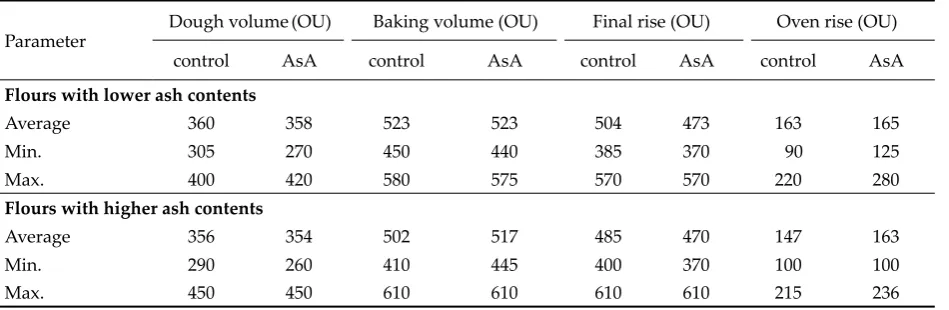
Parameter Dough volume(OU) Baking volume (OU) Final rise (OU) Oven rise (OU)
control AsA control AsA control AsA control AsA
Flours with lower ash contents
Average 360 358 523 523 504 473 163 165
Min. 305 270 450 440 385 370 90 125
Max. 400 420 580 575 570 570 220 280
Flours with higher ash contents
Average 356 354 502 517 485 470 147 163
Min. 290 260 410 445 400 370 100 100
[image:3.595.65.539.407.561.2] [image:3.595.65.540.602.757.2]cal parameters were typical for the Czech wheat production environment (protein 10.3–13.1%, FN 246–415s, Zeleny value 32–44 ml). The flour samples tested appeared, according to these characteris-tics, to be suitable for the standard manufacture of yeast-leavened dough in the industrial bakery but the specific bread volume and the shape ratio (Table 4) were found to be only up to the average.
Oxidising agents such as AsA can improve both the dough technological characteristics and the final products.
[image:4.595.82.502.216.719.2]The maturograph records the fermentation behaviour of dough during the proofing time by means of a sensing probe which touches the dough surface. With the help of an additional loading on this probe which occurs periodically, the elasticity
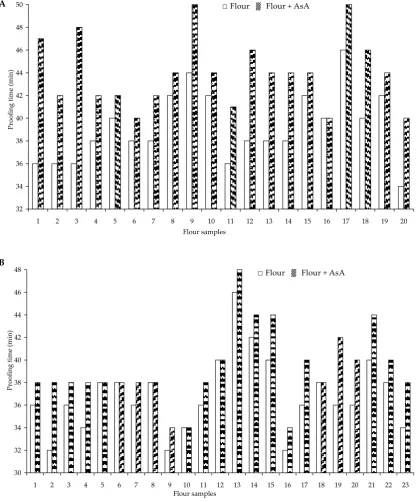
Figure 1. Influence of AsA on proofing time: A – flour with lower ash content and B – flour with higher ash content
32 34 36 38 40 42 44 46 48 50
1 2 3 4 5 6 7 8 9 10 11 12 13 14 15 16 17 18 19 20
Flour samples
Pr
oo
fin
g
tim
e
(m
in
)
30 32 34 36 38 40 42 44 46 48
1 2 3 4 5 6 7 8 9 10 11 12 13 14 15 16 17 18 19 20 21 22 23
Flour samples
Pr
oo
fin
g
tim
e
(m
in
)
A
B
of the fermented dough is recorded. This cycle is repeated every 2 min and the typical zigzag form of the maturogram is produced. The curve rises until maximum dough maturity is reached and it drops thereafter. This action is recorded in maturograph units (MU) on the strip-chart. The evaluation of maturograms which expresses the dough behaviour without and with AsA addition during the proof period is given in Table 2. The proofing time (expresses the optimum time for reaching the maximum volume of the end product) was found in a similar range for both sets (range 34–46 min and 32–46 min); after the AsA addition, longer time is needed for flours with lower ash contents. Differences between the individual flours of both sets are shown in Figure 1. The dough level, describing the dough resistance against mechanical stress during proofing, is slightly higher in the case of flours with lower ash contents and with AsA fortification it steps up more significantly (84 MU against 62 MU). The dough firmness (expressed as elasticity) of fermented dough was similar in both sets of flour and was increased by the AsA addi-tion in same range (approximately about 5%). The proofing stability which reflects the time tolerance of optimal proofing so as to ensure the highest volume of the final product is changed in same range (2–8 min). The increase by AsA is more sig-nificant in dough samples with a very low value of the proofing stability (from 2 to 4 min).
[image:5.595.62.291.102.301.2]The oven rise recorder describes the changes in the volume of dough (at the point of maximum maturity) during baking in the oil bath. Due to
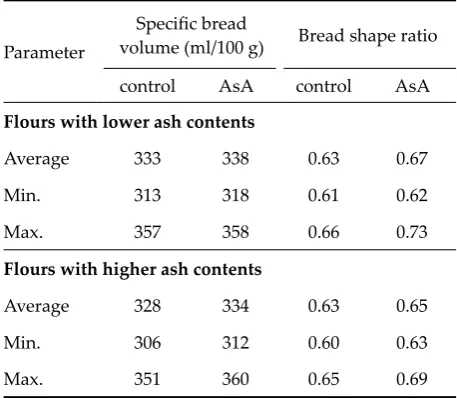
Table 4. Average values of baking test evaluation
Parameter
Specific bread
volume (ml/100 g) Bread shape ratio
control AsA control AsA
Flours with lower ash contents
Average 333 338 0.63 0.67
Min. 313 318 0.61 0.62
Max. 357 358 0.66 0.73
Flours with higher ash contents
Average 328 334 0.63 0.65
Min. 306 312 0.60 0.63
Max. 351 360 0.65 0.69
the exact heat transfer, the temperature and the dough volume can be determined at any point of the process. The volume of dough increases with the oil temperature (from 30° to 100°C) and the piece ascends in the bath. The action is recorded in oven rise units (OU) on the strip-chart. The evaluation of the oven rise diagrams of the dough without and with AsA addition is shown in Table 3. The dough volume, which is indicated by the volume of the dough at the start of the baking period, was found to be similar in both sets of samples. After AsA addition, the dough volume changed in a wider range for flours with higher ash contents (260–450 OU against 270–420 OU). The baking volume (indicates the final volume of the baked goods) and its changes after the AsA addition are slightly higher in flour samples with higher ash contents. The effect of AsA is evident only in sam-ples with small original volumes (increase about 10%). From these results it is apparent that the oven rise (the difference between the final bread and the dough volume) is lower in the set with higher ash contents but after the AsA addition the average value is comparable in both sets of flours. The final rise (represents the volume of the baked product after 11 min from the test beginning) de-scribes the shrinkage of the volume mostly by the AsA action (about 6%).
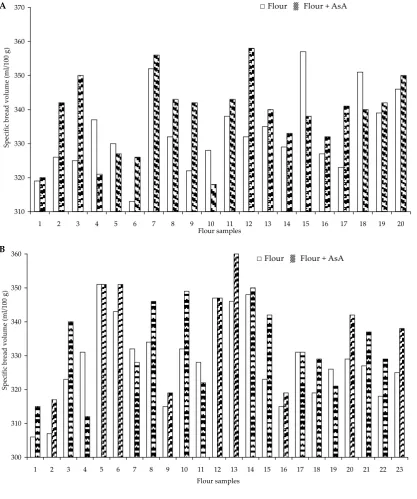
As a result, nearly the same specific bread volumes were obtained by the laboratory bak-ing test (Table 4) in both sets of flours (average 333 or 328 ml per 100 g of flour). In the case of the AsA addition, only an insignificant average volume increase was found (about 1%) but for the individual samples both an increase and a decrease were found (Figure 2). The bread shape ratio steps up approximately by 5% in both sets. As it is known, the influence of AsA was assessed as more important for flours with lower ash contents suitable for small bread products.
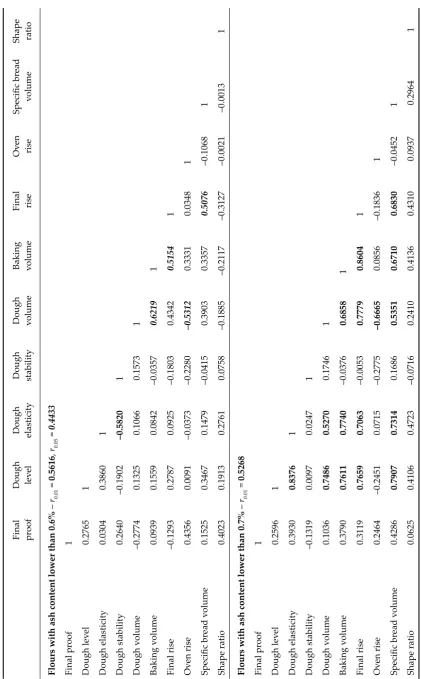
Ta bl e 5. D ou gh c ha ra ct er is tic s co rr el at io ns
Final proof Dough lev
el
Dough elasticity Dough stability Dough volume Baking volume Final rise
Ov
en
rise
Specific bread
volume
Shape ratio
Flours with ash content lower than 0.6%
– r0.01 = 0.5616 , r0.05 = 0.4433 Final proof 1 Dough lev el 0.2765 1 Dough elasticity 0.0304 0.3860 1 Dough stability 0.2640 –0.1902 –0.5820 1 Dough v olume –0.2774 0.1325 0.1066 0.1573 1 Baking v olume 0.0939 0.1559 0.0842 –0.0357 0.6219 1 Final rise –0.1293 0.2787 0.0925 –0.1803 0.4342 0.5154 1 Ov en rise 0.4356 0.0091 –0.0373 –0.2280 –0.5312 0.3331 0.0348 1
Specific bread v
olume 0.1525 0.3467 0.1479 –0.0415 0.3903 0.3357 0.5076 –0.1068 1 Shape ratio 0.4023 0.1913 0.2761 0.0758 –0.1885 –0.2117 –0.3127 –0.0021 –0.0013 1
Flours with ash content lower than 0.7%
– r0.01 = 0.5268 Final proof 1 Dough lev el 0.2596 1 Dough elasticity 0.3930 0.8376 1 Dough stability –0.1319 0.0097 0.0247 1 Dough v olume 0.1036 0.7486 0.5270 0.1746 1 Baking v olume 0.3790 0.7611 0.7740 –0.0376 0.6858 1 Final rise 0.3119 0.7659 0.7063 –0.0053 0.7779 0.8604 1 Ov en rise 0.2464 –0.2451 0.0715 –0.2775 –0.6665 0.0856 –0.1836 1
Specific bread v
[image:6.595.78.500.77.757.2]content and the protein quality described explicitly by Zeleny sedimentation value.
Conclusion
The technological quality of two sets of white wheat flour samples with different protein qual-ity described explicitly by Zeleny sedimentation value and ash contents was described by means
310 320 330 340 350 360 370
1 2 3 4 5 6 7 8 9 10 11 12 13 14 15 16 17 18 19 20
Flour samples
Sp
ec
ifi
c
br
ea
d
vo
lu
m
e
(m
l/1
00
g)
300 310 320 330 340 350 360
1 2 3 4 5 6 7 8 9 10 11 12 13 14 15 16 17 18 19 20 21 22 23
Flour samples
Sp
ec
ifi
c
br
ea
d
vo
lu
m
e
(m
l/1
00
[image:7.595.83.501.83.583.2]g)
Figure 2. Influence of AsA on specific bread volume: A – flour with lower ash content and B – flour with higher ash content
A
B
□ Flour ▒ Flour + AsA
of rheological methods (using the maturograph and the oven rise recorder) including a labora-tory baking test. The influence of a small amount of ascorbic acid on optimal proofing time was significant – the increase was about 13% for flours with lower ash contents and about 5% for samples with higher ash contents. Dough stability was prolonged mostly in samples with very short initial values. Dough behaviour during oil baking
in the oven rise tests was affected by the addition AsA at a low level, similarly as the specific bread volume in the baking test; important differences, however, were found between the individual flour samples. Bread shape ratio stepped of significantly by the AsA fortification. Significant correlation was obtained between the rheological parameters and the baking test results.
References
C����� J.E., P��� J. (1965): Some interrelationships of ascorbic acid and dehydroascorbic acid in the presence of flour suspension and in dough. Cereal Chem., 42: 201–245.
D� R����� D. (1968): Some observations on the effect of different breadmaking system. Baker Dig., 42: 24–25.
K������� T., M�������� H. (1963): �-ascorbic acid oxidising system in dough and dough improvement. Cereal Chem., 40: 647–649.
M�������� H., H����� I. (1959): Some aspect of sulf-hydryl-disulfide system in flour and dough. Cereal Chem., 36: 513–515.
N������� M., K����� T. (1997): Effect of �-ascorbic acid on the rheological properties of wheat – water dough. Cereal Chem., 75: 647–650.
P������� Y. (1971): Wheat Chemistry and Technology. AACC, II. ed., St Paul, Minnesota, US: 561–600. P������ J., N������ D. (1996): Zlepšovací prostředky
v pekárenské a cukrárenské technologii. Ročenka Pekař a cukrář: 29–38.
P���� E.J. (1988): Baking Science and Technology. Sosland Publ. Comp., Kansas City, US: 256–265. S����� P.R., T����� A.S. (2000): Wheat Gluten.
The Royal Society of Chemistry, Cambridge, UK: 271–282.
T������ B.H. (1972): Effect of ascorbic acid on bread-making process. Ber. Getreidechem. Tag, Detmold.: 12–15.
Received for publication June 4, 2003 Accepted a�er corrections July 10, 2003
Souhrn
H������� M., N������ D. (2003): Vliv kyseliny askorbové na reologické vlastnosti fermentovaného pšeničného těsta. Czech J. Food Sci., 21: 137–144.
Ve formě fermentovaného těsta byly studovány pekařské vlastnosti 43 vzorků pšeničných mouk, rozdělených podle obsahu popela do dvou skupin (světlé mouky s obsahem do 0,6 % a polosvětlé mouky s obsahem do 0,7 %) a jejich změny přídavkem kyseliny askorbové. Analytické znaky (obsah popela, bílkovin, mokrého lepku, číslo poklesu, Zelenyho sedimentační hodnota), reologické vlastnosti (měření na maturografu a OTG přístroji) a po-kusné pečení byly použity pro hodnocení vlastností mouk a těst. Vliv přídavku kyseliny askorbové na chování fermentovaného těsta se významně projevil ve fázi dokynutí (prodloužení optimální doby dokynutí) a závisí na kvalitě mouk. Měrný objem pečiva a vlastnosti těsta při zapékání, zjištěné na OTG přístroji, vykazovaly nevýrazné změny v obou souborech mouk. Významné korelace (r = 0,51–0,68) na hladině 99 % byly zjištěny mezi měrným objemem pečiva a objemem těsta při zapékání.
Klíčová slova: kyselina askorbová; pšeničná mouka; fermentované těsto; maturograf; OTG přístroj
Corresponding author:
Ing. M���� H�������, CSc., Vysoká škola chemicko-technologická, Ústav chemie a technologie sacharidů, Technická 5, 166 28 Praha 6, Česká republika