1-Fluoro-4-[(
E
)-2-nitrovinyl]benzene
S. Sreenivasa,aM. S. Nanjundaswamy,b
K. E. Manojkumar,aS. Madankumar,cN. K. Lokanathcand P. A. Suchetand*
aDepartment of Studies and Research in Chemistry, Tumkur University, Tumkur, Karnataka 572 103, India,bDepartment of Chemistry, AVK College for Women, Davangere-2, India,cDepartment of Studies in Physics, University of Mysore, Manasagangotri, Mysore, India, anddDepartment of Studies and Research in Chemistry, U.C.S., Tumkur University, Tumkur, Karnataka 572 103, India Correspondence e-mail: [email protected]
Received 5 January 2014; accepted 7 January 2014
Key indicators: single-crystal X-ray study;T= 293 K; mean(C–C) = 0.009 A˚; disorder in main residue;Rfactor = 0.078;wRfactor = 0.203; data-to-parameter ratio = 8.5.
The title compound, C8H6FNO2, is almost planar (r.m.s.
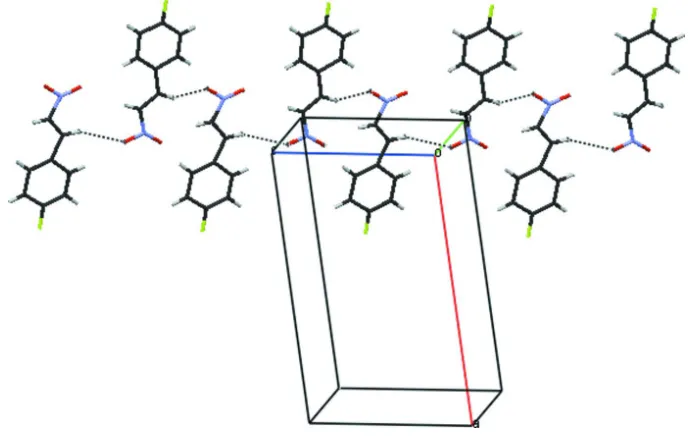
deviation for the non-H atoms = 0.019 A˚ ) and the conforma-tion across the C C bond istrans. The C and H atoms of the side chain are disordered over two sets of sites in a 0.56 (3):0.44 (3) ratio. In the crystal, molecules are linked by C—H O interactions, thus formingC(5) chains propagating in [001].
Related literature
For the biological activity of fluorinated aromatic compounds, see: Belestskaya & Cheprakov (2000). For the preparation of the title compound, see: Heck (1968).
Experimental
Crystal data
C8H6FNO2 Mr= 167.14
Orthorhombic,Pna21 a= 16.0965 (14) A˚ b= 4.8453 (4) A˚ c= 9.5538 (9) A˚ V= 745.12 (11) A˚3
Z= 4
CuKradiation
= 1.08 mm1 T= 293 K
0.330.250.19 mm
Data collection
Bruker APEXII CCD diffractometer
Absorption correction: multi-scan (SADABS; Bruker, 2009) Tmin= 0.761,Tmax= 0.815
8417 measured reflections 1095 independent reflections 892 reflections withI> 2(I) Rint= 0.100
Refinement
R[F2> 2(F2)] = 0.078 wR(F2) = 0.203 S= 1.07 1095 reflections 129 parameters
1 restraint
H-atom parameters constrained max= 0.34 e A˚
3
min=0.27 e A˚
3
Table 1
Hydrogen-bond geometry (A˚ ,).
D—H A D—H H A D A D—H A
C7A—H7A O1i
0.93 2.57 3.408 (13) 150
Symmetry code: (i)x;yþ2;zþ1 2.
Data collection:APEX2(Bruker, 2009); cell refinement: SAINT-Plus(Bruker, 2009); data reduction:SAINT-Plus; program(s) used to solve structure: SHELXS97(Sheldrick, 2008); program(s) used to refine structure:SHELXL97(Sheldrick, 2008); molecular graphics: Mercury(Macraeet al., 2008); software used to prepare material for publication:SHELXL97.
The authors acknowledge the IOE X-ray diffractometer facility, University of Mysore, Mysore, for the data collection.
Supporting information for this paper is available from the IUCr electronic archives (Reference: HB7182).
References
Belestskaya, I. P. & Cheprakov, A. V. (2000).Chem. Rev.100, 3009–3066. Bruker (2009). APEX2, SADABS and SAINT-Plus. Bruker AXS Inc.,
Madison, Wisconsin, USA.
Heck, R. F. (1968).J. Am. Chem. Soc.90, 5518–5526.
Macrae, C. F., Bruno, I. J., Chisholm, J. A., Edgington, P. R., McCabe, P., Pidcock, E., Rodriguez-Monge, L., Taylor, R., van de Streek, J. & Wood, P. A. (2008).J. Appl. Cryst.41, 466–470.
Sheldrick, G. M. (2008).Acta Cryst.A64, 112–122.
Acta Crystallographica Section E
Structure Reports Online
supporting information
Acta Cryst. (2014). E70, o124 [doi:10.1107/S1600536814000348]
1-Fluoro-4-[(E)-2-nitrovinyl]benzene
S. Sreenivasa, M. S. Nanjundaswamy, K. E. Manojkumar, S. Madankumar, N. K. Lokanath and P.
A. Suchetan
S1. Introduction
Fluorinated aromatic compounds exhibit different biological activities such as antibacterial, analgesic, anticancer,
diuretic, anticonvulsant, insecticidal, antifungal and antiviral (Belestskaya et al., 2000). Further, halogenated aromatic
derivatives act as a potent peptide deformylase inhibiter. As part of our studies in this area, the title compound was
synthesized and its crystal structure determined.
S2. Experimental
The title compound was synthesized by using the method reported in literature (Heck et al., 1968).
S2.1. Synthesis and crystallization
1-Bromo-4-fluorobenzene (5.7 mmol), tetrabutylammoniumbromide (11.4 mmol), cesium carbonate (17.1 mmol) and
palladium acetate (5.0 mmol) were taken in N,N-dimethylformamide (DMF) (20 mL) and stirred for 30 minutes. To this,
nitroethene (8.5 mmol) was added and the reaction mixture was stirred at 353K for 14 h under nitrogen atmosphere. The
confirmation of the reaction was confirmed by TLC. The organic layer was filtered and DMF was removed under
vacuum. The crude product obtained was purified by column chromatography using petroleum ether and ethyl acetate
(7:3) as eluent.
Colourless prisms of the title compound was obtained from slow evaporation of the solvent system: petroleum ether :
ethyl acetate (8:2).
S2.2. Refinement
The H atoms were positioned with idealized geometry using a riding model with C—H = 0.93 Å. The isotropic
displacement parameters for all H atoms were set to 1.2 times Ueq(C).
S3. Results and discussion
The title compound, C8H6FNO2, is almost planar (r.m.s. deviation for the non-H atoms = 0.019 Å) and the conformation
across the C=C bond is trans. The two carbon atoms of the side chain are disordered over two sets of sites with
occupancy factors 0.56 (3):0.44 (3). In the crystal structure, the molecules are linked into one another through C7A—
Figure 1
Molecular structure of the title compound, showing displacement ellipsoids at the 50% probability level. Only major
components of the disordered atoms are shown.
Figure 2
Linking of molecules into C(5) chains through C—H···O interactions.
1-Fluoro-4-[(E)-2-nitrovinyl]benzene
Crystal data
C8H6FNO2
Mr = 167.14
Orthorhombic, Pna21 Hall symbol: P 2c -2n
a = 16.0965 (14) Å
b = 4.8453 (4) Å
c = 9.5538 (9) Å
V = 745.12 (11) Å3
Z = 4
F(000) = 344
Prism
Dx = 1.490 Mg m−3 Melting point: 395 K
Cu Kα radiation, λ = 1.54178 Å Cell parameters from 1213 reflections
θ = 5.5–64.6°
µ = 1.08 mm−1
[image:3.610.132.477.284.502.2]Data collection
Bruker APEXII CCD diffractometer
Radiation source: fine-focus sealed tube Graphite monochromator
φ and ω scans
Absorption correction: multi-scan (SADABS; Bruker, 2009)
Tmin = 0.761, Tmax = 0.815
8417 measured reflections 1095 independent reflections 892 reflections with I > 2σ(I)
Rint = 0.100
θmax = 64.1°, θmin = 5.5°
h = −18→18
k = −5→5
l = −11→10
Refinement
Refinement on F2 Least-squares matrix: full
R[F2 > 2σ(F2)] = 0.078
wR(F2) = 0.203
S = 1.07 1095 reflections 129 parameters 1 restraint
Primary atom site location: structure-invariant direct methods
Secondary atom site location: difference Fourier map
Hydrogen site location: inferred from neighbouring sites
H-atom parameters constrained
w = 1/[σ2(F
o2) + (0.1544P)2] where P = (Fo2 + 2Fc2)/3 (Δ/σ)max = 0.011
Δρmax = 0.34 e Å−3 Δρmin = −0.27 e Å−3
Extinction correction: SHELXL97 (Sheldrick, 2008), Fc*=kFc[1+0.001xFc2λ3/sin(2θ)]-1/4 Extinction coefficient: 0.013 (4)
Special details
Geometry. All s.u.'s (except the s.u. in the dihedral angle between two l.s. planes) are estimated using the full covariance matrix. The cell s.u.'s are taken into account individually in the estimation of s.u.'s in distances, angles and torsion angles; correlations between s.u.'s in cell parameters are only used when they are defined by crystal symmetry. An approximate (isotropic) treatment of cell s.u.'s is used for estimating s.u.'s involving l.s. planes.
Refinement. Refinement of F2 against ALL reflections. The weighted R-factor wR and goodness of fit S are based on F2, conventional R-factors R are based on F, with F set to zero for negative F2. The threshold expression of F2 > 2σ(F2) is used only for calculating R-factors(gt) etc. and is not relevant to the choice of reflections for refinement. R-factors based on F2 are statistically about twice as large as those based on F, and R- factors based on ALL data will be even larger.
Fractional atomic coordinates and isotropic or equivalent isotropic displacement parameters (Å2)
x y z Uiso*/Ueq Occ. (<1)
C1 0.22198 (14) 0.0813 (5) 0.4662 (8) 0.0574 (9) C2 0.1931 (4) 0.1773 (11) 0.3445 (6) 0.0639 (15)
H2 0.2131 0.1031 0.2613 0.077*
C3 0.1370 (4) 0.3748 (12) 0.3401 (6) 0.0701 (15)
H3 0.1195 0.4429 0.2540 0.084*
C4 0.10325 (17) 0.4839 (6) 0.4642 (12) 0.0776 (13) C5 0.1310 (3) 0.3844 (12) 0.5870 (7) 0.0758 (17)
H5 0.1087 0.4542 0.6696 0.091*
C6 0.1934 (3) 0.1761 (12) 0.5954 (7) 0.0671 (16)
H6 0.2134 0.1088 0.6802 0.080*
C7 0.0410 (7) 0.708 (2) 0.4198 (14) 0.036 (4) 0.44 (3)
H7 0.0324 0.7490 0.3259 0.043* 0.44 (3)
C8 0.0004 (8) 0.839 (2) 0.5188 (15) 0.045 (4) 0.44 (3)
H8 0.0090 0.8030 0.6134 0.053* 0.44 (3)
H7A 0.0311 0.7124 0.6132 0.067* 0.56 (3) C8A 0.0010 (7) 0.828 (3) 0.4217 (14) 0.057 (4) 0.56 (3)
H8A 0.0100 0.7943 0.3270 0.068* 0.56 (3)
N1 −0.05955 (14) 1.0454 (5) 0.4692 (7) 0.0588 (8) F1 0.27937 (11) −0.1214 (4) 0.4674 (6) 0.0848 (9) O1 −0.0826 (3) 1.1361 (12) 0.3561 (5) 0.0967 (15) O2 −0.0840 (3) 1.1298 (12) 0.5777 (4) 0.0886 (14)
Atomic displacement parameters (Å2)
U11 U22 U33 U12 U13 U23
C1 0.0495 (14) 0.0531 (15) 0.070 (2) 0.0015 (10) −0.001 (3) −0.012 (3) C2 0.081 (4) 0.061 (3) 0.050 (3) −0.004 (3) 0.007 (3) −0.005 (2) C3 0.063 (3) 0.077 (4) 0.070 (4) −0.004 (3) −0.004 (3) 0.022 (3) C4 0.0459 (15) 0.0480 (15) 0.139 (4) −0.0036 (12) 0.012 (4) 0.006 (4) C5 0.064 (3) 0.063 (3) 0.100 (4) −0.011 (3) 0.030 (4) −0.019 (3) C6 0.060 (3) 0.082 (4) 0.059 (3) −0.011 (3) −0.004 (2) −0.003 (3) C7 0.039 (6) 0.044 (5) 0.025 (7) 0.011 (4) 0.012 (4) 0.001 (4) C8 0.062 (8) 0.041 (6) 0.030 (9) 0.009 (5) −0.013 (5) 0.008 (4) C7A 0.066 (7) 0.067 (7) 0.035 (7) −0.017 (5) 0.016 (4) 0.000 (4) C8A 0.058 (6) 0.085 (8) 0.028 (7) −0.003 (6) −0.007 (4) 0.004 (4) N1 0.0559 (13) 0.0616 (13) 0.0589 (18) 0.0046 (10) −0.015 (2) 0.003 (3) F1 0.0633 (11) 0.0673 (12) 0.124 (2) 0.0142 (7) −0.004 (2) 0.018 (3) O1 0.103 (4) 0.118 (3) 0.069 (3) −0.007 (3) −0.003 (3) 0.014 (3) O2 0.104 (3) 0.129 (4) 0.033 (2) −0.003 (3) 0.007 (3) 0.005 (2)
Geometric parameters (Å, º)
C1—C2 1.335 (10) C6—H6 0.9300
C1—F1 1.348 (3) C7—C8 1.31 (2)
C1—C6 1.395 (9) C7—H7 0.9300
C2—C3 1.317 (8) C8—N1 1.470 (13)
C2—H2 0.9300 C8—H8 0.9300
C3—C4 1.407 (12) C7A—C8A 1.31 (2)
C3—H3 0.9300 C7A—H7A 0.9300
C4—C5 1.345 (12) C8A—N1 1.506 (16)
C4—C7A 1.499 (13) C8A—H8A 0.9300
C4—C7 1.536 (14) N1—O2 1.182 (8)
C5—C6 1.426 (9) N1—O1 1.224 (8)
C5—H5 0.9300
C2—C1—F1 119.9 (6) C5—C6—H6 122.7
C2—C1—C6 122.8 (3) C8—C7—C4 117.8 (14)
F1—C1—C6 117.3 (6) C8—C7—H7 121.1
C3—C2—C1 121.3 (5) C4—C7—H7 121.1
C3—C2—H2 119.4 C7—C8—N1 115.1 (13)
C1—C2—H2 119.4 C7—C8—H8 122.5
C2—C3—H3 119.6 C8A—C7A—C4 115.3 (13)
C4—C3—H3 119.6 C8A—C7A—H7A 122.3
C5—C4—C3 118.2 (3) C4—C7A—H7A 122.3
C5—C4—C7A 99.1 (9) C7A—C8A—N1 117.9 (13)
C3—C4—C7A 142.7 (10) C7A—C8A—H8A 121.0
C5—C4—C7 135.3 (9) N1—C8A—H8A 121.0
C3—C4—C7 106.5 (9) O2—N1—O1 123.3 (3)
C4—C5—C6 122.5 (5) O2—N1—C8 99.9 (8)
C4—C5—H5 118.8 O1—N1—C8 136.7 (8)
C6—C5—H5 118.8 O2—N1—C8A 136.2 (7)
C1—C6—C5 114.5 (5) O1—N1—C8A 100.5 (7)
C1—C6—H6 122.7
F1—C1—C2—C3 179.9 (5) C3—C4—C7—C8 179.3 (7)
C6—C1—C2—C3 2.0 (6) C7A—C4—C7—C8 2.0 (7)
C1—C2—C3—C4 −2.5 (9) C4—C7—C8—N1 −178.6 (6)
C2—C3—C4—C5 1.2 (6) C5—C4—C7A—C8A 179.5 (7)
C2—C3—C4—C7A −177.6 (6) C3—C4—C7A—C8A −1.5 (12)
C2—C3—C4—C7 179.8 (6) C7—C4—C7A—C8A 2.8 (7)
C3—C4—C5—C6 0.5 (6) C4—C7A—C8A—N1 −177.2 (5)
C7A—C4—C5—C6 179.8 (6) C7—C8—N1—O2 −178.5 (8)
C7—C4—C5—C6 −177.5 (6) C7—C8—N1—O1 −1.1 (13)
C2—C1—C6—C5 −0.2 (5) C7—C8—N1—C8A 3.3 (7)
F1—C1—C6—C5 −178.2 (3) C7A—C8A—N1—O2 −1.2 (12)
C4—C5—C6—C1 −1.0 (8) C7A—C8A—N1—O1 178.4 (7)
C5—C4—C7—C8 −2.5 (11) C7A—C8A—N1—C8 1.4 (7)
Hydrogen-bond geometry (Å, º)
D—H···A D—H H···A D···A D—H···A
C7A—H7A···O1i 0.93 2.57 3.408 (13) 150