ISOLATION, PURIFICATION AND CHARACTERIZATION OF
ERYTHRINA INDICA AND TESTING ITS ANTI- CANCER ACTIVITY
BY INVITRO STUDIES
T. Karthick*, B. Guru Jeya1, R. Vimal Raj1, B. Sumithra1, K. P. Bhuvaneshwari1, J. JayaBarath2
*Assistant Professor, Department of Biotechnology, Pavendar Bharathidasan College of
Engineering and Technology, Anna University, Tiruchirappalli, Tamil Nadu, India.
1
Department of Biotechnology, Pavendar Bharathidasan College of Engineering and
Technology, Anna University, Tiruchirappalli, Tamilnadu, India.
2
Head, Department of Biotechnology, Pavendar Bharathidasan college of Engineering and
Technology, Anna University, Tiruchirappalli, Tamilnadu, India.
ABSTRACT
Erythrina indica (Fabaceae) is one of the important medicinal plants
coasts of India and Malaysia. Some of its medicinal usage has been
mentioned in traditional system of medicine such as Ayurveda, siddha
and unani. Seeds of Erythrina used in folk remedies for cancer, whose
bark is used for fever, hepatitis, malaria, rheumatism, toothache also
for boils and fractures. Now there is a growing importance for the
anti-cancer drug, which reveals the new study of traditionally used
medicinal plants. New researches were developing to produce
anti-cancer drug, having no side effects. Objective: This study aims at
analysing the anti-cancer activity of Erythrina indica, using rat cell
lines. Methods: the DPPH Scavenging activity and Anti- Lipid Per
oxidation activities are used to study the Anti-cancer activity. Results:
The colour change showed that the presence of Anti-cancer activity in
Erithrina indica plant and the Anti lipid peroxidation activity showed
that Erithrina indica has potent anti-cancer activity. Conclusion: The study proved that
Erithrina indica plant has moderate to potent anti -cancer activity.
KEY WORDS: Erythrina indica, anti- cancer activity, DPPH method and Anti Lipid Per oxidation activity. *Correspondence for Author T. Karthick Assistant Professor, Department of Biotechnology, Pavendar
Bharathidasan College of
Engineering and
Technology, Anna
University, Tiruchirappalli,
Tamil Nadu, India.
Article Received on 02 Feb 2016,
Revised on 23 Feb 2016, Accepted on 15 Mar 2016
INTRODUCTION
Cancer is the disease that is of most commonly now observed in all developed and
developing countries. It is that now there is an importance of extracting anti cancer drug from
traditionally used medicinal plants.[1] The plant Erythrina indica has traditional anti-cancer
activity and it is to show that it has minimal side effects when inhaled. Erythrina indica has
many traditional properties. It has been used for years as medicine. The entire plant consists
of the medicinal value. The anti- cancer activity of Erythrina indica was studied by the
DDPH scavenging activity and the lipid per oxidation assay using rat cell lines.[3] Erythrina
indica Lam leaf has been used traditionally in ayurveda for the treatment of diarrhoea and
dysentery.[4] Government and non-government organizations have planted Erithrina indica
trees in the public land in urban area and highways. This plant has been used as fertilizer
control by farmers.[6] Erythrina indica Lam. belongs to the family Leguminosae is an
important medicinal plant, distributed in the tropical and subtropical regions over the world.
Also found wild in deciduous forests throughout India and in Andaman and Nicobar Islands.
Bark used medicinally as febrifuge, anti-bilious and also used to treat dysentery. Bark powder
traditionally used for rheumatism, itching, fever, asthama and leprosy. In Cameroonian folk
medicine, the roots bark of E. indica used for the treatment of trachoma, elephantiasis, and
microbial infections. Different kinds of phenol compounds including isoflavones derivatives
and various biologically active metabolites were isolated from the bark of this plant. There
are numerous reports on the antioxidant and free radicals.[5] The presence of active
constituents’ viz. alkaloids, glycosides, phenyl coumarin, proteins, carbohydrates, amino
acids, steroids, tannins has been reported from root and seeds.[7] This study was aimed at
proving the anti-cancer activity of the Erythrina indica with the usage of Rat Cell Lines.
MATERIALS AND METHODS
The cell lines are collected from NCCS, Pune.
Preparation of the plant extract
The leaves of the Erythrina indica were dried. It is defatted with the petroleum ether at 60°C
DPPH (1, 1- Diphenyl -2-Picryl Hydrazyl) scavenging activity
The plant extracts were dissolved in methanol. The extract solution is mixed with DPPH
solution and heated at room temperature. The mixture was kept in the dark at room
temperature for 60 minutes. The absorbance was measured at 517 nm.
Anti-Lipid per oxidation Assay
The Anti-lipid per oxidation assay was performed by taking homogenates of cell lines and
15mM FeSo4 was added to the extract. Incubate for 30 minutes at room temperature. The
reaction mixture containing the 0.1 ml SDS and 0.75 ml acetic acid is heated in water bath at
95°C for 60 minutes. Add 2.5 ml of N-Butanol: pyridine at the ratio of 5:1 and centrifuged at
4000 rpm. The absorbance is measured at 532 nm.
RESULTS
DPPH scavenging activity
Table-1 DPPH activity of Erythrina indica
Fig.1 DPPH Scavenging activity
Anti-Lipid per oxidation activity
Table-2 Anti lipid per oxidation activity Concentration
(µg/ml)
Methanol extract (nm)
Ethyl acetate (nm)
10 0.06 0.03
100 0.21 0.16
200 0.40 0.28
500 0.65 0.39
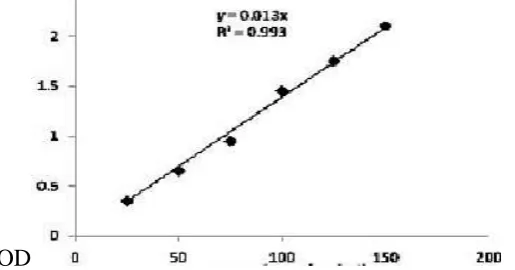
Concentration (µg/ml) Methanol extract (nm)
10 0.35
100 1.43
150 2.00
OD
Fig. 2 Anti Lipid per oxidation assay, OD- Optimum Density
DISCUSSION
DPPH scavenging activity: The color changed from purple to yellow. The methanol extract showed that DPPH scavenging activity in a concentration dependent manner. The graph
shows the effect of ethyl acetate and methanol extracts of E.indica leaves on DPPH (1, 1-
Diphenyl -2-Picryl Hydrazyl) radical scavenging activity. Values represented on the figure
are mean ± SD of three replicas.[2]
Anti-Lipid per oxidation assay: The inhibition of lipid peroxide formation is shown in figure. The methanolic extract has showed maximum inhibition of peroxide formation by
TBARS (Thio barbituric acid) method. Thio barbituric acid reacts with malondialdehyde to
yield the fluorescent product.
CONCLUSION
The present study shows that it has potent to moderate Anti- cancer activity of Erythrina
indica. Further research will be practiced as in vivo studies.
ACKNOWLEDGEMENT
We are Grateful to our institution “PAVENDAR BHARATHIDASAN COLLEGE OF
ENGINEERING AND TECHNOLOGY “.
REFERENCES
1. Mohammad Mubarak Husain, Sayed Koushik Ahamed, Syed Masudur Rahman Dewan,
MdMahadi Hassan1, Arif Istiaq, Mohammad Safiqul Islam and Md
MizanurRahmanMoghal, In vivo antipyretic, antiemetic, in vitro membrane stabilization,
antimicrobial, and cytotoxic activities of different extracts from Spilanthes paniculata
2. Ajay Kumar .P, Adarsh Verma .M, Kavitha. D, Kranthi Kumar. A K.B.Anurag, In-Vitro
Antioxidant and Anti inflammatory Activities of Erythrina Indica Bark, Research article,
2010; 5(3): 033.
3. Dr. Kuppurajendran, Effects of Bioinoculants on Seedling Growth, Biochemical Changes
and Nutrient Uptake of Erythrina Indica L. In Semi Arid Region of Southern India, J
Biostat, 2012;3(2).
4. R. Kamalraj, Anti-diarrhoeal Potential of Erythrina indica Lam-leaf extracts in laboratory
animals, International Journal of Pharmaceutical Sciences and Drug Research, 2011; 3(2):
155-157.
5. Kandhasamy Sowndhararajan, Jince Mary Joseph, Dharma Rajendrakumaran, 2012. In
vitro xanthine oxidase inhibitory activity of methanol extracts of Erythrina indica Lam.
leaves and stem bark, Asian Pacific Journal of Tropical Biomedicine, S1415-S1417.
6. List PH, Horhammer L 2008; 1969-1979 Hager’s handbuch der pharmazeutischen
praxis.Vols 2-6 Springer-Verlag, Berlin.